

|
시장보고서
상품코드
2100037
Wi-Fi용 무선 테스트 시장 : 점유율 분석, 업계 동향 및 통계, 성장 예측(2026-2031년)Wireless Testing for Wi-Fi - Market Share Analysis, Industry Trends & Statistics, Growth Forecasts (2026 - 2031) |
||||||
 Mordor Intelligence
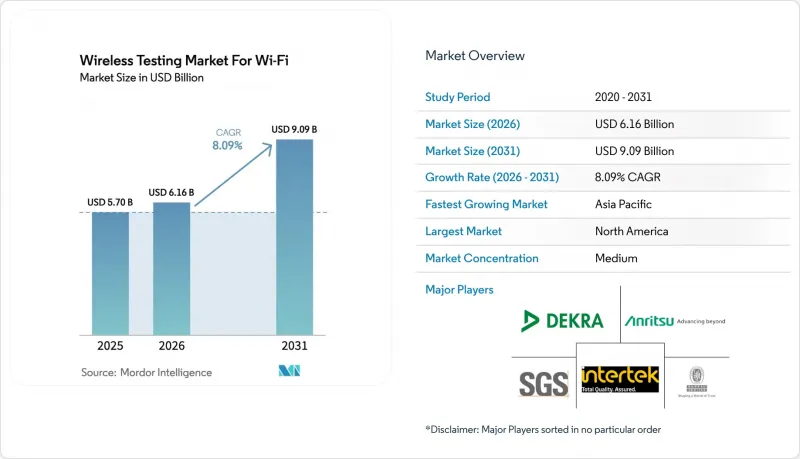
Mordor Intelligence에 의하면, Wi-Fi용 무선 테스트 시장 규모는 2025년 57억 달러에서 2026년에는 61억 6,000만 달러로 확대되어 2026년부터 2031년까지 CAGR 8.09%로 성장을 지속하여, 2031년에는 90억 9,000만 달러에 이를 것으로 예측됩니다.
본 보고서에서는 업계를 '제공(기기, 서비스)', '용도(가전제품, 자동차, IT 및 통신, 에너지 및 전력 등)', '연결 기술(5G/5.5G, Wi-Fi 6/6E/7 등)', '최종 용도 단계(연구 개발/실험실, 생산/제조 등)', 그리고 '지역'별로 분류하고 있습니다. 시장 전망은 금액(달러) 기준으로 제시되어 있습니다.
Wi-Fi용 무선 테스트 시장 인사이트 및 동향
연결 기기의 보급
Wi-Fi Alliance는 2024년 초에 Wi-Fi 7 하드웨어 인증을 시작했으며, 46Gbps의 피크 처리량과 상호 운용성 시나리오를 더욱 복잡하게 만드는 멀티링크 작동이 추가되었습니다. 현재 각 제조업체는 Wi-Fi, Bluetooth, UWB, 5G 무선 기능을 단일 칩셋에 통합하고 있으므로, 테스트 기관은 엣지 컴퓨팅 토폴로지에서의 지연을 측정하면서 3개 대역에 걸친 로밍 검증 스크립트를 작성해야 합니다. 가정용, 산업용, 의료용 IoT 노드 모두 실제 환경의 통신 듀티 사이클 하에서 배터리 수명 프로파일링이 필요하며, OEM 업체들이 전력 소비 스윕을 외부에 위탁함에 따라 서비스 수익이 확대되고 있습니다.
Wi-Fi 6/6E/7 및 5G/5.5G 규격의 발전
시험소에서는 320 MHz 채널, mm파 공존, 그리고 Release 18의 네트워크 슬라이싱을 에뮬레이션해야 합니다. 슈투트가르트에 위치한 DEKRA의 인증 Wi-Fi 실험실은 5G와 Wi-Fi 핸드오버의 안정성을 입증해야 하는 자동차 OEM 제조업체들의 요구를 충족하기 위해 2024년에 개설되었습니다. 각 통신 사업자들은 6GHz 대역의 실내 주파수 대역과 24GHz 대역의 차량용 레이돔 마운트를 동시에 지원하는 위상 배열 방식의 무선 테스트 장비에 투자하고 있습니다.
표준 규격의 파편화와 복잡한 시험 환경
802.11n부터 Wi-Fi 7까지의 병행 지원으로 인해, 시험실 구성과 교정 절차가 두 배로 늘어났습니다. 중국에서는 국제 규격에 더해 독자적인 SRRC 인증도 별도로 필요하기 때문에 전 세계로 출하되는 휴대전화 단말기는 시장 출시 전에 6가지의 서로 다른 Wi-Fi 테스트 스위트를 수행해야 하는 경우가 있습니다. 5G 비지상파 네트워크의 부상으로, 과거에는 정적이었던 실내 테스트 시나리오에 궤도 도플러 효과가 더해지면서 사이클 타임이 길어지고 있습니다.
부문 분석
2025년 Wi-Fi용 무선 테스트 시장에서 장비 매출액은 시장의 67.35%를 차지했습니다. 이는 Wi-Fi의 각 세대마다 새로운 벡터 신호 분석기나 잔향실이 필요하기 때문입니다. 그럼에도 불구하고, 서비스 매출은 2031년까지 연평균 11.58% 증가할 것으로 예측되며, 이는 지식 집약형 검증으로의 전환을 반영합니다. 이러한 추세의 차이는 사내 팀보다 더 신속하게 다중 표준 회귀 테스트 스크립트를 작성할 수 있는 숙련된 엔지니어의 가치를 부각시키고 있습니다. TTM Technologies사의 6.4-7.2GHz 대역 RF 프론트엔드는 장비 부문의 견조한 성장을 뒷받침하는 하드웨어 업그레이드의 한 예입니다.
프로바이더들은 하드웨어 사용 권한에 컨설팅 서비스를 결합하는 사례가 늘고 있습니다. 고객은 단일 계약을 통해 예약된 반사실 사용 시간, 프로토콜 스택 디버깅, 규제 관련 문서 작성 등의 서비스를 받을 수 있어, 제품 출시까지의 주기를 몇 주 단축할 수 있습니다. 그 결과, Wi-Fi용 무선 테스트 시장에서 하드웨어에 대한 절대적인 지출액이 높은 수준을 유지하는 가운데서도 서비스 부문의 점유율은 꾸준히 상승할 것으로 전망됩니다.
2025년 시점에서도 Wi-Fi용 무선 테스트 시장에서 4G/LTE가 여전히 32.10%를 차지하고 있지만, 5G/5.5G 워크스트림은 2031년까지 연평균 17.2%의 성장률을 보일 전망입니다. Skylo Technologies와 Rohde & Schwarz는 비지상파 네트워크 관련 테스트의 공백을 메우기 위해, 궤도 상의 시나리오에서 Release 17 NB-IoT와 Wi-Fi의 공존 메트릭스를 통합하는 파트너십을 체결했습니다.
고주파수 운영 및 네트워크 슬라이싱의 복잡화로 인해, 새로운 기기 변종마다 기존 4G 모델보다 더 많은 테스트 항목이 필요해지고 있습니다. Wi-Fi 6E 지원 기기조차도 5G mm파 백홀과의 적절한 공존성이 평가되어야 합니다. 이러한 기술적 부담 증가야말로 순수한 출하 대수가 아닌, Wi-Fi용 무선 테스트 시장에서 5G를 중심으로 한 업무가 이미 불균형할 정도로 많은 실험실 작업 시간을 차지하고 있는 이유를 설명해 줍니다.
지역별 분석
북미는 FCC의 엄격한 기기 인증 제도 하에서 2025년 전 세계 매출의 34.95%를 차지했습니다. 록히드 마틴의 '5G.MIL' 페이로드 프로그램은 지상파 Wi-Fi 6E 기지국과 원활하게 통합되어야 하는 우주 기반 백홀에 대한 해당 지역의 투자를 반영하고 있습니다. 초저전력 6GHz 대역의 허용 범위 설정 등 빈번한 규제 변경으로 인해 네트워크 기업들이 신형 무선 장비 인증 획득에 분주한 가운데, 안정적인 테스트 수요가 유지되고 있습니다.
아시아태평양은 18억 명의 모바일 가입자와 주파수 대역 결정을 신속히 추진하는 각국 정부의 지원에 힘입어 2031년까지 연평균 성장률(CAGR) 9.48%를 달성할 전망입니다. 중국에서 조만간 시행될 UWB 규제로 인해 7GHz 대역의 상부 대역에서 공존성 검증이 의무화되는 한편, 아세안(ASEAN) 규제 당국은 6GHz 대역의 주파수 할당을 통일하여 국경을 초월한 Wi-Fi 기기 확산을 뒷받침하고 있습니다. 중국, 일본, 인도의 국내 시험소는 처리 능력을 확대하고 있어 해외 위탁에 대한 의존도를 점진적으로 낮추며, Wi-Fi용 무선 테스트 시장의 무역 흐름을 재편하고 있습니다.
유럽은 자동차 분야로의 높은 보급률 덕분에 수익에서 중요한 비중을 차지하고 있습니다. 독일에 위치한 DEKRA의 인증 시험소는 현지 OEM 제조업체들에게 프로토타입을 해외로 보내지 않고도 Wi-Fi 7 인증을 취득할 수 있는 신속한 절차를 제공합니다. 한편, 중동 및 아프리카 국가들은 Wi-Fi가 통합된 스마트 시티 인프라에 대한 예산을 편성하고 있으며, 남미에서는 국내 광대역 네트워크 확충이 진행되고 있습니다. 이러한 요인들이 결합되어 시험소 운영 사업자에게 장기적인 성장 기회를 창출하고 있습니다.
기타 혜택:
- 엑셀 형식 시장 예측(ME) 시트
- 3개월간의 애널리스트 지원
자주 묻는 질문
목차
제1장 서론
제2장 조사 방법
제3장 주요 요약
제4장 시장 구도
제5장 시장 규모와 성장 예측
제6장 경쟁 구도
제7장 시장 기회와 향후 전망
JHS 26.08.11According to Mordor Intelligence, the wireless testing market size for Wi-Fi market is expected to grow from USD 5.7 billion in 2025 to USD 6.16 billion in 2026 and is forecast to reach USD 9.09 billion by 2031 at 8.09% CAGR over 2026-2031.
This report Segments the Industry Into Offering (Equipment, Services), Application (Consumer Electronics, Automotive, IT and Telecommunication, Energy and Power and More), Connectivity Technology (5G / 5. 5G, Wi-Fi 6/6E/7 and More), End-Use Phase (R&D / Lab, Production / Manufacturing and More), and Geography. The Market Forecasts are Provided in Terms of Value (USD).
Insights and Trends of Wireless Testing Market for Wi-Fi
Proliferation of connected devices
Wi-Fi Alliance began certifying Wi-Fi 7 hardware in early 2024, adding 46 Gbps peak throughput and multi-link operation that compounds interoperability scenarios. Manufacturers now blend Wi-Fi, Bluetooth, UWB, and 5G radios on single chipsets, so test houses must script roaming verification across three bands while measuring latency in edge-computing topologies. Consumer, industrial, and medical IoT nodes all demand battery-life profiling under real-world airtime duty cycles, driving service revenues as OEMs outsource power-consumption sweeps.
Advances in Wi-Fi 6/6E/7 and 5G/5.5G standards
Labs need to emulate 320 MHz channels, millimetre-wave coexistence, and Release 18 network slicing. DEKRA's authorised Wi-Fi lab in Stuttgart opened in 2024 to serve vehicle OEMs that must prove 5G-Wi-Fi handover stability. Providers invest in phased-array over-the-air test rigs that cover 6 GHz indoor concessions and 24 GHz vehicular radome mounts simultaneously.
Fragmented standards and complex test setups
Parallel support for 802.11n through Wi-Fi 7 multiplies chamber permutations and calibration routines. China retains separate SRRC filings alongside global marks, so a handset shipping worldwide may run six discrete Wi-Fi suites before market entry. The rise of 5G non-terrestrial networking adds orbital Doppler to what were once static indoor scripts, lengthening cycle times.
Other drivers and restraints analyzed in the detailed report include:
- IoT expansion across verticals
- Stricter global certification mandates
- Shortage of RF testing talent
For complete list of drivers and restraints, kindly check the Table Of Contents.
Segment Analysis
Equipment revenue accounted for 67.35% of the wireless testing market for Wi-Fi in 2025, as every Wi-Fi generation demands fresh vector signal analysers and reverberation chambers. Nevertheless, service revenue is forecast to rise 11.58% annually to 2031, reflecting a pivot toward knowledge-intensive validation. The divergence highlights the value of seasoned engineers who can script multi-standard regression tests faster than in-house teams. TTM Technologies' 6.4-7.2 GHz RF front-ends illustrate hardware upgrades that keep the equipment segment solid.
Providers increasingly bundle consultancy with hardware access. Clients gain scheduled chamber time, protocol-stack debugging, and regulatory paperwork in a single engagement, cutting launch cycles by weeks. As a result, the services slice of the wireless testing market for Wi-Fi should steadily climb even while absolute hardware spend remains high.
Although 4G/LTE still represents 32.10% of the wireless testing market for Wi-Fi size in 2025, 5G/5.5G workstreams will grow 17.2% per year to 2031. Skylo Technologies and Rohde & Schwarz joined forces to close test gaps around non-terrestrial networks, blending Release 17 NB-IoT and Wi-Fi coexistence metrics in orbital scenarios.
Higher-frequency operation and network-slicing complexity mean every new device variant generates a larger battery of tests than its 4G predecessor. Even Wi-Fi 6E gear must now be assessed for fair coexistence with 5G millimetre-wave back-haul. This technical lift, not pure shipment volume, explains why 5G-centric work already absorbs disproportionate lab hours inside the wireless testing market for Wi-Fi.
Complete Report Scope:
- By Offering
- Equipment
- Wireless Device Testing
- Wireless Network Testing
- Services
- Equipment
- By Connectivity Technology
- 5G / 5.5G
- Wi-Fi 6/6E/7
- Bluetooth and UWB
- GNSS / GPS
- Legacy Cellular (2G-4G/LTE)
- By Application
- Consumer Electronics
- Smartphones and Wearables
- Smart Home Devices
- Automotive
- ADAS and V2X
- Infotainment and Telematics
- IT and Telecommunication
- Energy and Power
- Aerospace and Defense
- Healthcare and Medical Devices
- Consumer Electronics
- By End-use Phase
- RandD / Lab
- Production / Manufacturing
- Field Service / Maintenance
- By Geography
- North America
- United States
- Canada
- Mexico
- Europe
- United Kingdom
- Germany
- France
- Italy
- Rest of Europe
- Asia-Pacific
- China
- Japan
- India
- South Korea
- Rest of Asia-Pacific
- Middle East
- Israel
- Saudi Arabia
- United Arab Emirates
- Turkey
- Rest of Middle East
- Africa
- South Africa
- Egypt
- Rest of Africa
- South America
- Brazil
- Argentina
- Rest of South America
- North America
Geography Analysis
North America generated 34.95% of global revenue in 2025 under the FCC's tight equipment-authorisation regime. Lockheed Martin's 5G.MIL payload program reflects the region's investment in space-based backhaul that must integrate smoothly with terrestrial Wi-Fi 6E ground stations. Frequent rule changes such as very-low-power 6 GHz allowances, sustain steady test demand as networking firms scramble to certify refreshed radios.
Asia-Pacific is on track for a 9.48% CAGR to 2031, propelled by 1.8 billion mobile subscribers and governments fast-tracking spectrum decisions. China's upcoming UWB rules will force coexistence checks in the upper 7 GHz band, while ASEAN regulators harmonise 6 GHz allocations, boosting cross-border Wi-Fi device roll-outs. Domestic labs in China, Japan, and India are expanding capacity, gradually reducing export-house dependence, and reshaping trade flows within the wireless testing market for Wi-Fi.
Europe holds a meaningful slice of revenue through strong automotive penetration. DEKRA's authorised lab in Germany gives local OEMs a high-speed path to Wi-Fi 7 certification without shipping prototypes overseas. Meanwhile, Middle Eastern and African nations budget for smart-city infrastructure that embeds Wi-Fi, and South America upgrades national broadband footprints, together creating long-tail growth pockets for lab operators.
- SGS Group
- Bureau Veritas
- Intertek Group PLC
- DEKRA SE
- Anritsu Corporation
- Keysight Technologies
- eInfochips (Arrow)
- Rohde and Schwarz
- VIAVI Solutions
- EXFO Inc.
- Spirent Communications
- Teledyne LeCroy
- National Instruments
- LitePoint (Teradyne)
- Yokogawa TandM
- Testo SE
- TUV Rheinland
- UL Solutions
- Eurofins EandE
- Tektronix
Additional Benefits:
- The market estimate (ME) sheet in Excel format
- 3 months of analyst support
TABLE OF CONTENTS
1 INTRODUCTION
- 1.1 Study Assumptions and Market Definition
- 1.2 Scope of the Study
2 RESEARCH METHODOLOGY
3 EXECUTIVE SUMMARY
4 MARKET LANDSCAPE
- 4.1 Market Overview
- 4.2 Market Drivers
- 4.2.1 Proliferation of connected devices
- 4.2.2 Advances in Wi-Fi 6/6E/7 and 5G/5.5G standards
- 4.2.3 IoT expansion across verticals
- 4.2.4 Stricter global certification mandates
- 4.2.5 OTA testing for autonomous and connected vehicles
- 4.2.6 Direct-to-device satellite link validation
- 4.3 Market Restraints
- 4.3.1 Fragmented standards and complex test setups
- 4.3.2 Shortage of RF testing talent
- 4.3.3 RF-grade component supply bottlenecks
- 4.3.4 Rising cyber-compliance burden on test cycles
- 4.4 Regulatory Landscape
- 4.5 Technological Outlook
- 4.6 Porter's Five Forces
- 4.6.1 Bargaining Power of Suppliers
- 4.6.2 Bargaining Power of Buyers
- 4.6.3 Threat of New Entrants
- 4.6.4 Threat of Substitutes
- 4.6.5 Intensity of Competitive Rivalry
5 MARKET SIZE AND GROWTH FORECASTS (VALUE)
- 5.1 By Offering
- 5.1.1 Equipment
- 5.1.1.1 Wireless Device Testing
- 5.1.1.2 Wireless Network Testing
- 5.1.2 Services
- 5.1.1 Equipment
- 5.2 By Connectivity Technology
- 5.2.1 5G / 5.5G
- 5.2.2 Wi-Fi 6/6E/7
- 5.2.3 Bluetooth and UWB
- 5.2.4 GNSS / GPS
- 5.2.5 Legacy Cellular (2G-4G/LTE)
- 5.3 By Application
- 5.3.1 Consumer Electronics
- 5.3.1.1 Smartphones and Wearables
- 5.3.1.2 Smart Home Devices
- 5.3.2 Automotive
- 5.3.2.1 ADAS and V2X
- 5.3.2.2 Infotainment and Telematics
- 5.3.3 IT and Telecommunication
- 5.3.4 Energy and Power
- 5.3.5 Aerospace and Defense
- 5.3.6 Healthcare and Medical Devices
- 5.3.1 Consumer Electronics
- 5.4 By End-use Phase
- 5.4.1 RandD / Lab
- 5.4.2 Production / Manufacturing
- 5.4.3 Field Service / Maintenance
- 5.5 By Geography
- 5.5.1 North America
- 5.5.1.1 United States
- 5.5.1.2 Canada
- 5.5.1.3 Mexico
- 5.5.2 Europe
- 5.5.2.1 United Kingdom
- 5.5.2.2 Germany
- 5.5.2.3 France
- 5.5.2.4 Italy
- 5.5.2.5 Rest of Europe
- 5.5.3 Asia-Pacific
- 5.5.3.1 China
- 5.5.3.2 Japan
- 5.5.3.3 India
- 5.5.3.4 South Korea
- 5.5.3.5 Rest of Asia-Pacific
- 5.5.4 Middle East
- 5.5.4.1 Israel
- 5.5.4.2 Saudi Arabia
- 5.5.4.3 United Arab Emirates
- 5.5.4.4 Turkey
- 5.5.4.5 Rest of Middle East
- 5.5.5 Africa
- 5.5.5.1 South Africa
- 5.5.5.2 Egypt
- 5.5.5.3 Rest of Africa
- 5.5.6 South America
- 5.5.6.1 Brazil
- 5.5.6.2 Argentina
- 5.5.6.3 Rest of South America
- 5.5.1 North America
6 COMPETITIVE LANDSCAPE
- 6.1 Market Concentration
- 6.2 Strategic Moves
- 6.3 Market Share Analysis
- 6.4 Company Profiles (includes Global level Overview, Market level overview, Core Segments, Financials as available, Strategic Information, Market Rank/Share for key companies, Products and Services, and Recent Developments)
- 6.4.1 SGS Group
- 6.4.2 Bureau Veritas
- 6.4.3 Intertek Group PLC
- 6.4.4 DEKRA SE
- 6.4.5 Anritsu Corporation
- 6.4.6 Keysight Technologies
- 6.4.7 eInfochips (Arrow)
- 6.4.8 Rohde and Schwarz
- 6.4.9 VIAVI Solutions
- 6.4.10 EXFO Inc.
- 6.4.11 Spirent Communications
- 6.4.12 Teledyne LeCroy
- 6.4.13 National Instruments
- 6.4.14 LitePoint (Teradyne)
- 6.4.15 Yokogawa TandM
- 6.4.16 Testo SE
- 6.4.17 TUV Rheinland
- 6.4.18 UL Solutions
- 6.4.19 Eurofins EandE
- 6.4.20 Tektronix
7 MARKET OPPORTUNITIES AND FUTURE OUTLOOK
- 7.1 White-space and Unmet-need Assessment


