

|
시장보고서
상품코드
2100041
암 줄기세포 시장 : 시장 점유율 분석, 업계 동향 및 통계, 성장 예측(2026-2031년)Cancer Stem Cells - Market Share Analysis, Industry Trends & Statistics, Growth Forecasts (2026 - 2031) |
||||||
 Mordor Intelligence
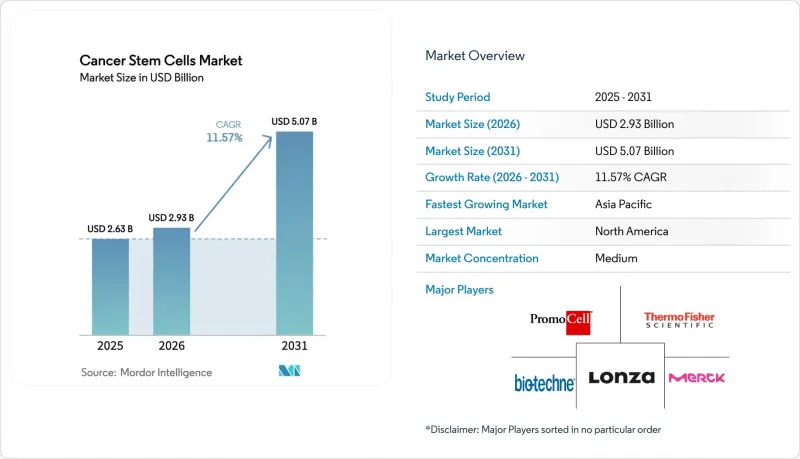
Mordor Intelligence에 의하면, 암 줄기세포 시장 규모는 2025년에 26억 3,000만 달러로 평가되었고, 2026년 29억 3,000만 달러에서 2031년까지 50억 7,000만 달러에 이를 것으로 예측되며, 예측 기간(2026-2031년) CAGR은 11.57%를 나타낼 전망입니다.
본 보고서는 암 유형별(유방암, 혈액암, 폐암, 뇌종양, 대장암 등), 용도별(자가 줄기세포 이식 및 동종 줄기세포 이식), 줄기세포 채취원별(골수, 말초혈액 등), 그리고 지역별(북미, 유럽 등)로 분류되어 있습니다. 시장 전망은 금액(달러) 기준으로 제시되어 있습니다.
세계의 암 줄기세포 시장 동향 및 인사이트
암 발병률 증가와 지원적인 법적 정비
세계적으로 암 환자 수가 증가하고 있으며, 재발의 원인이 되는 소량의 암 줄기세포 풀을 근절하는 치료법에 대한 수요가 높아지고 있습니다. 정책 입안자들은 현재 규제 절차를 간소화하고 있습니다. ‘FDA 현대화법’에 따라 특정 동물 실험 요건이 철폐되면서, 암 치료 분야에서의 iPS 세포 도입이 가속화되고 있습니다. 유럽에서는 EMA(유럽의약품청)의 첨단 치료 시범 프로그램을 통해 학술 기관 개발자에 대한 심사 수수료가 감면되고, 지속적인 과학적 지침이 제공되고 있습니다. 일본의 재생의료 신속 승인 제도에 따라 내년에 최초의 iPS 세포를 이용한 암 치료법이 승인될 것으로 예상되며, 전 세계적인 규제 조화가 부각되고 있습니다. 이러한 변화들이 맞물리면서 iPS 세포의 도입 전망이 밝아지고, 암 줄기세포 시장의 성장 궤도가 더욱 가속화되고 있습니다.
연구개발비 확대와 민관 자금 지원
정부와 투자자들은 중개 연구 프로그램에 대한 자금 투자를 점점 더 늘리고 있습니다. 일본이 재생의학에 배정한 1,100억 엔은 전 세계 60건 이상의 iPS 세포를 이용한 암 임상시험의 자금원이 되고 있습니다. 미국에서는 레이건-우달 재단이 유전자 치료와 줄기세포 생물학의 공통점을 강조하며, 다각적인 치료법에 대한 자금 지원을 뒷받침하고 있습니다. 벤처 캐피털은 현재 단일 세포 수준에서 암 줄기세포의 이질성을 분석하는 AI 기반 신약 개발 플랫폼에 투자하고 있으며, 이는 기술 주도형 플랫폼에 대한 강한 신뢰를 보여줍니다.
고액의 치료비와 보험 급여의 불확실성
CAR-T 요법의 비용은 환자 1인당 100만 달러를 초과하기도 하며, 이러한 고비용이 새로운 암 줄기세포 치료에 대한 지불 주체의 주저 요인이 되고 있습니다. 치료 접근성은 여전히 제한적이며, 미국에서는 적격 환자의 20% 미만이 승인된 세포 및 유전자 치료를 받고 있는데, 그 대부분은 보험 급여 지연이 원인입니다. 줄기세포 이식에 관한 메디케어의 전국적 적용 결정(NCD)은 기준을 명확히 하고 있지만, 여전히 질환별로 제한되어 있으며 새로운 적응증에는 자금이 배정되지 않고 있습니다. 신흥 시장에서는 경제적 부담의 격차가 더욱 심각하여, 암 줄기세포 시장 전체의 광범위한 보급을 저해하고 있습니다.
부문 분석
2025년에는 유방암이 매출의 26.05%를 차지했으며, 암 줄기세포 시장에서 가장 큰 점유율을 기록했습니다. 이 부문은 전 세계적으로 높은 유병률과 탄탄한 바이오마커 파이프라인의 혜택을 받고 있습니다. AI를 활용한 산화환원 시그니처 분석을 통해 면역요법이나 화학요법의 효과가 기대되는 환자를 계층화할 수 있게 되어, 치료와 종양의 생물학적 특성 간의 적합성이 향상되고 있습니다. CAR 변형 세포나 체크포인트 억제제를 평가하는 삼중 음성 유방암 임상시험에서는 줄기세포에 기인한 침습성이 높은 재발을 억제하는 것을 목표로 하고 있습니다.
폐암은 줄기세포의 호밍 및 지속성을 향상시키는 미세환경 표적 치료법의 발전에 힘입어 연평균 성장률(CAGR) 12.41%로 가장 빠르게 성장하고 있는 분야입니다. 혈액암은 확립된 이식 프로토콜 덕분에 상당한 규모를 유지하고 있는 반면, 교모세포종 프로그램에서는 내성을 가진 줄기세포 틈새를 근절하기 위해 자기 온열 요법이 시험되고 있습니다. 완전 관해(CR)를 보인 클라우딘 18.2-CAR-T 사례 보고를 포함한 췌장암 연구는 혁신의 폭이 얼마나 넓은지를 여실히 보여주고 있습니다. 이러한 동향들이 결합되어 암 줄기세포 시장 전반에 걸친 다양한 수요를 뒷받침하고 있습니다.
지역별 분석
북미는 2025년에 37.12%의 점유율을 유지했습니다. 이는 Ryoncil의 승인으로 상징되는 FDA의 점점 더 적극적인 태도와, 여러 이식법에 대한 보험 적용을 규정한 메디케어의 보상 체계에 힘입은 결과입니다. 산학 협력 생태계에서는 AI를 활용한 단일 세포 분석을 통해 임상시험 설계가 개선되고, 연구에서 임상 적용으로의 전환이 가속화되고 있습니다. 갈라파고스(Galapagos)와 Blood Centers of America의 네트워크와 같은 분산형 제조 파트너십은 공급까지의 리드타임을 단축하고 지역적 우위를 강화하고 있습니다.
아시아태평양은 연평균 성장률(CAGR) 13.05%를 달성할 전망입니다. 이는 일본의 규제상 패스트트랙 제도와 1,100억 엔을 넘는 설비 투자의 뒷받침을 받고 있으며, 이러한 요소들은 60건 이상의 iPS 세포를 활용한 암 임상시험을 지원하고 있습니다. 현지 주요 기업들은 미래 수요에 대응하기 위해 전용 cGMP 시설을 건설하고 있으며, 한편 중국에서는 지적 재산권 보호와 관련된 과제가 지속되고 있음에도 불구하고 규제 개혁을 통해 임상시험 파이프라인이 확대되고 있습니다. 학술 기관과 생명공학 기업 간의 지역적 협력은 암 줄기세포 시장을 주도하는 ‘정밀 종양학’ 패러다임과 잘 부합합니다.
유럽은 유럽의약품청(EMA)의 첨단 치료 프레임워크의 혜택을 받고 있지만, 여러 국가에 걸친 규제 준수 요건으로 인해 시장 출시까지의 기간은 여전히 길어지고 있습니다. CRISPR를 이용한 유전자 편집을 적용한 줄기세포 치료제 ‘Casgevy’의 승인은 복잡한 유전자 편집 기법의 유효성을 입증함과 동시에 안전성 기준을 확립하는 것입니다. T2EVOLVE 컨소시엄은 경쟁력을 유지하기 위해 CAR-T 요법에 관한 규제 합리화를 추진하고 있습니다. 사우디아라비아의 ‘Cancer BioShield’와 같이 중동에서 부상하고 있는 프로그램, 멕시코에서 정비되고 있는 세포 치료 관련 규제는 전 세계적인 확산을 시사하고 있습니다.
기타 혜택 :
- 엑셀 형식 시장 예측(ME) 시트
- 3개월간의 애널리스트 지원
자주 묻는 질문
목차
제1장 서론
제2장 조사 방법
제3장 주요 요약
제4장 시장 구도
제5장 시장 규모 및 성장 예측
제6장 경쟁 구도
제7장 시장 기회 및 향후 전망
AJY 26.08.07According to Mordor Intelligence, the cancer stem cells market size was valued at USD 2.63 billion in 2025 and estimated to grow from USD 2.93 billion in 2026 to reach USD 5.07 billion by 2031, at a CAGR of 11.57% during the forecast period (2026-2031).
This report is Segmented by Cancer Type (Breast Cancer, Blood Cancer, Lung Cancer, Brain Cancer, Colorectal Cancer, and More), Application (Autologous Stem-Cell Transplant and Allogeneic Stem-Cell Transplant), Stem-Cell Source (Bone Marrow, Peripheral Blood and More), and Geography (North America, Europe, and More). The Market Forecasts are Provided in Terms of Value (USD).
Global Cancer Stem Cells Market Trends and Insights
Rising Cancer Incidence and Supportive Legislation
Global oncology caseloads are climbing, intensifying demand for therapies that eradicate the small, relapse-driving cancer stem-cell pool. Policymakers now streamline regulatory pathways: the FDA Modernization Act has removed certain animal-testing requirements, accelerating iPSC adoption in oncology. In Europe, the EMA's advanced-therapy pilot cuts review fees for academic developers and provides continuous scientific guidance. Japan's fast-track scheme for regenerative medicine is expected to green-light the first iPSC-based cancer therapy within the next year, underscoring global regulatory convergence. These shifts collectively boost adoption prospects and elevate the cancer stem cells market trajectory.
Escalating R&D Spending & Public-Private Funding
Governments and investors increasingly funnel capital into translational programmes. Japan's ¥110 billion allocation to regenerative medicine finances more than 60 iPSC oncology trials worldwide. In the United States, the Reagan-Udall Foundation highlights gene-therapy overlaps with stem-cell biology, galvanising funding for multimodal regimens. Venture capital now targets AI-enhanced discovery engines that profile cancer stem-cell heterogeneity at single-cell depth, signalling strong confidence in technology-enabled platforms.
High Therapy Cost and Reimbursement Uncertainty
CAR-T procedures can top USD 1 million per patient, a benchmark that frames payer hesitancy for emerging cancer stem-cell interventions. Access remains limited: fewer than 20% of eligible U.S. patients receive approved cell and gene therapies, often due to reimbursement delays. Medicare's national coverage determination for stem-cell transplantation clarifies criteria but remains disease-specific, leaving newer indications unfunded. Emerging markets confront even sharper affordability gaps, stalling broad uptake across the cancer stem cells market.
Other drivers and restraints analyzed in the detailed report include:
- Rapid Adoption of Advanced Cell-Isolation/3-D Culture Platforms
- AI-Driven Single-Cell Multi-Omics Accelerating CSC Target Discovery
- Ethical / Regulatory Complexity Around Manipulating Human Stem Cells
For complete list of drivers and restraints, kindly check the Table Of Contents.
Segment Analysis
Breast cancer contributed 26.05% of revenue in 2025, the single-largest slice of the cancer stem cells market share. The segment benefits from high global prevalence and robust biomarker pipelines. AI-guided redox-signature assays now stratify patients by likely immunotherapy or chemotherapy benefit, tightening the fit between treatment and tumour biology. Triple-negative breast cancer trials evaluating CAR-modified cells and checkpoint inhibitors seek to curb aggressive, stem-cell-driven relapse.
Lung cancer represents the fastest-growing slice with a 12.41% CAGR, propelled by advances in micro-environment targeting that improve stem-cell homing and persistence. Blood cancers sustain material volumes thanks to entrenched transplantation protocols, while glioblastoma programmes test magnetic hyperthermia to eradicate resistant stem-cell niches. Pancreatic investigations, including claudin18.2-CAR-T case reports showing complete remission, highlight the breadth of innovation. Together, these trends reinforce diversified demand across the cancer stem cells market.
Complete Report Scope:
- By Cancer Type
- Breast Cancer
- Blood Cancer
- Lung Cancer
- Brain Cancer
- Colorectal Cancer
- Pancreatic Cancer
- Bladder Cancer
- Liver Cancer
- Other Cancer Types
- By Application
- Autologous Stem-Cell Transplant
- Allogeneic Stem-Cell Transplant
- By Stem-Cell Source
- Bone Marrow
- Peripheral Blood
- Umbilical Cord Blood
- Induced Pluripotent Stem Cells (iPSCs)
- Others
- By Geography
- North America
- United States
- Canada
- Mexico
- Europe
- Germany
- United Kingdom
- France
- Italy
- Spain
- Rest of Europe
- Asia Pacific
- China
- Japan
- India
- Australia
- South Korea
- Rest of Asia Pacific
- Middle East and Africa
- GCC
- South Africa
- Rest of Middle East and Africa
- South America
- Brazil
- Argentina
- Rest of South America
- North America
Geography Analysis
North America retained 37.12% share in 2025, anchored by the FDA's increasingly supportive stance exemplified by Ryoncil's approval and by Medicare reimbursement frameworks that codify coverage for several transplant modalities. Academic-industry ecosystems leverage AI for single-cell analytics, enhancing trial design and accelerating bench-to-bedside translation. Decentralised manufacturing partnerships, such as the Galapagos-Blood Centers of America network, shrink delivery timelines, reinforcing regional dominance.
Asia Pacific is on track for a 13.05% CAGR, catalysed by Japan's regulatory fast-track and capital spending exceeding ¥110 billion, which underpin more than 60 iPSC-based oncology trials. Local giants are erecting dedicated cGMP sites to meet future demand, while China's regulatory reforms widen trial pipelines despite ongoing IP-protection challenges. Regional collaborations between academic centres and biotechs align well with the precision-oncology paradigm dominating the cancer stem cells market.
Europe benefits from the EMA's advanced-therapy framework, though multi-country compliance still lengthens time to market. The approval of Casgevy, a CRISPR-edited stem-cell therapy, validates complex gene-editing modalities and sets safety benchmarks. The T2EVOLVE consortium pushes for streamlined CAR-T regulation to sustain competitiveness. Emerging Middle-East programmes, such as Saudi Arabia's Cancer BioShield, and Mexico's evolving cell-therapy rules, signal a widening global footprint.
- Thermo Fisher Scientific
- MerckKGaA
- Bio-Techne
- LonzaGroupAG
- MiltenyiBiotec
- PromoCellGmbH
- MacroGenicsInc.
- FUJIFILMIrvineScientific
- AcceGen
- CelprogenInc.
- ATCC
- STEMCELLTechnologiesInc.
- CorningInc.
- BDBiosciences
- QIAGENN.V.
- Cytiva
- SartoriusAG
- Advanced Cell Diagnostics
- BeckmanCoulter Life Sciences
- RocheDiagnostics
Additional Benefits:
- The market estimate (ME) sheet in Excel format
- 3 months of analyst support
TABLE OF CONTENTS
1 Introduction
- 1.1 Study Assumptions & Market Definition
- 1.2 Scope of the Study
2 Research Methodology
3 Executive Summary
4 Market Landscape
- 4.1 Market Overview
- 4.2 Market Drivers
- 4.2.1 Rising Cancer Incidence and Supportive Legislation
- 4.2.2 Escalating R&D Spending & Public-Private Funding
- 4.2.3 Rapid Adoption of Advanced Cell-isolation/3-D Culture Platforms
- 4.2.4 AI-driven Single-Cell Multi-Omics Accelerating CSC Target Discovery
- 4.2.5 Magnetogenetics Enabling Non-invasive CSC Modulation
- 4.2.6 Emergence of Decentralised, Hospital-Based Autologous Manufacture Labs
- 4.3 Market Restraints
- 4.3.1 High Therapy Cost and Reimbursement Uncertainty
- 4.3.2 Ethical / Regulatory Complexity Around Manipulating Human Stem Cells
- 4.3.3 In-Vitro Expansion Challenges Owing to CSC Micro-Environment Mimicry
- 4.3.4 Patent Clustering Around Niche CSC Markers Limiting New Entrants
- 4.4 Regulatory Landscape
- 4.5 Porter's Five Forces Analysis
- 4.5.1 Threat of New Entrants
- 4.5.2 Bargaining Power of Buyers/Consumers
- 4.5.3 Bargaining Power of Suppliers
- 4.5.4 Threat of Substitute Products
- 4.5.5 Intensity of Competitive Rivalry
5 Market Size & Growth Forecasts (Value)
- 5.1 By Cancer Type
- 5.1.1 Breast Cancer
- 5.1.2 Blood Cancer
- 5.1.3 Lung Cancer
- 5.1.4 Brain Cancer
- 5.1.5 Colorectal Cancer
- 5.1.6 Pancreatic Cancer
- 5.1.7 Bladder Cancer
- 5.1.8 Liver Cancer
- 5.1.9 Other Cancer Types
- 5.2 By Application
- 5.2.1 Autologous Stem-Cell Transplant
- 5.2.2 Allogeneic Stem-Cell Transplant
- 5.3 By Stem-Cell Source
- 5.3.1 Bone Marrow
- 5.3.2 Peripheral Blood
- 5.3.3 Umbilical Cord Blood
- 5.3.4 Induced Pluripotent Stem Cells (iPSCs)
- 5.3.5 Others
- 5.4 By Geography
- 5.4.1 North America
- 5.4.1.1 United States
- 5.4.1.2 Canada
- 5.4.1.3 Mexico
- 5.4.2 Europe
- 5.4.2.1 Germany
- 5.4.2.2 United Kingdom
- 5.4.2.3 France
- 5.4.2.4 Italy
- 5.4.2.5 Spain
- 5.4.2.6 Rest of Europe
- 5.4.3 Asia Pacific
- 5.4.3.1 China
- 5.4.3.2 Japan
- 5.4.3.3 India
- 5.4.3.4 Australia
- 5.4.3.5 South Korea
- 5.4.3.6 Rest of Asia Pacific
- 5.4.4 Middle East and Africa
- 5.4.4.1 GCC
- 5.4.4.2 South Africa
- 5.4.4.3 Rest of Middle East and Africa
- 5.4.5 South America
- 5.4.5.1 Brazil
- 5.4.5.2 Argentina
- 5.4.5.3 Rest of South America
- 5.4.1 North America
6 Competitive Landscape
- 6.1 Market Concentration
- 6.2 Market Share Analysis
- 6.3 Company Profiles (includes Global level Overview, Market level overview, Core Segments, Financials as available, Strategic Information, Market Rank/Share for key companies, Products & Services, and Recent Developments)
- 6.3.1 Thermo Fisher Scientific Inc.
- 6.3.2 MerckKGaA
- 6.3.3 Bio-Techne Corporation
- 6.3.4 LonzaGroupAG
- 6.3.5 MiltenyiBiotec
- 6.3.6 PromoCellGmbH
- 6.3.7 MacroGenicsInc.
- 6.3.8 FUJIFILMIrvineScientific
- 6.3.9 AcceGen
- 6.3.10 CelprogenInc.
- 6.3.11 ATCC
- 6.3.12 STEMCELLTechnologiesInc.
- 6.3.13 CorningInc.
- 6.3.14 BDBiosciences
- 6.3.15 QIAGENN.V.
- 6.3.16 Cytiva (Danaher)
- 6.3.17 SartoriusAG
- 6.3.18 Advanced Cell Diagnostics
- 6.3.19 BeckmanCoulter Life Sciences
- 6.3.20 RocheDiagnostics
7 Market Opportunities & Future Outlook
- 7.1 White-space & Unmet-Need Assessment


