

|
시장보고서
상품코드
2100043
장수 시장 : 시장 점유율 분석, 업계 동향 및 통계, 성장 예측(2026-2031년)Longevity - Market Share Analysis, Industry Trends & Statistics, Growth Forecasts (2026 - 2031) |
||||||
 Mordor Intelligence
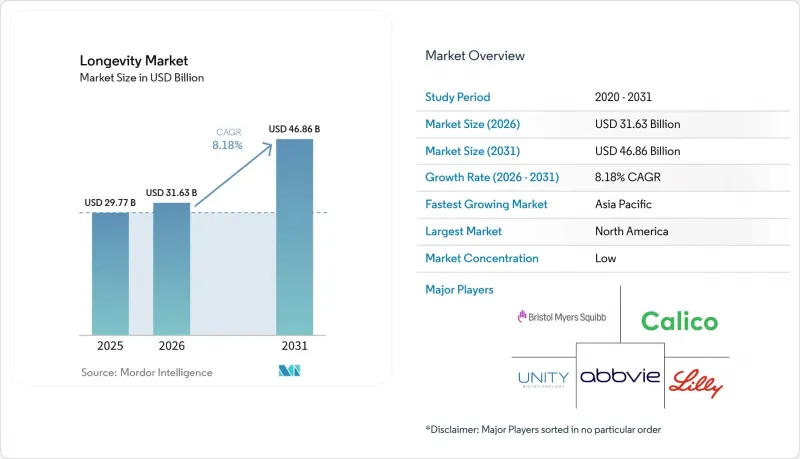
Mordor Intelligence에 의하면, 장수 시장 규모는 2025년 297억 7,000만 달러로 평가되었고, 2026년에는 316억 3,000만 달러로 확대될 것으로 추정되고, 2026-2031년 CAGR 8.18%로 성장을 지속할 전망이며, 2031년에는 468억 6,000만 달러에 이를 것으로 예측됩니다.
본 보고서는 치료법별(세노리틱 저분자 화합물, 세노모픽 제제, 유전자 치료 등), 전달 플랫폼별(생체 내 치료제 등), 적응증별(심혈관 질환, 신경퇴행성 질환 등), 최종 사용자별(제약 및 바이오기술 기업 등), 지역별(북미 등)로 분류되어 있습니다. 시장 전망은 금액(달러) 기준으로 제시되어 있습니다.
세계의 장수 시장 동향 및 인사이트
65세 이상 인구의 급증
유엔의 예측에 따르면, 2050년까지 전 세계 65세 이상 인구는 16억 명에 달하고, 2021년의 7억 6,100만 명에서 2배 이상 증가할 것으로 전망됩니다. 2024년 유엔의 최신 보고서에 따르면, 2030년대 중반까지 80세 이상 인구는 2억 6,500만 명에 달할 것이며, 2070년대 후반에는 65세 이상 세계 인구가 22억 명으로 급증할 전망입니다. 2024년 주민의 29%가 65세 이상이었던 일본에서는 ‘실버 인재 센터’에 자금을 지원하여 정기적인 고령자 건강검진에서 장수 진단 표준화를 추진하고 있습니다. 또한 유럽연합(EU)의 일부 회원국에서도 유사한 환급 제도에 관한 시범 사업이 검토되고 있습니다. 중국의 ‘제14차 5개년 계획’에서는 노인 돌봄 인프라 구축에 3조 2,000억 위안(인민폐)을 배정하고, 허약 상태 완화를 목적으로 한 세노리틱제 임상시험을 실시하는 병원 기반 시범 프로그램을 시작했습니다. 한편, 메디케어는 고령자의 만성 질환군 관리에 수혜자 1인당 연간 2만 3,000달러를 지출하고 있습니다. 보험 수리 모델에 따르면, 노화 세포를 제거하여 발병률을 낮추면 평생 의료비를 대폭 절감할 수 있는 것으로 나타났습니다. 세계보건기구(WHO)의 ‘건강한 노화를 위한 10년’은 다자간 자금원을 개척하고, 장수 과학을 공중보건의 우선 과제로 공식적으로 자리매김했습니다.
노화에 따른 만성 질환 증가하는 부담
심혈관 질환, 암, 신경퇴행성 질환 및 대사증후군은 전 세계 전체 사망의 71%를 차지하고 있습니다. 2024년에는 알츠하이머병만으로 미국 의료비 3,450억 달러가 지출되었으며, CMS(미국 의료보험·의료서비스센터)는 시판 후 안전성 모니터링과 급여를 연계하는 신속 승인 절차를 통해 레카네맙의 급여 적용에 합의했습니다. 전임상 연구에서는 다사티닙과 케르세틴의 병용 요법이 특발성 폐섬유증 및 퇴행성 관절염에서 노화 세포를 제거하는 것으로 나타났으나, 인간 조직의 노화 부하를 정량화할 수 있는 바이오마커가 없어 임상 적용으로의 전환이 지연되고 있습니다. 2045년까지 전 세계 당뇨병 유병자 수는 7억 명을 넘어설 것으로 예측되며, GLP-1 수용체 작용제와 더불어 β세포의 노화가 유망한 약리학적 표적이 되고 있습니다. 2024년에 발표된 EMA(유럽의약품청)의 지침 초안은 여러 장기계에 걸친 기능적 개선이 입증될 경우, 노화 방지제에 대한 규제 당국의 유연한 태도를 시사하고 있습니다.
노화를 질환으로 분류하는 것에 관한 규제상의 모호함
FDA는 노화를 진단 가능한 적응증이 아닌 위험 요인으로 취급하고 있어, 제약사는 프레이일(frailty)이나 대사증후군 등의 대체 평가 지표로 전환할 수밖에 없는 상황입니다. 다기관 공동 TAME 임상시험은 메트포르민을 노화 지연 요법으로 표시하기 위한 선례를 모색하고 있으나, 2026년까지 계속될 예정입니다. 2024년 EMA 지침 초안은 장기 시스템 전반에 걸친 기능적 개선이 승인 기준을 충족할 수 있음을 시사했으나, 검증된 대체 바이오마커의 부재로 인해 도입이 지연되고 있습니다. 한편, 일본의 PMDA는 보다 유연한 입장을 취하고 있으며, NMN 보충제를 기능성 식품으로 승인했습니다. 이는 처방약만큼 엄격하지는 않지만, 부분적인 우회책이 되고 있습니다. ICD-11에는 현재 노화에 따른 내재적 능력 저하에 관한 확장 코드가 기재되어 있으나, 각국의 채택 상황에는 편차가 보입니다.
부문 분석
유전자 치료는 만성 퇴행성 질환에서 반복 투여를 가능하게 하는 아데노연관바이러스(AAV) 기술의 개선에 힘입어, 2031년까지 연평균 성장률(CAGR)이 11.63%에 달하며, 치료법 중 가장 높은 성장률을 기록할 전망입니다. 2025년에는 세노리틱 저분자 화합물이 매출의 36.52%를 차지하며, 장수 시장에서 가장 큰 기여자라는 입지를 확고히 했습니다. 1세대 약물은 오프타겟 독성 문제에 직면해 있으며, 이로 인해 세포 사멸을 유발하지 않고 SASP의 방출을 억제하는 세노모픽 화합물로 전환이 가속화되고 있습니다. 대사 증후군을 대상으로 한 라팔로그의 임상시험에서는 염증 마커가 30% 감소한 것으로 나타나, 세포 제거가 아닌 신호 전달 경로의 조절이라는 치료적 논리가 입증되었습니다. 세포 재프로그래밍은 여전히 전임상 단계에 있지만, 특히 알토스 랩이 망막 퇴행성 질환에 대한 프로토콜을 IND 신청을 향해 추진하고 있는 점으로 인해 막대한 투자를 유치하고 있습니다. 줄기세포 주입 요법은 허약 상태에 대한 일본의 신속 승인 제도의 혜택을 받고 있지만, 인플레머징을 표적으로 하는 면역 요법은 사이토카인 억제에 따른 안전성상의 상충 문제에 직면해 있습니다. 미토퓨어(Mitopure)사의 GRAS 인증을 받은 우롤리틴 A를 포함한 마이크로바이옴 조절은 소비자용 영양 보충제라는 관점에서 파이프라인을 보완하고 있습니다.
전반적으로 유전자 치료의 장수 시장 규모는 낮은 출발점에서 확대될 전망이지만, 단기적으로는 세노리틱 저분자 물질이 장수 시장에서 최대 점유율을 유지할 것입니다. 유전자 치료 전 세노리틱 전처리와 같은 모달리티 간 조합은 현재 전임상 단계에서 검토가 진행 중이며, 2030년 이후 경쟁 구도를 완전히 바꿀 가능성이 있습니다.
생체 내 치료제는 저분자 화합물 및 전신 투여형 바이오의약품에 힘입어 2025년 매출의 71.83%를 차지했습니다. 한편, 후성유전학적 시계나 웨어러블 바이오마커 플랫폼 등을 포함한 디지털 장수 중재는 연평균 12.78%의 성장이 예상되며, 이는 모든 플랫폼 중에서 가장 빠른 속도입니다. 생물학적 연령 감소를 대상으로 보험 급여를 제공하는 보험사의 시범 사업은 이러한 데이터 기반 도구의 상업적 타당성을 입증하고 있습니다. Casgevy의 승인을 통해 그 유효성이 입증된 체외 세포 기반 접근법은 여전히 자본 집약적이지만, 제조 효율성 향상에 따라 시장 점유율을 확대할 가능성이 높습니다.
지불 주체에 의한 시범 사업이 완전한 환급 정책으로 전환된다면, 디지털 플랫폼을 활용한 장수 시장 규모는 예상을 뛰어넘을 가능성이 있습니다. 한편, 생체 내(in vivo) 접근법을 개발하는 기업들은 의약품 시험에 디지털 평가 지표를 도입함으로써 치료와 실시간 모니터링을 융합한 하이브리드 모델을 구축하고, 장수 시장에서 지배적인 점유율을 지키고 있습니다.
지역별 분석
북미는 NIH의 37억 달러 규모의 노화 연구 예산 배정과 실리콘밸리에서의 꾸준한 벤처 자금 조달에 힘입어 2025년 매출의 41.23%를 차지했습니다. 미국에서는 120건 이상의 장수 임상시험이 등록되어 있으나, 규제상의 모호성으로 인해 시장 출시 속도가 둔화되고 있습니다. 캐나다의 ‘줄기세포 네트워크’가 지원하는 3,000만 캐나다 달러의 보조금은 재생의학 및 노쇠 관련 연구를 촉진하고 있으며, 멕시코는 미국과 가까운 지리적 이점을 활용해 줄기세포 치료를 원하는 의료 관광객을 유치하고 있습니다.
아시아태평양은 2031년까지 연평균 성장률(CAGR) 10.35%를 기록할 전망입니다. 일본은 장수 진단을 국민건강보험 제도에 포함시켰고, 중국은 예방 의료 인프라에 16조 위안을 투자했으며, 인도는 첨단 치료에 대한 접근성에 편차가 있음에도 불구하고 고령자 돌봄 프로그램을 확대되고 있습니다. 한국과 호주는 노화 치료의 승인 절차를 명확히 하는 지침을 마련하여 신속한 승인을 원하는 생명공학 기업들을 유치하고 있습니다.
유럽은 중간 수준에 위치해 있지만, EMA(유럽의약품청)가 다중 시스템 평가 지표에 대해 관대한 태도를 보이고 있어 승인이 가속화될 가능성이 있습니다. 스위스에는 고급 클리닉이 밀집해 있어 전 세계에서 고객을 유치하고 있습니다. 한편, 영국의 NHS(국민보건서비스)는 조기 약물 치료나 생활 습관 개선을 통한 개입이 2034년까지 다중 질환 병존을 완화할 수 있는지 여부를 검증하고 있습니다. 중동 및 아프리카는 여전히 신흥 시장이며, UAE(아랍에미리트)는 ‘자비적 사용(Compassionate Use)’ 규정에 따라 줄기세포 클리닉에 대한 인가를 진행하고 있고, 남아프리카공화국은 허약 상태에 대한 MSC(중간엽 줄기세포) 요법을 승인하고 있습니다.
기타 혜택 :
- 엑셀 형식 시장 예측(ME) 시트
- 3개월간의 애널리스트 지원
자주 묻는 질문
목차
제1장 서론
제2장 조사 방법
제3장 주요 요약
제4장 시장 구도
제5장 시장 규모 및 성장 예측
제6장 경쟁 구도
제7장 시장 기회 및 향후 전망
AJY 26.08.07According to Mordor Intelligence, the longevity market size is expected to grow from USD 29.77 billion in 2025 to USD 31.63 billion in 2026 and is forecast to reach USD 46.86 billion by 2031 at 8.18% CAGR over 2026-2031.
This report is Segmented by Therapy (Senolytic Small Molecules, Senomorphic Agents, Gene Therapy, and More), Delivery Platform (In-Vivo Therapeutics, and More), Application (Cardiovascular Diseases, Neurodegenerative Disorders, and More), End User (Pharmaceutical & Biotechnology Companies, and More), and Geography (North America, and More). The Market Forecasts are Provided in Terms of Value (USD).
Global Longevity Market Trends and Insights
Rapid Rise in the 65+ Population
The United Nations projects a global cohort of 1.6 billion people aged 65 and older by 2050, more than doubling the 761 million counted in 2021. According to a 2024 United Nations update, by the mid-2030s, the number of individuals aged 80 and older is set to hit 265 million, and by the late 2070s, those aged 65 and older will soar to 2.2 billion globally. Japan, where 29% of residents were over 65 in 2024, funds Silver Human Resources Centers that standardize longevity diagnostics in routine geriatric visits, and similar reimbursement pilots are under review in several European Union member states.China's 14th Five-Year Plan assigns CNY 3.2 trillion to eldercare infrastructure, opening hospital-based pilot programs that test senolytics for frailty reduction. Medicare, meanwhile, spends USD 23,000 per beneficiary each year managing chronic disease clusters in older adults; actuarial models show that compressing morbidity via senescent-cell clearance could materially lower lifetime outlays. The World Health Organization's Decade of Healthy Ageing has unlocked multilateral funding streams, giving longevity science formal standing as a public-health priority.
Growing Burden of Age-Related Chronic Diseases
Cardiovascular disease, cancer, neurodegeneration, and metabolic syndrome drive 71% of all deaths worldwide. Alzheimer's disease alone consumed USD 345 billion in U.S. health expenditures in 2024, and CMS agreed to reimburse lecanemab using an accelerated pathway that links coverage to post-marketing safety surveillance. Preclinical research shows dasatinib-plus-quercetin clears senescent cells in idiopathic pulmonary fibrosis and osteoarthritis, yet translation slows without biomarkers that quantify senescent burden in human tissue. Global diabetes prevalence will top 700 million cases by 2045, with beta-cell senescence becoming a viable pharmacologic target alongside GLP-1 receptor agonists. Draft EMA guidance published in 2024 signals regulatory openness to geroprotectors if functional gain across multiple organ systems is proven.
Regulatory Ambiguity Over Classifying Aging as a Disease
The FDA treats aging as a risk factor rather than a diagnosable indication, compelling sponsors to pivot toward proxy endpoints such as frailty or metabolic syndrome. The multi-center TAME study seeks precedent for labeling metformin as an age-delaying therapy but remains in progress through 2026. EMA draft guidance in 2024 hinted that functional gains across organ systems could satisfy approval criteria, yet lack of validated surrogate biomarkers slows adoption. Japan's PMDA takes a looser stance, approving NMN supplements as functional foods, offering a partial workaround that falls short of prescription-drug rigor. ICD-11 now lists an extension code for aging-related decline in intrinsic capacity, but national uptake remains uneven.
Other drivers and restraints analyzed in the detailed report include:
- Venture Capital and SPAC Surge in Rejuvenation Biotech
- Breakthroughs in CRISPR and Gene-Editing Tools
- High Clinical-Trial Costs and Multi-Year Timelines
For complete list of drivers and restraints, kindly check the Table Of Contents.
Segment Analysis
Gene therapy will post an 11.63% CAGR through 2031, the fastest rate among modalities, helped by adeno-associated-virus refinements that permit repeat dosing in chronic degenerative conditions. Senolytic small molecules held 36.52% of revenue in 2025, cementing their position as the largest contributor to the longevity market. First-generation agents face off-target toxicity, which catalyzes a shift toward senomorphic compounds that limit SASP emissions without triggering apoptosis. Rapalog trials in metabolic syndrome showed a 30% inflammatory-marker drop, reinforcing the therapeutic logic of pathway modulation rather than cell clearance. Cellular reprogramming remains preclinical but garners high investment, especially with Altos Labs advancing retinal-degeneration protocols toward IND filings. Stem-cell infusions benefit from Japan's fast-track approvals for frailty, while immunotherapies targeting inflammaging encounter safety trade-offs tied to cytokine suppression. Microbiome manipulation, including Mitopure's GRAS-cleared urolithin A, rounds out the pipeline with consumer-facing nutraceutical angles.
In aggregate, the longevity market size for gene therapy is poised to expand from a low starting base, while senolytic small molecules retain the highest longevity market share in the short term. Cross-modality combinations such as senolytic preconditioning before gene therapy are under preclinical review and may re-shape competitive hierarchies after 2030.
In-vivo therapeutics captured 71.83% of 2025 revenue, powered by small molecules and systemically administered biologics. Yet digital longevity interventions, which include epigenetic clocks and wearable biomarker platforms, are forecast to grow 12.78% annually, the fastest pace of any platform. Insurer pilots that reimburse biological-age reduction underpin the commercial logic for these data-driven tools. Ex-vivo cell-based approaches, validated by Casgevy's approval, remain capital intensive but are likely to gain share as manufacturing efficiencies improve.
The longevity market size for digital platforms could outpace expectations if payor pilots convert to full reimbursement policies. Conversely, in-vivo developers protect their dominant longevity market share by layering digital endpoints onto drug trials, forming hybrid models that blend therapeutics with real-time monitoring.
Complete Report Scope:
- By Therapy
- Senolytic Small Molecules
- Senomorphic Agents
- Gene Therapy
- Cellular Reprogramming Therapy
- Stem Cell & Regenerative Therapy
- Immunotherapy
- Microbiome Manipulation
- Others
- By Delivery Platform
- In-vivo Therapeutics
- Ex-vivo / Cell-based Platforms
- Digital Longevity Interventions
- By Application
- Cardiovascular Diseases
- Neurodegenerative Disorders
- Metabolic Disorders (Diabetes, Obesity)
- Oncological Indications
- Musculoskeletal & Frailty
- Dermatology & Aesthetics
- Ophthalmology
- Others
- By End User
- Pharmaceutical & Biotechnology Companies
- Academic & Research Institutes
- CROs & CDMOs
- Wellness Clinics & Longevity Spas
- By Geography
- North America
- United States
- Canada
- Mexico
- Europe
- Germany
- France
- United Kingdom
- Italy
- Spain
- Rest of Europe
- Asia-Pacific
- China
- Japan
- India
- South Korea
- Australia
- Rest of Asia-Pacific
- Middle East & Africa
- GCC
- South Africa
- Rest of Middle East & Africa
- South America
- Brazil
- Argentina
- Rest of South America
- North America
Geography Analysis
North America generated 41.23% of 2025 revenue, buoyed by NIH's USD 3.7 billion aging-research allocation and steady venture financing in Silicon Valley. The United States lists more than 120 longevity trials, although regulatory ambiguity tempers speed to market. Canada's CAD 30 million Stem Cell Network grant fosters regenerative-frailty studies, and Mexico's proximity to the U.S. pulls medical tourists seeking stem-cell therapies.
Asia-Pacific is on course for a 10.35% CAGR through 2031. Japan integrates longevity diagnostics within universal coverage, China funds CNY 16 trillion in preventive infrastructure, and India scales elder-care programs despite uneven access to advanced therapies. South Korea and Australia finalize guidance that clarifies aging-therapy pathways, drawing biotechs that seek faster approvals.
Europe sits mid-pack, but EMA's permissive stance toward multi-system endpoints could accelerate approvals. Switzerland's dense cluster of premium clinics attracts global clientele, while the NHS tests whether early pharmacologic and lifestyle interventions reduce multimorbidity by 2034. The Middle East and Africa remain emergent; the UAE licenses stem-cell clinics under compassionate-use rules, and South Africa green-lights MSC therapies for frailty.
- Abbvie
- AgeX Therapeutics
- Altos Labs
- BioAge Labs
- Bristol-Myers Squibb
- Calico Life Sciences
- Cambrian BioPharma
- Clover Therapeutics
- CohBar Inc.
- Eli Lilly and Company
- FoxBio
- GlaxoSmithKline
- Insilico Medicine
- Juvenescence Ltd.
- Life Biosciences
- Merck
- Oisin Biotechnologies
- Pfizer
- Rejuvenate Bio
- Revel Pharmaceuticals
- Serina Therapeutics
- TheraSyn
- Turn.Bio
- Unity Biotechnology
Additional Benefits:
- The market estimate (ME) sheet in Excel format
- 3 months of analyst support
TABLE OF CONTENTS
1 Introduction
- 1.1 Study Assumptions & Market Definition
- 1.2 Scope of the Study
2 Research Methodology
3 Executive Summary
4 Market Landscape
- 4.1 Market Overview
- 4.2 Market Drivers
- 4.2.1 Rapid Rise in 65+ Population
- 4.2.2 Growing Burden of Age-Related Chronic Diseases
- 4.2.3 Venture Capital & SPAC Surge in Rejuvenation Biotech
- 4.2.4 Breakthroughs In CRISPR & Gene-Editing Platforms
- 4.2.5 AI-Driven in-Silico Discovery of Seno Therapeutics
- 4.2.6 Expansion of Payor Interest in Preventive Aging Care
- 4.3 Market Restraints
- 4.3.1 Regulatory Ambiguity Over Classifying Aging as a Disease
- 4.3.2 High Clinical-Trial Costs & Long Timelines for Gero Protectors
- 4.3.3 Bioethical Concerns Over Longevity-Access Inequality
- 4.3.4 Public Skepticism & "Snake-Oil" Perception of Longevity Products
- 4.4 Value / Supply-Chain Analysis
- 4.5 Regulatory Landscape
- 4.6 Technological Outlook
- 4.7 Porter's Five Forces Analysis
- 4.7.1 Threat of New Entrants
- 4.7.2 Bargaining Power of Buyers
- 4.7.3 Bargaining Power of Suppliers
- 4.7.4 Threat of Substitutes
- 4.7.5 Intensity of Competitive Rivalry
5 Market Size & Growth Forecasts (Value in USD)
- 5.1 By Therapy
- 5.1.1 Senolytic Small Molecules
- 5.1.2 Senomorphic Agents
- 5.1.3 Gene Therapy
- 5.1.4 Cellular Reprogramming Therapy
- 5.1.5 Stem Cell & Regenerative Therapy
- 5.1.6 Immunotherapy
- 5.1.7 Microbiome Manipulation
- 5.1.8 Others
- 5.2 By Delivery Platform
- 5.2.1 In-vivo Therapeutics
- 5.2.2 Ex-vivo / Cell-based Platforms
- 5.2.3 Digital Longevity Interventions
- 5.3 By Application
- 5.3.1 Cardiovascular Diseases
- 5.3.2 Neurodegenerative Disorders
- 5.3.3 Metabolic Disorders (Diabetes, Obesity)
- 5.3.4 Oncological Indications
- 5.3.5 Musculoskeletal & Frailty
- 5.3.6 Dermatology & Aesthetics
- 5.3.7 Ophthalmology
- 5.3.8 Others
- 5.4 By End User
- 5.4.1 Pharmaceutical & Biotechnology Companies
- 5.4.2 Academic & Research Institutes
- 5.4.3 CROs & CDMOs
- 5.4.4 Wellness Clinics & Longevity Spas
- 5.5 By Geography
- 5.5.1 North America
- 5.5.1.1 United States
- 5.5.1.2 Canada
- 5.5.1.3 Mexico
- 5.5.2 Europe
- 5.5.2.1 Germany
- 5.5.2.2 France
- 5.5.2.3 United Kingdom
- 5.5.2.4 Italy
- 5.5.2.5 Spain
- 5.5.2.6 Rest of Europe
- 5.5.3 Asia-Pacific
- 5.5.3.1 China
- 5.5.3.2 Japan
- 5.5.3.3 India
- 5.5.3.4 South Korea
- 5.5.3.5 Australia
- 5.5.3.6 Rest of Asia-Pacific
- 5.5.4 Middle East & Africa
- 5.5.4.1 GCC
- 5.5.4.2 South Africa
- 5.5.4.3 Rest of Middle East & Africa
- 5.5.5 South America
- 5.5.5.1 Brazil
- 5.5.5.2 Argentina
- 5.5.5.3 Rest of South America
- 5.5.1 North America
6 Competitive Landscape
- 6.1 Market Concentration
- 6.2 Market Share Analysis
- 6.3 Company Profiles (includes Global level Overview, Market level overview, Core Segments, Financials as available, Strategic Information, Market Rank/Share for key companies, Products and Services, and Recent Developments)
- 6.3.1 AbbVie Inc.
- 6.3.2 AgeX Therapeutics
- 6.3.3 Altos Labs
- 6.3.4 BioAge Labs
- 6.3.5 Bristol-Myers Squibb
- 6.3.6 Calico Life Sciences
- 6.3.7 Cambrian BioPharma
- 6.3.8 Clover Therapeutics
- 6.3.9 CohBar Inc.
- 6.3.10 Eli Lilly and Company
- 6.3.11 FoxBio
- 6.3.12 GlaxoSmithKline plc
- 6.3.13 Insilico Medicine
- 6.3.14 Juvenescence Ltd.
- 6.3.15 Life Biosciences
- 6.3.16 Merck & Co., Inc.
- 6.3.17 Oisin Biotechnologies
- 6.3.18 Pfizer Inc.
- 6.3.19 Rejuvenate Bio
- 6.3.20 Revel Pharmaceuticals
- 6.3.21 Serina Therapeutics
- 6.3.22 TheraSyn
- 6.3.23 Turn.Bio
- 6.3.24 Unity Biotechnology
7 Market Opportunities & Future Outlook
- 7.1 White-space & Unmet-Need Assessment


