|
시장보고서
상품코드
2100245
롱 리드 시퀀싱 시장 : 시장 점유율 분석, 업계 동향 및 통계, 성장 예측(2026-2031년)Long Read Sequencing - Market Share Analysis, Industry Trends & Statistics, Growth Forecasts (2026 - 2031) |
||||||
 Mordor Intelligence
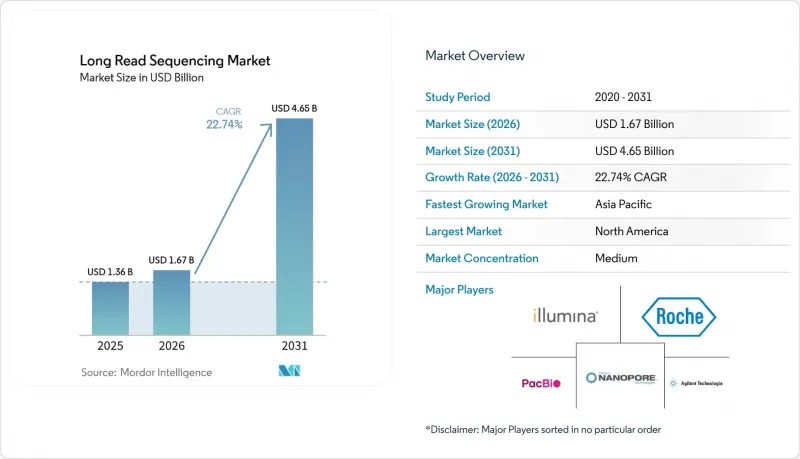
Mordor Intelligence에 의하면, 롱 리드 시퀀싱 시장 규모는 2025년 13억 6,000만 달러로 평가되었고, 2026년에는 16억 7,000만 달러로 확대될 것으로 추정되고, 2031년까지 46억 5,000만 달러에 이를 것으로 예상되며, 2026-2031년 CAGR 22.74%로 성장할 전망입니다.
본 보고서는 제품 및 서비스별(장비, 소모품 및 시약 등), 기술 플랫폼별(SMRT HiFi 시퀀싱, 나노포어 시퀀싱 등), 용도별(인간 유전체 분석·희귀질환 진단 등), 최종 사용자별(학술·정부 연구 기관 등), 지역별(북미, 유럽 등)로 분류되어 있습니다. 시장 전망은 금액(달러) 기준으로 제시되어 있습니다.
세계의 롱 리드 시퀀싱 시장 동향 및 인사이트
염기당 시퀀싱 비용의 급격한 하락
현재, PacBio사의 SPRQ 화학법을 채택한 Revio를 이용한 인간 전체 유전체 시퀀싱 비용은 500달러 미만으로, 2020년 대비 10분의 1 수준으로 하락했습니다. Oxford Nanopore사의 플로우셀 생산량은 연간 100만 유닛을 넘어설 전망이며, 이에 따라 공급이 확대되고 가격대가 낮아질 것으로 예측됩니다. 설비 투자 감소로 인해 중규모 병원에서도 복잡한 사례를 병원 내에서 처리할 수 있게 되면서, 중앙 집중형 시퀀싱 거점에 유리했던 기존의 의뢰 모델이 무너지고 있습니다.
희귀질환 진단 분야의 임상 도입 확대
연구에 따르면, 신경발달장애 코호트에서 롱 리드 시퀀싱은 숏 리드 기술에 비해 병인성 변이를 8.33% 더 많이 검출하는 것으로 나타났습니다. 캔자스시티의 칠드런스 머시 병원은 최근 HiFi 기반 검사를 도입하여 진단까지의 긴 과정을 단축하는 동시에, 미국 민간 보험사의 급여 정책에도 영향을 미치고 있습니다. 새로운 LDT 규정 하에서 EU의 여러 참조 검사실에서도 유사한 임상 도입이 현재 진행 중입니다.
롱 리드 플랫폼의 높은 설비 투자 및 운영 비용
도입 시 할인 가격이라 하더라도, 완전 구성의 Revio 또는 PromethION 번들에는 6자리 후반대의 막대한 투자가 필요하며, 중간 수준의 처리 능력을 가진 검사실의 경우 플로우셀 교체 비용은 여전히 가장 큰 경상 비용으로 남아 있습니다. 연간 300건 미만의 복잡한 사례를 다루는 병원에서는 보험 적용 범위가 확대되거나 국가 보조금을 통해 도입 비용이 충당될 때까지 구매를 미루는 경우가 많습니다.
부문 분석
소모품 및 시약은 2025년 매출의 거의 절반을 차지했으며, 대부분 공급업체 비즈니스 모델의 기반을 형성하고 있습니다. 구독형 시약 플랜은 고객에게 예측 가능한 지출을 정착시키고, 대형 장비 계약에서 제공되는 초기 투자 우대 조치를 상쇄하는 역할을 하고 있습니다. PacBio는 2025년 1분기에 2,010만 달러의 소모품 매출을 기록했으며, 장비 도입 대수가 정체되었음에도 불구하고 전년 동기 대비 26% 증가했습니다. 한편, 연구소들이 베어 메탈 하드웨어보다 턴키형 인포매틱스를 우선시하는 추세가 나타나면서 서비스 및 소프트웨어 부문이 가장 급격한 성장을 기록하고 있습니다. AI를 통해 선별된 변이 해석과 번들로 제공되는 클라우드 라이선스 덕분에 소규모 진료소에서도 인증된 검사 프로세스에 즉시 참여할 수 있게 되었으며, 이러한 추세가 예상되는 연평균 성장률(CAGR) 24.35%의 기반이 되고 있습니다.
QIAGEN Digital Insights와 같은 데이터 분석 플랫폼은 구조적 변이를 표현형이나 약물 표적과 연결하는 멀티오믹스 지식 그래프를 점차 통합하고 있으며, 이를 통해 소모품 데이터 세트가 구독형 수익원으로 전환되고 있습니다. 이러한 변화는 시약 판매량이 여전히 수익의 기반을 이루는 한편, 소프트웨어 계약이 더 높은 이익률과 강력한 락인 효과를 가져올 가능성이 있어, 롱 리드 시퀀싱 시장 경쟁 구도를 재편할 것임을 시사합니다.
HiFi 시퀀싱은 규제 대상 임상 프로토콜을 충족하는 일관된 Q30 정확도에 힘입어 2025년 매출의 58.92%를 차지했습니다. 반면, 나노포어(Nanopore) 장치는 규모는 작지만, 주머니에 들어갈 만한 ‘MinION’과 데스크톱형 ‘GridION’ 유닛 덕분에 감염병 유행 시 환자 곁에서 검사를 가능하게 하여 24.68%라는 가장 높은 연평균 성장률(CAGR)을 달성했습니다.
경쟁사들은 하이브리드 전략으로 수렴하고 있습니다. 로슈의 ‘Sequencing by Expansion(SBX)’은 화학 반응과 검출을 분리하는 것을 목표로 하고 있으며, 이를 통해 진입 가격을 낮출 수 있게 되어 기존 기업들은 추가 실행 시간을 소요하지 않고도 메틸화 프로파일링과 같은 부가가치 기능을 강화할 수밖에 없게 될 가능성이 있습니다. 중기적으로는 플랫폼의 차별화가 원시 리드 길이를 넘어 통합된 분석 기능, 광범위한 분석 포트폴리오, 그리고 서비스 수준 보증으로 전환될 것입니다.
지역별 분석
북미는 2025년 매출의 50.10%를 차지했으며, 성숙한 보험 환급 제도와 AI 유전체학 도구에 주력하는 스타트업을 뒷받침하는 풍부한 벤처 캐피털에 힘입고 있습니다. '알츠하이머병 및 관련 치매 센터' 등 NIH가 자금을 지원하는 이니셔티브에서는 멀티오믹스 프로파일링에 PromethION이 정기적으로 도입되어 해당 지역의 리더십을 강화하고 있습니다. 캐나다의 2억 캐나다 달러 규모의 ‘국가 유전체 데이터 이니셔티브’는 데이터 생성 능력을 더욱 확대하고, 국경을 초월한 연구 컨소시엄을 촉진하고 있습니다. 리더십을 유지하고 있지만, 주요 학술 기관이 포화 상태에 도달하고 확장 예산에서 갱신 예산으로 전환함에 따라 성장은 완만해지고 있습니다.
아시아태평양은 질병 예방 전략에 인구 유전학을 통합하는 공공 부문 프로그램을 배경으로 25.52%라는 가장 높은 연평균 성장률(CAGR)을 기록하고 있습니다. 일본의 리켄(RIKEN)은 2025년에 3,200명의 피험자로 구성된 획기적인 롱 리드 데이터 세트를 공개하여, 동아시아의 정밀 의학을 위한 레퍼런스 패널을 제공했습니다. 중국의 산업 정책에 따른 보조금은 플로우셀 부품의 대량 생산 공장 건설을 촉진하여 공급 안정성과 비용 경쟁력을 확보하고 있습니다. 호주에서는 신생아 유전체 선별 검사의 시범 운영이 진행 중이며, 롱 리드 시퀀싱을 중증 조기 발병 질환의 일선 진단 수단으로 자리매김하고 있습니다.
유럽에서는 ‘Genome of Europe’과 같은 협력적 노력의 혜택을 받고 있습니다. 이는 27개국 51개 연구 기관을 연결하여 대륙 규모의 판유전체을 구축하는 것을 목표로 하는 4,800만 달러 규모의 이니셔티브입니다. 독일의 ‘lonGER’ 프로젝트는 옥스퍼드 나노포어(Oxford Nanopore)사의 워크플로우를 국내 희귀질환 클리닉에 통합하여 진단 과정을 가속화하는 한편, 주변 EU 회원국을 위한 교육 거점 구축을 추진하고 있습니다. GDPR(EU 개인정보보호규정)(일반 데이터 보호 규정) 준수가 과제로 대두되면서 국경을 초월한 데이터 연계는 지연되고 있지만, 핀란드와 에스토니아의 선진적인 규제 샌드박스는 연구 발전을 저해하지 않으면서도 개인정보를 보호할 수 있는 현실적인 방안을 제시하고 있습니다.
기타 혜택 :
- 엑셀 형식 시장 예측(ME) 시트
- 3개월간의 애널리스트 지원
자주 묻는 질문
목차
제1장 서론
제2장 조사 방법
제3장 주요 요약
제4장 시장 구도
제5장 시장 규모 및 성장 예측
제6장 경쟁 구도
제7장 시장 기회 및 향후 전망
AJY 26.08.07According to Mordor Intelligence, the long read sequencing market size is expected to increase from USD 1.36 billion in 2025 to USD 1.67 billion in 2026 and reach USD 4.65 billion by 2031, growing at a CAGR of 22.74% over 2026-2031.
This report is Segmented by Product & Service (Instruments, Consumables & Reagents, and More), Technology Platform (SMRT HiFi Sequencing, Nanopore Sequencing, and More), Application (Human Genomics & Rare-Disease Diagnostics, and More), End-User (Academic & Government Research Institutes, and More), and Geography (North America, Europe, and More). The Market Forecasts are Provided in Terms of Value (USD).
Global Long Read Sequencing Market Trends and Insights
Rapid Decline in Per-Base Sequencing Cost
Human whole-genome sequencing now costs less than USD 500 on PacBio's Revio using SPRQ chemistry, a ten-fold reduction since 2020. Oxford Nanopore's increased flow-cell output is set to top 1 million units annually, widening supply and compressing price points. Lower capital outlays encourage mid-tier hospitals to move complex cases in-house, eroding the historic referral model that favored centralized sequencing hubs.
Growing Clinical Uptake for Rare-Disease Diagnostics
Studies show that long read sequencing detects an additional 8.33% of pathogenic variants over short-read techniques in neurodevelopmental cohorts. Children's Mercy Kansas City recently introduced HiFi-based testing, reducing diagnostic odysseys and influencing private-payer coverage policy in the United States. Similar clinical roll-outs are now underway in several EU reference laboratories under the emerging LDT rule.
High Capital & Operating Costs of Long-Read Platforms
Even at discounted launch pricing, a fully configured Revio or PromethION bundle requires a high-six-figure investment, and flow-cell replenishment remains the largest recurring expense for moderate-throughput laboratories. Hospitals with fewer than 300 complex cases per year often delay procurements until payer codes broaden or national grants defray acquisition costs.
Other drivers and restraints analyzed in the detailed report include:
- Accuracy & Throughput Leap via HiFi/Duplex Chemistries
- AI-Enabled Base-Calling & Methylation Analytics
- Bioinformatics & Data-Storage Complexity
For complete list of drivers and restraints, kindly check the Table Of Contents.
Segment Analysis
Consumables and reagents accounted for almost half of 2025 revenue and form the backbone of most vendor business models. Subscription-style reagent plans lock customers into predictable spending and offset initial capital concessions granted on large instrument deals. PacBio reported consumables revenue of USD 20.1 million in Q1 2025, up 26% year-over-year despite softer instrument placements. Services and software, however, register the steepest growth as laboratories prioritize turnkey informatics over bare-metal hardware. Cloud licenses bundled with AI-curated variant interpretation enable small clinics to jump straight into accredited testing pathways, a trend that underpins the expected 24.35% CAGR.
Progressively, data analytics platforms such as QIAGEN Digital Insights are embedding multi-omic knowledge graphs that link structural variants to phenotypes and drug targets, turning consumables datasets into subscription revenue streams. The shift suggests that reagent volumes will remain a revenue bedrock, yet software contracts may carry a higher margin and greater lock-in, reshaping competitive levers in the long read sequencing market.
HiFi sequencing captured 58.92% of 2025 revenue, backed by consistent Q30 accuracy that satisfies regulated clinical protocols. In parallel, nanopore devices grow off a smaller base but deliver the strongest 24.68% CAGR courtesy of pocket-sized MinION and desktop GridION units, which enable near-patient testing in infectious-disease outbreaks.
Competition is converging on hybrid strategies. Roche's Sequencing by Expansion (SBX) aims to decouple chemistry from detection, potentially dropping entry prices and forcing incumbents to sharpen value-added features such as methylation profiling at no extra run time Roche. Over the medium term, platform differentiation will move beyond raw read length toward integrated analytics, assay portfolio breadth, and service-level guarantees.
Complete Report Scope:
- By Product & Service
- Instruments / Platforms
- Consumables & Reagents
- Services & Software
- By Technology Platform
- SMRT HiFi Sequencing
- Nanopore Sequencing
- Synthetic Long-Read / Linked-Read
- Hybrid & Other Emerging
- By Application
- Human Genomics & Rare-Disease Diagnostics
- Oncology & Liquid Biopsy
- Metagenomics & Microbiome
- Transcriptomics (Iso-Seq, Direct RNA)
- Agrigenomics & Plant/Animal Breeding
- Others
- By End-User
- Academic & Government Research Institutes
- Clinical & Diagnostic Laboratories
- Pharmaceutical & Biopharma Companies
- CROs & Service Providers
- By Geography
- North America
- United States
- Canada
- Mexico
- Europe
- Germany
- United Kingdom
- France
- Italy
- Spain
- Rest of Europe
- Asia-Pacific
- China
- India
- Japan
- South Korea
- Australia
- Rest of Asia-Pacific
- South America
- Brazil
- Argentina
- Rest of South America
- Middle East and Africa
- GCC
- South Africa
- Rest of Middle East and Africa
- North America
Geography Analysis
North America delivered 50.10% of 2025 revenue, underpinned by mature reimbursement structures and abundant venture capital that sustains start-ups focused on AI genomics tooling. NIH-funded initiatives, such as the Center for Alzheimer's and Related Dementias, regularly deploy PromethION for multi-omic profiling, reinforcing regional leadership. Canada's CAD 200 million National Genomics Data Initiative further enlarges data-generation capacity and encourages cross-border research consortia. Despite leadership, growth moderates as saturated major academic centers transition to replacement rather than expansion budgets.
Asia-Pacific logs the fastest 25.52% CAGR on the back of public-sector programs that embed population genomics into disease-prevention strategies. Japan's RIKEN delivered a landmark 3,200-individual long read dataset in 2025, providing a reference panel for East Asian precision medicine. China's industrial policy grants drive large-scale factory builds for flow-cell components, ensuring supply security and cost competitiveness. Australia is piloting newborn genome screening, positioning long read sequencing as a frontline diagnostic for severe early-onset disorders.
Europe benefits from coordinated efforts such as Genome of Europe, a USD 48 million initiative connecting 51 institutes across 27 nations to generate a continent-wide pangenome. Germany's lonGER project integrates Oxford Nanopore workflows into national rare-disease clinics, accelerating diagnostic pipelines and creating training hubs for surrounding EU member states. While GDPR compliance challenges slow cross-border data federation, progressive regulatory sandboxes in Finland and Estonia suggest pragmatic routes to maintain privacy without stifling discovery.
- Pacific Bioscience
- Oxford Nanopore Technologies plc
- Illumina
- MGI Tech Co. Ltd.
- BGI Genomics Co. Ltd.
- Thermo Fisher Scientific
- QIAGEN
- Agilent Technologies
- Roche Sequencing Solutions Inc.
- Genapsys Inc.
- Ultima Genomics Inc.
- Element Biosciences Inc.
- 10x Genomics Inc.
- Nabsys Inc.
- Stratos Genomics (Danaher)
- Bionano Genomics Inc.
- SeqLL Inc.
- Quantapore Inc.
- Omniome (PacBio)
- Singular Genomics Systems Inc.
Additional Benefits:
- The market estimate (ME) sheet in Excel format
- 3 months of analyst support
TABLE OF CONTENTS
1 Introduction
- 1.1 Study Assumptions & Market Definition
- 1.2 Scope of the Study
2 Research Methodology
3 Executive Summary
4 Market Landscape
- 4.1 Market Overview
- 4.2 Market Drivers
- 4.2.1 Rapid Decline in Per-Base Sequencing Cost
- 4.2.2 Growing Clinical Uptake for Rare-Disease Diagnostics
- 4.2.3 Accuracy & Throughput Leap via HiFi/Duplex Chemistries
- 4.2.4 AI-Enabled Base-Calling & Methylation Analytics
- 4.2.5 Portable Real-Time Sequencing for Bio-Security Surveillance
- 4.2.6 National Genomic-Sovereignty Initiatives Funding Long-Read Programs
- 4.3 Market Restraints
- 4.3.1 High Capital & Operating Costs of Long-Read Platforms
- 4.3.2 Bioinformatics & Data-Storage Complexity
- 4.3.3 Reagent-Grade Nanopore Membrane Supply-Chain Fragility
- 4.3.4 Intensifying IP Litigation Among Platform Vendors
- 4.4 Value/ Supply-Chain Analysis
- 4.5 Regulatory Landscape
- 4.6 Technological Outlook
- 4.7 Porter's Five Forces
- 4.7.1 Threat of New Entrants
- 4.7.2 Bargaining Power of Suppliers
- 4.7.3 Bargaining Power of Buyers
- 4.7.4 Threat of Substitutes
- 4.7.5 Competitive Rivalry
5 Market Size & Growth Forecasts
- 5.1 By Product & Service
- 5.1.1 Instruments / Platforms
- 5.1.2 Consumables & Reagents
- 5.1.3 Services & Software
- 5.2 By Technology Platform
- 5.2.1 SMRT HiFi Sequencing
- 5.2.2 Nanopore Sequencing
- 5.2.3 Synthetic Long-Read / Linked-Read
- 5.2.4 Hybrid & Other Emerging
- 5.3 By Application
- 5.3.1 Human Genomics & Rare-Disease Diagnostics
- 5.3.2 Oncology & Liquid Biopsy
- 5.3.3 Metagenomics & Microbiome
- 5.3.4 Transcriptomics (Iso-Seq, Direct RNA)
- 5.3.5 Agrigenomics & Plant/Animal Breeding
- 5.3.6 Others
- 5.4 By End-User
- 5.4.1 Academic & Government Research Institutes
- 5.4.2 Clinical & Diagnostic Laboratories
- 5.4.3 Pharmaceutical & Biopharma Companies
- 5.4.4 CROs & Service Providers
- 5.5 By Geography
- 5.5.1 North America
- 5.5.1.1 United States
- 5.5.1.2 Canada
- 5.5.1.3 Mexico
- 5.5.2 Europe
- 5.5.2.1 Germany
- 5.5.2.2 United Kingdom
- 5.5.2.3 France
- 5.5.2.4 Italy
- 5.5.2.5 Spain
- 5.5.2.6 Rest of Europe
- 5.5.3 Asia-Pacific
- 5.5.3.1 China
- 5.5.3.2 India
- 5.5.3.3 Japan
- 5.5.3.4 South Korea
- 5.5.3.5 Australia
- 5.5.3.6 Rest of Asia-Pacific
- 5.5.4 South America
- 5.5.4.1 Brazil
- 5.5.4.2 Argentina
- 5.5.4.3 Rest of South America
- 5.5.5 Middle East and Africa
- 5.5.5.1 GCC
- 5.5.5.2 South Africa
- 5.5.5.3 Rest of Middle East and Africa
- 5.5.1 North America
6 Competitive Landscape
- 6.1 Market Concentration
- 6.2 Market Share Analysis
- 6.3 Company Profiles (includes Global Level Overview, Market Level Overview, Core Segments, Financials as Available, Strategic Information, Market Rank/Share for Key Companies, Products & Services, and Recent Developments)
- 6.3.1 Pacific Biosciences of California Inc.
- 6.3.2 Oxford Nanopore Technologies plc
- 6.3.3 Illumina Inc.
- 6.3.4 MGI Tech Co. Ltd.
- 6.3.5 BGI Genomics Co. Ltd.
- 6.3.6 Thermo Fisher Scientific Inc.
- 6.3.7 Qiagen NV
- 6.3.8 Agilent Technologies Inc.
- 6.3.9 Roche Sequencing Solutions Inc.
- 6.3.10 Genapsys Inc.
- 6.3.11 Ultima Genomics Inc.
- 6.3.12 Element Biosciences Inc.
- 6.3.13 10x Genomics Inc.
- 6.3.14 Nabsys Inc.
- 6.3.15 Stratos Genomics (Danaher)
- 6.3.16 Bionano Genomics Inc.
- 6.3.17 SeqLL Inc.
- 6.3.18 Quantapore Inc.
- 6.3.19 Omniome (PacBio)
- 6.3.20 Singular Genomics Systems Inc.
7 Market Opportunities & Future Outlook
- 7.1 White-space & Unmet-Need Assessment