

|
시장보고서
상품코드
2100268
치과용 3D 스캐너 시장 : 시장 점유율 분석, 업계 동향 및 통계, 성장 예측(2026-2031년)Dental 3D Scanners - Market Share Analysis, Industry Trends & Statistics, Growth Forecasts (2026 - 2031) |
||||||
 Mordor Intelligence
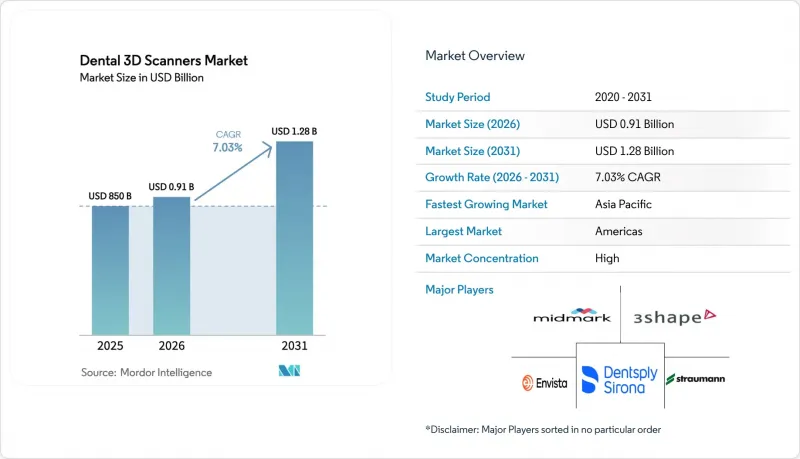
Mordor Intelligence에 의하면, 치과용 3D 스캐너 시장 규모는 2025년에 8억 5,000만 달러로 평가되었고, 2026년 9억 980만 달러에서 2031년까지 12억 8,000만 달러에 이를 것으로 예측되며, 예측 기간(2026-2031년) CAGR은 7.03%를 나타낼 전망입니다.
본 보고서는 제품 유형별(휴대용 치과용 3D 스캐너, 데스크톱/실험실용 치과용 3D 스캐너, 구강 내용 치과용 3D 스캐너, 콘빔 CT), 스캐너 유형별(치과용 3D 광 스캐너, 치과용 3D 레이저 스캐너), 지역별(북미, 유럽, 아시아태평양, 중동 및 아프리카, 남미)로 분류되어 있습니다. 본 보고서에서는 상기 각 부문별 시장 규모(달러)를 제시하고 있습니다.
세계의 치과용 3D 스캐너 시장 동향 및 인사이트
체어사이드 워크플로우의 디지털화가 주류로 부상
치과에서는 스캐너가 필수적인 장비로 간주되는 경향이 강해지고 있습니다. 디지털 인상 채득을 통해 재료 낭비나 택배로 인한 지연이 해소되며, AI를 활용한 임상 판단에 관한 ANSI/ADA 규격 제1110-1호에도 부합합니다. 풀 아치 디지털 워크플로우를 도입한 치과에서는 재방문 빈도가 40% 감소했으며, AI로 생성된 보철물에 대한 환자 만족도는 94%에 달하는 것으로 보고되고 있습니다. 치과 기공소 및 제휴 파트너 간의 네트워크 효과가 더해지면서, 치과용 3D 스캐너 시장은 상호 운용 가능한 치료 경로의 실질적인 기반으로서 확고한 입지를 다져가고 있습니다.
보철 치료 및 교정 치료의 부담 증가
고령화에 따라 보철 치료 건수가 증가하는 한편, 심미적인 치열 교정을 원하는 성인 수요가 높아지면서 교정치과 사례 수도 증가하고 있습니다. 치과 AI 매출액은 2030년까지 27억 달러에 달할 것으로 예상되며, 이는 치과용 3D 스캐너 업계에서 이미지 분석에 대한 수요가 증가하고 있음을 반영합니다. 클리어 얼라이너의 워크플로가 체어사이드 프린팅으로 전환됨에 따라, 몇 시간 이내에 트레이를 제작할 수 있게 되어 치료 주기가 단축되고 기술 도입이 촉진되고 있습니다.
높은 초기 투자 비용 및 학습 곡선
고급 구강 내 스캐너의 가격은 2만-5만 달러, 첨단 CBCT 시스템은 15만 달러를 초과하여 진료 건수가 적은 치과에서는 투자 회수 기간이 길어지고 있습니다. 2025년 미국에서 도입된 관세로 인해 수입 영상 진단 기기에 10%의 관세가 부과되면서 예산은 더욱 압박하고 있습니다. 직원 재교육으로 인해 일시적으로 처리 능력이 저하되지만, 6개월 후에는 착실히 회복된다는 보고가 각 치과에서 나오고 있습니다.
부문 분석
2025년에는 구강 내 스캐너가 매출의 42.12%를 차지했으며, 디지털 인상 채취의 주요 진입점으로서 치과용 3D 스캐너 시장을 지속적으로 뒷받침하고 있습니다. 연평균 성장률(CAGR) 8.42%로 성장이 예상되는 핸드헬드형 기기는 체어사이드에서 유연한 촬영을 가능하게 하고 인체공학적 이점을 제공함으로써, 높은 처리 능력을 자랑하는 치과를 뒷받침하고 있습니다. 데스크톱형 실험실용 스캐너는 20µm 미만의 정밀도가 요구되는 복잡한 보철물 분야에서 틈새 시장의 중요성을 유지하고 있는 반면, CBCT 하이브리드형은 수술 계획에 필수적인 깊이 매핑 기능을 통합하고 있습니다. 무선 모듈은 케이블로 인한 번거로움을 줄여주지만, 기기의 무게를 증가시키기 때문에 각 제조업체는 임상의의 편의성을 고려하여 배터리 밀도 향상에 주력하고 있습니다. 새롭게 등장한 포토그램메트리 기능을 통해 여러 스캔 방식을 통합한 STL 출력이 가능해져, 전악 무치악 사례에서의 정확도가 향상되고 있습니다.
2세대 구강 내 스캐너 플랫폼은 AI 진단과 자동 마진 감지를 융합하여, 치과용 3D 스캐너 시장에서 데이터 수집과 CAD 설계 사이에 매끄러운 가교 역할을 하고 있습니다. 햅틱 피드백이나 제스처 제어 분야에서는 여전히 경쟁 격차가 존재하지만, 이 두 분야 모두 핸드셋의 버튼을 사용하지 않고도 스캔을 시작할 수 있도록 하기 위한 연구 개발이 활발히 진행되고 있습니다. 무선 펌웨어 업데이트를 활용하는 제조업체들은 이미 도입된 기기 기반이라는 경쟁 우위를 유지하며, 진료소를 자사의 소프트웨어 생태계에 안착시키고, 치과용 3D 스캐너 업계 전체에서 지속적인 구독 수익률을 유지하고 있습니다.
구조화된 광 방식은 2025년 매출의 35.62%를 차지했으며, 연평균 성장률(CAGR) 8.61%로 성장할 전망입니다. 다중 패턴 투영을 통해 고속 프레임 획득이 가능해져, 엔드투엔드 풀 아치 정확도를 약 38µm로 유지하며, 보철물의 허용 오차 범위 내에 충분히 들어갑니다. 레이저 삼각측량 기술은 속도가 부차적인 요소인 초정밀 작업에서 여전히 치과 기공소의 주력 기술입니다. 공초점 이미징은 표면 아래의 병변 감지에 탁월하며, 광학적 깊이 정보와 형광 측정값을 결합하여 초기 우식 선별 정확도를 높입니다. 1µm 미만의 축 방향 정밀도를 보장하는 능동 파면 샘플링 기술은 현재 조사 단계에 머물러 있지만, 치과용 3D 스캐너 시장에서 차세대 경쟁의 조짐을 보이고 있습니다.
여러 광학 원리를 단일 센서에 통합하려는 움직임이 뚜렷한 추세로 나타나고 있습니다. 하이브리드형 장치는 표면의 반사율에 따라 투영 방식을 동적으로 전환함으로써, 법랑질, 잇몸, 금속 수복물에서 일관된 스캔 품질을 보장합니다. 폐루프 AI를 통한 노출 설정의 자동 조정을 통해 사용자의 기술적 부담이 경감되며, 치과용 3D 스캐너 시장에 새로 진입하는 업체들에게도 보다 원활한 도입이 가능해집니다.
지역별 분석
북미는 2025년에 매출의 36.40%를 차지했습니다. 이는 견조한 민간 보험 지출과 대규모 그룹 진료소에서의 AI 조기 도입을 반영한 것입니다. 미국의 관세로 인해 수입 가격은 10% 상승했으나, 자금력이 있는 사업자들은 경쟁력을 유지하기 위해 계속해서 장비 업그레이드를 구매하고 있습니다. Dentalcorp와 같은 캐나다 기업 네트워크에서는 수백 대의 진료 의자에 AI 스크리닝을 도입하여 스캔 건수를 늘리고 디지털 진료를 표준화하고 있습니다. 데이터 개인정보 보호 체계는 엄격하지만, 주요 공급업체가 제공하는 클라우드의 이중화 및 사이버 보안 강화 기능과 부합하여 국경을 초월한 데이터 저장에 대한 신뢰를 뒷받침하고 있습니다.
유럽은 2위를 차지했으며, 독일과 영국이 주도적인 역할을 하고 있습니다. 두 국가에서는 공적 보험에 의한 환급과 민간 자본을 결합하여 고사양의 영상 진단을 실현하고 있습니다. 측정 가능한 품질 향상과 연계하여 스캐너 도입을 지원하는 국가 프로그램 덕분에, 치과용 3D 스캐너 시장의 구조적인 성장 궤도가 유지되고 있습니다. GDPR(EU 개인정보보호규정)(일반 데이터 보호 규정)에 따라 엄격한 데이터 관리가 의무화되어 있지만, 규정 준수 인증을 획득한 공급업체는 보다 원활한 조달 경로를 확보할 수 있습니다. 다기관 공동 연구 컨소시엄은 임상 검증과 동료 심사를 거친 논문을 통한 지식 확산을 가속화하여 임상의들의 신뢰를 키워가고 있습니다.
아시아태평양은 주요 성장 동력이며, 2031년까지 연평균 성장률(CAGR) 9.12%를 나타낼 것으로 예측됩니다. 태국, 인도, 필리핀에서는 품질의 증거로서 디지털 스캔을 포함한 비용 대비 효과가 높은 패키지를 제공하여 해외 환자를 유치하고 있습니다. 중국의 도시 중산층은 고품질의 수복 치료를 원하고 있어, 스캔 처리 능력과 품질을 둘러싼 국내 경쟁이 격화되고 있습니다. 한국에서는 국민건강보험 제도 하에서 고령자의 영상 진단에 보조금이 지급되고 있어, 고령층 수요가 활성화되고 있습니다. 호주는 동남아시아로 환자를 송출하는 동시에, 복잡한 수술을 받기 위해 고부가가치 외국인 환자를 유치하고 있으며, 이는 치과용 3D 스캐너 시장을 강화하는 양국 간 장비 유통을 촉진하고 있습니다.
라틴아메리카에서는 도입이 서서히 진행되고 있습니다. 브라질에서는 임플란트 붐으로 인해 체어사이드 스캔에 대한 관심이 높아지고 있지만, 환율 변동으로 인해 교체 일정은 다소 소극적인 양상을 보이고 있습니다. 중동 및 아프리카에서는 민간 체인 병원들이 외국인 거주자나 의료 관광객을 대상으로 프리미엄 서비스를 차별화하기 위해 디지털 스위트를 도입하고 있어, 견조하지만 다소 낮은 성장세를 보이고 있습니다.
기타 혜택 :
- 엑셀 형식 시장 예측(ME) 시트
- 3개월간의 애널리스트 지원
자주 묻는 질문
목차
제1장 서론
제2장 조사 방법
제3장 주요 요약
제4장 시장 구도
제5장 시장 규모 및 성장 예측
제6장 경쟁 구도
제7장 시장 기회 및 향후 전망
AJY 26.08.07According to Mordor Intelligence, the dental 3D scanners market size was valued at USD 850 million in 2025 and estimated to grow from USD 909.8 million in 2026 to reach USD 1.28 billion by 2031, at a CAGR of 7.03% during the forecast period (2026-2031).
This report is Segmented by Product Type (Hand-Held 3D Dental Scanners, Desktop/Laboratory 3D Dental Scanners, Intraoral 3D Dental Scanners, Cone Beam Computerized Tomography), Scanner Type (3D Dental Light Scanners, 3D Dental Laser Scanners), and Geography (North America, Europe, Asia-Pacific, Middle East and Africa, and South America). The Report Offers the Value (in USD) for the Above Segments.
Global Dental 3D Scanners Market Trends and Insights
Mainstream Digitization of Chair-Side Workflows
Dental practices increasingly view scanners as non-negotiable. Digital impressions remove material waste and courier delays, aligning with ANSI/ADA Standard No. 1110-1 for AI-supported clinical decisions. Clinics using full-arch digital flows report 40% cuts in revisit frequency and 94% patient approval of AI-generated restorations. Network effects among laboratories and referral partners are cementing the Dental 3D scanners market as the de facto foundation of interoperable care pathways.
Growing Burden of Restorative & Orthodontic Procedures
An aging demographic raises restorative volumes, while adult demand for aesthetic alignment lifts orthodontic caseloads. Dental AI revenue is set to hit USD 2.7 billion by 2030, mirroring the heightened image-analysis needs of the Dental 3D scanners industry. Clear-aligner workflows converted to chair-side printing now produce trays within hours, compressing treatment cycles and reinforcing technology adoption.
High Capital Cost & Learning Curve
Premium intra-oral scanners list between USD 20,000 and USD 50,000; advanced CBCT systems surpass USD 150,000, stretching payback periods for low-volume clinics. A 2025 US tariff added 10% to imported imaging hardware, tightening budgets further. Staff retraining temporarily suppresses throughput, yet practices report a steady rebound after six months.
Other drivers and restraints analyzed in the detailed report include:
- Faster AI-Enhanced Scan Accuracy & Wireless Ergonomics
- Integration with In-Office 3D Printing Enabling Same-Day Dentistry
- Limited Reimbursement for Digital Impressions
For complete list of drivers and restraints, kindly check the Table Of Contents.
Segment Analysis
Intra-oral units headlined revenue at 42.12% in 2025 and remain the core gateway for digital impressions, anchoring the Dental 3D scanners market. Hand-held devices, set to rise at 8.42% CAGR, deliver flexible chair-side capture for ergonomic gains that support high-throughput clinics. Desktop laboratory scanners sustain niche relevance for complex prosthetics requiring sub-20 µm fidelity, while CBCT hybrids integrate depth mapping essential for surgical planning. Wireless modules reduce cable clutter but widen device weight, prompting manufacturers to refine battery density for clinician comfort. Emerging photogrammetry features now stitch multiple scan modalities into unified STL outputs, advancing accuracy for full-arch edentulous cases.
Second-generation intra-oral platforms blend AI diagnostics with automated margin detection, creating a seamless bridge between acquisition and CAD design within the Dental 3D scanners market. Competitive gaps persist in haptic feedback and gesture control, both under active R&D to streamline scan initiation without handset buttons. Manufacturers who leverage over-the-air firmware updates retain an installed-base moat, locking clinics into their software ecosystems and sustaining recurring subscription margins for the broader Dental 3D scanners industry.
Structured-light captured 35.62% of 2025 revenue and is positioned to climb at 8.61% CAGR. Multi-pattern projection ensures rapid frame acquisition, delivering end-to-end full-arch trueness near 38 µm, well within prosthetic tolerance. Laser triangulation remains the laboratory workhorse for ultra-fine work when speed is secondary. Confocal imaging excels in subsurface lesion detection, pairing optical depth cues with fluorescence metrics that enhance early caries screening. Active wavefront sampling, promising sub-1 µm axial precision, remains confined to research but signals next-wave competition for the Dental 3D scanners market.
The convergence of multiple light principles into single sensors is a visible trend. Hybrid devices dynamically switch projection methods based on surface reflectivity, ensuring scan consistency across enamel, gingiva and metallic restorations. Closed-loop AI calibrates exposure settings to reduce the user's technical burden, yielding smoother integration for new entrants to the Dental 3D scanners market.
Complete Report Scope:
- By Product Type
- Intra-oral Scanners
- Desktop / Laboratory Scanners
- Cone-Beam CT (Dental CBCT)
- Hand-held / Portable Scanners
- By Technology
- Structured-Light
- Laser Triangulation
- Confocal Imaging
- Active Wavefront Sampling
- By End User
- Dental Clinics
- Dental Laboratories
- Hospitals
- Academic & Research Institutes
- By Application
- Restorative Dentistry
- Orthodontics
- Implantology
- Endodontics & Others
- By Geography
- North America
- United States
- Canada
- Europe
- Germany
- United Kingdom
- France
- Italy
- Spain
- Rest of Europe
- Asia-Pacific
- China
- India
- Japan
- South Korea
- Australia
- Rest of Asia-Pacific
- South America
- Brazil
- Argentina
- Rest of South America
- Middle East and Africa
- GCC
- South Africa
- Rest of Middle East and Africa
- North America
Geography Analysis
North America maintained 36.40% revenue in 2025, reflecting robust private insurance spend and early AI adoption across large group practices. US tariffs lifted import prices by 10%, yet capital-rich operators continue purchasing upgrades to defend competitive standing. Canada's corporate networks, such as Dentalcorp, deploy AI screening across hundreds of chairs, raising scan volume and normalising digital care. Data-privacy frameworks, though strict, align with cloud redundancy and cyber-hardening features provided by leading vendors, undergirding confidence in cross-border data storage.
Europe ranks second, anchored by Germany and the United Kingdom, which combine public reimbursement with private capital for high-spec imaging. National programmes subsidise scanner adoption when linked to measurable quality improvements, sustaining a structured growth path for the Dental 3D scanners market. GDPR enforces rigorous data controls, but vendors who certify compliance find smoother procurement channels. Multi-centre research consortia accelerate clinical validation and peer-reviewed dissemination, nurturing clinician trust.
Asia-Pacific is the prime expansion engine, forecast to run at 9.12% CAGR through 2031. Thailand, India and the Philippines court foreign patients with cost-effective packages that include digital scans as proof points of quality. China's urban middle class demands premium restorative care, intensifying domestic competition on scan throughput and quality. South Korea subsidises senior imaging under National Health Insurance, invigorating demand in older cohorts. Australia simultaneously exports patients to Southeast Asia and imports high-value inbound travellers for complex surgeries, driving bilateral equipment flows that reinforce the Dental 3D scanners market.
Latin America shows gradual uptake; Brazil's implant boom sparks interest in chair-side scanning, although currency volatility tempers replacement schedules. The Middle East and Africa deliver steady but lower growth, as private chains import digital suites to differentiate premium offerings for expatriate populations and medical tourists.
- Dentsply Sirona
- 3 Shape
- Align Technology
- Planmeca
- Carestream Dental
- Medit
- Vatech
- Shining 3D
- Straumann Group (Dental Wings)
- Kulzer
- Envista Holdings (KaVo, i-CAT)
- Hexagon AB (AICON)
- 3M
- Runyes
- Zimmer Biomet (Zfx)
- Ormco
- Age Solutions
- Aoralscan (Shining 3D)
- AlliedStar
- Whip Mix
Additional Benefits:
- The market estimate (ME) sheet in Excel format
- 3 months of analyst support
TABLE OF CONTENTS
1 Introduction
- 1.1 Study Assumptions & Market Definition
- 1.2 Scope of the Study
2 Research Methodology
3 Executive Summary
4 Market Landscape
- 4.1 Market Overview
- 4.2 Market Drivers
- 4.2.1 Mainstream Digitization of Chair-Side Workflows
- 4.2.2 Growing Burden of Restorative & Orthodontic Procedures
- 4.2.3 Faster AI-Enhanced Scan Accuracy & Wireless Ergonomics
- 4.2.4 Integration with in-Office 3D Printing for Same-Day Dentistry
- 4.2.5 Dental-Tourism Corridors Driving APAC Upgrades
- 4.2.6 Subscription-Based Software Lowering Entry Barriers
- 4.3 Market Restraints
- 4.3.1 High Capital Cost & Learning Curve
- 4.3.2 Limited Reimbursement for Digital Impressions
- 4.3.3 Cyber-Security & Data-Integration Concerns in Cloud Workflows
- 4.3.4 Accuracy Challenges for Edentulous / Full-Arch Scans
- 4.4 Value / Supply-Chain Analysis
- 4.5 Regulatory Landscape
- 4.6 Technological Outlook
- 4.7 Porter's Five Forces
- 4.7.1 Threat of New Entrants
- 4.7.2 Bargaining Power of Suppliers
- 4.7.3 Bargaining Power of Buyers
- 4.7.4 Threat of Substitutes
- 4.7.5 Competitive Rivalry
5 Market Size & Growth Forecasts (Value)
- 5.1 By Product Type
- 5.1.1 Intra-oral Scanners
- 5.1.2 Desktop / Laboratory Scanners
- 5.1.3 Cone-Beam CT (Dental CBCT)
- 5.1.4 Hand-held / Portable Scanners
- 5.2 By Technology
- 5.2.1 Structured-Light
- 5.2.2 Laser Triangulation
- 5.2.3 Confocal Imaging
- 5.2.4 Active Wavefront Sampling
- 5.3 By End User
- 5.3.1 Dental Clinics
- 5.3.2 Dental Laboratories
- 5.3.3 Hospitals
- 5.3.4 Academic & Research Institutes
- 5.4 By Application
- 5.4.1 Restorative Dentistry
- 5.4.2 Orthodontics
- 5.4.3 Implantology
- 5.4.4 Endodontics & Others
- 5.5 By Geography
- 5.5.1 North America
- 5.5.1.1 United States
- 5.5.1.2 Canada
- 5.5.2 Europe
- 5.5.2.1 Germany
- 5.5.2.2 United Kingdom
- 5.5.2.3 France
- 5.5.2.4 Italy
- 5.5.2.5 Spain
- 5.5.2.6 Rest of Europe
- 5.5.3 Asia-Pacific
- 5.5.3.1 China
- 5.5.3.2 India
- 5.5.3.3 Japan
- 5.5.3.4 South Korea
- 5.5.3.5 Australia
- 5.5.3.6 Rest of Asia-Pacific
- 5.5.4 South America
- 5.5.4.1 Brazil
- 5.5.4.2 Argentina
- 5.5.4.3 Rest of South America
- 5.5.5 Middle East and Africa
- 5.5.5.1 GCC
- 5.5.5.2 South Africa
- 5.5.5.3 Rest of Middle East and Africa
- 5.5.1 North America
6 Competitive Landscape
- 6.1 Market Concentration
- 6.2 Market Share Analysis
- 6.3 Company Profiles {(includes Global Level Overview, Market Level Overview, Core Segments, Financials as Available, Strategic Information, Market Rank/Share for Key Companies, Products & Services, and Recent Developments)}
- 6.3.1 Dentsply Sirona
- 6.3.2 3Shape
- 6.3.3 Align Technology
- 6.3.4 Planmeca Oy
- 6.3.5 Carestream Dental
- 6.3.6 Medit
- 6.3.7 Vatech
- 6.3.8 Shining 3D
- 6.3.9 Straumann Group (Dental Wings)
- 6.3.10 Kulzer GmbH
- 6.3.11 Envista Holdings (KaVo, i-CAT)
- 6.3.12 Hexagon AB (AICON)
- 6.3.13 3M Company
- 6.3.14 Runyes
- 6.3.15 Zimmer Biomet (Zfx)
- 6.3.16 Ormco
- 6.3.17 Age Solutions
- 6.3.18 Aoralscan (Shining 3D)
- 6.3.19 AlliedStar
- 6.3.20 Whip Mix
7 Market Opportunities & Future Outlook
- 7.1 White-space & Unmet-Need Assessment
- 7.1.1 Asclepion Laser
- 7.1.2 Shanghai Fosun Pharmaceutical - Sisram
8 Market Opportunities & Future Outlook
- 8.1 White-space & Unmet-Need Assessment


