
|
시장보고서
상품코드
2100269
연료 유량계 시장 : 시장 점유율 분석, 업계 동향 및 통계, 성장 예측(2026년-2031년)Fuel Flow Meter - Market Share Analysis, Industry Trends & Statistics, Growth Forecasts (2026 - 2031) |
||||||
 Mordor Intelligence
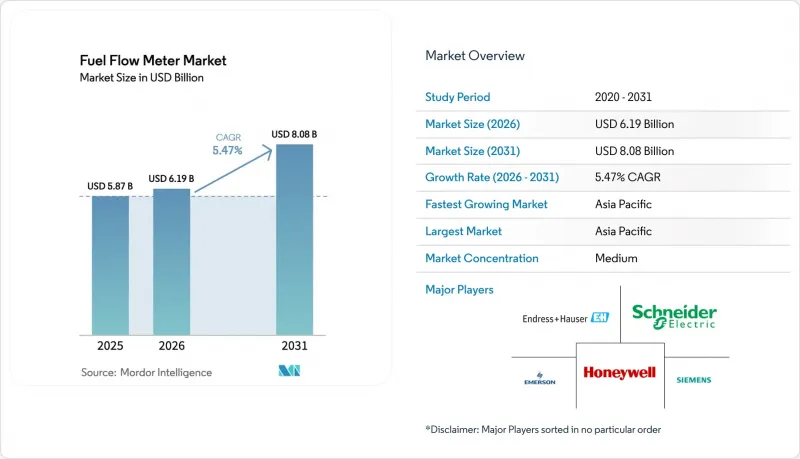
Mordor Intelligence에 의하면, 2026년 연료 유량계 시장 규모는 61억 9,000만 달러로 추정되고, 2025년 58억 7,000만 달러에서 확대해, 2031년에는 80억 8,000만 달러에 이를 것으로 예측됩니다.
2026-2031년 연평균 성장률(CAGR)은 5.47%가 될 것으로 전망됩니다.
본 보고서는 유량계 유형별(용적식, 코리올리식, 초음파식 등), 연료 유형별(디젤, 중유, LNG/극저온 연료 등), 배관 크기별(25mm 이하, 26-50mm, 51-100mm, 100mm 초과), 산업 분야별(석유 및 가스, 항공우주 및 방위, 화학·공정 산업 등), 지역별로 분류되어 있습니다. 시장 전망은 금액(달러) 기준으로 제시되어 있습니다.
세계의 연료 유량계 시장 동향 및 인사이트
엄격한 IMO DCS 규제로 인해, 해사 분야에서의 도입 가속화
2024년에 시행되는 IMO 데이터 수집 시스템(DCS)에 따라, 5,000 GT를 초과하는 선박은 실제 연료 소비량을 보고해야 하며, 기존의 추정치에 의한 보고는 폐지되고 ±2.5%의 정확도를 충족하는 인증된 유량계로 신속히 교체해야 합니다. 현재 약 60,000척의 선박이 이 규정의 적용 대상이며, 연료 유량계 시장에서 대규모 개조 기회가 창출되고 있습니다. KROHNE와 같은 공급업체들은 IMO 및 EU의 MRV(측정·보고·검증) 프레임워크를 모두 준수하기 위해 질량 유량계 하드웨어와 자동 탄소 배출량 산출 소프트웨어를 세트로 제공합니다. 많은 선단에서는 데이터 전송용 전자 출력이 없는 구형 기계식 장치가 여전히 사용되고 있어, 이 정책의 영향이 즉각적으로 나타나고 있습니다. 시행 체제가 갖춰진 유럽 및 아시아의 선적국에서 조기 도입이 가장 활발히 진행되고 있습니다. 이러한 요인들이 맞물려 전 세계 연료 유량계 시장의 성장을 가속화하고 있습니다.
고정밀 유량계를 통합한 실시간 항공 연료 최적화 시스템
각 항공사는 질량 유량 센서를 비행 관리 컴퓨터와 통합하여 연료 공급량을 실시간으로 조정함으로써, 편당 소비량을 최대 3% 절감하고 넷제로 목표 달성을 지원하고 있습니다. 사프란(Safran)의 'LiSafe'와 이튼(Eaton)의 디지털 게이지(gauge)는 배선 무게를 줄이면서도 기존 터빈식 유량계로는 달성할 수 없었던 ±0.1%의 정밀도를 실현하고 있습니다. 이러한 업그레이드를 통해 운영 성능이 향상되고, 단가 상승분을 상쇄하는 직접적인 비용 절감 효과를 얻을 수 있어 프리미엄 유량계의 가치 제안이 강화되고 있습니다. 바이오 제트 연료 및 파워-투-리퀴드(PTL) 연료에 대한 대응 인증을 획득함으로써 항공기 기단의 미래 대응력을 확보할 수 있습니다. 아시아태평양의 항공사들이 기체 현대화를 추진함에 따라, 해당 지역으로의 확장을 통해 연료 유량계의 잠재 시장은 더욱 확대될 전망입니다.
고정밀 코리올리식 유량계와 기계식 유량계의 CAPEX 차이
코리올리식 유량계는 대부분의 경우 터빈식 유량계보다 3-5배의 비용이 소요되며, 전용 장착 구조로 인해 설치 비용은 더욱 높아집니다. 이 높은 가격에 놀라, 체적 측정만으로도 충분한 용도에서는 업그레이드를 주저하는 경향이 있습니다. 단기적인 예산과 전체 수명 주기 동안의 비용 절감을 저울질하는 사업자는 구매를 미룰 가능성이 있으며, 그 결과 연료 유량계 시장의 단기적인 성장이 둔화될 우려가 있습니다. 그러나 유지보수가 필요 없는 설계와 직접적인 질량 출력 덕분에 총 소유 비용은 여전히 절감되므로, 자금 조달 모델이 발전함에 따라 이러한 제약 요인은 완화될 것으로 예측됩니다.
부문 분석
2025년, 코리올리식 유량계는 연료 유량계 시장 점유율의 27.84%를 차지했으며, 거래량 측정 및 다중 연료 운영에서의 역할을 부각시켰습니다. 직접 질량 측정 방식을 통해 밀도 보정이 불필요하며, 재교정 없이도 수소, LNG, 바이오연료의 혼합에 대응할 수 있습니다. 플랜트 운영자가 누출 경로와 유지보수를 줄이기 위해 유량 측정 지점을 통합함에 따라, 2인치를 초과하는 배관 크기에서의 채택이 증가하고 있습니다. 초음파 유량계는 주로 새로 인수한 Flexim사의 클램프온형 설계 덕분에 개조 시 가동 중단 시간을 단축할 수 있어 성장세가 가속화되어 연평균 성장률(CAGR) 5.65%를 기록할 전망입니다. 터빈식 및 용적식 유량계는 예산 제약이 여전히 남아 있는 저점도 또는 저유량 용도에서 틈새 시장 역할을 유지하고 있습니다. 와류 유량계 및 전자기 유량계 기술은 시장 점유율은 작지만, 증기나 전도성 액체에서는 여전히 유효한 선택지로 남아 있습니다. 이러한 복합적인 요인으로 인해 공급업체들의 연구 개발은 멀티패스 신호 처리, 자가 진단 기능 및 사이버 보안 강화에 집중되고 있으며, 기술의 다양성이 연료 유량계 시장의 확장을 뒷받침하고 있음을 보여줍니다.
2026-2031년 코리올리식 유량계 공급업체들은 액체 접촉부의 직경을 16인치까지 확대하는 것을 목표로 하고 있으며, 이를 통해 기존에는 초음파식 유량계가 주류를 이루던 벌크 터미널 시장에 진출할 수 있게 될 것입니다. 고급 진단 기능을 갖춘 모듈형 트랜스미터는 혼입 가스, 부착물, 진동 문제를 실시간으로 감지하여 문제 해결에 소요되는 노력을 줄여줍니다. 각 시스템 통합사업자들은 현재 코리올리식 유량계를 에너지 관리 소프트웨어와 번들로 제공하여, 유량, 밀도, 온도, 배출량을 포괄하는 단일 대시보드를 사용자에게 제공합니다. 이러한 생태계적 사고방식을 통해 하드웨어가 고객의 워크플로우에 깊이 통합되어 고객 유지율과 지속적인 수익이 강화됩니다. 이러한 요인들은 코리올리 방식의 우위를 높이는 한편, 이를 보완하는 초음파 유량계의 성장도 촉진하고 있으며, 다중 기술 포트폴리오가 연료 유량계 시장의 장기적인 회복력의 기반이 되고 있음을 보여줍니다.
대형 트럭, 철도, 비상용 전원은 여전히 디젤이 주를 이루고 있어, 디젤 연료는 여전히 연료 유량계 시장 규모의 56.05%를 차지하고 있습니다. 그러나 해운 및 도로 운송 차량이 저탄소 연료로 전환됨에 따라, LNG 및 기타 극저온 연료가 연평균 성장률(CAGR) 5.88%로 성장을 주도하고 있습니다. 극저온에서의 이송에는 -162°C에서 클래스 1.0의 정확도가 요구되지만, 이를 충족할 수 있는 코리올리식 및 초음파식 설계는 제한적입니다. 항공 업계에서는 지속 가능한 연료의 도입이 가속화되고 있으며, 유량계 공급업체들은 e-케로신 및 HEFA 블렌드에 대해 ASTM D4054에 기반한 하드웨어 인증을 추진하고 있습니다. IMO의 황 규제가 강화됨에 따라 중유 수요는 감소하고 있지만, 근해 항로의 보조 엔진용으로는 여전히 고점도 대응 유량계가 필요합니다. 수소 및 암모니아의 시범 도입으로 저밀도 가스 계량에 대한 틈새 수요가 발생하여 고가가 형성되고, 이는 전체 연료 유량계 시장의 평균 판매 가격을 끌어올리고 있습니다.
연료의 다양화로 인해 각 공급업체는 광범위한 온도, 압력, 점도 프로파일을 시뮬레이션하는 교정 장치 개발을 서둘러야 하는 상황에 놓여 있습니다. 다중 유체(multi-fluid) 대응 펌웨어를 통해 단일 트랜스미터에 최대 20종의 제품 특성 곡선을 저장할 수 있게 되어, 사용자는 현장에서 재교정 없이 연료를 전환할 수 있게 되었습니다. 이러한 기능 덕분에 전환 시간과 재고 비용이 절감됩니다. 재생 가능 디젤 혼합 연료가 도로 운송에 보급됨에 따라, 밀도 및 점도 변화를 감지하는 능력이 운영상의 필수 요건이 되어 디지털 밀도 측정 기능을 갖춘 첨단 유량계 수요가 증가하고 있습니다. 이러한 변화로 인해 대상 용도가 확대되어, 연료 유량계 시장은 거시적인 연료 대체 위험으로부터 보호받고 있습니다.
지역별 분석
아시아태평양은 2025년에 34.40%의 점유율로 연료 유량계 시장을 주도할 전망이며, 중국의 탄소 중립 계획, 일본의 수소 관련 이니셔티브, 그리고 인도의 산업 현대화에 힘입어 2031년까지 연평균 성장률(CAGR) 6.25%로 성장을 주도하고 있습니다. 싱가포르의 LNG 벙커링 프로토콜은 동남아시아 전역의 항만에서 유량계 사양을 표준화하는 지역적 기준으로 기능하고 있습니다. 현지 제조 거점을 통해 리드타임이 단축되고 비용이 절감됨에 따라, 연료 유량계 시장에서 아시아 거점을 둔 공급업체의 경쟁력이 강화되고 있습니다.
북미는 셰일가스 인도 계량, EPA의 엄격한 배출 규제, 그리고 항공우주 분야의 혁신 클러스터에 힘입어 2위를 차지하고 있습니다. 이 지역에서는 저밀도 가스의 교정이 필요한 수소 수송 파이프라인에 대한 초기 시험이 진행되고 있습니다. 디지털 트윈 및 예측 분석에 대한 투자로 인해 SCADA 시스템과 원활하게 통합되는 스마트 미터에 대한 수요가 증가하고 있습니다.
유럽은 규제 측면에서 선도적인 입지를 유지하고 있으며, 선박 및 산업용 보일러의 고도화된 계측을 촉진하는 EU의 MRV 및 ‘Fit-for-55’ 패키지를 시행하고 있습니다. 이 대륙의 수소 경제 로드맵은 ATEX 안전 규격을 충족하면서 성분이 변동하는 혼합 가스를 처리하는 유량계의 연구 개발을 추진하고 있습니다. 동유럽의 정유시설 현대화 및 지역 난방 네트워크 구축도 수요의 점진적 증가에 기여하고 있습니다.
중동 및 아프리카에서는 대규모 석유 및 가스 투자와 광업 프로젝트의 혜택을 받고 있으나, 혹독한 기후 조건으로 인해 견고한 외장과 높은 IP 등급이 요구되고 있습니다. 남미에서는 브라질의 해상 에너지 개발과 칠레의 구리 광산을 필두로, 운영 비용 절감을 목적으로 한 원격 및 클라우드 기반 모니터링에 대한 관심이 높아지고 있습니다. 이러한 지역별 차이로 인해 기술 포트폴리오의 다양성이 확보되어, 전 세계 연료 유량계 시장의 회복력이 유지되고 있습니다.
기타 혜택 :
- 엑셀 형식 시장 예측(ME) 시트
- 3개월간의 애널리스트 지원
자주 묻는 질문
목차
제1장 서론
제2장 조사 방법
제3장 주요 요약
제4장 시장 구도
제5장 시장 규모 및 성장 예측
제6장 경쟁 구도
제7장 시장 기회 및 향후 전망
AJY 26.08.07According to Mordor Intelligence, the fuel flow meter market size in 2026 is estimated at USD 6.19 billion, growing from 2025 value of USD 5.87 billion with 2031 projections showing USD 8.08 billion, growing at 5.47% CAGR over 2026-2031.
This report is Segmented by Flowmeter Type (Positive Displacement, Coriolis, Ultrasonic, and More), Fuel Type (Diesel, Heavy Fuel Oil, LNG/Cryogenic Fuels, and More), Pipe Size (Up To 25mm, 26-50mm, 51-100mm, Above 100mm), Industry Vertical (Oil and Gas, Aerospace and Defense, Chemicals and Process Industries, and More), and Geography. The Market Forecasts are Provided in Terms of Value (USD).
Global Fuel Flow Meter Market Trends and Insights
Stringent IMO DCS Mandates Accelerating Maritime Adoption
The 2024 implementation of the IMO Data Collection System obliges vessels over 5,000 GT to report actual fuel consumption, eliminating historical estimations and forcing rapid upgrades to certified meters that meet +-2.5% accuracy. About 60,000 ships now fall under this rule, creating a sizeable retrofit opportunity within the fuel flow meter market. Providers such as KROHNE bundle mass-flow hardware with automated carbon-emissions software to ensure compliance with both IMO and EU MRV frameworks. The policy impact is immediate because many fleets still operate legacy mechanical devices that lack electronic outputs for data transfer. Early adoption is strongest in European and Asian flag states where enforcement mechanisms are mature. These factors collectively add momentum to global fuel flow meter market growth.
Real-time Aviation Fuel Optimization Systems Integrating Precision Meters
Airlines integrate mass-flow sensors with flight-management computers to adjust fuel delivery in real time, trimming consumption by up to 3% per flight and supporting net-zero goals. Safran's LiSafe and Eaton's digital gauges reduce wiring weight while delivering +-0.1% accuracy, a level that conventional turbine meters cannot match. These upgrades improve operational performance and unlock direct savings that offset higher unit prices, strengthening the value proposition of premium meters. Certification to handle bio-jet and power-to-liquid blends future-proofs aircraft fleets. Expansion into Asia-Pacific fleets will widen the addressable fuel flow meter market as regional carriers modernize.
High CAPEX of High-Accuracy Coriolis vs Mechanical Meters
Coriolis units often cost three-to-five times more than turbine meters, and specialized mounting pushes installed cost even higher. The sticker shock discourages upgrades in applications where volumetric measurement suffices. Operators weighing short-term budgets against lifecycle savings may postpone purchases, trimming near-term growth of the fuel flow meter market. Yet the maintenance-free design and direct mass output still lower total cost of ownership, so the restraint is expected to ease as financing models evolve.
Other drivers and restraints analyzed in the detailed report include:
- LNG Bunkering Expansion Requiring Cryogenic-Capable Coriolis Meters
- Autonomous Mining Fleets' Need for Remote Diesel Monitoring
- Substitution by ECU-Based Virtual Fuel Flow Analytics
For complete list of drivers and restraints, kindly check the Table Of Contents.
Segment Analysis
Coriolis meters delivered 27.84% of fuel flow meter market share in 2025, underscoring their role in custody transfer and multi-fuel operations. Their direct mass measurement eliminates density corrections and supports hydrogen, LNG, and biofuel blends without recalibration. Adoption rises in pipe sizes above 2 inches as plant operators consolidate flow points to reduce leak paths and maintenance. Ultrasonic meters gain the momentum to post a 5.65% CAGR, primarily because clamp-on designs from newly acquired Flexim shorten shutdowns during retrofits. Turbine and positive-displacement units retain niche roles in low-viscosity or low-flow applications where budget constraints persist. Vortex and electromagnetic technologies occupy smaller shares but remain viable for steam or conductive liquids. The combined effect keeps supplier R&D focused on multi-path signal processing, self-diagnostics, and cybersecurity hardening, illustrating how technology diversity sustains expansion in the fuel flow meter market.
Across 2026-2031, Coriolis vendors aim to lift wetted-line diameters to 16 inches, enabling penetration into bulk terminals where ultrasonic meters have historically prevailed. Modular transmitters with advanced diagnostics detect entrained gas, coating, or vibration issues in real time, cutting troubleshooting labor. Integrators now bundle Coriolis meters with energy-management software to give users a single dashboard that covers rate, density, temperature, and emissions. Such ecosystem thinking embeds hardware deeper into customer workflows, reinforcing retention and recurring revenue. These factors elevate Coriolis dominance yet also spur complementary ultrasonic growth, showing that multi-technology portfolios underpin long-term resilience within the fuel flow meter market.
Diesel still accounts for 56.05% of the fuel flow meter market size because heavy-duty trucking, rail, and backup power remain diesel-centric. Nonetheless, LNG and other cryogens lead growth at a 5.88% CAGR as shipping and on-road fleets pivot to low-carbon fuels. Cryogenic transfers demand Class 1.0 accuracy at -162 °C, which only a limited set of Coriolis and ultrasonic designs can meet. Aviation accelerates sustainable fuel adoption, prompting meter suppliers to qualify hardware under ASTM D4054 for e-kerosene and HEFA blends. Heavy fuel oil declines as IMO sulfur caps tighten, yet it still requires viscous-service meters for auxiliary engines in short-sea corridors. Hydrogen and ammonia pilots create niche demand for low-density gas metering, commanding premium prices and raising average selling values across the fuel flow meter market.
Fuel diversity pushes vendors to develop calibration rigs that simulate wide temperature, pressure, and viscosity profiles. Multi-fluid firmware now stores up to 20 product curves in a single transmitter, letting users switch fuels without field recalibration. These capabilities lower change-over time and inventory costs. As renewable diesel blends permeate road transport, the ability to detect density and viscosity shifts becomes an operational necessity, locking in advanced meters with digital density measurement. The shift expands addressable applications and shields the fuel flow meter market from macro-fuel substitution risk.
Complete Report Scope:
- By Flowmeter Type
- Positive Displacement
- Coriolis
- Ultrasonic
- Turbine
- Electromagnetic
- Vortex
- Other Types
- By Fuel Type
- Diesel
- Heavy Fuel Oil (HFO)
- LNG/Cryogenic Fuels
- Alternative and Biofuels (E-Methan ol, Biodiesel, SAF)
- By Pipe Size
- Upto 25 mm
- 26 - 50 mm
- 51 - 100 mm
- Above 100 mm
- By Industry Vertical
- Oil and Gas (Upstream, Midstream, Downstream)
- Marine and Shipping
- Automotive and Commercial Fleet Management
- Aerospace and Defense
- Industrial Power Generation and Utilities
- Chemicals and Process Industries
- Agriculture and Off-Road Machinery
- By Geography
- North America
- United States
- Canada
- Mexico
- Europe
- Germany
- United Kingdom
- France
- Nordics
- Rest of Europe
- South America
- Brazil
- Rest of South America
- Asia-Pacific
- China
- Japan
- India
- South-East Asia
- Rest of Asia-Pacific
- Middle East and Africa
- Middle East
- Gulf Cooperation Council Countries
- Turkey
- Rest of Middle East
- Africa
- South Africa
- Rest of Africa
- Middle East
- North America
Geography Analysis
Asia-Pacific dominated the fuel flow meter market with a 34.40% share in 2025 and leads in growth with a 6.25% CAGR through 2031, buoyed by China's carbon-neutrality program, Japan's hydrogen initiatives, and India's industrial upgrades. Singapore's LNG bunkering protocols act as a regional reference, standardizing meter specifications across Southeast Asian ports. Local manufacturing hubs shorten lead times and reduce cost, strengthening competitiveness of Asia-based suppliers within the fuel flow meter market.
North America ranks second, propelled by shale gas custody transfer, strict EPA emissions rules, and aerospace innovation clusters. The region witnesses early trials of hydrogen transmission lines that require low-density gas calibration. Investment in digital twins and predictive analytics enhances demand for smart meters that integrate seamlessly with SCADA systems.
Europe maintains regulatory leadership, enforcing EU MRV and Fit-for-55 packages that incentivize advanced measurement on vessels and industrial boilers. The continent's hydrogen economy roadmap drives R&D for meters handling variable-composition blends while meeting ATEX safety codes. Eastern Europe's modernizing refineries and district heating networks also contribute incremental demand.
The Middle East and Africa benefit from large-scale oil and gas investments and mining projects, though harsh climates necessitate ruggedized enclosures and high-IP ratings. South America, led by Brazil's offshore energy expansion and Chilean copper mines, shows growing interest in remote, cloud-enabled monitoring to cut operational costs. These regional variations ensure that technology portfolios remain diversified, safeguarding resilience in the global fuel flow meter market.
- Emerson Electric Co.
- Honeywell International Inc.
- Endress+Hauser Group
- Schneider Electric SE
- Siemens AG
- Yokogawa Electric Corporation
- Roper Technologies Inc.
- KROHNE Group
- Brooks Instrument LLC
- Omega Engineering Inc.
- Badger Meter Inc.
- Aalborg Instruments
- AW-Lake Company
- Fueltek Ltd.
- Aquametro Oil and Marine AG
- Litre Meter Ltd.
- Smartflow Technologies Ltd.
- FUELTRAX (Nautical Control Solutions)
- Contrec Ltd.
- TE Connectivity (Sierra Instruments)
Additional Benefits:
- The market estimate (ME) sheet in Excel format
- 3 months of analyst support
TABLE OF CONTENTS
1 INTRODUCTION
- 1.1 Study Assumptions and Market Definition
- 1.2 Scope of the Study
2 RESEARCH METHODOLOGY
3 EXECUTIVE SUMMARY
4 MARKET LANDSCAPE
- 4.1 Market Overview
- 4.2 Market Drivers
- 4.2.1 Stringent IMO DCS Mandates Accelerating Maritime Adoption
- 4.2.2 Real-time Aviation Fuel Optimization Systems Integrating Precision Meters
- 4.2.3 LNG Bunkering Expansion Requiring Cryogenic-Capable Coriolis Meters
- 4.2.4 Autonomous Mining Fleets' Need for Remote Diesel Monitoring
- 4.2.5 Shift to Low-Carbon Fuels Demanding Multi-Fluid Calibration
- 4.2.6 Fuel Theft Mitigation in Emerging Markets via IoT-Enabled Meters
- 4.3 Market Restraints
- 4.3.1 High CAPEX of High-Accuracy Coriolis vs Mechanical Meters
- 4.3.2 Retrofitting Downtime on Aging Offshore Platforms
- 4.3.3 Calibration Complexity with Very-Low-Sulfur Marine Fuels
- 4.3.4 Substitution by ECU-Based Virtual Fuel Flow Analytics
- 4.4 Industry Ecosystem Analysis
- 4.5 Technological Outlook
- 4.6 Porter's Five Forces Analysis
- 4.6.1 Bargaining Power of Suppliers
- 4.6.2 Bargaining Power of Buyers
- 4.6.3 Threat of New Entrants
- 4.6.4 Threat of Substitutes
- 4.6.5 Intensity of Competitive Rivalry
5 MARKET SIZE AND GROWTH FORECASTS (VALUES)
- 5.1 By Flowmeter Type
- 5.1.1 Positive Displacement
- 5.1.2 Coriolis
- 5.1.3 Ultrasonic
- 5.1.4 Turbine
- 5.1.5 Electromagnetic
- 5.1.6 Vortex
- 5.1.7 Other Types
- 5.2 By Fuel Type
- 5.2.1 Diesel
- 5.2.2 Heavy Fuel Oil (HFO)
- 5.2.3 LNG/Cryogenic Fuels
- 5.2.4 Alternative and Biofuels (E-Methan ol, Biodiesel, SAF)
- 5.3 By Pipe Size
- 5.3.1 Upto 25 mm
- 5.3.2 26 - 50 mm
- 5.3.3 51 - 100 mm
- 5.3.4 Above 100 mm
- 5.4 By Industry Vertical
- 5.4.1 Oil and Gas (Upstream, Midstream, Downstream)
- 5.4.2 Marine and Shipping
- 5.4.3 Automotive and Commercial Fleet Management
- 5.4.4 Aerospace and Defense
- 5.4.5 Industrial Power Generation and Utilities
- 5.4.6 Chemicals and Process Industries
- 5.4.7 Agriculture and Off-Road Machinery
- 5.5 By Geography
- 5.5.1 North America
- 5.5.1.1 United States
- 5.5.1.2 Canada
- 5.5.1.3 Mexico
- 5.5.2 Europe
- 5.5.2.1 Germany
- 5.5.2.2 United Kingdom
- 5.5.2.3 France
- 5.5.2.4 Nordics
- 5.5.2.5 Rest of Europe
- 5.5.3 South America
- 5.5.3.1 Brazil
- 5.5.3.2 Rest of South America
- 5.5.4 Asia-Pacific
- 5.5.4.1 China
- 5.5.4.2 Japan
- 5.5.4.3 India
- 5.5.4.4 South-East Asia
- 5.5.4.5 Rest of Asia-Pacific
- 5.5.5 Middle East and Africa
- 5.5.5.1 Middle East
- 5.5.5.1.1 Gulf Cooperation Council Countries
- 5.5.5.1.2 Turkey
- 5.5.5.1.3 Rest of Middle East
- 5.5.5.2 Africa
- 5.5.5.2.1 South Africa
- 5.5.5.2.2 Rest of Africa
- 5.5.5.1 Middle East
- 5.5.1 North America
6 COMPETITIVE LANDSCAPE
- 6.1 Market Concentration
- 6.2 Strategic Moves (M&A, Partnerships, Product Launches)
- 6.3 Market Share Analysis
- 6.4 Company Profiles {(includes Global level Overview, Market level overview, Core Segments, Financials as available, Strategic Information, Market Rank/Share for key companies, Products and Services, and Recent Developments)}
- 6.4.1 Emerson Electric Co.
- 6.4.2 Honeywell International Inc.
- 6.4.3 Endress+Hauser Group
- 6.4.4 Schneider Electric SE
- 6.4.5 Siemens AG
- 6.4.6 Yokogawa Electric Corporation
- 6.4.7 Roper Technologies Inc.
- 6.4.8 KROHNE Group
- 6.4.9 Brooks Instrument LLC
- 6.4.10 Omega Engineering Inc.
- 6.4.11 Badger Meter Inc.
- 6.4.12 Aalborg Instruments
- 6.4.13 AW-Lake Company
- 6.4.14 Fueltek Ltd.
- 6.4.15 Aquametro Oil and Marine AG
- 6.4.16 Litre Meter Ltd.
- 6.4.17 Smartflow Technologies Ltd.
- 6.4.18 FUELTRAX (Nautical Control Solutions)
- 6.4.19 Contrec Ltd.
- 6.4.20 TE Connectivity (Sierra Instruments)
7 MARKET OPPORTUNITIES AND FUTURE OUTLOOK
- 7.1 White-Space and Unmet-Need Assessment