|
시장보고서
상품코드
2100277
정밀 종양학 시장 : 시장 점유율 분석, 업계 동향 및 통계, 성장 예측(2026-2031년)Precision Oncology - Market Share Analysis, Industry Trends & Statistics, Growth Forecasts (2026 - 2031) |
||||||
 Mordor Intelligence
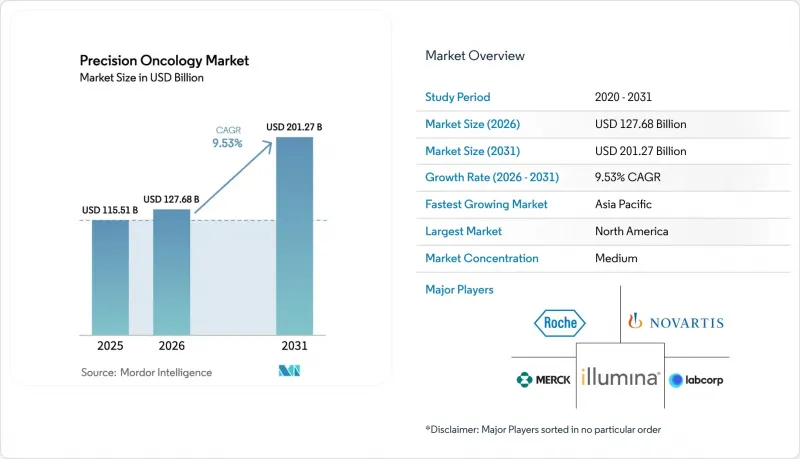
Mordor Intelligence에 의하면, 정밀 종양학 시장 규모는 2025년에 1,155억 1,000만 달러로 평가되었고, 2026년 1,276억 8,000만 달러에서 2031년까지 2,012억 7,000만 달러에 이를 것으로 예측되며, 예측 기간(2026-2031년) CAGR은 9.53%를 나타낼 전망입니다.
본 보고서에서는 산업을 유형별(치료, 진단), 바이오마커 유형별(유전체 바이오마커, 단백질체학 바이오마커, 기타), 암 유형별(유방암, 폐암, 기타), 최종 사용자별(병원·암 센터, 진단 검사 기관, 기타), 지역별(북미, 유럽, 아시아태평양, 기타)로 분류하고 있습니다. 시장 전망은 금액(달러) 기준으로 제시되어 있습니다.
세계의 정밀 종양학 시장 동향 및 인사이트
NGS와 AI를 활용한 분석 기술의 발전
AI의 활용으로 전체 유전체 분석에 소요되는 시간이 며칠에서 몇 시간으로 단축되었으며, 급성 백혈병이나 진행성 고형암의 경우 실시간으로 치료 방침을 결정할 수 있게 되었습니다. Illumina사의 DRAGEN 플랫폼은 1,200곳 이상의 임상 시설에 도입되어 있으며, 90분 이내에 높은 정확도로 유전체 분석을 완료합니다. FoundationOne CDx는 2025년 초에 적용 범위를 더 많은 종양 유형으로 확대하고, 50만 건 이상의 익명화된 기록을 활용해 학습된 머신러닝 모델을 통합함으로써 면역요법 반응에 대한 양성 예측도 78%를 달성하고 있습니다. 옥스퍼드 나노포어(Oxford Nanopore)사의 적응형 샘플링 기술을 통해 진단 민감도를 99% 이상 유지하면서, 샘플당 시약 비용을 40% 더 절감하고 있습니다. 이러한 효율화 덕분에 분자 프로파일링은 학술적인 보조 기법에서 지역 암 진료 전반에 걸친 일상적인 의사결정 지원 도구로 변모하고 있습니다.
암 발병률 상승과 유리한 보험 환급
2024년 전 세계 신규 암 환자 수는 2,040만 명에 달했고, 2020년 대비 15% 증가했습니다. 이러한 증가는 고령화의 진행과 저·중소득 국가에서의 검진 체계 개선에 기인합니다. 메디케어는 사전 승인 기준을 완화하고, 종합적인 유전체 프로파일링 1건당 최대 3,200달러를 지급하게 되면서, 2025년 1분기만 해도 검사 이용률이 60% 증가했습니다. 이에 이어 독일, 일본, 영국에서도 2025년에 유사한 보험 급여 제도 개선이 이루어졌으며, 분자 정보가 현재 표준 치료가 되었습니다는 명확한 시장 신호가 발신되었습니다. 그 결과, 전 세계 보험사들은 치료에 활용 가능한 돌연변이의 유병률이 60% 이상의 폐암, 대장암, 난소암에 대해 사전 프로파일링 검사의 보험 적용 범위를 확대되고 있습니다.
맞춤형 치료와 검사의 높은 비용
항체-약물 복합체(ADC) 등의 표적 치료는 연간 20만 달러를 초과하는 것이 일반적이며, 신흥 경제국의 의료 예산 허용 범위를 훨씬 초과하고 있습니다. 인도, 인도네시아, 브라질에서는 가구 소득이 3,000달러에 불과해 검사 비용을 감당할 수 없기 때문에 종합적인 유전체 프로파일링은 여전히 본인 부담으로 남아 있습니다. 고소득 국가에서도 보험사는 질조정생존년(QALY)당 15만 달러 이하 수준에서 비용 대비 효과를 입증하는 실세계 데이터를 요구하고 있으며, 이로 인해 신치료법의 보험 적용 여부에 대한 판단이 복잡해지고 있습니다. 차세대 억제제에 대한 특허 독점권으로 인해 바이오시밀러 시장 진입이 2030년 이후로 지연되고 있으며, 그 결과 약가가 높은 수준을 유지하고 있어 보급이 억제되고 있습니다.
지역별 분석
북미는 메디케어의 유전체 검사 보험 적용 범위 확대와 FDA의 동반 진단 심사 가속화에 힘입어 2025년에는 매출의 42.83%를 차지했습니다. 이 지역은 보험사의 광범위한 보상 및 잘 갖춰진 시퀀싱 인프라 덕분에 주도적인 위치를 유지하고 있으나, 대상 환자에 대한 보급률이 이미 70%를 초과함에 따라 연평균 성장률(CAGR)은 아시아태평양보다 낮습니다.
아시아태평양은 2025년 중국에서 12건의 동반진단제가 승인된 점과, 종합적인 프로파일 1건당 최대 2만 위안(2,800달러)을 환급하는 지방 보험 제도의 지원에 힘입어, 2026-2031년 연평균 성장률(CAGR) 13.27%를 나타낼 것으로 예측되며, 이는 전 지역 중 가장 높은 성장률입니다. BGI Genomics는 2025년에 80만 건의 종양학 검체를 처리할 예정이며, 2026년에는 처리 능력을 50% 확대할 계획입니다. 일본은 유전체 프로파일링 비용을 80만 엔(약 5,300달러)으로 인상하여 세계 기준에 부합하도록 하는 한편, 국내 검사 기관의 고성능 시퀀서 도입을 촉진하고 있습니다.
체외진단용 의료기기 규정(In Vitro Diagnostic Regulation)의 시행으로 비용은 증가하겠지만, 품질의 통일성이 확보되어 국경을 초월한 신뢰도 높은 데이터를 얻을 수 있게 됩니다. 영국의 유전체 의학 서비스(Genomic Medicine Service)에서 전장 유전체 시퀀싱 검사 건수는 1년 만에 2배로 증가했으며, 프랑스에서는 진행성 암에 대해 종합적인 프로파일링을 의무화하는 지역별 분자 종양 위원회 네트워크가 출범했습니다.
남미와 중동 및 아프리카는 공적 보험의 적용 범위가 제한적이기 때문에 지출에서 차지하는 비율은 합쳐서 10% 이하에 그치고 있습니다. 브라질에서는 2025년에 6개의 동반 진단제가 승인되었으나, 광범위한 보험 적용이 이루어지지 않아 대상 환자 중 검사를 받는 비율은 20% 이하에 그치고 있습니다. 남아프리카의 민간 보험사는 현재 종합적인 유전체 프로파일링을 보험 적용 대상으로 하고 있지만, 정부 프로그램이 뒤처져 대다수의 환자가 대상에서 제외됨에 따라 성장이 제한되고 있습니다.
기타 혜택
- 엑셀 형식 시장 예측(ME) 시트
- 3개월간의 애널리스트 지원
자주 묻는 질문
목차
제1장 서론
제2장 조사 방법
제3장 주요 요약
제4장 시장 구도
제5장 시장 규모 및 성장 예측
제6장 경쟁 구도
제7장 시장 기회 및 향후 전망
AJY 26.08.11According to Mordor Intelligence, the precision oncology market size was valued at USD 115.51 billion in 2025 and is estimated to grow from USD 127.68 billion in 2026 to reach USD 201.27 billion by 2031, at a CAGR of 9.53% during the forecast period (2026-2031).
This report Segments the Industry Into by Type (Therapeutics, Diagnostics), Biomarker Type (Genomic Biomarkers, Proteomic Biomarkers, and More), Cancer Type (Breast Cancer, Lung Cancer, and More), End-User (Hospitals & Cancer Centres, Diagnostic Laboratories, and More), and Geography (North America, Europe, Asia-Pacific, and More). The Market Forecasts are Provided in Terms of Value (USD).
Global Precision Oncology Market Trends and Insights
Advancements in NGS & AI-Driven Analytics
AI now reduces whole-genome interpretation from days to hours, allowing real-time therapeutic decisions in acute leukemia and aggressive solid tumors. Illumina's DRAGEN platform is deployed at more than 1,200 clinical sites and processes a genome in under 90 minutes with high accuracy. FoundationOne CDx expanded into additional tumor types in early 2025 and integrates machine-learning models trained on more than 500,000 de-identified records, yielding a 78% positive predictive value for immunotherapy response. Oxford Nanopore's adaptive sampling further reduces the per-sample reagent cost by 40% while maintaining diagnostic sensitivity above 99%. These efficiency gains convert molecular profiling from an academic add-on into a routine decision-support tool across community oncology.
Rising Cancer Incidence & Favorable Reimbursement
New cancer cases reached 20.4 million globally in 2024, up 15% from 2020, an increase driven by aging populations and better detection in low- and middle-income nations. Medicare lifted prior-authorization hurdles and now pays up to USD 3,200 per comprehensive genomic profile, boosting test utilization by 60% in Q1 2025 alone. Germany, Japan, and the United Kingdom followed with similar reimbursement upgrades in 2025, sending a clear market signal that molecular information is now the standard of care. As a result, insurers worldwide are increasingly covering upfront profiling for lung, colorectal, and ovarian cancers, where actionable mutations have a prevalence exceeding 60%.
High Cost of Personalized Therapeutics & Testing
Targeted drugs, such as antibody-drug conjugates, regularly exceed USD 200,000 annually, far outstripping the health budget capacity in emerging economies. Comprehensive genomic profiling remains self-funded in India, Indonesia, and Brazil, where household income cannot absorb a USD 3,000 test. Even within high-income countries, payers demand real-world evidence proving cost-effectiveness at a level below USD 150,000 per quality-adjusted life year, which muddies coverage decisions for new therapies. Patent exclusivity on next-generation inhibitors delays biosimilar entry until after 2030, keeping drug prices elevated and curbing uptake.
Other drivers and restraints analyzed in the detailed report include:
- Companion-Diagnostic Approvals Accelerating Commercialization
- Rapid Adoption of Liquid Biopsy Platforms
- Regulatory & Payer Uncertainties
For complete list of drivers and restraints, kindly check the Table Of Contents.
Geography Analysis
North America commanded 42.83% of the revenue in 2025, following the expansion of Medicare's genomic test coverage and the FDA's acceleration of companion diagnostic reviews. The region maintains leadership through widespread payer reimbursement and a dense sequencing infrastructure, yet its CAGR trails that of the Asia-Pacific region because penetration already exceeds 70% of eligible patients.
Asia-Pacific is forecast to post a 13.27% CAGR from 2026 to 2031, the fastest of any region, buoyed by China's 12 companion-diagnostic approvals in 2025 and provincial insurance that reimburses up to CNY 20,000 (USD 2,800) per comprehensive profile. BGI Genomics processed 800,000 oncology samples in 2025 and plans a 50% increase in capacity for 2026. Japan increased the payment for genomic profiling to JPY 800,000 (approximately USD 5,300), aligning with global benchmarks and encouraging domestic labs to adopt high-throughput sequencers.
Implementation of the In Vitro Diagnostic Regulation adds cost but harmonizes quality, ensuring reliable data across borders. Whole-genome sequencing within the U.K. Genomic Medicine Service doubled test volume in a year, and France launched regional molecular-tumor-board networks that mandate comprehensive profiling for advanced tumors.
South America and the Middle East & Africa together contribute less than 10% of the spend due to limited public coverage. Brazil cleared six companion diagnostics in 2025; however, without broad reimbursement, fewer than 20% of eligible patients receive the tests. South African private insurers now cover comprehensive genomic profiling, whereas government programs lag, leaving the majority excluded and limiting growth.
- Adaptive Biotechnologies
- Agendia NV
- BGI
- Burning Rock Biotech
- Caris Life Sciences
- Exact Sciences
- Foundation Medicine Inc.
- Roche
- GRAIL LLC
- Guardant Health
- Illumina
- LabCorp
- Myriad Genetics
- NanoString Technologies
- Natera
- NeoGenomics Laboratories
- Novartis
- Oxford Nanopore Technologies
- Personalis Inc.
- QIAGEN
- Sophia Genetics
- Strata Oncology Inc.
- Tempus Labs Inc.
- Thermo Fisher Scientific
Additional Benefits:
- The market estimate (ME) sheet in Excel format
- 3 months of analyst support
TABLE OF CONTENTS
1 Introduction
- 1.1 Study Assumptions & Market Definition
- 1.2 Scope of the Study
2 Research Methodology
3 Executive Summary
4 Market Landscape
- 4.1 Market Overview
- 4.2 Market Drivers
- 4.2.1 Advancements in NGS & AI-Driven Analytics
- 4.2.2 Rising Cancer Incidence & Favorable Reimbursement
- 4.2.3 Companion-Diagnostic Approvals Accelerating Commercialisation
- 4.2.4 Rapid Adoption of Liquid Biopsy Platforms
- 4.2.5 Single-Cell Multi-Omics Integration
- 4.2.6 Decentralised Clinical-Trial Models
- 4.3 Market Restraints
- 4.3.1 High Cost of Personalised Therapeutics & Testing
- 4.3.2 Regulatory & Payer Uncertainties
- 4.3.3 Data-Privacy / Interoperability Barriers
- 4.3.4 Genomic-Database Ethnic Skew
- 4.4 Regulatory Landscape
- 4.5 Technological Outlook
- 4.6 Porter's Five Forces Analysis
- 4.6.1 Threat of New Entrants
- 4.6.2 Bargaining Power of Buyers
- 4.6.3 Bargaining Power of Suppliers
- 4.6.4 Threat of Substitutes
- 4.6.5 Competitive Rivalry
5 Market Size & Growth Forecasts
- 5.1 By Type
- 5.1.1 Therapeutics
- 5.1.2 Diagnostics
- 5.2 By Technology
- 5.2.1 Next-Generation Sequencing (NGS)
- 5.2.2 Polymerase Chain Reaction (PCR)
- 5.2.3 Fluorescence In-Situ Hybridisation (FISH)
- 5.2.4 Microarray
- 5.2.5 Other Technologies
- 5.3 By Biomarker Type
- 5.3.1 Genomic Biomarkers
- 5.3.2 Proteomic Biomarkers
- 5.3.3 Epigenomic Biomarkers
- 5.3.4 Transcriptomic Biomarkers
- 5.3.5 Metabolomic Biomarkers
- 5.4 By Cancer Type
- 5.4.1 Breast Cancer
- 5.4.2 Lung Cancer
- 5.4.3 Colorectal Cancer
- 5.4.4 Prostate Cancer
- 5.4.5 Other Cancers
- 5.5 By End-User
- 5.5.1 Hospitals & Cancer Centres
- 5.5.2 Diagnostic Laboratories
- 5.5.3 Pharma & Biotech Firms
- 5.5.4 Research & Academic Institutes
- 5.6 By Geography
- 5.6.1 North America
- 5.6.1.1 United States
- 5.6.1.2 Canada
- 5.6.1.3 Mexico
- 5.6.2 Europe
- 5.6.2.1 Germany
- 5.6.2.2 United Kingdom
- 5.6.2.3 France
- 5.6.2.4 Italy
- 5.6.2.5 Spain
- 5.6.2.6 Rest of Europe
- 5.6.3 Asia-Pacific
- 5.6.3.1 China
- 5.6.3.2 Japan
- 5.6.3.3 India
- 5.6.3.4 Australia
- 5.6.3.5 South Korea
- 5.6.3.6 Rest of Asia-Pacific
- 5.6.4 Middle East & Africa
- 5.6.4.1 GCC
- 5.6.4.2 South Africa
- 5.6.4.3 Rest of Middle East & Africa
- 5.6.5 South America
- 5.6.5.1 Brazil
- 5.6.5.2 Argentina
- 5.6.5.3 Rest of South America
- 5.6.1 North America
6 Competitive Landscape
- 6.1 Market Concentration
- 6.2 Market Share Analysis
- 6.3 Company Profiles (includes Global level Overview, Market-level Overview, Core Segments, Financials, Strategic Information, Market Rank/Share, Products & Services, Recent Developments)
- 6.3.1 Adaptive Biotechnologies
- 6.3.2 Agendia NV
- 6.3.3 BGI Genomics
- 6.3.4 Burning Rock Biotech
- 6.3.5 Caris Life Sciences
- 6.3.6 Exact Sciences Corporation
- 6.3.7 Foundation Medicine Inc.
- 6.3.8 F. Hoffmann-La Roche AG
- 6.3.9 GRAIL LLC
- 6.3.10 Guardant Health Inc.
- 6.3.11 Illumina Inc.
- 6.3.12 Labcorp
- 6.3.13 Myriad Genetics Inc.
- 6.3.14 NanoString Technologies
- 6.3.15 Natera Inc.
- 6.3.16 NeoGenomics Laboratories
- 6.3.17 Novartis AG
- 6.3.18 Oxford Nanopore Technologies
- 6.3.19 Personalis Inc.
- 6.3.20 QIAGEN NV
- 6.3.21 Sophia Genetics
- 6.3.22 Strata Oncology Inc.
- 6.3.23 Tempus Labs Inc.
- 6.3.24 Thermo Fisher Scientific Inc.
7 Market Opportunities & Future Outlook
- 7.1 White-space & Unmet-need Assessment