

|
시장보고서
상품코드
2100486
쿠멘 시장 : 시장 점유율 분석, 업계 동향 및 통계, 성장 예측(2026-2031년)Cumene - Market Share Analysis, Industry Trends & Statistics, Growth Forecasts (2026 - 2031) |
||||||
 Mordor Intelligence
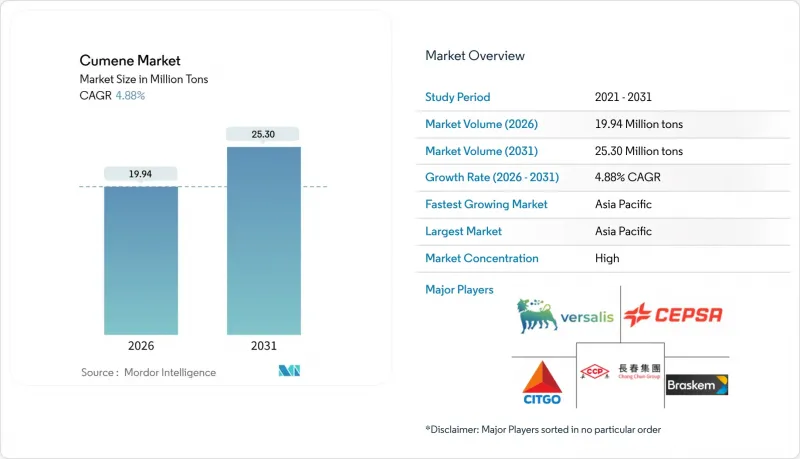
Mordor Intelligence에 의하면, 쿠멘 시장 규모는 2026년에 1,994만 톤으로 추정되고, 예측 기간(2026-2031년) CAGR 4.88%로 확대될 것으로 예측되며, 2031년에는 2,530만 톤에 이를 것으로 전망되고 있습니다.
본 보고서는 촉매 유형별(염화알루미늄, 고체 인산, 제올라이트, 기타), 용도별(페놀, 아세톤, 기타) 및 지역별(아시아태평양, 북미, 유럽, 남미, 중동 및 아프리카)로 분류되어 있습니다. 시장 전망은 수량(톤) 기준으로 제시되어 있습니다.
세계의 쿠멘 시장 동향 및 인사이트
페놀계 폴리카보네이트 및 에폭시 수지에 대한 수요 증가
전기자동차의 경우, 폴리카보네이트 재질의 유리를 사용함으로써 차체 중량을 줄이고, 주행 거리 연장이라는 목표 달성에 기여하고 있습니다. 일반 건설 수요가 정체되는 가운데, 전자기기 제조업체들은 고해상도 디스플레이용으로 광학적으로 투명한 수지를 채택하기 시작하면서 페놀 수지 수요를 끌어올리고 있습니다. 높은 피로 내성이 요구되는 해상 풍력 발전용 블레이드나 항공우주 분야의 주요 구조물로 인해 에폭시 수지의 소비량이 증가하고 있습니다. 자동차 브레이크 시스템에서는 페놀계 바인더가 금속 마찰재를 대체하는 경향이 강해지고 있어, 경량화와 소음 저감으로 이어지고 있습니다. 중국에서는 공급 리스크를 완화하기 위해 쿠멘, 페놀, 비스페놀 A의 생산 설비를 단일 거점으로 집약하는 후방 통합형 기업이 존재하지만, 이 전략은 의도치 않게 지역적인 공급 과잉을 초래했습니다.
정유시설 및 석유화학 복합 시설이 쿠멘의 경제성 향상
원유에서 화학제품으로의 전환 프로젝트에서는 혼합 원료 크래커와 방향족 유닛을 결합함으로써, 사업자는 현물 가격 변동에 영향을 받지 않는 내부 가격으로 벤젠 및 프로파일렌 공급량을 확보할 수 있습니다. 사우디아라비아의 야슬레프 정유시설 확장으로 인해 2029년까지 하류 페놀·아세톤 제조 체인을 위한 벤젠이 추가로 공급될 전망입니다. 또한, 카타르의 라스 라판 크래커는 2026년에 가동을 시작할 예정이며, 경질 원료의 크래킹 수율 균형을 맞추기 위해 프로파일렌의 탈수소화를 의도적으로 실시할 계획입니다. 이러한 복합 시설은 플랜트 간 물류를 제거하고 운전 자금의 순환 주기를 단축할 뿐만 아니라, 마진 동향이 변화할 때 쿠멘과 다른 방향족 화합물 간에 신속하게 전환할 수 있게 해줍니다.
원유, 벤젠, 프로파일렌의 가격 변동
2024년 4월부터 5월에 걸쳐 동북아시아에서는 벤젠·나프타 스프레드가 변동했습니다. 대조적으로, 서유럽에서는 같은 기간 동안 큰 폭의 하락이 나타났습니다. 이러한 하락은 LPG 크래킹이 피가스 유래 벤젠 수요를 대체한 것이 원인입니다. 브렌트 원유와 밀접하게 연관된 프로파일렌은 벤치마크가 되는 원유 가격이 상승할 때마다 마진이 급격히 축소됩니다. 북미의 에탄 크래커에서는 프로파일렌 생산량이 극히 미미합니다. 그 결과, 쿠멘 생산자들은 전용 PDH 공급에 주목하고 있지만, 높은 가격에 조달할 수밖에 없는 실정입니다. 통합형이 아닌 아시아의 플랜트는 수입 의존도가 높아 운임 및 환율 변동의 영향을 받기 쉬우며, 이러한 압박을 가장 크게 받고 있는 상황입니다.
부문 분석
2025년, 제올라이트 시스템은 쿠멘 시장 점유율의 70.68%를 차지했으며, 그 생산량은 2031년까지 연평균 6.17%의 성장률을 보일 전망입니다. 제올라이트 기술은 향후 몇 년간 쿠멘 시장에 대한 기여도를 더욱 높일 전망입니다. INEOS사의 마르 복합 시설에서는 제올라이트 기술 도입으로 인해 규격 외 제품 발생이 현저히 감소했을 뿐만 아니라, 톤당 CO₂ 배출량도 절감되었습니다. 한편, 엑슨모빌(ExxonMobil)사의 MCM-22 유닛은 특히 가성 알칼리 중화에 소요되는 추가 비용을 고려할 때, 고체 인산 시스템으로는 도저히 따라잡을 수 없는 수율을 자랑하고 있습니다.
염화알루미늄 공법은 현재 총 설비 용량의 극히 일부만을 차지할 뿐이며, 그 대부분은 개보수가 예정되어 있거나 조만간 폐쇄될 예정인 중국의 구식 시설에 집중되어 있습니다. COP28에 앞서 발표된 각국의 저탄소 목표를 바탕으로, 중동의 신규 프로젝트에서는 주로 제올라이트계 촉매가 채택되고 있습니다. 자급자족을 위한 노력의 일환으로, 중국의 완화 화학(Wanhua Chemical)은 자체 개발한 제올라이트 촉매의 개량을 성공적으로 이루어 쿠멘 생산 능력을 확대했습니다. 그러나 여전히 고체 인산(SPA) 설비를 사용하고 있는 사업자들에게는 불리한 상황입니다. 미국 환경보호청(EPA)의 40 CFR 60.112c에서는 엄격한 제어 효율이 의무화되어 있어, 이로 인해 증기 회수를 위한 막대한 설비 투자가 필요하기 때문입니다.
지역별 분석
아시아태평양은 2025년에 쿠멘 시장의 61.26%를 차지한 것으로 평가되었으며, 2031년까지 연평균 성장률(CAGR) 5.97%를 나타낼 것으로 전망됩니다. 2025년부터 2027년에 걸쳐 중국은 룽셩(Rongsheng)의 진탕(Jintang) 라인 등의 프로젝트를 포함해 페놀·아세톤 생산 능력을 시장에 대폭 투입했습니다. 그러나 벤젠공급 과잉이 확대되는 가운데, 비스페놀 A의 가동률은 억제되었습니다. 미쓰이 화학은 구조적인 공급 과잉을 이유로 2026년도까지 이치하라의 페놀 공장을 폐쇄하겠다고 발표했습니다. 대조적으로, 인도는 페놀 공급 부족에 직면해 있습니다. 할디아 페트로케미칼스는 2026년에 페놀 생산량을 확대할 예정이며, 디팍 켐테크는 2027년 가동을 목표로 하는 신규 프로젝트를 추진하고 있습니다. 한편, 동남아시아의 주요 기업인 PTTGC는 해당 지역의 포장 및 전자 산업을 대상으로 페놀 제조 시설을 운영하고 있습니다.
북미는 저비용 에탄을 활용하여 에틸렌 생산에서 높은 수율을 달성하고 있습니다. 그러나 이 공정에서는 프로파일렌의 수율이 낮아집니다. 그 결과, 미국의 쿠멘 시장은 정유시설의 FCC 및 PDH 설비에서 조달된 원료에 의존하고 있으며, 많은 경우 높은 가격에 조달되고 있습니다. 2024년, 벤젠 가격은 특히 스티렌 소비 증가에 따라 공급 부족 상황이 반영되었습니다. 2021년 이후, 미국 멕시코만 연안 지역, 특히 베이스타(Baystar)사와 GCGV사의 생산 능력 확대로 인해 통합형 프로파일렌 공급량은 증가했습니다. 그러나 이러한 진전은 특히 허리케인으로 인해 정유시설 가동이 중단될 때 등 가격 변동에 의해 그 성과가 가려지는 경우가 종종 있습니다.
유럽에서는 특히 EU-ETS 및 CBAM 체제 하에서 에너지 비용 급등과 탄소 배출에 대한 책임 증가에 직면해 있습니다. BASF는 2024년 전략적 조치로 루트비히스하펜 거점의 운영을 합리화하고, 비핵심 중간체를 축소하여 통합형 자산으로 자원을 재분배하고 있습니다. 이러한 전환은 동사의 기존 페놀 생산 라인에 가해지는 압박이 커지고 있음을 여실히 보여줍니다. 2024년, 서유럽의 벤젠-나프타 스프레드가 축소되면서 중동산 쿠멘 수입이 급증했습니다. 이 지역 많은 기업들이 어려움에 직면한 가운데, INEOS사의 첨단 말(Marl) 공장은 두각을 나타내고 있습니다. 이 회사의 혁신적인 제올라이트 플랫폼은 글라트베크에 위치한 페놀 생산 시설과의 근접성과 맞물려, 지역 내 전력 비용 급등이 미치는 영향을 완화하는 데 기여하고 있습니다.
중동은 쿠멘 산업에서 경쟁력 있는 수출 거점으로서의 입지를 공고히 하고 있습니다. 사우디 아람코는 액체에서 화학제품으로의 종합적인 전략에 막대한 투자를 단행하며 대담한 도박에 나섰습니다. 이 회사의 야심 찬 로드맵은 크래커, 방향족 화합물, 알킬화 복합 시설의 통합을 구상하고 있으며, 2030년까지 매일 대량의 원유를 전환하는 것을 목표로 하고 있습니다. 카타르 에너지의 라스 라판 이니셔티브는 쿠멘용 프로파일렌을 전담 생산할 예정입니다. 2026년에 기계적 준공이 예상되는 이 프로젝트는 주로 유럽 및 남아시아로의 수출을 목표로 하고 있습니다. 남미의 생산량은 다소 적은 임베디드니다. 브라질과 아르헨티나 양국은 국내 페놀 수지 수요를 충족하는 데 주력하고 있습니다. 한편, 사하라 이남 아프리카에서는 페놀 수요의 거의 전부를 수입에 의존하고 있습니다.
기타 혜택 :
- 엑셀 형식 시장 예측(ME) 시트
- 3개월간의 애널리스트 지원
자주 묻는 질문
목차
제1장 서론
제2장 조사 방법
제3장 주요 요약
제4장 시장 구도
제5장 시장 규모 및 성장 예측
제6장 경쟁 구도
제7장 시장 기회 및 향후 전망
AJY 26.08.07According to Mordor Intelligence, the cumene market size is estimated at 19.94 million tons in 2026, and is expected to reach 25.30 million tons by 2031, at a CAGR of 4.88% during the forecast period (2026-2031).
This report is Segmented by Catalyst Type (Aluminum Chloride, Solid Phosphoric Acid, Zeolite, and Other Types), Application (Phenol, Acetone, and Other Applications), and Geography (Asia-Pacific, North America, Europe, South America, and Middle-East and Africa). Market Forecasts are Provided in Terms of Volume (Tons).
Global Cumene Market Trends and Insights
Growing Demand for Phenol-Based Polycarbonates and Epoxy Resins
Electric vehicles are trimming their mass with the use of polycarbonate glazing, aiding in their range extension goals. As general construction demand levels off, electronics manufacturers are turning to optically clear resins for high-resolution displays, boosting phenol off-take. Offshore wind blades and primary structures in aerospace requiring high fatigue resistance are driving a rise in epoxy resin consumption. In automotive braking systems, phenolic binders are increasingly replacing metallic friction materials, leading to reductions in both weight and noise. While backward-integrated players in China have linked cumene, phenol, and bisphenol A units on single sites to mitigate supply risks, this strategy has inadvertently led to regional overcapacity.
Integrated Refinery-Petrochemical Complexes Improving Cumene Economics
Crude-to-chemicals projects pair mixed-feed crackers with aromatics units, giving operators internal benzene and propylene streams at transfer prices unaffected by spot swings. The Yasref refinery expansion in Saudi Arabia will add benzene for downstream phenol-acetone chains by 2029, and the Ras Laffan cracker in Qatar is scheduled to start up in 2026 with on-purpose propylene dehydrogenation to balance light-feed cracking yields. Such complexes eliminate inter-plant logistics, shorten working-capital cycles, and enable rapid swings between cumene and other aromatics when margin signals shift.
Crude Oil, Benzene, and Propylene Price Volatility
In April-May 2024, Northeast Asia saw benzene-naphtha spreads fluctuate. In contrast, Western Europe experienced a significant drop during the same period. This decline was driven by LPG cracking, which displaced pygas-derived benzene. Propylene, closely tied to Brent, sees its margins tighten sharply whenever benchmark crude prices rise. North American ethane crackers produce minimal propylene. As a result, cumene producers are turning to on-purpose PDH supplies, but at a premium. Asian plants that aren't integrated are feeling the brunt of the pressure, as their reliance on imports makes them vulnerable to fluctuations in freight and currency.
Other drivers and restraints analyzed in the detailed report include:
- Rapid Adoption of High-Selectivity Zeolite Catalysts
- Increasing Demand for Phenol in the Plastics Value Chain
- Stricter Emission Norms Raising Compliance Costs
For complete list of drivers and restraints, kindly check the Table Of Contents.
Segment Analysis
Zeolite systems captured 70.68% of the cumene market share in 2025, and their output is growing 6.17% yearly to 2031. Zeolite technology is poised to boost its contribution to the cumene market in the coming years. At INEOS's Marl complex, the adoption of zeolite technology has led to a notable reduction in off-spec streams and a decrease in CO2 emissions per ton. Meanwhile, ExxonMobil's MCM-22 units boast yields that solid phosphoric acid systems can't match, especially given their added caustic-neutralization costs.
Aluminum chloride methods now represent a small portion of the total installed capacity, predominantly in older Chinese facilities that are either set for retrofitting or imminent closure. In a nod to the national low-carbon targets unveiled before COP28, greenfield projects in the Middle East are predominantly opting for zeolite frameworks. Demonstrating a commitment to self-sufficiency, China's Wanhua Chemical has successfully enhanced its in-house zeolite catalyst, boosting cumene capacity. However, operators still using SPA units find themselves at a disadvantage: EPA 40 CFR 60.112c mandates a stringent control efficiency, leading to significant capital investments for vapor recovery.
Complete Report Scope:
- By Catalyst Type
- Aluminum Chloride Catalyst
- Solid Phosphoric Acid (SPA) Catalyst
- Zeolite Catalyst
- Other Catalyst Types
- By Application
- Phenol
- Acetone
- Other Applications (Paints, Enamels, Aviation Fuels, etc.)
- By Geography
- Asia-Pacific
- China
- India
- Japan
- South Korea
- Rest of Asia-Pacific
- North America
- United States
- Canada
- Mexico
- Europe
- Germany
- France
- United Kingdom
- Italy
- Russia
- Rest of Europe
- South America
- Brazil
- Argentina
- Rest of South America
- Middle-East and Africa
- Saudi Arabia
- South Africa
- Rest of Middle-East and Africa
- Asia-Pacific
Geography Analysis
Asia-Pacific retained 61.26% of the cumene market in 2025, and is expected to register a 5.97% CAGR through 2031. Between 2025 and 2027, China introduced significant phenol-acetone capacity to the market, including projects like Rongsheng's Jintang line. However, with benzene overcapacity increasing, bisphenol A run rates were curtailed. Mitsui Chemical announced the closure of its Ichihara phenol plant by FY 2026, attributing the decision to a structural oversupply. In contrast, India grapples with a phenol deficit. Haldia Petrochemicals ramped up its phenol output in 2026, and Deepak Chem Tech is pushing forward with new projects set to debut in 2027. Meanwhile, PTTGC, a key player in Southeast Asia, operates a phenol facility, catering to the region's packaging and electronics sectors.
North America capitalizes on its low-cost ethane, achieving high yields in ethylene production. However, this process yields weaker propylene streams. As a result, the US cumene market relies on feedstock sourced from refinery FCCs or PDH units, often at a premium price. In 2024, benzene prices reflected a tight supply scenario, especially with styrene's increasing consumption. Since 2021, capacity expansions on the US Gulf Coast, notably by Baystar and GCGV, have enhanced the availability of integrated propylene. Yet, this progress is often overshadowed by volatility, especially when hurricanes disrupt refinery operations.
Europe grapples with soaring energy costs and escalating carbon responsibilities, particularly under the EU-ETS and CBAM frameworks. In a strategic move for 2024, BASF is streamlining operations at its Ludwigshafen site, cutting back on non-core intermediates to reallocate resources towards integrated assets. This shift underscores the mounting pressures on its traditional phenol lines. In 2024, Western European benzene-naphtha spreads tightened, prompting a surge in cumene imports from the Middle East. While many in the region face challenges, INEOS's advanced Marl plant stands out. Its innovative zeolite platform, combined with its proximity to the Gladbeck phenol units, helps mitigate the impact of elevated regional power costs.
The Middle East is solidifying its position as a competitive export hub in the cumene industry. Saudi Aramco is making a significant bet, investing heavily in a comprehensive liquids-to-chemicals strategy. Their ambitious roadmap envisions the integration of crackers, aromatics, and alkylation complexes, with a target of converting large volumes of crude daily by 2030. QatarEnergy's Ras Laffan initiative is set to produce on-purpose propylene for cumene. With mechanical completion anticipated in 2026, the project eyes exports primarily to Europe and South Asia. In South America, production levels are modest. Both Brazil and Argentina are channeling efforts towards meeting their domestic phenolic resin needs. Meanwhile, Sub-Saharan Africa finds itself reliant on imports for nearly all its phenol demands.
- BASF SE
- Braskem
- Cepsa
- Chang Chun Group
- CITGO Petroleum Corporation
- Dow
- ExxonMobil Corporation
- Formosa Chemical & Fibre Corp.
- INEOS
- Koch Industries Inc.
- Kumho P&B Chemicals Inc.
- Prasol Chemicals Pvt. Ltd.
- PTT Phenol
- SABIC
- Shell PLC
- Sumitomo Chemical Co., Ltd.
- Sunoco LP
- Versalis S.p.A.
Additional Benefits:
- The market estimate (ME) sheet in Excel format
- 3 months of analyst support
TABLE OF CONTENTS
1 Introduction
- 1.1 Study Assumptions and Market Definition
- 1.2 Scope of the Study
2 Research Methodology
3 Executive Summary
4 Market Landscape
- 4.1 Market Overview
- 4.2 Market Drivers
- 4.2.1 Growing demand for phenol-based polycarbonates and epoxy resins
- 4.2.2 Expanding use of acetone in solvents and MMA
- 4.2.3 Integrated refinery-petchem complexes improving cumene economics
- 4.2.4 Rapid adoption of high-selectivity zeolite catalysts
- 4.2.5 Increasing Demand for Phenol from the Plastic Industry
- 4.3 Market Restraints
- 4.3.1 Health and environmental hazards of cumene exposure
- 4.3.2 Crude oil/benzene-propylene price volatility
- 4.3.3 Stricter emission norms raising compliance costs
- 4.4 Value Chain Analysis
- 4.5 Porter's Five Forces
- 4.5.1 Bargaining Power of Suppliers
- 4.5.2 Bargaining Power of Buyers
- 4.5.3 Threat of New Entrants
- 4.5.4 Threat of Substitutes
- 4.5.5 Degree of Competition
- 4.6 Pricing Analysis
- 4.7 Feedstock Analysis
- 4.8 Trade Analysis
5 Market Size and Growth Forecasts (Volume)
- 5.1 By Catalyst Type
- 5.1.1 Aluminum Chloride Catalyst
- 5.1.2 Solid Phosphoric Acid (SPA) Catalyst
- 5.1.3 Zeolite Catalyst
- 5.1.4 Other Catalyst Types
- 5.2 By Application
- 5.2.1 Phenol
- 5.2.2 Acetone
- 5.2.3 Other Applications (Paints, Enamels, Aviation Fuels, etc.)
- 5.3 By Geography
- 5.3.1 Asia-Pacific
- 5.3.1.1 China
- 5.3.1.2 India
- 5.3.1.3 Japan
- 5.3.1.4 South Korea
- 5.3.1.5 Rest of Asia-Pacific
- 5.3.2 North America
- 5.3.2.1 United States
- 5.3.2.2 Canada
- 5.3.2.3 Mexico
- 5.3.3 Europe
- 5.3.3.1 Germany
- 5.3.3.2 France
- 5.3.3.3 United Kingdom
- 5.3.3.4 Italy
- 5.3.3.5 Russia
- 5.3.3.6 Rest of Europe
- 5.3.4 South America
- 5.3.4.1 Brazil
- 5.3.4.2 Argentina
- 5.3.4.3 Rest of South America
- 5.3.5 Middle-East and Africa
- 5.3.5.1 Saudi Arabia
- 5.3.5.2 South Africa
- 5.3.5.3 Rest of Middle-East and Africa
- 5.3.1 Asia-Pacific
6 Competitive Landscape
- 6.1 Market Concentration
- 6.2 Strategic Moves
- 6.3 Market Share(%)/Ranking Analysis
- 6.4 Company Profiles (includes Global level Overview, Market level overview, Core Segments, Financials as available, Strategic Information, Products and Services, and Recent Developments)
- 6.4.1 BASF SE
- 6.4.2 Braskem
- 6.4.3 Cepsa
- 6.4.4 Chang Chun Group
- 6.4.5 CITGO Petroleum Corporation
- 6.4.6 Dow
- 6.4.7 ExxonMobil Corporation
- 6.4.8 Formosa Chemical & Fibre Corp.
- 6.4.9 INEOS
- 6.4.10 Koch Industries Inc.
- 6.4.11 Kumho P&B Chemicals Inc.
- 6.4.12 Prasol Chemicals Pvt. Ltd.
- 6.4.13 PTT Phenol
- 6.4.14 SABIC
- 6.4.15 Shell PLC
- 6.4.16 Sumitomo Chemical Co., Ltd.
- 6.4.17 Sunoco LP
- 6.4.18 Versalis S.p.A.
7 Market Opportunities and Future Outlook
- 7.1 White-space and Unmet-Need Assessment


