

|
시장보고서
상품코드
2100492
BDaaS(Big Data-as-a-Service) 시장 : 시장 점유율 분석, 업계 동향 및 통계, 성장 예측(2026-2031년)Big Data As A Service - Market Share Analysis, Industry Trends & Statistics, Growth Forecasts (2026 - 2031) |
||||||
 Mordor Intelligence
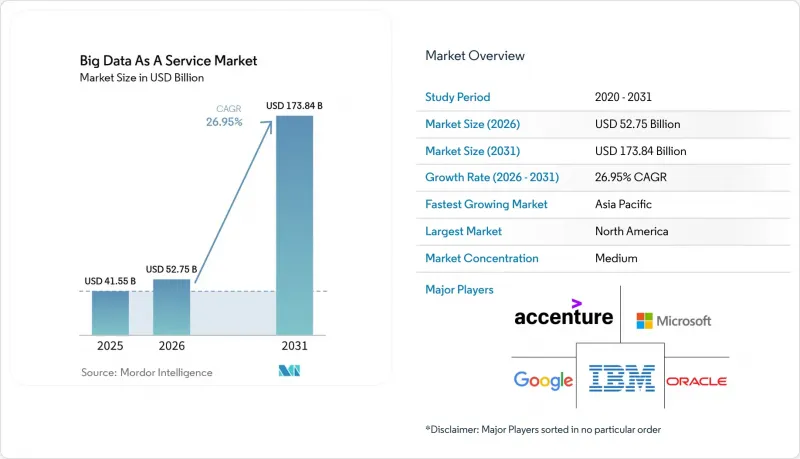
Mordor Intelligence에 의하면, BDaaS(Big Data-as-a-Service) 시장 규모는 2025년 415억 5,000만 달러로 평가되었고, 2026년에는 527억 5,000만 달러로 확대될 것으로 추정되고, 2026-2031년 CAGR 26.95%로 성장을 지속할 전망이며, 2031년에는 1,738억 4,000만 달러에 이를 것으로 예측됩니다.
본 보고서는 서비스 모델별(Hadoop-as-a-Service, Analytics-as-a-Service, Data Platform-as-a-Service), 도입 형태별(퍼블릭 클라우드, 프라이빗 클라우드, 하이브리드 클라우드), 최종 사용자 산업별(은행, 금융서비스 및 보험(BFSI), IT 및 통신, 헬스케어 및 생명과학, 소매 및 전자상거래, 제조, 에너지·발전, 기타), 지역별로 분류되어 있습니다. 시장 예측은 금액(달러) 기준으로 제시되어 있습니다.
세계의 BDaaS(Big Data-as-a-Service) 시장 동향 및 인사이트
클라우드 도입과 데이터량의 폭발적 증가
2025년, 기업들은 120제타바이트의 데이터를 생성할 것으로 예상되며, 이 데이터량은 온프레미스 클러스터의 처리 능력을 압도하여 탄력적인 클라우드 데이터 웨어하우스의 도입을 촉진했습니다. 각 하이퍼스케일러 기업은 총 3.8기가와트의 신규 용량을 구축했으며, AWS는 분석 및 워크로드의 지연 시간을 단축하기 위해 말레이시아와 뉴질랜드로 사업을 확장했습니다. 구글은 2030년까지 인프라에 1,800억 달러를 투자하기로 결정했으며, Apache Spark 파이프라인을 가속화하는 GPU를 풍부하게 갖춘 클러스터를 우선적으로 구축하고 있습니다. 현재는 하이브리드 아키텍처가 주류를 이루고 있으며, 기업의 73%가 퍼블릭 클라우드의 확장성과 프라이빗 환경의 관리성을 융합한 혼합 환경을 운영하고 있습니다. JP모건 등 대형 금융기관은 클라우드 네이티브 노트북과 분산형 SQL 엔진을 활용하여 수십 년에 걸친 틱 데이터를 이용해 거래 모델의 백테스트를 수행하고 있습니다. 제조 공장의 IoT 엔드포인트 증가로 인해 데이터는 더욱 클라우드 패브릭으로 이동하고 있습니다. 이는 기존 Hadoop 클러스터로는 수 테라바이트 규모의 데이터 스트림을 실시간으로 처리할 수 없기 때문입니다.
생성형 AI 대응 분석 수요
2025년, 대규모 언어 모델은 비즈니스 사용자가 자연어로 데이터 웨어하우스에 쿼리를 실행할 수 있게 함으로써 분석 워크플로우를 혁신했습니다. Snowflake는 2026년 2월, Cortex 서비스에 GPT-4를 통합하여 분석가가 SQL을 작성하지 않고도 대화 형식으로 질문을 하고 피벗 테이블을 얻을 수 있도록 했습니다. AWS는 2025년 6월, Amazon Bedrock을 Redshift와 통합하여 마케팅 팀이 코드가 아닌 구두로 세분화 로직을 작성할 수 있도록 했습니다. Google은 2025년 4월, BigQuery에 Gemini를 활용한 탐색 기능을 추가하여 스키마의 컨텍스트에 기반해 조인을 자동으로 제안하게 되었습니다. 도입이 급증하여 2024년 34%에서 2026년 초에는 기업의 58%가 퍼블릭 클라우드에서 생성형 AI 워크로드를 실행하게 되었습니다. 메이요 클리닉(Mayo Clinic)과 같은 의료 산업의 선도 기업들은 분산된 병원 데이터 세트 전체에서 진단 모델을 학습시키기 위해 페더레이티드 러닝(federated learning)을 활용하고 있으며, 이는 내장형 AI 기능이 빠르게 필수 요건이 되어가고 있는 이유를 여실히 보여줍니다.
데이터 개인정보 보호 및 사이버 보안 위험
체인지 헬스케어(Change Healthcare)가 2024년에 당한 랜섬웨어 공격으로 1억 건 이상의 환자 기록이 유출되었습니다. 이로 인해 모회사인 유나이티드헬스(UnitedHealth)는 8억 7,200만 달러의 손실을 입었으며, 미국 의료 산업 전반에서 클라우드 전환이 주춤하게 되었습니다. 스노우플레이크는 크레덴셜 스태핑으로 인해 165건의 고객 계정이 침해된 것을 계기로 다단계 인증을 의무화했습니다. 2024년 3월에 발생한 AT&T의 7,300만 건 기록 유출 사건은 제3자 처리 업체에 대한 모니터링 강화를 초래했습니다. GDPR(EU 개인정보보호규정)에 따른 과징금은 2025년까지 43억 유로(46억 달러)에 달했으며, 클라우드 제공업체는 정보 유출에 대해 연대 책임을 지게 되었습니다. AWS Nitro Enclaves와 같은 기밀 컴퓨팅 기능은 여전히 제한적이기 때문에 기업들은 독자적인 격리 계층을 구축할 수밖에 없어 도입이 6-12개월 지연되는 상황이 발생하고 있습니다.
부문 분석
2025년, Hadoop-as-a-Service는 BDaaS(Big Data-as-a-Service) 시장의 46.63%를 차지했습니다. 이는 온프레미스 클러스터에서 마이그레이션된 레거시 MapReduce 워크로드가 주도한 결과입니다. 각 벤더가 HDFS 배포판에 대한 지원을 종료하고, 구조화 데이터와 비구조화 데이터를 통합하는 레이크하우스를 추진하고 있어 이 부문의 중요성은 점차 낮아지고 있습니다. Analytics-as-a-Service는 자연어 프롬프트를 최적화된 SQL로 변환하는 임베디드 대규모 언어 모델에 힘입어 2031년까지 연평균 성장률(CAGR) 28.85%를 나타낼 것으로 예측됩니다. Databricks Genie와 IBM의 watsonx BI Assistant는 음성 질문을 Python 노트북으로 변환하여 인사이트 도출까지 걸리는 시간을 단축하고, 분석가가 DataFrame API를 익힐 필요성을 없애줍니다.
2026년에 도입된 서버리스 워크스페이스는 10초 이내에 컴퓨팅 리소스를 프로비저닝하고 0까지 자동 스케일링을 수행함으로써, 버스트 성향이 강한 소매 분석 워크로드의 실행 비용을 35% 절감합니다. 현재 각 벤더들은 쿼리 엔진에 규정 준수 제어 기능을 통합하고 있으며, 예를 들어 GoodData의 AI Assistant는 GDPR(EU 개인정보보호규정)과 HIPAA를 동시에 충족하는 열 수준 조치를 적용합니다. Data Platform-as-a-Service는 그 중간에 위치하며, SQL과 Spark에 동시에 액세스할 수 있게 해주는 Iceberg 형태의 레이크하우스를 포함하고 있습니다. Snowflake의 Cortex 기능을 통해 데이터 웨어하우스 사용자는 SQL 내에서 직접 GPT-4를 호출하여 감정 분석을 수행할 수 있으며, 이로 인해 스토리지와 추론의 경계가 더욱 모호해지고 있습니다.
지역별 분석
북미는 하이퍼스케일러의 본사 거점 및 기업들의 조기 도입에 힘입어 2025년에는 전 세계 매출의 38.83%를 차지했습니다. 성장은 견조하지만, 기업들이 1차 전환에서 FinOps 최적화로 초점을 옮기면서 그 기세는 둔화되고 있습니다. 골드만삭스 등 미국의 은행들은 밀리초 단위의 지연 시간에 최적화된 멀티클라우드 스택 위에서 페타바이트 규모의 거래 데이터를 처리하고 있습니다. 캐나다의 개인정보 보호 지침에서는 국경을 넘는 데이터 전송에 명시적인 동의를 요구하고 있어, 은행들은 지역별로 격리된 토폴로지로의 전환을 강요받고 있습니다. 멕시코의 니어쇼어링 붐에 힘입어 제조업체들은 신규 공장에 엣지부터 클라우드까지 이어지는 패브릭을 도입하여, 생산 지표를 미국 본사와 실시간으로 동기화하고 있습니다.
아시아태평양은 가장 빠른 성장 궤도를 그리고 있으며, BDaaS(Big Data-as-a-Service) 시장은 2031년까지 연평균 성장률(CAGR) 28.02%로 확대될 것으로 예측됩니다. 중국의 생태계는 알리바바 클라우드, 텐센트 클라우드, 화웨이 클라우드가 주도하고 있으며, 이들 기업의 가격은 유럽 및 미국의 제공업체보다 20-30% 저렴합니다. 인도의 하이퍼스케일링 추세는 통신 및 전자상거래에 의해 주도되고 있습니다. 예를 들어, 릴라이언스 지오(Reliance Jio)의 5G 네트워크는 테라바이트 규모의 가입자 데이터를 생성하고 있으며, AWS와 구글 클라우드는 뭄바이와 하이데라바드의 확장 지역에서 해당 데이터를 처리하고 있습니다. 아세안 기업들은 2025년에 AI 예산을 15% 증액하고, 데이터 거주 요건을 준수하기 위해 자국 내 데이터센터에 자금을 투입했습니다. 일본 경제산업성은 2025년에 AI 인프라 현대화를 위해 130억 달러(1조 9,000억 엔)를 투입하기로 결정했습니다. 한편, 한국은 2027년까지 민관 합동으로 70억 달러(9조 4,000억 원) 규모의 AI 투자를 목표로 하고 있습니다.
유럽에서는 엄격한 규제 부담 속에서 완만한 성장이 나타나고 있습니다. GDPR(EU 개인정보보호규정), NIS2, DORA는 중복되는 의무를 부과하고 있으며, 이로 인해 규정 준수 비용이 15-20% 증가하고 있습니다. 독일의 자동차 산업 클러스터에서는 커넥티드카에서 생성된 엣지 분석 데이터를 프랑크푸르트와 베를린의 AWS 및 Azure 리전으로 전송하고 있습니다. 영국의 금융행위감독청(FCA)은 2025년에 클라우드 책임에 관한 규정을 명확히 하고, 공급업체의 실사 기한을 연장했습니다. 프랑스의 병원에서는 데이터 거주지에 관한 법률을 준수하면서 분산형 노드 전체에서 AI 진단 훈련을 수행하기 위해 연합 학습(federated learning)을 채택하고 있습니다. 남미에서는 브라질이 주도적인 역할을 하고 있으며, Mercado Libre는 AWS 상파울루에서 수백만 건의 거래를 처리하고 있습니다. 사우디아라비아의 NEOM 등 중동의 스마트 시티 이니셔티브에서는 26,500 km²에 달하는 IoT 데이터를 수집하여 Oracle Cloud에서 분석함으로써 에너지와 교통의 최적화를 도모하고 있습니다. 아프리카는 아직 발전 단계에 있지만, Microsoft의 요하네스버그 리전을 통해 남아프리카공화국의 은행들은 데이터 상주 요건을 충족하기 위한 로컬 존을 이용할 수 있게 되었습니다.
기타 혜택
- 엑셀 형식 시장 예측(ME) 시트
- 3개월간의 애널리스트 지원
자주 묻는 질문
목차
제1장 서론
제2장 조사 방법
제3장 주요 요약
제4장 시장 구도
제5장 시장 규모 및 성장 예측
제6장 경쟁 구도
제7장 시장 기회 및 향후 전망
AJY 26.08.11According to Mordor Intelligence, the big data as a service market size is expected to grow from USD 41.55 billion in 2025 to USD 52.75 billion in 2026 and is forecast to reach USD 173.84 billion by 2031 at a 26.95% CAGR over 2026-2031.
This report is Segmented by Service Model (Hadoop-As-A-Service, Analytics-As-A-Service, and Data Platform-As-A-Service), Deployment (Public Cloud, Private Cloud, and Hybrid Cloud), End User Industry (BFSI, IT and Telecom, Healthcare and Life Sciences, Retail and E-Commerce, Manufacturing, Energy and Power, and More), and Geography. The Market Forecasts are Provided in Terms of Value (USD).
Global Big Data As A Service Market Trends and Insights
Cloud Adoption and Exploding Data Volumes
Enterprises generated 120 zettabytes of data in 2025, volumes that overwhelmed on-premises clusters and favored elastic cloud warehouses. Hyperscalers collectively deployed 3.8 gigawatts of new capacity, with AWS expanding into Malaysia and New Zealand to shorten latency for analytics workloads. Google earmarked USD 180 billion for infrastructure through 2030, prioritizing GPU-rich clusters that accelerate Apache Spark pipelines. Hybrid architectures now dominate, with 73% of firms running mixed environments that blend public elasticity with private control. Large financial institutions such as JPMorgan rely on cloud-native notebooks and distributed SQL engines to back-test trading models against decades of tick data. Rising numbers of IoT endpoints in manufacturing plants further push data to cloud fabrics, since legacy Hadoop clusters cannot ingest multi-terabyte streams in real time.
Generative-AI-Ready Analytics Demand
Large language models reshaped analytics workflows in 2025 by enabling business users to query warehouses in natural language. Snowflake embedded GPT-4 into its Cortex service in February 2026, allowing analysts to ask conversational questions and receive pivot tables without writing SQL. AWS integrated Amazon Bedrock with Redshift in June 2025, so marketing teams could describe segmentation logic verbally rather than code. Google added Gemini-powered exploration to BigQuery in April 2025, automatically suggesting joins based on schema context. Adoption surged, such as 58% of enterprises running generative AI workloads in the public cloud by early 2026, up from 34% in 2024. Healthcare leaders such as Mayo Clinic use federated learning to train diagnostics across distributed hospital data sets, illustrating why embedded AI capabilities are fast becoming table stakes.
Data Privacy and Cybersecurity Risks
Change Healthcare's 2024 ransomware attack exposed over 100 million patient records, costing parent UnitedHealth USD 872 million and stalling cloud migrations in the entire U.S. healthcare segment. Snowflake mandated multi-factor authentication after 165 customer accounts were compromised via credential stuffing. AT&T's March 2024 breach of 73 million records triggered heightened scrutiny of third-party processors. GDPR fines climbed to EUR 4.3 billion (USD 4.6 billion) by 2025, holding cloud providers jointly liable for breaches. Confidential-computing features such as AWS Nitro Enclaves remain limited, forcing enterprises to build their own isolation layers, delaying rollouts by 6-12 months.
Other drivers and restraints analyzed in the detailed report include:
- Cost-Effective Alternatives to On-Premises Big-Data Stacks
- Edge-to-Cloud Data Fabrics for IoT-Rich Verticals
- Legacy Integration Complexity
For complete list of drivers and restraints, kindly check the Table Of Contents.
Segment Analysis
Hadoop-as-a-Service accounted for 46.63% of the Big Data As A Service market in 2025, driven by legacy MapReduce workloads migrated from on-premises clusters. The segment's relevance is slipping as vendors sunset HDFS distributions and promote lakehouses that unify structured and unstructured data. Analytics-as-a-Service is projected to grow at a 28.85% CAGR through 2031, buoyed by embedded large-language models that translate natural-language prompts into optimized SQL. Databricks Genie and IBM's watsonx BI Assistant reduce time-to-insight by converting spoken questions into Python notebooks, eliminating the need for analysts to master DataFrame APIs.
Serverless workspaces launched in 2026 provision compute in under 10 seconds and auto-scale to zero, cutting runtime costs by 35% for bursty retail analytics workloads. Vendors now bake compliance controls into query engines such as GoodData's AI Assistant applies column-level policies that satisfy GDPR and HIPAA simultaneously. Data Platform-as-a-Service sits in the middle, offering Iceberg-formatted lakehouses that enable concurrent SQL and Spark access. Snowflake's Cortex functions let warehouse users invoke GPT-4 for sentiment analysis directly in SQL, further blurring lines between storage and inference.
Complete Report Scope:
- By Service Model
- Hadoop-as-a-Service (HaaS)
- Analytics-as-a-Service (AaaS)
- Data Platform-as-a-Service (DPaaS)
- By Deployment
- Public Cloud
- Private Cloud
- Hybrid Cloud
- By End User Industry
- BFSI
- IT and Telecom
- Healthcare and Life Sciences
- Retail and E-commerce
- Manufacturing
- Energy and Power
- Government and Public Sector
- By Geography
- North America
- United States
- Canada
- Mexico
- South America
- Brazil
- Argentina
- Rest of South America
- Europe
- Germany
- United Kingdom
- France
- Russia
- Rest of Europe
- Asia-Pacific
- China
- India
- Japan
- South Korea
- ASEAN
- Rest of Asia-Pacific
- Middle East
- GCC
- Turkey
- Rest of Middle East
- Africa
- South Africa
- Nigeria
- Rest of Africa
- North America
Geography Analysis
North America captured 38.83% of global revenue in 2025, driven by hyperscaler headquarters and early enterprise adoption. Growth is steady but cooling as companies pivot from first-wave migrations to FinOps optimization. U.S. banks such as Goldman Sachs process petabyte-scale trading data on multi-cloud stacks tuned for millisecond latency. Canada's privacy guidelines require explicit consent for cross-border transfers, pushing banks toward regionally walled topologies. Mexico's nearshoring boom prompts manufacturers to outfit new plants with edge-to-cloud fabrics that synchronize production metrics to U.S. headquarters in real time.
Asia-Pacific posts the fastest growth trajectory, with the Big Data as a Service market expected to grow at a 28.02% CAGR through 2031. China's ecosystem is dominated by Alibaba Cloud, Tencent Cloud, and Huawei Cloud, each of which prices 20-30% below Western providers. India's hyperscale momentum is driven by telecommunications and e-commerce such as Reliance Jio's 5G network generates terabytes of subscriber data that AWS and Google Cloud crunch in expanded regions in Mumbai and Hyderabad. ASEAN firms increased AI budgets by 15% in 2025, funding sovereign data centers that ensure residency compliance. Japan's Ministry of Economy, Trade and Industry committed USD 13 billion (JPY 1.9 trillion) in 2025 to modernize AI infrastructure, while South Korea aims for USD 7 billion (KRW 9.4 trillion) public-private AI investment by 2027.
Europe exhibits moderate growth under heavy regulatory burden. GDPR, NIS2 and DORA impose overlapping mandates that inflate compliance costs 15-20%. Automotive clusters in Germany feed edge analytics from connected vehicles into AWS and Azure regions in Frankfurt and Berlin. The United Kingdom's Financial Conduct Authority clarified cloud liability rules in 2025, extending vendor-due-diligence timelines. France's hospitals adopt federated learning to comply with data-residency laws while training AI diagnostics across decentralized nodes. South America is led by Brazil, where Mercado Libre processes millions of transactions in AWS Sao Paulo. Middle East smart-city initiatives such as Saudi Arabia's NEOM ingest IoT data across 26,500 km2, analyzed on Oracle Cloud for energy and transport optimization. Africa remains nascent, Microsoft's Johannesburg region gives South African banks a local zone to satisfy residency statutes.
- Amazon Web Services, Inc.
- Microsoft Corporation
- Google LLC
- International Business Machines Corporation
- Oracle Corporation
- SAP SE
- Hewlett Packard Enterprise Company
- SAS Institute Inc.
- Accenture plc
- Teradata Corporation
- Cloudera, Inc.
- Snowflake Inc.
- Databricks, Inc.
- Dell Technologies Inc.
- Splunk Inc.
- Palantir Technologies Inc.
- Informatica Inc.
- Huawei Technologies Co., Ltd.
- Alibaba Cloud Computing Co., Ltd.
- Tencent Cloud Computing (Beijing) Co., Ltd.
- Wipro Limited
Additional Benefits:
- The market estimate (ME) sheet in Excel format
- 3 months of analyst support
TABLE OF CONTENTS
1 INTRODUCTION
- 1.1 Study Assumptions and Market Definition
- 1.2 Scope of the Study
2 RESEARCH METHODOLOGY
3 EXECUTIVE SUMMARY
4 MARKET LANDSCAPE
- 4.1 Market Overview
- 4.2 Market Drivers
- 4.2.1 Cloud Adoption and Exploding Data Volumes
- 4.2.2 Cost-Effective Alternatives to On-Prem Big-Data Stacks
- 4.2.3 Generative-AI-Ready Analytics Demand
- 4.2.4 Edge-to-Cloud Data Fabrics for IoT-Rich Verticals
- 4.2.5 Data-Localization Rules Fueling Regional BDaaS Nodes
- 4.2.6 FinOps-Linked Consumption Pricing Models
- 4.3 Market Restraints
- 4.3.1 Data Privacy and Cybersecurity Risks
- 4.3.2 Legacy Integration Complexity
- 4.3.3 Carbon-Footprint Scrutiny on Hyperscale Data Centers
- 4.3.4 Talent Gap in FinOps and Data Engineering
- 4.4 Industry Value Chain Analysis
- 4.5 Regulatory Landscape
- 4.6 Technological Outlook
- 4.7 Impact of Macroeconomic Factors on the Market
- 4.8 Porter's Five Forces Analysis
- 4.8.1 Threat of New Entrants
- 4.8.2 Bargaining Power of Buyers
- 4.8.3 Bargaining Power of Suppliers
- 4.8.4 Threat of Substitutes
- 4.8.5 Intensity of Competitive Rivalry
5 MARKET SIZE AND GROWTH FORECASTS (VALUE)
- 5.1 By Service Model
- 5.1.1 Hadoop-as-a-Service (HaaS)
- 5.1.2 Analytics-as-a-Service (AaaS)
- 5.1.3 Data Platform-as-a-Service (DPaaS)
- 5.2 By Deployment
- 5.2.1 Public Cloud
- 5.2.2 Private Cloud
- 5.2.3 Hybrid Cloud
- 5.3 By End User Industry
- 5.3.1 BFSI
- 5.3.2 IT and Telecom
- 5.3.3 Healthcare and Life Sciences
- 5.3.4 Retail and E-commerce
- 5.3.5 Manufacturing
- 5.3.6 Energy and Power
- 5.3.7 Government and Public Sector
- 5.4 By Geography
- 5.4.1 North America
- 5.4.1.1 United States
- 5.4.1.2 Canada
- 5.4.1.3 Mexico
- 5.4.2 South America
- 5.4.2.1 Brazil
- 5.4.2.2 Argentina
- 5.4.2.3 Rest of South America
- 5.4.3 Europe
- 5.4.3.1 Germany
- 5.4.3.2 United Kingdom
- 5.4.3.3 France
- 5.4.3.4 Russia
- 5.4.3.5 Rest of Europe
- 5.4.4 Asia-Pacific
- 5.4.4.1 China
- 5.4.4.2 India
- 5.4.4.3 Japan
- 5.4.4.4 South Korea
- 5.4.4.5 ASEAN
- 5.4.4.6 Rest of Asia-Pacific
- 5.4.5 Middle East
- 5.4.5.1 GCC
- 5.4.5.2 Turkey
- 5.4.5.3 Rest of Middle East
- 5.4.6 Africa
- 5.4.6.1 South Africa
- 5.4.6.2 Nigeria
- 5.4.6.3 Rest of Africa
- 5.4.1 North America
6 COMPETITIVE LANDSCAPE
- 6.1 Market Concentration
- 6.2 Strategic Moves
- 6.3 Market Share Analysis
- 6.4 Company Profiles (includes Global Level Overview, Market Level Overview, Core Segments, Financials as available, Strategic Information, Market Rank/Share, Products and Services, Recent Developments)
- 6.4.1 Amazon Web Services, Inc.
- 6.4.2 Microsoft Corporation
- 6.4.3 Google LLC
- 6.4.4 International Business Machines Corporation
- 6.4.5 Oracle Corporation
- 6.4.6 SAP SE
- 6.4.7 Hewlett Packard Enterprise Company
- 6.4.8 SAS Institute Inc.
- 6.4.9 Accenture plc
- 6.4.10 Teradata Corporation
- 6.4.11 Cloudera, Inc.
- 6.4.12 Snowflake Inc.
- 6.4.13 Databricks, Inc.
- 6.4.14 Dell Technologies Inc.
- 6.4.15 Splunk Inc.
- 6.4.16 Palantir Technologies Inc.
- 6.4.17 Informatica Inc.
- 6.4.18 Huawei Technologies Co., Ltd.
- 6.4.19 Alibaba Cloud Computing Co., Ltd.
- 6.4.20 Tencent Cloud Computing (Beijing) Co., Ltd.
- 6.4.21 Wipro Limited
7 MARKET OPPORTUNITIES AND FUTURE OUTLOOK
- 7.1 White-Space and Unmet-Need Assessment


