

|
시장보고서
상품코드
2100499
의료기기 기술 시장 : 시장 점유율 분석, 업계 동향 및 통계, 성장 예측(2026-2031년)Medical Device Technologies - Market Share Analysis, Industry Trends & Statistics, Growth Forecasts (2026 - 2031) |
||||||
 Mordor Intelligence
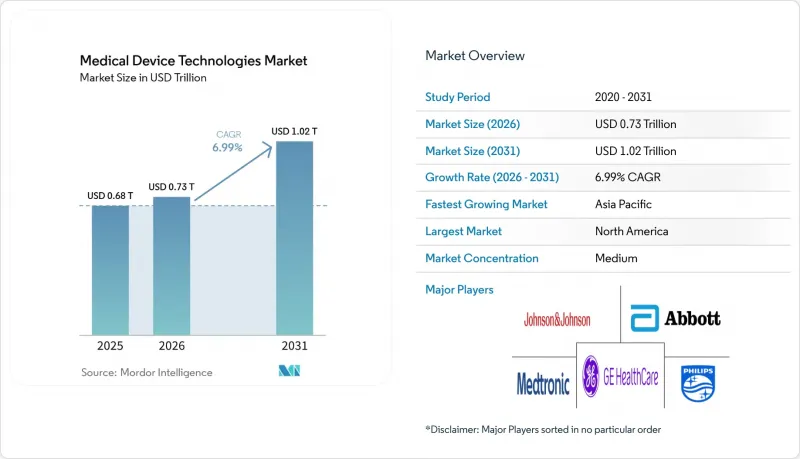
Mordor Intelligence에 의하면, 의료기기 기술 시장 규모는 2025년 6,800억 달러로 평가되었고, 2026년 7,300억 달러에서 2031년까지 1조 200억 달러로 확대될 것으로 예측되며, 2026-2031년 연평균 복합 성장률(CAGR)은 6.99%를 나타낼 전망입니다.
본 보고서는 기기 유형별(진단용(영상 진단 장치(MRI 시스템) 등), 치료용, 외과용 등), 기술 플랫폼별(기존, 웨어러블 등), 치료 용도별(순환기 등), 최종 사용자별(병원, 진료소 등) 및 지역별(북미, 유럽 등)로 분류되어 있습니다. 시장 전망은 금액(달러) 기준으로 제시되어 있습니다.
세계의 의료기기 기술 시장 동향 및 인사이트
고령화와 만성 질환 증가
2030년까지 전 세계 60세 이상 고령자 인구는 14억 명에 달할 것으로 예상되며, 이는 2020년 대비 40% 증가한 수치입니다. 이미 전체 사망자의 74%가 만성 질환으로 인한 것이며, 이로 인해 심전도 모니터, 지속 혈당 측정 장치 및 수액 기술에 대한 수요가 지속될 것으로 확실시되고 있습니다. 평균 수명의 연장은 더 이상 질병 기간이 짧아진다는 것을 의미하지 않습니다. 오히려 환자들은 여러 가지 동반 질환을 앓으면서 더 오래 살게 되어, 1인당 의료기기 사용 건수가 두 배로 늘어나고 있습니다. 예를 들어, 심부전, 당뇨병, 퇴행성 관절염을 앓고 있는 전형적인 75세 환자는 심전도 모니터, CGM, 정형외과용 보조기를 동시에 사용할 가능성이 있어, 1인당 하드웨어 요구 사항은 3배로 늘어납니다. 정액제 방식으로 전환하고 있는 보험사들은 재입원을 최소화할 수 있는 예측 분석 소프트웨어와 하드웨어를 묶어 제공하는 제조업체를 우대하고 있습니다.
저침습 기기와 AI 탑재 기기의 기술 융합
FDA가 2025년에 발표한 ‘사전 결정 변경 관리 계획(Predetermined Change Control Plans)’에 관한 지침안에 따라, 기업은 510(k) 재신청을 거치지 않고도 미리 설정된 안전 범위 내에서 알고리즘을 업데이트할 수 있게 되어, 업데이트 주기가 6-9개월 단축됩니다. 현재 로봇 수술 콘솔에서는 힘 감각 피드백 기능이 탑재된 기구에 실시간 조직 분류 기능이 통합되어 있으며, 초음파 프로브는 심장의 단면 이미지를 자동으로 생성하고, 내비게이션 시스템은 CT 재구성 이미지를 서브mm 단위의 정밀도로 중첩할 수 있게 되었습니다. Intuitive Surgical사의 ‘da Vinci 5’는 이미 도입된 8,600대의 시스템에서 수술 데이터를 수집하여 동작 알고리즘을 최적화하고 있으며, 대규모 데이터 세트를 보유한 기존 기업들은 후발 기업들에 비해 확고한 경쟁 우위를 구축하고 있습니다.
엄격하고 파편화된 규제 절차
EU의 MDR(의료기기 규정)에 따라 기존 규격 기기의 이행 기한은 2028년까지 연장되었으나, 인증 기관은 58개에서 34개로 감소했으며, 재인증에 소요되는 기간은 18-24개월에 달할 전망입니다. 중소기업은 기기 1대당 5만-20만 유로의 비용을 부담해야 하며, 그 금액이 나머지 제품 매출액을 초과하는 경우도 많아, 그 결과 클래스 IIa/IIb SKU의 30-40%가 시장에서 철수할 수밖에 없는 상황에 몰리고 있습니다. 중국의 우선 심사 트랙에서는 승인까지의 기간이 9개월로 단축되지만, FDA나 EU의 템플릿과는 다른 병행 신청 서류 제출이 의무화되어 있어 간접비가 25-35% 증가하고 있습니다. 일본의 PMDA는 현재 디지털 헬스 관련 심사 절차를 지원하고 있지만, 여전히 현지 환자 데이터가 요구되고 있어 시장 출시가 12-18개월 지연되고 있습니다.
부문 분석
2025년, 진단용 의료기기는 MRI, CT, 초음파 진단 장치의 막대한 도입 대수에 더해, 높은 이익률을 보이는 소모품에 힘입어 의료기기 기술 시장 점유율의 39.12%를 차지했습니다. 모니터링용 의료기기는 재택치료 및 원격 환자 모니터링 프로그램의 보급에 따라 연평균 7.23%의 성장이 예상되며, 시장 전체의 성장률을 상회할 것으로 전망됩니다. 치료용 기기는 고령화의 진행과 저침습 치료의 추세를 호재로 삼고 있습니다. 2024년에는 경카테터 판막 치환술이 전년 대비 22% 확대되었습니다. 외과 수술 생태계는 인튜이티브(Intuitive)사의 ‘다빈치(da Vinci)’, 메드트로닉(Medtronic)사의 ‘휴고(Hugo)’, 그리고 J&J사가 향후 출시 예정인 ‘오타바(Ottava)’를 중심으로 전개되고 있으며, 각사는 40-50%의 이익률을 가져다주는 독자적인 기구를 판매하고 있습니다.
광자 계수 CT는 0.2mm의 해상도를 실현하면서도 방사선 피폭을 대폭 저감하여, 방사선과 의사가 여러 단계의 프로토콜을 단일 스캔으로 대체할 수 있게 해줍니다. 3,000달러 미만의 AI 탑재 휴대용 초음파 장치는 영상 진단 부문 이외의 분야에서도 활용이 확대되고 있습니다. 체외진단용 패널은 하나의 검체에서 최대 30종의 병원체를 검출할 수 있게 되어, 진료 당일에 치료가 가능해졌습니다. 보조기기 시장은 지역별로 분열된 상태가 지속되고 있지만, 독일, 일본 및 미국의 특정 주에서는 보험 환급 제도가 정비됨에 따라 근전도식 의족의 보급이 확대되고 있습니다.
기존의 전기기계식 및 일회용 시스템은 2025년 매출의 55.9%를 차지했으며, 이는 5년간의 공동 구매 계약에 따라 구매되는 펌프, 인공호흡기 및 일회용 기기의 정착을 반영합니다. 나노기술 및 스마트 소재는 연평균 성장률(CAGR) 8.11%로 성장하고 있으며, 이를 주도하는 것은 임상시험에서 중심정맥 카테터 관련 감염을 대폭 감소시킨 항균 코팅과 생체 내에서 혈당, 젖산, pH 수치를 측정하는 바이오센서입니다. FDA 승인을 받은 웨어러블 심전도 모니터는 2024년에 47개 기종에 달했으며, Apple Watch와 같은 일반 소비자용 기기는 심방세동 선별 검사에서 98%의 특이도를 달성했습니다.
로봇 플랫폼은 멀티포트식 암 치료 시스템과 싱글포트식 비뇨기과용 장치로 나뉘고 있습니다. 인튜이티브(Intuitive)사의 SP는 2024년에 경구용 암 치료 승인을 획득하여 2억 달러 규모의 하위 시장을 개척했습니다. 3D 프린팅은 프로토타이핑 단계에서 1년 후 골유착률이 95%에 달하는 다공성 티타늄 케이지의 양산 단계로 전환되고 있습니다. AR/VR 오버레이 기술은 현재 척추 외과 의사의 수술을 지원하고 있으며, 나사 삽입 오류를 40% 감소시켰습니다. '의료기기로서의 AI(AI-as-a-Medical-Device)'는 2025년 말까지 미국에서 1,300건 이상의 승인을 받았으며, 그 중 74%가 방사선과 분야에 집중되어 있으며, 각각 고유한 CPT 코드와 지속적인 소프트웨어 수익원을 보유하고 있습니다.
지역별 분석
북미는 2025년 매출의 45.3%를 차지했습니다. 이는 4조 5,000억 달러에 달하는 미국의 의료 지출과, 새로운 510(k) 신청 없이도 AI의 반복적인 업데이트를 허용하는 FDA의 프레임워크에 힘입은 것으로, 시장 출시 기간을 반년 단축시켰습니다. 메디케어의 RPM 코드 덕분에 7,100만 명의 사용자가 서비스를 이용하고 있으며, 민간 보험사는 CGM 적용 범위를 인슐린 의존형 2형 당뇨병 환자 800만 명으로 확대했습니다. 캐나다의 단일 지불자 가격 협상으로 인해 가격은 10-15% 억제되고 있지만, 예측 가능한 접근성은 확보되어 있습니다. 한편, 멕시코에서는 니어쇼어링과 공립 병원에 대한 신규 지출로 인해 COFEPRIS 승인을 받는 데 12-18개월이 소요됨에도 불구하고, 연평균 8-10%의 성장이 예상됩니다.
아시아태평양은 중국의 9개월간 우선 심사 제도와 인도의 300억 루피에 달하는 제조 장려책에 힘입어 연평균 성장률(CAGR) 7.56%를 나타낼 것으로 예측됩니다. 일본에서는 인구의 29%가 65세 이상이며, 로봇 외골격 및 가정용 인공호흡기에 대한 수요가 증가하고 있습니다. 또한, PMDA의 2024년 디지털 심사 경로를 통해 소프트웨어 승인 기간이 12개월로 단축되었습니다. 한국은 AI 진단 및 로봇 공학 분야에 5,000억 원을 투자했습니다. 호주는 FDA 및 EU와의 승인 절차를 통합하여 중복 비용을 30-40% 절감했습니다. 중국의 임금 상승에 따라 동남아시아 국가들은 수탁 제조 유치를 추진하고 있으며, 메드트로닉과 애보트는 2024년에 베트남에 조립 공장을 개설할 예정입니다.
2025년, 유럽은 전 세계 매출의 상당 부분을 차지했으나, MDR(의료기기 규정)에 따른 병목 현상으로 인해 18-24개월의 심사 대기 기간이 발생하여 기존의 클래스 II 의료기기가 위협받고 있습니다. 독일의 NUB(신규 의료기기) 심사 절차에서는 의료 기술 평가 결과가 나올 때까지 일시적인 보험 적용이 허용되며, 대부분의 경우 프랑스나 영국보다 신속합니다. 브렉시트 이후의 UKCA(영국 적합성 마크)는 MHRA(영국 의약품 및 의료제품 규제청)의 패스트트랙을 통해 승인까지의 기간이 3-6개월 단축되었음에도 불구하고, 절차를 복잡하게 만들고 있습니다. GCC 국가들은 의료 관광 거점에 자금을 지원하고 있으며, 사우디아라비아만 해도 20개의 신규 병원 건설에 1,000억 사우디아라비아 리얄을 배정하고 있습니다. 남아프리카공화국의 민간 네트워크는 고급 의료기기를 구매하고 있지만, 공공 예산 투입은 지연되고 있습니다. 브라질에서는 임산부 건강 및 열대병 대책을 위한 의료기기에 대한 심사 신속화로 인해 매년 눈부신 성장을 이루고 있습니다.
기타 혜택 :
- 엑셀 형식 시장 예측(ME) 시트
- 3개월간의 애널리스트 지원
자주 묻는 질문
목차
제1장 서론
제2장 조사 방법
제3장 주요 요약
제4장 시장 구도
제5장 시장 규모 및 성장 예측
제6장 경쟁 구도
제7장 시장 기회 및 향후 전망
AJY 26.08.07According to Mordor Intelligence, the medical device technologies market size is projected to expand from USD 0.68 trillion in 2025 and USD 0.73 trillion in 2026 to USD 1.02 trillion by 2031, registering a CAGR of 6.99% between 2026 to 2031.
This report is Segmented by Device Type (Diagnostic (Diagnostic Imaging Devices (MRI Systems) and More), Therapeutic, Surgical, and More), Technology Platform (Conventional, Wearable, and More), Therapeutic Application (Cardiology, and More), End User (Hospitals, Clinics, and More), and Geography (North America, Europe, and More). Market Forecasts are Provided in Terms of Value (USD).
Global Medical Device Technologies Market Trends and Insights
Aging Population & Rise in Chronic Diseases
By 2030, 1.4 billion people worldwide will be aged 60 or older, up 40% versus 2020 . Chronic illnesses already drive 74% of all deaths, ensuring sustained need for cardiac monitors, continuous-glucose devices, and infusion technologies. Extended life expectancy no longer translates into shorter illness phases; instead, patients live longer with multiple comorbidities, multiplying device use per capita. A typical 75-year-old with heart failure, diabetes, and osteoarthritis may concurrently rely on a cardiac monitor, CGM, and orthopedic brace, tripling hardware requirements per person. Payers shifting toward capitated payments now reward manufacturers that bundle hardware with predictive-analytics software able to minimize readmissions.
Technological Convergence in Minimally-Invasive & AI-Enabled Devices
The FDA's 2025 draft guidance on Predetermined Change Control Plans lets firms update algorithms inside preset safety envelopes without refiling a 510(k), reducing update cycles by six to nine months . Robotic surgery consoles now layer real-time tissue classification on force-feedback instruments, ultrasound probes auto-generate cardiac views, and navigation systems overlay CT reconstructions with sub-millimeter accuracy. Intuitive Surgical's da Vinci 5 pulls procedure data from an installed base of 8,600 systems to refine motion algorithms, giving incumbents with large datasets a defensible moat versus later entrants.
Stringent & Fragmented Regulatory Pathways
EU MDR pushed legacy-device transition to 2028, yet only 34 notified bodies remain, down from 58, stretching recertification to 18-24 months. Small firms face EUR 50,000-200,000 per-device costs that often exceed remaining product revenue, prompting 30-40% of Class IIa/IIb SKUs toward withdrawal. China's priority track drops approval to nine months but forces parallel dossiers distinct from FDA or EU templates, increasing overhead 25-35%. Japan's PMDA now supports digital-health pathways, although local patient data are still required, delaying launches 12-18 months.
Other drivers and restraints analyzed in the detailed report include:
- Healthcare Infrastructure Expansion in Emerging Markets
- Rapid Uptake of Wearable & Remote-Monitoring Devices
- Reimbursement Cuts & Pricing Pressure
For complete list of drivers and restraints, kindly check the Table Of Contents.
Segment Analysis
Diagnostic Devices accounted for 39.12% of the medical device technologies market share in 2025, supported by large installed bases of MRI, CT, and ultrasound, plus high-margin consumables. Monitoring Devices are forecast to grow at 7.23% annually, eclipsing overall market growth as hospital-at-home and remote-patient-monitoring programs proliferate. Therapeutic Devices ride aging demographics and minimally invasive trends; transcatheter valve procedures expanded 22% year-over-year in 2024. Surgical ecosystems revolve around Intuitive's da Vinci, Medtronic's Hugo, and J&J's forthcoming Ottava, each selling proprietary tooling that yields 40-50% margins.
Photon-counting CT reduces radiation significantly while capturing 0.2 mm resolution, letting radiologists replace multi-phase protocols with a single scan. AI-powered handheld ultrasound priced below USD 3,000 broadens use beyond imaging departments. In-vitro panels now detect up to 30 pathogens from a single sample, enabling same-visit treatment. Assistive devices remain regionally fragmented, though myoelectric prosthetics gain traction as reimbursement frameworks mature in Germany, Japan, and select U.S. states.
Conventional Electro-mechanical & Disposable systems held 55.9% of 2025 revenue, reflecting the entrenchment of pumps, ventilators, and single-use instruments purchased under five-year group-purchasing contracts. Nanotechnology & Smart Materials are climbing at an 8.11% CAGR, led by antimicrobial coatings that cut central-line infections significantly in trials and biosensors tracking glucose, lactate, and pH in vivo. Wearable ECG monitors cleared by the FDA reached 47 models in 2024, and consumer devices such as the Apple Watch achieved 98% specificity for atrial-fibrillation screening.
Robotic platforms bifurcate into multiport cancer systems and single-port urology rigs; Intuitive's SP gained approval for transoral oncology in 2024, unlocking a USD 2 billion sub-segment. 3-D printing has shifted from prototyping to serial production of porous titanium cages with 95% osseointegration at one year. AR/VR overlays now guide spine surgeons, trimming screw-placement errors by 40%. AI-as-a-Medical-Device surpassed 1,300 U.S. authorizations by end-2025, 74% in radiology, each carrying its own CPT code and recurring software revenue stream.
Complete Report Scope:
- By Device Type
- Diagnostic Devices
- Diagnostic Imaging Devices
- MRI Systems
- CT Scanners
- Ultrasound
- In-Vitro Diagnostics
- Diagnostic Imaging Devices
- Therapeutic Devices
- Implants
- Drug-Delivery Pumps
- Surgical Devices
- Robotics & Navigation
- Energy-based Devices
- Monitoring Devices
- Multiparameter Monitors
- Remote Patient Monitors
- Others
- Diagnostic Devices
- By Technology Platform
- Conventional Electro-mechanical & Disposable
- Wearable & Remote Monitoring
- Telehealth & mHealth
- Robotic Surgery
- 3-D Printing
- Augmented / Virtual Reality
- Nanotechnology & Smart Materials
- AI-as-a-Medical-Device (SaMD)
- By Therapeutic Application
- Cardiology
- Orthopedics & Sports Medicine
- Neurology
- Ophthalmology
- General & Laparoscopic Surgery
- Oncology
- Others
- By End User
- Hospitals
- Clinics
- Ambulatory Surgical Centers
- Home Healthcare Settings
- Diagnostic Laboratories
- By Geography
- North America
- United States
- Canada
- Mexico
- Europe
- Germany
- United Kingdom
- France
- Italy
- Spain
- Rest of Europe
- Asia-Pacific
- China
- India
- Japan
- South Korea
- Australia
- Rest of Asia-Pacific
- Middle East and Africa
- GCC
- South Africa
- Rest of Middle East and Africa
- South America
- Brazil
- Argentina
- Rest of South America
- North America
Geography Analysis
North America held 45.3% of 2025 revenue, supported by USD 4.5 trillion in U.S. health spend and an FDA framework that allows iterative AI updates without new 510(k) filings, slicing half a year off time-to-market. Medicare's RPM codes drove 71 million users, and private payers broadened CGM coverage to 8 million insulin-dependent type-2 diabetics. Canada's single-payer bargaining suppresses prices 10-15% but offers predictable access, while Mexico's nearshoring and new public-hospital spending push 8-10% annual growth despite 12-18-month approvals at COFEPRIS.
Asia-Pacific is forecast to grow at 7.56% CAGR, paced by China's nine-month priority pathway and India's INR 30 billion manufacturing incentive. Japan faces 29% of its population over 65, fueling demand for robotic exoskeletons and home ventilators; the PMDA's 2024 digital pathway clipped software approval to 12 months. South Korea invested KRW 500 billion in AI diagnostics and robotics; Australia harmonized pathways with the FDA and the EU, slashing duplicate costs by 30-40%. Southeast Asian nations attract contract manufacturing as Chinese wages rise, with Medtronic and Abbott opening a Vietnam assembly in 2024.
Europe generated significant share of global revenue in 2025, but MDR bottlenecks have created 18-24-month queues that threaten the legacy Class II devices. Germany's NUB pathway gives temporary reimbursement pending health-technology assessment, often ahead of France or the U.K. post-Brexit UKCA adds complexity despite an MHRA fast track shaving 3-6 months from approvals. The GCC funds medical-tourism hubs, with Saudi Arabia alone allocating SAR 100 billion to build 20 new hospitals. South Africa's private networks buy premium equipment, though public budgets lag. Brazil grows notablly annually via expedited reviews for maternal-health and tropical-disease tools.
- Abbott Laboratories
- Baxter
- Beckton Dickinson
- Boston Scientific
- Canon
- Cardinal Health
- Danaher
- Dexcom
- Edward Lifesciences
- FUJIFILM
- GE HealthCare Technologies Inc.
- Hologic
- Intuitive Surgical
- Johnson & Johnson
- Medtronic
- Olympus
- Koninklijke Philips
- Resmed
- Roche
- Siemens Healthineers
- Smiths Group
- Stryker
- Terumo
- Zimmer Biomet
Additional Benefits:
- The market estimate (ME) sheet in Excel format
- 3 months of analyst support
TABLE OF CONTENTS
1 Introduction
- 1.1 Study Assumptions & Market Definition
- 1.2 Scope of the Study
2 Research Methodology
3 Executive Summary
4 Market Landscape
- 4.1 Market Overview
- 4.2 Market Drivers
- 4.2.1 Aging Population & Rise in Chronic Diseases
- 4.2.2 Technological Convergence in Minimally Invasive & AI-Enabled Devices
- 4.2.3 Healthcare Infrastructure Expansion in Emerging Markets
- 4.2.4 Rapid Uptake of Wearable & Remote-Monitoring Devices
- 4.2.5 Digital Twins & In-Silico Trials Shortening R&D Cycles
- 4.2.6 Point-Of-Care 3-D Printing Enabling Just-In-Time Implants
- 4.3 Market Restraints
- 4.3.1 Stringent & Fragmented Regulatory Pathways
- 4.3.2 Reimbursement Cuts & Pricing Pressure
- 4.3.3 Cyber-Security Liability Shifts Raising Compliance Costs
- 4.3.4 Rare-Earth Material Supply Constraints for Imaging Components
- 4.4 Supply-Chain Analysis
- 4.5 Regulatory Landscape
- 4.6 Technological Outlook
- 4.7 Porter's Five Forces
- 4.7.1 Threat of New Entrants
- 4.7.2 Bargaining Power of Suppliers
- 4.7.3 Bargaining Power of Buyers
- 4.7.4 Threat of Substitutes
- 4.7.5 Competitive Rivalry
5 Market Size & Growth Forecasts (Value, USD)
- 5.1 By Device Type
- 5.1.1 Diagnostic Devices
- 5.1.1.1 Diagnostic Imaging Devices
- 5.1.1.1.1 MRI Systems
- 5.1.1.1.2 CT Scanners
- 5.1.1.1.3 Ultrasound
- 5.1.1.2 In-Vitro Diagnostics
- 5.1.1.1 Diagnostic Imaging Devices
- 5.1.2 Therapeutic Devices
- 5.1.2.1 Implants
- 5.1.2.2 Drug-Delivery Pumps
- 5.1.3 Surgical Devices
- 5.1.3.1 Robotics & Navigation
- 5.1.3.2 Energy-based Devices
- 5.1.4 Monitoring Devices
- 5.1.4.1 Multiparameter Monitors
- 5.1.4.2 Remote Patient Monitors
- 5.1.5 Others
- 5.1.1 Diagnostic Devices
- 5.2 By Technology Platform
- 5.2.1 Conventional Electro-mechanical & Disposable
- 5.2.2 Wearable & Remote Monitoring
- 5.2.3 Telehealth & mHealth
- 5.2.4 Robotic Surgery
- 5.2.5 3-D Printing
- 5.2.6 Augmented / Virtual Reality
- 5.2.7 Nanotechnology & Smart Materials
- 5.2.8 AI-as-a-Medical-Device (SaMD)
- 5.3 By Therapeutic Application
- 5.3.1 Cardiology
- 5.3.2 Orthopedics & Sports Medicine
- 5.3.3 Neurology
- 5.3.4 Ophthalmology
- 5.3.5 General & Laparoscopic Surgery
- 5.3.6 Oncology
- 5.3.7 Others
- 5.4 By End User
- 5.4.1 Hospitals
- 5.4.2 Clinics
- 5.4.3 Ambulatory Surgical Centers
- 5.4.4 Home Healthcare Settings
- 5.4.5 Diagnostic Laboratories
- 5.5 By Geography
- 5.5.1 North America
- 5.5.1.1 United States
- 5.5.1.2 Canada
- 5.5.1.3 Mexico
- 5.5.2 Europe
- 5.5.2.1 Germany
- 5.5.2.2 United Kingdom
- 5.5.2.3 France
- 5.5.2.4 Italy
- 5.5.2.5 Spain
- 5.5.2.6 Rest of Europe
- 5.5.3 Asia-Pacific
- 5.5.3.1 China
- 5.5.3.2 India
- 5.5.3.3 Japan
- 5.5.3.4 South Korea
- 5.5.3.5 Australia
- 5.5.3.6 Rest of Asia-Pacific
- 5.5.4 Middle East and Africa
- 5.5.4.1 GCC
- 5.5.4.2 South Africa
- 5.5.4.3 Rest of Middle East and Africa
- 5.5.5 South America
- 5.5.5.1 Brazil
- 5.5.5.2 Argentina
- 5.5.5.3 Rest of South America
- 5.5.1 North America
6 Competitive Landscape
- 6.1 Market Concentration
- 6.2 Market Share Analysis
- 6.3 Company Profiles (includes Global-level Overview, Market-level Overview, Core Segments, Financials, Strategic Information, Market Rank/Share, Products & Services, Recent Developments)
- 6.3.1 Abbott Laboratories
- 6.3.2 Baxter International Inc.
- 6.3.3 Becton, Dickinson and Company
- 6.3.4 Boston Scientific Corporation
- 6.3.5 Canon Medical Systems Corporation
- 6.3.6 Cardinal Health Inc.
- 6.3.7 Danaher Corporation
- 6.3.8 Dexcom Inc.
- 6.3.9 Edwards Lifesciences Corporation
- 6.3.10 Fujifilm Holdings Corporation
- 6.3.11 GE HealthCare Technologies Inc.
- 6.3.12 Hologic Inc.
- 6.3.13 Intuitive Surgical Inc.
- 6.3.14 Johnson & Johnson
- 6.3.15 Medtronic plc
- 6.3.16 Olympus Corporation
- 6.3.17 Philips Healthcare
- 6.3.18 ResMed Inc.
- 6.3.19 Roche Diagnostics
- 6.3.20 Siemens Healthineers AG
- 6.3.21 Smith & Nephew plc
- 6.3.22 Stryker Corporation
- 6.3.23 Terumo Corporation
- 6.3.24 Zimmer Biomet Holdings Inc.
7 Market Opportunities & Future Outlook
- 7.1 White-space & Unmet-Need Assessment


