
|
시장보고서
상품코드
2100505
북미의 사이버 보안 시장 : 시장 점유율 분석, 업계 동향 및 통계, 성장 예측(2026-2031년)North America Cybersecurity - Market Share Analysis, Industry Trends & Statistics, Growth Forecasts (2026 - 2031) |
||||||
 Mordor Intelligence
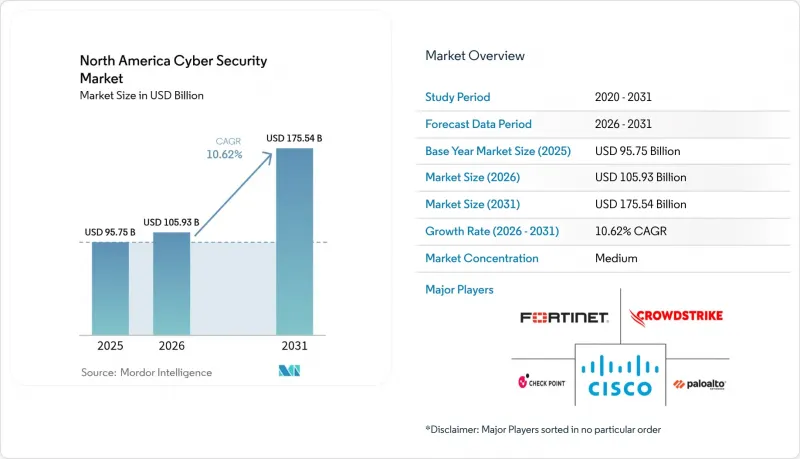
Mordor Intelligence에 의하면, 북미의 사이버 보안 시장 규모는 2025년에 957억 5,000만 달러로 평가되었고, 2026년 1,059억 3,000만 달러에서 2031년까지 1,755억 4,000만 달러에 이를 것으로 예측되며, 예측 기간(2026-2031년) CAGR은 10.62%를 나타낼 전망입니다.
본 보고서는 제공 형태별(솔루션 및 서비스), 도입 형태별(클라우드 및 온프레미스), 조직 규모별(중소기업 및 대기업), 최종 사용자별(은행, 금융서비스 및 보험(BFSI), 헬스케어, IT 및 통신, 기타) 및 국가별로 분류되어 있습니다. 시장 예측은 금액(달러)으로 표시되어 있습니다.
북미의 사이버 보안 시장 동향 및 인사이트
정보 유출 공개 의무화 법안과 급증하는 공격 건수
SEC가 SolarWinds 관련 공시 미흡을 이유로 4개 상장 기술 기업에 700만 달러의 벌금을 부과함에 따라 규제 당국의 감시는 한층 더 엄격해졌습니다. 이는 사이버 위험 보고의 미흡이 이제 구체적인 재무적 영향을 수반한다는 점을 여실히 보여주고 있습니다. 2024 회계연도에 발생한 583건의 집행 조치 및 82억 달러 규모의 시정 조치와 맞물려, 이러한 상황은 이사회가 사이버 보안을 단순한 IT 지출이 아닌 핵심적인 규정 준수 기능으로 다루도록 촉구하고 있습니다. 한편, 멕시코에서는 2024년에 4,240만 건의 악성코드 공격 시도(일일 평균 11만 6,000건)가 기록되었으며, 이는 현재 제조업에 가장 심각한 타격을 주고 있는 위협의 발생 건수가 지역 전체에서 급증하고 있는 실정을 반영합니다. 미국 전역의 모든 주에서 통지법이 시행되고 있으며, 연방 규정에서는 중대한 사고 발생 후 4영업일 이내에 공개할 것을 의무화하고 있기 때문에 기업들은 대응 주기를 단축하고 법적 책임을 최소화하기 위해 지속적인 모니터링, 자동 감지 및 침해 차단 플랫폼으로 예산을 전환하고 있습니다.
클라우드 전환 및 제로 트러스트 도입의 기세
연방 대통령령 및 NIST SP 800-207에 따라 신원 중심 아키텍처가 공공 부문의 표준으로 확립됨에 따라, 제로 트러스트 모델이 경계 중심 전략을 대체했습니다. 현재 북미 기업의 60%가 제로 트러스트 프로그램을 운영 중이며, 94%는 적어도 하나의 요소를 도입하고 있습니다. 이러한 전환은 네트워크 에지 및 인증 흐름을 재구축하는 지속적인 클라우드 도입의 흐름과 분리하여 생각할 수 없습니다. 하이브리드 또는 멀티 클라우드 환경 내에서 제로 트러스트를 도입한 조직은 사고 대응 및 정책 유지 관리 부담 경감을 통해 152%의 ROI를 달성했다고 보고하고 있습니다. 이 결과는 규제 요건과 비용 관리의 균형을 맞추어야 하는 금융 및 의료 분야 조직에게 특히 공감을 불러일으킵니다. 클라우드 전환과 제로 트러스트 도구의 융합으로 인해 SASE(Secure Access Service Edge) 및 ID·액세스 관리 플랫폼에 대한 수요가 증가하고 있으며, 멀티 클라우드 거버넌스를 전문으로 하는 MSSP에게는 구조적인 서비스 기회가 더욱 확대되고 있습니다.
숙련된 사이버 보안 전문가의 심각한 부족
북미에서는 2025년에 들어 사이버 보안 분야의 구인 건수가 54만 2,687건에 달했습니다. 이는 2024년에 고용주들이 직원 수를 2.7% 감축한 이후에도 4% 증가한 수치입니다. 37%의 기업이 예산 동결에 직면했지만, 90%의 기업은 여전히 특히 AI 기반 분석 및 제로 트러스트 구성 분야에서 심각한 기술 격차가 존재한다고 보고하고 있습니다. 멕시코만 해도 2025년까지 3만 5,000명의 전문가가 필요할 것으로 예상되지만, 현지 기업의 65%가 인재 부족을 가장 큰 장벽으로 꼽고 있으며, 이를 보완하기 위해 첨단 기술에 대한 지출이 80% 증가했습니다. 기술 부족은 기업을 공격의 잠복 기간 장기화에 노출시키게 되며, 인력 부족으로 인한 보안 침해로 발생하는 직접적인 손실은 평균 400만 달러에 달하고, 기술과 전문 지식을 구독형 패키지로 묶은 관리형 감지 및 대응(MDR) 서비스 도입에 대한 압박을 높이고 있습니다.
부문 분석
2025년 시점에서 솔루션은 북미 사이버 보안 시장에서 64.78%의 점유율을 유지했으나, 조직이 진화하는 위협에 대응하기 위해 연중무휴 24시간 모니터링을 외부에 위탁하는 경향이 강해지고 있어, 서비스 부문은 2031년까지 연평균 성장률(CAGR) 13.52%로 성장할 전망입니다. 이 서비스 부문의 성장 추세는 기술 인력 부족을 직접적으로 완화하는 동시에, 기업에 AI 기반 분석 플랫폼에 대한 신속한 접근을 제공합니다. 양자 내성 암호화 평가 및 제로 트러스트 로드맵 수립과 관련된 전문 서비스도 증가하고 있습니다. 관리형 감지 및 대응(Managed Detection and Response)은 이러한 변화를 여실히 보여주고 있으며, eSentire는 현재 250만 명의 환자 데이터를 보호하고 있어 규제가 엄격한 분야의 높은 수요를 입증하고 있습니다.
북미의 사이버 보안 시장에서 매니지드 서비스 시장 규모는 의료 업계 및 중견 제조 기업들 사이에서 가장 빠르게 확대되고 있습니다. 서비스 기반의 소비 모델은 기업이 분산된 도구 세트를 통합하고, 사이버 보안을 영업 비용으로 처리함으로써 이사회 승인을 얻는 데 도움이 되고 있습니다. 한편, 벤더들은 AI, 위협 인텔리전스 및 인간의 전문 지식을 결합함으로써 장기 계약을 확보하고 지속적인 수익 전망을 높이고 있습니다.
2025년 시점에서도 온프레미스 배포는 북미 사이버 보안 시장 규모의 55.63%를 차지했으나, 하이브리드 근무의 확산으로 경계 중심 보안의 취약성이 드러나는 가운데, 클라우드 보안에 대한 지출은 연평균 성장률(CAGR) 16.76%로 확대되고 있습니다. 연방 정부의 제로 트러스트 의무화와 클라우드 퍼스트 전략에 관한 대통령령이 맞물리면서, 국방 기관 및 민간 기관에서의 클라우드 네이티브 도입이 가속화되고 있습니다. 민간 기업 도입 업체에게 있어 이러한 전환은 설비 투자 절감, 정책 오케스트레이션 통합, 그리고 지속적인 규정 준수의 실현으로 이어집니다.
대기업은 데이터 주권 관점에서 하이브리드 모델을 운영하는 반면, 중소기업은 완전히 관리되는 클라우드 보안 서비스의 엣지 환경으로 단숨에 전환하고 있습니다. Oracle의 제로 트러스트 클라우드 제어 프레임워크는 신원 거버넌스, 마이크로 세분화 및 암호화가 어떻게 융합되어 공격 표면을 축소하는지 입증하고 있습니다. 정책 생성 및 설정 오류를 자동으로 수정해 주는 벤더는 멀티 클라우드의 복잡성이 증가함에 따라 지지를 얻고 있습니다.
기타 혜택 :
- 엑셀 형식 시장 예측(ME) 시트
- 3개월간의 애널리스트 지원
자주 묻는 질문
목차
제1장 서론
제2장 조사 방법
제3장 주요 요약
제4장 시장 구도
제5장 시장 규모 및 성장 예측
제6장 경쟁 구도
제7장 투자 분석
제8장 시장 기회 및 향후 동향
AJYAccording to Mordor Intelligence, the North America cybersecurity market size was valued at USD 95.75 billion in 2025 and estimated to grow from USD 105.93 billion in 2026 to reach USD 175.54 billion by 2031, at a CAGR of 10.62% during the forecast period (2026-2031).
This report is Segmented by Offering (Solutions and Services), Deployment Mode (Cloud and On-Premise), Organization Size (Small and Medium Enterprises and Large Enterprises), End-User (BFSI, Healthcare, IT and Telecom, and More), and Country. The Market Forecasts are Provided in Terms of Value (USD).
North America Cybersecurity Market Trends and Insights
Mandatory Breach Disclosure Laws and Surging Attack Volumes
Regulatory scrutiny intensified when the SEC levied USD 7 million in penalties on four listed technology companies for deficient SolarWinds-related disclosures, underscoring that incomplete cyber-risk reporting now carries tangible financial consequences. Coupled with 583 enforcement actions and USD 8.2 billion in remedies during fiscal 2024, the climate pushes boards to treat cybersecurity as a core compliance function rather than a discretionary IT spend. At the same time, Mexico logged 42.4 million malware attempts in 2024-116,000 per day-reflecting the wider regional surge in threat volume that now hits manufacturing hardest. Because every U.S. state enforces a notification statute and federal rules require disclosure within four business days of a material incident, enterprises have shifted budgets toward continuous monitoring, automated detection, and breach-containment platforms that shorten response cycles and cap liability.
Cloud Migration and Zero-Trust Adoption Momentum
Zero-trust models replaced perimeter-centric strategies once federal Executive Orders and NIST SP 800-207 established identity-focused architectures as the public-sector default. Today, 60% of North American enterprises have an active zero-trust program, and 94% have deployed at least one element; the transition is inseparable from sustained cloud-adoption waves that re-shape network edges and authentication flows. Organizations implementing zero-trust within hybrid or multi-cloud environments report 152% ROI through diminished incident handling and policy-maintenance burdens, a finding that resonates with finance and healthcare entities balancing regulatory mandates with cost discipline. The confluence of cloud migration and zero-trust tooling propels demand for secure access service edge (SASE) and identity-and-access-management platforms, reinforcing a structural service opportunity for MSSPs that specialize in multi-cloud governance.
Acute Shortage of Skilled Cyber-Security Professionals
North America entered 2025 with 542,687 open cybersecurity positions, a 4% increase even after employer headcount cuts of 2.7% in 2024. Budget freezes struck 37% of firms, but 90% still reported material skill gaps, particularly in AI-enabled analytics and zero-trust configuration. Mexico alone needs 35,000 specialists by 2025, yet 65% of local organizations cite talent scarcity as their top barrier, triggering an 80% uptick in advanced-technology spending to compensate. Skills shortages expose enterprises to prolonged dwell times, and breaches blamed on understaffed teams averaged USD 4 million in direct losses, adding pressure to adopt managed detection and response services that wrap technology and expertise in subscription packages.
Other drivers and restraints analyzed in the detailed report include:
- Explosion of IoT/IIoT Endpoints Across Industry
- U.S. Federal Post-Quantum Cryptography Transition Deadlines
- Legacy OT Systems Expanding Unmanaged Attack Surface
For complete list of drivers and restraints, kindly check the Table Of Contents.
Segment Analysis
Solutions retained a 64.78% share of the North America cybersecurity market in 2025, yet services are on pace for 13.52% CAGR through 2031 as organizations outsource 24/7 monitoring to counter evolving threats. The services uptrend directly mitigates the skills shortage while giving firms rapid access to AI-driven analytics platforms. Professional services for quantum-safe cryptography assessments and zero-trust road-mapping have also risen. Managed detection and response illustrates this shift: eSentire now protects data for 2.5 million patients, underscoring demand in regulated fields.
The North America cybersecurity market size for managed services is expanding fastest among healthcare and mid-market manufacturing firms. Service-based consumption models help firms consolidate sprawling toolsets and secure board approval by treating cybersecurity as an operating expense. Vendors, in turn, bundle AI, threat intelligence, and human expertise, capturing sticky multiyear contracts and boosting recurring revenue visibility.
On-premise deployments still made up 55.63% of the North America cybersecurity market size in 2025, but cloud security spending is advancing at 16.76% CAGR as hybrid work exposes perimeter-centric gaps. Federal zero-trust mandates, coupled with executive orders on cloud-first strategies, accelerate cloud-native adoption in defense and civil agencies. For private-sector adopters, the pivot lowers capital expenditure, integrates policy orchestration, and enables continuous compliance.
Large enterprises operate hybrid models for data-sovereignty reasons, while SMEs leapfrog straight to fully managed cloud-security service edges. Oracle's framework for zero-trust cloud controls demonstrates how identity governance, micro-segmentation, and encryption converge to tighten attack surfaces. Vendors that automate policy creation and misconfiguration remediation find traction as multicloud complexity scales.
Complete Report Scope:
- By Offering
- Solutions
- Application Security
- Cloud Security
- Data Security
- Identity and Access Management
- Infrastructure Protection
- Integrated Risk Management
- Network Security Equipment
- Endpoint Security
- Other Solutions
- Services
- Professional Services
- Managed Services
- Solutions
- By Deployment Mode
- Cloud
- On-Premise
- By Organization Size
- Small and Medium Enterprises (SMEs)
- Large Enterprises
- By End-user
- BFSI
- Healthcare
- IT and Telecom
- Industrial and Defense
- Retail
- Energy and Utilities
- Manufacturing
- Other End-users
- By Country
- United States
- Canada
- Mexico
List of Companies Covered in this Report:
- Palo Alto Networks, Inc.
- Fortinet, Inc.
- CrowdStrike Holdings, Inc.
- Cisco Systems, Inc.
- Check Point Software Technologies Ltd.
- Zscaler, Inc.
- Okta, Inc.
- Cloudflare, Inc.
- SentinelOne, Inc.
- Tenable Holdings, Inc.
- Rapid7, Inc.
- Qualys, Inc.
- Proofpoint, Inc.
- Trend Micro Incorporated
- Sophos Group plc
- CyberArk Software Ltd.
- Imperva, Inc.
- F5, Inc.
- Forcepoint LLC
- Darktrace plc
- Bitdefender LLC
- Varonis Systems, Inc.
- Arctic Wolf Networks, Inc.
- Elastic N.V.
- Mandiant (Google Cloud)
Additional Benefits:
- The market estimate (ME) sheet in Excel format
- 3 months of analyst support
TABLE OF CONTENTS
1 INTRODUCTION
- 1.1 Study Assumptions and Market Definition
- 1.2 Scope of the Study
2 RESEARCH METHODOLOGY
3 EXECUTIVE SUMMARY
4 MARKET LANDSCAPE
- 4.1 Market Overview
- 4.2 Market Drivers
- 4.2.1 Mandatory breach-disclosure laws and surging attack volumes
- 4.2.2 Cloud migration and zero-trust adoption momentum
- 4.2.3 Explosion of IoT/IIoT endpoints across industry
- 4.2.4 U.S. federal post-quantum cryptography transition deadlines
- 4.2.5 Cyber-insurance underwriting tying premiums to controls
- 4.2.6 AI-powered SecOps platforms cutting mean-time-to-respond
- 4.3 Market Restraints
- 4.3.1 Acute shortage of skilled cyber-security professionals
- 4.3.2 High cost and complexity of multi-vendor tool stacks
- 4.3.3 Legacy OT systems expanding unmanaged attack surface
- 4.3.4 Energy footprint of always-on analytics limiting adoption
- 4.4 Industry Value Chain Analysis
- 4.5 Regulatory Landscape
- 4.6 Technological Outlook
- 4.7 Industry Attractiveness - Porter's Five Forces Analysis
- 4.7.1 Threat of New Entrants
- 4.7.2 Bargaining Power of Suppliers
- 4.7.3 Bargaining Power of Buyers
- 4.7.4 Threat of Substitutes
- 4.7.5 Intensity of Competitive Rivalry
- 4.8 Impact of Macroeconomic Factors on the Market
5 MARKET SIZE AND GROWTH FORECASTS (VALUES)
- 5.1 By Offering
- 5.1.1 Solutions
- 5.1.1.1 Application Security
- 5.1.1.2 Cloud Security
- 5.1.1.3 Data Security
- 5.1.1.4 Identity and Access Management
- 5.1.1.5 Infrastructure Protection
- 5.1.1.6 Integrated Risk Management
- 5.1.1.7 Network Security Equipment
- 5.1.1.8 Endpoint Security
- 5.1.1.9 Other Solutions
- 5.1.2 Services
- 5.1.2.1 Professional Services
- 5.1.2.2 Managed Services
- 5.1.1 Solutions
- 5.2 By Deployment Mode
- 5.2.1 Cloud
- 5.2.2 On-Premise
- 5.3 By Organization Size
- 5.3.1 Small and Medium Enterprises (SMEs)
- 5.3.2 Large Enterprises
- 5.4 By End-user
- 5.4.1 BFSI
- 5.4.2 Healthcare
- 5.4.3 IT and Telecom
- 5.4.4 Industrial and Defense
- 5.4.5 Retail
- 5.4.6 Energy and Utilities
- 5.4.7 Manufacturing
- 5.4.8 Other End-users
- 5.5 By Country
- 5.5.1 United States
- 5.5.2 Canada
- 5.5.3 Mexico
6 COMPETITIVE LANDSCAPE
- 6.1 Market Concentration
- 6.2 Strategic Moves
- 6.3 Market Share Analysis
- 6.4 Company Profiles (includes Global level Overview, Market level overview, Core Segments, Financials as available, Strategic Information, Market Rank/Share for key companies, Products and Services, and Recent Developments)
- 6.4.1 Palo Alto Networks, Inc.
- 6.4.2 Fortinet, Inc.
- 6.4.3 CrowdStrike Holdings, Inc.
- 6.4.4 Cisco Systems, Inc.
- 6.4.5 Check Point Software Technologies Ltd.
- 6.4.6 Zscaler, Inc.
- 6.4.7 Okta, Inc.
- 6.4.8 Cloudflare, Inc.
- 6.4.9 SentinelOne, Inc.
- 6.4.10 Tenable Holdings, Inc.
- 6.4.11 Rapid7, Inc.
- 6.4.12 Qualys, Inc.
- 6.4.13 Proofpoint, Inc.
- 6.4.14 Trend Micro Incorporated
- 6.4.15 Sophos Group plc
- 6.4.16 CyberArk Software Ltd.
- 6.4.17 Imperva, Inc.
- 6.4.18 F5, Inc.
- 6.4.19 Forcepoint LLC
- 6.4.20 Darktrace plc
- 6.4.21 Bitdefender LLC
- 6.4.22 Varonis Systems, Inc.
- 6.4.23 Arctic Wolf Networks, Inc.
- 6.4.24 Elastic N.V.
- 6.4.25 Mandiant (Google Cloud)
7 INVESTMENT ANALYSIS
8 MARKET OPPORTUNITIES AND FUTURE TRENDS
- 8.1 White-Space and Unmet-Need Assessment