

|
시장보고서
상품코드
2100516
집광형 태양열발전(CSP) 시장 : 시장 점유율 분석, 업계 동향 및 통계, 성장 예측(2026-2031년)Concentrated Solar Power (CSP) - Market Share Analysis, Industry Trends & Statistics, Growth Forecasts (2026 - 2031) |
||||||
 Mordor Intelligence
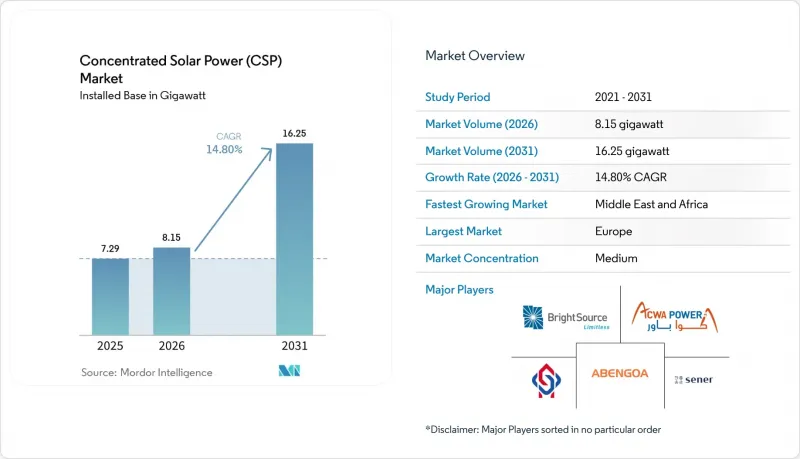
Mordor Intelligence에 의하면, 집광형 태양열발전(CSP) 시장 규모(설치용량 기반)는 2025년 7.29기가와트로 평가되었고, 2026년 8.15기가와트에서, 2031년까지 16.25기가와트로 확대될 전망이며, 2026-2031년 연평균 복합 성장률(CAGR)은 14.80%를 나타낼 것으로 예측됩니다.
본 보고서는 기술별(파라볼릭 트로프, 리니어 프레넬, 파워 타워, 디쉬/스털링), 열매체별(용융염, 합성유, 직접 증기/물, 기타 열매체), 출력 범위별(50MW 이하, 50-150MW, 150MW 이상), 지역별(유럽, 아시아태평양, 중동 및 아프리카, 기타)로 분류되어 있습니다. 시장 규모와 전망은 출력(GW) 단위로 표시되어 있습니다.
세계의 집광형 태양열 발전 시장 동향 및 인사이트
축열 기능을 갖춘 CSP의 LCOE 하락
용융염 축열 시스템을 결합한 CSP의 균등화 발전 원가(LCOE) 곡선은 2010-2024년 70% 하락하여 전 세계적으로 1kWh당 0.092달러에 도달했습니다. 한편, 중국의 프로젝트에서는 2024년 말 기준 1kWh당 0.069달러를 기록했습니다. 표준화된 헬리오스태트 설계, 중국 및 걸프 국가에서의 현지 생산, 입찰을 통한 경쟁이 이러한 하락을 뒷받침하고 있으며, CSP 시장의 경제적 기반을 더욱 공고히 하고 있습니다. 두바이의 950MW 규모 ‘모하메드 빈 라시드 알 막툼 4단계’ 프로젝트는 2023년에 kWh당 0.073달러라는 사상 최저의 임베디드 가격을 확보하며, 탄소 배출 규제가 엄격한 시장에서 가스 터빈에 대한 경쟁력을 입증했습니다. 15시간의 전력 저장이 가능해짐에 따라, 전력 사업자들은 대규모 배터리 조달을 미룰 수 있게 되었습니다. 자본 시장에서는 수익 변동성 감소가 가중평균자본비용(WACC) 모델에 반영되기 시작했으며, 최근 자금 조달에서 요구되는 자기자본이익률(ROE)이 최대 150베이시스포인트 하락했습니다. 개발 사업자들은 현재 2030년까지 연간 5%에서 7%의 설비 투자(CAPEX) 감소를 가정하여 프로젝트의 수익성을 산정하고 있으며, 이에 따라 보조금이 적은 지역에서의 파이프라인 확장이 가속화되고 있습니다.
장시간 조절형 재생에너지에 대한 송전망 수요
세계 송전 사업자들은 태양광 발전 보급률이 높아짐에 따라 순부하의 급격한 변동 폭이 확대되고 있다고 보고하고 있습니다. 2024년 봄 캘리포니아주에서 발생한 ‘덕 커브’에서는 3시간 동안 13GW의 부하 변동이 관찰되어 예비 전력에 부담이 가해졌습니다. 리튬 이온 배터리는 4시간 방전에는 우수하지만, 8시간을 초과하면 경제성이 떨어지기 때문에 그 격차를 용융염 CSP가 더 낮은 수명 주기 비용으로 메우고 있습니다. CSP 터빈은 10분 이내에 가동 가능하며, 사이클 수명 저하를 초래하지 않으면서 관성 및 주파수 응답을 제공합니다. 현재 스페인, 남아프리카공화국, 칠레에서는 용량 크레딧 제도에 따라 CSP에 정격 출력의 최대 85%가 할당되고 있지만, 태양광 발전과 축전지를 결합한 하이브리드 시스템의 경우 30%-50%에 그치고 있습니다. 전력 시스템이 24시간 365일 재생에너지 포트폴리오를 목표로 하는 가운데, 기획 담당자들은 자원 충족성 확보를 위해 장주기 에너지 저장(LDES)에 대한 최소 할당 기준을 점점 더 많이 반영하고 있으며, 이는 집광형 태양열 발전 시장을 직접적으로 뒷받침하고 있습니다.
태양광 발전 + 축전지의 비용 하락이 CSP의 입찰 가격을 밑돌고 있습니다.
2024년에는 태양광 모듈 가격이 전년 대비 12% 더 하락했으며, 리튬 이온 배터리 팩 가격은 2010년 대비 89% 저렴해졌습니다. 이로 인해 일사량이 높은 시장에서는 4시간의 축전 용량을 갖춘 하이브리드 시스템이 1kWh당 0.055달러 전후의 가격으로 입찰을 따낼 수 있게 되었습니다. 호주의 2024-2025년도 입찰에서는 CSP가 낙찰된 사례가 없었으며, 미국에서도 2020년 이후 새로운 CSP 프로젝트가 발표되지 않았습니다. 이는 자금 제공업체들이 더 신속하고 실적이 입증된 태양광 발전 프로젝트를 선호하기 때문입니다. RFP(제안 요청서)에서 8시간 이상의 방전을 명시적으로 요구하지 않는 한, 혹은 탄소 배출량 상한 규제가 CSP에 유리하게 작용하지 않는 한, 입찰 경쟁의 약화로 인해 단기적으로는 집광형 태양광 발전 시장 점유율은 계속해서 축소될 것으로 보입니다.
부문 분석
2025년 집광형 태양열 발전 시장에서 파라볼릭 트로프 시스템 시장 규모는 4.86GW로 전체 용량의 66.7%를 차지했으나, 파워 타워는 연평균 성장률(CAGR) 16.8%로 확대되고 있어 2031년까지 7.3 GW에 달할 전망입니다. 타워형은 565°C에 달하며 15시간의 축열 기능을 통합하고 있어, 2023년 두바이 4단계 프로젝트에서 100MW의 수주를 확보했습니다. 타워형은 15%-20%의 추가 비용이 발생하지만, 스페인의 2025년 입찰에서는 트러프형이 70%인 반면 타워형에는 85%의 용량 크레딧이 할당되어 신규 수주 균형을 타워형 쪽으로 기울이고 있습니다. 리니어 프레넬과 디쉬 스털링은 여전히 틈새 시장으로 남아 있으며, 2025년 도입 실적 합계는 3% 이하에 그치겠지만, 프레넬 어레이는 부지 제약이나 저온 수요가 경제성을 좌우하는 공정 열 프로젝트에서 지지를 얻고 있습니다.
헬리오스태트의 자동화가 진행되고 있으며, 초임계 CO2 사이클이 2030년까지 터빈 효율 50%를 목표로 하고 있는 만큼, 설비 투자의 학습 곡선은 타워형에 유리하게 작용하고 있습니다. 트러프형은 터빈 및 플랜트 부속 설비를 재사용하는 하이브리드형 개조 프로젝트에서 계속해서 채택되고 있으며, 리파워링에 필요한 설비 투자를 최대 40%까지 절감하고 있습니다. 기술 선택에 있어서는 현재 광학 설계보다 발전 가동 시간이나 축전 시스템과의 통합에 중점을 두고 있으며, 이러한 변화로 인해 집중형 태양열 발전 시장은 향후 10년간 다양성을 유지하면서도 타워형이 주류를 이룰 전망입니다.
지역별 분석
유럽은 2025년에 2.34GW의 발전 용량을 유지할 전망이며, 이는 전 세계 총 용량의 32.1%에 해당하지만, 입찰에서는 태양광 발전과 축전지의 하이브리드 방식이 우선시되기 때문에 성장은 둔화되고 있습니다. 스페인의 ‘Solgest-1’(110MW 직접 증기식 트로프형)은 유럽에서 건설 중인 유일한 신규 CSP 프로젝트로, 2026년 가동을 시작할 예정입니다. 정책의 불확실성과 북유럽의 풍부한 해상 풍력 자원이 추가적인 보급을 제한하고 있어, 집광형 태양열 발전 시장의 확대 기회를 제약하고 있습니다.
중동 및 아프리카는 연평균 성장률(CAGR) 22.5%라는 가장 빠른 성장세를 기록했습니다. 사우디아라비아의 2.6GW에 달하는 계획 프로젝트, 아랍에미리트의 가동 중인 950MW 복합 시설, 이집트의 600MW 입찰이 이러한 성장세를 뒷받침하고 있습니다. 모로코의 누르 복합 시설은 북아프리카에서 CSP의 실현 가능성을 입증하고 있으며, 튀니지와 알제리에서의 타당성 조사를 뒷받침하고 있습니다. 또한 2024년에는 누르 복합 발전소의 200MW 확장 계획이 검토되었습니다. 입찰 규정에 정부 보증이 포함되어 있어 대외 부채 위험이 경감되었으며, 이는 해당 지역의 CSP 시장의 급속한 성장에 기여하고 있습니다.
아시아태평양의 성장은 중국이 주도하고 있습니다. 2024년 현재 838MW를 가동 중인 중국은 3.3GW를 건설 중이며, 10시간 이상의 축전 능력을 갖춘 발전소에 대해 각 성에서 시행하는 고정가격임베디드제도(FIT)에 따른 프리미엄을 바탕으로 2030년까지 15GW를 목표로 하고 있습니다. 인도의 CSP 계획은 당초 ‘자와할랄 네루 미션’의 할당량 500MW 중 불과 225MW만 완공에 이르렀기 때문에 정체되어 있으며, 호주의 오로라 프로젝트는 여전히 자금 조달에 성공하지 못하고 있습니다. 북미에서는 기존 1.7GW 규모의 설비를 제외하고 2014년 이후 신규 프로젝트가 시작되지 않았는데, 이는 투자자들이 신용도가 높은 태양광 발전과 에너지 저장 장치의 조합을 선호하는 경향을 반영한 것입니다. 남미에서는 칠레의 110MW 규모 '세로 도미나도르'만이 가동 중이며, 그 이후의 CSP 제안은 국내 리튬 배터리 제조 정책으로 인해 보류된 상태라, 집광형 태양열 발전 시장에서 지역 간 격차가 두드러지고 있습니다.
기타 혜택
- 엑셀 형식 시장 예측(ME) 시트
- 3개월간의 애널리스트 지원
자주 묻는 질문
목차
제1장 서론
제2장 조사 방법
제3장 주요 요약
제4장 시장 구도
제5장 시장 규모 및 성장 예측
제6장 경쟁 구도
제7장 시장 기회 및 향후 전망
AJY 26.08.11According to Mordor Intelligence, the concentrated solar power market size in terms of installed base is projected to expand from 7.29 gigawatt in 2025 and 8.15 gigawatt in 2026 to 16.25 gigawatt by 2031, registering a CAGR of 14.80% between 2026 to 2031.
This report is Segmented by Technology (Parabolic Trough, Linear Fresnel, Power Tower, and Dish/Stirling), Heat Transfer Fluid (Molten Salt, Synthetic Oil, Direct Steam/Water, and Other Fluids), Capacity Range (Below 50 MW, 50-150 MW, and Above 150 MW), and Geography (Europe, Asia-Pacific, Middle East and Africa, and More). The Market Sizes and Forecasts are Provided in Terms of Capacity (GW).
Global Concentrated Solar Power (CSP) Market Trends and Insights
Declining LCOE for CSP With Storage
Levelized-cost curves for CSP combined with molten-salt storage fell 70% between 2010 and 2024, hitting USD 0.092 per kWh worldwide, while Chinese projects landed at USD 0.069 per kWh in late 2024. Standardized heliostat designs, local manufacturing in China and Gulf states, and auction-driven competition underpin that drop, creating a stronger economic foundation for the CSP market. Dubai's 950 MW Mohammed bin Rashid Al Maktoum Phase 4 locked a record USD 0.073 per kWh tariff in 2023, proving competitiveness against gas turbines in carbon-constrained markets. Fifteen-hour storage lets utilities defer large battery procurements. Capital markets have started to factor the lower revenue volatility into weighted-average cost of capital models, reducing required equity returns by up to 150 basis points in recent financings. Developers are now underwriting projects assuming a 5% to 7% annual capex decline through 2030, which accelerates pipeline growth in subsidy-light jurisdictions.
Grid Need for Long-Duration Dispatchable Renewables
Global transmission operators report deepening net-load ramps as solar penetration rises. California's spring 2024 "duck curve" saw a 13 GW three-hour ramp, straining reserves. Lithium-ion batteries excel at four-hour discharge but become uneconomic beyond eight hours, leaving a gap that molten-salt CSP supplies at a lower lifetime cost. CSP turbines can start in under ten minutes, offering inertia and frequency response without cycle-life degradation. Capacity-credit frameworks now assign CSP up to 85% of nameplate rating in Spain, South Africa, and Chile, compared with 30%-50% for photovoltaic-battery hybrids. As grids target 24/7 renewable portfolios, planners are increasingly embedding minimum long-duration storage quotas in resource-adequacy procurements, directly boosting the Concentrated Solar Power market.
PV + Battery Cost Declines Undercutting CSP Bids
Photovoltaic modules fell another 12% year-on-year in 2024, while lithium-ion packs are 89% cheaper than in 2010, letting four-hour hybrids clear auctions near USD 0.055 per kWh in high-irradiance markets. Australia's 2024-2025 tenders awarded no CSP, and the United States has not announced new CSP since 2020, as financiers prefer faster, proven photovoltaic projects. Unless RFPs explicitly demand eight-hour-plus discharge or carbon caps favor CSP, bid competitiveness will keep eroding near-term Concentrated Solar Power market share.
Other drivers and restraints analyzed in the detailed report include:
- MENA & China Policy Auctions Accelerating Build-Out
- Industrial Process-Heat & Green-Hydrogen Coupling
- High Upfront CAPEX & Limited Project Finance Pools
For complete list of drivers and restraints, kindly check the Table Of Contents.
Segment Analysis
The Concentrated Solar Power market size for parabolic trough systems stood at 4.86 GW in 2025, equal to 66.7% of total capacity, yet power towers are expanding at a 16.8% CAGR en route to 7.3 GW by 2031. Power towers reach 565 °C, integrate 15-hour storage, and secured 100 MW at Dubai Phase 4 in 2023. Although towers carry a 15%-20% cost premium, Spain's 2025 auctions awarded them 85% capacity credits against 70% for troughs, tilting new orders. Linear Fresnel and dish-Stirling remain niche, collectively under 3% of 2025 installations, but Fresnel arrays find traction in process-heat projects where land constraints and lower temperature needs dominate economics.
Capex learning rates favor towers as heliostat automation improves and supercritical CO2 cycles target 50% turbine efficiency by 2030. Troughs continue in hybrid retrofits that reuse turbines and balance-of-plant gear, cutting repower capex by up to 40%. Technology choice now hinges less on optical design and more on dispatch duration and storage integration, a shift that will keep the Concentrated Solar Power market diversified yet tower-weighted through the decade.
Complete Report Scope:
- By Technology
- Parabolic Trough
- Linear Fresnel
- Power Tower
- Dish/Stirling
- By Heat Transfer Fluid
- Molten Salt
- Synthetic Oil
- Direct Steam/Water
- Other Fluids (CO2, Nanofluids)
- By Capacity Range
- Below 50 MW
- 50 to 150 MW
- Above 150 MW
- By Geography
- North America
- United States
- Canada
- Mexico
- Europe
- United Kingdom
- Germany
- France
- Spain
- Nordic Countries
- Russia
- Rest of Europe
- Asia-Pacific
- China
- India
- Japan
- South Korea
- Malaysia
- Thailand
- Indonesia
- Vietnam
- Australia
- Rest of Asia-Pacific
- South America
- Brazil
- Argentina
- Colombia
- Rest of South America
- Middle East and Africa
- United Arab Emirates
- Saudi Arabia
- South Africa
- Egypt
- Rest of Middle East and Africa
- North America
Geography Analysis
Europe retained 2.34 GW of capacity in 2025, equal to 32.1% of the global base, yet growth is muted as auctions favor PV-battery hybrids. Spain's Solgest-1, a 110 MW direct-steam trough, is the only new European CSP under construction, slated for 2026 commissioning. Policy uncertainty and ample offshore wind resources in Northern Europe limit further uptake, constraining expansion opportunities in the concentrated solar power market.
The Middle East and Africa posted the fastest expansion at 22.5% CAGR. Saudi Arabia's 2.6 GW pipeline, the UAE's operating 950 MW complex, and Egypt's 600 MW tender underpin that momentum. Morocco's Noor complex proves CSP viability in North Africa, spurring feasibility studies in Tunisia and Algeria, while a 200 MW expansion at Noor was evaluated in 2024. Auction rules bundle sovereign guarantees, de-risking foreign debt, and helping the Concentrated Solar Power market grow rapidly in the region.
Asia-Pacific growth is China-centric. Operating 838 MW in 2024, China has 3.3 GW under construction and targets 15 GW by 2030, backed by provincial feed-in premiums for >=10-hour storage. India's CSP ambitions stalled after only 225 MW out of the original 500 MW Jawaharlal Nehru Mission quota reached completion, and Australia's Aurora project remains unfunded. North America's 1.7 GW legacy fleet has seen no new projects since 2014, reflecting investor preference for credit-enhanced photovoltaic storage. South America hosts only Chile's 110 MW Cerro Dominador, with subsequent CSP proposals sidelined by domestic lithium-battery manufacturing policy, highlighting regional disparities within the concentrated solar power market.
- ACWA Power
- Abengoa Solar / Atlantica
- BrightSource Energy
- SENER
- Nextera Energy
- ENGIE
- Acciona Energia
- Shouhang High-Tech
- Aalborg CSP
- TSK Flagsol
- Cobra Energia
- Bechtel
- Chiyoda Corporation
- SR Energy
- SolarReserve
- SEPCO III
- DEWA (Dubai Electricity & Water Authority)
- EDF Renewables
- China Power International Development
- Masdar
Additional Benefits:
- The market estimate (ME) sheet in Excel format
- 3 months of analyst support
TABLE OF CONTENTS
1 Introduction
- 1.1 Study Assumptions & Market Definition
- 1.2 Scope of the Study
2 Research Methodology
3 Executive Summary
4 Market Landscape
- 4.1 Market Overview
- 4.2 Market Drivers
- 4.2.1 Declining LCOE for CSP with storage
- 4.2.2 Grid need for long-duration, dispatchable renewables
- 4.2.3 MENA & China policy auctions accelerating build-out
- 4.2.4 Industrial process-heat & green-hydrogen coupling
- 4.2.5 Hybrid CSP-desalination in water-stressed regions
- 4.2.6 24/7 clean heat demand from hyperscale datacentres
- 4.3 Market Restraints
- 4.3.1 PV + battery cost declines undercutting CSP bids
- 4.3.2 High upfront CAPEX & limited project finance pools
- 4.3.3 Hitec-salt supply-chain price volatility
- 4.3.4 Cooling-water scarcity at desert project sites
- 4.4 Supply-Chain Analysis
- 4.5 Regulatory Landscape
- 4.6 Technological Outlook
- 4.7 Porter's Five Forces
- 4.7.1 Bargaining Power of Suppliers
- 4.7.2 Bargaining Power of Buyers
- 4.7.3 Threat of New Entrants
- 4.7.4 Threat of Substitutes
- 4.7.5 Competitive Rivalry
5 Market Size & Growth Forecasts
- 5.1 By Technology
- 5.1.1 Parabolic Trough
- 5.1.2 Linear Fresnel
- 5.1.3 Power Tower
- 5.1.4 Dish/Stirling
- 5.2 By Heat Transfer Fluid
- 5.2.1 Molten Salt
- 5.2.2 Synthetic Oil
- 5.2.3 Direct Steam/Water
- 5.2.4 Other Fluids (CO2, Nanofluids)
- 5.3 By Capacity Range
- 5.3.1 Below 50 MW
- 5.3.2 50 to 150 MW
- 5.3.3 Above 150 MW
- 5.4 By Geography
- 5.4.1 North America
- 5.4.1.1 United States
- 5.4.1.2 Canada
- 5.4.1.3 Mexico
- 5.4.2 Europe
- 5.4.2.1 United Kingdom
- 5.4.2.2 Germany
- 5.4.2.3 France
- 5.4.2.4 Spain
- 5.4.2.5 Nordic Countries
- 5.4.2.6 Russia
- 5.4.2.7 Rest of Europe
- 5.4.3 Asia-Pacific
- 5.4.3.1 China
- 5.4.3.2 India
- 5.4.3.3 Japan
- 5.4.3.4 South Korea
- 5.4.3.5 Malaysia
- 5.4.3.6 Thailand
- 5.4.3.7 Indonesia
- 5.4.3.8 Vietnam
- 5.4.3.9 Australia
- 5.4.3.10 Rest of Asia-Pacific
- 5.4.4 South America
- 5.4.4.1 Brazil
- 5.4.4.2 Argentina
- 5.4.4.3 Colombia
- 5.4.4.4 Rest of South America
- 5.4.5 Middle East and Africa
- 5.4.5.1 United Arab Emirates
- 5.4.5.2 Saudi Arabia
- 5.4.5.3 South Africa
- 5.4.5.4 Egypt
- 5.4.5.5 Rest of Middle East and Africa
- 5.4.1 North America
6 Competitive Landscape
- 6.1 Market Concentration
- 6.2 Strategic Moves (M&A, Partnerships, PPAs)
- 6.3 Market Share Analysis (Market Rank/Share for key companies)
- 6.4 Company Profiles (includes Global level Overview, Market level overview, Core Segments, Financials as available, Strategic Information, Products & Services, and Recent Developments)
- 6.4.1 ACWA Power
- 6.4.2 Abengoa Solar / Atlantica
- 6.4.3 BrightSource Energy
- 6.4.4 SENER
- 6.4.5 Nextera Energy
- 6.4.6 ENGIE
- 6.4.7 Acciona Energia
- 6.4.8 Shouhang High-Tech
- 6.4.9 Aalborg CSP
- 6.4.10 TSK Flagsol
- 6.4.11 Cobra Energia
- 6.4.12 Bechtel
- 6.4.13 Chiyoda Corporation
- 6.4.14 SR Energy
- 6.4.15 SolarReserve
- 6.4.16 SEPCO III
- 6.4.17 DEWA (Dubai Electricity & Water Authority)
- 6.4.18 EDF Renewables
- 6.4.19 China Power International Development
- 6.4.20 Masdar
7 Market Opportunities & Future Outlook
- 7.1 White-space & Unmet-Need Assessment


