

|
시장보고서
상품코드
2100517
클라우드 ID 및 액세스 관리 소프트웨어 시장 : 시장 점유율 분석, 업계 동향 및 통계, 성장 예측(2026-2031년)Cloud Identity and Access Management Software - Market Share Analysis, Industry Trends & Statistics, Growth Forecasts (2026 - 2031) |
||||||
 Mordor Intelligence
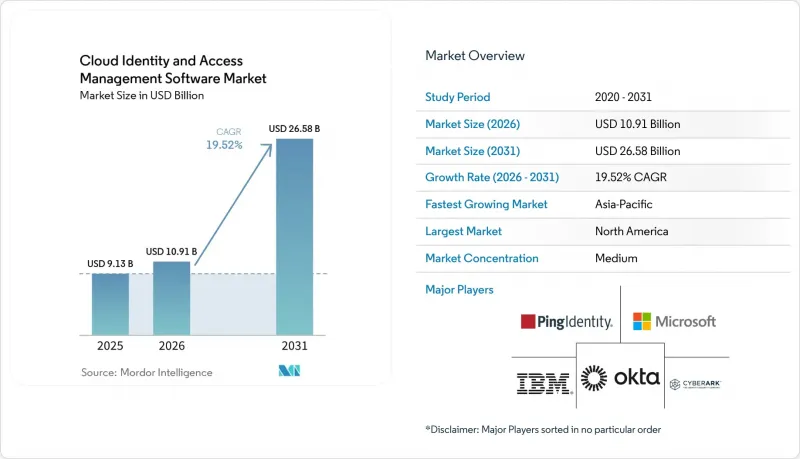
Mordor Intelligence에 의하면, 2026년 클라우드 ID 및 액세스 관리 소프트웨어 시장 규모는 109억 1,000만 달러로 추정되고, 2025년 91억 3,000만 달러에서 확대해, 2031년에는 265억 8,000만 달러에 이를 것으로 예측됩니다.
2026-2031년 연평균 성장률(CAGR)은 19.52%가 될 것으로 전망됩니다.
본 보고서는 구성 요소별(소프트웨어 및 서비스), 배포 모델별(퍼블릭 클라우드, 프라이빗 클라우드, 하이브리드 클라우드), 조직 규모별(대기업·중소기업), 업종별(IT 및 통신, 의료, 정부 기관, 소매 및 전자상거래, 제조업 등), 지역별로 분류되어 있습니다. 시장 전망은 금액(달러) 기준으로 제시되어 있습니다.
세계의 클라우드 ID 및 액세스 관리 소프트웨어 시장 동향 및 인사이트
제로 트러스트 보안 프레임워크 도입 확대
과거에는 경계 방화벽을 신뢰했던 기업들도 현재는 모든 요청을 잠재적 위협으로 간주하고 있습니다. NIST는 2024년 SP 800-207A에서 제로 트러스트를 규정했으며, 이에 따라 전 세계 기업의 81%가 이러한 원칙을 IAM 로드맵에 반영하게 되었습니다. 연방 대통령령 제14028호에 따라 미국 정부 기관은 각 액세스 시도를 검증해야 할 의무가 있으며, 이로 인해 하이브리드 환경 전반에 걸쳐 최소 권한 원칙을 적용하는 특권 액세스 관리(PAM) 및 정책 기반 엔진에 대한 상업적 수요가 증가하고 있습니다. 금융 기관들은 그 효과를 여실히 보여주고 있으며, 예를 들어 내부 용도의 대부분을 제로 트러스트 제어 방식으로 전환한 후, 무단 접근이 감소한 것으로 추정됩니다. Istio와 같은 서비스 메시 기술은 현재 마이크로서비스 간 상호 TLS를 통합하여 정적 비밀번호를 제거하고, 횡방향 이동(lateral movement)의 위험을 줄이고 있습니다. ISO/IEC 27001:2022는 인증을 입증 가능한 제로 트러스트 구현과 연계하여, 이 프레임워크를 단순한 모범 사례에서 조달상의 필수 요건으로 전환하고 있습니다.
기업 내 클라우드 서비스의 보급
현재 조직이 이용하는 퍼블릭 클라우드 플랫폼의 평균 수는 3.4개에 달하며, 각 플랫폼에서는 인증 정보의 난립을 방지하기 위해 페더레이티드 ID가 필요합니다. 분산형 ID(Decentralized Identity) 솔루션의 등장으로 기업은 클라우드 생태계 전반에 걸쳐 안전한 인증, 개인정보 제어, 디지털 신뢰 관리를 강화할 수 있게 되었습니다. 2024년, AWS, Azure, Google Cloud에서는 하루 평균 1조 2,000억 건의 인증된 API 호출이 처리되었으나, 그 대부분은 중앙 집중식 IAM 허브에서 발급된 OAuth 2.0 토큰에 의해 제어되었습니다. 컨테이너 워크로드에서는 인증서가 1시간마다 갱신되기 때문에 비인간 신원에 대해서는 자동화된 SPIFFE 프레임워크가 필수적입니다. 5G 코어를 하이퍼스케일 클라우드로 마이그레이션하고 있는 통신 사업자는 방대한 규모의 머신 간 인증의 대표적인 사례이며, Verizon은 2024년에 5G 코어의 60%를 AWS에서 운영하고 있었습니다. 2024년 10월에 발효되는 유럽의 NIS2 지침에 따라 클라우드 의존성에 대한 공급망 위험 평가가 의무화되었으며, 신원 거버넌스가 규정 준수 체크리스트에 포함되게 되었습니다.
도입 및 통합에 드는 높은 비용
딜로이트의 2024년 조사에 따르면, 직원 500명 미만의 기업은 IT 예산의 불과 8%만을 신원 관리에 할당하고 있으며, 이는 대기업의 할당액의 절반에 불과합니다. 최신 프로토콜을 갖추지 않은 레거시 용도의 경우, 대개 맞춤형 커넥터가 필요하며, 이로 인해 IAM 프로젝트 지출의 40%를 차지하기도 합니다. 미국의 중소기업들은 IAM을 포함한 사이버 보안 비용을 디지털 전환의 세 번째로 큰 장벽으로 꼽고 있습니다. 금융 기관에 따르면, ATM, 모바일 앱, 핵심 뱅킹 시스템 간에 IAM을 동기화하는 데 18-24개월이 소요되는 것으로 보고되고 있으며, 이로 인해 병렬 시스템이 유지되어 전환 기간 동안 운영 위험이 높아지고 있습니다. 유럽의 금융 기관에서는 숨겨진 교육비나 헬프데스크 비용을 이유로 42%의 사례에서 업그레이드가 연기되었습니다.
부문 분석
소프트웨어 라이선스 및 구독은 2025년 매출의 58.62%를 차지했으나, 전문 서비스 및 관리형 서비스는 2031년까지 연평균 성장률(CAGR) 19.61%로 확대되고 있습니다. 이러한 성장의 배경에는 기업들이 기성 플랫폼이라 하더라도 레거시 급여 시스템을 위한 맞춤형 커넥터, SaaS 앱을 위한 SCIM 프로비저닝, 권한 부여를 최소 권한 원칙에 부합시키기 위한 역할 엔지니어링 워크숍이 여전히 필요하다는 점을 인식하고 있기 때문입니다. 프로페셔널 서비스는 현재 총 도입 비용의 최대 45%를 차지하고 있으며, 이러한 추세는 클라우드 ID 및 액세스 관리 소프트웨어 시장에서 ‘전문 지식이 코드보다 중요하다’는 메시지를 뒷받침하고 있습니다. 또한 기업들은 분기별 기능 릴리스(예: 2024년 마이크로소프트가 Entra에 대해 출시한 14건의 주요 업데이트 등)에 대응하기 위해 수년에 걸친 지원 계약을 체결하고 있습니다.
교육, 감사, 규정 준수 평가를 통한 지속적인 수익 덕분에 서비스 수주 파이프라인은 항상 탄탄합니다. GDPR(EU 개인정보보호규정) 제30조는 모든 처리 활동에 대한 종합적인 기록을 요구하고 있으며, 각 인증 결정을 정책 항목과 연계할 수 있는 감사 로그를 설정할 수 있는 컨설턴트를 기업이 채용하도록 장려하고 있습니다. ISO/IEC 27001에 기반한 침투 테스트에서는 특권이 자동으로 만료된다는 증거가 점점 더 요구되고 있으며, 이로 인해 서비스 요금이 운영 예산에 더욱 반영되고 있습니다. 그 결과, 이 서비스는 클라우드 ID 및 액세스 관리 소프트웨어 시장의 확대에 있어 매우 중요한 역할을 수행하고 있습니다.
2025년에는 하이퍼스케일러 고유의 IAM 기능 덕분에 퍼블릭 클라우드가 46.95%의 점유율을 차지했으나, 규제 당국이 데이터의 국내 보관을 의무화하고 있어 하이브리드 솔루션은 연평균 성장률(CAGR) 19.84%로 확대되고 있습니다. 예를 들어, 인도의 데이터 보호법에 따르면 기업은 기밀성이 낮은 데이터를 해외에서 처리하는 것은 허용되지만, 기밀성이 높은 ID 로그는 국내에 보관해야 할 의무가 있어 듀얼 스택 아키텍처의 도입이 불가피합니다. 중국에서도 유사한 추세가 나타나고 있으며, 중국에서는 국내 데이터가 국경을 넘어 유출되는 것을 절대 허용하지 않습니다.
지연 시간 및 엣지 환경에서의 이용 사례 또한 하이브리드 방식의 채택을 뒷받침하고 있습니다. 산업용 센서나 POS 단말기의 인증에 있어서는 밀리초 단위로 실행되는 On-Premise 검증 방식이 효과적입니다. 현재 표준화 기구들은 로컬에서 발급되는 인증서 기반의 디바이스 ID를 권장하고 있으며, 한편 클라우드상의 중앙 정책 엔진이 거버넌스의 일관성을 유지하고 있습니다. 그 결과, 하이브리드 배포를 위한 클라우드 ID 및 액세스 관리 소프트웨어 시장 규모는 두 자릿수 성장 궤도에 올라섰습니다.
지역별 분석
북미는 IAM 벤더의 집중, 견조한 벤처 자금 조달, 연방 정부의 제로 트러스트 의무화 조치에 힘입어 2025년 매출의 38.21%를 차지했습니다. 캐나다의 정보 유출 통지법 및 멕시코의 핀테크 라이선싱 제도 또한 이 지역의 성장세를 더욱 뒷받침하고 있습니다. 경쟁력 있는 보조금과 FedRAMP 인증 덕분에 클라우드 ID 및 액세스 관리 소프트웨어 시장은 북미 대륙 전체에서 지속적인 확장이 예상됩니다.
아시아태평양은 20.32%라는 가장 높은 연평균 성장률(CAGR)을 기록하고 있습니다. 인도의 생체 인증 프로그램 ‘Aadhaar’는 민간 IAM과 연계하여 신속한 e-KYC를 실현하고 있는 한편, 위반 시 25억 루피(3,000만 달러)의 벌금이 부과됨에 따라 규정 준수가 최우선 과제가 되고 있습니다. 중국에서는 보안 승인(security clearance)이 없는 경우 100만 건 이상의 기록 전송이 제한되고 있어, 다국적 기업들은 국내에 ID 저장소를 도입하도록 권장받고 있습니다. 일본의 APPI(개인정보보호법)의 역외 적용에 관한 개정안과 한국의 의무적 감사가 수요를 뒷받침하고 있습니다. 호주에서는 벌금을 5,000만 호주 달러(3,300만 달러)로 인상하는 법안이 제출되어 그 중요성이 더욱 부각되고 있습니다.
유럽은 여전히 GDPR(EU 개인정보보호규정)에 의해 규제되는 성숙한 시장이며, 2021년 이후 부과된 2,154건의 과징금은 그 집행의 엄격함을 여실히 보여주고 있습니다. 독일의 BSI는 모든 특권 사용자에게 하드웨어 기반의 다단계 인증을 요구하고 있으며, 프랑스의 CNIL은 클라우드 기반 생체 인증을 제한하고 있고, 영국의 브렉시트 이후 제도에서도 여전히 엄격한 동의 감사가 부과되고 있습니다. 중동 및 남미는 사우디아라비아와 브라질의 GDPR(EU 개인정보보호규정)과 유사한 법규에 힘입어 성장의 주축으로 부상하고 있으며, 이는 클라우드 ID 및 액세스 관리 소프트웨어 시장이 세계 규모를 달성할 것임을 확실히 하고 있습니다.
기타 혜택:
- 엑셀 형식 시장 예측(ME) 시트
- 3개월간의 애널리스트 지원
자주 묻는 질문
목차
제1장 서론
제2장 조사 방법
제3장 주요 요약
제4장 시장 구도
제5장 시장 규모 및 성장 예측
제6장 경쟁 구도
제7장 시장 기회 및 향후 전망
AJY 26.08.11According to Mordor Intelligence, the cloud identity and access management software market size in 2026 is estimated at USD 10.91 billion, growing from 2025 value of USD 9.13 billion with 2031 projections showing USD 26.58 billion, growing at 19.52% CAGR over 2026-2031.
This report is Segmented by Component (Software and Services), Deployment Model (Public Cloud, Private Cloud, and Hybrid Cloud), Organization Size (Large Enterprises and Small and Medium Enterprises), Industry Vertical (IT and Telecom, Healthcare, Government, Retail and Ecommerce, Manufacturing, and More), and Geography. The Market Forecasts are Provided in Terms of Value (USD).
Global Cloud Identity and Access Management Software Market Trends and Insights
Growing Adoption of Zero Trust Security Frameworks
Enterprises that once trusted perimeter firewalls now regard every request as potentially hostile. NIST codified Zero Trust in SP 800-207A during 2024, prompting 81% of global businesses to embed these principles into IAM roadmaps. Federal Executive Order 14028 compels U.S. agencies to verify each access attempt, driving commercial demand for Privileged Access Management and policy-based engines that enforce least-privilege rules across hybrid environments. Financial institutions illustrate the payoff, for instance, it is estimated to be reported a decline in unauthorized access was reported after shifting most of internal apps to Zero Trust controls. Service-mesh technologies, such as Istio, now embed mutual TLS between microservices, eliminating static passwords and reducing lateral-movement risk. ISO/IEC 27001:2022 links certification to demonstrable Zero Trust enforcement, turning the framework from optional best practice into a procurement prerequisite.
Proliferation of Cloud Services Across Enterprises
Organizations now average 3.4 distinct public-cloud platforms, each requiring federated identity to prevent credential sprawl. The emergence of Decentralized Identity solutions is enabling enterprises to enhance secure authentication, privacy control, and digital trust management across cloud ecosystems. AWS, Azure, and Google Cloud processed 1.2 trillion authenticated API calls daily in 2024, most gated by OAuth 2.0 tokens issued by centralized IAM hubs. Container workloads rotate certificates hourly, making automated SPIFFE frameworks indispensable for non-human identities. Telecom operators migrating 5G cores to hyperscale clouds exemplify machine-to-machine authentication at massive volume, as Verizon ran 60% of its 5G core on AWS in 2024. Europe's NIS2 Directive, effective October 2024, now obligates supply-chain risk assessments for cloud dependencies, hard-wiring identity governance into compliance checklists.
High Cost of Implementation and Integration
Deloitte's 2024 survey shows firms under 500 staff devote only 8% of IT budgets to identity controls, half the enterprise allocation. Legacy applications that lack modern protocols often need bespoke connectors that can swallow 40% of IAM project expenditure. Smaller U.S. businesses list cybersecurity costs, including IAM, as their third-largest digital-transformation barrier. Financial institutions report 18-24-month timelines when synchronizing IAM across ATMs, mobile apps, and core banking, leaving parallel systems in place and inflating operational risk during cutover. European lenders postponed upgrades in 42% of cases because of hidden training and help-desk expenses.
Other drivers and restraints analyzed in the detailed report include:
- Strict Regulatory Compliance Requirements Such as GDPR and CCPA
- Surge in Remote Workforces Post-Pandemic
- Shortage of Skilled IAM Professionals
For complete list of drivers and restraints, kindly check the Table Of Contents.
Segment Analysis
Software licenses and subscriptions captured 58.62% of 2025 revenue, yet professional and managed services are accelerating at 19.61% CAGR through 2031. The growth stems from enterprises discovering that off-the-shelf platforms still need custom connectors for legacy payroll systems, SCIM provisioning for SaaS apps, and role-engineering workshops that align entitlements with least-privilege mandates. Professional services now absorb up to 45% of total implementation spending, a trend that reinforces the cloud identity and access management software market message that expertise often outweighs code. Businesses also lock in multi-year support to keep pace with quarterly feature drops, such as the 14 significant updates Microsoft issued for Entra in 2024.
Recurring revenue from training, audits, and compliance assessments keeps the services pipeline full. GDPR Article 30 demands exhaustive records of every processing activity, pushing firms to enlist consultants who can configure audit logs that map each authentication decision to a policy line item. ISO/IEC 27001-driven penetration tests increasingly require evidence that privileges expire automatically, further embedding service fees into operating budgets. As a result, services play a pivotal role in scaling the cloud identity and access management software market.
Public cloud garnered 46.95% share in 2025 thanks to hyperscaler-native IAM features, but hybrid solutions are expanding at a 19.84% CAGR as regulators insist on local data residency. India's data-protection act, for example, lets businesses process non-sensitive data abroad but forces sensitive identity logs to stay onshore, making dual-stack architectures unavoidable. A similar dynamic appears in China, where resident data must never leave national borders.
Latency and edge use cases reinforce the hybrid argument. Authentication for industrial sensors or point-of-sale terminals benefits from on-premise validation that executes in milliseconds. Standards bodies now recommend certificate-based device identities issued locally, while central policy engines in the cloud maintain governance consistency. The cloud identity and access management software market size for hybrid deployments is therefore on a double-digit trajectory.
Complete Report Scope:
- By Component
- Software
- Services
- By Deployment Model
- Public Cloud
- Private Cloud
- Hybrid Cloud
- By Organization Size
- Large Enterprises
- Small and Medium Enterprises
- By Industry Vertical
- IT and Telecom
- Banking, Financial Services and Insurance (BFSI)
- Healthcare
- Government
- Retail and Ecommerce
- Manufacturing
- Other Industry Vertical
- By Geography
- North America
- United States
- Canada
- Mexico
- Europe
- Germany
- United Kingdom
- France
- Italy
- Rest of Europe
- Asia-Pacific
- China
- Japan
- India
- South Korea
- Australia
- Rest of Asia-Pacific
- Middle East and Africa
- Middle East
- Saudi Arabia
- United Arab Emirates
- Rest of Middle East
- Africa
- South Africa
- Egypt
- Rest of Africa
- Middle East
- South America
- Brazil
- Argentina
- Rest of South America
- North America
Geography Analysis
North America generated 38.21% of 2025 revenue, fueled by a concentration of IAM vendors, robust venture funding, and federal Zero Trust mandates. Canada's breach-notification law and Mexico's fintech licensing regime adds further regional momentum. Competitive grants and FedRAMP authorizations position the cloud identity and access management software market for continued scale across the continent.
Asia Pacific delivers the fastest CAGR at 20.32%. India's biometric Aadhaar program integrates with private IAM for rapid e-KYC, while penalties of INR 2.5 billion (USD 30 million) for violations keep compliance top-of-mind. China restricts transfers of more than 1 million records without security clearance, prompting multinationals to deploy in-country identity vaults. Japan's extraterritorial APPI amendments and South Korea's mandatory audits sustain demand. Australia's draft bill raising fines to AUD 50 million (USD 33 million) further underscores the stakes.
Europe remains a mature arena governed by GDPR, where 2 154 fines since 2021 underscore enforcement vigor. Germany's BSI calls for hardware multi-factor for all privileged users, France's CNIL restricts cloud-based biometrics, and the U.K.'s post-Brexit regime still imposes strict consent audits. The Middle East and South America emerge as growth corridors through Saudi Arabia's and Brazil's GDPR-like statutes, ensuring that the cloud identity and access management software market achieves global span.
- Okta Inc.
- Microsoft Corporation
- IBM Corporation
- Ping Identity Holding Corp.
- CyberArk Software Ltd.
- ForgeRock Inc.
- SailPoint Technologies Holdings Inc.
- One Identity LLC
- RSA Security LLC
- Duo Security LLC
- Broadcom Inc. (Symantec)
- Oracle Corporation
- JumpCloud Inc.
- Saviynt Inc.
- Centrify Corporation
- HID Global Corporation
- SecureAuth Corporation
- Auth0 Inc.
- Avatier Corporation
- MiniOrange Inc.
- WSO2 LLC
Additional Benefits:
- The market estimate (ME) sheet in Excel format
- 3 months of analyst support
TABLE OF CONTENTS
1 INTRODUCTION
- 1.1 Study Assumptions and Market Definition
- 1.2 Scope of the Study
2 RESEARCH METHODOLOGY
3 EXECUTIVE SUMMARY
4 MARKET LANDSCAPE
- 4.1 Market Overview
- 4.2 Market Drivers
- 4.2.1 Growing Adoption of Zero Trust Security Frameworks
- 4.2.2 Proliferation of Cloud Services Across Enterprises
- 4.2.3 Strict Regulatory Compliance Requirements Such as GDPR and CCPA
- 4.2.4 Surge in Remote Workforces Post-Pandemic
- 4.2.5 Rising Integration of CIAM with Decentralized Identity (Blockchain)
- 4.2.6 Emerging Demand for Passwordless Authentication to Enhance User Experience
- 4.3 Market Restraints
- 4.3.1 High Cost of Implementation and Integration
- 4.3.2 Shortage of Skilled IAM Professionals
- 4.3.3 Interoperability Challenges Among Heterogeneous Identity Protocols
- 4.3.4 Privacy Concerns Around Behavioral Biometrics
- 4.4 Industry Value Chain Analysis
- 4.5 Regulatory Landscape
- 4.6 Technological Outlook
- 4.7 Porter's Five Forces Analysis
- 4.7.1 Threat of New Entrants
- 4.7.2 Bargaining Power of Suppliers
- 4.7.3 Bargaining Power of Buyers
- 4.7.4 Threat of Substitutes
- 4.7.5 Competitive Rivalry
- 4.8 Impact of Macroeconomic Factors
5 MARKET SIZE AND GROWTH FORECASTS (VALUE)
- 5.1 By Component
- 5.1.1 Software
- 5.1.2 Services
- 5.2 By Deployment Model
- 5.2.1 Public Cloud
- 5.2.2 Private Cloud
- 5.2.3 Hybrid Cloud
- 5.3 By Organization Size
- 5.3.1 Large Enterprises
- 5.3.2 Small and Medium Enterprises
- 5.4 By Industry Vertical
- 5.4.1 IT and Telecom
- 5.4.2 Banking, Financial Services and Insurance (BFSI)
- 5.4.3 Healthcare
- 5.4.4 Government
- 5.4.5 Retail and Ecommerce
- 5.4.6 Manufacturing
- 5.4.7 Other Industry Vertical
- 5.5 By Geography
- 5.5.1 North America
- 5.5.1.1 United States
- 5.5.1.2 Canada
- 5.5.1.3 Mexico
- 5.5.2 Europe
- 5.5.2.1 Germany
- 5.5.2.2 United Kingdom
- 5.5.2.3 France
- 5.5.2.4 Italy
- 5.5.2.5 Rest of Europe
- 5.5.3 Asia-Pacific
- 5.5.3.1 China
- 5.5.3.2 Japan
- 5.5.3.3 India
- 5.5.3.4 South Korea
- 5.5.3.5 Australia
- 5.5.3.6 Rest of Asia-Pacific
- 5.5.4 Middle East and Africa
- 5.5.4.1 Middle East
- 5.5.4.1.1 Saudi Arabia
- 5.5.4.1.2 United Arab Emirates
- 5.5.4.1.3 Rest of Middle East
- 5.5.4.2 Africa
- 5.5.4.2.1 South Africa
- 5.5.4.2.2 Egypt
- 5.5.4.2.3 Rest of Africa
- 5.5.4.1 Middle East
- 5.5.5 South America
- 5.5.5.1 Brazil
- 5.5.5.2 Argentina
- 5.5.5.3 Rest of South America
- 5.5.1 North America
6 COMPETITIVE LANDSCAPE
- 6.1 Market Concentration
- 6.2 Strategic Moves
- 6.3 Market Share Analysis
- 6.4 Company Profiles (includes Global Level Overview, Market Level Overview, Core Segments, Financials as Available, Strategic Information, Market Rank/Share for Key Companies, Products and Services, and Recent Developments)
- 6.4.1 Okta Inc.
- 6.4.2 Microsoft Corporation
- 6.4.3 IBM Corporation
- 6.4.4 Ping Identity Holding Corp.
- 6.4.5 CyberArk Software Ltd.
- 6.4.6 ForgeRock Inc.
- 6.4.7 SailPoint Technologies Holdings Inc.
- 6.4.8 One Identity LLC
- 6.4.9 RSA Security LLC
- 6.4.10 Duo Security LLC
- 6.4.11 Broadcom Inc. (Symantec)
- 6.4.12 Oracle Corporation
- 6.4.13 JumpCloud Inc.
- 6.4.14 Saviynt Inc.
- 6.4.15 Centrify Corporation
- 6.4.16 HID Global Corporation
- 6.4.17 SecureAuth Corporation
- 6.4.18 Auth0 Inc.
- 6.4.19 Avatier Corporation
- 6.4.20 MiniOrange Inc.
- 6.4.21 WSO2 LLC
7 MARKET OPPORTUNITIES AND FUTURE OUTLOOK
- 7.1 White-Space and Unmet-Need Assessment


