

|
시장보고서
상품코드
2100539
스마트 그리드 네트워크 시장 : 점유율 분석, 업계 동향 및 통계, 성장 예측(2026-2031년)Smart Grid Network - Market Share Analysis, Industry Trends & Statistics, Growth Forecasts (2026 - 2031) |
||||||
 Mordor Intelligence
스마트 그리드 네트워크 시장 규모는 2025년 265억 1,000만 달러에서 2026년에는 292억 8,000만 달러로 확대되어 2031년까지 467억 7,000만 달러에 이를 것으로 예상되고 있어 2026년부터 2031년까지 CAGR 9.82%로 성장할 전망입니다.
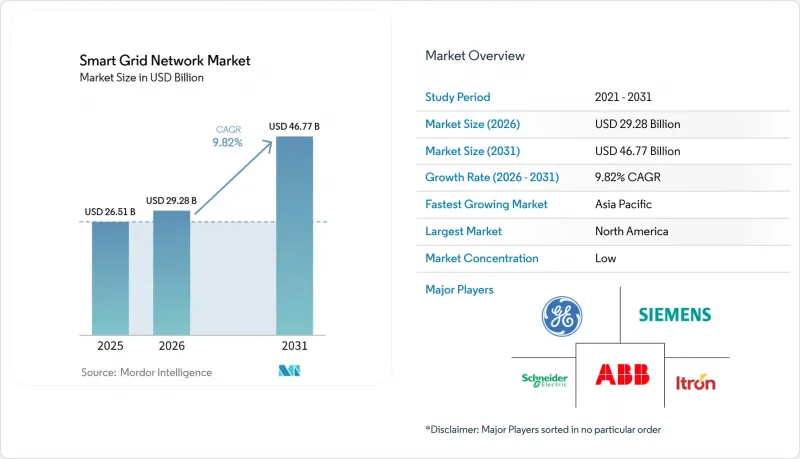
본 보고서는 구성 요소(하드웨어, 소프트웨어, 서비스), 그리드 단계(발전, 송전, 배전, 프로슈머), 기술 용도(AMI, 자동화, 수요 반응, 사이버 보안, 분석), 통신 방식(유선, 무선, 하이브리드), 최종 사용자(주거, 상업, 산업, 유틸리티/DSO), 지역(북미, 유럽, 아시아태평양, 남미, 중동 및 아프리카)별로 분류되어 있습니다. 예측치는 금액(달러)으로 표시되어 있습니다.
전 세계 스마트 그리드 네트워크 시장 동향 및 인사이트
정부 주도의 그리드 디지털화 의무화
정부 주도의 그리드 관련 지출은 정책적 신호 발신에서 직접적인 조달 지원으로 전환되고 있으며, 이에 따라 스마트 그리드 네트워크 시장에서 전력 사업자의 의사결정 주기가 단축되고 있습니다. 2026년 3월, 미국 에너지부는 ‘그리드 복원력 및 혁신 파트너십(GRIP)’ 프로그램의 일환으로 19억 달러 규모의 ‘스파크 이니셔티브’ 자금 지원 기회를 발표했습니다. 이 중 6억 1,400만 달러는 스마트 그리드 도입에, 8억 6,200만 달러는 그리드 혁신에 배정되었습니다. 유럽에서는 프랑스 규제 당국이 2017년부터 2024년까지 스마트 그리드 도입을 통해 누적 절감액이 17억 유로에 달했다고 보고함에 따라, 디지털 그리드로의 업그레이드에 대한 사업적 타당성이 더욱 확고해졌습니다. 또한, 독일의 TenneT Germany가 2025년에 전력 인프라 확장 및 현대화를 위해 100억 4,700만 유로(111억 달러)를 투자한 것으로 보아, 필요한 조치의 규모가 드러났습니다. 이러한 프로그램을 통해 전력 사업자들은 장기적인 자동화, 통신, 소프트웨어 프로젝트에 더 확신을 가지고 임할 수 있게 되었으며, 이에 따라 스마트 그리드 네트워크 시장에 대한 수요가 증가하고 있습니다. 또한, 공공 자금 지원 프로그램에서는 네트워크 전반에 걸쳐 변전소, 현장 장치, 고객 측 자산을 연결할 수 있는 플랫폼이 점점 더 중요시되고 있어, 전력 사업자들은 상호 운용 가능한 디지털 시스템으로의 전환을 요구받고 있습니다.
재생에너지 및 분산형 에너지 자원(DER) 통합에 대한 압박
발전 구성은 급속히 변화하고 있으며, 전력 사업자는 변동성이 더 크고 양방향인 전력 흐름을 관리해야 하기 때문에 스마트 그리드 네트워크 시장 전반에 걸쳐 제어 요구 사항이 증가하고 있습니다. 2025년, 전 세계 재생에너지 발전량이 석탄 화력 발전량을 처음으로 넘어섰으며, 이는 전력망이 수급 균형을 조정하는 방식에 있어 중대한 전환점이 되었습니다. 독일에서는 TenneT Germany사가 2025년 해상 풍력 발전의 통합 및 주요 송전 회랑을 지원하기 위해 투자액을 100억 4,700만 유로(111억 달러)로 증액했습니다. 이는 재생에너지의 확대가 현재 핵심 네트워크에 대한 지출을 주도하고 있음을 보여줍니다. 현재 가장 큰 압박을 받고 있는 부분은 배전망의 말단 부분입니다. 이곳에서는 지붕형 태양광 발전, 전기차 충전, 에너지 저장, 스마트 인버터를 통해 고객이 수동적인 부하에서 능동적인 전력망 참여자로 변화하고 있습니다. 이러한 변화로 인해 스마트 그리드 네트워크 시장에서 정밀 계량, 분산형 에너지 자원(DER) 관리, 수요 반응의 가치가 높아지고 있습니다. 이는 사업자가 보다 상세한 데이터와 더 빠른 제어 루프를 필요로 하기 때문입니다. 또한 이로 인해 발전 억제, 지역별 전압 관리 및 유연한 부하 조정이 부차적인 계획 과제가 아닌 현실적인 우선 과제가 되고 있습니다.
높은 설비 투자(CapEx) 요건
높은 자본 집약도는 여전히 스마트 그리드 네트워크 시장에서 가장 뚜렷한 제약 요인 중 하나입니다. 이는 전력 회사가 하드웨어, 통신, 소프트웨어, 시스템 통합에 동시에 자금을 투입해야 하기 때문입니다. 독일의 TenneT사는 2025년 한 해에만 100억 4,700만 유로(111억 달러)를 투자하고 있는데, 이는 성숙하고 자금력이 풍부한 그리드 시스템이라 할지라도 어느 정도의 규모가 필요한지를 보여줍니다. 미국 에너지부(DOE)의 SPARK 자금 조달 라운드 역시, 전력 회사의 자본 계획에서는 진행이 더딘 경향이 있는 프로젝트를 가속화하기 위해서는 종종 공공 지원이 필요함을 보여줍니다. 스마트 그리드 시장에서 중견 전력 회사들에게 이러한 지출 부담은 더욱 무겁습니다. 자금 조달 옵션이 제한적이고 비용 회수 속도도 느려지는 경향이 있기 때문입니다. 그 결과, 많은 사업자들은 그리드 디지털화를 전략적으로 정당화할 수 있는 범위 내에서 시스템이 요구하는 속도보다 더 느린 속도로 프로젝트를 단계적으로 진행하게 됩니다. 이러한 제약은 규제 측면의 지원, 요금을 통한 비용 회수, 또는 현지 제조거점이 현대화 목표를 아직 따라잡지 못한 시장에서 가장 두드러집니다.
부문 분석
2025년에는 하드웨어가 매출의 60.8%를 차지했습니다. 이는 스마트 그리드 네트워크 시장 전체에서 계량기 도입, 피더 자동화, 릴레이 및 변전소 설비의 물리적 규모를 반영한 것입니다. 전력 회사가 소프트웨어 주도형 오케스트레이션 및 분석의 가치를 극대화하기 위해서는 여전히 대규모 현장 장치 도입 기반이 필요하기 때문에 하드웨어의 입지는 계속해서 견고합니다. 많은 전력 회사가 1세대 설비를 교체하거나 네트워크의 새로운 영역으로 자동화를 확대함에 따라, 스마트 계량기, 자동화 장치, 보호 시스템은 여전히 자본 예산의 상당 부분을 차지하고 있습니다. 이로 인해 경쟁적 가치가 소프트웨어 계층으로 더욱 이동하고 있음에도 불구하고, 하드웨어는 스마트 그리드 네트워크 시장에서 중심적인 위치를 계속 차지하고 있습니다. 또한, 하드웨어 수요는 송전, 배전 및 고객 엔드포인트 전반에 걸친 신뢰할 수 있는 감지 및 통신에 대한 실질적인 요구와 밀접하게 연결되어 있습니다.
소프트웨어 시장은 2031년까지 연평균 성장률(CAGR) 13.5%를 나타낼 것으로 예측되며, 스마트 그리드 네트워크 시장에서 가장 빠르게 성장하는 분야가 될 것입니다. 이러한 성장은 고급 배전 관리 시스템(ADMS), 분산형 에너지 자원 관리 시스템(DERMS), 정전 분석, 그리고 전력 회사가 더욱 역동적인 그리드 환경에서 현장 데이터를 운영상의 의사 결정에 활용할 수 있도록 지원하는 기타 플랫폼에 대한 수요 증가를 반영합니다. 이러한 변화는 공급업체의 전략에도 나타나고 있으며, 허니웰은 2025년 8월 SparkMeter사의 Praxis, GridScan, GridFin과 같은 소프트웨어 자산을 인수하여 유틸리티용 포트폴리오를 확대했습니다. 하드웨어 분야도 가격 압박에 직면해 있으며, 중국 제조업체들이 수직 통합을 통해 스마트 계량기 단가에서 30%에서 40%의 비용 우위를 확보하고 있기 때문에 소프트웨어 및 서비스를 통한 이익률 보호가 필요해지고 있습니다. 유틸리티자가 OT 시스템과 IT 시스템을 대규모로 연동하기 위해 통합, 사이버 보안 운영 및 관리형 지원을 점점 더 필요로 하고 있기 때문에 서비스는 스마트 그리드 네트워크 시장의 두 부문을 모두 뒷받침하고 있습니다.
2025년에는 배전 부문이 매출의 48.0%를 차지하며, 이는 전력 회사들이 스마트 그리드 네트워크 시장에서 여전히 실질적인 현대화 투자의 최대 비중을 배전 부문에 집중하고 있음을 보여줍니다. 이러한 분배는 정전, 전력 손실 및 고객과 직결되는 신뢰성 문제가 발전이나 장거리 송전 자산보다 배전 네트워크에서 더 두드러지게 나타나는 경우가 많다는 운영상의 현실을 반영합니다. 따라서 피더 자동화, 정전 관리, 고급 계량 인프라(AMI), 전압 제어는 스마트 그리드 네트워크 시장에서 계속해서 주요 구매 분야로 남아 있습니다. 또한 배전은 전력 회사의 시스템과 프로슈머 자산, 상업용 부하, 그리고 교통 및 디지털 인프라에서 발생하는 새로운 전기화 수요가 연결되는 접점으로서의 역할도 수행하고 있습니다. 이로 인해 배전은 예측 기간 동안 다른 그리드 단계보다 더 큰 역할을 계속 수행할 가능성이 높은 구조적 위치에 있습니다.
소비자 및 프로슈머(생산자 겸 소비자) 부문은 2031년까지 연평균 성장률(CAGR) 12.6%를 나타낼 것으로 예측되며, 스마트 그리드 네트워크 시장에서 가장 빠르게 확대될 그리드 단계가 될 전망입니다. 그 이유는 분명합니다. 지붕형 태양광 발전, 전기차 충전기, 가정용 배터리, 스마트 인버터의 보급으로 인해 전력 회사가 모니터링하고 제어해야 하는 양방향 전력 흐름과 지역 차원의 의사결정 지점이 증가하고 있기 때문입니다. 분산형 에너지 도입률이 높은 시장에서는 이러한 고객 측 자산이 수요 유연성의 원천일 뿐만 아니라 유용한 그리드 센서 역할도 수행하고 있습니다. 송전망의 현대화는 여전히 중요하며, 독일의 TenneT사가 수립한 2025년 투자 프로그램은 재생에너지의 통합이 동시에 핵심 네트워크에 대한 지출을 어떻게 끌어올릴 수 있는지를 보여주고 있습니다. 그렇지만 스마트 그리드 네트워크 시장에서 현재 가장 역동적인 부분은 그리드 에지에 있으며, 이곳에서는 고객의 행동, 분산형 에너지 자원(DER)의 참여, 그리고 지역별 제어 요건이 전력 회사의 운영 모델을 변화시키고 있습니다.
지역별 분석
2025년, 북미는 매출의 35.5%를 차지하며 스마트 그리드 네트워크 시장에서 가장 규모가 큰 지역 점유율을 기록했습니다. 이 지역은 스마트 계량기 도입 대수가 많고, 제2차 AMI(첨단 계량 인프라) 업데이트가 진행 중이며, 전력 회사들이 피더 자동화 및 디지털 제어에 폭넓게 주력하고 있다는 점에서 혜택을 보고 있습니다. 미국 에너지부는 2026년 3월, SPARK 프로그램 하에서 19억 달러를 지원함으로써 이러한 수요 증가를 뒷받침했습니다. 이 중 6억 1,400만 달러는 스마트 그리드 도입에, 8억 6,200만 달러는 그리드 혁신에 배정되었습니다. 유럽은 스마트 그리드 네트워크 시장에서 다른 길을 걷고 있으며, 탈탄소화에 대한 강력한 압력이 있는 반면, 사업자가 인프라를 어느 정도의 속도로 구축할 수 있는지에 대해서는 더 엄격한 자본 규율이 부과되고 있습니다. 프랑스 규제 당국은 2017년부터 2024년까지 스마트 그리드를 통해 누적 절감액이 17억 유로에 달했다고 보고했습니다. 한편, 독일의 TenneT사는 2025년에 100억 4,700만 유로(111억 달러)를 투자하고 있으며, 이는 디지털화와 송전망 업그레이드가 모두 전력 사업자의 주요 지출 계획에 포함되고 있음을 보여줍니다.
아시아태평양은 2031년까지 연평균 성장률(CAGR) 14.8%로 확대될 것으로 예측되며, 스마트 그리드 네트워크 시장 규모 측면에서 가장 빠르게 성장하는 지역이 될 전망입니다. 이 지역에서는 대규모 네트워크 확장 프로그램과 신속한 구축 아키텍처가 결합되어, 기본적인 전력 인프라 업그레이드와 새로운 디지털 그리드 계층을 모두 뒷받침하고 있습니다. 인도의 송배전 투자액은 지난 5년간 연평균 15%의 성장률을 기록한 후 2026년에는 260억 달러에 달할 전망이며, 인도는 그리드의 광범위한 디지털화를 뒷받침할 대규모 스마트 계량기 도입 목표를 추진하고 있습니다. 중국은 국가 주도의 인프라 계획이 재생에너지 통합과 디지털 네트워크 투자를 지속적으로 뒷받침하고 있어, 스마트 그리드 네트워크 시장의 또 다른 주요 성장 동력으로 자리 잡고 있습니다. 이 지역 전체에서 전력 사업자들은 ‘FTTM(Fiber-to-the-Meter)’, 무선 광역 네트워크(WAN), 소프트웨어 기반 제어 방식으로 빠르게 전환하고 있으며, 이를 통해 아시아태평양은 다른 지역에서 볼 수 있는 점진적인 업데이트 주기에 비해 현대화 일정을 단축할 수 있게 되었습니다.
남미는 스마트 그리드 네트워크 시장에서 여전히 높은 잠재력을 지니고 있으나 보급률은 낮은 지역으로, 현대화의 필요성은 분명하지만 도입 속도는 지역별로 편차를 보이고 있습니다. 멕시코는 2025년부터 2030년까지의 전략 계획에 따라 송전망 현대화 프로젝트에 1,635억 4,000만 페소(95억 달러)를 투자할 것이라고 발표했습니다. 한편, 브라질의 CEMIG는 험준한 지형에서 송전망 자동화를 향상시키기 위해 화웨이(Huawei)와 제휴하여 450 MHz 대역의 프라이빗 LTE(Long-Term Evolution) 네트워크를 구축했습니다. 중동 및 아프리카에서는 디지털 그리드에 대한 투자가 고밀도 레거시 통신 네트워크의 교체를 위한 것보다는 에너지 다각화, 원격 운영 및 획기적인 구축 모델과 더 밀접하게 관련되어 있습니다. 이로 인해 기존 유선 네트워크 확장에 더 오랜 기간과 막대한 비용이 소요되는 분야에서 스마트 그리드 네트워크 시장 내에서 무선 자동화, 지능형 변전소 및 원격 모니터링 솔루션에 대한 수요가 발생하고 있습니다.
기타 혜택:
- 엑셀 형식 시장 예측(ME) 시트
- 3개월간의 애널리스트 지원
자주 묻는 질문
목차
제1장 서론
제2장 조사 방법
제3장 주요 요약
제4장 시장 구도
제5장 시장 규모와 성장 예측
제6장 경쟁 구도
제7장 시장 기회와 향후 전망
JHS 26.08.11According to Mordor Intelligence, the smart grid network market size is expected to increase from USD 26.51 billion in 2025 to USD 29.28 billion in 2026 and reach USD 46.77 billion by 2031, growing at a CAGR of 9.82% over 2026-2031.
This report is Segmented by Component (Hardware, Software, Services), Grid Stage (Generation, Transmission, Distribution, Prosumer), Technology Application (AMI, Automation, Demand Response, Cybersecurity, Analytics), Communication (Wired, Wireless, Hybrid), End User (Residential, Commercial, Industrial, Utilities/DSOs), Geography (North America, Europe, Asia-Pacific, South America, MEA). Forecasts in Value (USD).
Global Smart Grid Network Market Trends and Insights
Government-Funded Grid Digitization Mandates
Government-backed grid spending has moved from policy signaling into direct procurement support, which shortens utility decision cycles in the smart grid network market. In March 2026, the U.S. Department of Energy announced the USD 1.9 billion Spark Initiative funding opportunity under the Grid Resilience and Innovation Partnerships (GRIP) program, including USD 614 million for smart grid deployments and USD 862 million for grid innovation. In Europe, the business case for digital grid upgrades is stronger because France's regulator reported EUR 1.7 billion in cumulative savings from smart grid deployments between 2017 and 2024. Germany also showed the scale of commitment required, as TenneT Germany invested EUR 10.047 billion, or USD 11.1 billion, in 2025 to expand and modernize power infrastructure. These programs lift demand in the smart grid network market because utilities can commit to long-cycle automation, communications, and software projects with more confidence. They also push utilities toward interoperable digital systems, since public funding programs increasingly favor platforms that can connect substations, field devices, and customer-side assets across the full network.
Renewable & Distributed Energy Resources (DER) Integration Pressure
The generation mix is changing fast, and that raises control requirements across the smart grid network market because utilities must manage more variable and bidirectional power flows. Global renewable electricity generation exceeded coal-fired generation for the first time in 2025, which marked a major shift in how grids must balance supply and demand. In Germany, TenneT Germany raised investment to EUR 10.047 billion, or USD 11.1 billion, in 2025 to support offshore wind integration and major transmission corridors, showing how renewable buildout now drives core network spending. The pressure is now strongest at the distribution edge, where rooftop solar, EV charging, storage, and smart inverters turn customers into active grid participants rather than passive loads. That shift increases the value of advanced metering, DER management, and demand response in the smart grid network market because operators need more granular data and faster control loops. It also makes curtailment, local voltage management, and flexible load orchestration practical priorities rather than secondary planning topics.
High CapEx Requirements
High capital intensity remains one of the clearest limits on the smart grid network market because utilities must fund hardware, communications, software, and systems integration at the same time. TenneT Germany invested EUR 10.047 billion, or USD 11.1 billion, in 2025 alone, which shows the scale required even in mature and well-funded grid systems. The Department of Energy's (DOE's) SPARK funding round also shows that public support is often needed to accelerate projects that would otherwise move more slowly through utility capital plans. In the smart grid network market, this spending burden is heavier for mid-tier utilities because they often face narrower financing options and slower cost recovery. The result is that many operators can justify grid digitization strategically but still phase projects more slowly than system needs would suggest. That constraint is strongest in markets where regulatory support, rate recovery, or local manufacturing depth are still catching up with modernization targets.
Other drivers and restraints analyzed in the detailed report include:
- AI-Based Predictive Maintenance Adoption
- 5G/ Low-Power Wide-Area (LPWA) Connectivity Enabling Edge Intelligence
- Protocol & System Interoperability Gaps
For complete list of drivers and restraints, kindly check the Table Of Contents.
Segment Analysis
Hardware accounted for 60.8% of revenue in 2025, which reflects the physical scale of meter deployment, feeder automation, relays, and substation equipment across the smart grid network market. That position remains strong because utilities still need large installed bases of field devices before they can unlock the full value of software-led orchestration and analytics. Smart meters, automation devices, and protection systems continue to absorb a large share of capital budgets because many utilities are replacing first-generation installations or extending automation into new parts of their networks. This keeps hardware central to the smart grid network market even as competitive value moves further into software layers. Hardware demand also remains tied to the practical need for dependable sensing and communications across transmission, distribution, and customer endpoints.
Software is forecast to grow at 13.5% CAGR through 2031, which makes it the fastest-growing component in the smart grid network market. That growth reflects rising demand for Advanced Distribution Management System (ADMS), Distributed Energy Resource Management System (DERMS), outage analytics, and other platforms that help utilities turn field data into operating decisions across more dynamic grid conditions. The shift is visible in vendor strategy, because Honeywell expanded its utility portfolio in August 2025 by acquiring SparkMeter's Praxis, GridScan, and GridFin software assets. The hardware side is also facing price pressure, with Chinese manufacturers holding a 30%-to-40%-unit cost advantage in smart meters through vertical integration, which raises the need for margin protection through software and services. Services support both segments in the smart grid network market because utilities increasingly need integration, cybersecurity operations, and managed support to connect OT and IT systems at scale.
Distribution held 48.0% of revenue in 2025, which shows where utilities still concentrate the largest share of practical modernization spending in the smart grid network market. That allocation reflects the operational reality that outages, losses, and customer-facing reliability issues are often most visible on distribution networks rather than on generation or long-distance transmission assets. Feeder automation, outage management, Advanced Metering Infrastructure (AMI), and voltage control therefore remain central purchase areas in the smart grid network market. Distribution also serves as the connection point where utility systems meet prosumer assets, commercial loads, and new electrified demand from transport and digital infrastructure. This gives it a structural role that is likely to remain larger than other grid stages over the forecast period.
The consumption and prosumer segment is forecast to grow at 12.6% CAGR through 2031, making it the fastest-moving grid stage in the smart grid network market. The reason is clear: rooftop solar, EV chargers, residential batteries, and smart inverters are increasing the volume of two-way flows and local decision points that utilities must monitor and control. In markets with high distributed energy adoption, these customer-side assets are becoming useful grid sensors as well as sources of demand flexibility. Transmission modernization still matters, and TenneT Germany's 2025 investment program shows how renewable integration can lift backbone network spending at the same time. Even so, the most dynamic part of the smart grid network market now sits at the grid edge, where customer behavior, DER participation, and localized control requirements are changing the operating model of utilities.
Complete Report Scope:
- By Component
- Hardware
- Software
- Services
- By Grid Stage
- Generation
- Transmission
- Distribution
- Consumption/Prosumer
- By Technology Application Area
- Advanced Metering Infrastructure (AMI)
- Distribution Automation
- Transmission Upgrades and FACTS
- Demand Response
- Grid Cybersecurity
- Grid Analytics and Software
- Other Emerging Areas
- By Communication Technology
- Wired (Fiber, PLC)
- Wireless (RF Mesh, Cellular IoT, 5G, LPWA)
- Hybrid Architectures
- By End User
- Residential
- Commercial
- Industrial
- Utilities and DSOs
- By Geography
- North America
- United States
- Canada
- Mexico
- Europe
- Germany
- France
- United Kingdom
- Spain
- Italy
- NORDIC Countries
- Russia
- Rest of Europe
- Asia-Pacific
- China
- Japan
- India
- South Korea
- ASEAN Countries
- Australia and New Zealand
- Rest of Asia-Pacific
- South America
- Brazil
- Argentina
- Colombia
- Rest of South America
- Middle East and Africa
- Saudi Arabia
- United Arab Emirates
- South Africa
- Egypt
- Rest of Middle East and Africa
- North America
Geography Analysis
North America held 35.5% of revenue in 2025, which gave it the largest regional position in the smart grid network market. The region benefits from a large installed smart meter base, ongoing second-wave AMI replacement, and a broad utility focus on feeder automation and digital control. The U.S. Department of Energy strengthened that demand path in March 2026 by releasing USD 1.9 billion under SPARK, including USD 614 million for smart grid deployments and USD 862 million for grid innovation. Europe follows a different path in the smart grid network market, with strong decarbonization pressure but tighter capital discipline around how fast operators can build. France's regulator reported EUR 1.7 billion in cumulative smart grid savings between 2017 and 2024, while TenneT Germany invested EUR 10.047 billion, or USD 11.1 billion, in 2025, which shows that digital and transmission upgrades are both moving into core utility spending plans.
Asia-Pacific is forecast to expand at 14.8% CAGR through 2031, making it the fastest-growing region in the smart grid network market size. The region combines large network expansion programs with faster rollout architectures, which supports both basic electrification upgrades and newer digital grid layers. India's transmission and distribution investment reached USD 26 billion in 2026 after growing at 15% annually over the prior five years, and the country is pushing large smart meter targets that support broader grid digitization. China remains the other major volume engine in the smart grid network market because state-backed infrastructure planning continues to support renewable integration and digital network investment. Across the region, utilities are moving quickly toward fiber-to-the-meter, wireless field-area networks, and software-enabled control, which helps Asia-Pacific compress modernization timelines relative to more incremental replacement cycles elsewhere.
South America remains a high-potential but underpenetrated part of the smart grid network market, where modernization needs are clear but rollout speed is uneven. Mexico has announced 163,540 million pesos, or USD 9.5 billion, in transmission modernization projects under its 2025 to 2030 strategic plan, while Brazil's CEMIG partnered with Huawei on a private 450 MHz Long-Term Evolution (LTE) network to improve grid automation over challenging terrain. In the Middle East and Africa, digital grid investment is tied more closely to energy diversification, remote operations, and leapfrog deployment models than to replacement of dense legacy communication networks. That creates room in the smart grid network market for wireless automation, intelligent substations, and remote monitoring solutions where conventional wireline expansion would take longer or cost more.
- ABB Ltd
- Cisco Systems Inc.
- Eaton Corporation plc
- General Electric Company
- Itron Inc.
- Osaki Electric Co. Ltd
- Hitachi Ltd
- Schneider Electric SE
- Siemens AG
- Honeywell International Inc.
- Landis+Gyr AG
- IBM Corporation
- Oracle Corporation
- Huawei Technologies Co. Ltd.
- Kamstrup A/S
- S&C Electric Company
- Toshiba Corporation
- Wipro Limited
- Johnson Controls International plc
Additional Benefits:
- The market estimate (ME) sheet in Excel format
- 3 months of analyst support
TABLE OF CONTENTS
1 Introduction
- 1.1 Study Assumptions & Market Definition
- 1.2 Scope of the Study
2 Research Methodology
3 Executive Summary
4 Market Landscape
- 4.1 Market Overview
- 4.2 Market Drivers
- 4.2.1 Government-funded grid digitization mandates
- 4.2.2 Rapid AMI roll-outs for demand-side management
- 4.2.3 Renewable & DER integration pressure
- 4.2.4 AI-based predictive maintenance adoption
- 4.2.5 5G / LPWA connectivity enabling edge intelligence
- 4.2.6 Blockchain-enabled transactive energy platforms
- 4.3 Market Restraints
- 4.3.1 High capex requirements
- 4.3.2 Protocol & system interoperability gaps
- 4.3.3 Shortage of cyber-physical talent
- 4.3.4 Geopolitical supply-chain restrictions
- 4.4 Supply-Chain Analysis
- 4.5 Regulatory Landscape
- 4.6 Technological Outlook
- 4.7 Porter's Five Forces
- 4.7.1 Bargaining Power of Suppliers
- 4.7.2 Bargaining Power of Buyers
- 4.7.3 Threat of New Entrants
- 4.7.4 Threat of Substitutes
- 4.7.5 Competitive Rivalry
5 Market Size & Growth Forecasts
- 5.1 By Component
- 5.1.1 Hardware
- 5.1.2 Software
- 5.1.3 Services
- 5.2 By Grid Stage
- 5.2.1 Generation
- 5.2.2 Transmission
- 5.2.3 Distribution
- 5.2.4 Consumption/Prosumer
- 5.3 By Technology Application Area
- 5.3.1 Advanced Metering Infrastructure (AMI)
- 5.3.2 Distribution Automation
- 5.3.3 Transmission Upgrades and FACTS
- 5.3.4 Demand Response
- 5.3.5 Grid Cybersecurity
- 5.3.6 Grid Analytics and Software
- 5.3.7 Other Emerging Areas
- 5.4 By Communication Technology
- 5.4.1 Wired (Fiber, PLC)
- 5.4.2 Wireless (RF Mesh, Cellular IoT, 5G, LPWA)
- 5.4.3 Hybrid Architectures
- 5.5 By End User
- 5.5.1 Residential
- 5.5.2 Commercial
- 5.5.3 Industrial
- 5.5.4 Utilities and DSOs
- 5.6 By Geography
- 5.6.1 North America
- 5.6.1.1 United States
- 5.6.1.2 Canada
- 5.6.1.3 Mexico
- 5.6.2 Europe
- 5.6.2.1 Germany
- 5.6.2.2 France
- 5.6.2.3 United Kingdom
- 5.6.2.4 Spain
- 5.6.2.5 Italy
- 5.6.2.6 NORDIC Countries
- 5.6.2.7 Russia
- 5.6.2.8 Rest of Europe
- 5.6.3 Asia-Pacific
- 5.6.3.1 China
- 5.6.3.2 Japan
- 5.6.3.3 India
- 5.6.3.4 South Korea
- 5.6.3.5 ASEAN Countries
- 5.6.3.6 Australia and New Zealand
- 5.6.3.7 Rest of Asia-Pacific
- 5.6.4 South America
- 5.6.4.1 Brazil
- 5.6.4.2 Argentina
- 5.6.4.3 Colombia
- 5.6.4.4 Rest of South America
- 5.6.5 Middle East and Africa
- 5.6.5.1 Saudi Arabia
- 5.6.5.2 United Arab Emirates
- 5.6.5.3 South Africa
- 5.6.5.4 Egypt
- 5.6.5.5 Rest of Middle East and Africa
- 5.6.1 North America
6 Competitive Landscape
- 6.1 Market Concentration
- 6.2 Strategic Moves (M&A, Partnerships, PPAs)
- 6.3 Market Share Analysis (Market Rank/Share for key companies)
- 6.4 Company Profiles (includes Global level Overview, Market level overview, Core Segments, Financials as available, Strategic Information, Products & Services, and Recent Developments)
- 6.4.1 ABB Ltd
- 6.4.2 Cisco Systems Inc.
- 6.4.3 Eaton Corporation plc
- 6.4.4 General Electric Company
- 6.4.5 Itron Inc.
- 6.4.6 Osaki Electric Co. Ltd
- 6.4.7 Hitachi Ltd
- 6.4.8 Schneider Electric SE
- 6.4.9 Siemens AG
- 6.4.10 Honeywell International Inc.
- 6.4.11 Landis+Gyr AG
- 6.4.12 IBM Corporation
- 6.4.13 Oracle Corporation
- 6.4.14 Huawei Technologies Co. Ltd.
- 6.4.15 Kamstrup A/S
- 6.4.16 S&C Electric Company
- 6.4.17 Toshiba Corporation
- 6.4.18 Wipro Limited
- 6.4.19 Johnson Controls International plc
7 Market Opportunities & Future Outlook
- 7.1 White-space & Unmet-Need Assessment


