|
시장보고서
상품코드
2100557
자궁내막암 시장 : 시장 점유율 분석, 업계 동향 및 통계, 성장 예측(2026-2031년)Endometrial Cancer - Market Share Analysis, Industry Trends & Statistics, Growth Forecasts (2026 - 2031) |
||||||
 Mordor Intelligence
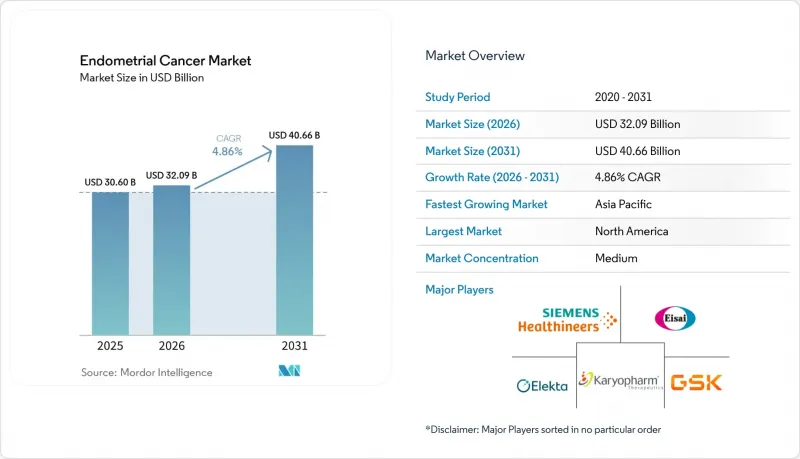
Mordor Intelligence에 의하면, 자궁내막암 시장 규모는 2025년 306억 달러로 평가되었고, 2026년에는 320억 9,000만 달러로 확대될 것으로 추정되고, 2026-2031년 CAGR 4.86%로 성장을 지속할 전망이며, 2031년에는 406억 6,000만 달러에 이를 것으로 예측됩니다.
본 보고서는 암 유형별(자궁내막암(선암, 육종 등) 및 자궁육종), 치료법별(면역요법, 방사선 요법 등), 진단 방법별(생검, 골반 초음파 검사, 자궁경 검사 등), 그리고 지역별(북미, 유럽, 아시아태평양 등)로 분류되어 있습니다. 시장 전망은 금액(달러) 기준으로 제시되어 있습니다.
세계의 자궁내막암 시장 동향 및 인사이트
비만 및 여성 고령화에 따른 발병률 상승
세계 비만 증가와 여성의 평균 수명 연장으로 인해 치료 대상 환자 수가 증가하고 있으며, 이로 인해 종양 의료 서비스에 부담이 가중되고 치료법 및 진단법에 대한 지속적인 수요가 발생하고 있습니다. 당뇨병이나 고혈압 등의 대사성 합병증은 수술 위험을 높이고 수술 전후 관리를 복잡하게 만들기 때문에 전신 요법의 조기 도입이 촉진되고 있습니다. 자궁내막 두께가 14mm를 초과할 경우, 동반 악성 종양의 위험이 4배로 높아지기 때문에 병기 판정을 위해 산부인과 종양학과로의 의뢰가 증가하고 있습니다. 이에 대응하여 의료 시스템에서는 특히 교외나 지방에서 증가하는 환자 수를 관리하기 위해 다직종 협력 클리닉의 확충과 원격 종양학의 활용이 추진되고 있습니다. 보험사도 비만과 관련된 위험을 점점 더 인식하게 되어, 예방적 선별 검사에 대한 보험 급여를 승인함으로써 새로 진단된 환자를 치료 과정으로 유도하고 있습니다. BMI가 높은 환자층이 60-65세 연령대에 진입함에 따라, 자궁내막암 시장은 장기적인 성장이 예상됩니다.
면역요법과 화학요법의 병용 요법의 급속한 보급
2024년 1월부터 2025년 3월 사이에 3가지 체크포인트 억제제의 병용 요법이 규제 당국의 승인을 받았으며, 모두 백금계 이중 화학요법에 비해 우수한 생존율을 보였습니다. 도스탈리맙과 카보플라틴·파클리탁셀 병용 요법에서는 전체 생존 기간의 중앙값이 44.6개월로 연장된 반면, 화학요법 단독 요법에서는 28.2개월이었습니다. 펨브롤리주맙을 포함한 요법은 미스매치 복구 결손(MMR-D) 종양에서 무재발 생존 기간을 70% 개선한 반면, 듀르발맙은 DUO-E 임상시험에서 질병 진행 위험을 58% 감소시켰습니다. 이러한 데이터를 통해 임상적 기대치가 재정의되었으며, 현재 각국의 지침에서는 진행성 암의 1차 치료법으로 병용 요법이 권장되고 있습니다. 이러한 변화에 따라 분자 검사의 확대가 요구되고 있습니다. 바이오마커에 기반한 적격성 판정이 보험 급여 여부를 결정하고, 치료 성과를 최적화하기 때문입니다. 캐나다와 유럽연합(EU)에서의 신속한 승인은 전 세계적인 조화가 진행되고 있음을 보여주며, 다국적 임상시험의 결과가 신속하게 상업적 수익으로 이어질 수 있도록 하고 있습니다.
신약의 높은 치료비
체크포인트 억제제의 병용 요법은 고가의 정가가 책정되어 있으며, 미스매치 복구 능력을 가진 종양에서 질 조정 생존년(QALY)당 15만 달러를 초과하는 증분 비용 대비 효과 비율을 나타내고 있습니다. 약제경제학 연구에 따르면, 중국에서 도스탈리맙과 화학요법의 병용 요법이 지불 의향액 상한선을 충족하려면 가격을 15% 인하해야 합니다. 재발 사례의 관리에는 비재발 사례와 비교하여 환자 1인당 연간 8만 4,562달러의 추가 비용이 소요됩니다. 저소득 지역에서는 최대 7년에 달하는 보험 급여 지연이 생존 격차를 확대시켜, 임상적 돌파구가 있음에도 불구하고 자궁내막암 시장의 성장을 제약하고 있습니다.
부문 분석
2025년 자궁내막암 시장에서 자궁내막암은 매출 점유율의 73.10%를 차지하며 시장의 중심이 되었습니다. 이는 가장 많은 환자 수와 체크포인트 억제제와의 병용 요법에 관한 광범위한 근거에 힘입은 결과입니다. 자궁육종은 사례 수로는 소수이지만, 정밀 수술 기술과 적응증 외 사용된 표적 치료제로 인해 치료 성과가 향상되고 있어 연평균 성장률(CAGR) 7.84%의 성장 궤도에 올라 있습니다. 현재 암 육종 진료 지침에서는 MMR(미스매치 복구) 상태와 관계없이 확실한 생존 이점이 인정되고 있음을 반영하여, 도스탈리맙을 기반으로 한 치료 요법이 권장되고 있습니다. 진행성 선암은 펨브롤리주맙과 카보플라틴·파클리탁셀 병용 요법에 특히 양호한 반응을 보이고 있으며, 무재발 생존 기간이 70% 연장된 것이 입증됨에 따라 의료진의 선호도가 정착되고 있습니다. 분자 아형 분석을 통해 예상치 못하게 침습성이 높은 p53 유사 NSMP 종양이 밝혀졌으며, 이러한 병변은 이중 체크포인트 억제 요법을 검증하는 차세대 임상시험에 빠르게 포함되고 있습니다.
AI를 활용한 조직병리학 플랫폼은 기존에 오분류되었던 고위험 클론을 특정하여 전신 요법의 조기 시작을 가능하게 하고 있습니다. 육종양 암 사례 시리즈에서 검토된 렌바티닙과 펨브롤리주맙의 병용 요법은 관리 가능한 범위의 고혈압과 피로를 동반하면서도 60% 이상의 질병 제어율을 달성하여, 백금 제제 치료에 반응하지 않았을 경우의 구제 요법으로서의 선택지를 제공합니다. 바이오마커 검사가 일상화된 현재, 치료법 선택은 조직형에서 변이에 기반한 알고리즘으로 전환되고 있으며, 이에 따라 시장 세분화가 더욱 세분화되면서 자궁내막암 시장에서 동반 진단제에 대한 수요가 증가하고 있습니다.
지역별 분석
북미는 면역요법의 보험 적용 범위가 넓고, 선별 검사의 보급률이 높으며, 전문 암 치료 센터가 집중되어 있다는 점을 배경으로 2025년에는 37.25%의 점유율을 차지하며 자궁내막암 시장 규모를 견인했습니다. 분자진단의 보급률은 거의 100%에 육박하며, 캐나다 보건부가 2025년에 펨브롤리주맙과 도스탈리맙을 몇 주 간격으로 잇달아 승인한 것은 신속한 규제 심사 절차를 뒷받침합니다. 성과 연계형 계약(Outcomes-Based Agreements) 등의 가격 협상 메커니즘을 통해 예산에 미치는 영향을 관리하는 동시에, 공적 보험자에 의한 적시 보험 적용이 보장되고 있습니다.
유럽은 혁신에 우호적이면서도 비용 의식이 높은 환경이 유지되고 있습니다. CHMP(유럽의약품청 의약품위원회)가 도스탈리맙의 적응증을 모든 진행성 사례로 확대하는 데 대해 긍정적인 견해를 밝힘에 따라, 유럽 전역에서의 보험 적용을 위한 길이 열렸으나, 각국 규제 당국은 비용 대비 효과 비율을 면밀히 검토하고 있으며, 보험 적용 전에 위험 분담 계약을 의무화하는 경우도 있습니다. 동유럽 시장에서는 보급 속도가 완만하지만, EU의 결속 기금이 분자병리학 검사실에 대한 지원을 시작함에 따라 접근성 격차 해소가 진행되고 있습니다.
아시아태평양은 2031년까지의 연평균 성장률(CAGR)이 8.93%로 가장 높으며, 이는 인구 통계학적 압력과 정부의 정책 모두를 반영하고 있습니다. 일본과 한국은 면역요법을 국가 지침에 포함시킨 반면, 중국은 국내 생산을 활용하여 가격을 인하하고, 하이난성에서 진행 중인 실제 임상 데이터(RWE) 시범 사업을 통해 승인을 가속화하고 있습니다. 보다 광범위한 질병 부담에 관한 연구에 따르면, 2050년까지 특히 60-64세 여성에서 환자 수가 지속적으로 증가할 것으로 예측되어 수요의 지속성이 강조되고 있습니다.
남미에서는 민간 보험의 확대와 의료 관광 증가가 치료 도입 양상에 영향을 미치고 있습니다. 안데스 국가 및 중미의 환자들은 자국에서는 구할 수 없는 체크포인트 억제제를 구하기 위해 종종 브라질로 여행하고 있습니다. 사하라 이남 아프리카에서는 의료 격차가 가장 심각합니다. 조사 대상 의료 제공업체의 92%가 부인과 종양학 분야의 해외 의료 여행을 보고하고 있어, 충족되지 않은 수요가 부각되고 있습니다. 병리 검사실 설비 갱신을 지원하는 국제 원조 프로그램 덕분에 진단 격차는 줄어들기 시작했으며, 이는 향후 10년 동안 측정 가능한 시장 성장으로 이어질 것입니다.
기타 혜택 :
- 엑셀 형식 시장 예측(ME) 시트
- 3개월간의 애널리스트 지원
자주 묻는 질문
목차
제1장 서론
제2장 조사 방법
제3장 주요 요약
제4장 시장 구도
제5장 시장 규모 및 성장 예측
제6장 경쟁 구도
제7장 시장 기회 및 향후 전망
AJY 26.08.07According to Mordor Intelligence, the endometrial cancer market size is expected to grow from USD 30.60 billion in 2025 to USD 32.09 billion in 2026 and is forecast to reach USD 40.66 billion by 2031 at 4.86% CAGR over 2026-2031.
This report is Segmented by Type of Cancer (Endometrial Carcinoma [Adenocarcinoma, Carcinosarcoma, and More], and Uterine Sarcomas), Type of Therapy (Immunotherapy, Radiation Therapy, and More), Diagnosis Method (Biopsy, Pelvic Ultrasound, Hysteroscopy, and More), and Geography (North America, Europe, Asia-Pacific, and More). The Market Forecasts are Provided in Terms of Value (USD).
Global Endometrial Cancer Market Trends and Insights
Rising Prevalence Linked to Obesity & Ageing Women
Global increases in obesity and longer female life expectancy enlarge the treated population, straining oncology services and creating sustained demand for therapies and diagnostics. Metabolic comorbidities such as diabetes and hypertension raise surgical risk and complicate perioperative management, encouraging earlier adoption of systemic therapy options. Endometrial thickness readings above 14 mm quadruple concurrent malignancy risk, prompting more frequent gynecologic oncology referrals for staging. Healthcare systems respond by scaling multidisciplinary clinics and leveraging tele-oncology to manage rising caseloads, especially in suburban and rural settings. Insurers increasingly recognize obesity-linked risk, approving preventive screening benefits that feed newly diagnosed cases into the treatment pipeline. As high-BMI cohorts enter the 60-65 year age band, the endometrial cancer market is set for long-run expansion.
Rapid Adoption of Immunotherapy-Chemotherapy Combinations
Three checkpoint inhibitor combinations won regulatory clearance between January 2024 and March 2025, each showing superior survival to platinum doublet chemotherapy. Dostarlimab plus carboplatin-paclitaxel extended median overall survival to 44.6 months versus 28.2 months for chemotherapy alone. Pembrolizumab regimens improved progression-free survival by 70% in mismatch-repair-deficient tumors, while durvalumab cut disease-progression risk by 58% in the DUO-E trial. Such data reset clinical expectations, and national guidelines now recommend combination therapy as frontline care for advanced disease. The shift forces expansion of molecular testing, because biomarker-guided eligibility determines reimbursement and optimizes outcomes. Rapid approvals in Canada and the European Union illustrate global harmonization, enabling multinational trial readouts to convert swiftly into commercial revenue.
High Treatment Costs of Novel Agents
Checkpoint inhibitor combinations command premium list prices, leading to incremental cost-effectiveness ratios above USD 150,000 per quality-adjusted life year for mismatch-repair-proficient tumors. Pharmacoeconomic studies show dostarlimab plus chemotherapy requires a 15% price trim to meet willingness-to-pay thresholds in China. Recurrent-disease management adds USD 84,562 in excess annual costs per patient compared with non-recurrent cases. In lower-income regions, reimbursement delays of up to seven years exacerbate survival gaps, constraining the endometrial cancer market despite clinical breakthroughs.
Other drivers and restraints analyzed in the detailed report include:
- Favourable Reimbursement for Targeted Therapies
- Growth in Minimally-Invasive Diagnostic Procedures
- Drug-Related Toxicities Limiting Adherence
For complete list of drivers and restraints, kindly check the Table Of Contents.
Segment Analysis
Endometrial carcinoma anchored the endometrial cancer market with a 73.10% revenue share in 2025, supported by the largest patient pool and extensive evidence for checkpoint inhibitor combinations. Uterine sarcomas, though accounting for a minority of cases, are on an 7.84% CAGR trajectory as precision-surgery techniques and off-label targeted agents improve outcomes. Carcinosarcoma guidelines now recommend dostarlimab-based regimens, reflecting solid survival benefits across mismatch-repair status. Advanced adenocarcinoma responds especially well to pembrolizumab plus carboplatin-paclitaxel, which demonstrated a 70% progression-free survival gain, consolidating physician preference. Molecular sub-typing reveals p53-like NSMP tumors with unexpectedly aggressive behavior; these lesions are enrolling rapidly in next-generation trials exploring double-checkpoint blockade.
AI-enabled histopathology platforms flag high-risk clones previously misclassified, allowing earlier systemic therapy. Lenvatinib-pembrolizumab, studied in carcinosarcoma case series, achieved disease-control rates above 60% with manageable hypertension and fatigue, offering a salvage option when platinum regimens fail. With biomarker testing now routine, therapeutic choice shifts from histology to mutation-based algorithms, deepening segmentation and pushing demand for companion diagnostics within the endometrial cancer market.
Complete Report Scope:
- By Type of Cancer
- Endometrial Carcinoma
- Adenocarcinoma
- Carcinosarcoma
- Squamous Cell Carcinoma
- Other Types
- Uterine Sarcomas
- Endometrial Carcinoma
- By Type of Therapy
- Immunotherapy
- Radiation Therapy
- Chemotherapy
- Other Therapies
- By Diagnosis Method
- Biopsy
- Pelvic Ultrasound
- Hysteroscopy
- CT Scan
- Other Methods
- Geography
- North America
- United States
- Canada
- Mexico
- Europe
- Germany
- United Kingdom
- France
- Italy
- Spain
- Rest of Europe
- Asia-Pacific
- China
- Japan
- India
- South Korea
- Australia
- Rest of Asia-Pacific
- Middle East and Africa
- GCC
- South Africa
- Rest of Middle East and Africa
- South America
- Brazil
- Argentina
- Rest of South America
- North America
Geography Analysis
North America led the endometrial cancer market size with 37.25% share in 2025 on the strength of broad immunotherapy insurance coverage, high screening penetration, and concentration of specialized oncology centers. Uptake of molecular diagnostics is near-universal, and Health Canada's 2025 approvals of pembrolizumab and dostarlimab within weeks of each other confirm swift regulatory throughput. Price negotiation mechanisms such as Outcomes-Based Agreements ensure timely public-payer listing while managing budget impact.
Europe remains an innovation-friendly but cost-aware environment. The CHMP's positive opinion for dostarlimab expansion to all advanced cases sets the stage for continent-wide reimbursement, yet national bodies scrutinize cost-effectiveness ratios, sometimes mandating risk-sharing deals before inclusion. Eastern European markets show slower uptake, but EU cohesion funds now subsidize molecular pathology labs, closing access gaps.
Asia-Pacific exhibits the fastest 8.93% CAGR through 2031, reflecting both demographic pressure and government action. Japan and South Korea integrate immunotherapy into national guidelines, while China leverages domestic manufacturing to lower prices and accelerate approvals via the Hainan Real-World Evidence pilot. A broader disease burden study predicts continuous incidence growth until 2050, especially in women aged 60-64, underscoring sustained demand.
In South America, expanding private insurance and medical-tourism flows influence adoption patterns. Patients from Andean and Central American countries often travel to Brazil for checkpoint inhibitors unavailable locally. Sub-Saharan Africa faces the largest care gaps; 92% of providers surveyed report outbound medical travel for gynecologic oncology, spotlighting unmet need. International aid programs that sponsor pathology-lab upgrades are beginning to narrow the diagnostic divide, which will translate into measurable market growth over the next decade.
- Merck
- Eisai
- Novartis
- Elekta
- Siemens Healthineers (Varian)
- GlaxoSmithKline
- Karyopharm Therapeutics
- Takeda Pharmaceuticals
- Bristol-Myers Squibb
- Roche
- Context Therapeutics
- AstraZeneca
- Pfizer
- Hologic
- Myriad Genetics
- GE Healthcare
- Medtronic
- Astellas Pharma
- Clovis Oncology
- Seagen Inc
Additional Benefits:
- The market estimate (ME) sheet in Excel format
- 3 months of analyst support
TABLE OF CONTENTS
1 Introduction
- 1.1 Study Assumptions & Market Definition
- 1.2 Scope of the Study
2 Research Methodology
3 Executive Summary
4 Market Landscape
- 4.1 Market Overview
- 4.2 Market Drivers
- 4.2.1 Rising Prevalence Linked To Obesity & Ageing Women
- 4.2.2 Rapid Adoption Of Immunotherapy-Chemotherapy Combinations
- 4.2.3 Favourable Reimbursement For Targeted Therapies
- 4.2.4 Growth In Minimally-Invasive Diagnostic Procedures
- 4.2.5 Outpatient Shift For Brachytherapy Expanding Access
- 4.3 Market Restraints
- 4.3.1 High Treatment Costs Of Novel Agents
- 4.3.2 Drug-Related Toxicities Limiting Adherence
- 4.3.3 Radio-Isotope Supply Constraints For Imaging/Therapy
- 4.4 Supply-Chain Analysis
- 4.5 Porter's Five Forces Analysis
- 4.5.1 Bargaining Power of Suppliers
- 4.5.2 Bargaining Power of Buyers
- 4.5.3 Threat of New Entrants
- 4.5.4 Threat of Substitutes
- 4.5.5 Intensity of Competitive Rivalry
5 Market Size & Growth Forecasts (Value, USD)
- 5.1 By Type of Cancer
- 5.1.1 Endometrial Carcinoma
- 5.1.1.1 Adenocarcinoma
- 5.1.1.2 Carcinosarcoma
- 5.1.1.3 Squamous Cell Carcinoma
- 5.1.1.4 Other Types
- 5.1.2 Uterine Sarcomas
- 5.1.1 Endometrial Carcinoma
- 5.2 By Type of Therapy
- 5.2.1 Immunotherapy
- 5.2.2 Radiation Therapy
- 5.2.3 Chemotherapy
- 5.2.4 Other Therapies
- 5.3 By Diagnosis Method
- 5.3.1 Biopsy
- 5.3.2 Pelvic Ultrasound
- 5.3.3 Hysteroscopy
- 5.3.4 CT Scan
- 5.3.5 Other Methods
- 5.4 Geography
- 5.4.1 North America
- 5.4.1.1 United States
- 5.4.1.2 Canada
- 5.4.1.3 Mexico
- 5.4.2 Europe
- 5.4.2.1 Germany
- 5.4.2.2 United Kingdom
- 5.4.2.3 France
- 5.4.2.4 Italy
- 5.4.2.5 Spain
- 5.4.2.6 Rest of Europe
- 5.4.3 Asia-Pacific
- 5.4.3.1 China
- 5.4.3.2 Japan
- 5.4.3.3 India
- 5.4.3.4 South Korea
- 5.4.3.5 Australia
- 5.4.3.6 Rest of Asia-Pacific
- 5.4.4 Middle East and Africa
- 5.4.4.1 GCC
- 5.4.4.2 South Africa
- 5.4.4.3 Rest of Middle East and Africa
- 5.4.5 South America
- 5.4.5.1 Brazil
- 5.4.5.2 Argentina
- 5.4.5.3 Rest of South America
- 5.4.1 North America
6 Competitive Landscape
- 6.1 Market Concentration
- 6.2 Market Share Analysis
- 6.3 Company Profiles (includes Global level Overview, Market level overview, Core Segments, Financials as available, Strategic Information, Market Rank/Share for key companies, Products & Services, and Recent Developments)
- 6.3.1 Merck KGaA
- 6.3.2 Eisai Co Ltd
- 6.3.3 Novartis AG
- 6.3.4 Elekta AB
- 6.3.5 Siemens Healthineers (Varian)
- 6.3.6 GSK plc
- 6.3.7 Karyopharm Therapeutics
- 6.3.8 Takeda Pharmaceutical
- 6.3.9 Bristol Myers Squibb
- 6.3.10 F. Hoffmann-La Roche
- 6.3.11 Context Therapeutics
- 6.3.12 AstraZeneca PLC
- 6.3.13 Pfizer Inc
- 6.3.14 Hologic Inc
- 6.3.15 Myriad Genetics
- 6.3.16 GE HealthCare
- 6.3.17 Medtronic plc
- 6.3.18 Astellas Pharma
- 6.3.19 Clovis Oncology
- 6.3.20 Seagen Inc
7 Market Opportunities & Future Outlook
- 7.1 White-space & Unmet-Need Assessment