

|
시장보고서
상품코드
2100558
장갑차 업그레이드 및 레트로핏 시장 : 점유율 분석, 업계 동향 및 통계, 성장 예측(2026-2031년)Armored Vehicle Upgrade and Retrofit - Market Share Analysis, Industry Trends & Statistics, Growth Forecasts (2026 - 2031) |
||||||
 Mordor Intelligence
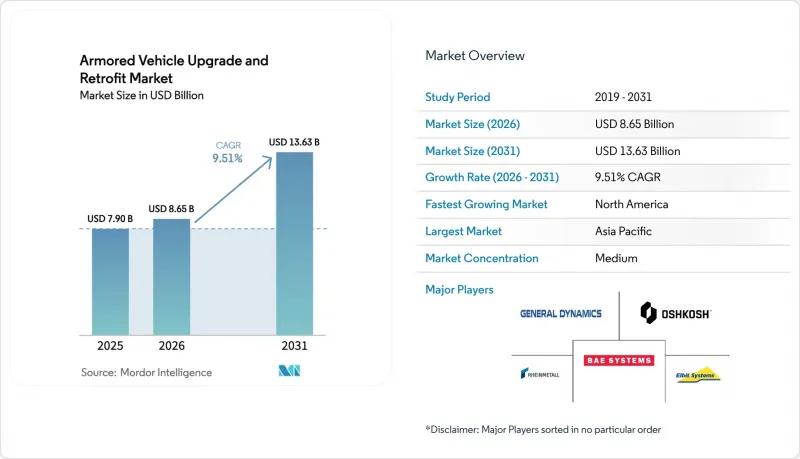
장갑차 업그레이드 및 레트로핏 시장 규모는 2025년 79억 달러에서 2026년에는 86억 5,000만 달러로 확대되어 2026년부터 2031년까지 CAGR 9.51%로 성장을 지속하여, 2031년에는 136억 3,000만 달러에 이를 것으로 예측됩니다.
본 보고서는 차량 유형(장갑 병력 수송차 등), 업그레이드 유형(장갑·생존성 키트, 무기 및 원격 조종 무기 스테이션, 기동성 등), 최종 사용자(육군, 해군, 공군, 국토안보 및 준군사 조직), 그리고 지역(북미, 유럽, 아시아태평양 등)별로 분류되어 있습니다. 시장 전망은 금액(달러) 기준으로 제시되어 있습니다.
전 세계 장갑차 업그레이드 및 레트로핏 시장 동향과 인사이트
노후화된 장갑차의 현대화
NATO의 주전차(MBT)의 평균 사용 연수는 2025년에 28년에 달할 전망이며, 현재 수명을 40-45년으로 연장하기 위해서는 전면적인 교체보다는 파워트레인, 장갑, 전자 장비의 대대적인 정비에 의존하고 있습니다. 폴란드의 250대 규모 '레오파드 2PL' 프로그램은 단계적 업그레이드를 통해 상호 운용성을 유지하면서, 포병 및 방공 분야의 우선 순위에 대한 예산을 확보하는 방법을 보여주고 있습니다. 미국은 처음부터 설계하는 에이브럼스 전차의 신형 개발 예산 12억 달러를 재배정하여, 이스라엘산 ‘트로피’ 능동 방어 시스템과 차세대 적외선 센서를 추가하는 SEPv4 업그레이드에 투입했습니다. 이와 유사한 논리에 따라 일본도 3억 4,000만 달러를 투입해 90식 전차를 개량하고 있으며, 여기에는 네트워크 무전기 및 대드론 전자전(EW) 모듈이 탑재되어 있습니다. 이러한 사례들은 개량 전략이 생산 라인을 유지하고 위험을 장기적으로 분산시킨다는 점을 보여줍니다.
국방 예산 증가와 지정학적 긴장
2025년 전 세계 국방비는 6.8% 증가하여 2조 2,400억 달러에 달했습니다. 독일의 ‘차이텐벤데(Zeitenwende)’ 구상에서는 31억 유로(36억 1,000만 달러)가 ‘레오파드’ 및 ‘푸마’ 개량에 투입되어, 긴축 재정에서 벗어나 예산 우선순위에 지속적인 전환이 이루어졌음을 보여줍니다. 한국은 하드킬 방어 기능과 레이저 경보 수신기를 탑재한 K2 및 K21의 성능 향상에 8억 9,000만 달러를 투자했습니다. 인도-태평양 지역의 개량 지출 비중은 인도의 42억 달러 규모 BMP-2 프로그램과 호주의 ‘랜드 400 3단계’ 이니셔티브에 힘입어 2023년 38%에서 2025년 43.78%로 상승했습니다. 예산의 지속적인 증가세는 다년 계약을 뒷받침하며, 공급업체의 투자 위험을 완화합니다.
프로그램 및 부품 비용의 고가
능동 방어 키트는 1대당 30만-50만 달러의 추가 비용이 소요되며, 완전한 C4ISR 제품군을 도입할 경우 추가 비용이 120만 달러를 초과할 가능성이 있어, 하위 시스템의 60% 이상을 교체해야 하는 경우 개조의 경제적 타당성이 떨어집니다. 브래들리 M2A4E1의 업그레이드 비용은 현재 1대당 430만 달러로, 신규 설계된 동급 차량에 비해 불과 28% 저렴할 뿐입니다. 희토류 자석의 가격은 여전히 변동이 심하여, 일부 프로그램에서는 페라이트 대체재를 사용함으로써 토크 밀도를 15-20% 낮출 수밖에 없는 상황입니다. 이에 반해 남미 및 아프리카의 고객들은 부분적인 업그레이드 패키지를 구매하는 방식으로 대응하고 있으며, 이로 인해 발주 수량이 세분화되어 규모의 경제 효과가 저하되고 있습니다.
부문 분석
보병전투차(IFV)는 2025년 장갑차 업그레이드 및 레트로핏 시장 점유율의 37.89%를 차지하며, 통합 병과 기동에서 그 중심적인 역할을 부각시키고 있습니다. 지원 차량용 장갑차 업그레이드 및 레트로핏 시장 규모는 더욱 빠른 성장이 예상되며, 병참 수송차, 지휘소, 공병용 변형 모델은 2031년까지 연평균 성장률(CAGR) 11.56%를 나타낼 것으로 전망됩니다. IFV 프로그램은 화력과 생존성이 동급의 주전차(MBT)에 필적해야 하기 때문에 예산의 과반수를 차지하고 있습니다. 미국의 브래들리 M2A4는 ‘아이언 피스트 라이트 디커플드(Iron Fist Light Decoupled)’ 능동 방어 시스템과 3세대 적외선 센서를 통합하고 있어, IFV의 업데이트 주기에 드는 막대한 비용을 보여줍니다. 대반군 작전 지역을 위한 지뢰 내성 차량에 대한 수주는 견조한 추세를 보이고 있는 반면, APC(장갑병력수송차)는 캐나다의 ‘라이트 아머드 비클 6.0’ 시리즈와 같은 상호운용성 요건을 통해 탄력을 받고 있습니다.
기본 성능이 비교적 낮기 때문에 지원형 차량은 소규모 업그레이드만으로도 획기적인 효과를 거둘 수 있으며, 각 군은 현재 후방 부대의 방호를 작전상 필수 요건으로 삼고 있습니다. '트로피' 및 '링크 16'을 탑재한 M88A3 회수차의 개조는 정비·병참 자산의 생존성을 높이는 추세를 상징합니다. 신흥 시장이 재난 구호 차량으로도 기능하는 다목적 자산을 요구하는 가운데, 수륙양용 및 중량급 플랫폼도 개발 계획에 포함되고 있습니다. 이러한 요인들이 복합적으로 작용함에 따라, 장갑차 업그레이드 및 레트로핏 시장은 전투용 및 지원용 차량군이 순차적이 아닌 병행적으로 현대화되는 궤도에 올라섰습니다.
지역별 분석
아시아태평양은 2025년 장갑차 업그레이드 및 레트로핏 시장 매출의 43.78%를 차지하고 있으며, 이러한 선두 위상은 인도의 42억 달러 규모 BMP-2 프로그램과 한국의 K2/K21 개조 사업에 의해 뒷받침되고 있습니다. 일본의 3억 4,000만 달러 규모 90식 전차 개량에 더해, 동남아시아 구매자들의 관심이 높아지면서 이 지역의 성장세가 뒷받침되고 있습니다. 또한 공개된 이미지를 통해 중국이 2025년 말까지 약 400대의 96식·99식 전차에 능동 방어 시스템을 통합하고 있는 것으로 나타나지만, 중국 정부는 이 프로그램에 대한 세부 사항을 거의 공개하지 않고 있습니다.
북미에서는 미국이 장갑 다목적 차량(AMPV)의 생산을 확대하는 동시에 구형 전투 차량의 교체를 병행함에 따라, 2026년부터 2031년까지 연평균 성장률(CAGR)이 12.21%로 가장 높은 성장세를 기록할 것으로 예측됩니다. 캐나다의 LAV 6.0은 2025년에 본격 생산에 들어갈 예정이며, 멕시코는 국내 치안 작전을 강화하기 위해 대드론 키트를 장착한 지뢰 저항 차량에 2억 1,000만 달러를 투자했습니다. 안정적인 예산 배분과 단계적인 능력 향상을 중시하는 태도가 이 지역의 성장을 뒷받침하고 있습니다.
유럽은 매출액 면에서 아시아태평양에 뒤처져 있지만, 독일의 ‘차이텐벤데’ 계획, 프랑스의 ‘르클레르 XLR’ 프로그램, 폴란드의 ‘레오파드 2PL’ 개량 계획의 혜택을 받고 있습니다. 영국의 ‘챌린저 3’ 생산 라인은 2025년에 가동을 시작하여, NATO 동맹국과의 탄약 호환성을 제한하던 라이플포의 격차를 해소했습니다. 중동은 여전히 매우 중요한 전구이며, 사우디아라비아의 18억 달러 규모 ‘에이브럼스’ 계획과 UAE의 국산화 노력이 현지 산업 기반을 형성하고 있습니다. 남미 및 아프리카에서는 재정적 역풍으로 인해 제한적인 현대화 작업에 그치고 있지만, 브라질과 남아프리카공화국의 주요 프로젝트는 장기적인 가능성을 시사하고 있습니다.
기타 혜택:
- 엑셀 형식 시장 예측(ME) 시트
- 3개월간의 애널리스트 지원
자주 묻는 질문
목차
제1장 서론
제2장 조사 방법
제3장 주요 요약
제4장 시장 구도
제5장 시장 규모와 성장 예측
제6장 경쟁 구도
제7장 시장 기회와 향후 전망
JHS 26.08.11According to Mordor Intelligence, the armored vehicle upgrade and retrofit market size is expected to grow from USD 7.90 billion in 2025 to USD 8.65 billion in 2026 and is forecasted to reach USD 13.63 billion by 2031 at a 9.51% CAGR over 2026-2031.
This report is Segmented by Vehicle Type (Armored Personnel Carriers, and More), Upgrade Type (Armor and Survivability Kits, Weapon and Remote Weapon Stations, Mobility, and More), End User (Army, Navy, Air Force, and Homeland Security and Paramilitary), and Geography (North America, Europe, Asia-Pacific, and More). The Market Forecasts are Provided in Terms of Value (USD).
Global Armored Vehicle Upgrade and Retrofit Market Trends and Insights
Modernization of Ageing Armored Fleets
The median age of NATO MBTs reached 28 years in 2025, and service-life extensions to 40-45 years now rely on overhauls of the powertrain, armor, and electronics rather than wholesale replacement. Poland's 250-unit Leopard 2PL program demonstrates how incremental upgrades support interoperability while preserving budgets for artillery and air defense priorities. The US shifted USD 1.2 billion from a clean-sheet Abrams variant to SEPv4 upgrades that add Israeli Trophy active protection and next-generation infrared sensors. Similar logic informs Japan's USD 340 million Type 90 tank refresh, which incorporates network radios and counter-drone electronic warfare (EW) modules. These cases demonstrate that retrofit strategies maintain industrial lines open and distribute risk over time.
Rising Defense Budgets and Geopolitical Tensions
Global defense outlays increased by 6.8% in 2025 to USD 2.24 trillion. Germany's Zeitenwende initiative injected EUR 3.1 billion (USD 3.61 billion) into overhauls of the Leopard and Puma, signaling a durable shift in budget priorities away from austerity. South Korea devoted USD 890 million to K2 and K21 enhancements that incorporate hard-kill protection and laser warning receivers. The Indo-Pacific share of retrofit spending rose from 38% in 2023 to 43.78% in 2025, fueled by India's USD 4.2 billion BMP-2 program and Australia's Land 400 Phase 3 initiative. Sustained budget momentum underwrites multi-year contracts and de-risks supplier investment.
High Program and Component Costs
Active-protection kits add USD 300,000-500,000 per vehicle, and a full C4ISR suite can push incremental costs past USD 1.2 million, eroding the financial logic of retrofits when more than 60% of subsystems need replacement. The Bradley M2A4E1 upgrade now sits at USD 4.3 million per unit, only 28% cheaper than a clean-sheet equivalent. Rare-earth magnet prices remain volatile, forcing some programs to accept torque densities 15-20% lower with ferrite substitutes. South American and African customers respond by buying partial upgrade packages, fragmenting volumes, and squeezing economies of scale.
Other drivers and restraints analyzed in the detailed report include:
- Demand for Enhanced Survivability vs IEDs and Drones
- Digitization and Network-Centric Warfare Upgrades
- Integration Complexity with Legacy Platforms
For complete list of drivers and restraints, kindly check the Table Of Contents.
Segment Analysis
Infantry fighting vehicles (IFVs) retained 37.89% of the 2025 armored vehicle upgrade and retrofit market share, underscoring their central role in combined-arms maneuver. The armored vehicle upgrade and retrofit market size for support vehicles is poised for faster growth, with logistics carriers, command posts, and engineering variants projected to post an 11.56% CAGR through 2031. IFV programs consume disproportionate budgets because lethality and survivability must match peer MBTs. The US Bradley M2A4 integrates Iron Fist Light Decoupled active protection and third-generation infrared, demonstrating the cost intensity of IFV refresh cycles. Mine-resistant vehicles receive steady orders for counter-insurgency theaters, while APCs gain momentum through interoperability mandates such as Canada's Light Armoured Vehicle 6.0 line.
Lower-baseline capability lets support variants realize step-function benefits from modest upgrades, and armies now treat rear-echelon protection as an operational imperative. The M88A3 recovery vehicle retrofit, which incorporates Trophy and Link 16, exemplifies the trend of enhancing survivability for maintenance and logistics assets. Amphibious and medium-weight platforms also enter the pipeline as emerging markets seek versatile assets that double as disaster-relief vehicles. Together, these factors keep the armored vehicle upgrade and retrofit market on a trajectory where combat and support fleets modernize in parallel rather than sequentially.
Complete Report Scope:
- By Vehicle Type
- Armored Personnel Carriers (APCs)
- Infantry Fighting Vehicles (IFVs)
- Mine-Resistant Ambush Protected (MRAP) Vehicles
- Main Battle Tanks (MBTs)
- Other Vehicle Types
- By Upgrade Type
- Armor and Survivability Kits
- Weapon and Remote Weapon Stations
- Mobility (Engine, Transmission, Suspension)
- Electronics/Sensors/C4ISR
- Powertrain Electrification and Energy Systems
- Other Upgrades (Tires, Software, etc.)
- By End User
- Army
- Navy
- Air Force
- Homeland Security and Paramilitary
- By Geography
- North America
- United States
- Canada
- Mexico
- Europe
- United Kingdom
- France
- Germany
- Russia
- Rest of Europe
- Asia-Pacific
- China
- India
- Japan
- South Korea
- Rest of Asia-Pacific
- South America
- Brazil
- Rest of South America
- Middle East and Africa
- Middle East
- United Arab Emirates
- Saudi Arabia
- Rest of Middle East
- Africa
- South Africa
- Rest of Africa
- Middle East
- North America
Geography Analysis
The Asia-Pacific region generated 43.78% of the 2025 revenue for the armored vehicle upgrade and retrofit market, a lead built on India's USD 4.20 billion BMP-2 program and South Korea's K2/K21 retrofits. Japan's USD 340 million Type 90 refresh, along with rising interest from Southeast Asian buyers, sustains regional momentum. Open-source imagery also shows China integrating active protection on roughly 400 Type 96/Type 99 tanks by late 2025, although Beijing discloses few details about the program.
North America is expected to record the fastest 2026-2031 CAGR of 12.21% as the US ramps up armored multi-purpose vehicle (AMPV) production and upgrades its legacy combat fleets in parallel. Canada's LAV 6.0 entered full-rate production in 2025, and Mexico invested USD 210 million in mine-resistant vehicles with counter-drone kits to harden domestic security operations. Consistent appropriations and a preference for incremental capability upgrades underpin regional growth.
Europe trails the Asia-Pacific region in revenue but benefits from Germany's Zeitenwende spending, France's Leclerc XLR program, and Poland's Leopard 2PL conversion. The United Kingdom's Challenger 3 line entered production in 2025, closing a rifled-gun gap that had limited ammunition commonality with NATO allies. The Middle East remains a pivotal theater, with Saudi Arabia's USD 1.8 billion Abrams plan and the UAE's efforts to indigenize shaping the local industry footprint. South America and Africa pursue selective refresh work constrained by fiscal headwinds, yet flagship projects in Brazil and South Africa signal longer-term potential.
- General Dynamics Corporation
- Rheinmetall AG
- BAE Systems plc
- Textron Inc.
- Elbit Systems Ltd.
- Oshkosh Corporation
- KNDS N.V.
- FNSS Savunma Sistemleri A.S.
- Thales Group
- RUAG International Holding AG
- Patria Plc
- Bharat Electronics Limited
- AM General LLC
- Otokar Otomotiv ve Savunma Sanayi A.S.
- Singapore Technologies Engineering Ltd.
Additional Benefits:
- The market estimate (ME) sheet in Excel format
- 3 months of analyst support
TABLE OF CONTENTS
1 INTRODUCTION
- 1.1 Study Assumptions and Market Definition
- 1.2 Scope of the Study
2 RESEARCH METHODOLOGY
3 EXECUTIVE SUMMARY
4 MARKET LANDSCAPE
- 4.1 Market Overview
- 4.2 Market Drivers
- 4.2.1 Modernization of ageing armored fleets
- 4.2.2 Rising defense budgets and geopolitical tensions
- 4.2.3 Demand for enhanced survivability vs IEDs and drones
- 4.2.4 Digitization and network-centric warfare upgrades
- 4.2.5 Field-deployable additive-manufactured retrofit kits
- 4.2.6 Hybrid/electric-propulsion retrofits for silent mobility
- 4.3 Market Restraints
- 4.3.1 High program and component costs
- 4.3.2 Integration complexity with legacy platforms
- 4.3.3 Budget volatility and procurement cycles
- 4.3.4 Emerging cybersecurity risks in digital retrofits
- 4.4 Value Chain Analysis
- 4.5 Regulatory Landscape
- 4.6 Technological Outlook
- 4.7 Porter's Five Forces Analysis
- 4.7.1 Threat of New Entrants
- 4.7.2 Bargaining Power of Suppliers
- 4.7.3 Bargaining Power of Buyers
- 4.7.4 Threat of Substitutes
- 4.7.5 Intensity of Competitive Rivalry
5 MARKET SIZE AND GROWTH FORECASTS (VALUE)
- 5.1 By Vehicle Type
- 5.1.1 Armored Personnel Carriers (APCs)
- 5.1.2 Infantry Fighting Vehicles (IFVs)
- 5.1.3 Mine-Resistant Ambush Protected (MRAP) Vehicles
- 5.1.4 Main Battle Tanks (MBTs)
- 5.1.5 Other Vehicle Types
- 5.2 By Upgrade Type
- 5.2.1 Armor and Survivability Kits
- 5.2.2 Weapon and Remote Weapon Stations
- 5.2.3 Mobility (Engine, Transmission, Suspension)
- 5.2.4 Electronics/Sensors/C4ISR
- 5.2.5 Powertrain Electrification and Energy Systems
- 5.2.6 Other Upgrades (Tires, Software, etc.)
- 5.3 By End User
- 5.3.1 Army
- 5.3.2 Navy
- 5.3.3 Air Force
- 5.3.4 Homeland Security and Paramilitary
- 5.4 By Geography
- 5.4.1 North America
- 5.4.1.1 United States
- 5.4.1.2 Canada
- 5.4.1.3 Mexico
- 5.4.2 Europe
- 5.4.2.1 United Kingdom
- 5.4.2.2 France
- 5.4.2.3 Germany
- 5.4.2.4 Russia
- 5.4.2.5 Rest of Europe
- 5.4.3 Asia-Pacific
- 5.4.3.1 China
- 5.4.3.2 India
- 5.4.3.3 Japan
- 5.4.3.4 South Korea
- 5.4.3.5 Rest of Asia-Pacific
- 5.4.4 South America
- 5.4.4.1 Brazil
- 5.4.4.2 Rest of South America
- 5.4.5 Middle East and Africa
- 5.4.5.1 Middle East
- 5.4.5.1.1 United Arab Emirates
- 5.4.5.1.2 Saudi Arabia
- 5.4.5.1.3 Rest of Middle East
- 5.4.5.2 Africa
- 5.4.5.2.1 South Africa
- 5.4.5.2.2 Rest of Africa
- 5.4.5.1 Middle East
- 5.4.1 North America
6 COMPETITIVE LANDSCAPE
- 6.1 Market Concentration
- 6.2 Strategic Moves
- 6.3 Market Share Analysis
- 6.4 Company Profiles (includes Global level Overview, Market level overview, Core Segments, Financials as available, Strategic Information, Market Rank/Share for key companies, Products and Services, and Recent Developments)
- 6.4.1 General Dynamics Corporation
- 6.4.2 Rheinmetall AG
- 6.4.3 BAE Systems plc
- 6.4.4 Textron Inc.
- 6.4.5 Elbit Systems Ltd.
- 6.4.6 Oshkosh Corporation
- 6.4.7 KNDS N.V.
- 6.4.8 FNSS Savunma Sistemleri A.S.
- 6.4.9 Thales Group
- 6.4.10 RUAG International Holding AG
- 6.4.11 Patria Plc
- 6.4.12 Bharat Electronics Limited
- 6.4.13 AM General LLC
- 6.4.14 Otokar Otomotiv ve Savunma Sanayi A.S.
- 6.4.15 Singapore Technologies Engineering Ltd.
7 MARKET OPPORTUNITIES AND FUTURE OUTLOOK
- 7.1 White-space and Unmet-need Assessment


