

|
시장보고서
상품코드
2100562
보호 코팅 시장 : 시장 점유율 분석, 업계 동향 및 통계, 성장 예측(2026-2031년)Protective Coatings - Market Share Analysis, Industry Trends & Statistics, Growth Forecasts (2026 - 2031) |
||||||
 Mordor Intelligence
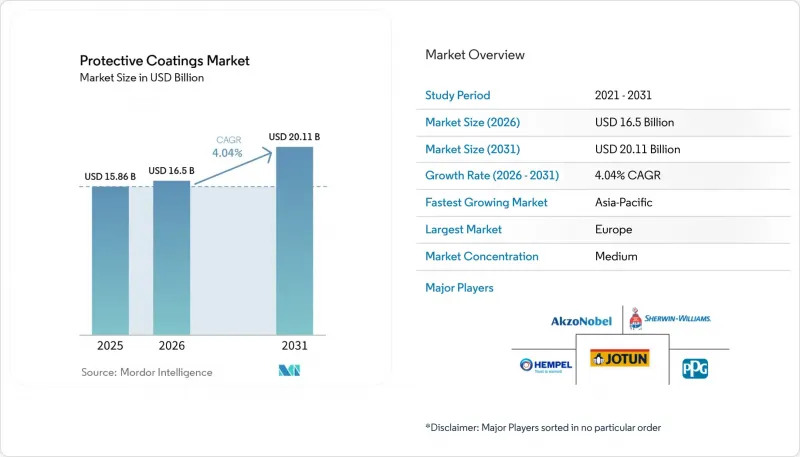
Mordor Intelligence에 의하면, 세계의 보호 코팅 시장 규모는 2025년 158억 6,000만 달러로 평가되었고, 2026년에는 165억 달러로 확대될 것으로 추정되고, 2031년까지 201억 1,000만 달러에 이를 것으로 전망되며, 2026-2031년 CAGR 4.04%를 나타낼 것으로 예측됩니다.
본 보고서는 수지 유형별(에폭시, 폴리우레탄, 비닐 에스테르 등), 기술별(용제형, 수성 등), 기판별(금속, 콘크리트 등), 최종 이용 산업별(석유 및 가스, 광업, 전력, 인프라 등) 및 지역별(아시아태평양, 북미, 유럽, 남미, 중동 및 아프리카)로 분류되어 있습니다. 시장 전망은 금액(달러) 기준으로 제시되어 있습니다.
세계의 보호 코팅 시장 동향 및 인사이트
아시아태평양 및 GCC의 공공 부문 메가 프로젝트 계획
아시아태평양 및 GCC 국가 정부는 2030년까지 철도, 항만, 에너지 인프라에 2조 8,000억 달러를 배정하고 있으며, 이 계획에 따라 습도 85% 이상, 염화물 농도 500 ppm 이상의 환경에서도 내성을 지닌 에폭시·폴리아미드계 프라이머, 규산아연계 하도 도료 및 폴리우레탄계 상도 도료에 대한 안정적인 수요가 창출되고 있습니다. 인도의 국가 인프라 계획만 보더라도, 16개 도시의 지하철 연장 사업에 1조 4,000억 달러가 배정되어 있으며, IS 15489의 해안 내구성 등급을 준수하는 도료가 요구되고 있습니다. 사우디아라비아의 NEOM 및 레드시 프로젝트에서는 5,000만 m²가 넘는 구조용 강재가 사용되고 있으며, 각각 ISO 12944 C5-M을 준수하도록 지정되어 있어 아연·에폭시·폴리우레탄 3층 도장 체계가 채택되고 있습니다. 파키스탄 및 인도네시아의 ‘일대일로’ 철도 회랑에서도 철근에는 용착형 에폭시 도료를, 콘크리트 터널에는 수성 아크릴 도료를 표준으로 채택하고 있습니다. GCC(걸프협력회의) 국가들의 해수 담수화 시설 개보수(2028년까지 1,200만 m³/일의 신규 처리 능력 증강)에서는 NSF/ANSI 61 인증을 취득한 페놀·에폭시계 라이닝이 요구되고 있으며, 차아염소산 환경 하에서의 내화학성 필요성이 강조되고 있습니다.
용제계에서 저VOC/제로VOC 시스템으로의 전환 가속화
유럽연합(EU)은 2024년 1월, 밀폐 공간에서의 용도에 대한 VOC 상한치를 250 g/L로 하향 조정하여, 산화제를 첨가하지 않는 롱오일 알키드 수지를 사실상 폐지했습니다. 캘리포니아주 사우스코스트 규정 1107에 따라 2025년에 금속용 도료의 VOC 상한치가 100 g/L로 낮아지고, 플래시오프 시간이 20% 길어짐에도 불구하고 수성 에폭시 도료의 채택이 가속화되었습니다. VOC를 전혀 배출하지 않는 분체 도료는 2025년에 보호 도료 시장의 8%를 차지했으나, 여전히 180-200°C의 경화 사이클을 견딜 수 있는 기판으로 제한되어 있습니다. 한편, 2025년 유럽의 에스테르 제조 공장에서 발생한 폭발 사고로 인해 코어리스 센트공급이 부족해지면서 수성 도료로의 전환이 어려워졌습니다. VOC가 150 g/L 미만인 하이브리드 고고형분 에폭시 도료는 현장 온도가 15°C 미만인 환경에서 사양상의 격차를 메우는 역할을 하고 있습니다.
에폭시 수지 및 이산화티타늄의 가격 변동 심화
쓰촨성에서의 생산 능력 감축에 따라, 2025년 1분기 이산화티타늄 현물 가격은 12% 상승했습니다. 한편, 보호 도료 업계의 프로파일렌옥사이드 공급 부족으로 인해 에폭시 수지 가격은 2023년 수준보다 18% 높은 상태를 유지하고 있습니다. 소규모 지역 제조업체는 헤지(위험 회피)를 수행할 만한 규모가 부족하고, 분기마다 15%에 달하는 가격 변동의 영향을 받기 쉬우므로, 최종 사용자들은 공표된 수지 벤치마크에 연동된 고정 가격 계약 체결을 요구하기 시작했습니다. 수성 아크릴계나 폴리우레탄 분산액으로의 전환은 어느 정도 위험을 회피하는 데 도움이 되지만, 제품 라인당 50만 달러의 비용과 1년 이상의 현장 검증 기간이 필요합니다. 현금 흐름의 악화로 인해 이미 일부 중견 공급업체들은 용제형 알키드 수지 제품 라인에서 철수할 수밖에 없는 상황에 처해 있습니다.
부문 분석
폴리우레탄은 2025년에 보호 도료 시장에서 30.44%의 점유율을 확보한 것으로 평가되었으며, 2031년까지 연평균 성장률(CAGR) 4.78%로 점유율을 확대될 전망입니다. 2액형 지방족 등급은 QUV-A 노출 5,000시간 후에도 색상 변화(Delta E: ΔE)를 2.0 미만으로 억제함으로써 해상 타워의 보호에 기여하고 있습니다. 에폭시 수지는 Sa 2.5에 달하는 연마 블라스팅 부착성 지표를 바탕으로 여전히 필수적인 프라이머로 자리 잡고 있지만, 자외선(UV)에 의한 초킹 현상으로 인해 탑코트로서의 사용이 제한되고 있습니다. 알키드 수지는 VOC 규제의 압박으로 인해 건조한 기후 하에서의 틈새 보수 용도로 그 영역이 축소되고 있습니다. 비닐 에스테르 수지는 고온 환경에서 98% 황산에 대한 화학 반응기의 보호에 기여하고 있으며, 한편 폴리에스테르 젤코트는 음극 방식을 생략한 복합재 청정조의 수명을 연장하고 있습니다. 폴리우레탄 마감의 밑칠로 사용되는 하이브리드형 고아연 에폭시는 현재 ISO 12944 C5-M 규격에서 주류를 이루고 있으며, 여러 화학 계통을 활용하는 배합 기술자들에게 큰 성과를 가져다주고 있습니다.
수지 라인업의 확대는 보호 도료 시장의 원자재 가격 급등도 반영하고 있습니다. 비스페놀 A와 이소시아네이트의 원가 상승으로 인해 용제 사용량을 30% 절감하고 이산화티타늄 사용량도 줄이는 고고형분 배합이 촉진되고 있습니다. 에폭시 매트릭스에 그래핀 나노플레이틀릿을 배합한 공급업체는 음극 방식에 필요한 전류를 25% 저감할 수 있었습니다고 보고하고 있으며, 이를 통해 해상 시설의 개보수 공사에서 새로운 가치가 창출되고 있습니다. 이러한 혁신 경쟁은 마이크로캡슐 기반의 자가 복구 시스템에 관한 특허 출원으로 인해 더욱 가속화되고 있습니다. 이 시스템은 50µm 크기의 흠집을 자율적으로 봉합함으로써 유지보수 주기를 연장합니다. 이러한 발전들이 결합되어 폴리우레탄은 최전선의 지위를 유지하는 한편, 특수 화학제품이 내식성과 내화학성이 요구되는 고수익성 틈새 시장을 개척할 수 있게 하고 있습니다.
2025년에도 용제계 시스템은 부식 방지 도료 시장 규모의 71.39%를 차지했습니다. 이는 습도 85%의 환경에서도 신속하게 경화되며, 현장에서의 신뢰성이 입증되었기 때문입니다. 그러나 VOC 상한치를 250 g/L 미만으로 낮추려는 규제 당국의 움직임으로 인해 시장 점유율의 추가 하락은 피할 수 없으며, 그 결과 15°C의 저온 환경에서 현장 작업 시 재도장 간격이 20% 길어진다는 사실이 있음에도 불구하고, 수성 도료 수요는 연평균 성장률(CAGR) 4.68%로 증가하고 있습니다. '기타 기술'로 분류되는 고고형분 에폭시 도료는 분자량을 증가시켜 VOC를 150 g/L 미만으로 억제하고 있지만, 수직 강재 표면에서의 흘러내림을 방지하기 위해서는 가열식 다성분 스프레이 장치와 숙련된 작업자가 필요합니다.
UV 경화형 도료는 소형 부품에서 60초 미만의 완전 경화를 실현하지만, 광개시제의 비용 및 시야 범위 제약으로 인해 보호 도료 시장에서의 광범위한 채택은 제한적입니다. ISO 12944-5는 2024년에 수성 시스템이 용제계 도료와 동등한 염수 분무 시험 및 음극 박리 시험 기준을 충족하는 경우, C5-M 사이트에서의 사용을 최종 승인했습니다. 이러한 변경으로 인해, 특히 REACH 규제의 압력과 기업의 ESG 목표가 맞물리는 유럽에서 사양의 폭이 넓어지고 있습니다. 하이브리드 에멀젼과 용제와 같은 유동성을 결합한 공급업체는 블라스팅 처리된 강재 위에서 5B 크로스해치 접착력을 달성하고, 폴리실록산과 견줄 만한 광택 유지력을 실현함으로써 생산 효율과 규정 준수가 양립할 수 있음을 입증하고 있습니다.
지역별 분석
2025년, 북해의 자산 유지, 자동차 OEM 생산, 그리고 엄격한 REACH 규제가 맞물려 보호 코팅 시장이 강화된 결과, 유럽은 전 세계 매출의 50.17%를 차지했습니다. 개정된 산업 배출 지침에 따라 밀폐 공간 내 VOC 상한선이 250 g/L로 설정되면서 수성 에폭시 수지의 보급이 가속화되었습니다. 독일 화학 업계에서는 2027년 사용 금지 시한을 앞두고 PFAS가 포함되지 않은 탱크 라이닝으로의 전환이 진행 중이며, 제품 라인당 200만 유로의 연구개발비가 투입되고 있습니다. 영국의 ‘라운드 5’ 해상 리스 계획에 따라 NORSOK M-501 규격을 준수하는 코팅이 적용된 모노파일 1,260개에 대한 수요가 촉발되었으며, 각 모노파일에는 최대 15t의 3층 코팅 시스템이 사용되고 있습니다. 프랑스와 이탈리아의 지하철 확장 계획에서도 마찬가지로 100g/L 미만의 수성 아크릴계 도료가 지정되어 있으며, 용제계 도료는 시장에서 점차 사라지고 있습니다.
아시아태평양에서는 중국의 9,000억 달러 규모 인프라 계획, 대만의 15GW 해상 풍력 로드맵, 그리고 한국과 인도의 기가팩토리 건설 계획을 배경으로 보호 도료 시장이 연평균 성장률(CAGR) 5.33%로 확대되고 있습니다. '일대일로' 철도 투자에 따라 선전-잔장 노선에서는 8,000톤의 융착 에폭시 철근용 도료가 사용될 전망입니다. 오스트에드(Austed)와 에퀴노르(Equinor)의 대만 내 모노파일 프로젝트에는 5,000시간의 염수 분무 시험 후에도 광택도를 80% 이상 유지할 수 있는 폴리실록산 탑코트가 요구되고 있습니다. 인도에서는 연성 주철 파이프라인에 에폭시 라이닝이 채택되어 내구 연한이 50년으로 연장됨에 따라, 보호 코팅 수요가 연평균 성장률(CAGR) 6.2%로 확대될 것으로 전망됩니다. 일본과 한국에서는 수소 네트워크 구축이 진행되고 있어 수소 투과를 방지하는 배리어 코팅이 요구되고 있으나, 그 가격은 일반 코팅에 비해 30% 더 비쌉니다.
북미, 남미, 중동 및 아프리카는 보호용 도료 시장에서 이들 지역공급량을 합쳐도 비교적 적은 상황입니다. 건설 중인 미국 멕시코만 연안의 LNG 터미널에서는 -162°C의 저장 스피어용으로 극저온 대응 페놀계 에폭시 수지가 필요합니다. 캐나다의 오일샌드 운반선은 180°C의 환경에서 가동되고 있으며, 에폭시·노보락 규격의 적용이 의무화되어 있습니다. 멕시코의 니어쇼어링 붐에 힘입어 프레스 금형용 보호 코팅 수요가 연평균 성장률(CAGR) 5.8%로 증가하고 있습니다. 브라질의 프레솔트층용 부유식 유닛에서는 20 MPa의 내압성을 갖춘 유리 플레이크 함유 에폭시 수지가 사용되고 있습니다. 사우디아라비아 네옴(NEOM)의 철강 건설 프로젝트는 3중 도장 ISO 12944 C5-M 시스템의 주요 수요원으로 자리 잡고 있으며, 남아프리카공화국의 슬러리 라인에서는 마모 방지를 위해 쇼어 A 경도 85-95의 폴리우레탄 엘라스토머가 지정되어 있습니다.
기타 혜택 :
- 엑셀 형식 시장 예측(ME) 시트
- 3개월간의 애널리스트 지원
자주 묻는 질문
목차
제1장 서론
제2장 조사 방법
제3장 주요 요약
제4장 시장 구도
제5장 시장 규모 및 성장 예측
제6장 경쟁 구도
제7장 시장 기회 및 향후 전망
AJY 26.08.07According to Mordor Intelligence, the global protective coatings market size is expected to increase from USD 15.86 billion in 2025 to USD 16.5 billion in 2026 and reach USD 20.11 billion by 2031, and is expected to grow at a CAGR of 4.04% over 2026-2031.
This report is Segmented by Resin Type (Epoxy, Polyurethane, Vinyl Ester, and More), Technology (Solvent-Borne, Water-Borne, and More), Substrate (Metal, Concrete, and More), End-Use Industry (Oil and Gas, Mining, Power, Infrastructure, and More), and Geography (Asia-Pacific, North America, Europe, South America, and Middle-East and Africa). The Market Forecasts are Provided in Terms of Value (USD).
Global Protective Coatings Market Trends and Insights
Public-Sector Megaproject Pipeline in APAC and GCC
Governments across Asia-Pacific and the GCC have earmarked USD 2.8 trillion for rail, port, and energy infrastructure through 2030, a program that creates a steady pull for epoxy-polyamide primers, zinc-silicate bases, and polyurethane topcoats that survive humidity above 85% and chloride levels above 500 ppm. India's National Infrastructure Pipeline alone set aside USD 1.4 trillion for metro-rail extensions in 16 cities, requiring coatings compliant with IS 15489 coastal durability classes. Saudi Arabia's NEOM and Red Sea Project encompass more than 50 million m2 of structural steel, each specified to ISO 12944 C5-M, thereby favoring three-coat zinc-epoxy-polyurethane sequences. Belt-and-Road rail corridors in Pakistan and Indonesia have also standardized fusion-bonded epoxy for rebar and water-borne acrylics for concrete tunnels. GCC desalination upgrades, 12 million m3/day of new capacity by 2028, demand phenolic-epoxy linings certified to NSF/ANSI 61, underlining the need for chemical resistance in hypochlorite service.
Accelerating Shift from Solvent-Borne to Low/Zero-VOC Systems
The European Union slashed VOC ceilings to 250 g/L for confined-space applications in January 2024, effectively retiring long-oil alkyds without add-on oxidizers. California's South Coast Rule 1107 dropped metal-coating limits to 100 g/L in 2025, catalyzing water-borne epoxy uptake despite 20% longer flash-off times. Powder coatings, which emit zero VOCs, captured 8% of the protective coatings market in 2025 but remain confined to substrates tolerating 180-200°C cure cycles. Meanwhile, a 2025 explosion at a European ester plant squeezed coalescent availability, complicating the water-borne transition. Hybrid high-solids epoxies with <150 g/L VOC are filling specification gaps where field temperatures sit below 15°C.
Escalating Epoxy and TiO2 Price Volatility
Titanium dioxide spot prices climbed 12% in Q1 2025 after capacity cuts in Sichuan, while epoxy pricing remains 18% above 2023 levels owing to propylene-oxide shortages in the protective coatings industry. Smaller regional formulators lack hedging scale and are exposed to 15% quarterly price swings, prompting end-users to negotiate fixed contracts indexed to published resin benchmarks. Switching to water-borne acrylics or polyurethane dispersions offers partial shelter but demands USD 0.5 million per product line and over a year of field validation. Cash-flow strain is already forcing some mid-tier suppliers to exit solvent-borne alkyd lines.
Other drivers and restraints analyzed in the detailed report include:
- Spike in Offshore-Wind Foundation Demand
- Surge in EV-Battery Gigafactory Construction
- Tightening Global VOC & PFAS Bans
For complete list of drivers and restraints, kindly check the Table Of Contents.
Segment Analysis
Polyurethane captured a 30.44% protective coatings market share in 2025 and is on track to widen at a 4.78% CAGR through 2031. Two-component aliphatic grades safeguard offshore towers by holding Delta E (ΔE) color change below 2.0 after 5,000 hours of QUV-A exposure. Epoxies remain indispensable primers thanks to abrasive-blast adhesion metrics that hit Sa 2.5, yet UV chalking limits their use as topcoats. Alkyds, squeezed by VOC limits, retreat to niche dry-climate repair. Vinyl esters defend chemical reactors against 98% sulfuric acid at elevated temperatures, while polyester gel coats extend service life in composite clarifiers that bypass cathodic protection. Hybrid zinc-rich epoxies beneath polyurethane finishes now dominate ISO 12944 C5-M specifications, rewarding formulators adept at multi-chemistry systems.
Growth within the resin slate also mirrors raw-material inflation in the protective coatings market. Rising bisphenol-A and isocyanate costs encourage high-solids formulations that trim solvent volumes by 30% and cut titanium-dioxide usage. Suppliers injecting graphene nanoplatelets into epoxy matrices report 25% lower cathodic-protection current requirements, unlocking value in offshore retrofits. The innovation race is further fueled by patent filings for microcapsule-based self-healing systems, which extend service intervals by autonomously sealing 50-µm scratches. Collectively, these advances keep polyurethane at the forefront, while allowing specialty chemistries to claim high-margin niches where corrosion and chemical resistance converge.
Solvent-borne systems still accounted for 71.39% of the protective coatings market size in 2025 because they cure quickly in humid 85% conditions and exhibit proven field reliability. Yet regulators pushing VOC ceilings below 250 g/L make further share loss inevitable, and water-borne demand therefore rises at a 4.68% CAGR despite 20% longer recoat intervals observed in cool 15°C field work. High-solids epoxies, falling under other technologies, achieve <150 g/L VOC by boosting molecular weight, but they require heated plural-component spray rigs and skilled operators to avoid sag on vertical steel.
UV-cured coatings open sub-60-second through-cure for small parts, yet photoinitiator cost and line-of-sight constraints limit wide adoption in the protective coatings market. ISO 12944-5 finally endorsed water-borne systems for C5-M sites in 2024 if they equal solvent-borne salt-spray and cathodic-disbondment benchmarks. That change widens the specification window, particularly in Europe, where REACH pressure and corporate ESG targets converge. Suppliers that marry hybrid emulsions with solvent-like flow are achieving 5B cross-hatch adhesion on blasted steel and gloss retention rivaling polysiloxanes, proving that production efficiency and compliance can coexist.
Complete Report Scope:
- By Resin Type
- Epoxy
- Polyurethane
- Vinyl Ester
- Polyester
- Alkyd
- Other Resins (Acrylic. Zinc-Rich, etc.)
- By Technology
- Solvent-borne
- Water-borne
- Powder
- Other Technologies (High-Solids, UV-Cured, etc.)
- By Substrate
- Metal
- Concrete
- Plastic and Composites
- Other Substrates (Wood, Glass, etc)
- By End-use Industry
- Oil and Gas
- Mining
- Power
- Infrastructure
- Other End-User Industries(Water Treatment, Chemicals and Petrochemicals, Automotive, Marine)
- By Geography
- Asia-Pacific
- China
- India
- Japan
- South Korea
- Rest of Asia-Pacific
- North America
- United States
- Canada
- Mexico
- Europe
- Germany
- United Kingdom
- France
- Italy
- Rest of Europe
- South America
- Brazil
- Argentina
- Rest of South America
- Middle-East and Africa
- Saudi Arabia
- South Africa
- Rest of Middle-East and Africa
- Asia-Pacific
Geography Analysis
Europe contributed 50.17% of global revenue in 2025 as North Sea asset maintenance, automotive OEM output, and stringent REACH rules converged, strengthening the protective coatings market. The revised Industrial Emissions Directive capped confined-space VOCs at 250 g/L, accelerating water-borne epoxies. Germany's chemical sector is migrating to PFAS-free tank linings ahead of a 2027 cutoff, incurring EUR 2 million per product line in R&D outlays. UK Round 5 offshore leasing unleashed demand for 1,260 monopiles coated to NORSOK M-501, each using up to 15 t of three-layer systems. France and Italy's metro expansions likewise specify sub-100 g/L water-borne acrylics, sidelining solvent-borne rivals.
Asia-Pacific is advancing at 5.33% CAGR in the protective coatings market on the back of China's USD 900 billion infrastructure program, Taiwan's 15-GW offshore-wind roadmap, and South Korea-India gigafactory pipelines. Belt-and-Road rail investments are drawing 8,000 t of fusion-bonded-epoxy rebar coatings on the Shenzhen-Zhanjiang line. Orsted and Equinor's Taiwanese monopiles demand polysiloxane topcoats retaining more than 80% gloss after 5,000-hour salt-fog. India foresees a 6.2% CAGR in protective demand as ductile-iron pipelines adopt epoxy linings, extending lifetimes to 50 years. Japan and South Korea pursue hydrogen networks requiring barrier coatings at a 30% price premium against atomic permeation.
North America, South America, and Middle East-Africa collectively supply a lower volume in the protective coatings market. US Gulf Coast LNG terminals under construction need cryogenic-rated phenolic epoxies for -162°C storage spheres. Canada's oil-sands vessels run at 180°C, enforcing epoxy novolac standards. Mexico's near-shoring boom lifts protective demand on stamping dies at 5.8% CAGR. Brazil's pre-salt floating units use 20 MPa-pressure glass-flake epoxies. Saudi Arabia's NEOM steel build-out remains a prime consumer of three-coat ISO 12944 C5-M systems, and South Africa's slurry lines specify Shore A 85-95 polyurethane elastomers for abrasion control.
- Advanced Polymer Coatings
- Akzo Nobel N.V.
- Asian Paints PPG Pvt. Ltd.
- Axalta Coating Systems, LLC
- BASF
- Belzona International Ltd.
- Berger Paints India
- Chugoku Marine Paints, Ltd.
- DuluxGroup Ltd.
- Hempel A/S
- Jotun
- Kansai Paint Co.,Ltd.
- Nippon Paint Holdings Co., Ltd.
- PPG Industries, Inc.
- RPM International Inc.
- Sika AG
- Teknos Group
- The Sherwin-Williams Company
- Tikkurila
Additional Benefits:
- The market estimate (ME) sheet in Excel format
- 3 months of analyst support
TABLE OF CONTENTS
1 Introduction
- 1.1 Study Assumptions & Market Definition
- 1.2 Scope of the Study
2 Research Methodology
3 Executive Summary
4 Market Landscape
- 4.1 Market Overview
- 4.2 Market Drivers
- 4.2.1 Public-sector megaproject pipeline in APAC and GCC
- 4.2.2 Accelerating shift from solvent-borne to low/zero-VOC systems
- 4.2.3 Spike in offshore-wind foundation demand
- 4.2.4 AI-enabled predictive maintenance driving on-site recoating
- 4.2.5 Surge in EV-battery gigafactory construction
- 4.3 Market Restraints
- 4.3.1 Escalating epoxy and TiO2 price volatility
- 4.3.2 Tightening global VOC & PFAS bans
- 4.3.3 Skilled applicator shortage in emerging markets
- 4.4 Value Chain Analysis
- 4.5 Porter's Five Forces
- 4.5.1 Bargaining Power of Suppliers
- 4.5.2 Bargaining Power of Buyers
- 4.5.3 Threat of New Entrants
- 4.5.4 Threat of Substitutes
- 4.5.5 Degree of Competition
5 Market Size and Growth Forecasts (Value)
- 5.1 By Resin Type
- 5.1.1 Epoxy
- 5.1.2 Polyurethane
- 5.1.3 Vinyl Ester
- 5.1.4 Polyester
- 5.1.5 Alkyd
- 5.1.6 Other Resins (Acrylic. Zinc-Rich, etc.)
- 5.2 By Technology
- 5.2.1 Solvent-borne
- 5.2.2 Water-borne
- 5.2.3 Powder
- 5.2.4 Other Technologies (High-Solids, UV-Cured, etc.)
- 5.3 By Substrate
- 5.3.1 Metal
- 5.3.2 Concrete
- 5.3.3 Plastic and Composites
- 5.3.4 Other Substrates (Wood, Glass, etc)
- 5.4 By End-use Industry
- 5.4.1 Oil and Gas
- 5.4.2 Mining
- 5.4.3 Power
- 5.4.4 Infrastructure
- 5.4.5 Other End-User Industries(Water Treatment, Chemicals and Petrochemicals, Automotive, Marine)
- 5.5 By Geography
- 5.5.1 Asia-Pacific
- 5.5.1.1 China
- 5.5.1.2 India
- 5.5.1.3 Japan
- 5.5.1.4 South Korea
- 5.5.1.5 Rest of Asia-Pacific
- 5.5.2 North America
- 5.5.2.1 United States
- 5.5.2.2 Canada
- 5.5.2.3 Mexico
- 5.5.3 Europe
- 5.5.3.1 Germany
- 5.5.3.2 United Kingdom
- 5.5.3.3 France
- 5.5.3.4 Italy
- 5.5.3.5 Rest of Europe
- 5.5.4 South America
- 5.5.4.1 Brazil
- 5.5.4.2 Argentina
- 5.5.4.3 Rest of South America
- 5.5.5 Middle-East and Africa
- 5.5.5.1 Saudi Arabia
- 5.5.5.2 South Africa
- 5.5.5.3 Rest of Middle-East and Africa
- 5.5.1 Asia-Pacific
6 Competitive Landscape
- 6.1 Market Concentration
- 6.2 Strategic Moves
- 6.3 Market Share(%) Analysis
- 6.4 Company Profiles (includes Global level Overview, Market level overview, Core Segments, Financials as available, Strategic Information, Products and Services, Recent Developments)
- 6.4.1 Advanced Polymer Coatings
- 6.4.2 Akzo Nobel N.V.
- 6.4.3 Asian Paints PPG Pvt. Ltd.
- 6.4.4 Axalta Coating Systems, LLC
- 6.4.5 BASF
- 6.4.6 Belzona International Ltd.
- 6.4.7 Berger Paints India
- 6.4.8 Chugoku Marine Paints, Ltd.
- 6.4.9 DuluxGroup Ltd.
- 6.4.10 Hempel A/S
- 6.4.11 Jotun
- 6.4.12 Kansai Paint Co.,Ltd.
- 6.4.13 Nippon Paint Holdings Co., Ltd.
- 6.4.14 PPG Industries, Inc.
- 6.4.15 RPM International Inc.
- 6.4.16 Sika AG
- 6.4.17 Teknos Group
- 6.4.18 The Sherwin-Williams Company
- 6.4.19 Tikkurila
7 Market Opportunities and Future Outlook
- 7.1 White-space and Unmet-Need Assessment
- 7.2 Nano-engineered smart self-healing coatings
- 7.3 Bio-based resin systems for offshore wind towers


