

|
시장보고서
상품코드
2100571
보이스 오버 WiFi(VoWiFi) 시장 : 점유율 분석, 업계 동향 및 통계, 성장 예측(2026-2031년)Voice-over Wi-Fi (VoWiFi) - Market Share Analysis, Industry Trends & Statistics, Growth Forecasts (2026 - 2031) |
||||||
 Mordor Intelligence
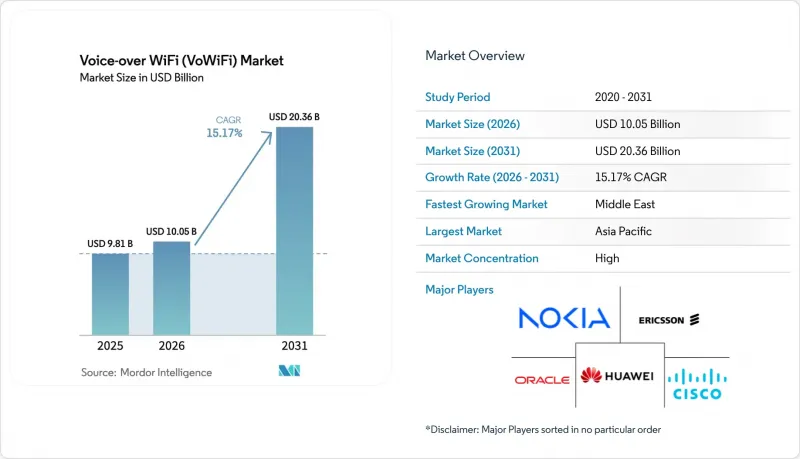
Mordor Intelligence에 의하면, 보이스 오버 WiFi(VoWiFi) 시장 규모는 2026년에 100억 5,000만 달러에 이르고, 2031년까지 203억 6,000만 달러로 확대한다고 예측되고 있어 2026년부터 2031년까지 CAGR 15.17%로 성장할 전망입니다.
본 보고서는 VoWiFi 클라이언트(통합형 VoWiFi 클라이언트, 개별형 VoWiFi 클라이언트 등), 기기 유형(스마트폰, 태블릿, 노트북 등), 구축 모델(네트워크 기반 IMS 코어, 클라우드 호스팅 VoWiFi, 하이브리드 엣지·클라우드), 최종 사용자(개인, 중소기업 등), 지역별로 분류되어 있습니다. 시장 전망은 금액(달러) 기준으로 제시되어 있습니다.
전 세계 보이스 오버 Wi-Fi(VoWiFi) 시장 동향 및 인사이트
캐리어급 Wi-Fi 로밍 계약의 급속한 확대
모바일 네트워크 사업자들은 국제 종단 요금을 절감하고 PSTN 상호 접속 요금을 회피하기 위해 도매 계약에 VoWiFi 로밍을 포함시키고 있습니다. GSMA의 2025년 IR.92 개정으로 ePDG 감지가 표준화되어 방문 네트워크 간 원활한 음성 세션이 가능해졌습니다. 보다폰의 범유럽 규모 시범 운영을 통해 음성 전송 비용을 40% 절감했으며, 이는 Tier 1 통신사 간의 유사한 계약 체결을 촉진했습니다. 주파수 대역에 제약이 있는 동남아시아의 통신 사업자들은 현재 캐리어급 로밍을 프리미엄 서비스가 아닌 커버리지 확장의 수단으로 간주하고 있습니다. Passpoint R3를 통해 인증 정보 제공이 더욱 간소화되어 최종 사용자의 편의성이 향상되었습니다. 이러한 변화들이 맞물려 면허 대역의 트래픽이 경감되고, 통신 사업자의 수익성이 향상되고 있습니다.
5G NR 구축 시 실내 커버리지 격차 확대
미드밴드 및 mm파 신호는 콘크리트 구조물 내에서 최대 20 dB의 감쇠가 발생하기 때문에 통신 사업자는 음성 통신의 연속성을 확보하기 위해 LTE 오버레이를 유지할 수밖에 없습니다. VoWiFi는 새로운 스몰셀을 도입하지 않고도 이러한 공백을 메울 수 있으므로, 통신 사업자는 도심 지역의 레거시 계층을 폐지할 수 있게 됩니다. 버라이즌이 2025년 맨해튼에서 실시한 C-밴드 구축에서는 90일 이내에 실내 통화의 60%를 VoWiFi로 전환하여, 계획되었던 스몰셀 밀도를 30% 줄였습니다. 이러한 신속한 투자 회수(ROI) 덕분에 북미와 유럽 전역에서 유사한 노력이 진행되고 있습니다.
VoWiFi에서 VoLTE로의 핸드오프 시 지속되는 품질 문제
실시간 IPsec 터널의 재협상으로 인해 200-400밀리초의 지터가 발생하며, 그 결과 사용자가 통화 끊김으로 인식할 수 있는 들리는 끊김 현상이 발생합니다. 에릭슨의 2025년 현장 데이터에 따르면, Wi-Fi에서 셀룰러로 전환하는 동안 통화 중 끊김 비율이 18%에 달하며, 이는 VoLTE 벤치마크를 크게 상회하는 수치입니다. 레거시 코어 네트워크를 보유한 소규모 통신 사업자들은 이 격차를 해소하는 데 필요한 예측 인증 업그레이드에 필요한 자금을 확보하는 데 어려움을 겪고 있습니다. 품질이 안정될 때까지 일부 소비자들은 VoWiFi를 비활성화하기 때문에 전체 트래픽 증가세가 둔화되고 있습니다.
부문 분석
통합형 클라이언트는 사용자 편의성을 높이는 OS 수준의 인증 기능 덕분에 2025년 매출의 56.48%를 차지했습니다. 브라우저 기반 옵션은 규모는 작지만 연평균 성장률(CAGR) 17.32%로 성장하고 있습니다. 브라우저 클라이언트와 연계된 보이스 오버 Wi-Fi(VoWiFi) 시장 규모는 WebRTC의 성숙화에 힘입어, 설치가 필요 없는 음성 통신이 BYOD(Bring Your Own Device) 환경에서 매력적인 요소로 부상하고 있습니다. 기업들은 브라우저가 제공하는 정책 제어 및 제로 트러스트(Zero Trust)에 의한 분리를 중요시하고 있습니다. 통합형 클라이언트는 여전히 예측적 핸드오버에 뛰어나 통신 영역 전환 시 지연을 줄여주고 있지만, 브라우저의 기술 혁신으로 인해 그 성능 차이는 계속 줄어들고 있습니다.
두 번째 촉진요인은 브라우저 세션의 인증 정보 프로비저닝을 자동화하는 Passpoint R3입니다. 시스코의 Webex Calling은 네이티브 클라이언트 구축을 피함으로써 개발 비용을 30% 절감하고 있으며, 이러한 높은 비용 효율성으로 인해 중견 기업들로부터 지지를 받고 있습니다. 예측 기간 동안 통합형 클라이언트가 최대 점유율을 유지할 것으로 보이며, 브라우저 솔루션이 Wi-Fi 음성 통신(VoWiFi) 시장에서 차지하는 비중은 확대될 전망입니다.
2025년에는 스마트폰이 매출 점유율의 80.36%를 차지하며, 음성 통신 분야에서 스마트폰이 수행하는 핵심적인 역할을 여실히 보여주고 있습니다. 기타 연결 기기의 점유율은 작지만, 연평균 성장률(CAGR) 15.49%로 증가할 것으로 예측됩니다. 산업용 게이트웨이, 텔레매틱스 장치, 의료용 웨어러블 기기는 모두 칩셋 수준에서 ePDG 통합의 혜택을 받고 있으며, 이로 인해 별도의 셀룰러 모듈이 필요 없어집니다. 비용 및 에너지 효율성 측면에서 이러한 신흥 엔드포인트들이 Wi-Fi 통화를 채택함에 따라 스마트폰이 차지하는 보이스 오버 Wi-Fi(VoWiFi) 시장 점유율은 점차 감소할 것입니다.
퀄컴이 5달러 미만으로 제공한 VoWiFi 지원 IoT 칩셋은 제조 현장 전반에 음성 기능이 탑재된 센서를 도입하는 길을 열었습니다. 자동차 제조업체들은 셀룰러 통신이 불안정한 상황에서도 eCall 규정을 충족하기 위해 텔레매틱스 제어 장치에 VoWiFi를 통합하고 있습니다. 병원에서는 건물 내 셀룰러 통신 제한이 Wi-Fi에는 적용되지 않기 때문에 환자 모니터에 VoWiFi를 도입하는 경향이 있습니다. 노트북이나 태블릿은 보조적인 역할에 그치지만, 대용량 배터리를 탑재하고 있어 장시간 회의 중에도 ePDG 터널을 지속적으로 유지할 수 있습니다.
지역별 분석
2025년, 아시아태평양은 VoWiFi 매출의 45.16%를 차지했습니다. 차이나 모바일의 Wi-Fi 6E 네트워크와 릴라이언스 지오의 고정 무선 번들 서비스는 해당 지역의 주파수 대역 부족에 대한 대응책을 여실히 보여주고 있습니다. KT는 지하철 터널 내에서 Wi-Fi 통화 서비스를 제공하여 고객 이탈을 억제했습니다. 일본의 통신 사업자들은 상호 운용성 테스트를 완료했으며, 인도에서는 신규 스마트폰에 VoWiFi 지원이 의무화되어 지방 지역의 단말기 지원 범위가 확대되었습니다.
중동은 15.33%라는 가장 높은 연평균 성장률(CAGR)을 나타낼 전망입니다. 사우디아라비아 규제 당국은 2025년 중반까지 전국적인 VoWiFi 도입을 명령했습니다. 남아프리카공화국에서는 라이선스 발급 절차를 90일로 단축하여 중소 통신사의 신속한 서비스 확장을 가능하게 했습니다. 나이지리아에서는 라고스의 낮은 휴대전화 보급률을 기업용 Wi-Fi가 보완한 결과, 2025년에는 모바일 사용자의 15%가 VoWiFi를 이용하게 되었습니다. UAE의 통신 사업자들은 현재 에미리트 간 로밍 서비스를 제공하여 도시 간 이동 중 통화 끊김 현상을 최소화하고 있습니다.
북미에서는 E911 요건을 충족하고 실내 네트워크 밀도 향상에 드는 예산을 절감하기 위해 VoWiFi가 활용되고 있습니다. T-Mobile은 VoWiFi를 5G 독립형 코어에 통합하여 도시 지역의 통화 끊김률을 35% 줄였습니다. Verizon의 C-밴드 계획에서는 실내 통화를 Wi-Fi로 유도함으로써 스몰 셀 관련 비용을 2억 달러 절감했습니다. 캐나다에서는 별도의 면허가 필요 없는 6GHz 대역의 VoWiFi가 승인되어 지역 내 보급이 가속화되고 있습니다. 유럽에서는 국경을 넘는 로밍이 자발적인 합의에 의존하고 있어 진척 상황이 제각각이지만, 독일에서는 이미 통화 시간의 22%가 Wi-Fi를 통해 이루어지고 있습니다. 남미는 여전히 도시 중심의 전개 양상을 보이고 있으며, 브라질에서는 신규 면허에 VoWiFi 도입이 의무화되어 있는 반면, 아르헨티나와 칠레에서는 인프라 제약에 직면해 있습니다.
기타 혜택:
- 엑셀 형식 시장 예측(ME) 시트
- 3개월간의 애널리스트 지원
자주 묻는 질문
목차
제1장 서론
제2장 조사 방법
제3장 주요 요약
제4장 시장 구도
제5장 시장 규모와 성장 예측
제6장 경쟁 구도
제7장 시장 기회와 향후 전망
JHS 26.08.11According to Mordor Intelligence, the voice-over wi-Fi (VoWiFi) market size reached USD 10.05 billion in 2026 and is forecast to climb to USD 20.36 billion by 2031, advancing at a 15.17% CAGR during 2026-2031.
This report is Segmented by Voice Client (Integrated VoWiFi Client, Separate VoWiFI Client, and More), Device Type (Smartphones, Tablets and Laptops, and More), Deployment Model (Network-Based IMS Core, Cloud-Hosted VoWiFi, and Hybrid Edge-Cloud), End-User (Residential Consumers, Small and Medium Enterprises, and More), and Geography. The Market Forecasts are Provided in Terms of Value (USD).
Global Voice-over Wi-Fi (VoWiFi) Market Trends and Insights
Rapid Expansion of Carrier-Grade Wi-Fi Roaming Agreements
Mobile network operators embed VoWiFi roaming in wholesale agreements to cut international termination fees and avoid PSTN interconnect charges. The GSMA 2025 IR.92 amendment standardized ePDG discovery, allowing seamless voice sessions across visited networks. Vodafone's pan-European trial cut voice delivery costs by 40% and spurred similar deals among tier-1 carriers. Operators in spectrum-constrained Southeast Asia now view carrier-grade roaming as a coverage extension tool rather than a premium service. Passpoint R3 further simplified credential provisioning, reducing friction for end-users. These shifts collectively lift traffic off licensed spectrum and improve operator economics.
Rising Indoor Coverage Gaps in 5G NR Deployments
Mid-band and millimeter-wave signals lose up to 20 dB within concrete structures, forcing operators to keep LTE overlays for voice continuity. VoWiFi fills those gaps without new small cells, letting carriers retire legacy layers in urban cores. Verizon's 2025 Manhattan C-band rollout redirected 60% of indoor calls to VoWiFi within 90 days, reducing planned small-cell density by 30%. The quick ROI encourages similar approaches across North America and Europe.
Persistent VoWiFi-to-VoLTE Handoff Quality Issues
Real-time IPsec tunnel renegotiation introduces 200-400 milliseconds of jitter, resulting in audible gaps that users perceive as dropped calls. Ericsson's 2025 field data showed 18% mid-call drop rates during Wi-Fi-to-cellular transitions, far exceeding VoLTE benchmarks. Smaller operators with legacy cores struggle to fund the predictive authentication upgrades required to close the gap. Until quality stabilizes, some consumers disable VoWiFi, slowing overall traffic growth.
Other drivers and restraints analyzed in the detailed report include:
- Growing Penetration of VoWiFi-Capable Handsets
- Government Emergency-Service Mandates for Wi-Fi E911 Indoors
- Limited Monetization Models for MNOs
For complete list of drivers and restraints, kindly check the Table Of Contents.
Segment Analysis
Integrated clients contributed 56.48% of 2025 revenue, powered by OS-level authentication that removes user friction. Browser-based options, though smaller, are growing at a 17.32% CAGR. The Voice-over Wi-Fi (VoWiFi) Market size attached to browser clients benefits from WebRTC maturity that makes installation-free voice attractive for bring-your-own-device environments. Enterprises value policy control and zero-trust separation that browsers deliver. Integrated clients still excel at predictive handoffs, reducing latency during coverage changes, yet browser innovations continue to narrow the performance gap.
A second driver is Passpoint R3, which automates credential provisioning for browser sessions. Cisco's Webex Calling realized 30% lower development costs by avoiding native client builds, and this spending efficiency appeals to mid-market enterprises. Over the forecast, integrated clients will retain the largest share, but browser solutions will account for an expanding slice of the Voice-over Wi-Fi (VoWiFi) Market.
Smartphones held 80.36% revenue share in 2025, underlining their central role in voice communication. Other connected devices, although smaller, are expected to rise at a 15.49% CAGR. Industrial gateways, telematics units, and medical wearables all gain from chipset-level ePDG integration, which removes the need for separate cellular modules. The Voice-over Wi-Fi (VoWiFi) Market share for smartphones will gradually erode as these emerging endpoints adopt Wi-Fi calling due to cost and energy considerations.
Qualcomm's sub-USD 5 VoWiFi-ready IoT chipset opened the door for voice-enabled sensors across manufacturing floors. Automotive makers embed VoWiFi in telematics control units to satisfy eCall regulations when cellular service is weak. Hospitals prefer VoWiFi for patient monitors because in-building cellular restrictions do not apply to Wi-Fi. Laptops and tablets play a secondary role, but larger batteries help them maintain continuous ePDG tunnels during long meetings.
Complete Report Scope:
- By Voice Client
- Integrated VoWiFI Client
- Separate VoWiFI Client
- Browser-based VoWiFi Client
- By Device Type
- Smartphones
- Tablets and Laptops
- Other Connected Device Types
- By Deployment Model
- Network-Based (IMS Core)
- Cloud-Hosted VoWiFi
- Hybrid (Edge-Cloud)
- By End-User
- Residential Consumers
- Small and Medium Enterprises
- Large Enterprises
- Public-Safety and Government Agencies
- By Geography
- North America
- United States
- Canada
- Mexico
- South America
- Brazil
- Argentina
- Rest of South America
- Europe
- Germany
- United Kingdom
- France
- Italy
- Spain
- Rest of Europe
- Asia-Pacific
- China
- Japan
- India
- South Korea
- ASEAN
- Rest of Asia-Pacific
- Middle East
- Saudi Arabia
- United Arab Emirates
- Rest of Middle East
- Africa
- South Africa
- Nigeria
- Rest of Africa
- North America
Geography Analysis
Asia-Pacific generated 45.16% of VoWiFi revenue in 2025. China Mobile's Wi-Fi 6E fabric and Reliance Jio's fixed-wireless bundles underline the region's spectrum scarcity workaround. KT covered subway tunnels with Wi-Fi calling, easing customer churn. Japan's carriers completed interoperability testing, and India mandated VoWiFi support on new smartphones, enlarging handset readiness across rural zones.
Middle East will post the fastest 15.33% CAGR. Saudi Arabia's regulator ordered nationwide VoWiFi by mid-2025. South Africa streamlined licensing to 90 days, letting smaller carriers deploy quickly. Nigeria saw adoption rise to 15% of mobile users in 2025 as enterprise Wi-Fi offset poor cellular penetration in Lagos. UAE operators now offer cross-emirate roaming, minimizing call drops during inter-city travel.
North America leans on VoWiFi to meet E911 mandates and shrink indoor densification budgets. T-Mobile integrated VoWiFi with its 5G standalone core, cutting urban call-drop rates by 35%. Verizon's C-band plan saved USD 200 million in small-cell costs by steering indoor calls to Wi-Fi. Canada cleared 6 GHz VoWiFi with no individual licenses, accelerating regional uptake. Europe shows mixed progress because cross-border roaming rests on voluntary agreements, yet Germany already records 22% of voice minutes over Wi-Fi. South America remains city-centric, with Brazil mandating VoWiFi in new licenses while Argentina and Chile face infrastructure constraints.
- Cisco Systems, Inc.
- Nokia Corporation
- Telefonaktiebolaget LM Ericsson
- Huawei Technologies Co., Ltd.
- Oracle Corporation
- Samsung Electronics Co., Ltd.
- Apple Inc.
- Xiaomi Corporation
- ZTE Corporation
- Mitel Networks Corporation
- Ribbon Communications Operating Company, Inc.
- KT Corporation
- Aptilo Networks AB
- D-Link Corporation
- Aruba Networks, Inc.
- Broadcom Inc.
- Qualcomm Incorporated
- Boingo Wireless, Inc.
- CommScope Holding Company, Inc.
- Reliance Jio Infocomm Limited
- T-Mobile US, Inc.
Additional Benefits:
- The market estimate (ME) sheet in Excel format
- 3 months of analyst support
TABLE OF CONTENTS
1 INTRODUCTION
- 1.1 Study Assumptions and Market Definition
- 1.2 Scope of the Study
2 RESEARCH METHODOLOGY
3 EXECUTIVE SUMMARY
4 MARKET LANDSCAPE
- 4.1 Market Overview
- 4.2 Market Drivers
- 4.2.1 Rapid Expansion of Carrier-Grade Wi-Fi Roaming Agreements
- 4.2.2 Rising Indoor-Coverage Gaps in 5G NR Deployments
- 4.2.3 Growing Penetration of VoWiFi-capable Handsets
- 4.2.4 Enterprise BYOD Security Mandates Favouring Wi-Fi Calling Firewalls
- 4.2.5 Government Emergency-service Mandates for Wi-Fi E911 Indoors
- 4.2.6 Energy-efficiency Regulations Pushing Device OEMs to Off-load Voice to Wi-Fi
- 4.3 Market Restraints
- 4.3.1 Persistent VoWiFi-to-VoLTE Hand-off Quality Issues
- 4.3.2 Limited Monetisation Models for MNOs
- 4.3.3 Carrier-Wi-Fi Spectrum Congestion in Unlicensed 6 GHz Bands
- 4.3.4 Slow Adoption of Wi-Fi CERTIFIED 6 Release 2 APs in Rural Markets
- 4.4 Industry Value Chain Analysis
- 4.5 Regulatory Landscape
- 4.6 Technological Outlook
- 4.7 Porter's Five Forces Analysis
- 4.7.1 Bargaining Power of Suppliers
- 4.7.2 Bargaining Power of Buyers
- 4.7.3 Threat of New Entrants
- 4.7.4 Threat of Substitutes
- 4.7.5 Intensity of Competitive Rivalry
5 MARKET SIZE AND GROWTH FORECASTS (VALUE)
- 5.1 By Voice Client
- 5.1.1 Integrated VoWiFI Client
- 5.1.2 Separate VoWiFI Client
- 5.1.3 Browser-based VoWiFi Client
- 5.2 By Device Type
- 5.2.1 Smartphones
- 5.2.2 Tablets and Laptops
- 5.2.3 Other Connected Device Types
- 5.3 By Deployment Model
- 5.3.1 Network-Based (IMS Core)
- 5.3.2 Cloud-Hosted VoWiFi
- 5.3.3 Hybrid (Edge-Cloud)
- 5.4 By End-User
- 5.4.1 Residential Consumers
- 5.4.2 Small and Medium Enterprises
- 5.4.3 Large Enterprises
- 5.4.4 Public-Safety and Government Agencies
- 5.5 By Geography
- 5.5.1 North America
- 5.5.1.1 United States
- 5.5.1.2 Canada
- 5.5.1.3 Mexico
- 5.5.2 South America
- 5.5.2.1 Brazil
- 5.5.2.2 Argentina
- 5.5.2.3 Rest of South America
- 5.5.3 Europe
- 5.5.3.1 Germany
- 5.5.3.2 United Kingdom
- 5.5.3.3 France
- 5.5.3.4 Italy
- 5.5.3.5 Spain
- 5.5.3.6 Rest of Europe
- 5.5.4 Asia-Pacific
- 5.5.4.1 China
- 5.5.4.2 Japan
- 5.5.4.3 India
- 5.5.4.4 South Korea
- 5.5.4.5 ASEAN
- 5.5.4.6 Rest of Asia-Pacific
- 5.5.5 Middle East
- 5.5.5.1 Saudi Arabia
- 5.5.5.2 United Arab Emirates
- 5.5.5.3 Rest of Middle East
- 5.5.6 Africa
- 5.5.6.1 South Africa
- 5.5.6.2 Nigeria
- 5.5.6.3 Rest of Africa
- 5.5.1 North America
6 COMPETITIVE LANDSCAPE
- 6.1 Market Concentration
- 6.2 Strategic Moves
- 6.3 Market Share Analysis
- 6.4 Company Profiles (includes Global level Overview, Market Level Overview, Core Segments, Financials as Available, Strategic Information, Market Rank/Share for Key Companies, Products and Services, and Recent Developments)
- 6.4.1 Cisco Systems, Inc.
- 6.4.2 Nokia Corporation
- 6.4.3 Telefonaktiebolaget LM Ericsson
- 6.4.4 Huawei Technologies Co., Ltd.
- 6.4.5 Oracle Corporation
- 6.4.6 Samsung Electronics Co., Ltd.
- 6.4.7 Apple Inc.
- 6.4.8 Xiaomi Corporation
- 6.4.9 ZTE Corporation
- 6.4.10 Mitel Networks Corporation
- 6.4.11 Ribbon Communications Operating Company, Inc.
- 6.4.12 KT Corporation
- 6.4.13 Aptilo Networks AB
- 6.4.14 D-Link Corporation
- 6.4.15 Aruba Networks, Inc.
- 6.4.16 Broadcom Inc.
- 6.4.17 Qualcomm Incorporated
- 6.4.18 Boingo Wireless, Inc.
- 6.4.19 CommScope Holding Company, Inc.
- 6.4.20 Reliance Jio Infocomm Limited
- 6.4.21 T-Mobile US, Inc.
7 MARKET OPPORTUNITIES AND FUTURE OUTLOOK
- 7.1 White-space and Unmet-Need Assessment


