

|
시장보고서
상품코드
2100575
실리콘 유체 시장 : 점유율 분석, 업계 동향 및 통계, 성장 예측(2026-2031년)Silicone Fluids - Market Share Analysis, Industry Trends & Statistics, Growth Forecasts (2026 - 2031) |
||||||
 Mordor Intelligence
Mordor Intelligence에 의하면, 2026년 실리콘 유체 시장 규모는 62억 3,000만 달러로 추정되고 있어 2025년 59억 2,000만 달러에서 확대해, 2031년에는 80억 3,000만 달러에 이를 것으로 예측됩니다.
2026년부터 2031년까지의 연평균 성장률(CAGR)은 5.22%가 될 것으로 전망됩니다.
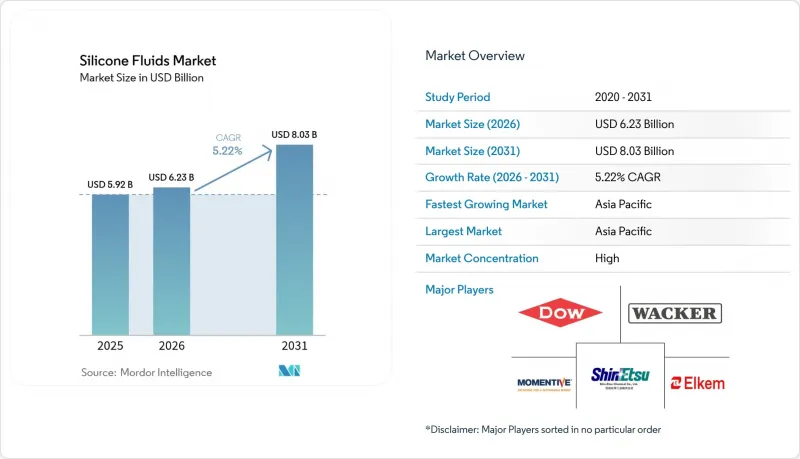
본 보고서는 제품 유형(스트레이트 실리콘 유체·변성 실리콘 유체), 용도(윤활제·그리스, 댐핑 매체, 액체 유전체, 작동유, 소포제, 퍼스널케어, 페인트 및 코팅용 첨가제, 섬유, 의약품, 기타), 지역(아시아태평양, 북미, 유럽, 남미, 중동 및 아프리카)별로 분류되어 있습니다.
세계 실리콘 유체 시장 동향과 인사이트
퍼스널케어 및 화장품 분야 수요 증가
제품 개발자들은 규제 대상인 고리형 실리콘을, 사용감이 우수하면서도 지속가능성을 겸비한 차세대 소재로 신속하게 대체하는 움직임을 보이고 있습니다. Siltech사의 바이오 유래 알킬디메티콘은 연신성을 향상시키는 동시에, 미정제 화석 원료에 대한 의존도를 낮춥니다. CHT Group사의 ‘BeauSil RE-AMO 919 EM’은 94% 이상이 재생 모노머로 구성되어 있어, 보습력을 저해하지 않으면서 순환 경제의 목표를 달성하고 있습니다. 아시아태평양에서 확대되고 있는 중산층은 프리미엄 다기능 스킨케어 및 헤어케어 제품을 적극적으로 수용하고 있으며, 하나의 블렌드로 컨디셔닝, 장벽 기능, 윤기 효과를 제공하는 실리콘 유체 수요를 뒷받침하고 있습니다. 각 브랜드가 제품 포트폴리오를 축소해 나가는 가운데, 다기능성은 중요한 차별화 요소로 부상하고 있으며, 저탄소 발자국을 입증할 수 있는 공급업체가 우선 공급업체로서의 지위를 확보하고 있습니다.
전기차(EV) 열 관리용 유체에서의 채택 확대
액체 냉각식 배터리 팩에는 열 폭주를 억제하면서 효율적으로 열을 전달하는 절연액이 필요합니다. 루브리졸의 '라이프타임 필(Lifetime Fill)' 실리콘 냉각액은 EV 배터리 팩의 전체 수명 기간 동안 안정성을 유지함으로써 이러한 변화를 구현하고 있습니다. 중국에서 조만간 시행될 GB 29743.2의 전도도 기준은 기존의 글리콜-물 혼합액으로는 충족할 수 없는 높은 기준을 설정하고 있어, 자동차 제조업체들을 실리콘 기반 배합으로 이끌고 있습니다. 배터리 외에도 와이드 밴드갭 인버터, 전기 모터, 충전 시스템에서도 실리콘 유체의 폭넓은 작동 온도 범위가 활용되고 있습니다. 업스트림 공정에서는 전기차의 성장에 따른 금속 실리콘 수요가 2030년까지 연평균 4.56% 증가할 것으로 예상되어, 원료의 안정적인 공급을 확보할 수 있는 수직 통합형 제조업체에게는 호재가 되고 있습니다.
변동이 심한 금속 실리콘·모노머 가격
중국은 전 세계 금속 실리콘 생산량의 약 4분의 3을 장악하고 있으며, 이는 실리콘 유체 시장 전체에 파급되는 ‘단일 국가 리스크’를 초래하고 있습니다. 에너지 가격 급등, 생산 제한, 지정학적 마찰 등이 현물 가격을 급등락하게 하여, 하류 혼합 제조업체의 예산 수립을 혼란스럽게 하고 있습니다. 미국은 ‘인플레이션 억제법’에 따라 국내 제련소 프로젝트를 장려하고 있지만, 새로운 생산 능력이 실질적으로 가동되는 것은 2030년 이후가 될 전망입니다. 그동안 생산자들은 장기 공급 계약을 통한 헤지나 후방 통합을 검토하고 있지만, 이러한 조치에는 막대한 자본이 필요하며, 많은 중견 기업들은 그 자금력을 확보하기 어렵습니다.
부문 분석
개질 등급은 비개질 등급보다 빠르게 확대되고 있으며, 배합 제조업체가 특정 측쇄, 반응성 부위 또는 가교 가능기를 갖춘 실록산을 지정함에 따라 연평균 성장률(CAGR)은 6.72%로 성장을 지속하고, 있습니다. 이러한 맞춤형 분자는 기판에 선택적으로 결합하거나, 접착력을 높이거나, 소수성 표면을 형성함으로써 최종 사용자가 과도한 설계를 거치지 않고도 성능 목표를 달성할 수 있도록 합니다. 수요는 전기차(EV)용 포팅, 컨포멀 코팅, 고굴곡성 섬유용 잉크 분야에서 두드러집니다. 그럼에도 불구하고, 비용 효율성과 폭넓은 사양에 대한 적합성 덕분에 일반 폴리디메틸실리콘 등급은 여전히 판매량 1위를 유지하고 있습니다. 해당 공급망은 성숙해 있으며, 연속 공정을 통한 병목 현상 해소로 단위 비용은 더욱 낮아졌습니다.
지속 가능한 생산을 둘러싼 경쟁은 격화되고 있습니다. 다우(Dow)와 서커실(Circusil)의 합작 사업을 통해 PDMS의 탄소 발자국을 50% 이상 줄일 수 있는 재활용 루프가 실현되었습니다. 바커(Wacker)는 2025년 5월, 중국에서 새로운 유체 및 에멀젼 생산 라인을 가동하여 차세대 전자제품용 고순도 제품의 생산 능력을 확충했습니다. KCC가 2024년에 모멘티브를 인수함에 따라, 업스트림의 실록산 단량체부터 하류의 특수 유체에 이르는 수직 통합 범위가 확대되었습니다. 순환형 경제 목표가 엄격해지는 가운데, 폐쇄형 루프 체제를 갖춘 제조업체는 스코프 3 배출 감축 인증 취득에 열심인 전 세계 OEM 기업들로부터 공급 계약 선정 시 우선권을 받고 있습니다.
지역별 분석
아시아태평양은 실리콘 금속 제련부터 완성된 배합 제품에 이르기까지 일관된 공급망을 활용하여 실리콘 유체 시장을 독점하고 있습니다. 중국의 비용 경쟁력과 원자재의 75%를 자국에서 조달하는 체계가 이 지역의 리더십을 뒷받침하고 있는 반면, 일본과 한국은 초고순도 유전체 유체가 필요한 소형 전자기기 및 메모리 반도체 분야를 주도하고 있습니다. 동남아시아는 제조 거점으로서의 입지를 확립해 가고 있으며, 베트남과 태국은 특수 화학제품 복합 시설에 대한 외국인 직접 투자를 유치하고 있습니다. 인도는 국내 자동차 생산 확대와 지속적으로 성장하는 퍼스널케어 분야의 성장에 힘입어 현지 매출에서 두 자릿수 성장을 기록하고 있습니다.
북미에서는 다른 추세가 나타나고 있습니다. 미국은 중요 광물공급망 국내 복귀를 추진하고 있으며, 데이터센터 및 전기차(EV) 인프라 확충이 특수 유체 수요를 견인하고 있습니다. 미시간주에서 다우(Dow)사의 실리콘 엘라스토머 생산 능력 확대는 빠른 납기를 요구하는 지역 고객들을 지원하고 있습니다. 엑슨모빌은 텍사스주에서 고점도 합성 기유 생산 능력을 증강함으로써, 고품질 기능성 유체가 산업계에서 더욱 널리 수용되고 있음을 보여주고 있습니다. 캐나다는 수성 야금용 실리콘을 공급하고 있으며, 멕시코의 마키라도라 회랑에서는 전자기기 조립 및 자동차용 와이어 하네스 생산을 위한 유체에 대한 수요가 증가하고 있습니다.
유럽은 가장 엄격한 규제 장벽에 직면해 있음에도 불구하고 여전히 혁신의 중심지로 자리 잡고 있습니다. 바커(Wacker)사는 범용 등급의 판매량 감소를 특수 등급이 상쇄함으로써 2025년 실리콘 부문 매출이 10% 성장할 것으로 예측했습니다. 독일의 기계 제조업체들은 공작기계용으로 실리콘 제 감쇠 매체를 지정하고 있는 반면, 프랑스의 화장품 제조업체들은 곧 시행될 포장 규제 및 탄소 발자국 규제에 대응하기 위해 업사이클링된 실리콘 원료 개발을 주도하고 있습니다. 북유럽 전력 회사의 친환경 전력 구성은 순환형 제조에 대한 주장의 신빙성을 높여주며, 실리콘 유체 제조업체가 기술적 성능에 더해 환경적 가치를 어필하는 데 일조하고 있습니다.
기타 혜택:
- 엑셀 형식 시장 예측(ME) 시트
- 3개월간의 애널리스트 지원
자주 묻는 질문
목차
제1장 서론
제2장 조사 방법
제3장 주요 요약
제4장 시장 구도
제5장 시장 규모와 성장 예측
제6장 경쟁 구도
제7장 시장 기회와 향후 전망
JHS 26.08.11According to Mordor Intelligence, silicone fluids market size in 2026 is estimated at USD 6.23 billion, growing from 2025 value of USD 5.92 billion with 2031 projections showing USD 8.03 billion, growing at 5.22% CAGR over 2026-2031.
This report is Segmented by Product Type (Straight Silicone Fluid and Modified Silicone Fluid), Application (Lubricants and Greases, Damping Media, Liquid Dielectrics, Hydraulic Fluids, Defoamers, Personal Care, Paints and Coating Additives, Textile, Pharmaceuticals, and Other Applications), and Geography (Asia-Pacific, North America, Europe, South America, and Middle-East and Africa).
Global Silicone Fluids Market Trends and Insights
Rising Demand from Personal Care and Cosmetics
Formulators are moving quickly to replace restricted cyclic silicones with next-generation materials that marry sensory appeal and sustainability. Bio-based alkyl dimethicones from Siltech improve spreadability while cutting reliance on virgin fossil feedstocks. CHT Group's BeauSil RE-AMO 919 EM incorporates over 94% recycled monomers to meet circular-economy targets without sacrificing emolliency. Expanding middle-class populations in Asia-Pacific are embracing premium multifunctional skin- and hair-care products, spurring demand for silicone fluids that deliver conditioning, barrier, and gloss benefits in a single blend. As brands tighten product portfolios, multifunctionality becomes a critical differentiator, and suppliers able to document lower carbon footprints gain preferred-supplier status.
Increasing Adoption in Electric Vehicle Thermal-Management Fluids
Liquid-cooled battery packs need dielectric fluids that suppress thermal runaway yet transfer heat efficiently. Lubrizol's lifetime-fill silicone coolant exemplifies this shift by remaining stable for the full service life of an EV battery pack. China's forthcoming GB 29743.2 conductivity threshold sets a high bar that conventional glycol-water blends cannot meet, steering automakers toward silicone-based formulations. Beyond batteries, wide-bandgap inverters, e-motors, and charging systems also benefit from the broad operating-temperature band of silicone fluids. Upstream, silicon metal demand tied to EV growth is rising 4.56% annually through 2030, rewarding vertically integrated producers that can secure raw supply.
Volatile Silicon Metal and Monomer Prices
China controls roughly three-quarters of the world's silicon metal output, creating a single-country risk that cascades through the silicone fluids market. Energy-price spikes, production curbs, and geopolitical frictions swing spot quotes, disrupting budgeting for downstream formulators. The United States is incentivizing domestic smelter projects under the Inflation Reduction Act, yet new capacity will not meaningfully come onstream before 2030. In the meantime, producers hedge with long-term supply contracts and evaluate backward integration, actions that demand capital many mid-sized players cannot muster.
Other drivers and restraints analyzed in the detailed report include:
- Growth in High-Performance Lubricants for Industrial Automation
- Liquid-Immersion Cooling of Hyperscale Data Centres
- Stringent VOC and REACH Compliance Costs
For complete list of drivers and restraints, kindly check the Table Of Contents.
Segment Analysis
Modified grades are expanding faster than unmodified counterparts, charting a 6.72% CAGR as formulators specify siloxanes with tailored side-chains, reactive sites, or crosslinkable groups. These custom molecules bond selectively to substrates, boost adhesion, or create hydrophobic surfaces, letting end-users hit performance targets without over-engineering. Demand is prominent in EV potting, conformal coatings, and high-flex textile inks. Straight polydimethyl-silicone grades nevertheless maintain volume leadership due to cost efficiency and broad spec inclusion. Their supply chains are mature, and continuous-process debottlenecking further reduces unit cost.
Competition is intensifying around sustainable production. Dow's joint venture with Circusil brings a recycling loop able to cut PDMS carbon footprint by more than 50%. Wacker commissioned new Chinese fluid and emulsion lines in May 2025, adding high-purity capacity aimed at next-gen electronics. KCC's 2024 purchase of Momentive broadens vertical reach from upstream siloxane monomers to downstream specialty fluids. As circular-economy targets harden, producers with closed-loop capabilities gain supply-award preference from global OEMs keen to certify Scope 3 reductions.
Complete Report Scope:
- By Product Type
- Straight Silicone Fluids
- Poly-dimethyl Silicone Fluid
- Methylphenyl Silicone Fluid
- Methylhydrogen Silicone Fluid
- Other Straight Silicone Fluids
- Modified Silicone Fluids
- Reactive Silicone Fluid
- Non-reactive Silicone Fluid
- Straight Silicone Fluids
- By Application
- Lubricants and Greases
- Damping Media
- Liquid Dielectrics
- Hydraulic Fluids
- Defoamers
- Personal Care
- Paints and Coating Additives
- Textile Finishes
- Pharmaceuticals
- Other Applications
- By Geography
- Asia-Pacific
- China
- Japan
- India
- South Korea
- ASEAN Countries
- Rest of Asia-Pacific
- North America
- United States
- Canada
- Mexico
- Europe
- Germany
- United Kingdom
- France
- Italy
- Spain
- Russia
- NORDIC Countries
- Rest of Europe
- South America
- Brazil
- Argentina
- Rest of South America
- Middle-East and Africa
- Saudi Arabia
- South Africa
- Rest of Middle-East and Africa
- Asia-Pacific
Geography Analysis
Asia-Pacific dominates the silicone fluids market, leveraging integrated supply chains that begin with silicon metal smelting and culminate in finished formulations. China's cost advantage and 75% raw-material control anchor the region's leadership, while Japan and South Korea champion miniaturized electronics and memory semiconductors that require ultra-pure dielectric fluids. Southeast Asia is emerging as a manufacturing hedge, with Vietnam and Thailand courting foreign direct investment for specialty-chemical complexes. India, supported by domestic automotive build-out and an expanding personal-care sector, records double-digit local sales increases.
North America presents a different dynamic. The United States orchestrates supply-chain onshoring for critical minerals, while datacenter and EV build-outs propel specialty-fluid demand. Dow's capacity expansion for silicone elastomers in Michigan supports regional customers seeking short lead times. ExxonMobil added high-viscosity synthetic base-stock capacity in Texas, signaling wider industrial acceptance of premium functional fluids. Canada supplies hydro-based metallurgical-grade silicon, and Mexico's maquiladora corridor pulls in fluids for electronics assembly and automotive wiring harness production.
Europe contends with the strictest regulatory hurdles yet remains an innovation epicenter. Wacker forecasts 10% revenue growth in its Silicones division for 2025 as specialty grades offset lower commodity volumes. Germany's engineering companies specify silicone damping media for machine tools, while France's cosmetic houses pioneer upcycled silicone ingredients to meet imminent packaging and carbon-footprint rules. Nordic utilities' green-power matrices lend credibility to circular-manufacturing claims, helping silicone fluid makers sell environmental value alongside technical performance.
- BRB International B.V.
- CHT Germany GmbH
- Dow
- DuPont
- Elkem ASA
- GELEST Inc.
- Innospec Inc.
- IOTA silicone
- KCC SILICONE CORPORATION
- Momentive
- Shin-Etsu Chemical Co., Ltd.
- Siltech Corporation
- Supreme Silicones India Pvt. Ltd.
- Wacker Chemie AG
- Zhejiang Zhongtian Fluorine Silicon Material Co., Ltd.
Additional Benefits:
- The market estimate (ME) sheet in Excel format
- 3 months of analyst support
TABLE OF CONTENTS
1 Introduction
- 1.1 Study Assumptions and Market Definition
- 1.2 Scope of the Study
2 Research Methodology
3 Executive Summary
4 Market Landscape
- 4.1 Market Overview
- 4.2 Market Drivers
- 4.2.1 Rising demand from personal care and cosmetics
- 4.2.2 Increasing adoption in electric vehicle thermal-management fluids
- 4.2.3 Growth in high-performance lubricants for industrial automation
- 4.2.4 Liquid-immersion cooling of hyperscale data centres
- 4.2.5 Precision agriculture anti-foam agents for biostimulant mixtures
- 4.3 Market Restraints
- 4.3.1 Volatile silicon metal and monomer prices
- 4.3.2 Stringent VOC and REACH compliance costs
- 4.3.3 High supplier concentration in raw siloxanes
- 4.4 Value Chain Analysis
- 4.5 Porter's Five Forces
- 4.5.1 Threat of New Entrants
- 4.5.2 Bargaining Power of Suppliers
- 4.5.3 Bargaining Power of Buyers
- 4.5.4 Threat of Substitutes
- 4.5.5 Competitive Rivalry
5 Market Size and Growth Forecasts (Value)
- 5.1 By Product Type
- 5.1.1 Straight Silicone Fluids
- 5.1.1.1 Poly-dimethyl Silicone Fluid
- 5.1.1.2 Methylphenyl Silicone Fluid
- 5.1.1.3 Methylhydrogen Silicone Fluid
- 5.1.1.4 Other Straight Silicone Fluids
- 5.1.2 Modified Silicone Fluids
- 5.1.2.1 Reactive Silicone Fluid
- 5.1.2.2 Non-reactive Silicone Fluid
- 5.1.1 Straight Silicone Fluids
- 5.2 By Application
- 5.2.1 Lubricants and Greases
- 5.2.2 Damping Media
- 5.2.3 Liquid Dielectrics
- 5.2.4 Hydraulic Fluids
- 5.2.5 Defoamers
- 5.2.6 Personal Care
- 5.2.7 Paints and Coating Additives
- 5.2.8 Textile Finishes
- 5.2.9 Pharmaceuticals
- 5.2.10 Other Applications
- 5.3 By Geography
- 5.3.1 Asia-Pacific
- 5.3.1.1 China
- 5.3.1.2 Japan
- 5.3.1.3 India
- 5.3.1.4 South Korea
- 5.3.1.5 ASEAN Countries
- 5.3.1.6 Rest of Asia-Pacific
- 5.3.2 North America
- 5.3.2.1 United States
- 5.3.2.2 Canada
- 5.3.2.3 Mexico
- 5.3.3 Europe
- 5.3.3.1 Germany
- 5.3.3.2 United Kingdom
- 5.3.3.3 France
- 5.3.3.4 Italy
- 5.3.3.5 Spain
- 5.3.3.6 Russia
- 5.3.3.7 NORDIC Countries
- 5.3.3.8 Rest of Europe
- 5.3.4 South America
- 5.3.4.1 Brazil
- 5.3.4.2 Argentina
- 5.3.4.3 Rest of South America
- 5.3.5 Middle-East and Africa
- 5.3.5.1 Saudi Arabia
- 5.3.5.2 South Africa
- 5.3.5.3 Rest of Middle-East and Africa
- 5.3.1 Asia-Pacific
6 Competitive Landscape
- 6.1 Market Concentration
- 6.2 Strategic Moves
- 6.3 Market Share(%)/Ranking Analysis
- 6.4 Company Profiles (includes Global level Overview, Market level overview, Core Segments, Financials as available, Strategic Information, Market Rank/Share, Products and Services, Recent Developments)
- 6.4.1 BRB International B.V.
- 6.4.2 CHT Germany GmbH
- 6.4.3 Dow
- 6.4.4 DuPont
- 6.4.5 Elkem ASA
- 6.4.6 GELEST Inc.
- 6.4.7 Innospec Inc.
- 6.4.8 IOTA silicone
- 6.4.9 KCC SILICONE CORPORATION
- 6.4.10 Momentive
- 6.4.11 Shin-Etsu Chemical Co., Ltd.
- 6.4.12 Siltech Corporation
- 6.4.13 Supreme Silicones India Pvt. Ltd.
- 6.4.14 Wacker Chemie AG
- 6.4.15 Zhejiang Zhongtian Fluorine Silicon Material Co., Ltd.
7 Market Opportunities and Future Outlook
- 7.1 White-space and Unmet-need Assessment


