|
시장보고서
상품코드
2100578
보조생식기술(ART) 시장 : 점유율 분석, 업계 동향 및 통계, 성장 예측(2026-2031년)Assisted Reproductive Technology (ART) - Market Share Analysis, Industry Trends & Statistics, Growth Forecasts (2026 - 2031) |
||||||
 Mordor Intelligence
Mordor Intelligence에 의하면, 보조생식기술(ART) 시장 규모는 2025년 286억 4,000만 달러에서 2026년에는 306억 7,000만 달러로 확대되어 2026년부터 2031년까지 CAGR 7.1%로 성장을 지속하여, 2031년에는 432억 2,000만 달러에 이를 것으로 예측됩니다.
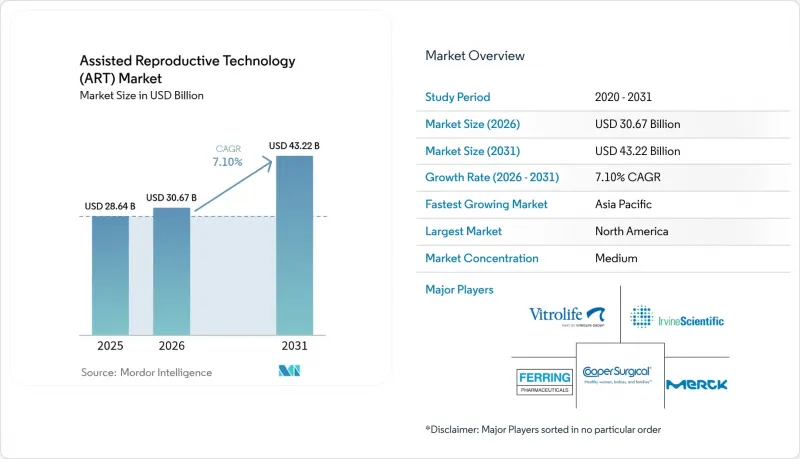
본 보고서는 제품 및 서비스(기기·장치 등), 기술(체외수정(IVF) 등), 시술(신선 배아(비기증자) 등), 최종 사용자(불임 치료 클리닉 등), 지역(북미, 유럽, 아시아태평양, 중동 및 아프리카, 남미)별로 분류되어 있습니다. 시장 전망은 금액(달러) 기준으로 제시되어 있습니다.
전 세계 보조생식기술(ART) 시장 동향 및 인사이트
전 세계 불임 유병률 상승
아시아태평양의 여성 불임은 현저히 증가하고 있으며, 다낭성 난소 증후군(PCOS)이 주요 원인으로 꼽히고 있습니다. 중동의 일부 국가에서는 인구통계학적 불임률이 38.5%에 달하여, 임상적 불임률인 3.8%를 크게 상회하고 있으며, 이는 막대한 잠재 수요가 있음을 시사합니다. 생활 방식의 변화, 도시 지역의 스트레스, 식습관의 변화, 직업적 유해 물질이 모든 연령대에서 생식 건강을 더욱 악화시키고 있습니다. 정책 입안자들은 불임을 체계적인 개입이 필요한 공중보건 문제로 인식하는 경향이 강해지고 있습니다. 이러한 요인들이 복합적으로 작용하여 보조생식기술(ART) 시장의 장기적인 수요 증가를 뒷받침하고 있습니다.
보조생식기술(ART)에 대한 수용도 증가
인도의 조직화된 클리닉 체인은 국내 체외수정(IVF) 주기의 35-40%를 차지하게 되었습니다(10년 전에는 0%였습니다). 이는 불임에 대한 편견의 감소와 브랜드 주도형 업계 재편을 보여줍니다. 폴란드가 2025년에 체외수정(IVF)에 대한 보험 적용을 재개함에 따라, 모든 EU 회원국이 체외수정 비용을 공적 자금으로 부담하게 되어 유럽 전역에서 이에 대한 지지가 나타났습니다. 미국 기업들은 인재를 확보하기 위해 불임 치료 복리후생을 추진하고 있으며, 직원의 66%가 취업처를 결정할 때 생식 건강 관련 복리후생을 중요하게 여기고 있습니다. LGBTQIA+ 분들, 한부모 가정, 그리고 저명한 지지자들이 불임 치료 이용을 당연한 것으로 받아들이면서 그 인지도가 높아지고 있습니다. 사회의 수용성이 높아짐에 따라 환자 수가 증가하여, 보조생식기술(ART) 시장의 지불자 구성이 안정화되고 있습니다.
고액의 치료비와 제한적인 보험 적용
미국에서 체외수정(IVF) 1주기당 평균 비용은 12,000-25,000달러이며, 일반적으로 2.5주기가 소요되므로 많은 가구가 3만 달러가 넘는 비용 부담을 감당해야 합니다. 불임 치료의 일부를 보험 적용 대상으로 의무화한 주는 미국 내 21개 주에 불과하여, 큰 보장 공백이 남아 있습니다. 치료를 시작하는 근로자의 약 28%가 빚을 지고 있어, 사회적 취약 계층에 불균형적인 부담을 안겨주고 있습니다. 국제적으로 볼 때, 1주기당 비용은 많은 EU 회원국에서 4,000유로인 반면, 아시아의 선진국에서는 그보다 더 비싸며, 이것이 해외 의료 관광을 촉진하고 있지만, 그 결과 경과 관찰이 단편화될 우려가 있습니다. 보다 광범위한 보험 환급이 이루어지지 않는 한, 비용은 여전히 보조생식기술(ART) 시장 진입의 가장 큰 장벽이 될 것입니다.
부문 분석
'기기·장비' 부문은 2025년 매출의 52.88%를 차지하고 있으며, 정자 및 난자 배양, 영상 진단, 미세 조작을 수행하기 위한 고부가가치 자본 자산에 대한 실험실의 높은 의존도가 두드러지게 나타나고 있습니다. '소프트웨어·AI 솔루션'은 착상률을 높이기 위한 예측 분석을 원하는 클리닉 수요에 힘입어 2031년까지 연평균 성장률(CAGR) 9.25%로 성장할 것으로 전망됩니다. 각 벤더사는 EmbryoScope+와 iDAScore의 조합 등, 현미경과 AI 알고리즘을 묶어 제공함으로써 통합된 의사결정 지원 워크플로우를 제공하는 움직임을 강화하고 있습니다. Conceivable Life Sciences를 비롯한 자동화 선구자들은 업계 최초의 완전 로봇화 체외수정(IVF) 실험실 ‘AURA’를 도입하여, 연간 2,000주기의 처리를 실현하는 동시에 인력을 대폭 감축하고 있습니다.
반복적으로 사용되는 소모품은 여전히 필수적입니다. 난자 채취 시마다 새로운 배치가 필요하기 때문에 배양 배지의 매출은 주기 수와 연동되어 경기 침체기에도 수익을 안정적으로 유지하고 있습니다. 한편, 제조업체들이 지속적인 소프트웨어 업데이트 및 원격 교정을 위한 구독 모델을 도입함에 따라, 검사실 서비스 계약과 연계된 보조생식기술(ART) 시장 규모는 확대되고 있습니다. 이러한 하드웨어와 소프트웨어를 결합한 하이브리드형 서비스는 전환 비용을 높이고 현금 흐름의 안정성을 강화함으로써 사모펀드 자본을 유치하고 있습니다.
또한 디지털화는 머신러닝 모델에 데이터를 공급하는 데이터 공유 네트워크를 촉진하여, 도입 선도 기업과 후발 기업 간의 성과 격차를 확대시키고 있습니다. AI 기반 배정 프로토콜을 채택한 클리닉에서는 모범 사례의 표준화를 통해 체인 인수 후 성공률이 13.6% 향상되었다고 보고되었습니다. 2026년부터 2031년까지 제품 로드맵은 단일 기기에서 일회용 소모품과 독자적인 데이터 세트를 모두 수익화하는 클라우드 기반 생태계로 명확한 전환을 보이고 있습니다.
체외수정(IVF)은 수십 년에 걸친 노하우와 광범위한 보험 적용에 힘입어 2025년 63.72%의 시장 점유율로 기술적 우위를 유지했습니다. 그러나 선택적 전체 배아 동결 전략으로 인해 동결 배아 이식 주기의 연평균 성장률(CAGR)은 9.18%에 달했습니다. 이 방법을 통해 호르몬으로 인한 자궁내막의 부담 없이 염색체 선별 검사 및 유연한 일정 조정이 가능해집니다. 각 클리닉의 보고에 따르면, 유리화 냉동과 단일 배아 이식 프로토콜을 병행함으로써 다태 임신 발생률이 감소하고 있으며, 이는 점점 더 의무화되고 있는 품질 지표가 되고 있습니다.
새로운 과학적 진전에 따라 기술 체계가 재구축되고 있습니다. Fertilo로 대표되는 유도 만능 줄기세포(iPS 세포)를 활용한 기법을 통해 난소 자극 노출을 80% 줄이면서 치료 기간을 3일로 단축할 가능성이 있습니다. 체외 생식세포 형성에 관한 연구는 중증 남성 요인 불임이나 동성 커플에게 새로운 부모가 될 길을 열어줄 가능성이 있는 실험실에서 배양된 생식세포의 실현을 시사하고 있습니다. 현재로서는 인공수정이 복잡성이 낮은 선택지로 여전히 존재하고 있지만, 보험사 측이 투자 대비 종합적인 성공률이 높다는 점을 인식함에 따라 그 점유율은 체외수정(IVF)의 다양한 기법에 밀려나고 있습니다.
임상의들은 유리화 배아, PGT-A 유전자 검사, AI 스코어링을 결합한 기술 패키지를 환자별 예후에 맞추어 맞춤화하는 경향이 강해지고 있으며, 이를 통해 유산 위험을 줄이면서 출생 1건당 비용을 최적화하고 있습니다. 이러한 개별화를 통해 고령 환자들도 치료의 실현 가능성을 검토할 수 있게 되었으며, 보조생식기술(ART) 시장은 더욱 확대되고 있습니다.
지역별 분석
북미는 프리미엄 가격 책정과 고액의 치료 주기 비용을 흡수하는 고용주의 복리후생 확충에 힘입어 2025년 매출의 45.01%를 차지했습니다. 이 지역의 보조생식기술(ART) 시장 규모는 진행 중인 자동화 시범 사업과 바이오메디컬 코리도 주변에 집적된 소프트웨어 벤더 생태계도 반영하고 있습니다. 미국에서는 기업 보험 플랜을 통한 보험 보상 범위의 확대가 주별 규제 차이를 상쇄하고 있지만, 반면 캐나다의 단일 지불자 제도에서는 보험이 적용되는 치료 주기 수가 제한되어 있어 일부 환자들이 미국의 민간 서비스를 찾게 되면서 국경을 넘는 환자 유입이 지속되고 있습니다.
아시아태평양은 2031년까지 연평균 성장률(CAGR) 8.38%를 나타낼 것으로 예측되며, 이는 각 지역 중 가장 높은 성장률입니다. 인도에서는 매년 60-70곳의 새로운 체외수정(IVF) 시설이 개설되고 있으며, 체계화된 체인점들이 가격에 민감한 도시 지역 커플들에게 어필하는 브랜드를 통한 품질 보증을 바탕으로 꾸준히 시장 점유율을 확대되고 있습니다. 중국 정부는 출산율 하락에 대응해 출산 장려 정책을 추진하고 있으며, 각 성에서 보조금을 제공하는 한편, 클리닉 인가 건수를 늘리고 있습니다. 아시아태평양의 보조생식기술(ART) 시장 규모는 합리적인 가격과 고품질 의료 서비스를 모두 추구하는 외국인 환자를 끌어들이는 비용 면에서의 우위를 바탕으로, 2028년까지 137억 4,000만 달러에 달할 것으로 예측됩니다.
유럽에서는 시장이 성숙해 가면서도 계속해서 변화하고 있습니다. 2025년 폴란드의 정책 전환에 따른 공공 자금의 전면 도입으로 국가별 격차는 해소되었으나, 대기 목록 상황에는 여전히 큰 편차가 있습니다. 인구 통계학적 측면에서 유럽의 총출산율은 여성 1인당 1.46명으로 인구 대체 수준에 미치지 못하고 있어, 수요는 장기화될 전망입니다. 2027년에 시행될 SoHO 규정에 따라 품질 지표와 추적 가능성이 표준화되어, EU 내 환자 수용 능력이 높은 시설로의 전원 절차가 원활해질 가능성이 있습니다. 스페인, 덴마크, 벨기에에서는 이미 다수의 외국인 환자를 대상으로 불임 치료 주기가 진행되고 있으며, EU 공통 데이터 등록 제도를 통해 투명성과 치료 성과가 향상되어 보조생식기술(ART) 시장에서 유럽의 역할이 더욱 강화될 것입니다.
기타 혜택:
- 엑셀 형식 시장 예측(ME) 시트
- 3개월간의 애널리스트 지원
자주 묻는 질문
목차
제1장 보조생식기술(ART) 시장
제2장 서론
제3장 조사 방법
제4장 주요 요약
제5장 시장 구도
제6장 시장 규모와 성장 예측
제7장 경쟁 구도
제8장 시장 기회와 향후 전망
JHS 26.08.11According to Mordor Intelligence, the assisted reproductive technology market size is expected to grow from USD 28.64 billion in 2025 to USD 30.67 billion in 2026 and is forecast to reach USD 43.22 billion by 2031 at 7.1% CAGR over 2026-2031.
This report is Segmented by Product & Service (Instruments & Equipment, and More), Technology (In-Vitro Fertilisation (IVF), and More), Procedure (Fresh Non-Donor, and More), End User (Fertility Clinics, and More), Geography (North America, Europe, Asia-Pacific, The Middle East and Africa, and South America). The Market Forecasts are Provided in Terms of Value (USD).
Global Assisted Reproductive Technology (ART) Market Trends and Insights
Rising Global Infertility Prevalence
Female infertility in Asia-Pacific rose markedly, with polycystic ovary syndrome (PCOS) cited as a major driver. Demographic infertility in some Middle-Eastern countries stands at 38.5%, far above the 3.8% clinical infertility rate, indicating large latent demand. Lifestyle shifts-urban stress, dietary change, occupational toxins-further erode reproductive health across age groups. Policymakers increasingly frame infertility as a public-health issue requiring systematic intervention. Together, these factors sustain long-run volume growth for the assisted reproductive technology market.
Increasing Acceptance of Assisted Reproductive Procedures
Organised Indian clinic chains now capture 35-40% of national IVF cycles-up from zero 10 years ago-showing stigma decline and brand-led consolidation. All EU members fund IVF after Poland reinstated reimbursement in 2025, signalling pan-European support. U.S. companies promote fertility benefits to attract talent; 66% of employees weigh reproductive-health perks in job decisions. Visibility rises as LGBTQIA+ populations, single parents and celebrity advocates normalise usage. Societal openness drives patient inflows and stabilises payer mix for the assisted reproductive technology market.
High Treatment Costs and Limited Insurance Coverage
United States IVF averages USD 12,000-25,000 per cycle, with 2.5 cycles typically needed, thrusting many households above USD 30,000 in expenses. Only 21 U.S. states mandate partial infertility coverage, leaving sizeable gaps. Nearly 28% of employees entering treatment incur debt, disproportionately burdening marginalized groups. Internationally, cycle costs vary from EUR 4,000 in many EU states to higher levels in developed Asia, spurring outbound medical tourism that can fragment follow-up care. Without broader reimbursement, cost remains the steepest barrier to assisted reproductive technology market participation.
Other drivers and restraints analyzed in the detailed report include:
- Rapid Technological Innovations in Reproductive Medicine
- Growth of Cross-Border Fertility Services
- Stringent and Evolving Regulatory Frameworks
For complete list of drivers and restraints, kindly check the Table Of Contents.
Segment Analysis
Instruments & Equipment generated 52.88% of 2025 revenue, underscoring laboratories' dependence on high-value capital assets for incubating, imaging and micromanipulating gametes. Software & AI Solutions will grow at 9.25% CAGR to 2031 as clinics chase predictive analytics that boost implantation odds. Vendors increasingly bundle microscopes with AI algorithms-such as EmbryoScope+ paired with iDAScore-to offer an integrated decision-support workflow. Automation pioneers including Conceivable Life Sciences deploy AURA, the first fully robotic IVF lab, processing 2,000 cycles a year while slashing headcount.
Recurring consumables remain crucial. Culture media sales track cycle volume because every retrieval triggers new batches, stabilising revenue even during downturns. Meanwhile, the assisted reproductive technology market size linked to laboratory service contracts is expanding as manufacturers introduce subscription models for continuous software updates and remote calibration. These hybrid hardware-software offerings deepen switching costs and create stickier cash flows, attracting private-equity capital.
Digitalisation also fosters data-sharing networks that feed machine-learning models, widening performance gaps between adopters and laggards. Clinics using AI allocation protocols have reported 13.6% higher success rates after chain acquisition due to standardised best practices. Over 2026-2031, product roadmaps show a clear pivot from stand-alone instruments toward cloud-enabled ecosystems that monetise both disposables and proprietary datasets.
In-Vitro Fertilisation preserved technological primacy with 63.72% 2025 share, benefiting from decades of know-how and broad reimbursements. Yet elective freeze-all strategies fuel a 9.18% CAGR for Frozen Embryo Replacement cycles, which allow chromosomal screening and flexible scheduling without hormone-related endometrial stress. Clinics report fewer multiple pregnancies after vitrification plus single-embryo transfer protocols-an increasingly mandated quality metric.
Emerging science reshapes the technology stack. Induced-pluripotent-stem-cell methods, exemplified by Fertilo, could lower ovarian stimulation exposure by 80% while compressing treatment duration to three days. Research into in-vitro gametogenesis hints at lab-grown gametes that may open new parenthood routes for severe male-factor or same-sex couples. For now, artificial insemination persists as a lower-complexity option but surrenders share to IVF variants as payers recognise higher overall success per investment.
Clinicians increasingly tailor technology bundles-combining vitrified embryos, PGT-A genetic testing and AI scoring-to patient-specific prognostics, reducing miscarriage risk while optimising cost per live birth. That personalisation further enlarges the assisted reproductive technology market as older patients consider treatment viable.
Complete Report Scope:
- By Product & Service
- Instruments & Equipment
- Reagents & Media
- Software & AI Solutions
- By Technology
- In-Vitro Fertilisation (IVF)
- Artificial Insemination (AI-IUI)
- Frozen Embryo Replacement (FER)
- Other Technology
- By Procedure
- Fresh Non-Donor
- Fresh Donor
- Frozen Donor
- Frozen Non-Donor
- By End User
- Fertility Clinics
- Hospitals & Surgical Centres
- Cryobanks & Research Institutes
- Geography
- North America
- United States
- Canada
- Mexico
- Europe
- Germany
- United Kingdom
- France
- Italy
- Spain
- Rest of Europe
- Asia-Pacific
- China
- Japan
- India
- Australia
- South Korea
- Rest of Asia-Pacific
- Middle East & Africa
- GCC
- South Africa
- Rest of Middle East & Africa
- South America
- Brazil
- Argentina
- Rest of South America
- North America
Geography Analysis
North America controlled 45.01% of 2025 revenue, buoyed by premium pricing and rising employer benefits that absorb high cycle costs. The assisted reproductive technology market size in this region also reflects ongoing automation pilots and an ecosystem of software vendors clustered around biomedical corridors. U.S. reimbursement expansion through corporate plans continues to offset uneven state mandates, whereas Canada's single-payer system covers limited cycles, prompting some patients to seek private U.S. services and sustaining cross-border flows.
Asia-Pacific is projected to exhibit an 8.38% CAGR to 2031, the fastest among regions. India opens 60-70 new IVF facilities annually, with organised chains steadily capturing share through branded quality guarantees that appeal to price-sensitive urban couples. China's government promotes fertility following birth-rate declines, offering provincial subsidies and approving more clinic licences. The assisted reproductive technology market size for Asia-Pacific is forecast to reach USD 13.74 billion by 2028, supported by cost arbitrage that attracts foreign patients seeking both affordability and competent care.
Europe presents a mature yet evolving picture. Universal public funding after Poland's policy reversal in 2025 eliminates national gaps, yet waiting lists vary widely. Demographically, Europe's fertility rate of 1.46 births per woman remains below replacement, prolonging demand. The 2027 SoHO regulation will standardise quality metrics and traceability, potentially smoothing intra-EU patient redirection to high-capacity centers. Spain, Denmark and Belgium already host large volumes of foreign cycles, and shared EU data registries could enhance transparency and outcomes, reinforcing Europe's role in the assisted reproductive technology market.
- The Cooper Companies
- Vitrolife
- FUJIFILM Irvine Scientific Inc.
- Ferring Pharmaceuticals
- Merck
- Hamilton Thorne Ltd.
- Thermo Fisher Scientific
- Cook Group
- Genea Biomedx
- Bloom IVF Centre
- Esco Lifesciences
- Memmert
- Laboratoire CCD
- Nidacon International
- Microm Ltd.
- Progyny Inc.
- Ovascience
- CCRM Fertility
- Igenomix
- Gyntics Medical Products
Additional Benefits:
- The market estimate (ME) sheet in Excel format
- 3 months of analyst support
TABLE OF CONTENTS
1 Assisted Reproductive Technology (ART) Market
2 Introduction
- 2.1 Study Assumptions & Market Definition
- 2.2 Scope of the Study
3 Research Methodology
4 Executive Summary
5 Market Landscape
- 5.1 Market Overview
- 5.2 Market Drivers
- 5.2.1 Rising Global Infertility Prevalence
- 5.2.2 Increasing Acceptance of Assisted Reproductive Procedures
- 5.2.3 Rapid Technological Innovations in Reproductive Medicine
- 5.2.4 Growth of Cross-Border Fertility Services
- 5.2.5 Integration of Artificial Intelligence in Embryo Selection
- 5.2.6 Expansion of Employer-Sponsored Fertility Benefits
- 5.3 Market Restraints
- 5.3.1 High Treatment Costs and Limited Insurance Coverage
- 5.3.2 Stringent and Evolving Regulatory Frameworks
- 5.3.3 Ethical And Religious Concerns Regarding Embryo Manipulation
- 5.3.4 Clinical Variability and Uncertain Success Rates
- 5.4 Regulatory Landscape
- 5.5 Porter's Five Forces Analysis
- 5.5.1 Threat Of New Entrants
- 5.5.2 Bargaining Power Of Buyers
- 5.5.3 Bargaining Power Of Suppliers
- 5.5.4 Threat Of Substitutes
- 5.5.5 Competitive Rivalry
6 Market Size & Growth Forecasts (Value, USD)
- 6.1 By Product & Service
- 6.1.1 Instruments & Equipment
- 6.1.2 Reagents & Media
- 6.1.3 Software & AI Solutions
- 6.2 By Technology
- 6.2.1 In-Vitro Fertilisation (IVF)
- 6.2.2 Artificial Insemination (AI-IUI)
- 6.2.3 Frozen Embryo Replacement (FER)
- 6.2.4 Other Technology
- 6.3 By Procedure
- 6.3.1 Fresh Non-Donor
- 6.3.2 Fresh Donor
- 6.3.3 Frozen Donor
- 6.3.4 Frozen Non-Donor
- 6.4 By End User
- 6.4.1 Fertility Clinics
- 6.4.2 Hospitals & Surgical Centres
- 6.4.3 Cryobanks & Research Institutes
- 6.5 Geography
- 6.5.1 North America
- 6.5.1.1 United States
- 6.5.1.2 Canada
- 6.5.1.3 Mexico
- 6.5.2 Europe
- 6.5.2.1 Germany
- 6.5.2.2 United Kingdom
- 6.5.2.3 France
- 6.5.2.4 Italy
- 6.5.2.5 Spain
- 6.5.2.6 Rest of Europe
- 6.5.3 Asia-Pacific
- 6.5.3.1 China
- 6.5.3.2 Japan
- 6.5.3.3 India
- 6.5.3.4 Australia
- 6.5.3.5 South Korea
- 6.5.3.6 Rest of Asia-Pacific
- 6.5.4 Middle East & Africa
- 6.5.4.1 GCC
- 6.5.4.2 South Africa
- 6.5.4.3 Rest of Middle East & Africa
- 6.5.5 South America
- 6.5.5.1 Brazil
- 6.5.5.2 Argentina
- 6.5.5.3 Rest of South America
- 6.5.1 North America
7 Competitive Landscape
- 7.1 Market Concentration
- 7.2 Market Share Analysis
- 7.3 Company Profiles (includes Global level Overview, Market level overview, Core Business Segments, Financials, Headcount, Key Information, Market Rank, Market Share, Products and Services, and analysis of Recent Developments)
- 7.3.1 CooperSurgical Inc.
- 7.3.2 Vitrolife AB
- 7.3.3 FUJIFILM Irvine Scientific Inc.
- 7.3.4 Ferring B.V.
- 7.3.5 Merck KGaA (EMD Serono)
- 7.3.6 Hamilton Thorne Ltd.
- 7.3.7 Thermo Fisher Scientific Inc.
- 7.3.8 Cook Medical Inc.
- 7.3.9 Genea Biomedx
- 7.3.10 Bloom IVF Centre
- 7.3.11 Esco Medical
- 7.3.12 Memmert GmbH + Co.KG
- 7.3.13 Laboratoire CCD
- 7.3.14 Nidacon International AB
- 7.3.15 Microm Ltd.
- 7.3.16 Progyny Inc.
- 7.3.17 OvaScience Inc.
- 7.3.18 CCRM Fertility
- 7.3.19 Igenomix
- 7.3.20 Gyntics Medical Products
8 Market Opportunities & Future Outlook
- 8.1 White-Space & Unmet-Need Assessment