

|
시장보고서
상품코드
2100591
핵산 표지 시장 : 점유율 분석, 업계 동향 및 통계, 성장 예측(2026-2031년)Nucleic Acid Labeling - Market Share Analysis, Industry Trends & Statistics, Growth Forecasts (2026 - 2031) |
||||||
 Mordor Intelligence
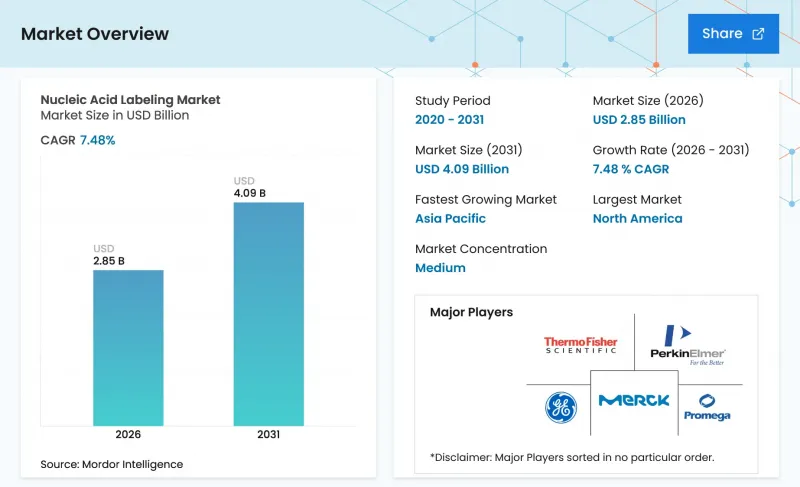
핵산 표지 시장 규모는 2025년 26억 5,000만 달러에서 2026년에는 28억 5,000만 달러로 확대되어 2026년부터 2031년까지 CAGR 7.48%로 성장을 지속하여, 2031년에는 40억 9,000만 달러에 이를 것으로 예측됩니다.
본 보고서는 표지 유형(비오틴 계열 등), 제품(시약 및 키트 등), 기법(직접 화학 표지 등), 용도(마이크로어레이·유전자 발현 등)별로 분류되어 있습니다. 최종 사용자(학술·연구 기관 등), 지역(북미, 유럽 등)별로 분류되어 있습니다. 시장 전망은 금액(달러) 기준으로 제시되어 있습니다.
전 세계 핵산 표지 시장 동향과 인사이트
유전체학 및 프로테옴학 연구에 대한 자금 지원 확대
대규모의 공공 투자로 인해 실험 규모는 점점 더 확대되고 있습니다. NIH(미국 국립보건원)의 '유전체 과학 우수 센터(Centers of Excellence in Genomic Science)' 프로그램은 혁신적인 시퀀싱 기술에 막대한 연구비를 지원하고 있습니다. '인간 유전체 프로젝트 II'와 같은 병행 프로젝트는 전 세계 인구의 1% 이상을 대상으로 유전자형 분석을 수행하는 것을 목표로 하고 있으며, 오류율을 낮게 유지하면서 방대한 양의 샘플을 처리할 수 있는 확장 가능한 표지 시약에 대한 수요를 견인하고 있습니다. 단백질체학 컨소시엄은 한 번의 실행으로 수백 유형의 단백질을 식별할 수 있는 다중 표지 기술을 추진하고 있어, 학술 기관의 핵심 시설 전반에서 시약 소비량이 증가하고 있습니다. 또한, 자금 지원은 다양성 관련 노력도 뒷받침하고 있어, 시약은 다양한 조상적 배경이나 생물 유래 시료에서 일관된 성능을 발휘해야 합니다. 전반적으로, 자금력이 있는 연구소가 늘어나는 것은 고수익률의 표지 키트 및 효소 조달 증가로 직결됩니다.
정밀의료 및 동반 진단의 보급 확대
의료 제공업체들은 일상적인 의사 결정에 분자 수준의 측정 결과를 반영하고 있습니다. QIAGEN사는 최근 QIAstat-Dx 패널을 만성 질환 바이오마커까지 확대했습니다. 이는 다중 PCR 진단이 동시 검출을 위해 견고한 표지 화학 기술에 의존하고 있음을 보여줍니다. 현재 30개 이상의 바이오의약품 기업과의 제휴를 통해 암 분야를 넘어선 동반 진단이 공동 개발되고 있으며, 각 기업은 표준화되고 전 세계적으로 인정받는 표지 워크플로우를 요구하고 있습니다. 규제 당국이 조화로운 지침을 추진하고 있기 때문에 여러 관할 구역에 걸쳐 시약을 검증할 수 있는 공급업체들이 주목받고 있습니다. 아시아태평양에서는 분자 병리학 역량의 확대에 따라 도입이 가속화되고 있으며, 고가의 프로브에 대한 새로운 수익원이 창출되고 있습니다. 맞춤형 치료로 인해 투여 범위가 좁아지는 가운데, 임상의들은 극히 낮은 분석 대상 물질 농도에서도 명확한 신호를 읽어낼 수 있는 표지 기술을 필요로 하고 있습니다.
첨단 표지 시약 및 장비의 높은 비용
고가의 형광증백제나 특수 장비는 소규모 검사실의 경우 가격 면에서 감당하기 어려울 수 있습니다. 고성능 자동 표지 도입 시스템의 가격은 10만 달러를 초과하여, 막대한 설비 투자 예산을 확보하지 못한 시설에게는 큰 장벽이 되고 있습니다. 최근 테크네튬-99m공급 부족 등 전 세계적인 공급 혼란은 단일 공급원에 대한 의존도를 드러내며, 대체 키트의 가격 급등을 초래하고 있습니다. 기업 측은 원자재의 다각적 조달이나 가격대별 제품 출시를 통해 대응하고 있지만, 특히 현지 통화가 달러 대비 약세를 보이는 지역에서는 여전히 이익률에 대한 압박이 지속되고 있습니다.
부문 분석
2025년, 형광 시약은 핵산 표지 시장의 46.12%를 차지하며, 고처리량 현미경법, 유세포 분석법, qPCR 워크플로우에서 표준 솔루션으로서의 입지를 확고히 했습니다. 이러한 선도적 지위는 생물안전 요건이 비교적 완만하고, 폐기 처리가 간소화되어 있으며, 자동 광학 시스템과의 긴밀한 통합이 반영된 결과입니다. 방사성 기법은 규제 대상이지만, 차세대 방사성 의약품이 종양 영상에서 동위원소의 정밀도를 활용하고 있어 연평균 성장률(CAGR) 9.25%로 성장하고 있습니다. 구리를 포함하지 않는 클릭 표지 및 테트라진 결합을 통해 연구자들은 광 퇴색이나 독성에 대한 우려 없이 생세포 내의 핵산을 추적할 수 있게 되었습니다.
이 분야에서는 기술 융합이 진행되고 있습니다. 형광 플랫폼은 과거 동위원소 추적자에서만 가능했던 아토몰 수준의 감도를 점점 더 실현해 나가고 있는 반면, 최신 동위원소는 오프타겟 방사선을 억제하기 위해 항체나 앱타머를 이용한 표적화를 채택하고 있습니다. Bio-Rad사의 32색 지원 'StarBright' 확장 제품은 공급업체가 특정 유세포 분석기에 맞추어 밝기와 발광 스펙트럼을 최적화한 좋은 예입니다. 한편, VERAXA Biotech사의 프리타겟형 'Affilin' 방사성 접합체는 클릭 화학을 활용하여 항체 결합 후에만 동위원소를 결합시킴으로써 배경 흡수를 줄이고 있습니다. 이러한 분야 간의 상호 교류를 통해 기존 표지 기술의 경계가 모호해지면서, 두 하위 부문 전반에 걸쳐 혁신의 기세가 유지되고 있습니다.
2025년, 핵산 표지 시장에서 시약 및 즉시 사용 가능한 키트의 점유율은 55.05%를 차지했습니다. 이는 배치 처리 시마다 소모품이 보충되기 때문입니다. 연구자들은 프로브, 버퍼, 컨트롤이 세트로 구성된 올인원 키트를 선호하며, 이를 통해 검증 시간을 단축할 수 있습니다. 한편, 내열성이 높고 정확도가 향상된 변이체가 증폭 후가 아닌 합성 중에 표지를 삽입하기 때문에 설계된 효소 및 폴리머라제는 9.05%라는 가장 높은 연평균 성장률(CAGR)을 보이고 있습니다.
가치 창출은 업스트림 공정으로 이동하고 있습니다. 머크의 'Aptegra CHO' 유전자 안정성 분석법은 전장 유전체 시퀀싱과 합리화된 표지법을 결합하여 바이오세이프티 시험 시간을 66%, 비용을 43% 절감합니다. 듀얼 삽입 폴리머라제를 통해 화학적 사후 합성법을 능가하는 균일성과 수율을 실현하는 직교적 말단 표지화가 가능해집니다. 클릭 핸들이 내장된 맞춤형 올리고뉴클레오티드를 제공하는 서비스는 카탈로그 SKU로는 충족할 수 없는 공간 전사체학 및 단일 세포 멀티오믹스와 같은 전문 분야의 요구를 충족시킵니다.
지역별 분석
북미는 견조한 NIH 예산, 벤처 자금, 그리고 표지 시약의 분류를 명확히 하는 FDA의 프레임워크를 배경으로 2025년 핵산 표지 시장 규모의 43.10%를 차지했습니다. 미국은 성숙한 시퀀싱 인프라, 광범위한 CRISPR 진단 시범 프로젝트, 그리고 활기찬 생명공학 공급망을 강점으로 삼아 시장을 선도하고 있습니다. 캐나다의 연구 거점은 전문적인 줄기세포 및 후성유전학 프로그램을 통해 시장에 깊이를 더하고 있는 반면, 멕시코는 지역 내에서 표지용 소모품을 조달할 수 있는 바이오 제조 회랑을 확대되고 있습니다.
아시아태평양은 2031년까지 연평균 성장률(CAGR)이 8.35%에 달하고, 가장 빠르게 성장하는 시장입니다. 중국만 해도 핵산 의약품 개발에 11억 2,000만 달러를 배정하고 있으며, 연구 기관 및 CDMO에서의 시약 채택을 가속화하고 있습니다. 일본의 내열성 mRNA 보존 기술 혁신으로 키트의 내구성이 향상되어, 열대 지역에서의 확산에 필수적인 요소가 되고 있습니다. 인도의 CRO 부문은 급속히 확대되고 있으며, 비용 최적화된 형광 시약 및 클릭 시약에 대한 수요가 증가하고 있습니다. 한국과 호주는 고해상도 이미징 분야의 인력과 승인 기간을 단축하는 조화로운 IVD 규제를 제공합니다.
유럽에서는 정책 주도의 꾸준한 확장이 이어지고 있습니다. 독일과 영국은 견고한 제약 생태계를 기반으로 연구 개발의 핵심을 담당하고 있는 반면, 프랑스, 이탈리아, 스페인은 브렉시트 이후의 물류 문제를 완화하기 위해 지역 내 제조 거점에 대한 투자를 추진하고 있습니다. 지속가능성에 관한 규제로 인해 방사성 물질을 사용하는 워크플로우에서 보다 친환경적인 형광증백제나 구리를 포함하지 않는 클릭 화학으로의 전환이 촉진되고 있습니다. 정밀 종양학을 지원하는 EU 전역의 노력으로 지속적인 발전이 보장되고 있지만, 폐기물 관리 및 공급 투명성에 대해서는 더욱 엄격한 감시가 이루어지고 있습니다.
기타 혜택:
- 엑셀 형식 시장 예측(ME) 시트
- 3개월간의 애널리스트 지원
자주 묻는 질문
목차
제1장 서론
제2장 조사 방법
제3장 주요 요약
제4장 시장 구도
제5장 시장 규모와 성장 예측
제6장 경쟁 구도
제7장 시장 기회와 향후 전망
JHS 26.08.11According to Mordor Intelligence, the nucleic acid labeling market size is expected to grow from USD 2.65 billion in 2025 to USD 2.85 billion in 2026 and is forecast to reach USD 4.09 billion by 2031 at 7.48% CAGR over 2026-2031.
This report is Segmented by Label Type (Biotin-Based, and More), Product (Reagents & Kits, and More), Method (Direct Chemical Labeling, and More), Application (Microarray & Gene Expression, and More). End User (Academic & Research Institutes, and More), Geography (North America, Europe, and More). The Market Forecasts are Provided in Terms of Value (USD).
Global Nucleic Acid Labeling Market Trends and Insights
Expansion of Genomics and Proteomics Research Funding
Generous public investment fuels an ever-larger experimental footprint. The NIH Centers of Excellence in Genomic Science program is channeling substantial grants into transformative sequencing technologies. Parallel efforts such as Human Genome Project II aim to genotype more than 1% of the global population, driving demand for scalable labeling reagents that can handle huge sample volumes while keeping error rates low. Proteomics consortia are pushing multiplexed labeling that distinguishes hundreds of proteins in a single run, raising reagent consumption across academic core facilities. Funding also supports diversity initiatives, meaning reagents must perform consistently across varied ancestries and biosources. In aggregate, better-funded laboratories translate directly into elevated procurement of high-margin labeling kits and enzymes.
Increasing Adoption of Precision Medicine and Companion Diagnostics
Healthcare providers are embedding molecular readouts into routine decision-making. QIAGEN recently broadened its QIAstat-Dx panel to include chronic disease biomarkers, illustrating how multiplex PCR diagnostics rely on robust labeling chemistry for simultaneous detection. Over 30 biopharma partnerships now co-develop companion diagnostics beyond oncology, each demanding standardized, globally accepted labeling workflows. Regulatory agencies push harmonized guidelines, so suppliers able to validate reagents across multiple jurisdictions gain traction. Asia-Pacific uptake is accelerating in step with expanding molecular pathology capacity, creating fresh revenue pools for premium-priced probes. As personalized therapy narrows dosing windows, clinicians need labels that deliver unambiguous signal readouts at very low analyte levels.
High Cost of Advanced Labeling Reagents and Instruments
Premium fluorophores and specialized instrumentation can price out smaller laboratories. A high-end automated label-incorporation system exceeds USD 100,000, a steep barrier for facilities without large capital budgets. Global supply disruptions, such as recent technetium-99m shortages, expose reliance on single-source isotopes and drive up pricing for alternative kits. Businesses counter by multisourcing raw materials and launching value-tier products, but margin pressure persists, especially where local currencies depreciate against USD.
Other drivers and restraints analyzed in the detailed report include:
- Rapid Growth of Next-Generation Sequencing Workflows
- Rising Utilization of Fluorescent Probes in Molecular Diagnostics
- Technical Complexity and Skill Gap in Low-Resource Settings
For complete list of drivers and restraints, kindly check the Table Of Contents.
Segment Analysis
Fluorescent reagents captured 46.12% of the nucleic acid labeling market in 2025, underscoring their status as the default solution for high-throughput microscopy, flow cytometry, and qPCR workflows. This leadership reflects lower biosafety requirements, streamlined disposal, and tight integration with automated optics systems. Radioactive approaches, although regulated, are climbing at 9.25% CAGR as next-generation radiopharmaceuticals leverage isotopic precision for oncological imaging. Copper-free click-labels and tetrazine ligation now let researchers track nucleic acids inside living cells without photo-bleaching or toxicity.
The segment illustrates convergence. Fluorescent platforms increasingly touch attomolar sensitivity once reserved for isotope tracers, while modern isotopes adopt antibody or aptamer targeting to limit off-target radiation. Bio-Rad's 32-colour StarBright expansion exemplifies how suppliers tailor brightness and emission spectra to specific cytometers. Conversely, VERAXA Biotech's pre-targeted Affilin radio conjugates rely on click chemistry to attach isotopes only after antibody binding, lowering background uptake. Such cross-pollination blurs traditional label boundaries and sustains innovation momentum across both subsegments.
Reagents and ready-to-use kits represented 55.05% share of the nucleic acid labeling market in 2025 because consumables are replenished with every batch run. Researchers favor all-inclusive boxes that bundle probes, buffers, and controls, cutting qualification time. Yet engineered enzymes and polymerases show the briskest 9.05% CAGR as thermostable, fidelity-enhanced variants incorporate labels during synthesis rather than after amplification.
Value creation is moving upstream. Merck's Aptegra CHO genetic stability assay combines whole-genome sequencing with streamlined labeling, trimming 66% off biosafety testing time and 43% off costs. Dual-incorporation polymerases allow orthogonal end labeling that surpasses chemical post-synthesis methods in uniformity and yield. Services supplying custom oligos with embedded click-handles fill specialty gaps for spatial transcriptomics or single-cell multiomics where catalog SKUs fall short.
Complete Report Scope:
- By Label Type
- Biotin-based
- Fluorescent
- Radioactive (32P, 35S, etc.)
- Other Label Types
- By Product
- Reagents & Kits
- Probes & Primers
- Enzymes & Polymerases
- Custom Labeling Services
- By Method
- Direct Chemical Labeling
- PCR-based Incorporation
- Nick Translation / Random Priming
- Click-Chemistry Conjugation
- By Application
- Microarray & Gene Expression
- Next-Generation Sequencing (NGS)
- In-situ Hybridization / FISH
- Polymerase Chain Reaction (PCR/qPCR)
- CRISPR Screening & Diagnostics
- Other Applications
- By End User
- Academic & Research Institutes
- Hospitals & Clinics
- Diagnostic Laboratories
- Biopharma & Biotechnology Companies
- CROs & Service Providers
- Geography
- North America
- United States
- Canada
- Mexico
- Europe
- Germany
- United Kingdom
- France
- Italy
- Spain
- Rest of Europe
- Asia-Pacific
- China
- Japan
- India
- Australia
- South Korea
- Rest of Asia-Pacific
- Middle East & Africa
- GCC
- South Africa
- Rest of Middle East & Africa
- South America
- Brazil
- Argentina
- Rest of South America
- North America
Geography Analysis
North America contributed 43.10% of the nucleic acid labeling market size in 2025 on the strength of robust NIH budgets, venture funding, and an FDA framework that clarifies labeling reagent classification. The United States leads with mature sequencing infrastructure, widespread CRISPR diagnostic pilots, and a vibrant biotech supply chain. Canadian centers add depth through specialized stem-cell and epigenetics programs, while Mexico expands biomanufacturing corridors that source labeling consumables regionally.
Asia-Pacific is the fastest-growing arena at 8.35% CAGR to 2031. China alone set aside USD 1.12 billion for nucleic acid drug development, accelerating reagent uptake across research institutes and CDMOs. Japan's innovation in heat-stable mRNA storage broadens kit durability, critical for tropical deployment. India's CRO sector scales rapidly, demanding cost-optimized fluorescent and click reagents. South Korea and Australia contribute high-resolution imaging talent and harmonized IVD regulations that shorten approval timelines.
Europe maintains steady, policy-driven expansion. Germany and the United Kingdom anchor R&D with strong pharmaceutical ecosystems, while France, Italy, and Spain invest in regional manufacturing to mitigate post-Brexit logistics hurdles. Sustainability rules encourage moves away from radioactive workflows toward greener fluorophores and copper-free click chemistries. EU-wide initiatives supporting precision oncology ensure continued progression but with heightened scrutiny on waste management and supply transparency.
- Thermo Fisher Scientific
- Merck
- PerkinElmer
- GE Healthcare / Cytiva
- Promega
- Enzo Biochem
- Vector Laboratories
- New England Biolabs
- Agilent Technologies
- Integrated DNA Technologies (IDT)
- LGC Biosearch Technologies
- Takara Bio
- QIAGEN
- Roche
- Bio-Rad Laboratories
- Bioneer Corp.
- Jena Bioscience
- TriLink BioTechnologies
- Lucigen
- Tocris Bioscience
- Marker Gene Technologies
- Other Emerging Players
Additional Benefits:
- The market estimate (ME) sheet in Excel format
- 3 months of analyst support
TABLE OF CONTENTS
1 Introduction
- 1.1 Study Assumptions & Market Definition
- 1.2 Scope of the Study
2 Research Methodology
3 Executive Summary
4 Market Landscape
- 4.1 Market Overview
- 4.2 Market Drivers
- 4.2.1 Expansion of Genomics and Proteomics Research Funding
- 4.2.2 Increasing Adoption of Precision Medicine and Companion Diagnostics
- 4.2.3 Rapid Growth of Next-Generation Sequencing Workflows
- 4.2.4 Rising Utilization of Fluorescent Probes in Molecular Diagnostics
- 4.2.5 Emergence of Click-Chemistry and Bio-Orthogonal Labeling Technologies
- 4.2.6 Integratioon f CRISPR-Based Point-Of-Care Diagnostics
- 4.3 Market Restraints
- 4.3.1 High Cost of Advanced Labeling Reagents and Instruments
- 4.3.2 Technical Complexity and Skill Gap in Low-Resource Settings
- 4.3.3 Regulatory Restrictions on Radioactive Labeling Methods
- 4.3.4 Supply Chain Vulnerabilities for Specialty Fluorophores
- 4.4 Regulatory Landscape
- 4.5 Porter's Five Forces Analysis
- 4.5.1 Threat of New Entrants
- 4.5.2 Bargaining Power of Buyers
- 4.5.3 Bargaining Power of Suppliers
- 4.5.4 Threat of Substitutes
- 4.5.5 Industry Rivalry
5 Market Size & Growth Forecasts (Value, USD)
- 5.1 By Label Type
- 5.1.1 Biotin-based
- 5.1.2 Fluorescent
- 5.1.3 Radioactive (32P, 35S, etc.)
- 5.1.4 Other Label Types
- 5.2 By Product
- 5.2.1 Reagents & Kits
- 5.2.2 Probes & Primers
- 5.2.3 Enzymes & Polymerases
- 5.2.4 Custom Labeling Services
- 5.3 By Method
- 5.3.1 Direct Chemical Labeling
- 5.3.2 PCR-based Incorporation
- 5.3.3 Nick Translation / Random Priming
- 5.3.4 Click-Chemistry Conjugation
- 5.4 By Application
- 5.4.1 Microarray & Gene Expression
- 5.4.2 Next-Generation Sequencing (NGS)
- 5.4.3 In-situ Hybridization / FISH
- 5.4.4 Polymerase Chain Reaction (PCR/qPCR)
- 5.4.5 CRISPR Screening & Diagnostics
- 5.4.6 Other Applications
- 5.5 By End User
- 5.5.1 Academic & Research Institutes
- 5.5.2 Hospitals & Clinics
- 5.5.3 Diagnostic Laboratories
- 5.5.4 Biopharma & Biotechnology Companies
- 5.5.5 CROs & Service Providers
- 5.6 Geography
- 5.6.1 North America
- 5.6.1.1 United States
- 5.6.1.2 Canada
- 5.6.1.3 Mexico
- 5.6.2 Europe
- 5.6.2.1 Germany
- 5.6.2.2 United Kingdom
- 5.6.2.3 France
- 5.6.2.4 Italy
- 5.6.2.5 Spain
- 5.6.2.6 Rest of Europe
- 5.6.3 Asia-Pacific
- 5.6.3.1 China
- 5.6.3.2 Japan
- 5.6.3.3 India
- 5.6.3.4 Australia
- 5.6.3.5 South Korea
- 5.6.3.6 Rest of Asia-Pacific
- 5.6.4 Middle East & Africa
- 5.6.4.1 GCC
- 5.6.4.2 South Africa
- 5.6.4.3 Rest of Middle East & Africa
- 5.6.5 South America
- 5.6.5.1 Brazil
- 5.6.5.2 Argentina
- 5.6.5.3 Rest of South America
- 5.6.1 North America
6 Competitive Landscape
- 6.1 Market Concentration
- 6.2 Market Share Analysis
- 6.3 Company Profiles (includes Global level Overview, Market level overview, Core Business Segments, Financials, Headcount, Key Information, Market Rank, Market Share, Products and Services, and analysis of Recent Developments)
- 6.3.1 Thermo Fisher Scientific, Inc.
- 6.3.2 Merck KGaA
- 6.3.3 PerkinElmer, Inc.
- 6.3.4 GE Healthcare / Cytiva
- 6.3.5 Promega Corporation
- 6.3.6 Enzo Biochem
- 6.3.7 Vector Laboratories
- 6.3.8 New England Biolabs
- 6.3.9 Agilent Technologies
- 6.3.10 Integrated DNA Technologies (IDT)
- 6.3.11 LGC Biosearch Technologies
- 6.3.12 Takara Bio
- 6.3.13 QIAGEN
- 6.3.14 Roche Diagnostics
- 6.3.15 Bio-Rad Laboratories
- 6.3.16 Bioneer Corp.
- 6.3.17 Jena Bioscience
- 6.3.18 TriLink BioTechnologies
- 6.3.19 Lucigen Corporation
- 6.3.20 Tocris Bioscience
- 6.3.21 Marker Gene Technologies
- 6.3.22 Other Emerging Players
7 Market Opportunities & Future Outlook
- 7.1 White-space & Unmet-need Assessment


