

|
시장보고서
상품코드
2100593
우주선 시장 : 시장 점유율 분석, 업계 동향 및 통계, 성장 예측(2026-2031년)Spacecraft - Market Share Analysis, Industry Trends & Statistics, Growth Forecasts (2026 - 2031) |
||||||
 Mordor Intelligence
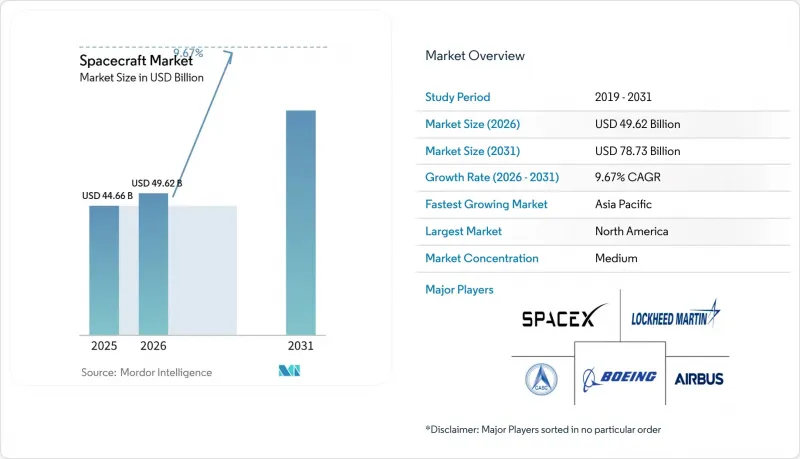
Mordor Intelligence에 의하면, 우주선 시장 규모는 2025년 446억 6,000만 달러로 평가되었고, 2026년에는 496억 2,000만 달러로 확대될 것으로 추정되고, 2026-2031년 CAGR 9.67%로 성장을 지속할 전망이며, 2031년에는 787억 3,000만 달러에 이를 것으로 예측됩니다.
본 보고서는 유형별(위성, 화물 우주선, 유인 우주선, 심우주 탐사선), 용도별(통신, 지구관측, 항법·측량, 기타), 궤도별(저궤도, 중궤도, 기타), 하위 시스템별(추진 시스템, 기타), 지역별(북미, 유럽, 아시아태평양, 기타)로 분류되어 있습니다. 시장 전망은 금액(달러) 기준으로 제시되어 있습니다.
세계의 우주선 시장 동향 및 인사이트
상용 전자 부품의 채택이 우주선 개발을 가속화하고 있습니다.
COTS(상용 제품) 부품은 리드타임이 길고 내방사선성이 필요한 부품을, 소프트웨어를 통한 오류 정정 및 중복성을 통해 보호되는 대량 생산형 자동차용 또는 민수용 칩으로 대체함으로써 설계 주기를 단축하고 단위 비용을 절감합니다. 에어로스페이스 코퍼레이션(Aerospace Corporation)의 2024년 가이드라인에 따르면, 현재 고도 600km 미만에서 최대 5년간 비행하는 소형 위성의 유도 컴퓨터에 COTS 프로세서가 채택되고 있는 것으로 확인되었습니다. 유럽 우주국(ESA)도 이러한 추세에 발맞추어, 비중요 서브시스템용 상용 마이크로컨트롤러의 채택을 승인했습니다. 이에 따라 주요 제조업체들은 우주용 인증 제품이 납품될 때까지 18개월을 기다릴 필요 없이, 인피니온이나 텍사스 기기로부터 부품을 조달할 수 있게 되었습니다. 미국 우주개발청(SDA)의 ‘트랜치 1’ 수송 계층에서는 90일간의 재보급 목표를 달성하기 위해 COTS를 다용도로 활용한 설계가 규정되어 있습니다. 또한, 미국 국방부(DoD)의 2025년 조달 방침 개정안에서는 위험이 관리 가능한 임무에서 COTS의 채택이 더욱 장려되고 있습니다. 이러한 움직임들이 맞물리면서 조달이 가속화되는 한편, 공급망이 상용 팹에 의존하는 경향이 강해지고 있습니다.
광대역 위성 군집의 확장이 우주선 제조 수요를 증가시키고 있습니다.
메가 콘스텔레이션에는 조립 라인을 통한 생산이 필수적입니다. 스페이스X의 레드몬드 공장에서는 하루에 6대의 스타링크 위성을 제조하고 있으며, 1대당 비용을 100만 달러 미만으로 억제함으로써 가격 책정의 상식을 뒤바꾸고 있습니다. 유럽의 IRIS2 계약에서는 290기의 위성에 106억 유로(123억 9,000만 달러)가 배정되어, 자동 테스트에 대한 투자를 정당화하는 동시에 첫 발사를 2028년으로 앞당기고 있습니다. 아마존의 ‘프로젝트 카이퍼’는 3,236기의 위성 승인을 받아 2029년까지 83회의 발사를 예약해 두었으며, 이에 따라 2025-2026년 생산 확대가 가속화될 전망입니다. 유테르샛이 과반수 지분을 보유한 원웹은 더 큰 용량의 2세대 위성을 계획하고 있어, 이에 따라 공급망이 재편될 전망입니다. 이러한 주문 쇄도로 인해 우주선 시장 전반에 걸쳐 대량 생산 관행이 정착되고 있습니다.
발사 기지의 수용 능력 제약과 발사 일정의 혼잡이 사업 전개를 지연시키고 있다.
케이프 커내버럴과 케네디 우주 센터에서는 2024년에 50회 이상의 발사가 이루어져 발사장 안전 요원의 부담이 증가했으며, 이상 상황이 발생했을 때는 수 주간에 걸친 지연이 발생했습니다. 밴덴버그 우주 기지는 연간 50회의 비행에 대응할 수 있도록 업그레이드를 완료했으나, 스페이스X만 해도 40회 이상의 발사 슬롯을 신청하고 있습니다. 블루 오리진의 ‘뉴 글렌’ 첫 비행은 발사대 가용성 경쟁도 한 요인이 되어 2025년으로 연기되었습니다. 이러한 포화 상태는 우주선 제조업체에도 파급되어 납기를 연장시키고, 비용 여유를 고려해야 할 필요성이 대두되고 있습니다.
부문 분석
2025년 우주선 시장의 매출 중 76.78%는 위성이 차지했으며, 이는 통신, 항법, 지구관측 임무에서 위성이 수행하는 핵심적인 역할을 뒷받침합니다. 대조적으로, 화물 우주선은 연평균 성장률(CAGR) 10.12%를 나타낼 것으로 예측되어, 우주선 시장에서 가장 빠르게 성장하는 부문으로 자리매김하고 있습니다. NASA의 '상업 달 페이로드 서비스(CLPS)'는 이미 8억 달러를 배정했으며, 연간 2-3회의 달 궤도 화물 비행을 확보함으로써 무인 물류 우주선에 대한 수요를 확고히 하고 있습니다. 적재량 5,500kg에 활주로 착륙이 가능한 시에라 스페이스(Sierra Space)의 ‘드림 체이서(Dream Chaser)’는 2024년 하반기 국제우주정거장(ISS)에서 운용을 시작할 예정이며, 완만한 재진입 경로를 통해 타사와의 차별화를 꾀하고 있습니다.
화물 수송의 성장은 계획 중인 상업용 우주 정거장과 밀접한 관련이 있으며, 액시옴(Axiom)의 모듈이나 오비탈 리프(Orbital Reef)의 컨셉에는 정기적인 물자 공급이 필요합니다. 유인 우주선은 여전히 틈새 시장이지만 수익성은 높습니다. 스페이스X의 ‘드래곤’ 캡슐이 현재 승무원 교체를 주도하고 있는 반면, 보잉의 ‘스타라이너’는 2026년 운용 비행을 위한 최종 인증을 획득했습니다. 심우주 탐사선은 생산량은 적지만 계약 금액이 높으며, 심우주용 광통신 링크나 자율 내비게이션 등의 서브시스템 혁신을 주도하고 있습니다. 이러한 확대되는 제품 구성이 종합적으로 폭넓은 생산 기반을 유지하며, 우주선 시장의 토대를 뒷받침하고 있습니다.
통신 분야는 2025년 우주선 시장 규모에서 42.24%의 점유율을 유지했으며, 이는 광대역 용량 및 안전한 국방 통신 회선에 대한 끊임없는 수요를 반영합니다. 한편, 기술 실증 임무는 운영 사업자가 수명 연장, 우주 쓰레기 제거, 궤도상 조립과 같은 개념의 유효성을 검증해 나감에 따라 2031년까지 연평균 성장률(CAGR) 10.32%를 나타낼 것으로 예측됩니다. MEV(궤도 상 폐기물)와의 도킹이나 향후 예정된 아스트로스케일(AstroScale)사의 운영 등, 궤도 상 서비스의 성공 사례는 상용화의 전환점을 보여주고 있습니다.
지구관측 부문의 성장은 국방 및 농업 기술 분석 수요를 충족시키는 서브미터급 합성개구레이더(SAR) 위성군에 의해 주도되고 있습니다. 항법 임무는 GPS III 및 갈릴레오의 업데이트로 인해 안정적인 속도를 유지하고 있으며, 2-3년마다 일괄 발주가 확실하게 이행되고 있습니다. 50억 달러를 초과하는 ‘유로파 클리퍼’와 같은 과학 임무는 기술의 선구자 역할을 수행하며, 주요 계약업체의 조직적 전문성을 유지하고 있습니다.
지역별 분석
북미는 2025년 매출의 47.89%를 차지했으며, 오리온 캡슐 수주와 2024년 케이프 커내버럴 및 반덴버그의 발사 능력을 최대한 활용한 스페이스X의 148회 발사에 힘입고 있습니다. 국가정찰국(NRO)의 5,000만 달러 미만 소형 위성 계약은 분산형 아키텍처의 보급을 더욱 촉진하고 있습니다. 캐나다의 텔레샛 라이트스피드 콘스텔레이션은 2026년 서비스 개시를 목표로 하고 있으며, 이 지역 내 광대역 시장 경쟁을 공고히 하고 있습니다.
아시아태평양은 2031년까지 연평균 성장률(CAGR) 11.25%라는 가장 높은 성장률을 보일 것으로 예측됩니다. 중국은 2024년에 67회의 궤도 투입을 실시하며, 랜드스페이스(LandSpace)사의 ‘주작 3호’와 같은 재사용형 부스터를 선보이는 한편, 상업용 페이로드 점유율을 확대했습니다. 인도의 NewSpace India Limited(NSIL)는 12건의 소형 위성 발사 주문을 수주했으며, 1kg당 비용을 절반으로 줄이기 위해 재사용형 발사체 실증기 개발을 추진하고 있습니다. 일본의 화성 위성 탐사선 ‘Martian Moons eXploration’은 2026년 발사를 향해 순조롭게 진행되고 있으며, 심우주에 대한 야망을 강조하고 있습니다. 또한, 한국의 ‘누리’ 로켓과 대만 최초의 기상 위성 ‘트리톤’은 이 지역에서의 보다 광범위한 참여를 보여주고 있습니다.
유럽은 주권형 광대역 프로그램 ‘IRIS2’와 소행성 방어 임무 ‘헤라’를 통해 전략적 자율성을 추진하고 있습니다. OHB SE는 계속해서 500kg급 틈새 시장을 개척하고 있는 반면, 영국은 ‘오베론’ 및 ‘ISTARI’ ISR 위성군에 투자하고 있습니다. 제재로 인해 러시아의 2024년 발사 횟수는 19회로 제한되었지만, 국내 정지 궤도(GEO) 및 ‘프로그레스’ 물류는 안정적입니다. 중동 및 아프리카에서는 UAE의 ‘MBZ-SAT’나 사우디아라비아의 ‘비전 2030’과 같은 이니셔티브를 통해 탄력을 받고 있으며, 이는 고해상도 영상 및 안전한 통신 회선에 대한 수요가 증가하고 있음을 보여줍니다.
기타 혜택 :
- 엑셀 형식 시장 예측(ME) 시트
- 3개월간의 애널리스트 지원
자주 묻는 질문
목차
제1장 서론
제2장 조사 방법
제3장 주요 요약
제4장 시장 구도
제5장 시장 규모 및 성장 예측
제6장 경쟁 구도
제7장 시장 기회 및 향후 전망
AJY 26.08.07According to Mordor Intelligence, the spacecraft market size is expected to grow from USD 44.66 billion in 2025 to USD 49.62 billion in 2026 and is forecast to reach USD 78.73 billion by 2031 at a 9.67% CAGR over 2026-2031.
This report is Segmented by Type (Satellites, Cargo Spacecraft, Crewed Spacecraft, and Deep-Space Probes), Application (Communication, Earth Observation, Navigation and Mapping, and More), Orbit (Low Earth Orbit, Medium Earth Orbit, and More), Subsystem (Propulsion Systems, and More), and Geography (North America, Europe, Asia-Pacific, and More). The Market Forecasts are Provided in Terms of Value (USD).
Global Spacecraft Market Trends and Insights
Adoption of Commercial-Off-the-Shelf Electronics is Accelerating Spacecraft Development
COTS components shorten design cycles and lower unit costs by replacing long-lead, radiation-hardened parts with high-volume automotive or consumer chips, safeguarded through software error correction and redundancy. The Aerospace Corporation's 2024 guidelines confirm that COTS processors now power guidance computers in small satellites flying below 600 km for up to five years. ESA echoed the trend by green-lighting commercial microcontrollers for non-critical subsystems, enabling primes to source from Infineon and Texas Instruments rather than waiting 18 months for space-qualified equivalents. The US Space Development Agency's Tranche 1 transport layer specifies COTS-heavy designs to hit 90-day replenishment goals. The DoD's 2025 acquisition policy revision further encourages the adoption of COTS for missions with manageable risk. Together, these moves accelerate procurement while introducing supply chain exposure to commercial fabs.
Growth of Broadband Satellite Constellations is Increasing Spacecraft Manufacturing Demand
Mega-constellations require assembly line production. SpaceX's Redmond plant builds six Starlink spacecraft daily, holding per-unit cost under USD 1 million and resetting pricing expectations. Europe's IRIS2 contract allocates EUR 10.6 billion (USD 12.39 billion) to 290 satellites, justifying investments in automated testing and pushing the first launches to 2028. Amazon's Project Kuiper received approval for 3,236 satellites and booked 83 launches through 2029, triggering a production ramp in 2025-2026. OneWeb, majority-owned by Eutelsat, is planning a higher-capacity second generation that will reopen its supply chain. This flood of orders institutionalizes mass-manufacturing practices across the spacecraft market.
Launch-Site Capacity Constraints and Manifest Congestion Are Delaying Deployments
Cape Canaveral and Kennedy Space Center hosted more than 50 launches in 2024, stretching range safety staffing and causing multi-week slips when anomalies struck. Vandenberg completed upgrades for 50 flights per year, yet SpaceX has requested over 40 slots alone. Blue Origin's New Glenn debut moved to 2025, partly due to pad availability conflicts. Such saturation cascades to spacecraft builders, extending delivery timelines and adding cost buffers.
Other drivers and restraints analyzed in the detailed report include:
- Government Lunar and Mars Exploration Programs Are Driving Advanced Spacecraft Procurement
- Rising Defense ISR Requirements Are Expanding Small-Satellite Deployments
- Increasing Space Debris and Collision Risks Are Complicating Mission Planning
For complete list of drivers and restraints, kindly check the Table Of Contents.
Segment Analysis
Satellites generated 76.78% of the 2025 revenue for the spacecraft market, confirming their centrality to communication, navigation, and Earth observation missions. In contrast, cargo spacecraft are forecast to post a 10.12% CAGR, making them the fastest-growing segment of the spacecraft market. NASA's Commercial Lunar Payload Services has already allocated USD 800 million, securing two to three cislunar cargo flights per year and cementing demand for uncrewed logistics craft. Sierra Space's Dream Chaser, with a 5,500 kg capacity and runway landing, is set for a late-2024 ISS debut and differentiates through gentle re-entry profiles.
Cargo growth dovetails with planned commercial stations, where Axiom modules and Orbital Reef concepts need routine supply. Crewed spacecraft remain niche but lucrative; SpaceX's Dragon capsules dominate current rotations, while Boeing's Starliner clears final certification for operational flights in 2026. Deep-space probes, although low-volume, deliver high contracting value and drive subsystem innovations, such as deep-space optical links and autonomous navigation. Collectively, the expanding mix sustains a broad production base and underpins the spacecraft market.
Communication retained a 42.24% share of the spacecraft market size for 2025, reflecting the relentless demand for broadband capacity and secure defense links. Technology demonstration missions, however, are forecast to grow at a 10.32% CAGR through 2031 as operators validate life-extension, debris-removal, and on-orbit assembly concepts. In-orbit servicing successes, such as MEV dockings and forthcoming Astroscale operations, signal a commercial tipping point.
The growth of the Earth observation segment is powered by sub-meter synthetic aperture radar constellations that fulfill defense and agritech analytics. Navigation missions maintain a steady cadence with GPS III and Galileo replenishments, ensuring batch orders are fulfilled every two to three years. Science missions, such as the Europa Clipper, which exceeds USD 5 billion, act as technology pathfinders and maintain institutional knowledge at prime contractors.
Complete Report Scope:
- By Type
- Satellites
- Cargo Spacecraft
- Crewed Spacecraft
- Deep-Space Probes
- By Application
- Communication
- Earth Observation
- Navigation and Mapping
- Science and Exploration
- Technology Demonstration
- By Orbit
- Low Earth Orbit (LEO)
- Medium Earth Orbit (MEO)
- Geostationary Orbit (GEO)
- Others
- By Subsystem
- Propulsion Systems
- Power Systems
- Communication Systems
- Thermal Control Systems
- Guidance and Navigation Systems
- Payloads
- By Geography
- North America
- United States
- Canada
- Mexico
- Europe
- United Kingdom
- France
- Germany
- Russia
- Rest of Europe
- Asia-Pacific
- China
- India
- Japan
- South Korea
- Rest of Asia-Pacific
- South America
- Brazil
- Rest of South America
- Middle East and Africa
- Middle East
- United Arab Emirates
- Saudi Arabia
- Rest of Middle East
- Africa
- South Africa
- Rest of Africa
- Middle East
- North America
Geography Analysis
North America contributed 47.89% of 2025 revenue, buoyed by Orion capsule orders and SpaceX's 148 launches in 2024 that soak up Cape and Vandenberg capacity. The National Reconnaissance Office's sub-USD 50 million small-sat awards further embed proliferated architectures. Canada's Telesat Lightspeed constellation targets a 2026 service launch, cementing regional broadband competition.
Asia-Pacific is forecast to witness the highest growth at an 11.25% CAGR to 2031. China executed 67 orbital launches in 2024, showcasing reusable boosters such as Landspace's Zhuque-3 and expanding the commercial payload share. India's NewSpace India Limited (NSIL) booked twelve small-sat launches and is maturing a reusable launch demonstrator to halve per-kilogram prices. Japan's Martian Moons eXploration probe remains on track for 2026, emphasizing deep-space ambition: South Korea's Nuri rocket and Taiwan's maiden Triton weather satellite signal broader regional participation.
Europe advances strategic autonomy with the IRIS2 sovereign broadband program and the asteroid-defense Hera mission. OHB SE continues to carve out a 500 kg-class niche, while the UK invests in the Oberon and ISTARI ISR constellations. Sanctions constrain Russia to 19 launches in 2024, but domestic GEO and Progress logistics remain steady. The Middle East and Africa are gaining momentum through the UAE's MBZ-SAT and Saudi Vision 2030 initiatives, signaling growing demand for high-resolution imaging and secure links.
- Airbus SE
- The Boeing Company
- Lockheed Martin Corporation
- Northrop Grumman Corporation
- Space Exploration Technologies Corp.
- Thales Group
- Blue Origin Enterprises, L.P.
- Sierra Space Corporation
- Rocket Lab Limited
- Israel Aerospace Industries Ltd.
- OHB SE
- Mitsubishi Electric Corporation
- Axiom Space, Inc.
- Surrey Satellite Technology Ltd.
- Indian Space Research Organisation
- China Aerospace Science and Technology Corporation
- Planet Labs PBC
Additional Benefits:
- The market estimate (ME) sheet in Excel format
- 3 months of analyst support
TABLE OF CONTENTS
1 INTRODUCTION
- 1.1 Study Assumptions and Market Definition
- 1.2 Scope of the Study
2 RESEARCH METHODOLOGY
3 EXECUTIVE SUMMARY
4 MARKET LANDSCAPE
- 4.1 Market Overview
- 4.2 Market Drivers
- 4.2.1 Adoption of commercial-off-the-shelf electronics is accelerating spacecraft development
- 4.2.2 Growth of broadband satellite constellations is increasing spacecraft manufacturing demand
- 4.2.3 Government lunar and Mars exploration programs are driving advanced spacecraft procurement
- 4.2.4 Rising defense ISR requirements are expanding small satellite deployments
- 4.2.5 In-orbit servicing and life-extension concepts are creating new spacecraft demand
- 4.2.6 Additive manufacturing is enabling scalable and cost-efficient spacecraft production
- 4.3 Market Restraints
- 4.3.1 Launch-site capacity constraints and launch manifest congestion are delaying deployments
- 4.3.2 Increasing space debris and collision risks are complicating mission planning
- 4.3.3 Export control regulations are restricting international spacecraft collaboration
- 4.3.4 Shortages of radiation-hardened components are constraining spacecraft production
- 4.4 Value Chain Analysis
- 4.5 Regulatory Landscape
- 4.6 Technological Outlook
- 4.7 Porter's Five Forces Analysis
- 4.7.1 Bargaining Power of Suppliers
- 4.7.2 Bargaining Power of Buyers
- 4.7.3 Threat of New Entrants
- 4.7.4 Threat of Substitutes
- 4.7.5 Competitive Rivalry
5 MARKET SIZE AND GROWTH FORECASTS (VALUE)
- 5.1 By Type
- 5.1.1 Satellites
- 5.1.2 Cargo Spacecraft
- 5.1.3 Crewed Spacecraft
- 5.1.4 Deep-Space Probes
- 5.2 By Application
- 5.2.1 Communication
- 5.2.2 Earth Observation
- 5.2.3 Navigation and Mapping
- 5.2.4 Science and Exploration
- 5.2.5 Technology Demonstration
- 5.3 By Orbit
- 5.3.1 Low Earth Orbit (LEO)
- 5.3.2 Medium Earth Orbit (MEO)
- 5.3.3 Geostationary Orbit (GEO)
- 5.3.4 Others
- 5.4 By Subsystem
- 5.4.1 Propulsion Systems
- 5.4.2 Power Systems
- 5.4.3 Communication Systems
- 5.4.4 Thermal Control Systems
- 5.4.5 Guidance and Navigation Systems
- 5.4.6 Payloads
- 5.5 By Geography
- 5.5.1 North America
- 5.5.1.1 United States
- 5.5.1.2 Canada
- 5.5.1.3 Mexico
- 5.5.2 Europe
- 5.5.2.1 United Kingdom
- 5.5.2.2 France
- 5.5.2.3 Germany
- 5.5.2.4 Russia
- 5.5.2.5 Rest of Europe
- 5.5.3 Asia-Pacific
- 5.5.3.1 China
- 5.5.3.2 India
- 5.5.3.3 Japan
- 5.5.3.4 South Korea
- 5.5.3.5 Rest of Asia-Pacific
- 5.5.4 South America
- 5.5.4.1 Brazil
- 5.5.4.2 Rest of South America
- 5.5.5 Middle East and Africa
- 5.5.5.1 Middle East
- 5.5.5.1.1 United Arab Emirates
- 5.5.5.1.2 Saudi Arabia
- 5.5.5.1.3 Rest of Middle East
- 5.5.5.2 Africa
- 5.5.5.2.1 South Africa
- 5.5.5.2.2 Rest of Africa
- 5.5.5.1 Middle East
- 5.5.1 North America
6 COMPETITIVE LANDSCAPE
- 6.1 Market Concentration
- 6.2 Strategic Moves
- 6.3 Market Share Analysis
- 6.4 Company Profiles (includes Global level Overview, Market level overview, Core Segments, Financials as available, Strategic Information, Market Rank/Share for key companies, Products and Services, and Recent Developments)
- 6.4.1 Airbus SE
- 6.4.2 The Boeing Company
- 6.4.3 Lockheed Martin Corporation
- 6.4.4 Northrop Grumman Corporation
- 6.4.5 Space Exploration Technologies Corp.
- 6.4.6 Thales Group
- 6.4.7 Blue Origin Enterprises, L.P.
- 6.4.8 Sierra Space Corporation
- 6.4.9 Rocket Lab Limited
- 6.4.10 Israel Aerospace Industries Ltd.
- 6.4.11 OHB SE
- 6.4.12 Mitsubishi Electric Corporation
- 6.4.13 Axiom Space, Inc.
- 6.4.14 Surrey Satellite Technology Ltd.
- 6.4.15 Indian Space Research Organisation
- 6.4.16 China Aerospace Science and Technology Corporation
- 6.4.17 Planet Labs PBC
7 MARKET OPPORTUNITIES AND FUTURE OUTLOOK
- 7.1 White-space and Unmet-Need Assessment


