

|
시장보고서
상품코드
2100605
소방 항공기 시장 : 점유율 분석, 업계 동향 및 통계, 성장 예측(2026-2031년)Fire Fighting Aircraft - Market Share Analysis, Industry Trends & Statistics, Growth Forecasts (2026 - 2031) |
||||||
 Mordor Intelligence
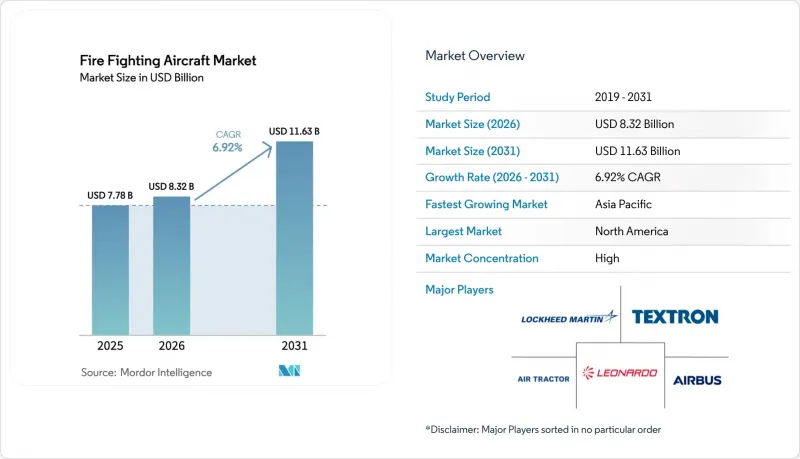
소방 항공기 시장 규모는 2025년 77억 8,000만 달러에서 2026년에는 83억 2,000만 달러로 확대되어 2026년부터 2031년까지 CAGR 6.92%로 성장을 지속하여, 2031년에는 116억 3,000만 달러에 이를 것으로 예측됩니다.
본 보고서는 항공기 유형(고정익기 등), 탱크 용량(1만 리터 미만 등), 최종 사용자(정부 기관 및 임업 서비스, 군사 운용자 등), 항속 거리(1,000킬로미터 미만, 1,000-3,000킬로미터, 3,000킬로미터 이상), 지역(북미, 유럽 등)별로 분류되어 있습니다. 시장 전망은 금액(달러) 기준으로 제시되어 있습니다.
전 세계 소방 항공기 시장 동향 및 인사이트
산불 발생 빈도 및 심각성 확대
산불 발생 상황은 기존의 기준을 계속해서 뒤엎고 있으며, 과거에는 3개월 동안의 문제였던 것이 이제는 사계절 내내 지속되는 위협으로 변모하고 있습니다. 2024년에는 미국에서 750만 에이커, 캐나다에서 1,800만 헥타르가 소실되어 역대 최악의 기록을 세웠기 때문에 각 기관은 현재 항공기를 연중 대기 태세에 두고 있습니다. 기후 조사에 따르면, 이러한 급증은 2000년 이후 ‘산불 발생에 유리한 기상 조건’이 지속되는 일수가 25% 증가한 것과 관련이 있으며, 그 결과 계약 기간의 장기화와 고정비 증가로 이어지고 있습니다. 그리스에서는 17만 5,000헥타르가 소실됨에 따라 소방 항공기 임대 계약이 10월까지 연장되었고, 호주에서는 상주 배치가 도입되었습니다. 이러한 움직임은 운용 기간을 연장하고 대형 플랫폼에 대한 투자 수익률을 높이는 것입니다.
정부의 항공 소방 예산 확대와 장기 계약
모든 수준에서 공공 지출이 증가하고 있습니다. 워싱턴은 2025 회계연도 항공 소방 예산을 5억 3,400만 달러로 증액하여 2024 회계연도 수준보다 12% 증가했습니다. 한편, 캘리포니아주는 4억 달러를 초과하는 예산을 편성하여 헬리콥터 12대와 대형 소방용 항공기 2대의 자금을 조달했습니다. 국경 북쪽에서는 오타와 정부가 외딴 호수에서 물을 퍼올릴 수 있는 수륙양용기에 대해 5년간 2억 5,760만 캐나다 달러(1억 8,506만 달러)를 지원하기로 약속했습니다. 브뤼셀의 ‘rescEU’ 프로그램은 6억 유로(6억 4,840만 달러)를 투입해 EU 관할 구역 내에 항공기 24대를 사전 배치함으로써 비용이 많이 드는 스팟 리스를 줄였습니다. 스페인의 15년에 걸친 DHC-515 패키지(훈련 및 정비 세트)는 OEM의 수익을 안정화시키는 수명 주기 계약으로의 전환을 보여줍니다.
높은 취득 비용과 수명 주기 비용
자본 집약성은 특히 중소득 지역에서 여전히 확장의 주요 걸림돌로 작용하고 있습니다. 신형 DHC-515의 정가는 3,700만 달러이지만, 구조 개조 및 투하 시스템을 포함한 개조형 B747 대형 공중 급수기의 가격은 5,000만 달러에 육박합니다. 운용 비용도 누적되고 있습니다. 연료, 예비 부품, 대규모 점검으로 인해 비행 1시간당 8,000-1만 2,000달러가 소요되지만, 항공기가 최대 8개월 동안 유휴 상태가 되기 때문에 지상 인력에 대한 갤런당 비용이 불어납니다. 브라질의 2025년도 연방 예산에는 리스 비용으로 2,400만 달러만 계상되어 있어, 화재 위험이 악화되고 있음에도 불구하고 신흥 시장이 고정익 항공기 기단의 자금 조달에 어려움을 겪고 있는 실정이 여실히 드러나고 있습니다.
부문 분석
2025년 소방 항공기 시장에서 고정익기는 52.50%의 시장 점유율을 차지하고 있으며, 이는 광범위한 소방 활동에서 뛰어난 적재 효율을 반영한 것입니다. 이 부문의 지속가능성은 2025년 미국에서 투수 작업의 대부분을 담당한 C-130 및 S-2T 기종에 의해 뒷받침되고 있습니다. 무인 시스템은 아직 발전 단계에 있지만, 중국의 EH216-F 인증 및 미국의 FAA 샌드박스 시험을 통해 자율 운용이 입증되면서 연평균 성장률(CAGR) 8.87%로 확대되고 있습니다. 회전익기는 정밀한 구조물 방어 및 수직 참조 임무에 탁월하며, 이탈리아 및 로스앤젤레스로의 AW139 납품으로 도시 주변 지역에서의 대응 능력이 향상되고 있습니다.
기체군의 현대화 측면에서는 수명을 연장하고 정밀 투하용 아비오닉스를 통합하는 개조 프로그램이 중시되고 있습니다. 고정익기 운항 사업자들은 제트기의 속도와 적정한 운용 비용을 겸비한 퇴역 제트기를 활용하고 있으며, 이로 인해 소방 항공기 시장은 치열한 경쟁 상태를 유지하고 있습니다. 승무원의 위험 감소를 배경으로 한 UAS(무인 항공기 시스템) 도입으로 인해, 유인 비행이 불가능한 연기로 뒤덮인 협곡 등으로의 임무 범위가 확대되고 있습니다. 회전익기의 성장은 즉각적인 출동 능력이 필요한 공공 기관과의 연중 식생 관리 계약과 밀접한 관련이 있습니다.
2025년 소방 항공기 시장 규모 중 1만 리터 미만 기체가 47.80%를 차지하며, 북미 및 호주 전역에서 운용되는 에어 트랙터(Air Tractor)사의 AT-802F 기종이 주도적인 역할을 하고 있습니다. CL-415 및 DHC-515를 주력으로 하는 1만-3만 리터급은 적재량과 호수에서의 급수 기동성 간 균형이 잘 잡혀 있으나, 미결 주문량 제약으로 인해 성장이 둔화되고 있습니다. 용량이 3만 리터를 초과하는 초대형 소방 항공기는 연평균 성장률(CAGR) 7.74%로 확대되고 있습니다. 이는 1회 비행으로 3킬로미터의 방화선을 커버할 수 있어 대규모 화재 시 비용 효율성이 향상되기 때문입니다.
인근 수역에서의 신속한 급수·방수에는 중용량 항공기가 여전히 필수적이지만, 각 기관은 승무원의 비행 시간과 출동 횟수를 줄이기 위해 VLAT(초대형 항공 급수기) 조달을 추진하고 있습니다. 적합한 B747이나 DC-10 기체가 부족하여 VLAT의 절대 수는 제한적이며, 이로 인해 운항 사업자의 가격 결정력이 유지되고 있습니다. 경량급 항공기는 활주로 인프라나 예산 제약으로 인해 대형기 도입이 제한되는 신흥 시장에서 활기를 띠고 있습니다.
지역별 분석
북미는 2025년 연방 및 주 예산이 9억 달러를 초과함에 따라 매출 점유율 47.10%를 유지했습니다. 그러나 조종사 부족과 기체 포화 상태로 인해 해당 지역의 연평균 성장률(CAGR)은 둔화되었습니다. 미국에서는 2025년 대형 소방기 23대, VLAT 8대, 그리고 100대 이상의 헬리콥터가 운용되었습니다. 캐나다의 2억 5,760만 캐나다 달러(1억 8,506만 달러) 투자 규모는 수륙양용 플랫폼에 중점을 두고 있는 반면, 멕시코에서는 헬리콥터 리스 시장이 완만하게 확대되고 있습니다. 시즌당 250시간 미만의 가동률은 신규 자본 투자를 제약하고 있으며, 그 결과 소유보다는 가용성을 우선시하는 서비스 계약으로의 조달 전환이 진행되고 있습니다.
아시아태평양은 가장 성장세가 두드러지는 지역으로, 2031년까지의 연평균 성장률(CAGR)은 7.45%입니다. 호주는 3억 5,290만 호주 달러(2억 3,637만 달러) 규모의 계획을 통해 북미산 임대 자산에 대한 의존도를 낮추기 위한 자체 역량을 구축하고 있습니다. 중국은 AG600 수륙양용기를 배치했으며, 소방 헬리콥터 보유 대수는 50대를 넘어섰고, 그 대부분은 신장 위구르 자치구와 헤이룽장성에 집중되어 있습니다. 일본, 인도네시아, 태국은 규모는 작지만 산악 지대나 이탄지 화재에 대응하기 위해 헬리콥터 기체를 확충하고 있습니다.
유럽의 rescEU 기단은 북미의 수출 독점 체제를 타파해 나가고 있습니다. 스페인은 73대의 항공기를 운용 중이며, 2025년에 DHC-515 6대를 발주했습니다. 프랑스의 Securite Civile는 23대의 수륙양용기를 운용 중이며, DHC-515 3대를 추가했습니다. 그리스는 2024년 이후 산불 대책으로 신형 CL-415 4대를 도입하여 장비를 현대화했습니다. 러시아의 ‘아비아레소오크라나’는 60대 이상의 항공기를 보유하고 있으나, 현대화에는 과제를 안고 있습니다. 중동 및 아프리카 시장은 서서히 부상하고 있으며, 사우디아라비아는 에너지 인프라를 보호하기 위해 헬리콥터 역량 강화에 투자하고 있습니다.
기타 혜택:
- 엑셀 형식 시장 예측(ME) 시트
- 3개월간의 애널리스트 지원
자주 묻는 질문
목차
제1장 서론
제2장 조사 방법
제3장 주요 요약
제4장 시장 구도
제5장 시장 규모와 성장 예측
제6장 경쟁 구도
제7장 시장 기회와 향후 전망
JHS 26.08.11According to Mordor Intelligence, the fire fighting aircraft market size is expected to grow from USD 7.78 billion in 2025 to USD 8.32 billion in 2026 and is forecast to reach USD 11.63 billion by 2031 at a 6.92% CAGR over 2026-2031.
This report is Segmented by Aircraft Type (Fixed-Wing Aircraft, and More), Tank Capacity (Less Than 10, 000 Litres, and More), End User (Government Agencies and Forestry Services, Military Operators, and More), Operational Range (Less Than 1, 000 Km, 1, 000 - 3, 000 Km, and More Than 3, 000 Km), and Geography (North America, Europe, and More). The Market Forecasts are Provided in Terms of Value (USD).
Global Fire Fighting Aircraft Market Trends and Insights
Escalating Frequency And Intensity Of Wildfires
Wildfire activity continues to challenge historical norms, transforming what was once a three-month issue into a threat that lingers throughout every season. Agencies now hold aircraft on alert all year because 2024 saw 7.5 million acres burn in the US and 18 million hectares in Canada, the worst totals ever logged. Climate research links the surge to a 25% increase in fire-weather days since 2000, resulting in longer contracts and higher fixed costs. Greece's 175,000-hectare loss stretched tanker leases into October, and Australia adopted permanent basing, moves that lengthen utilization windows and improve return on large-platform investments.
Expanding Government Aerial-Fire Budgets And Long-Term Contracts
Public spending is climbing at every tier. Washington raised its fiscal-2025 aerial-fire allocation to USD 534 million, 12% above the 2024 level, while California surpassed USD 400 million to finance 12 helicopters and two large tankers. North of the border, Ottawa pledged CAD 257.6 million (USD 185.06 million) over five years for amphibious aircraft that can scoop remote lakes. Brussels' rescEU program injected EUR 600 million (USD 648.40 million) to pre-position 24 platforms across the bloc, reducing costly spot leases. Spain's 15-year DHC-515 package, bundling training and maintenance, signals a pivot toward lifecycle contracting that stabilizes OEM revenue.
High Acquisition And Lifecycle Costs
Capital intensity remains the primary brake on expansion, especially in middle-income regions. A new DHC-515 lists at USD 37 million, while a converted B747 large air tanker, including structural work and delivery system, nears USD 50 million. Operational bills pile on: fuel, spares, and heavy checks burn USD 8,000-12,000 every flight hour, yet aircraft sit idle up to eight months, inflating the cost per gallon against ground crews. Brazil's federal budget only covered USD 24 million in 2025 leases, underscoring how emerging markets struggle to finance fixed-wing fleets despite worsening fire risk.
Other drivers and restraints analyzed in the detailed report include:
- Next-Generation Airframes And Precision-Drop Technologies
- Retired Narrow-Body Feedstock Enabling Low-Cost Tanker Conversions
- Shortage Of Experienced Aerial-Fire Pilots And Mechanics
For complete list of drivers and restraints, kindly check the Table Of Contents.
Segment Analysis
Fixed-wing aircraft held a 52.50% market share in the fire fighting aircraft market in 2025, reflecting superior payload economics for large-area suppression. The segment's longevity is reinforced by the C-130 and S-2T fleets, which performed the majority of US drops in 2025. Unmanned systems, though nascent, are expanding at an 8.87% CAGR as Chinese certification of the EH216-F and FAA sandbox trials in the US validate autonomous operations. Rotorcraft excel in precision structure defense and vertical reference missions, and AW139 deliveries to Italy and Los Angeles advance urban interface capability.
Fleet modernization favors conversion programs that extend service life and integrate precision-drop avionics. Fixed-wing operators capitalize on retired jets that combine jet speed with moderate operating costs, keeping the fire fighting aircraft market competitive. UAS deployments, backed by lower crew risk, are widening mission envelopes into smoke-obscured canyons where manned flight is untenable. Rotorcraft growth is tied to year-round vegetation-management contracts from utilities that demand immediate dispatch capability.
Aircraft under 10,000 liters represented 47.80% of the fire fighting aircraft market size in 2025, led by Air Tractor AT-802F fleets across North America and Australia. The 10,000-30,000 liter class, anchored by CL-415s and DHC-515s, strikes a balance between payload and lake-scooping agility; however, backlog constraints slow its growth. Huge air tankers with capacities above 30,000 liters are expanding at a 7.74% CAGR, as single-pass coverage of 3-kilometer firelines enhances cost efficiency during mega-fires.
Mid-capacity assets remain indispensable for rapid turnaround from proximal water bodies; yet, agencies are procuring VLATs to reduce crew flight hours and sortie counts. The scarcity of suitable B747 and DC-10 airframes caps the absolute number of VLATs, maintaining pricing power for operators. Lightweight categories thrive in emerging markets where runway infrastructure or budgets limit the adoption of heavy aircraft.
Complete Report Scope:
- By Aircraft Type
- Fixed-wing Aircraft
- Rotorcraft
- Unmanned Aircraft Systems (UAS)
- By Tank Capacity
- Less than 10,000 liters
- 10,000 - 30,000 liters
- More than 30,000 liters
- By End User
- Government Agencies and Forestry Services
- Military Operators
- Private Contractors and Aerial Firefighting Firms
- By Operational Range
- Less than 1,000 km
- 1,000 to 3,000 km
- More than 3,000 km
- By Geography
- North America
- United States
- Canada
- Mexico
- Europe
- Germany
- France
- Spain
- Greece
- Russia
- Rest of Europe
- Asia-Pacific
- China
- Japan
- Australia
- Rest of Asia Pacific
- South America
- Brazil
- Rest of South America
- Middle East and Africa
- Middle East
- Saudi Arabia
- Rest of Middle East
- Africa
- South Africa
- Rest of Africa
- Middle East
- North America
Geography Analysis
North America retained a 47.10% revenue share in 2025, as federal and state budgets surpassed USD 900 million; however, pilot shortages and airframe saturation moderated the regional CAGR. The US operated 23 large tankers, 8 VLATs, and more than 100 helicopters in 2025. Canada's CAD 257.6 million (USD 185.06 million) investment focuses on amphibious platforms, while Mexico modestly expands helicopter leases. Utilization rates below 250 hours per season constrain new capital deployment, leading to a shift in procurement toward service contracts that prioritize availability over ownership.
The Asia-Pacific region is the fastest-growing region, with a 7.45% CAGR through 2031. Australia's AUD 352.9 million (USD 236.37 million) plan builds sovereign capacity to cut reliance on leased North American assets. China has fielded the AG600 amphibious aircraft and has surpassed 50 fire fighting helicopters, with a concentration in Xinjiang and Heilongjiang. Japan, Indonesia, and Thailand expand helicopter fleets for mountainous and peatland fires, albeit from small bases.
Europe's rescEU fleet fragments North American export dominance. Spain operates 73 aircraft and ordered six DHC-515s in 2025. France's Securite Civile flies 23 amphibious aircraft and added three DHC-515s. Greece modernized its post-2024 fires with four new CL-415s. Russia's Avialesookhrana maintains over 60 aircraft but faces hurdles in modernization. The Middle East and Africa markets are emerging slowly, with Saudi Arabia investing in helicopter capacity to protect its energy infrastructure.
- Lockheed Martin Corporation
- De Havilland Aircraft of Canada Limited
- ShinMaywa Industries, Ltd.
- MD Helicopters Inc.
- Textron Inc.
- Airbus SE
- Leonardo S.p.A.
- HYNAERO SAS
- Air Tractor, Inc.
- Saab AB
- Erickson Incorporated
- Thrush Aircraft
- Guangzhou EHang Intelligent Technology Co. Ltd.
- Russian Helicopters' JSC
- United Aircraft Corporation
Additional Benefits:
- The market estimate (ME) sheet in Excel format
- 3 months of analyst support
TABLE OF CONTENTS
1 INTRODUCTION
- 1.1 Study Assumptions and Market Definition
- 1.2 Scope of the Study
2 RESEARCH METHODOLOGY
3 EXECUTIVE SUMMARY
4 MARKET LANDSCAPE
- 4.1 Market Overview
- 4.2 Market Drivers
- 4.2.1 Escalating frequency and intensity of wildfires
- 4.2.2 Expanding government aerial-fire budgets and long-term contracts
- 4.2.3 Next-gen airframes and precision-drop technologies
- 4.2.4 Retired narrowbody feedstock enabling low-cost tanker conversions
- 4.2.5 Utility-liability risk fuelling private-sector aircraft demand
- 4.2.6 ICAO I4F initiative easing cross-border aircraft leasing
- 4.3 Market Restraints
- 4.3.1 High acquisition and lifecycle costs
- 4.3.2 Shortage of experienced aerial-fire pilots and mechanics
- 4.3.3 Tariff-driven avionics/airframe supply-chain disruptions
- 4.3.4 Weather-smoke grounding limits annual utilization
- 4.4 Value Chain Analysis
- 4.5 Regulatory Landscape
- 4.6 Technological Outlook
- 4.7 Porter's Five Forces Analysis
- 4.7.1 Bargaining Power of Suppliers
- 4.7.2 Bargaining Power of Buyers
- 4.7.3 Threat of New Entrants
- 4.7.4 Threat of Substitute Products
- 4.7.5 Intensity of Competitive Rivalry
5 MARKET SIZE AND GROWTH FORECASTS (VALUE)
- 5.1 By Aircraft Type
- 5.1.1 Fixed-wing Aircraft
- 5.1.2 Rotorcraft
- 5.1.3 Unmanned Aircraft Systems (UAS)
- 5.2 By Tank Capacity
- 5.2.1 Less than 10,000 liters
- 5.2.2 10,000 - 30,000 liters
- 5.2.3 More than 30,000 liters
- 5.3 By End User
- 5.3.1 Government Agencies and Forestry Services
- 5.3.2 Military Operators
- 5.3.3 Private Contractors and Aerial Firefighting Firms
- 5.4 By Operational Range
- 5.4.1 Less than 1,000 km
- 5.4.2 1,000 to 3,000 km
- 5.4.3 More than 3,000 km
- 5.5 By Geography
- 5.5.1 North America
- 5.5.1.1 United States
- 5.5.1.2 Canada
- 5.5.1.3 Mexico
- 5.5.2 Europe
- 5.5.2.1 Germany
- 5.5.2.2 France
- 5.5.2.3 Spain
- 5.5.2.4 Greece
- 5.5.2.5 Russia
- 5.5.2.6 Rest of Europe
- 5.5.3 Asia-Pacific
- 5.5.3.1 China
- 5.5.3.2 Japan
- 5.5.3.3 Australia
- 5.5.3.4 Rest of Asia Pacific
- 5.5.4 South America
- 5.5.4.1 Brazil
- 5.5.4.2 Rest of South America
- 5.5.5 Middle East and Africa
- 5.5.5.1 Middle East
- 5.5.5.1.1 Saudi Arabia
- 5.5.5.1.2 Rest of Middle East
- 5.5.5.2 Africa
- 5.5.5.2.1 South Africa
- 5.5.5.2.2 Rest of Africa
- 5.5.5.1 Middle East
- 5.5.1 North America
6 COMPETITIVE LANDSCAPE
- 6.1 Market Concentration
- 6.2 Strategic Moves
- 6.3 Market Share Analysis
- 6.4 Company Profiles (includes Global level Overview, Market level overview, Core Segments, Financials as available, Strategic Information, Market Rank/Share for key companies, Products and Services, and Recent Developments)
- 6.4.1 Lockheed Martin Corporation
- 6.4.2 De Havilland Aircraft of Canada Limited
- 6.4.3 ShinMaywa Industries, Ltd.
- 6.4.4 MD Helicopters Inc.
- 6.4.5 Textron Inc.
- 6.4.6 Airbus SE
- 6.4.7 Leonardo S.p.A.
- 6.4.8 HYNAERO SAS
- 6.4.9 Air Tractor, Inc.
- 6.4.10 Saab AB
- 6.4.11 Erickson Incorporated
- 6.4.12 Thrush Aircraft
- 6.4.13 Guangzhou EHang Intelligent Technology Co. Ltd.
- 6.4.14 Russian Helicopters' JSC
- 6.4.15 United Aircraft Corporation
7 MARKET OPPORTUNITIES AND FUTURE OUTLOOK
- 7.1 White-space and Unmet-Need Assessment


