

|
시장보고서
상품코드
2100612
절단기 및 절단 장비 시장 : 점유율 분석, 업계 동향 및 통계, 성장 예측(2026-2031년)Cutting Machine and Equipment - Market Share Analysis, Industry Trends & Statistics, Growth Forecasts (2026 - 2031) |
||||||
 Mordor Intelligence
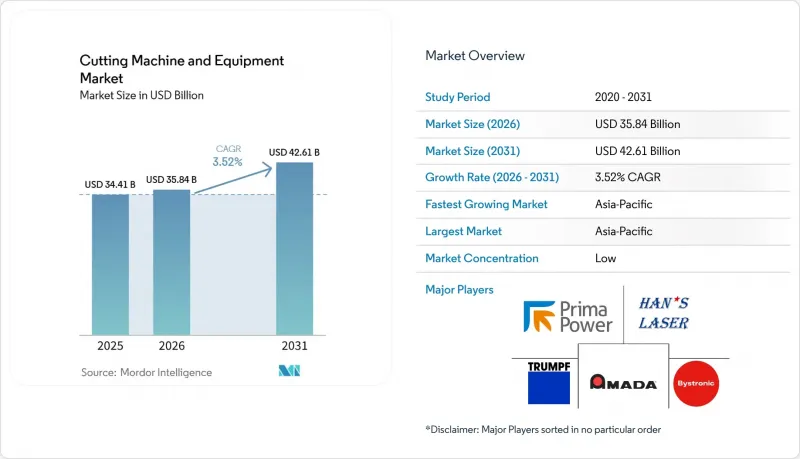
Mordor Intelligence에 의하면, 절단기 및 절단 장비 시장 규모는 2025년 344억 1,000만 달러, 2026년 358억 4,000만 달러에서 2031년까지 426억 1,000만 달러로 확대되어 2026년부터 2031년까지 CAGR 3.52%를 나타낼 것으로 예측됩니다.
본 보고서는 용도별(판금, 튜브·파이프 등), 기술별(레이저, 플라즈마 등), 자동화 수준별(수동, 반자동, 로봇/완전 자동), 최종 사용자 산업별(자동차, 항공우주 및 방위 등), 지역별(북미, 유럽, 아시아태평양 등)로 분류되어 있습니다. 시장 예측은 금액(달러) 및 수량(단위)으로 제시되어 있습니다.
전 세계 절단기 및 절단 장치 시장 동향과 인사이트
전 세계 방위·조선 분야의 재군비 주기가 두꺼운 판재 절단 시스템의 수주 급증을 견인
2025년 전 세계 군사 지출은 2조 8,870억 달러에 달했고, 유럽의 지출은 14% 증가한 8,640억 달러를 기록함에 따라 중가공 장비 수요 시장이 대폭 확대되었습니다. 유럽의 NATO 회원국 및 캐나다도 2035년까지 GDP의 5%를 목표로 한다는 동맹의 공약을 바탕으로, 2025년에는 총 지출액을 571억 달러 이상으로 늘렸습니다. 이에 따라 절단기 및 절단 장치 시장을 뒷받침하는 장기적인 조달 전망이 강화되고 있습니다. 미국의 2026 회계연도 국방 예산에서는 해군의 조선 및 개조에 474억 달러가 배정되어, 엄격한 공차 내에서 두꺼운 해군용 강판을 절단해야 하는 19척의 신형 전투함 건조 자금이 확보되었습니다. 이는 직접적인 방위 계약의 범위를 넘어 중요한 의미를 지닙니다. 왜냐하면 인증된 군용 강재는 제철소의 프리미엄 생산 능력을 점유하기 때문에 민간 강판 가공업체에게는 공급이 부족해지고 투입 비용이 급등하게 되기 때문입니다. 이에 반해, 절단기 및 절단 장치 시장의 구매자들은 처리 톤당 이익률을 유지할 수 있는 더 빠르고 수율이 높은 시스템을 선호하는 경향이 있는 반면, 한국과 호주는 세계 해군 조달 주기에 더욱 깊이를 더하고 있습니다.
기가팩토리 및 수소 전해 장치용 강판 수요의 급증
2021년부터 2025년까지 전 세계 전해조 설치 용량은 0.6GW에서 4.9 GW로 증가했으며, 제조 능력은 연간 57 GW에 달했습니다. 이에 따라 절단기 및 절단 장치 시장을 뒷받침하는 제조거점이 확대되고 있습니다. 1 MW 규모의 경우, 알칼리형 전해조의 스택 1기당 구성에 따라 4,365 kg에서 13,095 kg의 강재가 필요하므로, 생산 능력 증강은 단순한 추상적인 설비 투자에 그치지 않고 실제 강판 절단 수요로 직결됩니다. 수소를 활용한 제철 분야의 신규 투자 중 70% 이상을 유럽이 차지하고 있습니다. 이 지역은 2024년에 청정 산업 기술에 약 150억 달러를 투자했으며, 그 중 80%가 철강 탈탄소화 프로젝트에 투입됨에 따라, 이 지역은 단기적인 정밀 강판 수요의 중심지가 되고 있습니다. 배터리 공장은 케이스, 프레임, 냉각 부품 등 많은 하위 조립품에 대량의 절단된 강재와 알루미늄을 필요로 하기 때문에 수요에 또 다른 층을 더하고 있습니다. 전해조 및 기가팩토리 구매자들이 표준 플라즈마나 화염 시스템으로는 일관되게 달성할 수 없는 절단면 품질과 가공 정밀도를 요구함에 따라, 절단기 및 절단 장치 시장은 혜택을 보고 있으며, 수요는 첨단 레이저 및 워터젯 플랫폼으로 이동하고 있습니다.
변동이 심한 산업용 전기 요금이 15 kW를 초과하는 레이저 가공 공장의 영업이익률을 압박하고 있습니다.
15 kW를 초과하는 고출력 파이버 레이저 시스템은 칠러 및 보조 시스템을 포함할 경우 가동 1시간당 30-60 kWh를 소비하므로, 전력 비용은 절단기 및 절단 장치 시장에서 직접적인 이익 변동 요인이 되고 있습니다. 2026년 미국의 산업용 전력 가격 전국 평균은 1kWh당 8.54센트로 예측되며, 이는 북미 사용자들이 많은 유럽 가공업체들과는 다른 비용 구조에 직면하고 있는 이유 중 하나입니다. 또한, 천연가스 가격 상승과 데이터센터 수요 증가로 인해 전력망에 공급되는 전력이 늘어난 결과, 2025년에는 미국의 전력 도매 가격도 12% 이상 상승하여, 경쟁이 치열한 지역에서도 에너지 비용에 대한 압박이 확산되고 있음을 보여줍니다. 이러한 비용 격차는 조달에 영향을 미치고 있습니다. 다국적 제조업체들은 공급업체의 입지를 비교할 때 인건비나 물류 비용뿐만 아니라 에너지 가격 변동 위험에 대한 노출 정도도 고려하기 때문입니다. 그 결과, 절단기 및 절단 장치 시장에서는 고효율 레이저 시스템에 대한 수요가 높아지는 한편, 운영 비용 증가분을 고객에게 전가할 수 없는 공장에서는 설비 교체 결정이 지연되는 경향도 나타나고 있습니다.
부문 분석
2025년, 판금 분야는 절단기 및 절단 장치 시장의 34.4% 점유율을 차지하며, 자동차용 패널, 전기 인클로저, HVAC 부품에 대한 지속적인 수요를 통해 이 용도가 수익 창출의 중심 역할을 계속하고 있습니다. 절단기 및 절단 장치 시장은 여전히 이 부문을 가동률의 기반으로 삼고 있습니다. 이는 이 분야의 수주가 빈번하고 표준화되어 있으며, 보다 광범위한 가공 활동과 밀접하게 연결되어 있기 때문입니다. 보다 전문적인 용도가 급격한 주기로 변동하는 가운데, 이러한 안정성은 중요한 의미를 지닙니다. 왜냐하면 판재 가공은 더 폭넓은 고객 기반에서 기계군의 생산성을 유지하기 때문입니다. 또한, 이것이 각 공급업체들이 표준적인 평면 부품 가공 분야에서 처리 능력, 네스팅 정밀도, 서비스 지원 측면에서 치열한 경쟁을 계속하고 있는 이유이기도 합니다.
'튜브·파이프'는 가장 빠르게 성장하고 있는 용도 분야입니다. 재생에너지용 타워, 경량 차량 구조, 구조용 가공에 대한 수요 증가를 반영하여, 2031년까지 연평균 성장률(CAGR) 4.1%로 확대될 것으로 예측됩니다. TRUMPF사가 2026년 3월에 발표한 'TruLaser Tube 7000'은 자동 베벨 절단 기능과 이전 모델 대비 최대 150% 향상된 이송 속도를 통해 이러한 변화에 대응하고 있으며, 이는 각 공급업체들이 튜브 가공에 막대한 개발 자원을 투입하고 있음을 보여줍니다. 또한, Han’s Laser사도 2026년 3월, 최대 550mm 파이프를 지원하는 초대형 구경 튜브 커터 ‘WTX15055T’를 출시했습니다. 이는 해양, 석유화학, 조선 분야 수요 증가를 보여줍니다. 아울러 방위 관련 규격이 엄격해짐에 따라 판재 가공 분야에서도 파이버 레이저에 대한 투자가 증가하고 있습니다. 한편, 구조용 강재 및 소규모 첨단 소재 분야에서는 인프라, 전기차(EV), 항공우주 분야의 가공 수요를 통해 절단기 및 절단 장치 시장의 폭을 넓혀가고 있습니다.
2025년, 레이저는 시장 점유율의 41.7%를 차지하며 기술 분야 중 최대의 위상을 확립했습니다. 절단기 및 절단 장치 시장에서 이 정도의 점유율은 광범위한 제조 수요에 있어 레이저 시스템이 여전히 가장 선호되는 선택지임을 보여줍니다. 레이저 플랫폼은 판금, 관재, 정밀 부품 생산에서 높은 절단 정밀도, 더 깔끔한 절단면, 뛰어난 공정 일관성을 실현하기 때문에 수요가 견조하게 유지되고 있습니다. 또한, 레이저의 활용은 수작업 개입보다 재현성과 가동 시간이 중시되는 자동 생산 라인에도 적합합니다. 그 결과, 레이저 시스템은 계속해서 절단기 및 절단 장치 시장의 경쟁 중심을 형성하고 있습니다.
또한, 레이저는 가장 빠르게 성장하는 기술 분야이기도 하며, 2031년까지 연평균 성장률(CAGR) 4.5%로 확대될 것으로 예측됩니다. 이러한 성장세는 생산 기준이 엄격해지고 가동 효율이 점점 더 중요해지는 가운데, 구매자들이 여전히 레이저 기반 플랫폼에 대한 투자를 확대하고 있음을 보여줍니다. 이 부문은 절단 품질과 처리량이 생산 가치에 직접적인 영향을 미치는 자동차, 항공우주, 전기기기 및 첨단 제조 환경에서 꾸준히 도입이 확대되고 있는 점으로부터 혜택을 받고 있습니다. 또한, 소프트웨어와의 통합성이 더 높고 생산성도 뛰어난 시스템으로 구형 절단 설비를 광범위하게 교체하는 추세에서도 혜택을 얻고 있습니다. 현재 매출 점유율과 예측 성장률 모두에서 주도적인 위치를 차지하고 있는 레이저는 절단기 및 절단 장치 시장 규모 전망에 있어 계속해서 주요 기술적 원동력으로 남아 있습니다.
지역별 분석
아시아태평양은 2025년에 절단기 및 절단 장치 시장 점유율의 47.7%를 차지하고 있으며, 2031년까지 연평균 성장률(CAGR) 4.4%를 나타낼 것으로 예측되어, 이 지역은 계속해서 세계 수요의 중심지로서의 지위를 유지할 전망입니다. 중국은 전 세계적으로 이미 도입되었거나 최종 투자 결정이 완료된 전해조 설비 용량의 65% 및 전해조 제조 능력의 60% 가까이를 차지하고 있으며, 이 모두 중공업용 가공 수요를 직접 뒷받침하고 있어 계속해서 핵심적인 역할을 수행하고 있습니다. 이러한 제조 규모 덕분에 아시아태평양의 절단기 및 절단 장치 시장은 에너지 전환 관련 장비, 금속 가공, 수출 지향형 생산 등 폭넓은 분야에서 기반을 다지고 있습니다. 또한 인도에서도 국내 철강 사용량 증가와 자본재 투자를 뒷받침하는 정책 지원에 힘입어 시장이 급속히 확대되고 있습니다. 일본과 한국은 강력한 모션 제어 및 광학 관련 밸류체인을 통해 정밀한 부가가치를 제공하고 있으며, 이는 이 지역이 대량 수요와 고사양 생산 능력을 양립하는 데 일조하고 있습니다.
2026년에도 유럽은 절단기 및 절단 장치 시장에서 중요한 위치를 차지하고 있지만, 더 복잡한 상황에 놓인 지역입니다. 독일의 군사 지출은 2025년에 24% 증가한 1,140억 달러에 달하며, 이는 장갑차 및 해군 프로그램에서의 두꺼운 강판 절단 수요를 뒷받침하고 있습니다. EU의 탄소국경조정메커니즘(CBAM)은 2026년에 최종 단계에 접어들며, 이로 인해 탄소 집약형 철강 생산 경로의 규정 준수 부담이 증가함에 따라 레이저 기반 시스템에 대한 투자 근거가 더욱 강화되고 있습니다. 스페인, 북유럽 국가들, 영국도 계속해서 활발한 구매자로 자리 잡고 있으며, 해상 풍력 발전 설비 제조, 항공우주 분야의 유지보수, 고정밀 가공이 설비 수요를 뒷받침하고 있습니다.
북미에서는 방위 조달, 제조업의 국내 복귀, 그리고 배터리 공장 투자로 인한 혜택이 계속해서 나타나고 있으며, 이에 따라 절단기 및 절단 장비 시장은 다각적인 기반을 유지하고 있습니다. 2026 회계연도 미국 조선 예산 474억 달러는 잠수함 및 구축함 프로그램에 걸친 다년간의 설비 수요를 뒷받침하고 있습니다. 캐나다에서는 전기차(EV) 공급망 프로젝트와 청정 기술 제조 세액 공제를 통해 지원이 강화되고 있으며, 이로 인해 구형 CO2 시스템을 파이버 레이저로 교체하는 이점이 커지고 있습니다. 남미, 중동 및 아프리카는 현재로서는 규모가 여전히 작은 임베디드니다. 그럼에도 불구하고 브라질, 칠레, 사우디아라비아, 남아프리카공화국에서는 인프라, 광업, 산업 다각화 및 에너지 효율이 높은 제조에 대한 투자와 관련된 수요가 나타나고 있습니다.
기타 혜택:
- 엑셀 형식 시장 예측(ME) 시트
- 3개월간의 애널리스트 지원
자주 묻는 질문
목차
제1장 서론
제2장 조사 방법
제3장 주요 요약
제4장 시장 구도
제5장 시장 규모와 성장 예측
제6장 경쟁 구도
제7장 시장 기회와 향후 전망
JHS 26.08.11According to Mordor Intelligence, the cutting machine and Equipment Market size is projected to expand from USD 34.41 billion in 2025 and USD 35.84 billion in 2026 to USD 42.61 billion by 2031, registering a CAGR of 3.52% between 2026 to 2031.
This report is Segmented by Application (Sheet Metal, Tube & Pipe, and More), by Technology (Laser, Plasma, and More), by Automation Level (Manual, Semi-Automated, Robotic/Fully-automated), by End-User Industry (Automotive, Aerospace & Defense, and More), and by Geography (North America, Europe, Asia-Pacific, and More). The Market Forecasts are Provided in Terms of Value (USD) and Volume (Units).
Global Cutting Machine and Equipment Market Trends and Insights
Global Defense and Shipbuilding Rearmament Cycle Fuels Surge in Orders for Thick-Plate Cutting Systems
Global military expenditure reached USD 2,887 billion in 2025, and European spending rose 14% to USD 864 billion, which sharply widened the addressable base for heavy-fabrication equipment demand. European NATO allies and Canada also raised combined outlays to more than USD 571 billion in 2025, following the alliance's commitment to move toward 5% of GDP by 2035, which strengthens long-term procurement visibility supporting the cutting machine and equipment market. The United States FY2026 defense budget assigns USD 47.4 billion to Navy shipbuilding and conversion, funding 19 new battle-force vessels that require thick naval-grade plate cut to tight tolerances. This matters beyond direct defense contracts because certified military steel consumes premium mill capacity, leaving commercial plate fabricators with tighter supply and higher input costs. In response, buyers in the cutting machine and equipment market are favoring faster and higher-yield systems that can protect margins per ton processed, while South Korea and Australia add further depth to the global naval procurement cycle.
Surge in Demand for Plates from Giga-factories and Hydrogen Electrolyzers
Installed global electrolyzer capacity rose from 0.6 GW to 4.9 GW between 2021 and 2025, while manufacturing capacity reached 57 GW per year, thereby expanding the fabrication base that feeds the cutting machine and equipment market. At the 1 MW scale, each alkaline electrolyzer stack requires 4,365 kg to 13,095 kg of steel, depending on configuration, so every capacity addition translates into real plate-cutting demand rather than only abstract capital spending. Europe accounted for more than 70% of new investment in hydrogen-based steelmaking. It invested nearly USD 15 billion in clean industrial technologies in 2024, with 80% directed toward steel decarbonization projects, which places the region at the center of near-term precision plate demand. Battery plants add another layer because enclosures, frames, and cooling components require large volumes of cut steel and aluminum across many subassemblies. The cutting machine and equipment market benefits because electrolyzer and gigafactory buyers specify edge quality and handling precision that standard plasma and flame systems cannot consistently deliver, pushing demand toward advanced laser and waterjet platforms.
Volatile Industrial Electricity Tariffs Squeezing Operating Margins of Greater Than 15 kW Laser Shops
High-power fiber laser systems above 15 kW consume 30-60 kWh per operating hour when chillers and support systems are included, making electricity costs a direct margin variable for the cutting machine and equipment market. The United States national average industrial electricity price is projected at 8.54 cents per kWh in 2026, which helps explain why North American users face a different cost structure than many European shops. United States wholesale power prices also rose by more than 12% in 2025 as natural gas costs increased and data center demand pulled more electricity into the grid, indicating that energy pressure is spreading even in more competitive regions. This cost gap affects procurement because multinational manufacturers compare supplier locations not only on labor and logistics, but also on exposure to energy price volatility. The cutting machine and equipment market, therefore, sees stronger demand for efficient laser systems, but also slower upgrade decisions from shops that cannot pass through operating cost increases to customers.
Other drivers and restraints analyzed in the detailed report include:
- Sustainability Push Accelerates Shift Towards Energy-Efficient Fiber Lasers
- Net-Zero Initiatives Propel Adoption of High-Power Lasers, Shielded by Nitrogen for Low-Dross Output
- Semiconductor-Grade Motion-Controller Shortages Delaying Delivery of Advanced CNC Gantries
For complete list of drivers and restraints, kindly check the Table Of Contents.
Segment Analysis
Sheet Metal held 34.4% of the cutting machine and equipment market share in 2025, keeping this application at the center of revenue generation through repeat demand for automotive panels, electrical enclosures, and HVAC components. The cutting machine and equipment market still relies on this segment as a baseline for utilization because these orders are frequent, standardized, and closely tied to broader fabrication activity. That stability matters when more specialized applications move in sharper cycles, because sheet-based work keeps machine fleets productive across a wider customer base. It also explains why vendors continue to compete hard on throughput, nesting accuracy, and service support in standard flat-part processing.
Tube & Pipe is the fastest-growing application segment. It is projected to expand at a 4.1% CAGR through 2031, reflecting stronger demand for renewable energy towers, lightweight vehicle structures, and structural fabrication. TRUMPF's March 2026 TruLaser Tube 7000 supports this shift with automated bevel cutting and feed rates up to 150% higher than its predecessor, demonstrating that suppliers are allocating meaningful development effort to tube processing. Han's Laser also delivered its WTX15055T ultra-large-diameter tube cutter in March 2026 for pipes up to 550 mm, indicating rising demand from offshore, petrochemical, and shipbuilding environments. Plate processing is also attracting more fiber laser investment as defense-related specifications tighten, while Structural Steel and smaller advanced-material categories are adding breadth to the cutting machine and equipment market through infrastructure, EV, and aerospace fabrication demand.
Laser held 41.7% of the market in 2025, giving it the largest position within the technology landscape. This level of market share in the cutting machine and equipment market shows that laser systems remain the preferred choice across a broad range of fabrication needs. Demand remains firm because laser platforms deliver high cutting accuracy, cleaner edges, and better process consistency across sheet metal, tube, and precision part production. Their use also fits well with automated production lines where repeatability and uptime matter more than manual intervention. As a result, laser systems continue to define the competitive center of the cutting machine and equipment market.
Laser is also the fastest-growing technology segment, forecast to expand at a 4.5% CAGR through 2031. This pace shows that buyers are still moving investment toward laser-based platforms as production standards become stricter and operating efficiency becomes more important. The segment benefits from steady adoption in automotive, aerospace, electrical equipment, and advanced fabrication environments where cut quality and throughput directly affect output value. It also gains from the broader replacement of older cutting setups with systems that support stronger software integration and higher productivity. With leadership in both current revenue share and forecast growth, laser remains the main technology driver in the cutting machine and equipment market size outlook.
Complete Report Scope:
- By Application
- Sheet Metal
- Plate
- Tube & Pipe
- Structural Steel
- Others
- By Technology
- Laser
- Fiber
- CO2
- Others
- Plasma
- High-definition
- Conventional
- Water-Jet
- Abrasive
- Pure
- Flame / Oxy-fuel
- Ultrasonic & Emerging
- Laser
- By Automation Level
- Manual
- Semi-automated
- Robotic / Fully-automated
- By End-User Industry
- Automotive
- Aerospace & Defense
- Electrical & Electronics
- Construction & Infrastructure
- Metal-Fabrication Job Shops
- Shipbuilding
- Energy & Power
- Others (Medical Devices, etc.)
- By Geography
- North America
- United States
- Canada
- Mexico
- South America
- Brazil
- Argentina
- Chile
- Peru
- Rest of South America
- Europe
- Germany
- United Kingdom
- France
- Italy
- Spain
- BENELUX (Belgium, Netherlands, and Luxembourg)
- NORDICS (Denmark, Finland, Iceland, Norway, and Sweden)
- Rest of Europe
- Asia-Pacific
- China
- India
- Japan
- South Korea
- Australia
- Southeast Asia (Indonesia, Vietnam, Thailand, Malaysia, Philippines)
- Rest of Asia-Pacific
- Middle East & Africa
- United Arab Emirates
- Saudi Arabia
- South Africa
- Nigeria
- Rest of Middle East & Africa
- North America
Geography Analysis
Asia-Pacific held 47.7% of the cutting machine and equipment market share in 2025 and is projected to grow at a 4.4% CAGR through 2031, which keeps the region at the center of global demand. China remains the anchor because it accounts for 65% of globally installed and final-investment-decision electrolyzer capacity and nearly 60% of electrolyzer manufacturing capacity, both of which directly support heavy fabrication demand. That manufacturing scale gives the cutting machine and equipment market in Asia-Pacific a wide base across energy transition hardware, metal fabrication, and export-oriented production. India is also emerging more quickly as domestic steel use rises and policy support improves the case for capital goods investment. Japan and South Korea add precision value through strong motion control and optical supply chains, helping the region combine high-volume demand with high-specification production capability.
Europe remains an important but more complex part of the cutting machine and equipment market in 2026. Germany's military expenditure rose 24% to USD 114 billion in 2025, which supports demand for heavy-plate cutting in armored vehicle and naval programs. The EU Carbon Border Adjustment Mechanism entered its definitive phase in 2026, which is increasing the compliance burden on carbon-intensive steel routes and giving laser-based systems a stronger investment case. Spain, the Nordics, and the United Kingdom also remain active buyers, with offshore wind manufacturing, aerospace maintenance, and high-definition fabrication supporting equipment demand.
North America continues to benefit from defense procurement, manufacturing reshoring, and battery plant investment, which keeps the cutting machine and equipment market on a diversified footing. The United States shipbuilding allocation of USD 47.4 billion in FY2026 supports multi-year equipment demand across submarine and destroyer programs. Canada adds support through EV supply chain projects and its clean technology manufacturing tax credit, which improves the case for replacing older CO2 systems with fiber lasers. South America, the Middle East, and Africa remain smaller today. Still, Brazil, Chile, Saudi Arabia, and South Africa show demand tied to infrastructure, mining, industrial diversification, and investment in energy-efficient fabrication.
- TRUMPF
- Bystronic
- Amada
- Prima Power
- Han's Laser
- Bodor Laser
- Penta Laser
- Mitsubishi Electric
- Mazak Optonics
- Hypertherm
- ESAB
- Lincoln Electric
- Messer Cutting Systems
- Koike Aronson
- Flow International
- LVD Group
- KMT Waterjet
- HSG Laser
- Salvagnini
- Eagle Group
Additional Benefits:
- The market estimate (ME) sheet in Excel format
- 3 months of analyst support
TABLE OF CONTENTS
1 Introduction
- 1.1 Study Assumptions & Market Definition
- 1.2 Scope of the Study
2 Research Methodology
3 Executive Summary
4 Market Landscape
- 4.1 Market Overview
- 4.2 Market Drivers
- 4.2.1 Global Defense and Shipbuilding Rearmament Cycle Fuels Surge in Orders for Thick-Plate Cutting Systems
- 4.2.2 Surge in Demand for Plates from Giga-factories and Hydrogen Electrolyzers
- 4.2.3 Sustainability Push Accelerates Shift Towards Energy-Efficient Fiber Lasers
- 4.2.4 Net-Zero Initiatives Propel Adoption of High-Power Lasers, Shielded by Nitrogen for Low-Dross Output
- 4.2.5 On-Shore Wind-Blade Mandates in Circular Economy Drive Surge in Demand for Composite Sectioning
- 4.2.6 Precise Post-Print Finishing Becomes Crucial as Additive-Subtractive Hybrid Manufacturing Scales Up
- 4.3 Market Restraints
- 4.3.1 Volatile Industrial Electricity Tariffs Squeezing Operating Margins of Greater than 15 kW Laser Shops
- 4.3.2 Semiconductor-Grade Motion-Controller Shortages Delaying Delivery of Advanced CNC Gantries
- 4.3.3 Impending PFAS-Coolant Bans Elevating Retrofit Costs for Abrasive Water-Jet Installations
- 4.3.4 EU CBAM Carbon Tariffs Penalizing Energy-Intensive Plasma/Flame Processes
- 4.4 Value / Supply-Chain Analysis
- 4.5 Regulatory Landscape
- 4.6 Technological Outlook
- 4.7 Porter's Five Forces - Industry Attractiveness Scoring
- 4.7.1 Threat of New Entrants
- 4.7.2 Bargaining Power of Suppliers
- 4.7.3 Bargaining Power of Buyers
- 4.7.4 Threat of Substitutes
- 4.7.5 Industry Rivalry
- 4.8 Global Manufacturing-Sector Snapshot
- 4.9 Customer Purchasing Decision Analysis
- 4.10 Impact of Geopolitical Events on the market
5 Market Size & Growth Forecasts
- 5.1 By Application
- 5.1.1 Sheet Metal
- 5.1.2 Plate
- 5.1.3 Tube & Pipe
- 5.1.4 Structural Steel
- 5.1.5 Others
- 5.2 By Technology
- 5.2.1 Laser
- 5.2.1.1 Fiber
- 5.2.1.2 CO2
- 5.2.1.3 Others
- 5.2.2 Plasma
- 5.2.2.1 High-definition
- 5.2.2.2 Conventional
- 5.2.3 Water-Jet
- 5.2.3.1 Abrasive
- 5.2.3.2 Pure
- 5.2.4 Flame / Oxy-fuel
- 5.2.5 Ultrasonic & Emerging
- 5.2.1 Laser
- 5.3 By Automation Level
- 5.3.1 Manual
- 5.3.2 Semi-automated
- 5.3.3 Robotic / Fully-automated
- 5.4 By End-User Industry
- 5.4.1 Automotive
- 5.4.2 Aerospace & Defense
- 5.4.3 Electrical & Electronics
- 5.4.4 Construction & Infrastructure
- 5.4.5 Metal-Fabrication Job Shops
- 5.4.6 Shipbuilding
- 5.4.7 Energy & Power
- 5.4.8 Others (Medical Devices, etc.)
- 5.5 By Geography
- 5.5.1 North America
- 5.5.1.1 United States
- 5.5.1.2 Canada
- 5.5.1.3 Mexico
- 5.5.2 South America
- 5.5.2.1 Brazil
- 5.5.2.2 Argentina
- 5.5.2.3 Chile
- 5.5.2.4 Peru
- 5.5.2.5 Rest of South America
- 5.5.3 Europe
- 5.5.3.1 Germany
- 5.5.3.2 United Kingdom
- 5.5.3.3 France
- 5.5.3.4 Italy
- 5.5.3.5 Spain
- 5.5.3.6 BENELUX (Belgium, Netherlands, and Luxembourg)
- 5.5.3.7 NORDICS (Denmark, Finland, Iceland, Norway, and Sweden)
- 5.5.3.8 Rest of Europe
- 5.5.4 Asia-Pacific
- 5.5.4.1 China
- 5.5.4.2 India
- 5.5.4.3 Japan
- 5.5.4.4 South Korea
- 5.5.4.5 Australia
- 5.5.4.6 Southeast Asia (Indonesia, Vietnam, Thailand, Malaysia, Philippines)
- 5.5.4.7 Rest of Asia-Pacific
- 5.5.5 Middle East & Africa
- 5.5.5.1 United Arab Emirates
- 5.5.5.2 Saudi Arabia
- 5.5.5.3 South Africa
- 5.5.5.4 Nigeria
- 5.5.5.5 Rest of Middle East & Africa
- 5.5.1 North America
6 Competitive Landscape
- 6.1 Market Concentration
- 6.2 Strategic Moves
- 6.3 Market Share Analysis
- 6.4 Company Profiles (Includes Global Level Overview, Market Level Overview, Core Segments, Financials as Available, Strategic Information, Products & Services, and Recent Developments)
- 6.4.1 TRUMPF
- 6.4.2 Bystronic
- 6.4.3 Amada
- 6.4.4 Prima Power
- 6.4.5 Han's Laser
- 6.4.6 Bodor Laser
- 6.4.7 Penta Laser
- 6.4.8 Mitsubishi Electric
- 6.4.9 Mazak Optonics
- 6.4.10 Hypertherm
- 6.4.11 ESAB
- 6.4.12 Lincoln Electric
- 6.4.13 Messer Cutting Systems
- 6.4.14 Koike Aronson
- 6.4.15 Flow International
- 6.4.16 LVD Group
- 6.4.17 KMT Waterjet
- 6.4.18 HSG Laser
- 6.4.19 Salvagnini
- 6.4.20 Eagle Group
7 Market Opportunities & Future Outlook
- 7.1 White-Space & Unmet-Need Assessment


