
|
시장보고서
상품코드
2100622
민간 항공기용 좌석내 전원 시스템 시장 : 시장 점유율 분석, 업계 동향 및 통계, 성장 예측(2026-2031년)Commercial Aircraft In-Seat Power System - Market Share Analysis, Industry Trends & Statistics, Growth Forecasts (2026 - 2031) |
||||||
 Mordor Intelligence
Mordor Intelligence에 의하면, 민간 항공기용 좌석내 전원 시스템 시장 규모는 2025년 1억 6,478만 달러로 평가되었고, 2026년에는 1억 7,273만 달러로 확대될 것으로 추정되고, 2026-2031년 CAGR 4.90%로 성장을 지속할 전망이며, 2031년에는 2억 1,940만 달러에 이를 것으로 예측됩니다.
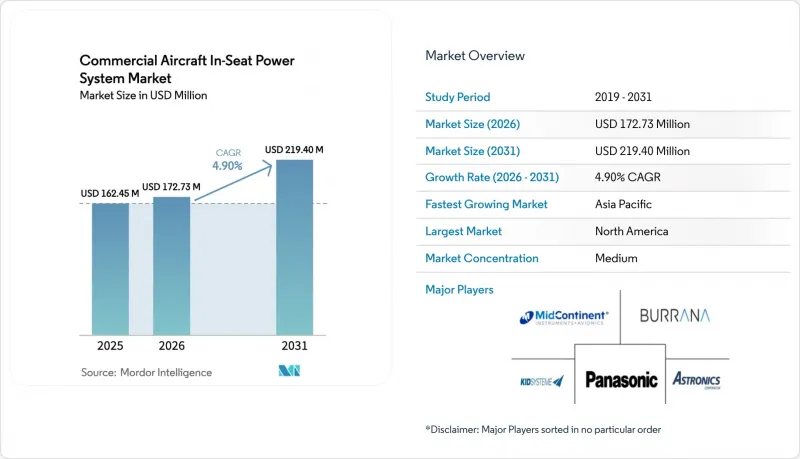
본 보고서는 좌석 등급별(이코노미 클래스, 프리미엄 이코노미 클래스, 비즈니스 클래스, 퍼스트 클래스), 항공기 유형별(나로우드바디기, 와이드바디기, 리저널 제트), 도입 형태별(라인 핏 및 레트로핏), 지역별(북미, 유럽, 아시아태평양, 기타)로 분류되어 있습니다. 시장 전망은 금액(달러)으로 표시되어 있습니다.
세계의 민간 항공기용 좌석내 전원 시스템 시장 동향 및 인사이트
개인용 전자기기 충전 및 기내 연결에 대한 승객 수요 증가
승객은 평균 2.3대의 전자기기를 기내에 반입하고 있으며, 이는 2020년의 1.8대에서 증가한 수치입니다. 또한, 최소 60W의 전력을 공급하는 고속 충전이 가능한 USB-C 콘센트를 기대하고 있습니다. 이에 대응하여 에미레이트 항공은 111대의 항공기 모든 좌석에 67W USB-C 포트를 장착하는 한편, 비즈니스 클래스에는 무선 충전 기능도 도입했습니다. 에어 캐나다가 80대의 항공기에 도입한 파나소닉의 ‘아스트로바’ 플랫폼은 100W USB-C 전원 공급을 지원하며, 전력 공급이 경쟁상의 차별화 요소가 되고 있음을 여실히 보여주고 있습니다. 2026년까지 노트북에 USB-C 채택을 의무화하는 EU의 ‘공통 충전기 지침’에 따라, 각 항공사는 승객의 불만을 미연에 방지하기 위해 도입을 가속화하고 있습니다.
기내 전원 설비 도입을 가속화하는 기단 현대화 및 개조 프로그램
싱가포르 항공의 A350-900 41대 개조 작업에서는 콘센트, 기내 엔터테인먼트(IFE), 좌석을 세트로 도입하여 객실 가동 중단 기간을 최소화하고 있습니다. 대한항공이 11대의 B777-300ER을 대상으로 진행한 2억 1,600만 달러 규모의 대대적인 정비에서는 프리미엄 이코노미 좌석을 40석 증설하고, 승객 1인당 60W USB-C 포트를 추가했습니다. 에어버스사는 2028년까지 390대 이상의 A350이 취항 8년 차를 맞이할 전망이며, 이에 따라 전원 설비 개조를 위한 지속적인 애프터마켓 수요가 발생할 것으로 예상하고 있습니다. 아스트로닉스사는 이미 ‘EmPower’ 개조 수주 잔고가 300대에 달하고,, 견조한 수요를 뒷받침하고 있습니다.
높은 개조 비용과 이에 따른 항공기 운항 중단 기간이 도입을 제한하고 있습니다.
싱가포르 항공은 A350 1대당 2,000만 달러를 투자해 객실을 개조하고 있으며, 대한항공의 B777용 패키지 비용도 1대당 1,960만 달러에 육박하는 금액입니다. 이러한 수치는 소규모 항공사들이 유사한 프로젝트를 추진하는 데 주저하게 만드는 요인이 되고 있습니다. 각 항공기는 수 주간 운항 중단 상태에 놓일 가능성이 있어 수익에 타격을 입힐 수 있습니다. MRO(정비·수리·오버홀) 지출 증가가 예상에도 불구하고, 객실 개조는 선택적 성격을 띠기 때문에 경기 침체기에는 우선순위가 낮아지는 경우가 많습니다. 이는 항공 업계에서 이러한 프로젝트에 수반되는 재정적 및 운항상의 과제를 여실히 드러내고 있습니다.
부문 분석
프리미엄 이코노미는 38-40인치의 좌석 간격이나 노트북용 전원 공급에 요금을 지불할 의사가 있는 중산층 승객을 항공사가 수익원으로 활용함에 따라, 각 객실 등급 중 가장 높은 연평균 성장률(CAGR) 5.12%를 나타낼 것으로 예측됩니다. 대한항공의 B777 개조에서는 새로운 객실에 60W USB-C 포트가 장착되어 있으며, 이는 캐세이퍼시픽항공이 B777-300ER을 개편할 계획과 유사합니다. 이코노미 클래스는 좌석 수가 압도적으로 많기 때문에 상업용 항공기 좌석용 전원 시스템 시장 점유율의 64.66%를 계속 차지하고 있지만, 에미레이트 항공조차도 현재는 모든 이코노미 클래스 좌석에 67W USB-C 포트를 설치하고 있습니다. 비즈니스 클래스와 퍼스트 클래스는 여전히 전력 수요가 높으며, 승객 1인당 100W에 더해 편의 조명도 필요한 경우가 많은데, 싱가포르 항공이 도입을 예정하고 있는 A350의 퍼스트 스위트가 그 대표적인 예입니다.
각 항공사는 프리미엄 이코노미를 수익성 향상 수단으로 간주하고 있으며, 이를 비즈니스 클래스에 가까운 전원 사양을 채택하는 정당한 근거로 삼고 있습니다. 파나소닉의 ‘아스트로바’는 에어 캐나다가 프리미엄 이코노미 고객에게 100W 전원을 제공할 수 있게 해 주며, 대서양 횡단 노선에서 대형 화면을 활용한 업무 효율화를 지원하고 있습니다. 한편, 아스트로닉스의 Qi 인증을 획득한 무선 충전 패드는 케이블이 필요 없습니다는 편의성을 제공하며, 각 항공사는 이를 프리미엄 클래스 좌석에 선택적으로 도입하고 있습니다.
지역별 분석
2025년, 북미는 민간 항공기용 좌석내 전원 시스템 시장의 33.85%를 차지했습니다. 이는 FAA(연방항공청)의 지침과 여행객의 높은 가처분 소득으로 인해 전원이 기본적인 편의 시설이 되었기 때문입니다. 델타항공의 ‘FlytEDGE’ 도입은 듀얼 콘센트를 갖춘 A220 기내와 맞물려 지역적 기준을 확립하고 있으며, 아스트로닉스사의 뉴욕 거점을 통해 해당 기업은 개조 프로그램에 대한 신속한 공급이 가능해졌습니다. 또한, FAA 통지 20-158A는 세계적인 기준 문서가 되어 국내 인증 추진의 기세를 뒷받침하며 시장의 급속한 확산으로 이어지고 있습니다.
에미레이트 항공, 싱가포르 항공, 대한항공, 캐세이퍼시픽 항공, 콴타스 항공, 에어 인도가 개조 및 OEM 프로그램을 잇달아 시행하는 가운데, 아시아태평양은 5.32%라는 가장 높은 연평균 성장률(CAGR)을 기록하고 있습니다. 에미레이트 항공만 해도 111대의 와이드바디 항공기를 오버홀할 예정이며, 싱가포르 항공은 A350 기단의 미래 경쟁력을 확보하기 위해 8억 1,500만 달러를 투자합니다. 규제 측면에서의 지원으로는 중국 민용항공국(CAAC)이 제정한 기기 충전 관련 지침과 홍콩의 휴대용 배터리 금지령이 꼽히며, 이 모두 항공사들에게 인증된 좌석용 콘센트 제공을 촉진하고 있습니다.
유럽은 여전히 중요한 역할을 하고 있으며, 유럽항공안전청(EASA)이 미국 연방항공청(FAA)의 배선 및 전자기 간섭(EMI) 규정과의 조화를 추진하고 있을 뿐만 아니라, ‘공통 충전기 지침’에 따라 사실상 USB-C 채택이 의무화되어 있습니다. 브리티시 에어웨이즈는 이미 A320neo에 듀얼 규격 콘센트를 장착하고 있으며, 루프트한자는 A350 객실에 100W USB-C 도입을 검토하고 있습니다. 중동 항공사들은 에미레이트 항공의 벤치마크 프로그램을 통해 두드러진 존재감을 보이고 있는 반면, 남미는 경제적 역풍으로 인해 뒤처지고 있으나, LATAM이 B767-300ER용 Power-C 사후 개조를 검토하고 있는 점으로 미루어 볼 때 개선의 조짐이 보입니다.
기타 혜택 :
- 엑셀 형식 시장 예측(ME) 시트
- 3개월간의 애널리스트 지원
자주 묻는 질문
목차
제1장 서론
제2장 조사 방법
제3장 주요 요약
제4장 시장 구도
제5장 시장 규모 및 성장 예측
제6장 경쟁 구도
제7장 시장 기회 및 향후 전망
AJYAccording to Mordor Intelligence, the commercial aircraft in-seat power system market size is expected to grow from USD 164.78 million in 2025 to USD 172.73 million in 2026 and is forecasted to reach USD 219.40 million by 2031 at a 4.90% CAGR over 2026-2031.
This report is Segmented by Seating Class (Economy Class, Premium Economy Class, Business Class, and First Class), Aircraft Type (Narrowbody Aircraft, Widebody Aircraft, and Regional Jets), Fit (Linefit and Retrofit), and Geography (North America, Europe, Asia-Pacific, and More). The Market Forecasts are Provided in Terms of Value (USD).
Global Commercial Aircraft In-Seat Power System Market Trends and Insights
Rising Passenger Demand for Personal Electronic Device Charging and Onboard Connectivity
Passengers board with an average of 2.3 devices, up from 1.8 in 2020, and expect fast-charging USB-C outlets that deliver at least 60 W. Emirates responded by outfitting 111 aircraft with 67 W USB-C ports in every seat, while also introducing wireless charging in Business Class. Panasonic's Astrova platform, chosen by Air Canada for 80 aircraft, supplies 100 W USB-C, underscoring how electricity has become a competitive differentiator. The EU's Common Charger directive, mandating USB-C for laptops by 2026, accelerates airline adoption to pre-empt passenger dissatisfaction.
Fleet Modernization and Retrofit Programs Accelerating In-Seat Power Installations
Singapore Airlines' refit of 41 A350-900s bundles outlets, IFE, and seats to amortize cabin downtime. Korean Air's USD 216 million overhaul of 11 B777-300ERs adds 40 Premium Economy seats and 60 W USB-C per passenger. Airbus expects over 390 A350s to reach 8 years of service by 2028, creating a sustained aftermarket pipeline for power conversions. Astronics already logs a 300-aircraft backlog for EmPower retrofits, evidencing robust demand.
High Retrofit Costs and Associated Aircraft Downtime Limiting Adoption
Singapore Airlines spends USD 20 million per A350 to refresh cabins, while Korean Air's B777 packages approach USD 19.6 million per tail, figures that discourage smaller operators from similar projects. Each airframe can sit grounded for weeks, eroding revenue. Despite projected growth in MRO spending, cabin enhancements are often deprioritized during economic downturns due to their discretionary nature. This highlights the financial and operational challenges associated with such projects in the aviation industry.
Other drivers and restraints analyzed in the detailed report include:
- Lightweight and High-Efficiency Power Conversion Technologies Reducing System Weight and Heat Generation
- Emerging FAA and EASA Requirements Driving Adoption of USB-C Power Delivery Outlets
- Weight and Space Constraints Affecting Fuel Efficiency and Cabin Integration
For complete list of drivers and restraints, kindly check the Table Of Contents.
Segment Analysis
Premium economy is forecasted to log a 5.12% CAGR, the fastest among cabins, as carriers monetize mid-tier passengers prepared to pay for 38-40 inches of pitch and laptop-grade power. Korean Air's B777 retrofits feature 60 W USB-C ports in the new cabin, mirroring Cathay Pacific's plan to rejuvenate its B777-300ERs. The economy segment retains a 64.66% commercial aircraft in-seat power system market share because it dominates the seat count; yet, even Emirates now installs 67 W USB-C at every economy seat. Business and first class remain power-hungry, often stipulating 100 W per passenger plus amenity lighting, evidenced by Singapore Airlines' forthcoming A350 First suites.
Airlines view premium economy as a margin lever that justifies a power spec closer to business class. Panasonic's Astrova helps Air Canada provide 100 W to Premium customers, supporting large-screen productivity on trans-Atlantic flights. Astronics' Qi-certified wireless pad, meanwhile, offers a cable-free perk that airlines selectively roll into premium rows.
Complete Report Scope:
- By Seating Class
- Economy Class
- Premium Economy Class
- Business Class
- First Class
- By Aircraft Type
- Narrowbody Aircraft
- Widebody Aircraft
- Regional Jets
- By Fit
- Linefit
- Retrofit
- By Geography
- North America
- United States
- Canada
- Mexico
- Europe
- United Kingdom
- France
- Germany
- Italy
- Spain
- Rest of Europe
- Asia-Pacific
- China
- India
- Japan
- South Korea
- Australia
- Rest of Asia-Pacific
- South America
- Brazil
- Rest of South America
- Middle East and Africa
- Middle East
- United Arab Emirates
- Saudi Arabia
- Rest of Middle East
- Africa
- South Africa
- Rest of Africa
- Middle East
- North America
Geography Analysis
North America accounted for 33.85% of the commercial aircraft in-seat power system market in 2025, as FAA directives and high disposable income among travelers have made power a baseline amenity. Delta's FlytEDGE deployment, paired with dual-outlet A220 cabins, sets a regional standard, and Astronics' New York base positions it to supply retrofit programs quickly. FAA circular 20-158A has also become the global reference document, fostering domestic certification momentum that translates into rapid market uptake.
Asia-Pacific posts the fastest 5.32% CAGR as Emirates, Singapore Airlines, Korean Air, Cathay Pacific, Qantas, and Air India line up retrofit and OEM programs. Emirates alone will overhaul 111 widebodies, while Singapore Airlines spends USD 815 million to future-proof its A350 fleet. Regulatory nudges stem from China's CAAC guidelines on device charging and Hong Kong's power-bank ban, both of which encourage airlines to offer certified in-seat outlets.
Europe remains pivotal as EASA harmonizes with FAA wiring and EMI rules, and the Common Charger directive de facto forces USB-C adoption. British Airways has already fitted A320neos with dual-standard outlets, and Lufthansa is exploring 100 W USB-C for its A350 cabins. Middle East carriers feature prominently through Emirates' benchmark program, while South America lags due to economic headwinds but shows signs of improvement as LATAM evaluates Power-C retrofits for its B767-300ERs.
- Astronics Corporation
- Burrana Pty Ltd.
- KID-Systeme GmbH
- Imagik Corp.
- IFPL Group Limited
- Inflight Canada Inc.
- Mid-Continent Instrument Co., Inc.
- AstrodyneTDI (TRANSISTOR DEVICES INCORPORATED)
- Thales Group
- Panasonic Avionics Corporation (Panasonic Holdings Corporation)
- RTX Corporation
- Diehl Aviation
Additional Benefits:
- The market estimate (ME) sheet in Excel format
- 3 months of analyst support
TABLE OF CONTENTS
1 INTRODUCTION
- 1.1 Study Assumptions and Market Definition
- 1.2 Scope of the Study
2 RESEARCH METHODOLOGY
3 EXECUTIVE SUMMARY
4 MARKET LANDSCAPE
- 4.1 Market Overview
- 4.2 Market Drivers
- 4.2.1 Rising passenger demand for personal electronic device charging and onboard connectivity
- 4.2.2 Fleet modernization and retrofit programs are accelerating in-seat power outlet installations
- 4.2.3 Lightweight and high-efficiency power conversion technologies are reducing system weight and heat generation
- 4.2.4 Emerging FAA and EASA requirements are driving adoption of USB-C power delivery outlets
- 4.2.5 Transition toward higher-voltage aircraft architectures is enabling higher seat-level power availability
- 4.2.6 Growth in long-haul operations and premium cabin density is increasing per-seat power requirements
- 4.3 Market Restraints
- 4.3.1 High retrofit costs and associated aircraft downtime are limiting adoption
- 4.3.2 Weight and space constraints are affecting fuel efficiency and cabin integration
- 4.3.3 Stringent electromagnetic interference and safety certification requirements are extending approval timelines
- 4.3.4 Rapidly evolving USB power delivery and wireless charging standards are delaying airline investment decisions
- 4.4 Value Chain Analysis
- 4.5 Regulatory Landscape
- 4.6 Technological Outlook
- 4.7 Porter's Five Forces Analysis
- 4.7.1 Bargaining Power of Suppliers
- 4.7.2 Bargaining Power of Buyers
- 4.7.3 Threat of New Entrants
- 4.7.4 Threat of Substitutes
- 4.7.5 Competitive Rivalry
5 MARKET SIZE AND GROWTH FORECASTS (VALUE)
- 5.1 By Seating Class
- 5.1.1 Economy Class
- 5.1.2 Premium Economy Class
- 5.1.3 Business Class
- 5.1.4 First Class
- 5.2 By Aircraft Type
- 5.2.1 Narrowbody Aircraft
- 5.2.2 Widebody Aircraft
- 5.2.3 Regional Jets
- 5.3 By Fit
- 5.3.1 Linefit
- 5.3.2 Retrofit
- 5.4 By Geography
- 5.4.1 North America
- 5.4.1.1 United States
- 5.4.1.2 Canada
- 5.4.1.3 Mexico
- 5.4.2 Europe
- 5.4.2.1 United Kingdom
- 5.4.2.2 France
- 5.4.2.3 Germany
- 5.4.2.4 Italy
- 5.4.2.5 Spain
- 5.4.2.6 Rest of Europe
- 5.4.3 Asia-Pacific
- 5.4.3.1 China
- 5.4.3.2 India
- 5.4.3.3 Japan
- 5.4.3.4 South Korea
- 5.4.3.5 Australia
- 5.4.3.6 Rest of Asia-Pacific
- 5.4.4 South America
- 5.4.4.1 Brazil
- 5.4.4.2 Rest of South America
- 5.4.5 Middle East and Africa
- 5.4.5.1 Middle East
- 5.4.5.1.1 United Arab Emirates
- 5.4.5.1.2 Saudi Arabia
- 5.4.5.1.3 Rest of Middle East
- 5.4.5.2 Africa
- 5.4.5.2.1 South Africa
- 5.4.5.2.2 Rest of Africa
- 5.4.5.1 Middle East
- 5.4.1 North America
6 COMPETITIVE LANDSCAPE
- 6.1 Market Concentration
- 6.2 Strategic Moves
- 6.3 Market Share Analysis
- 6.4 Company Profiles (includes Global level Overview, Market level overview, Core Segments, Financials as available, Strategic Information, Market Rank/Share for key companies, Products and Services, and Recent Developments)
- 6.4.1 Astronics Corporation
- 6.4.2 Burrana Pty Ltd.
- 6.4.3 KID-Systeme GmbH
- 6.4.4 Imagik Corp.
- 6.4.5 IFPL Group Limited
- 6.4.6 Inflight Canada Inc.
- 6.4.7 Mid-Continent Instrument Co., Inc.
- 6.4.8 AstrodyneTDI (TRANSISTOR DEVICES INCORPORATED)
- 6.4.9 Thales Group
- 6.4.10 Panasonic Avionics Corporation (Panasonic Holdings Corporation)
- 6.4.11 RTX Corporation
- 6.4.12 Diehl Aviation
7 MARKET OPPORTUNITIES AND FUTURE OUTLOOK
- 7.1 White-space and Unmet-need Assessment