|
시장보고서
상품코드
2100623
에어리스 타이어 : 시장 점유율 분석, 업계 동향 및 통계, 성장 예측(2026-2031년)Airless Tires - Market Share Analysis, Industry Trends & Statistics, Growth Forecasts (2026 - 2031) |
||||||
 Mordor Intelligence
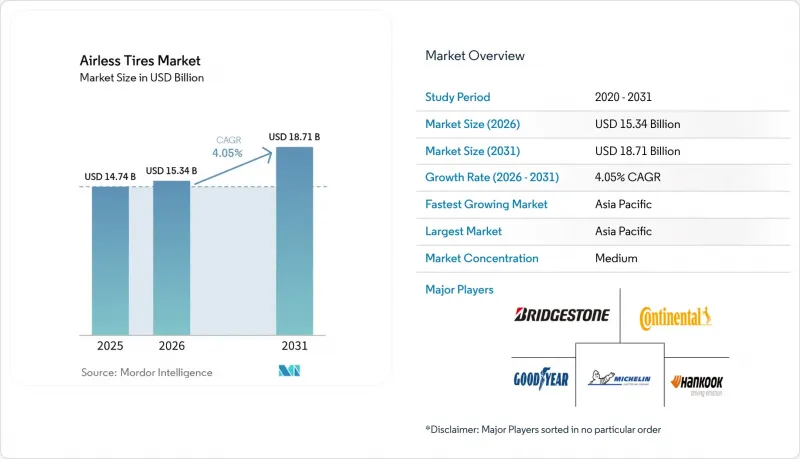
Mordor Intelligence에 의하면, 에어리스 타이어 시장 규모는 2025년에 147억 4,000만 달러로 평가되었습니다. 2026년 153억 4,000만 달러에서 2031년까지 187억 1,000만 달러에 이를 것으로 예상되며, 예측 기간(2026-2031년) CAGR은 4.05%를 나타낼 전망입니다.
본 보고서는 차종(승용차, 상용차 등), 소재(고무, 플라스틱 등), 제조 기술(3D 프린팅 격자 구조, 성형 스포크 웹 등), 판매 채널(OEM 및 애프터마켓), 지역(북미, 남미 등)별로 분류되어 있습니다. 시장 전망은 금액(달러) 기준으로 제시되어 있습니다.
세계의 에어리스 타이어 시장 동향 및 인사이트
EV 제조업체가 요구하는 신속한 펑크 방지 솔루션
EV 제조업체는 실내 공간을 확대하고 차량 총중량을 줄이기 위해 스페어 타이어 수납 공간을 축소하고 있으며, 그 결과 도로에서 고장이 발생했을 때의 비용이 증가하고 있습니다. 테슬라와 Uptis의 시범 도입 사례는 단일 OEM의 결정이 에어리스 타이어 시장 전체를 대규모 보급으로 이끌 가능성을 보여주고 있습니다. 차량 운영 사업자들로부터는 비공기식 타이어로 전환한 후 고장 건수가 최대 80% 감소했다는 보고가 있어, 예기치 못한 가동 중단으로 인한 비용이 절감되고 있습니다. 배터리 중량 및 토크에 대한 높은 하중 지지력은 에어리스 구조의 장점과 부합하며, 미쉐린은 도입이 확대되면 연간 2억 개의 타이어 폐기를 방지할 수 있을 것으로 예측했습니다. 이러한 요인들로 인해 EV 플랫폼은 에어리스 타이어 시장의 성장세를 뒷받침하는 중기적인 원동력으로 자리매김하고 있습니다.
광업 부문에서 타이어 가동 중단 시간 감소를 위한 노력
운반 트럭의 가동 중단은 광석 생산량 손실로 10만 달러를 초과할 가능성이 있습니다. 브리지스톤의 'Smart On-Site' 패키지는 에어리스 타이어와 AI 진단 기능을 결합하여 채굴 현장의 차량 군에 대해 예측 유지보수를 통한 일정 관리를 실현합니다. 칠레에 위치한 미쉐린의 타이어 재활용 공장은 연간 3만 톤의 토목용 타이어를 처리하며, 내구성과 순환형 경제를 통한 가치 창출을 결합하고 있습니다. 검증된 투자 수익률(ROI) 덕분에 광산 운영자들은 프리미엄 가격을 수용하게 되었으며, 아시아태평양을 주축으로 한 에어리스 타이어 시장의 확장이 지속되고 있습니다.
레이디얼 타이어에 비해 높은 단가
현재의 에어리스 타이어는 특수한 폴리우레탄이나 복합재료가 사용되고 있어, 동급의 레이디얼 타이어에 비해 40-60% 비쌉니다. 전 세계 공기 주입식 타이어 생산량은 24억 개에 달하고,, 현재 에어리스 타이어의 생산 능력을 훨씬 상회하고 있기 때문에 규모의 경제가 제한되고 있습니다. 광업 및 소포 물류 차량의 경우 가동 중단 시간 단축 효과로 인해 여전히 구매가 증가하고 있지만, 일반 승용차 시장에서는 가격에 대한 민감도가 여전히 높아 중기적으로는 에어리스 타이어 시장의 성장 궤도를 억제하는 요인으로 작용하고 있습니다.
부문 분석
2025년에는 승용차 모델이 45.68%라는 최대 점유율을 유지했으며, 오프로드 차량은 7.12%라는 가장 높은 연평균 성장률(CAGR) 전망을 보였습니다. 광산 사업자들이 가동 시간을 최우선으로 한 결과, 오프로드 기계용 에어리스 타이어 시장 규모는 상당한 수준에 도달했습니다. 레저용 ATV 및 UTV의 경우, 기복이 심한 지형에 대응하기 위해 레이디얼 강성이 높은 스포크식 디자인이 채택되어, 이에 따라 소비자 부문이 확대되고 있습니다.
상용 트럭 분야에서는 총 소유 비용(TCO) 측면에서 펑크 방지 기능이 높이 평가됨에 따라 에어리스 타이어로의 전환이 착실히 진행되고 있습니다. 파워 스포츠 시장에서는 각 제조업체가 외딴 지역의 트레일 라이더들에게 매력적인 무정비 기능을 탑재함으로써 모델 간 차별화를 꾀하고 있습니다. 이륜차 용도는 틈새 시장이지만, 전기 자전거 플리트에서 신뢰성이 중시되는 도시 지역에서 성장을 이어가고 있습니다. 전반적으로 다양한 차량 등급이 어우러지면서 에어리스 타이어 시장은 당초의 산업 분야라는 기반을 넘어 확대되고 있습니다.
2025년에는 기존 공급망과 비용 측면의 우위를 반영하여 고무가 64.74%의 점유율을 차지한 반면, 복합 엘라스토머는 5.89%라는 가장 높은 연평균 성장률(CAGR)을 나타낼 전망입니다. 바이오 유래 원료를 도입함으로써 순환 경제에 대한 노력이 진전되고 있으며, 미쉐린은 2030년까지 재생 가능하고 재활용 가능한 소재의 비율을 40%로 늘리는 것을 목표로 하고 있습니다. 폴리우레탄계 엘라스토머는 스포크 어셈블리에 대해 뛰어난 내균열성을 발휘하여, 에어리스 타이어 시장 전체의 내구성을 향상시킵니다.
고무는 대량 생산에 있어 여전히 비용 효율성이 뛰어나지만, 환경세 측면에서는 복합 소재가 유리합니다. 플라스틱 배합 소재는 공항 지상 지원 장비(GSE) 등 내화학성이 요구되는 특수한 틈새 시장에 대응하고 있습니다. 이러한 소재의 진화는 지속가능성 요건이 공급업체의 전략을 어떻게 변화시키고 있는지를 여실히 보여주며, 에어리스 타이어 시장에서의 프리미엄 입지를 강화하고 있습니다.
지역별 분석
아시아태평양은 38.20%라는 최대 점유율을 차지했으며, 7.88%라는 가장 높은 연평균 성장률(CAGR)을 기록했습니다. 정부의 전기차(EV) 인센티브, 다수의 OEM(원천 장비 제조업체) 존재, 그리고 한코크의 'iFlex' 프로그램과 같은 국내 혁신 기업들이 이 지역의 성장세를 뒷받침하고 있습니다. 전 세계 상위 75개 타이어 기업 중 34개사가 중국에 거점을 두고 있으며, 이러한 규모와 비용 측면의 우위가 국내 및 수출 채널에서의 에어리스 타이어 시장 성장을 견인하고 있습니다.
북미는 방위 관련 계약과 첨단 연구 개발(R&D) 생태계의 혜택을 받고 있습니다. 아메리칸 엔지니어링 그룹의 제로 프레스처 기술과 테슬라 및 미쉐린의 실증 실험은 산업 전반에 걸친 실증 사례를 보여주고 있습니다. 일부 주에서 도입된 생산자 책임 규제는 재활용 가능한 설계를 촉진하고 있으며, 초기 비용이 높음에도 불구하고 에어리스 타이어 시장의 장기적인 성장을 뒷받침하고 있습니다.
유럽에서는 엄격한 배기가스 규제 및 매립 처분에 관한 규정이 마련되어 있습니다. 유로 7 타이어 마모 상한 기준과 확대된 생산자 책임 체계는 에어리스 타이어의 재활용 가능성이라는 특성과 부합합니다. 미쉐린은 ‘비전’에 부합하는 생산을 통해 유럽의 동향을 활용하고, 성능을 확보하는 동시에 지역 에어리스 타이어 시장이 기후 변화 대응 공약을 달성할 수 있도록 지원하고 있습니다.
기타 혜택 :
- 엑셀 형식 시장 예측(ME) 시트
- 3개월간의 애널리스트 지원
자주 묻는 질문
목차
제1장 서론
제2장 조사 방법
제3장 주요 요약
제4장 시장 구도
제5장 시장 규모 및 성장 예측
제6장 경쟁 구도
제7장 시장 기회 및 향후 전망
KTHAccording to Mordor Intelligence, the airless tires market size was valued at USD 14.74 billion in 2025 and estimated to grow from USD 15.34 billion in 2026 to reach USD 18.71 billion by 2031, at a CAGR of 4.05% during the forecast period (2026-2031).
This report is Segmented by Vehicle Type (Passenger Vehicles, Commercial Vehicles, and More), Material (Rubber, Plastic, and More), Manufacturing Technology (3-D Printed Lattice, Molded Spoke Web, and More), Sales Channel (OEM and Aftermarket), and Geography (North America, South America, and More). The Market Forecasts are Provided in Terms of Value (USD).
Global Airless Tires Market Trends and Insights
Rapid Puncture-Proof Solutions Demanded by EV OEMs
EV makers eliminate spare-tire space to extend cabin volume and curb weight; doing so elevates the cost of roadside failures. Uptis trials with Tesla illustrate how a single OEM decision can pull the wider airless tires market toward volume adoption. Fleet operators report up to 80% fewer breakdowns after switching to non-pneumatic tires, cutting unplanned downtime costs. Higher load tolerance for battery mass and torque aligns with airless construction advantages, while Michelin projects 200 million tire scrappage avoidance annually once deployment scales. These factors position EV platforms as the medium-term catalyst for the airless tires market momentum.
Mining Sector Push to Cut Tire Downtime
Haul-truck immobilization can exceed USD 100,000 in lost ore output. Bridgestone's Smart On-Site bundle couples airless tires with AI diagnostics, delivering predictive scheduling for pit fleets. Michelin's tire recycling plant in Chile processes 30,000 tons of earthmover tires annually, linking durability with circular value capture. The proven ROI persuades mine operators to accept premium pricing, sustaining Asia-Pacific-led expansion of the airless tires market.
Higher Unit Cost Versus Radial Tires
Current non-pneumatic units cost 40-60% above comparable radials owing to specialized polyurethane and composite inputs. Global output of 2.4 billion pneumatic units dwarfs current airless capacity, limiting economies of scale. Fleets in mining or parcel logistics are still buying due to downtime savings, yet mainstream passenger sales remain price sensitive, tempering the airless tires market trajectory during the medium term.
Other drivers and restraints analyzed in the detailed report include:
- Rising Military Spending on Run-Flat Mobility Platforms
- Stricter EU Landfill Rules Favoring Recyclable Non-Pneumatics
- Limited High-Speed Load Certifications
For complete list of drivers and restraints, kindly check the Table Of Contents.
Segment Analysis
Off-road vehicles posted the highest 7.12% CAGR outlook, even though passenger models retained the largest 45.68% share in 2025. The airless tires market size for off-road machinery reached a significant value as mine operators prioritized uptime. Recreational ATVs and UTVs use spoked designs offering higher radial stiffness for rough terrain, thereby widening consumer segments.
The commercial-truck niche shows steady conversion because total-cost-of-ownership models reward puncture avoidance. In Power-sports market, the makers differentiate models through maintenance-free features attractive to remote trail riders. Two-wheeler use is a niche yet growing in urban settings where e-bike fleets value reliability. Overall, diverse vehicle classes collectively expand the airless tires market beyond its initial industrial anchor points.
Rubber held a 64.74% share in 2025, reflecting legacy supply chains and cost advantages, whereas composite elastomers are projected to register the fastest 5.89% CAGR. Incorporation of bio-sourced feedstocks advances circularity pledges; Michelin targets 40% renewable and recyclable content by 2030. Polyurethane-based elastomers offer superior crack resistance for spoke assemblies, enhancing durability across the airless tires market.
Rubber remains cost-effective for high-volume runs, yet environmental levies favor composites. Plastic formulations serve specialist chemical-resistant niches such as airport GSE. The materials evolution underscores how sustainability mandates are reshaping supplier strategies and reinforce premium positioning within the airless tires market.
Complete Report Scope:
- By Vehicle Type
- Passenger Vehicles
- Commercial Vehicles
- Off-Road Vehicles
- Two-Wheeler
- Power Sports (ATV/UTV, Snowmobile)
- By Material
- Rubber
- Plastic
- Composite Elastomers
- By Manufacturing Technology
- 3-D Printed Lattice
- Molded Spoke Web
- Layered Honeycomb
- By Sales Channel
- OEM
- Aftermarket
- By Geography
- North America
- United States
- Canada
- Rest of North America
- South America
- Brazil
- Argentina
- Rest of South America
- Europe
- Germany
- United Kingdom
- France
- Spain
- Italy
- Russia
- Rest of Europe
- Asia-Pacific
- China
- Japan
- India
- South Korea
- Australia
- New Zealand
- Rest of Asia-Pacific
- Middle East and Africa
- Saudi Arabia
- United Arab Emirates
- Egypt
- Turkey
- South Africa
- Rest of Middle East and Africa
- North America
Geography Analysis
Asia-Pacific combined the largest 38.20% slice with the fastest 7.88% CAGR. Government EV incentives, a dense OEM base, and domestic innovators such as Hankook's iFlex program power regional momentum. China's 34 of the top 75 global tire companies deliver scale and cost advantages, propelling the airless tires market in local and export channels.
North America benefits from defense contracts and advanced R&D ecosystems. American Engineering Group's zero-pressure work and Tesla-Michelin pilots demonstrate cross-sector validation. Producer-responsibility regulations in several states support recyclable designs, underpinning long-term growth of the airless tires market despite higher upfront costs.
Europe orchestrates stringent emission and landfill rules. Euro 7 tyre abrasion caps and extended-producer-responsibility frameworks align with airless recyclability attributes. Michelin leverages continental policy trends through Vision-aligned production, helping the regional airless tires market meet climate commitments while safeguarding performance.
- Michelin Group
- Goodyear Tire & Rubber Co.
- Continental AG
- Hankook Tire & Technology Group
- Bridgestone Corporation
- Trelleborg AB
- Toyo Tire Corporation
- Amerityre Corporation
- Tannus Ltd
- Polaris Inc. (Resilient Technologies)
- Kenda Rubber Industrial Co.
- Marathon Industries Inc.
- SMART Tire Company
Additional Benefits:
- The market estimate (ME) sheet in Excel format
- 3 months of analyst support
TABLE OF CONTENTS
1 Introduction
- 1.1 Study Assumptions & Market Definition
- 1.2 Scope of the Study
2 Research Methodology
3 Executive Summary
4 Market Landscape
- 4.1 Market Overview
- 4.2 Market Drivers
- 4.2.1 Rapid puncture-proof solutions demanded by EV OEMs
- 4.2.2 Mining sector's push to cut tyre downtime
- 4.2.3 Rising military spending on run-flat mobility platforms
- 4.2.4 Stricter EU landfill rules favouring recyclable non-pneumatics
- 4.2.5 3-D printed lattice wheels slashing prototyping cycles
- 4.2.6 Growing micro-mobility fleets for last-mile logistics
- 4.3 Market Restraints
- 4.3.1 Higher unit cost versus radial tires
- 4.3.2 Limited high-speed load certifications
- 4.3.3 OEM hesitation due to NVH concerns
- 4.3.4 Regulatory uncertainty on new road-worthiness standards
- 4.4 Value / Supply-Chain Analysis
- 4.5 Regulatory Landscape
- 4.6 Technological Outlook
- 4.7 Porter's Five Forces
- 4.7.1 Threat of New Entrants
- 4.7.2 Bargaining Power of Buyers
- 4.7.3 Bargaining Power of Suppliers
- 4.7.4 Threat of Substitute Products
- 4.7.5 Intensity of Competitive Rivalry
5 Market Size & Growth Forecasts (Value in USD)
- 5.1 By Vehicle Type
- 5.1.1 Passenger Vehicles
- 5.1.2 Commercial Vehicles
- 5.1.3 Off-Road Vehicles
- 5.1.4 Two-Wheeler
- 5.1.5 Power Sports (ATV/UTV, Snowmobile)
- 5.2 By Material
- 5.2.1 Rubber
- 5.2.2 Plastic
- 5.2.3 Composite Elastomers
- 5.3 By Manufacturing Technology
- 5.3.1 3-D Printed Lattice
- 5.3.2 Molded Spoke Web
- 5.3.3 Layered Honeycomb
- 5.4 By Sales Channel
- 5.4.1 OEM
- 5.4.2 Aftermarket
- 5.5 By Geography
- 5.5.1 North America
- 5.5.1.1 United States
- 5.5.1.2 Canada
- 5.5.1.3 Rest of North America
- 5.5.2 South America
- 5.5.2.1 Brazil
- 5.5.2.2 Argentina
- 5.5.2.3 Rest of South America
- 5.5.3 Europe
- 5.5.3.1 Germany
- 5.5.3.2 United Kingdom
- 5.5.3.3 France
- 5.5.3.4 Spain
- 5.5.3.5 Italy
- 5.5.3.6 Russia
- 5.5.3.7 Rest of Europe
- 5.5.4 Asia-Pacific
- 5.5.4.1 China
- 5.5.4.2 Japan
- 5.5.4.3 India
- 5.5.4.4 South Korea
- 5.5.4.5 Australia
- 5.5.4.6 New Zealand
- 5.5.4.7 Rest of Asia-Pacific
- 5.5.5 Middle East and Africa
- 5.5.5.1 Saudi Arabia
- 5.5.5.2 United Arab Emirates
- 5.5.5.3 Egypt
- 5.5.5.4 Turkey
- 5.5.5.5 South Africa
- 5.5.5.6 Rest of Middle East and Africa
- 5.5.1 North America
6 Competitive Landscape
- 6.1 Market Concentration
- 6.2 Strategic Moves
- 6.3 Market Share Analysis
- 6.4 Company Profiles (Includes Global Level Overview, Market Level Overview, Core Segments, Financials as Available, Strategic Information, Market Rank/Share for Key Companies, Products and Services, SWOT Analysis, and Recent Developments)
- 6.4.1 Michelin Group
- 6.4.2 Goodyear Tire & Rubber Co.
- 6.4.3 Continental AG
- 6.4.4 Hankook Tire & Technology Group
- 6.4.5 Bridgestone Corporation
- 6.4.6 Trelleborg AB
- 6.4.7 Toyo Tire Corporation
- 6.4.8 Amerityre Corporation
- 6.4.9 Tannus Ltd
- 6.4.10 Polaris Inc. (Resilient Technologies)
- 6.4.11 Kenda Rubber Industrial Co.
- 6.4.12 Marathon Industries Inc.
- 6.4.13 SMART Tire Company
7 Market Opportunities & Future Outlook
- 7.1 White-space & Unmet-Need Assessment