|
시장보고서
상품코드
2100627
종양 영양 시장 : 점유율 분석, 업계 동향 및 통계, 성장 예측(2026-2031년)Oncology Nutrition - Market Share Analysis, Industry Trends & Statistics, Growth Forecasts (2026 - 2031) |
||||||
 Mordor Intelligence
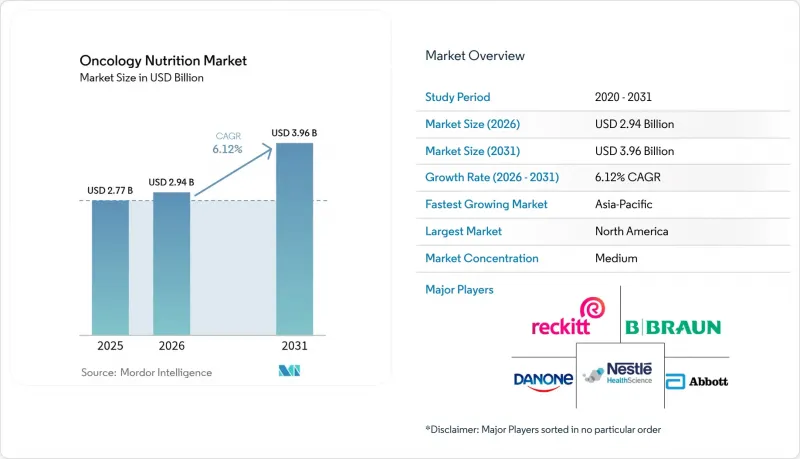
Mordor Intelligence에 의하면, 종양 영양 시장 규모는 2025년 27억 7,000만 달러, 2026년 29억 4,000만 달러에서 2031년까지 39억 6,000만 달러로 확대한다고 예측되고 있어 2026년부터 2031년까지 연평균 복합 성장률(CAGR)은 6.12%를 나타낼 전망입니다.
본 보고서는 암의 유형(두경부암, 위·소화기계암 등), 영양 공급 방식(경장 영양, 정맥 영양), 제제 유형(표준 제제 등), 최종 사용자(병원, 재택 간호, 전문 종양 클리닉), 지역(북미, 유럽, 아시아태평양 등)별로 분류되어 있습니다. 시장 전망은 금액(달러) 기준으로 제시되어 있습니다.
전 세계 종양 영양 시장 동향과 인사이트
전 세계 암 유병률의 상승
2022년 전 세계 신규 암 발병 건수는 2,000만 건이었으나, 2050년까지 연간 3,500만 건으로 급증할 것으로 예측됩니다. 이는 고령화, 도시형 생활 방식 및 선별 검진 프로그램 확대와 관련하여 75% 증가율을 나타냅니다. 환자의 40-80%가 암 관련 영양실조를 경험하고 있으며, 이는 화학요법 완수 및 전체 생존 기간에 직접적인 악영향을 미치고 있습니다. 아시아태평양에서는 환자 수 증가세가 가장 빠르며, 대기 오염에 노출된 비흡연 여성들 사이에서 폐암이 급증하고 있습니다. 남아시아에서는 담배 및 베텔넛 섭취 습관으로 인해 두경부암이 여전히 많이 발생하고 있으며, 연하 장애로 인한 영양 요구가 증가하고 있습니다. 의료 시스템에서는 치료 격차를 해소하기 위해 ‘환자 주관적 종합 평가(PGSA)’와 같은 선별 도구가 도입되고 있습니다.
비경구 영양에서 경구 영양으로의 전환
임상적 증거에 따르면, 장내 영양은 비장내 영양에 비해 카테터 관련 혈류 감염을 40-50% 감소시키는 것으로 확인되었으며, 이러한 안전성상의 우위성으로 인해 종양학과 병동의 프로토콜 템플릿이 재검토되고 있습니다. 장내 영양은 장관의 건전성과 상재 미생물 군집을 유지하며, 이는 현재 면역관문억제제에 대한 우수한 반응과 연관되어 있습니다. 메디케어는 2025년에 재택 장내 영양에 대한 사전 승인 요건을 철폐하여 미국 내 보급을 가속화하고 있습니다. 각 의료기기 제조업체들은 젊은 혈액암 환자에게 중요한 편안함과 미적 측면을 향상시키는 눈에 잘 띄지 않는 위루 버튼과 비강-공장 튜브를 출시하고 있습니다. 중증 점막염이나 장폐색의 경우 여전히 정맥영양이 필수적이지만, 그 사용은 특정 합병증으로 제한되는 경향이 강해지고 있습니다.
고품질 종양 영양 제품의 높은 비용
면역영양제의 소매 가격은 1회분당 8-15달러이며, 장영양만으로 1,500-2,000kcal를 섭취해야 하는 환자의 경우월비용은 240-450달러에 달할 전망입니다. 2024년 미국 조사에 따르면, 암 환자의 38%가 가격을 이유로 보충제 섭취량을 줄이거나 중단하고 있으며, 특히 메디케어 급여 공백기에 있는 수급자들이 가장 큰 영향을 받고 있습니다. 제네릭 고분자 제제는 저렴하지만, 염증을 조절하는 글루타민이나 오메가-3 성분이 포함되어 있지 않아 임상의들의 지지는 제한적입니다. 저소득 지역에서는 1인당 의료비 예산이 50-200달러에 그치기 때문에 시판 제품은 감당하기 어려운 수준이며, 단백질이나 미량 영양소의 목표치를 충족하지 못하는 경우가 많은 블렌더 조리식에 의존할 수밖에 없는 상황입니다. 각 제조업체들은 가격과 판매량 사이의 균형을 맞추는 데 고심하고 있습니다. 가격을 낮추면 접근성은 높아지지만, 복잡하고 품질 관리가 철저한 공급망에서의 이익률이 떨어지기 때문입니다.
부문 분석
2025년, 두경부 악성 종양은 종양 영양 시장 점유율 28.54%를 차지하며 최대 수익원으로서의 입지를 공고히 했습니다. 중증 연하 장애, 연하통, 구강 건조증은 방사선 치료 기간을 넘어 지속되는 경우가 많아, 그 결과 위루에 대한 의존 기간이 장기화되고 영양제 소비량이 지속적으로 증가하고 있습니다. 폐암에 할당되는 종양 영양 시장 규모는 2031년까지 연평균 성장률(CAGR) 7.25%로 확대될 것으로 예측되며, 이는 비흡연자의 발병률 상승과 PD-1/PD-L1 체크포인트 억제제 병용 요법에 따른 대사 수요 증가를 반영한 것입니다.
방사선으로 인한 점막염은 두경부암 환자의 최대 80%에 영향을 미치고 있으며, 소화 부담을 줄이기 위해 조기 예방적 경관 영양 튜브 삽입 및 요소 영양제 선택이 권장되고 있습니다. 폐암 치료법은 안정 시 에너지 소비량을 10-15% 증가시키며, 임상의들은 이화 작용을 상쇄하기 위해 면역영양제를 처방하는 경향이 강해지고 있지만, 프로토콜 세부 사항에 대한 합의에 대해서는 여전히 논의가 계속되고 있습니다. 위암 및 소화기 계통의 암은 절제술 후 장기적인 지원 필요성을 통해 뚜렷한 수요를 창출하고 있는 반면, 혈액 악성 종양은 집중적인 화학요법 단계에서 비경구 영양에 대한 수요를 유지하고 있습니다.
2025년 종양 영양 시장 규모 중 장내 영양 제품이 75.54%를 차지했습니다. 이는 감염 예방의 이점과 저렴한 비용이 처방 기준의 기반이 되고 있기 때문입니다. 경장 영양 경로에서는 카테터 관련 혈류 감염 발생률이 40-50% 감소하며, 장을 통한 면역 반응이 체크포인트 억제제의 효능을 높이는 것으로 여겨집니다. 비경구 영양은 시장 점유율이 24.46%에 그치지만, 고농도 지질 에멀전이 염증성 합병증을 감소시키고, 재택 정맥 주사 플랫폼이 적용 대상을 확대함에 따라 연평균 성장률(CAGR) 6.65%로 성장하고 있습니다.
보험 급여 정책은 영양 요법 선택에 큰 영향을 미치고 있습니다. 미국 메디케어의 2025년 개정으로 체중 감소율이 10%를 초과하는 사례에 대해 사전 승인이 면제됨에 따라 장내 영양 처방 건수가 증가했으나, 반면 비경구 영양의 승인에는 여전히 흡수 부전에 관한 상세한 문서 제출이 요구되고 있습니다. 비용 면에서는 여전히 현저한 차이가 있습니다. 경장영양은 1일당 50-100달러인 반면, 비경구영양은 150-300달러이며, 금기 사항이 없는 한 병원 약품 목록에서는 경장영양이 기본으로 채택되는 경향이 있습니다.
지역별 분석
2025년, 북미는 전 세계 매출의 39.23%를 차지했습니다. 이는 메디케어의 적용 범위, 연간 200만 건 이상의 암 진단, 그리고 화학요법 각 주기마다 영양 스크리닝을 의무화하는 확립된 임상 경로에 힘입은 결과입니다. 2025년에 재택 장내 영양 요법에 대한 사전 승인 요건이 철폐됨에 따라 처방 절차가 간소화되었고, 공급업체에 대한 주문량이 급증했습니다. 캐나다의 보험 적용 범위는 주마다 다르며, 온타리오주와 브리티시컬럼비아주가 가장 종합적인 혜택을 제공하는 반면, 멕시코의 공적 의료 제도는 뒤처져 있어 민간 보험 이용 확대를 촉진하고 있습니다.
유럽은 2위를 차지했으며, 독일, 영국, 프랑스, 이탈리아, 스페인이 주도하고 있습니다. 독일의 국민건강보험 제도는 재택 장내영양 요법을 종합적으로 보장하고 있어, 1인당 소비량은 세계 최고 수준입니다. 영국의 국민보건서비스(NHS)는 특정 종양 유형에만 적용되므로, 정책 확대를 위해서는 환자 단체의 로비가 매우 중요합니다. 동유럽 시장은 종양학 인프라의 현대화와 EU의 자금 지원에 따른 공급망 개선에 힘입어 성장하고 있습니다.
아시아태평양은 2031년까지 연평균 성장률(CAGR) 7.12%를 나타낼 것으로 예측됩니다. 중국 규제 당국은 2024년부터 2025년까지 여러 장내 영양 제품을 승인했으며, 고령화가 진행 중인 중국에서는 폐암, 위암, 대장암 환자 수가 증가하고 있습니다. 인도에서는 보험 환급 제도의 미비점이 과제로 대두되고 있으나, 대도시권의 주요 3차 의료기관에서는 국제 영양 지침에 따른 대응이 진행되고 있습니다. 일본에서는 국민건강보험 제도에 따라 재택 장내 영양 요법이 보장되고 있어, 총인구가 감소하고 있음에도 불구하고 안정적인 수요가 유지되고 있습니다. 호주나 한국 등의 성숙한 시장에서는 보급률이 높은 반면, 동남아시아에서는 경제적 장벽으로 인해 시장이 아직 발전 단계에 있습니다.
기타 혜택:
- 엑셀 형식 시장 예측(ME) 시트
- 3개월간의 애널리스트 지원
자주 묻는 질문
목차
제1장 서론
제2장 조사 방법
제3장 주요 요약
제4장 시장 구도
제5장 시장 규모와 성장 예측
제6장 경쟁 구도
제7장 시장 기회와 향후 전망
JHS 26.08.11According to Mordor Intelligence, the oncology nutrition market size is projected to expand from USD 2.77 billion in 2025 and USD 2.94 billion in 2026 to USD 3.96 billion by 2031, registering a CAGR of 6.12% between 2026 to 2031.
This report is Segmented by Cancer Type (Head & Neck Cancer, Stomach & Gastrointestinal Cancers, and More), Nutrition Type (Enteral Nutrition, Parenteral Nutrition), Formula Type (Standard Formula, and More), End-User (Hospitals, Home Care, Specialty Oncology Clinics), and Geography (North America, Europe, Asia-Pacific, and More). The Market Forecasts are Provided in Terms of Value (USD).
Global Oncology Nutrition Market Trends and Insights
Rising Prevalence of Cancer Worldwide
Global cancer incidence stood at 20 million new cases in 2022 and is projected to soar to 35 million per year by 2050, a 75% upswing linked to aging populations, urban lifestyles, and broader screening programs. Forty-to-eighty percent of patients experience cancer-related malnutrition, which directly undermines chemotherapy completion and overall survival. Asia-Pacific is registering the fastest case growth, including sharp lung-cancer increases among never-smoking women exposed to air pollution. Head-and-neck cancers remain prevalent in South Asia because of tobacco and betel-nut habits, amplifying dysphagia-driven nutrition needs. Health systems are embedding screening tools such as the Patient-Generated Subjective Global Assessment to close the care gap.
Shift from Parenteral to Enteral Nutrition
Clinical evidence confirms that enteral routes cut catheter-related bloodstream infections by 40-50% compared with parenteral alternatives, a safety edge that is reshaping protocol templates in oncology wards. Enteral feeding maintains gut integrity and commensal microbiota, factors now linked to superior responses to immune-checkpoint inhibitors. Medicare dropped prior-authorization hurdles for home enteral nutrition in 2025, accelerating U.S. uptake. Device makers have introduced low-profile gastrostomy buttons and nasojejunal tubes that improve comfort and aesthetics, important for younger hematologic-oncology patients. Parenteral nutrition remains essential for severe mucositis and bowel obstruction, but its use is increasingly confined to specific complications.
High Cost of Premium Oncology Nutrition Products
Immunonutrition formulas retail at USD 8-15 per serving, translating to USD 240-450 in monthly spending for patients requiring 1,500-2,000 kcal exclusively from enteral sources. In a 2024 U.S. survey, 38% of oncology patients reduced or discontinued supplements because of price, with Medicare beneficiaries in the coverage gap most affected. Generic polymeric formulas are cheaper but lack glutamine and omega-3 features that modulate inflammation, limiting their appeal to clinicians. In low-income regions, per capita health budgets of USD 50-200 make commercial products unattainable, forcing reliance on blenderized diets that frequently miss protein and micronutrient targets. Manufacturers wrestle with price-volume trade-offs: cutting prices widens access but dilutes margins on complex, quality-controlled supply chains.
Other drivers and restraints analyzed in the detailed report include:
- Growing Adoption of Home-Based Enteral Feeding Devices
- Product Innovation - Elemental & Immuno-Modulating Formulas
- Reimbursement Gaps for Outpatient Nutrition Therapy
For complete list of drivers and restraints, kindly check the Table Of Contents.
Segment Analysis
Head-and-neck malignancies captured 28.54% of Oncology nutrition market share in 2025, cementing their position as the largest revenue generator. Severe dysphagia, odynophagia, and xerostomia often last beyond the radiation window, driving extended gastrostomy dependence and sustained formula volumes. The Oncology nutrition market size allocated to lung cancer is projected to advance at a 7.25% CAGR through 2031, reflecting rising non-smoking-related incidence and the metabolic demands of PD-1/PD-L1 checkpoint combinations.
Radiation-induced mucositis affects up to 80% of head-and-neck patients, encouraging early prophylactic feeding-tube placement and elemental formula preference because of reduced digestive effort. Lung-cancer regimens elevate resting energy expenditure by 10-15%, and clinicians increasingly prescribe immunonutrition formulas to counter catabolism, though consensus on protocol specifics remains under debate. Stomach and gastrointestinal cancers add notable volume through long-term support needs after resections, while hematologic malignancies sustain parenteral demand during intensive chemotherapy phases.
Enteral products accounted for 75.54% of Oncology nutrition market size in 2025 as infection-avoidance benefits and lower costs underpin prescribing norms. Catheter bloodstream infections occur 40-50% less often with enteral routes, and gut-mediated immunity is thought to aid checkpoint-inhibitor efficacy. Parenteral nutrition, although holding only 24.46% share, is growing at 6.65% CAGR as advanced lipid emulsions cut inflammatory complications and home-infusion platforms broaden eligibility.
Reimbursement policy significantly influences modality choice. U.S. Medicare's 2025 update waiving prior authorization for weight-loss cases above 10% boosted enteral discharges, whereas parenteral approvals still demand detailed malabsorption documentation. Cost remains a stark differential: USD 50-100 per day for enteral versus USD 150-300 for parenteral, steering hospital formularies toward enteral default except when contraindicated.
Complete Report Scope:
- By Cancer Type
- Head & Neck Cancer
- Stomach & Gastrointestinal Cancer
- Blood Cancer
- Breast Cancer
- Lung Cancer
- Other Cancers
- By Nutrition Type
- Enteral Nutrition
- Parenteral Nutrition
- By Formula Type
- Standard Formula
- Elemental / Semi-elemental Formula
- Disease-specific / Immunonutrition Formula
- By End User
- Hospitals
- Home Care Settings
- Specialty Oncology Clinics
- Geography
- North America
- United States
- Canada
- Mexico
- Europe
- Germany
- United Kingdom
- France
- Italy
- Spain
- Rest of Europe
- Asia-Pacific
- China
- India
- Japan
- Australia
- South Korea
- Rest of Asia-Pacific
- Middle East and Africa
- GCC
- South Africa
- Rest of Middle East and Africa
- South America
- Brazil
- Argentina
- Rest of South America
- North America
Geography Analysis
North America held 39.23% of global revenue in 2025, anchored by Medicare coverage, two-million-plus annual cancer diagnoses, and entrenched clinical pathways that mandate nutrition screening at each chemotherapy cycle. The 2025 removal of prior-authorization requirements for home enteral therapy simplified discharge and swelled supplier order volumes. Canada's coverage is province-specific, with Ontario and British Columbia offering the most generous benefits, while Mexico's public systems lag, propelling private insurance uptake.
Europe ranked second, led by Germany, the United Kingdom, France, Italy, and Spain. Germany's universal insurance reimburses home enteral nutrition comprehensively, driving per-capita consumption rates among the world's highest. The United Kingdom's National Health Service grants coverage to select tumor types only, making patient advocacy pivotal to policy expansion. Eastern European markets are rising as oncology infrastructure modernizes and EU funding improves supply chains.
Asia-Pacific is projected to deliver a 7.12% CAGR through 2031. China's regulator approved multiple enteral products in 2024-2025, and its aging population is driving lung, gastric, and colorectal volume. India struggles with reimbursement gaps but flagship tertiary hospitals in metro areas are aligning with global nutrition guidelines. Japan's universal payer system underwrites home enteral therapy, supporting stable demand even as total population contracts. Mature markets such as Australia and South Korea enjoy high adoption, while Southeast Asia remains nascent because of affordability barriers.
- Abbott Laboratories
- Ajinomoto Co., Inc.
- Avanos Medical
- B. Braun
- Baxter
- Cardinal Health
- Danone
- Fresenius
- Global Health Product
- Grifols
- Hormel Foods
- Kate Farms
- Meiji Holdings Co., Ltd.
- Moog
- Nestle S.A.
- Otsuka Pharmaceutical Co. Ltd.
- ProDiet
- Reckitt Benckiser Group
- Victus
Additional Benefits:
- The market estimate (ME) sheet in Excel format
- 3 months of analyst support
TABLE OF CONTENTS
1 Introduction
- 1.1 Study Assumptions & Market Definition
- 1.2 Scope of the Study
2 Research Methodology
3 Executive Summary
4 Market Landscape
- 4.1 Market Overview
- 4.2 Market Drivers
- 4.2.1 Rising prevalence of cancer worldwide
- 4.2.2 Shift from parenteral to enteral nutrition
- 4.2.3 Growing adoption of home-based enteral feeding devices
- 4.2.4 Product innovation - elemental & immuno-modulating formulas
- 4.2.5 AI-driven personalised macro/micro-nutrient planning
- 4.2.6 Microbiome-modulating immunonutrition research gains
- 4.3 Market Restraints
- 4.3.1 High cost of premium oncology nutrition products
- 4.3.2 Reimbursement gaps for outpatient nutrition therapy
- 4.3.3 Feeding-tube-related infection & complication risk
- 4.3.4 Supply-chain scarcity of specialised amino-acid blends
- 4.4 Supply-Chain Analysis
- 4.5 Regulatory Landscape
- 4.6 Technological Outlook
- 4.7 Porter's Five Forces
- 4.7.1 Threat of New Entrants
- 4.7.2 Bargaining Power of Buyers
- 4.7.3 Bargaining Power of Suppliers
- 4.7.4 Threat of Substitute Products
- 4.7.5 Intensity of Competitive Rivalry
5 Market Size & Growth Forecasts (Value, USD)
- 5.1 By Cancer Type
- 5.1.1 Head & Neck Cancer
- 5.1.2 Stomach & Gastrointestinal Cancer
- 5.1.3 Blood Cancer
- 5.1.4 Breast Cancer
- 5.1.5 Lung Cancer
- 5.1.6 Other Cancers
- 5.2 By Nutrition Type
- 5.2.1 Enteral Nutrition
- 5.2.2 Parenteral Nutrition
- 5.3 By Formula Type
- 5.3.1 Standard Formula
- 5.3.2 Elemental / Semi-elemental Formula
- 5.3.3 Disease-specific / Immunonutrition Formula
- 5.4 By End User
- 5.4.1 Hospitals
- 5.4.2 Home Care Settings
- 5.4.3 Specialty Oncology Clinics
- 5.5 Geography
- 5.5.1 North America
- 5.5.1.1 United States
- 5.5.1.2 Canada
- 5.5.1.3 Mexico
- 5.5.2 Europe
- 5.5.2.1 Germany
- 5.5.2.2 United Kingdom
- 5.5.2.3 France
- 5.5.2.4 Italy
- 5.5.2.5 Spain
- 5.5.2.6 Rest of Europe
- 5.5.3 Asia-Pacific
- 5.5.3.1 China
- 5.5.3.2 India
- 5.5.3.3 Japan
- 5.5.3.4 Australia
- 5.5.3.5 South Korea
- 5.5.3.6 Rest of Asia-Pacific
- 5.5.4 Middle East and Africa
- 5.5.4.1 GCC
- 5.5.4.2 South Africa
- 5.5.4.3 Rest of Middle East and Africa
- 5.5.5 South America
- 5.5.5.1 Brazil
- 5.5.5.2 Argentina
- 5.5.5.3 Rest of South America
- 5.5.1 North America
6 Competitive Landscape
- 6.1 Market Concentration
- 6.2 Market Share Analysis
- 6.3 Company Profiles (includes Global level Overview, Market level overview, Core Segments, Financials as available, Strategic Information, Market Rank/Share for key companies, Products & Services, and Recent Developments)
- 6.3.1 Abbott Laboratories
- 6.3.2 Ajinomoto Co., Inc.
- 6.3.3 Avanos Medical
- 6.3.4 B. Braun SE
- 6.3.5 Baxter International Inc.
- 6.3.6 Cardinal Health
- 6.3.7 Danone SA (Nutricia)
- 6.3.8 Fresenius SE & Co. KGaA (Fresenius Kabi)
- 6.3.9 Global Health Products, Inc.
- 6.3.10 Grifols S.A.
- 6.3.11 Hormel Foods Corporation
- 6.3.12 Kate Farms
- 6.3.13 Meiji Holdings Co., Ltd.
- 6.3.14 Moog Inc.
- 6.3.15 Nestle S.A.
- 6.3.16 Otsuka Pharmaceutical Co. Ltd.
- 6.3.17 ProDiet
- 6.3.18 Reckitt Benckiser Group plc
- 6.3.19 Victus, Inc.
7 Market Opportunities & Future Outlook
- 7.1 White-space & Unmet-Need Assessment