

|
시장보고서
상품코드
2100628
종양학 정보 시스템 시장 : 점유율 분석, 업계 동향 및 통계, 성장 예측(2026-2031년)Oncology Information System - Market Share Analysis, Industry Trends & Statistics, Growth Forecasts (2026 - 2031) |
||||||
 Mordor Intelligence
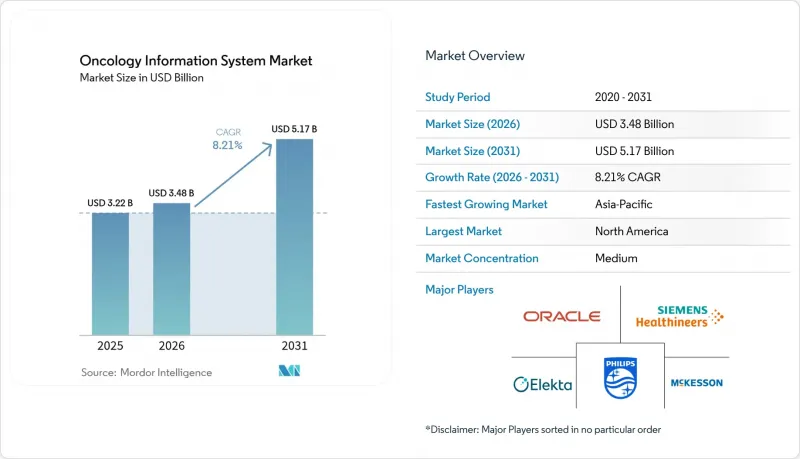
Mordor Intelligence에 의하면, 종양학 정보 시스템 시장 규모는 2025년 32억 2,000만 달러에서 2026년에는 34억 8,000만 달러로 확대되어 2026년부터 2031년까지 CAGR 8.21%로 성장을 지속하여, 2031년에는 51억 7,000만 달러에 이를 것으로 예측됩니다.
본 보고서는 제품 및 서비스(소프트웨어 및 서비스), 용도(의료 종양학, 방사선 종양학, 외과 종양학), 최종 사용자(병원, 연구센터, 전문 클리닉) 및 지역(북미, 유럽, 아시아태평양, 중동 및 아프리카, 남미)별로 분류되어 있습니다. 본 보고서에서는 상기 각 부문별 시장 규모(달러)를 제시하고 있습니다.
전 세계 종양학 정보 시스템 시장 동향 및 인사이트
전 세계 암 발병률의 상승
세계 암 부담은 계속 증가하고 있으며, 미국에서만 매년 170만 건의 신규 사례가 진단되고 있어 데이터 관리 및 치료 연계에 전례 없는 수요가 발생하고 있습니다. 현재 종양학 워크플로우에는 유전체 시퀀싱, 다중 모달 영상 진단, 실세계 데이터가 통합되어 있으며, 이 모든 것을 지원하기 위해서는 맞춤형 의료를 뒷받침할 수 있는 통합 플랫폼이 필요합니다. 생존율 향상(지난 30년간 33% 상승)으로 인해 장기적인 경과 관찰이 필요한 암 생존자 집단이 증가하고 있어, 정보 인프라에 대한 부담이 더욱 커지고 있습니다. 고령화 사회로의 인구 구조 변화가 이러한 압박을 가중시키고 있어, 의료 기관은 다학제 팀과 평생에 걸친 치료 경로를 지원하는 종양학 정보 시스템의 도입을 확대할 수밖에 없는 상황입니다.
암 IT 현대화를 위한 정부 자금
공공 부문의 투자를 통해 첨단 암 정보학의 도입이 가속화되고 있습니다. 미국의 ‘Cancer Moonshot’ 이니셔티브에서는 전자의무기록 전반에 걸친 표준화된 종양학 데이터 요소에 대한 특정 자금이 배정된 반면, CDC의 AIMS 플랫폼 및 NOAH 허브는 주 암 등록 기관에 실시간 병리·검사 분석 기능을 제공합니다. 뉴욕주는 통합 암 프로그램을 최우선 과제로 삼아 병원 현대화에 1억 8,800만 달러를 투자했습니다. 영국은 ‘Cancer 360’ 기술에 20억 파운드를 배정하여 NHS(국민보건서비스) 산하 각 기관에 걸쳐 통합된 종양학 정보 계층을 구축했습니다. 이러한 노력은 상호 운용성 규정을 강화하고 민간 투자를 촉진함으로써 종양학 정보 시스템 시장의 성장을 뒷받침하고 있습니다.
높은 총소유비용(TCO) 및 도입 비용
지역 암 진료 기관은 자본 지출과 장기적인 비용 절감 효과를 신중하게 비교 검토해야 합니다. 메이요 클리닉의 투여량 자동 반올림에 관한 연구에서는 3년간 3,975만 달러의 비용 절감이 예상되었으나, 이를 실현하기 위해서는 기술, 교육, 시스템 유지보수를 위한 막대한 초기 투자가 필요했습니다. 'Enhancing Oncology Model'에서는 보고 및 진료 관리 의무가 추가되어 소규모 진료소에게는 부담이 되고 있습니다. 비용 대비 효과 프레임워크에서는 안전성 향상, 이상반응 감소, 직원 생산성 향상과 같은 비금전적 이점이 강조되고 있지만, 보상 제도가 조정되기 전까지는 현금 흐름 문제는 여전히 심각합니다.
부문 분석
2025년, 병원 및 진료소가 워크플로우 매핑, 시스템 설정, 교육 및 지속적인 지원을 도입 파트너에 의존한 결과, 서비스 부문은 종양학 정보 시스템 시장 점유율의 50.32%를 차지했습니다. 카디널 헬스(Cardinal Health)가 인티그레이티드 종양 네트워크(Integrated Oncology Network)를 11억 달러에 인수한 것은 전문 서비스 번들 제공이 기업 고객의 도입률과 유지율을 얼마나 높이는지를 보여줍니다. 종양학 정보 시스템 서비스 시장 규모는 맞춤형 통합이 필요한 양성자선 치료 및 CAR-T 모니터링의 도입 확대에 따라 성장할 것으로 전망됩니다.
소프트웨어는 가장 빠르게 성장하는 분야로, 2031년까지 연평균 성장률(CAGR) 8.74%를 유지할 것으로 전망됩니다. GE 헬스케어의 ‘CareIntellect for Oncology’는 치료 이력과 의사결정 지원을 단일 대시보드에 통합하여 데이터 수집 시간을 몇 시간에서 몇 분으로 단축합니다. 레이서치 래버러토리즈(RaySearch Laboratories)는 'RayCare'에 치료 계획 품질 분석 기능을 통합하여, AI를 활용한 자동화를 통해 공급업체들이 차별화를 꾀하고 있음을 보여줍니다. 의료 서비스 제공업체들이 FHIR 업그레이드, 클라우드 전환, 사이버 보안 강화를 외부에 위탁함에 따라 컨설팅, 유지보수, 매니지드 서비스 등 각 하위 부문이 확대되고 있습니다. 그 결과, 라이선싱과 지속적인 서비스가 종양학 정보 시스템 시장 전체에서 예측 가능한 현금 흐름을 창출하는 하이브리드형 수익 모델이 형성되고 있습니다.
지역별 분석
2025년, 북미는 종양학 정보 시스템 시장 점유율의 44.78%를 차지했습니다. 이는 ‘Cures Act’에 따른 상호 운용성 의무화, 견고한 환급 메커니즘, 그리고 전자 건강 기록의 높은 보급률에 힘입은 결과입니다. CDC(미국 질병통제예방센터)의 데이터 현대화 이니셔티브와 같은 연방 프로그램은 실시간암 감시를 가속화하고, 의료 제공업체들이 클라우드 우선 아키텍처로 전환하도록 촉진하고 있습니다. 학술 기관들은 기술 기업과 제휴하여 AI 솔루션의 선도적인 개발을 추진하고 있으며, 이를 통해 이 지역의 리더십을 더욱 공고히 하고 있습니다.
아시아태평양은 가장 빠르게 성장하는 지역으로, 2031년까지 연평균 성장률(CAGR) 9.34%를 나타낼 것으로 전망됩니다. 중국의 ‘트리니티(Trinity)’ 스마트 병원 구상은 통합된 전자건강기록(EMR) 및 스마트 서비스 표준을 수립하여, 현지 의료 시스템이 기존 아키텍처를 뛰어넘을 수 있도록 하고 있습니다. 한국의 ‘K-CURE 공공 암 라이브러리’는 226만 명의 환자 익명화 기록을 집약하고 있으며, 한편 2,500만 달러 규모의 정부 기금이 AI를 활용한 신약 개발을 지원하고 있습니다. 일본의 의료 DX 프로그램은 환자 데이터를 통합하기 위한 전국적인 정보 플랫폼을 구축하고 있으며, 인도의 전인도 의학 연구소(AIIMS)에서는 AI 영상 분석을 도입해 유방암 및 난소암의 조기 발견을 도모하고 있습니다. 이러한 협력적인 노력을 통해 기준이 강화되고 조달이 원활해지며, 종양학 정보 시스템 시장 전반에 걸쳐 수요가 창출되고 있습니다.
유럽에서는 ‘유럽 암 영상 이니셔티브(European Cancer Imaging Initiative)’나 ‘JANE 프로젝트’와 같은 지역 간 협력 사업이 진행되고 있으며, 영상 데이터 및 AI 도구의 검증을 위한 연합 네트워크가 구축되고 있습니다. 가맹국들은 클라우드 기반 레지스트리 및 점유율 분석 시스템에 공동으로 투자하고 있으며, 벤더들에게 FHIR 지원 및 GDPR(EU 개인정보보호규정) 준수에 대한 인증 획득을 장려하고 있습니다. 중동 및 아프리카 및 라틴아메리카에서는 종양학 정보 시스템의 본격적인 시장 진출을 위한 기초 단계로서, 원격 종양학, 원격 모니터링 및 기본적인 전자건강기록(EMR) 업그레이드를 결합한 민관 파트너십을 통해 도입이 점진적으로 진행되고 있습니다.
기타 혜택:
- 엑셀 형식 시장 예측(ME) 시트
- 3개월간의 애널리스트 지원
자주 묻는 질문
목차
제1장 서론
제2장 조사 방법
제3장 주요 요약
제4장 시장 구도
제5장 시장 규모와 성장 예측
제6장 경쟁 구도
제7장 시장 기회와 향후 전망
JHS 26.08.11According to Mordor Intelligence, the oncology information system market size is expected to grow from USD 3.22 billion in 2025 to USD 3.48 billion in 2026 and is forecast to reach USD 5.17 billion by 2031 at 8.21% CAGR over 2026-2031.
This report is Segmented by Product and Service (Software and Services), Application (Medical Oncology, Radiation Oncology, and Surgical Oncology), End User (Hospitals, Research Centers, and Specialty Clinics), and Geography (North America, Europe, Asia-Pacific, Middle East and Africa, and South America). The Market Provides the Value (USD) for the Abovementioned Segments.
Global Oncology Information System Market Trends and Insights
Rising Incidence of Cancer Worldwide
Global cancer burden continues to climb, with 1.7 million new cases diagnosed each year in the United States alone, placing unprecedented demands on data management and care coordination . Oncology workflows now incorporate genomic sequencing, multi-modal imaging, and real-world evidence, all of which require an integrated platform capable of supporting personalized medicine. Improved survival rates-up 33% over three decades-have created a growing cohort of cancer survivors who need long-term monitoring, further stretching information infrastructure . Demographic shifts toward aging populations amplify these pressures, pushing healthcare organizations to scale oncology information system market deployments that support multidisciplinary teams and lifelong care pathways.
Government Funding for Oncology IT Modernization
Public-sector investment is accelerating adoption of advanced cancer informatics. The United States Cancer Moonshot allocates targeted funds for standardized oncology data elements across electronic health records, while the CDC's AIMS platform and NOAH hub bring real-time pathology and laboratory analytics to state cancer registries. New York State committed USD 188 million to hospital modernization, prioritizing integrated cancer programs. The United Kingdom set aside GBP 2 billion for Cancer 360 technology, creating unified oncology information layers across NHS institutions . Such initiatives tighten interoperability rules and stimulate private investment, reinforcing growth in the oncology information system market.
High Total Cost of Ownership & Implementation
Community oncology practices must weigh capital outlays against long-term savings. Mayo Clinic's automated dose rounding study showed potential savings of USD 39.75 million over three years yet required sizable upfront investment for technology, training, and system maintenance. The Enhancing Oncology Model adds reporting and care-management obligations that strain smaller clinics. Cost-benefit frameworks underline non-financial gains-improved safety, fewer adverse events, and higher staff productivity-yet the cash flow challenge remains acute until reimbursement adjusts.
Other drivers and restraints analyzed in the detailed report include:
- Interoperability Mandates (21st Century Cures Act)
- AI-Driven Clinical Decision Support Boosting ROI
- Shortage of Oncology-Informatics Professionals
For complete list of drivers and restraints, kindly check the Table Of Contents.
Segment Analysis
Services held 50.32% of oncology information system market share in 2025 as hospitals and clinics relied on implementation partners for workflow mapping, system configuration, training, and ongoing support. Cardinal Health's USD 1.1 billion purchase of Integrated Oncology Network illustrates how bundled professional services amplify adoption and stickiness for enterprise clients. The oncology information system market size for services is projected to expand in tandem with growing proton-therapy and CAR-T monitoring deployments that demand bespoke integrations.
Software is the fastest-growing component, tracking an 8.74% CAGR through 2031. GE HealthCare's CareIntellect for Oncology consolidates treatment history and decision support into a single dashboard, cutting data-gathering time from hours to minutes. RaySearch Laboratories integrates plan-quality analytics into RayCare, showing how vendors differentiate on AI-enabled automation. Consulting, maintenance, and managed-service subsegments rise as providers outsource FHIR upgrades, cloud migrations, and cybersecurity hardening. The result is a blended revenue model in which software licensing and recurring services generate predictable cash flows across the oncology information system market.
Complete Report Scope:
- Oncology
- Software
- Patient-information systems
- Treatment-planning systems
- Services
- Consulting
- Implementation & Integration
- Maintenance & Support
- Software
- By Application
- Medical Oncology
- Radiation Oncology
- Surgical Oncology
- By End User
- Hospitals
- Oncology Clinics
- Research & Academic Centers
- By Geography
- North America
- United States
- Canada
- Mexico
- Europe
- Germany
- United Kingdom
- France
- Italy
- Spain
- Rest of Europe
- Asia-Pacific
- China
- Japan
- India
- South Korea
- Australia
- Rest of Asia-Pacific
- Middle East
- GCC
- South Africa
- Rest of Middle East
- South America
- Brazil
- Argentina
- Rest of South America
- North America
Geography Analysis
North America accounted for 44.78% of oncology information system market share in 2025, supported by the Cures Act interoperability mandate, robust reimbursement mechanisms, and well-established electronic health record penetration. Federal programs such as the CDC's data-modernization initiative accelerate real-time cancer surveillance, nudging providers toward cloud-first architectures. Academic centers partner with technology firms to pioneer AI solutions, reinforcing the region's leadership stance.
Asia-Pacific is the fastest-growing region, projecting a 9.34% CAGR through 2031. China's Trinity smart-hospital blueprint outlines standards for unified EMRs and smart services, positioning local health systems to leapfrog legacy architectures . South Korea's K-CURE Public Cancer Library aggregates anonymized records for 2.26 million patients, while a USD 25 million government fund backs AI-driven drug discovery. Japan's medical DX program builds a national information platform to unify patient data, and India's All India Institute of Medical Sciences deploys AI image analytics to detect breast and ovarian cancers earlier. These coordinated efforts tighten standards, ease procurement, and seed demand across the oncology information system market.
Europe follows with pan-regional initiatives such as the European Cancer Imaging Initiative and JANE project, which create federated networks for imaging data and AI tool validation. Member states co-invest in cloud-based registries and shared analytics, encouraging vendors to certify FHIR readiness and GDPR compliance. Middle East & Africa and Latin America show incremental adoption, often through public-private partnerships that bundle tele-oncology, remote monitoring, and basic EMR upgrades as foundational steps toward a full oncology information system market rollout.
- Oracle Health (Cerner)
- Siemens Healthineers (Varian)
- Elekta
- Mckesson
- Koninklijke Philips
- F. Hoffmann-La Roche (Flatiron Health)
- Accuray
- RaySearch Laboratories
- Optum
- Epic Systems
- GE Healthcare
- Tempus Labs Inc.
- ViewRay Inc.
- Merative (IBM Watson Health)
- Medisolv
- IntelliCyt Corporation
- CEDAR Oncology Solutions
- Carevive Systems
- EndoSoft
- MIM Software
- Flatiron OncoEMR (Altos)
Additional Benefits:
- The market estimate (ME) sheet in Excel format
- 3 months of analyst support
TABLE OF CONTENTS
1 Introduction
- 1.1 Study Assumptions & Market Definition
- 1.2 Scope of the Study
2 Research Methodology
3 Executive Summary
4 Market Landscape
- 4.1 Market Overview
- 4.2 Market Drivers
- 4.2.1 Rising incidence of cancer worldwide
- 4.2.2 Government funding for oncology IT modernization
- 4.2.3 Interoperability mandates (e.g., 21st Century Cures Act)
- 4.2.4 Cloud-hosted OIS adoption across multi-site cancer networks
- 4.2.5 AI-driven clinical-decision support boosting ROI
- 4.2.6 Value-based reimbursement models demanding real-time outcomes tracking
- 4.3 Market Restraints
- 4.3.1 High total cost of ownership & implementation
- 4.3.2 Shortage of oncology-informatics professionals
- 4.3.3 Cyber-security & patient-data-privacy risks
- 4.3.4 Integration gaps with emerging proton-therapy data formats
- 4.4 Value / Supply-Chain Analysis
- 4.5 Regulatory Landscape
- 4.6 Technological Outlook
- 4.7 Porter's Five Forces Analysis
- 4.7.1 Threat of New Entrants
- 4.7.2 Bargaining Power of Buyers
- 4.7.3 Bargaining Power of Suppliers
- 4.7.4 Threat of Substitutes
- 4.7.5 Competitive Rivalry
5 Market Size & Growth Forecasts (Value, USD)
- 5.1 Oncology
- 5.1.1 Software
- 5.1.1.1 Patient-information systems
- 5.1.1.2 Treatment-planning systems
- 5.1.2 Services
- 5.1.2.1 Consulting
- 5.1.2.2 Implementation & Integration
- 5.1.2.3 Maintenance & Support
- 5.1.1 Software
- 5.2 By Application
- 5.2.1 Medical Oncology
- 5.2.2 Radiation Oncology
- 5.2.3 Surgical Oncology
- 5.3 By End User
- 5.3.1 Hospitals
- 5.3.2 Oncology Clinics
- 5.3.3 Research & Academic Centers
- 5.4 By Geography
- 5.4.1 North America
- 5.4.1.1 United States
- 5.4.1.2 Canada
- 5.4.1.3 Mexico
- 5.4.2 Europe
- 5.4.2.1 Germany
- 5.4.2.2 United Kingdom
- 5.4.2.3 France
- 5.4.2.4 Italy
- 5.4.2.5 Spain
- 5.4.2.6 Rest of Europe
- 5.4.3 Asia-Pacific
- 5.4.3.1 China
- 5.4.3.2 Japan
- 5.4.3.3 India
- 5.4.3.4 South Korea
- 5.4.3.5 Australia
- 5.4.3.6 Rest of Asia-Pacific
- 5.4.4 Middle East
- 5.4.4.1 GCC
- 5.4.4.2 South Africa
- 5.4.4.3 Rest of Middle East
- 5.4.5 South America
- 5.4.5.1 Brazil
- 5.4.5.2 Argentina
- 5.4.5.3 Rest of South America
- 5.4.1 North America
6 Competitive Landscape
- 6.1 Market Concentration
- 6.2 Market Share Analysis
- 6.3 Company profiles (includes Global level Overview, Market level overview, Core Segments, Financials as available, Strategic Information, Market Rank/Share for key companies, Products & Services, and Recent Developments)
- 6.3.1 Oracle Health (Cerner)
- 6.3.2 Siemens Healthineers (Varian)
- 6.3.3 Elekta AB
- 6.3.4 McKesson Corporation
- 6.3.5 Koninklijke Philips N.V.
- 6.3.6 F. Hoffmann-La Roche (Flatiron Health)
- 6.3.7 Accuray Incorporated
- 6.3.8 RaySearch Laboratories
- 6.3.9 Optum Inc.
- 6.3.10 Epic Systems Corporation
- 6.3.11 GE HealthCare
- 6.3.12 Tempus Labs Inc.
- 6.3.13 ViewRay Inc.
- 6.3.14 Merative (IBM Watson Health)
- 6.3.15 Medisolv Inc.
- 6.3.16 IntelliCyt Corporation
- 6.3.17 CEDAR Oncology Solutions
- 6.3.18 Carevive Systems
- 6.3.19 EndoSoft LLC
- 6.3.20 MIM Software Inc.
- 6.3.21 Flatiron OncoEMR (Altos)
7 Market Opportunities & Future Outlook
- 7.1 White-space & Unmet-need Assessment


