

|
시장보고서
상품코드
2100633
바닥용 접착제 시장 : 점유율 분석, 업계 동향 및 통계, 성장 예측(2026-2031년)Floor Adhesives - Market Share Analysis, Industry Trends & Statistics, Growth Forecasts (2026 - 2031) |
||||||
 Mordor Intelligence
Mordor Intelligence에 의하면, 바닥용 접착제 시장 규모는 2025년에 21억 2,000만 달러로 평가되었고 2026년 22억 2,000만 달러에서 2031년까지 28억 1,000만 달러에 이를 것으로 예측되며, 예측 기간(2026-2031년) CAGR은 4.78%를 나타낼 전망입니다.
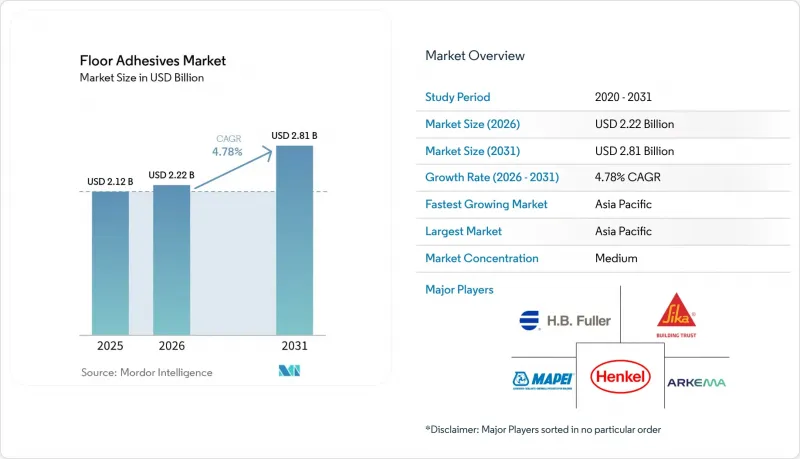
본 보고서는 수지 유형(에폭시, 아크릴, 비닐 등), 기술(수성 및 용제계), 용도(타일·석재, 카펫, 라미네이트, 탄성 바닥재 등), 최종 사용자 산업(주택, 상업, 산업), 지역(아시아태평양, 북미, 유럽, 남미, 중동 및 아프리카)별로 분류되어 있습니다. 시장 예측은 금액(달러) 기준으로 제시되어 있습니다.
전 세계 바닥용 접착제 시장 동향 및 인사이트
급속히 확대되는 전 세계 건설 지출
세계적으로 건설 지출이 증가함에 따라, 바닥용 접착제 시장에는 내구성이 뛰어난 접착 솔루션이 필요한 프로젝트가 꾸준히 공급되고 있습니다. 미국의 건설 지출은 2024년에 전년 대비 11.3% 증가했습니다. 이는 비주거용 건설이 18% 급증하고 단독주택이 5.5% 증가한 데 힘입은 결과입니다. 건설 활동의 지표인 인도의 시멘트 수요는 2,564만 호의 농촌 주택을 공급해 온 정부의 주택 프로그램 하에서 2026년까지 연평균 성장률(CAGR) 7.5%로 증가할 것으로 예측됩니다. 건설업체의 수주 잔고가 8.5개월 분량에 달한다는 것은 접착제 소비가 안정적임을 나타내는 한편, ‘반도체 생산 촉진 및 과학법(CHIPS법)’에 힘입어 추진되는 반도체 공장 건설은 고사양 바닥재 수요를 창출하고 있습니다. 브라질, 인도네시아, 사우디아라비아의 인프라 관련 입법 조치는 내습성 에폭시 및 속경화형 폴리우레탄 시스템을 제공하는 공급업체들에게 유사한 비즈니스 기회를 창출하고 있습니다. 연간 2%라는 완만한 원자재 가격 상승으로 인해 제조업체는 수요를 저해하지 않으면서 가격 전가가 가능해졌으며, 주택 및 상업 분야 전반에서 이익률을 유지하고 있습니다.
성숙한 경제권에서의 리모델링 및 개보수 수요 증가
2024년으로 미뤄졌던 유지보수 수요가 누적되면서, 현재 북미 및 유럽의 바닥용 접착제 시장에서 접착제 판매를 견인하고 있습니다. 미국의 바닥재 부문은 상업 부문의 성장이 주택 부문의 부진을 상쇄함에 따라 2024년에 3%의 성장을 달성했으나, 업계 관계자들은 주택담보대출 금리가 완화되고 별장 거래가 회복되면 2025년에는 더욱 강력한 회복세가 나타날 것으로 전망하고 있습니다. 유럽 가정에서는 에너지 효율 향상을 위한 리모델링이 진행되고 있으며, 이때 새로운 방수 바닥 시스템의 설치가 빈번하게 이루어지고 있습니다. 이를 위해서는 더욱 엄격해진 실내 공기질 기준을 충족하기 위해 휘발성 유기화합물(VOC) 함량이 적은 접착제가 필요합니다. 주택 리모델링 용품 소매 체인사들에 따르면, DIY(직접 시공)를 간소화하는 감압 접착제 제품에 대한 수요가 증가하고 있으며, 고객층이 전문 시공업체 외에도 확대되고 있습니다. 속건성 수성 아크릴계 접착제의 높은 가격 책정으로 인해 소매업체의 이익률은 개선되고 있는 반면, 전자상거래 채널에서는 부분적인 보수를 하는 소비자를 대상으로 소용량 패키지 판매가 촉진되고 있습니다. 이러한 동향들이 맞물려 신축 건물 건설량이 변동하는 경우에도 접착제 공급업체에게는 지속적인 수익원을 뒷받침하고 있습니다.
엄격한 VOC 및 실내 공기질 규제
배출 제한이 강화됨에 따라 접착제의 화학 성분이 재검토되고 있으며, 바닥용 접착제 시장의 제조업체들은 기존 용제계 제품의 배합을 재검토할 수밖에 없는 상황입니다. 미국 환경보호청(EPA)은 2025년 1월, 에어로졸 도료에 대해 반응성 가중 VOC 상한치를 새롭게 설정하고, 카펫 및 직물용 접착제의 허용 기준치를 중량비 기준으로 유기 유해 대기 오염 물질 5% 이하로 강화했습니다. 유럽의 REACH 규정에서는 현재 디이소시아네이트를 0.1% 이상 함유한 제품이 규제되고 있어, 구조용 바닥재 용도에서 2액형 에폭시계 및 아크릴계 접착제의 채택이 가속화되고 있습니다. 캘리포니아주 사우스코스트 대기질 관리국(AQMD)은 특정 카펫 패드용 접착제에 대해 4 g/L라는 세계 최저 수준의 VOC 허용치를 유지하고 있으며, 이는 사실상 전미 기준이 되고 있습니다. 규정 준수 비용에는 저취성 프로파일렌글리콜 에테르의 조달 및 밀폐형 혼합 라인 설치 등이 포함되며, 소규모 지역 혼합 업체에게는 설비 투자 부담이 가중되고 있습니다. 이러한 정책은 단기적으로는 용제 수요를 억제하는 한편, 인증된 VOC 제로 수성 또는 바이오 대체품을 제공하는 공급업체에게는 차별화를 꾀할 기회도 창출하고 있습니다.
부문 분석
에폭시계 제품은 2025년 바닥용 접착제 시장에서 39.05%의 점유율을 유지하고 있으며, 물류 센터나 의료시설의 복도 등에서 내화학성과 높은 압축 강도가 높이 평가받고 있습니다. 폴리우레탄의 판매량은 연평균 성장률(CAGR) 5.06%라는 가장 빠른 속도로 증가하고 있으며, 이는 내재된 탄소 배출량을 최대 50%까지 줄이고 친환경 건축물 인증 요건을 충족하는 바이오 폴리올에 힘입은 결과입니다. 폴리우레탄 등급 바닥용 접착제 시장 규모는 2031년까지 10억 7,000만 달러에 달할 것으로 예상되며, 하층재의 움직임에 맞추어 유연하게 신축하는 탄력성 있는 비닐 플랭크에 대한 추가 수요를 흡수할 전망입니다. 아크릴계 분산액은 무취성과 속건성이 우선시되는 주택 리모델링 용도로 계속 사용되고 있는 반면, 하이브리드형 습기 경화형 화학제품은 틈새 시장인 냉동 창고나 식품 가공 시설의 바닥에 대응하고 있습니다. 헨켈의 ‘LOCTITE HB S ECO’ 플랫폼은 60% 이상이 바이오 유래 원료로 구성되어 있으며, 지속가능성을 내세우는 것이 공공 부문 입찰에서 프리미엄 사양을 확보할 수 있음을 보여줍니다.
바닥용 접착제 시장에서는 각 접착제 제조업체들이 석유 유래 기준 제품과 동등한 인장 특성을 유지하는 식물성 기름 유래 폴리올의 파일럿 플랜트를 확대하고 있어, 과거 채택을 제한했던 성능상의 격차를 해소하고 있습니다. BASF는 에틸아크릴레이트 생산을 바이오물질 수지 원료로 전환한 결과, 제품의 탄소 발자국이 30% 감소했다고 보고했으며, 이는 업계 전반에 걸쳐 전환이 진행되고 있음을 시사합니다. 두껍게 도포하는 자가 레벨링 바닥재 분야에서 저발열성 에폭시 수지에 대한 수요도 증가하고 있으며, 각 공급업체들은 대규모 상업용 시공 시 작업 가능 시간을 연장해 주는 잠열 경화형 아민을 제품에 추가하고 있습니다. 이러한 수지 수준의 혁신이 더해지면서, 화학 기술은 고부가가치 프로젝트를 수주하기 위한 중요한 차별화 요인으로 자리매김하고 있습니다.
용제형 제품은 입증된 접착 강도와 시공업체들의 폭넓은 인지도 덕분에 2025년 매출의 44.20%를 계속 차지하고 있지만, VOC 규제 강화로 인해 연평균 성장률(CAGR) 5.48%로 성장하고 있는 수성 제품으로 시장 점유율이 이동하고 있습니다. 건설업체와 건축가들이 프로젝트의 가동 중단 시간을 최소화하는 저취 시공을 요구하는 가운데, 수성 화학 기술을 활용한 바닥용 접착제 시장 규모는 2031년까지 11억 2,000만 달러를 넘어설 것으로 예측됩니다. VINNAPAS사의 에코폴리머 분산액은 화석 유래 n-부탄올을 바이오메탄올로 대체함으로써 전단 강도를 저하시키지 않고 스코프 3 배출량을 감축하고 있으며, 이는 수성 플랫폼이 성능 면에서 동등하게 경쟁할 수 있음을 보여줍니다. 핫멜트 반응성 우레탄은 1시간 이내에 보행이 가능해야 하는 소매점의 신속한 입점 과정에서 활용되고 있지만, 설비 비용 측면에서 볼 때 전반적인 보급률은 여전히 틈새 시장 수준에 머물러 있습니다.
규제 준수는 바닥용 접착제 시장에서 가장 큰 호재로 작용하고 있습니다. 캘리포니아주 대기자원국(CARB)의 2026년 개정안에서는 특정 방향족 용제가 전면 금지될 가능성이 있어, 이에 따라 수성 제품 공급업체들은 사양 수립에서 유리한 입지를 확보하게 될 것입니다. 각 제조업체는 초기 접착 특성을 향상시키기 위해 유변학 조절제를 개선하고, 내열성을 높이는 가교제를 첨가함으로써 시공업체들이 오랫동안 제기해 온 우려에 대응하고 있습니다. 인지도가 높아짐에 따라 유통업체들은 혼합 실수를 줄여주는 듀얼 파우치 포장의 2액형 수분산형 접착제에 진열 공간을 할당하고 있으며, 이는 채택을 더욱 가속화하고 있습니다.
지역별 분석
아시아태평양은 2025년 매출의 43.40%를 차지하며 선두를 달리고 있으며, 인도와 인도네시아의 메가 프로젝트 파이프라인이 입찰 활동을 가속화함에 따라 2031년까지 연평균 성장률(CAGR) 5.92%로 성장할 전망입니다. 이 지역의 바닥용 접착제 시장 점유율은 중국의 도시 재생 예산과, 방진 에폭시 모르타르 사용이 의무화된 철도 확장 사업 덕분에 혜택을 보고 있습니다. 베트남 산업단지에 대한 외국인 직접 투자로 인해 전도성 폴리우레탄이 배합된 정전기 방지 바닥재에 대한 수요가 발생하고 있습니다. 인도 20,000 카롤 루피(23억 달러) 규모의 건설용 화학제품 부문은 전 세계의 신규 진출기업들을 끌어들이고 있습니다. 마스터 빌더스 솔루션즈(Master Builders Solutions)는 고습도 기후에 대응하는 현지화된 타일용 접착제 제품 라인을 통해 2028년까지 500카롤 루피(580억 달러)의 매출을 목표로 하고 있습니다.
북미는 2위를 차지하고 있으며, 2024년 건설 지출이 11.3% 증가한 점과 무분진 및 내화학성 바닥이 필요한 반도체 제조 공장에 대한 연방 정부의 우대 조치가 이를 뒷받침하고 있습니다. 미국의 상업시설용 바닥 접착제 시장 규모는 연기되었던 의료 및 교육 시설의 개보수 공사가 2025년에 재개될 경우, 한 자릿수 중반대의 성장이 예상됩니다. 캐나다의 인프라 계획에서는 대중교통 시설 개보수에 330억 캐나다 달러(241억 달러)가 배정되어 있으며, 역 승강장용으로는 습기 방지용 에폭시 수지에 대한 수주가 집중되고 있습니다. 유럽의 성장세는 완만하지만, 규제로 인해 프리미엄 가격이 유지되고 있습니다. ‘화학물질의 등록, 평가, 허가 및 제한(REACH)’을 준수하는 아크릴계 제품은 기존 용제계 제품에 비해 8-10%의 가격 프리미엄이 있어, 판매량이 정체되더라도 공급업체의 수익성을 유지하고 있습니다.
남미, 중동 및 아프리카을 합쳐도 2025년 바닥용 접착제 시장 수요의 15% 미만을 차지할 뿐이지만, 대규모 행사나 관광 프로젝트에서 성장 여지가 있습니다. 사우디아라비아의 스마트 시티 개발 프로젝트 ‘NEOM’에서는 저VOC 접착제 사용을 의무화하는 병원 및 호텔 바닥재 패키지 입찰이 진행 중이며, 이는 수성 접착제 전문 업체들에게 시장 진입 기회를 제공합니다. 브라질의 국내 석유화학 투자에 대한 세제 혜택은 현지 원자재 비용을 안정시키고, 그동안 접착제 보급을 저해해 온 가격 변동을 완화할 가능성이 있습니다.
기타 혜택:
- 엑셀 형식 시장 예측(ME) 시트
- 3개월간의 애널리스트 지원
자주 묻는 질문
목차
제1장 서론
제2장 조사 방법
제3장 주요 요약
제4장 시장 구도
제5장 시장 규모와 성장 예측
제6장 경쟁 구도
제7장 시장 기회와 향후 전망
JHS 26.08.11According to Mordor Intelligence, the floor adhesives market size was valued at USD 2.12 billion in 2025 and estimated to grow from USD 2.22 billion in 2026 to reach USD 2.81 billion by 2031, at a CAGR of 4.78% during the forecast period (2026-2031).
This report is Segmented by Resin Type (Epoxy, Acrylic, Vinyl, and More), Technology (Water-Borne and Solvent-Borne), Application (Tile and Stone, Carpet, Laminate, Resilient Flooring, and More), End-User Industry (Residential, Commercial, and Industrial), and Geography (Asia-Pacific, North America, Europe, South America, and Middle East and Africa). The Market Forecasts are Provided in Terms of Value (USD).
Global Floor Adhesives Market Trends and Insights
Rapidly Growing Global Construction Spending
Construction outlays are increasing worldwide, giving the Floor Adhesive market a steady pipeline of projects that need durable bonding solutions. United States construction spending climbed 11.3% year over year in 2024, lifted by an 18% surge in non-residential work and single-family housing gains of 5.5%. India's cement demand, a proxy for building activity, is expected to rise at 7.5% CAGR through 2026 under government housing programs that have delivered 25.64 Million rural units. The contractor backlog of 8.5 months signals consistent adhesive consumption, while semiconductor-plant construction incentivized by the Creating Helpful Incentives to Produce Semiconductors (CHIPS) and Science Act adds high-specification flooring needs. Legislative infrastructure packages in Brazil, Indonesia, and Saudi Arabia are creating parallel opportunities for suppliers offering moisture-resistant epoxy and quick-set polyurethane systems. Moderate raw-material inflation of 2% annually is allowing producers to pass through price increases without eroding demand, preserving margins across residential and commercial channels.
Rising Renovation and Remodeling Demand in Mature Economies
Deferred maintenance during 2024 created pent-up replacement activity that is now boosting adhesive sales in North America and Europe in the Floor Adhesive market. The United States flooring sector managed 3% growth in 2024 as commercial gains offset residential softness, but industry executives forecast a sharper recovery in 2025 once mortgage rates ease and secondary-home transactions rebound. European households are undertaking energy-efficiency upgrades that frequently involve installing new waterproof floor systems, which require low-volatile organic compound (VOC) adhesives to satisfy stricter indoor-air-quality codes. Retail home-improvement chains report higher demand for pressure-sensitive products that simplify Do-It-Yourself (DIY) installation, widening the customer base beyond professional contractors. Premium pricing for water-borne acrylics with fast tack times is improving retailer margins, while e-commerce channels are promoting small-pack offerings for consumers handling spot repairs. These trends collectively support recurring revenue streams for adhesive suppliers even when new-build volumes fluctuate.
Stringent VOC and Indoor-Air-Quality Regulations
Tougher emission limits are reshaping adhesive chemistry, compelling producers in the floor adhesives market to reformulate legacy solvent-borne lines. The United States Environmental Protection Agency imposed new reactivity-weighted VOC caps for aerosol coatings in January 2025, tightening permissible thresholds for carpet and fabric adhesives to 5% organic hazardous air-pollutants by weight. Europe's REACH rules now restrict products containing over 0.1% diisocyanates, hastening adoption of two-part epoxies and acrylics in structural flooring applications. California's South Coast Air Quality Management District (AQMD) maintains the world's lowest VOC allowance at 4 g/L for certain carpet-pad glues, effectively setting a de-facto national benchmark. Compliance costs include sourcing low-odor propylene glycol ethers and installing closed-loop mixing lines, raising capital expenditure for small regional blenders. While these policies suppress short-term solvent demand, they also open differentiation avenues for suppliers offering certified zero-VOC water-borne or bio-based alternatives.
Other drivers and restraints analyzed in the detailed report include:
- Commercial Shift Toward Resilient and LVT Flooring Systems
- Emergence of Modular Flooring Needing Releasable Adhesives
- Volatile Petrochemical Feedstock Prices
For complete list of drivers and restraints, kindly check the Table Of Contents.
Segment Analysis
Epoxy systems retained a 39.05% share of the Floor Adhesive market in 2025, favored for chemical resistance and high compressive strength in logistics centers and healthcare corridors. Polyurethane volumes are rising fastest at a 5.06% CAGR, propelled by bio-based polyols that cut embodied carbon by up to 50% and qualify for green-building credits. The Floor Adhesives market size for polyurethane grades is projected to reach USD 1.07 billion by 2031, capturing incremental demand from resilient vinyl planks that flex with substrate movement. Acrylic dispersions continue to serve residential renovations where odor neutrality and quick tack are priorities, while hybrid moisture-cure chemistries tackle niche cold-storage and food-processing floors. Henkel's LOCTITE HB S ECO platform uses more than 60% bio-attributed feedstock, demonstrating how sustainable claims can secure premium specifications in public-sector bids.
Adhesive manufacturers are scaling pilot plants for vegetable-oil-derived polyols in the floor adhesives market that maintain equivalent tensile properties to petroleum-based references, bridging performance gaps that once limited adoption. BASF reported a 30% product-carbon-footprint drop after shifting ethyl acrylate production to biomass-balanced feedstock, signaling broader industry migration. Demand for low-exotherm epoxies in thick-pour self-leveling floors is also climbing, and suppliers are adding latent-curing amines that extend pot life for large commercial pours. Collectively, these resin-level innovations position chemistry as the key differentiator in winning high-value projects.
Solvent-borne lines still command 44.20% of 2025 revenues thanks to proven bond strength and broad installer familiarity, but tightening VOC limits are shifting share to water-borne products growing at 5.48% CAGR . The floor adhesives market size attributed to water-borne chemistries is forecast to surpass USD 1.12 billion by 2031 as builders and architects seek low-odor installations that minimize project downtime. VINNAPAS eco polymer dispersions substitute fossil n-butanol with bio-methanol inputs, reducing Scope 3 emissions without sacrificing shear strength, illustrating how water-borne platforms can compete head-to-head on performance. Hot-melt reactive urethanes find use in fast-track retail store rollouts where 1-hour walk-on time is essential, though their overall penetration remains niche due to equipment costs.
Regulatory compliance is the chief tailwind in the floor adhesive market: California's upcoming 2026 Air Resources Board revision may ban certain aromatic solvents entirely, giving water-borne suppliers a head start on specification. Manufacturers are upgrading rheology modifiers to improve early-grab characteristics and adding crosslinkers that raise heat resistance, answering historical installer objections. As awareness grows, distributors are dedicating shelf space to two-part water dispersions packaged in dual-pouch sachets that lower mixing errors, further accelerating adoption.
Complete Report Scope:
- By Resin Type
- Epoxy
- Polyurethane
- Acrylic
- Vinyl
- Other Resin Types
- By Technology
- Water-borne
- Solvent-borne
- Other Technologies
- By Application
- Tile and Stone
- Carpet
- Wood
- Laminate
- Resilient Flooring
- Other Applications
- By End-user Industry
- Residential
- Commercial
- Industrial
- By Geography
- Asia-Pacific
- China
- India
- Japan
- South Korea
- ASEAN
- Rest of Asia-Pacific
- North America
- United States
- Canada
- Mexico
- Europe
- Germany
- United Kingdom
- France
- Italy
- Spain
- Russia
- Rest of Europe
- South America
- Brazil
- Argentina
- Rest of South America
- Middle East and Africa
- Saudi Arabia
- United Arab Emirates
- South Africa
- Egypt
- Rest of Middle East and Africa
- Asia-Pacific
Geography Analysis
Asia-Pacific led with 43.40% of 2025 revenue and is set to advance at a 5.92% CAGR through 2031 as megaproject pipelines in India and Indonesia accelerate tender activity. The floor adhesive market share of the region benefits from China's urban-renewal budgets and railway expansions that specify vibration-dampening epoxy mortars. Foreign direct investment into Vietnam's industrial parks is spawning demand for anti-static flooring bonded with conductive polyurethane. India's INR 20,000 crore (USD 2.3 Billion) construction-chemicals sector is luring global entrants; Master Builders Solutions targets INR 500 crore (USD 58 Billion) turnover by 2028 via localized tile-adhesive lines compatible with high-humidity climates.
North America ranks second, underpinned by an 11.3% uptick in 2024 construction expenditure and federal incentives for semiconductor fabs that require dust-free, chemical-resistant floors. The United States commercial installations' floor adhesives market size is poised for mid-single-digit growth once deferred healthcare and education refurbishments restart in 2025. Canada's infrastructure plan allocates CAD 33 Billion (USD 24.1 Billion) to public transit upgrades and channel orders to moisture-mitigating epoxies for station platforms. Europe's trajectory is flatter, yet premium due to regulations; Registration, Evaluation, Authorization, and Restriction of Chemicals (REACH)-compliant acrylics enjoy price premiums of 8-10% over legacy solvent lines, preserving supplier profitability even as volumes level off.
South America and the Middle East & Africa collectively represent less than 15% of 2025 demand floor adhesive market but offer upside in mega-events and tourism projects. Saudi Arabia's NEOM smart-city development is tendering hospital and hotel flooring packages that mandate low-VOC adhesives, creating entry points for water-borne specialists. Brazil's tax incentives for domestic petrochemical investments could stabilize local raw-material costs, moderating price swings that have historically dampened adhesive uptake.
- 3M
- Ardex Group
- Arkema
- Ashland
- BASF
- Dow
- Forbo Flooring
- H.B. Fuller Company
- Henkel AG & Co. KGaA
- Jowat
- LATICRETE International, Inc.
- MAPEI S.p.A.
- Pidilite Industries Ltd.
- Saint-Gobain
- Sika AG
- Tesa SE
- Wacker Chemie AG
Additional Benefits:
- The market estimate (ME) sheet in Excel format
- 3 months of analyst support
TABLE OF CONTENTS
1 Introduction
- 1.1 Study Assumptions & Market Definition
- 1.2 Scope of the Study
2 Research Methodology
3 Executive Summary
4 Market Landscape
- 4.1 Market Overview
- 4.2 Market Drivers
- 4.2.1 Rapidly Growing Global Construction Spending
- 4.2.2 Rising Renovation and Remodeling Demand in Mature Economies
- 4.2.3 Commercial Shift Toward Resilient and LVT Flooring Systems
- 4.2.4 Emergence of Modular Flooring Needing Releasable Adhesives
- 4.2.5 Bio-based Polyurethane Recipes Aligned with Green Buildings
- 4.3 Market Restraints
- 4.3.1 Stringent VOC and Indoor-air-quality Regulations
- 4.3.2 Volatile Petrochemical Feedstock Prices
- 4.3.3 Installer Skill Shortages for Advanced Adhesives
- 4.4 Value Chain Analysis
- 4.5 Porter's Five Forces
- 4.5.1 Bargaining Power of Suppliers
- 4.5.2 Bargaining Power of Buyers
- 4.5.3 Threat of New Entrants
- 4.5.4 Threat of Substitutes
- 4.5.5 Degree of Competition
5 Market Size & Growth Forecasts (Value)
- 5.1 By Resin Type
- 5.1.1 Epoxy
- 5.1.2 Polyurethane
- 5.1.3 Acrylic
- 5.1.4 Vinyl
- 5.1.5 Other Resin Types
- 5.2 By Technology
- 5.2.1 Water-borne
- 5.2.2 Solvent-borne
- 5.2.3 Other Technologies
- 5.3 By Application
- 5.3.1 Tile and Stone
- 5.3.2 Carpet
- 5.3.3 Wood
- 5.3.4 Laminate
- 5.3.5 Resilient Flooring
- 5.3.6 Other Applications
- 5.4 By End-user Industry
- 5.4.1 Residential
- 5.4.2 Commercial
- 5.4.3 Industrial
- 5.5 By Geography
- 5.5.1 Asia-Pacific
- 5.5.1.1 China
- 5.5.1.2 India
- 5.5.1.3 Japan
- 5.5.1.4 South Korea
- 5.5.1.5 ASEAN
- 5.5.1.6 Rest of Asia-Pacific
- 5.5.2 North America
- 5.5.2.1 United States
- 5.5.2.2 Canada
- 5.5.2.3 Mexico
- 5.5.3 Europe
- 5.5.3.1 Germany
- 5.5.3.2 United Kingdom
- 5.5.3.3 France
- 5.5.3.4 Italy
- 5.5.3.5 Spain
- 5.5.3.6 Russia
- 5.5.3.7 Rest of Europe
- 5.5.4 South America
- 5.5.4.1 Brazil
- 5.5.4.2 Argentina
- 5.5.4.3 Rest of South America
- 5.5.5 Middle East and Africa
- 5.5.5.1 Saudi Arabia
- 5.5.5.2 United Arab Emirates
- 5.5.5.3 South Africa
- 5.5.5.4 Egypt
- 5.5.5.5 Rest of Middle East and Africa
- 5.5.1 Asia-Pacific
6 Competitive Landscape
- 6.1 Market Concentration
- 6.2 Strategic Moves
- 6.3 Market Share(%)/Ranking Analysis
- 6.4 Company Profiles (includes Global level Overview, Market level overview, Core Segments, Financials as available, Strategic Information, Market Rank/Share, Products & Services, Recent Developments)
- 6.4.1 3M
- 6.4.2 Ardex Group
- 6.4.3 Arkema
- 6.4.4 Ashland
- 6.4.5 BASF
- 6.4.6 Dow
- 6.4.7 Forbo Flooring
- 6.4.8 H.B. Fuller Company
- 6.4.9 Henkel AG & Co. KGaA
- 6.4.10 Jowat
- 6.4.11 LATICRETE International, Inc.
- 6.4.12 MAPEI S.p.A.
- 6.4.13 Pidilite Industries Ltd.
- 6.4.14 Saint-Gobain
- 6.4.15 Sika AG
- 6.4.16 Tesa SE
- 6.4.17 Wacker Chemie AG
7 Market Opportunities & Future Outlook
- 7.1 White-space & Unmet-Need Assessment
- 7.2 Sustainable Binders for Floor Adhesives


