

|
시장보고서
상품코드
2100634
치매 치료제 : 시장 점유율 분석, 업계 동향 및 통계, 성장 예측(2026-2031년)Dementia Drugs - Market Share Analysis, Industry Trends & Statistics, Growth Forecasts (2026 - 2031) |
||||||
 Mordor Intelligence
Mordor Intelligence에 의하면, 치매 치료제 시장 규모는 2025년에 174억 6,000만 달러로 평가되었습니다. 2026년 185억 3,000만 달러에서 2031년까지 249억 2,000만 달러에 이를 것으로 예상되며, 예측 기간(2026-2031년) CAGR은 6.11%를 나타낼 전망입니다.
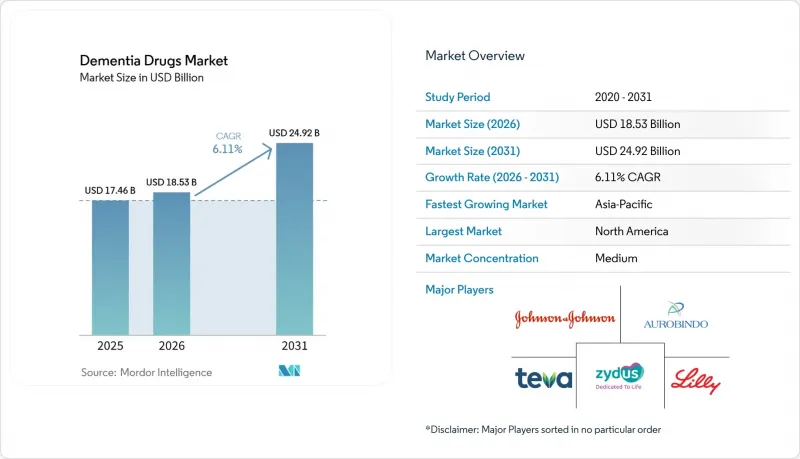
본 보고서는 약물 분류별(콜린에스테라제 억제제, NMDA 수용체 길항제 등), 적응증별(알츠하이머병, 파킨슨병에 따른 치매 등), 투여 경로(경구 투여 등), 유통 채널(병원 약국 등), 지역(북미, 유럽 등)별로 분류되어 있습니다. 시장 예측은 금액(달러) 기준으로 제시되어 있습니다.
세계의 치매 치료제 시장 동향과 인사이트
고령화와 치매 유병률의 급증
급속한 인구 고령화에 따라 65세 이상 인구가 다른 어떤 연령층보다 빠르게 확대되고 있어, 치매 치료제 시장은 성장하고 있습니다. 65세 이후 치매 발병률은 약 5년마다 2배로 증가하며, 세계보건기구(WHO)는 2050년까지 전 세계 환자 수가 3배로 늘어날 것으로 예측했습니다. 일본, 한국, 이탈리아, 독일에서는 단기적으로 유병률이 가장 급격히 증가할 것으로 예상되는 반면, 인도, 브라질, 인도네시아에서는 2020년대 후반에 걸쳐 환자 수의 절대 수가 더욱 급증할 것으로 예측됩니다. 치매를 사회경제적 위협으로 인식하는 각국 정부는 조기 진단, 간병인 지원, 연구 인프라에 더 많은 예산을 배정하고 있습니다. 보험사들도 바이오마커 기반 치료에 대한 보험 적용을 확대하고 있으며, 이에 따라 치료 대상자가 늘어나 처방 건수 증가가 촉진되고 있습니다. 이러한 동향들이 맞물리면서 치매 치료제 시장은 구조적으로 장기적인 성장 궤도에 올라섰습니다.
질환 수정형 항아밀로이드 요법의 승인
2024년 일라이 릴리(Eli Lilly)사의 ‘키선라(Kisunla)’에 대한 FDA 승인 및 2025년 에자이(Eisai)사의 ‘레켐비(Leqembi)’에 대한 유럽 승인은 수십 년에 걸친 좌절을 딛고 아밀로이드 가설을 뒷받침하는 것입니다. 이러한 획기적인 사건들은 질병 수정 요법에 대한 누적된 수요를 실제 매출로 전환시키고, 정맥 주사 투여 센터, PET 진단 역량 및 모니터링 체계의 구축을 촉진할 것입니다. 특정 관할 구역에서의 조건부 승인은 단계적인 가격 책정을 가져오는 한편, 실제 임상 현장에서 인지 기능 유지를 평가하는 가치 기반 계약을 촉진하고 있습니다. '레켄비'의 3년간 데이터가 지속적인 효과를 입증함에 따라 의료진의 신뢰는 더욱 높아지고 있습니다. 이러한 요인들이 결합되어 치매 치료제 시장에 탄력을 불어넣고 있으며, 아밀로이드와 타우를 병용하는 치료법으로의 파이프라인 다각화를 뒷받침하고 있습니다.
높은 임상시험 실패율과 투자 위험
알츠하이머병 치료제 개발의 과거 탈락률은 90%를 초과하여, 종양학 및 순환기 분야의 벤치마크를 상회하고 있습니다. 2024년에 로슈, 세이지, 오츠카 제약이 잇달아 실패한 것은 투자자들의 신중한 태도를 재확인시키는 것이며, 그 결과 투자 문턱이 높아지고 민간 자금 유입이 둔화되고 있습니다. 신경학적 평가 지표, 위약 효과, 그리고 환자 간의 생물학적 이질성은 통계적 검출력 산정을 복잡하게 만들어, 3상 프로그램 1건당 비용을 10억 달러 이상으로 끌어올리고 있습니다. 적응형 임상시험 설계나 디지털 바이오마커가 효율성을 약속하고 있음에도 불구하고, 위험과 수익의 균형을 고려한 판단으로 인해 여전히 자본 유입이 억제되고 있으며, 이는 치매 치료제 시장의 더 빠른 성장을 저해하고 있습니다.
부문 분석
2025년, 콜린에스테라제 억제제는 치매 치료제 시장에서 50.12%라는 압도적인 점유율을 유지하며, 경증에서 중등도의 알츠하이머병에 대한 1차 치료제로서의 입지를 공고히 했습니다. 그럼에도 불구하고, 항아밀로이드 단일클론 항체는 연평균 성장률(CAGR) 6.78%의 전망과 북미, 유럽, 한국에서의 신규 승인을 바탕으로 해당 카테고리에서 가장 빠른 성장세를 기록했습니다. NMDA 수용체 길항제는 중등도에서 중증 단계의 환자를 대상으로 계속되고 있지만, 차별화에는 한계가 있습니다. 항타우 및 키나제 억제제를 중심으로 한 파이프라인은 FDA의 패스트 트랙 지정을 획득하여 상업적 선택의 폭을 넓히고 있습니다. 제조 확장성과 정맥 주입 인프라는 여전히 단일클론 항체 처방의 주요 장벽으로 남아 있지만, 인지 기능 개선 효과가 지속됨을 보여주는 데이터로 인해 신경과 전문의들의 인식이 변화하고 보험 급여 지원도 강화되면서, 치매 치료제 시장에서 항아밀로이드 약물의 침투가 깊어지고 있습니다.
앞으로 경쟁의 향방은 제품 포트폴리오의 폭과 제조의 유연성에 좌우될 것입니다. 존슨앤드존슨의 포스디네맙이 2025년 1월 패스트트랙 지정을 받은 데 따라, 경쟁사들은 아밀로이드와 타우의 작용기전을 결합한 병용 임상시험을 가속화하고 있습니다. 브리스톨-마이어스 스퀴브의 코벤피 적응증 확대는 정신병, 흥분 상태, 인지 기능 등 다양한 영역을 아우르는 다중 적응증 플랫폼으로의 광범위한 움직임을 시사합니다. 이러한 변화 속에서 치매 치료제 시장 내 항아밀로이드 약물 시장 규모는 2030년까지 두 배로 증가할 것으로 예측되지만, 기존 카테고리는 성장 한계에 도달할 전망이며, 기존 기업들은 사업 다각화를 도모하지 않으면 시장 점유율 하락을 초래할 우려가 있습니다.
2025년, 알츠하이머병은 대증 요법 및 질환 수정 요법의 선택지에 힘입어 치매 치료제 시장에서 여전히 60.62%라는 압도적인 점유율을 유지했습니다. 그러나 1차 진료에서 바이오마커 기반 진단이 확대됨에 따라 경도 인지 장애(MCI)가 가장 빠르게 성장하는 틈새 시장으로 부상하고 있으며, 2031년까지 연평균 성장률(CAGR) 6.92%를 나타낼 것으로 전망됩니다. 'Cognivue Clarity' 및 'CognICA'를 통한 선별 검사는 높은 특이도를 바탕으로 MCI(경도 인지 장애)와 정상적인 노화를 구별하여, 보다 조기 치료의 기회를 열어주고 있습니다. 파킨슨병 치매 및 레비소체형 치매는 규모는 작지만 여전히 중요한 치료 영역으로 자리 잡고 있습니다. 3상 임상시험 단계에 있는 암브록솔 및 기타 재포지셔닝된 약물을 통해 2020년대 후반에는 시장 침투율이 향상될 가능성이 있습니다.
조기 개입은 치료 기간, 보험사의 예산, 환자 선정과 관련된 중요한 과제를 제기하고 있습니다. 미국 메디케어의 보험 적용안에서는 항아밀로이드 제제의 정맥 주사가 바이오마커로 확인된 MCI 또는 경도 치매로 제한되어 있어, 진단과 수익 성장 간의 밀접한 연관성이 부각되고 있습니다. 아시아태평양에서는 각국의 보험 적용이 현지 비용 대비 효과 데이터에 좌우되지만, 일본과 한국의 고령화로 인해 치료 대상이 되는 환자의 절대 수는 증가할 전망입니다.
지역별 분석
2025년 치매 치료제 시장에서 북미는 전 세계 매출의 42.63%를 차지했으며, 이는 유리한 보험 환급 제도, 규제 당국의 조기 승인, 그리고 탄탄한 임상 연구 인프라에 힘입은 결과입니다. 아밀로이드 PET 영상 진단에 대한 메디케어의 전국적 적용 결정은 중요한 장벽을 제거하고, 보다 정확한 환자 선정을 가능하게 할 뿐만 아니라, 인지 기능 개선 추세에 대한 보험사의 신뢰를 강화하고 있습니다. 캐나다에서는 신중한 접근 방식을 취하고 있으며 비용 대비 효과를 중시하고 있지만, 각 주에서 시행 중인 시범 프로그램을 통해 바이오마커로 확인된 경도 인지 장애에 대한 접근성이 확대되고 있습니다. 멕시코는 시장 규모는 작지만, 고소득층을 대상으로 미국에서 승인된 생물학적 제제를 수입하는 민간 신경과 네트워크가 부상하고 있어, 새로운 국경을 초월한 틈새 시장의 출현을 시사하고 있습니다.
아시아태평양은 2031년까지 연평균 성장률(CAGR)이 9.30%로 가장 빠르게 성장하고 있는 지역입니다. 아시아태평양의 성장세는 압도적인 인구 규모와 1인당 의료비 지출 증가에 힘입고 있습니다. 일본의 초고령 사회가 단기적인 수요를 견인하고 있으며, 아밀로이드 및 타우 추적자를 공급할 수 있는 강력한 국내 진단약 산업이 이를 뒷받침하고 있습니다. 한국의 단일 지불자 제도에서는 위험 분담형 상환 제도 하에 ‘레켄비’가 신속하게 도입되고 있어, 고가의 질환 수정 요법을 수용할 제도적 준비가 되어 있음을 보여주고 있습니다. 중국은 여전히 불확실한 요소입니다. 방대한 환자층은 타의 추종을 불허하는 성장 잠재력을 지니고 있지만, 규제 변동과 공급망 마찰이 실행상의 위험 요인으로 작용하고 있습니다. 인도와 인도네시아에서는 당초 대증 요법용 제네릭 의약품이 우선시되겠지만, 중산층의 구매력 향상으로 인해 장기적으로는 생물학적 제제에 대한 수요가 증가하여 치매 치료제 시장을 재편할 가능성이 있습니다.
유럽에서는 꾸준하지만 완만한 성장이 예상됩니다. 각국의 의료기술평가(HTA) 기관은 계속해서 정가를 억제하고 있어, 기업들은 비공개 할인이나 조건부 가치 계약을 수용할 수밖에 없는 상황입니다. 독일에서 새로운 진단법의 급속한 보급은 영국과 스페인에서의 치료법 보급 지연을 상쇄하고 있습니다. 프랑스의 국가 치매 계획에는 간병인에 대한 수당이 포함되어 있어, 부수적인 비용을 상쇄함으로써 간접적으로 치료의 보급을 촉진하고 있습니다. 동유럽 시장은 진단 능력과 보험 적용 범위 양면에서 뒤처져 있지만, 노인 돌봄 개선에 할당된 EU 구조 기금을 통해 기초적인 인프라가 구축될 가능성이 있습니다. 전반적으로 유럽의 정책 환경은 치매 치료제 시장 규모 확대에 있어 폭발적인 기여라기보다는 점진적인 기여를 가져올 것으로 보입니다.
기타 혜택 :
- 엑셀 형식 시장 예측(ME) 시트
- 3개월간의 애널리스트 지원
자주 묻는 질문
목차
제1장 서론
제2장 조사 방법
제3장 주요 요약
제4장 시장 구도
제5장 시장 규모 및 성장 예측
제6장 경쟁 구도
제7장 시장 기회 및 향후 전망
KTH 26.08.07According to Mordor Intelligence, the dementia drugs market size was valued at USD 17.46 billion in 2025 and is estimated to grow from USD 18.53 billion in 2026 to reach USD 24.92 billion by 2031, at a CAGR of 6.11% during the forecast period (2026-2031).
This report is Segmented by Drug Class (Cholinesterase Inhibitors, NMDA Receptor Antagonists, and More), Indication (Alzheimer's Disease, Parkinson's Disease Dementia, and More), Route of Administration (Oral, and More), Distribution Channel (Hospital Pharmacies, and More), and Geography (North America, Europe, and More). The Market Forecasts are Provided in Terms of Value (USD).
Global Dementia Drugs Market Trends and Insights
Ageing Population & Dementia Prevalence Surge
Rapid population ageing is swelling the dementia drugs market as the 65-plus cohort expands faster than any other age group. Dementia incidence doubles roughly every five years after 65, and the World Health Organization projects global cases will triple by 2050. Japan, South Korea, Italy, and Germany exhibit the most acute near-term prevalence spikes, whereas India, Brazil, and Indonesia are expected to encounter steeper late-decade surges in absolute patient numbers. Governments that view dementia as a socioeconomic threat are allocating larger budgets to early diagnosis, caregiver support, and research infrastructure. Insurers are increasingly reimbursing biomarker-guided interventions, thereby enlarging the treated pool and reinforcing prescription growth. Collectively, these dynamics anchor a structurally long-run expansion path for the dementia drugs market.
Approvals of Disease-Modifying Anti-Amyloid Therapies
The 2024 FDA nod for Eli Lilly's Kisunla and the 2025 European authorization of Eisai's Leqembi verify the amyloid hypothesis after decades of setbacks. These milestones convert pent-up demand for disease-modifying options into realized sales, catalyzing the development of infusion centers, diagnostic PET capacity, and monitoring pathways. Conditional approvals in certain jurisdictions create tiered pricing but also stimulate value-based contracts that reward real-world cognitive preservation. Three-year Leqembi data demonstrating sustained benefits further strengthen physician confidence. Collectively, these factors inject momentum into the dementia drugs market and spur pipeline diversification into amyloid-plus-tau combination regimens.
High Clinical-Trial Failure Rates & Investment Risk
Historic Alzheimer's attrition exceeds 90%, eclipsing oncology and cardiovascular benchmarks. Failures in 2024 by Roche, Sage, and Otsuka reaffirm investor caution, which in turn elevates hurdle rates and slows private funding. Neurological endpoints, placebo effects, and heterogeneous patient biology complicate statistical powering, pushing costs beyond USD 1 billion per Phase 3 program. While adaptive trial designs and digital biomarkers promise efficiencies, the risk-reward calculus still curtails capital inflows, restraining the dementia drugs market from achieving faster growth.
Other drivers and restraints analyzed in the detailed report include:
- Growing Adoption of Diagnostic Biomarkers & PET Tracers
- Digital Therapeutics & Combination Regimens Emerging
- Stringent HTA / Reimbursement Hurdles
For complete list of drivers and restraints, kindly check the Table Of Contents.
Segment Analysis
Cholinesterase inhibitors maintained a commanding 50.12% share of the dementia drugs market in 2025, affirming their role as front-line management for mild to moderate Alzheimer's disease. Nonetheless, anti-amyloid monoclonal antibodies recorded the category's fastest expansion, supported by a 6.78% CAGR outlook and fresh approvals across North America, Europe, and South Korea. NMDA receptor antagonists continue to address moderate-to-severe stages but face limited differentiation. Pipelines centred on anti-tau and kinase inhibitors have gained FDA Fast Track tags, broadening commercial optionality. Production scalability and infusion infrastructure remain the primary gating factors for monoclonal antibody prescriptions, yet sustained cognitive benefit data are converting neurologists and solidifying reimbursement support, thereby deepening anti-amyloid penetration within the dementia drugs market.
Looking ahead, competitive dynamics hinge on portfolio breadth and manufacturing agility. Johnson & Johnson's posdinemab received Fast Track status in January 2025, prompting rivals to accelerate combination trials pairing amyloid and tau mechanisms. Bristol Myers Squibb's repurposing of Cobenfy signals a broader move toward multi-indication platforms that straddle psychosis, agitation, and cognition. Amid these shifts, the dementia drugs market size for anti-amyloid drugs is forecast to double by 2030, whereas legacy categories plateau, forcing incumbents to diversify or risk share erosion.
Alzheimer's disease retained a formidable 60.62% share of the dementia drugs market in 2025, bolstered by symptomatic and disease-modifying options. Yet mild cognitive impairment has surfaced as the fastest-growing niche, tracking a 6.92% CAGR through 2031 as biomarker-guided diagnosis expands in primary care. Cognivue Clarity and CognICA screenings differentiate MCI from normal ageing with high specificity, opening an earlier therapeutic window. Parkinson's disease dementia and Lewy-body conditions maintain meaningful, though smaller, treatment footprints; Ambroxol and other repositioned agents in Phase 3 could lift penetration by late decade.
Early-stage intervention raises pivotal questions on treatment length, payer budgets, and patient selection. U.S. Medicare's draft coverage restricts anti-amyloid infusion to biomarker-confirmed MCI or mild dementia, underscoring the linkage between diagnostics and revenue growth. In Asia-Pacific, national reimbursement is contingent on local cost-utility files, but ageing populations in Japan and South Korea will swell absolute candidate pools.
Complete Report Scope:
- By Drug Class
- Cholinesterase Inhibitors
- NMDA Receptor Antagonists
- Anti-Amyloid Monoclonal Antibodies
- Multi-target Kinase & Other Emerging Classes
- By Indication
- Alzheimer's Disease
- Parkinson's Disease Dementia
- Lewy-Body & Frontotemporal Dementias
- By Route of Administration
- Oral
- Intravenous
- Transdermal
- By Distribution Channel
- Hospital Pharmacies
- Retail Pharmacies
- Online Pharmacies
- By Geography
- North America
- United States
- Canada
- Mexico
- Europe
- Germany
- United Kingdom
- France
- Italy
- Spain
- Rest of Europe
- Asia-Pacific
- China
- India
- Japan
- South Korea
- Australia
- Rest of Asia-Pacific
- South America
- Brazil
- Argentina
- Rest of South America
- Middle East and Africa
- GCC
- South Africa
- Rest of Middle East and Africa
- North America
Geography Analysis
North America holds 42.63% of global revenue in 2025 in the dementia drugs market, sustained by favorable reimbursement, early regulatory endorsements, and extensive clinical research infrastructure. Medicare's national coverage determination for amyloid PET imaging removes a critical barrier, allowing more accurate patient selection and reinforcing payer confidence in cognitive benefit trajectories. Canada's deliberative approach stresses cost-utility, but provincial pilot programmes are paving access for biomarker-confirmed mild cognitive impairment. Mexico, although smaller, is witnessing the rise of private neurology networks that import U.S.-approved biologics for high-income cohorts, indicating an emergent cross-border niche.
Asia-Pacific is the fastest-growing region at 9.30% CAGR through 2031. Asia-Pacific's momentum is grounded in sheer demographic scale alongside rising per-capita healthcare spend. Japan's super-aged society drives near-term volume, supported by a strong domestic diagnostics industry capable of supplying amyloid and tau tracers. South Korea's single-payer system has quickly integrated Leqembi under risk-sharing reimbursement, demonstrating institutional readiness to embrace expensive disease-modifying therapies. China remains a wildcard: its large patient pool offers unmatched upside, yet evolving regulatory rules and supply-chain frictions introduce execution risks. India and Indonesia will initially prioritise symptomatic generics, but rising middle-class affordability foreshadows long-run biologic demand that could reshape the dementia drugs market.
Europe delivers steady but moderated growth. National HTA bodies continue to constrain list prices, compelling companies to accept confidential discounts or contingent-value agreements. Germany's rapid adoption of new diagnostics balances slower therapeutic uptake in the UK and Spain. France's national dementia plan incorporates caregiver stipends, indirectly easing treatment adoption by offsetting ancillary costs. Eastern European markets trail in both diagnostic capacity and reimbursement scope, yet EU structural funds earmarked for geriatric care upgrades may lift baseline infrastructure. Overall, Europe's policy environment favours gradual rather than explosive contributions to the dementia drugs market size.
- Biogen
- Eisai
- Eli Lilly and Company
- Novartis
- Pfizer
- Johnson & Johnson
- Roche
- Otsuka
- Lundbeck A/S
- Merck
- Abbvie
- Amgen
- AC Immune SA
- Cassava Sciences, Inc.
- Cognition Therapeutics
- BioArctic AB
- Sun Pharma Advanced Research Company
Additional Benefits:
- The market estimate (ME) sheet in Excel format
- 3 months of analyst support
TABLE OF CONTENTS
1 Introduction
2 Research Methodology
3 Executive Summary
4 Market Landscape
- 4.1 Market Overview
- 4.2 Market Drivers
- 4.2.1 Ageing population & dementia prevalence surge
- 4.2.2 Approvals of disease-modifying anti-amyloid therapies
- 4.2.3 Growing adoption of diagnostic biomarkers & PET tracers
- 4.2.4 Digital therapeutics & combination regimens emerging
- 4.2.5 Government dementia plans & funding momentum
- 4.2.6 AI-enabled drug-discovery platforms shorten R&D cycles
- 4.3 Market Restraints
- 4.3.1 High clinical-trial failure rates & investment risk
- 4.3.2 Stringent HTA / reimbursement hurdles
- 4.3.3 Limited patient adherence owing to adverse events
- 4.3.4 Supply-chain dependence on complex biologic manufacturing
- 4.4 Value / Supply-Chain Analysis
- 4.5 Regulatory Landscape
- 4.6 Technological Outlook
- 4.7 Porter's Five Forces
- 4.7.1 Threat of New Entrants
- 4.7.2 Bargaining Power of Suppliers
- 4.7.3 Bargaining Power of Buyers
- 4.7.4 Threat of Substitutes
- 4.7.5 Competitive Rivalry
5 Market Size & Growth Forecasts (Value)
- 5.1 By Drug Class
- 5.1.1 Cholinesterase Inhibitors
- 5.1.2 NMDA Receptor Antagonists
- 5.1.3 Anti-Amyloid Monoclonal Antibodies
- 5.1.4 Multi-target Kinase & Other Emerging Classes
- 5.2 By Indication
- 5.2.1 Alzheimer's Disease
- 5.2.2 Parkinson's Disease Dementia
- 5.2.3 Lewy-Body & Frontotemporal Dementias
- 5.3 By Route of Administration
- 5.3.1 Oral
- 5.3.2 Intravenous
- 5.3.3 Transdermal
- 5.4 By Distribution Channel
- 5.4.1 Hospital Pharmacies
- 5.4.2 Retail Pharmacies
- 5.4.3 Online Pharmacies
- 5.5 By Geography
- 5.5.1 North America
- 5.5.1.1 United States
- 5.5.1.2 Canada
- 5.5.1.3 Mexico
- 5.5.2 Europe
- 5.5.2.1 Germany
- 5.5.2.2 United Kingdom
- 5.5.2.3 France
- 5.5.2.4 Italy
- 5.5.2.5 Spain
- 5.5.2.6 Rest of Europe
- 5.5.3 Asia-Pacific
- 5.5.3.1 China
- 5.5.3.2 India
- 5.5.3.3 Japan
- 5.5.3.4 South Korea
- 5.5.3.5 Australia
- 5.5.3.6 Rest of Asia-Pacific
- 5.5.4 South America
- 5.5.4.1 Brazil
- 5.5.4.2 Argentina
- 5.5.4.3 Rest of South America
- 5.5.5 Middle East and Africa
- 5.5.5.1 GCC
- 5.5.5.2 South Africa
- 5.5.5.3 Rest of Middle East and Africa
- 5.5.1 North America
6 Competitive Landscape
- 6.1 Market Concentration
- 6.2 Market Share Analysis
- 6.3 Company Profiles (includes Global level Overview, Market level overview, Core Segments, Financials as available, Strategic Information, Market Rank/Share for key companies, Products & Services, and Recent Developments)
- 6.3.1 Biogen Inc.
- 6.3.2 Eisai Co., Ltd.
- 6.3.3 Eli Lilly and Company
- 6.3.4 Novartis AG
- 6.3.5 Pfizer Inc.
- 6.3.6 Johnson & Johnson
- 6.3.7 F. Hoffmann-La Roche AG
- 6.3.8 Otsuka Pharmaceutical Co., Ltd.
- 6.3.9 Lundbeck A/S
- 6.3.10 Merck & Co., Inc.
- 6.3.11 AbbVie Inc.
- 6.3.12 Amgen Inc.
- 6.3.13 AC Immune SA
- 6.3.14 Cassava Sciences, Inc.
- 6.3.15 Cognition Therapeutics
- 6.3.16 BioArctic AB
- 6.3.17 Sun Pharma Advanced Research Company
7 Market Opportunities & Future Outlook
- 7.1 White-space & Unmet-Need Assessment


