

|
시장보고서
상품코드
2100647
아시아태평양의 항공기 엔진 MRO 시장 : 점유율 분석, 업계 동향 및 통계, 성장 예측(2026-2031년)Asia-Pacific Aircraft Engine MRO - Market Share Analysis, Industry Trends & Statistics, Growth Forecasts (2026 - 2031) |
||||||
 Mordor Intelligence
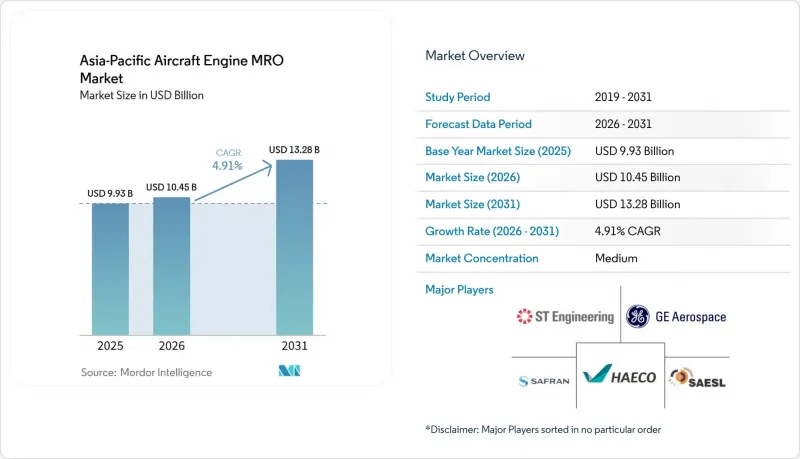
Mordor Intelligence에 의하면, 아시아태평양 항공기 엔진 MRO 시장 규모는 2025년 99억 3,000만 달러에서 2026년에는 104억 5,000만 달러로 확대되어 2026년부터 2031년까지 CAGR 14.91%로 성장을 지속하여, 2031년에는 132억 8,000만 달러에 이를 것으로 예측됩니다.
본 보고서는 엔진 유형(터빈 엔진 및 피스톤 엔진), 항공 분야(민간 항공, 군용 항공, 일반 항공 등), 서비스 제공업체(항공사 내 MRO, 독립 제3자 MRO, OEM 제휴 MRO), 지역(중국, 인도, 일본, 싱가포르, 인도네시아, 한국, 호주 등)별로 분류되어 있습니다. 시장 전망은 금액(달러)으로 제시되어 있습니다.
아시아태평양 항공기 엔진 MRO 시장 동향과 인사이트
기체 확대 및 신형 항공기 인도
아시아태평양의 항공사들은 전례 없는 수의 신형 협폭체 제트기를 지속적으로 인도받고 있으며, 각 인도는 향후 정비 수요를 창출하고 있습니다. 2025년 1월부터 9월 사이에 에어버스와 보잉은 지역 항공사들의 기단에 229대의 A320neo 및 B737 MAX를 인도했으며, 동일한 수의 LEAP 엔진을 추가했습니다. 이 엔진들은 2032년경 첫 성능 회복 정비를 맞이할 시기가 다가오고 있습니다. 리스 회사가 공급 파이프라인을 유지하고 있습니다. BOC 항공만 해도 500대 이상의 수주를 확보하고 있으며, 그중 10대 중 6대가 중국이나 인도로 향하고 있기 때문에 향후 정비 수요는 사실상 이들 지역에 집중될 것입니다. 비엣젯(Vietjet)이나 아카사(Akas)와 같은 저비용 항공사들은 이미 ‘시간당 요금(PBO)’ 방식의 장기 계약을 통해 이익률을 확보하고 있어, 독립 계열 정비 업체들은 밀려나고 있습니다.
중기 정비가 필요한 노후화된 협폭기 기단
아시아태평양의 방대한 CFM56 엔진 기단은 비용이 높아지는 수명 주기의 중반에 접어들고 있습니다. 이 지역에서 운용 중인 4,200기의 엔진 중 약 1,800기는 15년 이상 가동되어 왔으며, 2차 또는 3차 정비 입고를 앞두고 있습니다. 1회당 비용은 300만 달러에 달할 가능성이 있습니다. 중국남방항공이나 중국국제항공 등 중국의 주요 항공사들은 이러한 비용을 미루기 위해 온윙 점검 간격을 500비행시간 연장했습니다. 그러나 이 전략은 예정에 없던 엔진 탈거 위험을 높이고, 이용 가능한 도크 슬롯 수를 감소시킵니다. 광저우와 자카르타의 독립 정비 업체들은 이러한 긴박한 상황을 활용하여, 아시아 전역으로 확대되는 디지털 마켓플레이스를 통해 구매한 인증 중고 부품을 통합함으로써 납기일을 2주 단축하고 청구 금액을 할인해 주겠다고 약속하고 있습니다.
숙련 기술자 부족과 임금 상승
정비 수요가 가속화되는 바로 그 시점에, 이 지역의 인력 공급원은 고갈되고 있습니다. IATA의 예측에 따르면, 아시아태평양에서는 2037년까지 180만 명의 새로운 항공 전문가가 필요할 것으로 보이지만, 현재 양성 인원은 그 필요량의 3분의 2에도 미치지 못하는 상황입니다. 싱가포르의 터빈 전문 기술자 연봉은 2025년에 8만 5,000싱가포르달러(6만 6,045미국달러)에 달하고, 전년 대비 12% 급증했습니다. 이로 인해 독립 정비 공장의 이익률은 압박을 받았으나, 인재 유출을 막지는 못했습니다. 인도에서는 2024년에 인증받은 정비 엔지니어가 고작 1,200명에 그쳐 예상 수요의 3분의 1에 불과했기 때문에 항공사들은 40%의 임금 프리미엄을 지급하며 외국인 정비사를 영입할 수밖에 없었습니다. 호주의 광업 붐은 더 높은 급여와 안정적인 근무 일정을 제시하며 기술자들을 빼앗아가고 있어, 산업 간 경쟁이 인력 부족을 얼마나 심각하게 만들고 있는지를 여실히 보여주고 있습니다.
부문 분석
2025년, 터빈 엔진은 아시아태평양 항공기 엔진 MRO 시장 점유율의 71.41%를 차지하고 있으며, 해당 지역을 비행하는 6,800기의 CFM56, LEAP 및 PW1000G 엔진에 힘입어 2031년까지 연평균 성장률(CAGR) 5.37%를 달성할 것으로 예측됩니다. 이 부문에서 아시아태평양의 항공기 엔진 MRO 시장 규모는 확대될 것으로 예상되며, 2026년에는 320기, 2027년에는 580기의 LEAP 엔진이 첫 번째 해체를 앞두고 있어, OEM 산하의 정비 역량이 이를 따라잡을 수 있을지가 시험대에 오르게 될 것입니다. 휴대용 툴링 라이선스를 확보하고 고압 터빈 개조 기술을 개발한 독립형 공급업체는 잉여 수요를 흡수할 수 있을 것입니다.
와이드바디 기종의 엔진은 정비 횟수는 적지만 비용이 고액인 임베디드니다. 그러나 780대에 달하는 도입 대수에서 연간 110회의 탈거가 발생할 것으로 예상되며, 이러한 규모 수요에는 싱가포르나 홍콩의 확립된 거점이 가장 효율적으로 대응하고 있습니다. 터보프롭 및 터보샤프트 엔진은 아시아태평양 항공기 엔진 MRO 시장의 총량 중 20%를 차지하고 있습니다. 이 분야는 여전히 서비스가 충분히 제공되지 않고 있어, 지역 항공기 및 헬리콥터 기단이 밀집해 있는 하이데라바드나 수라바야에서 신규 진입의 호기가 되고 있습니다. 훈련용 기단이 하이브리드 및 전기 추진 방식으로 전환되는 가운데, 피스톤 엔진의 점유율은 소폭에 그치고 있습니다.
기타 혜택:
- 엑셀 형식 시장 예측(ME) 시트
- 3개월간의 애널리스트 지원
자주 묻는 질문
목차
제1장 서론
제2장 조사 방법
제3장 주요 요약
제4장 시장 구도
제5장 시장 규모와 성장 예측
제6장 경쟁 구도
제7장 시장 기회와 향후 전망
JHS 26.08.11According to Mordor Intelligence, the Asia-Pacific aircraft MRO market size is expected to grow from USD 9.93 billion in 2025 to USD 10.45 billion in 2026 and is forecast to reach USD 13.28 billion by 2031 at a 14.91% CAGR over 2026-2031.
This report is Segmented by Engine Type (Turbine Engine and Piston Engine), Aviation (Commercial Aviation, Military Aviation, General Aviation, and More), Maintenance Provider Type (Airline In-House MRO, Independent Third-Party MRO, and OEM-Affiliated MRO), and Geography (China, India, Japan, Singapore, Indonesia, South Korea, Australia, and More). Market Forecasts are Provided in Value (USD).
Asia-Pacific Aircraft Engine MRO Market Trends and Insights
Fleet Expansion And New Aircraft Deliveries
Asia-Pacific carriers continue to receive unprecedented numbers of new narrowbody jets, and each delivery sets off a future maintenance event. Between January and September 2025, Airbus and Boeing placed 229 A320neo and B737 MAX aircraft in regional fleets, adding the same number of LEAP powerplants that will age into their first performance-restoration visit around 2032. Lessors sustain the pipeline: BOC Aviation alone holds orders exceeding 500 aircraft, with six out of every ten units earmarked for China or India, effectively clustering future shop demand in these regions. Low-cost airlines such as Vietjet and Akasa already protect margins through long-term power-by-the-hour contracts, sidelining independent overhaulers.
Aging Narrow-Body Fleet Requiring Mid-Life Shop Visits
Asia-Pacific's vast CFM56 fleet is entering the high-cost middle of its life cycle. Of the region's 4,200 engines in service, roughly 1,800 have been in operation for more than 15 years and are approaching their second or third shop visits, which can cost USD 3 million each. Chinese majors, such as China Southern and Air China, have increased on-wing intervals by 500 flight hours to defer these expenses. Still, this strategy increases the risk of unscheduled removal and reduces the number of available dock slots. Independent shops in Guangzhou and Jakarta exploit the squeeze, promising two-week faster turnarounds and discounting invoices by integrating certified used parts purchased through expanding digital marketplaces across Asia.
Skilled-Technician Shortage And Wage Inflation
The region's talent pipeline is drying up just as demand for shop visits accelerates. IATA forecasts that the Asia-Pacific region will need 1.8 million new aviation professionals by 2037, yet the current training output covers barely two-thirds of that requirement. Singapore's turbine specialists earned SGD 85,000 (USD 66,045) in 2025, a 12% annual jump that squeezed independent shops' margins while failing to curb attrition. India certified only 1,200 maintenance engineers in 2024, one-third of the forecasted demand, prompting airlines to import expatriate mechanics at a 40% wage premium. Australia's mining boom siphons off technicians with higher pay and more predictable schedules, underscoring how cross-sector competition severely compounds the labor crunch.
Other drivers and restraints analyzed in the detailed report include:
- OEM And Joint-Venture Capacity Investments Across APAC Hubs
- Early-Life Reliability Issues In LEAP And GTF Engines
- Supply-Chain Bottlenecks For Critical Engine Parts
For complete list of drivers and restraints, kindly check the Table Of Contents.
Segment Analysis
Turbine engines held 71.41% of the Asia-Pacific aircraft engine MRO market share in 2025 and are forecasted to achieve a 5.37% CAGR through 2031, sustained by 6,800 CFM56, LEAP, and PW1000G units flying across the region. The Asia-Pacific aircraft engine MRO market size for this segment is expected to grow, with 320 LEAP engines scheduled for their first removals in 2026 and 580 in 2027, testing whether OEM-affiliated capacity can keep pace. Independent providers that secure portable tooling licenses and develop high-pressure turbine refurbishment skills stand to capture overflow demand.
Although widebody powerplants require fewer but more costly events, the installed base of 780 aircraft translates into 110 annual removals, volumes that are most efficiently handled by established hubs in Singapore and Hong Kong. Turboprop and turboshaft engines collectively account for 20% of the Asia-Pacific aircraft engine MRO market. They remain underserved, presenting green-field opportunities in Hyderabad and Surabaya, where regional and helicopter fleets are dense. Piston engines retain a modest share as training fleets migrate toward hybrid and electric propulsion.
Complete Report Scope:
- By Engine Type
- Turbine Engine
- Turbofan Engine
- Turboprop Engine
- Turboshaft Engine
- Turbojet Engine
- Piston Engine
- Turbine Engine
- By Aviation
- Commercial Aviation
- Narrowbody
- Widebody
- Regional Jets
- Military Aviation
- Combat
- Transport
- Special Mission
- Helicopters
- General Aviation
- Business Jets
- Commercial Helicopters
- Unmanned Aerial Vehicles (UAVs)
- Commercial Aviation
- By Service Providers
- Airline In-house MRO
- Independent Third-Party MRO
- OEM-Affiliated MRO
- By Geography
- China
- India
- Japan
- Singapore
- Indonesia
- South Korea
- Australia
- Rest of Asia-Pacific
List of Companies Covered in this Report:
- Singapore Aero Engine Services Private Limited
- Singapore Technologies Engineering Ltd.
- SIA Engineering Company Limited
- Safran SA
- Hong Kong Aircraft Engineering Company Limited
- GE Aerospace (General Electric Company)
- Rolls-Royce Holdings plc
- Asia Pacific Aerospace Pty Ltd.
- Mitsubishi Heavy Industries, Ltd.
- PT GMF AeroAsia Tbk
- Aircraft Maintenance & Engineering Corporation
- MTU Maintenance Zhuhai Co. Ltd.
- Aerfin Limited
- Aero Engine Corporation of China
- IHI Corporation
- Sojitz Aerospace Corporation
- ATS Turbine Service Sdn Bhd
Additional Benefits:
- The market estimate (ME) sheet in Excel format
- 3 months of analyst support
TABLE OF CONTENTS
1 INTRODUCTION
- 1.1 Study Assumptions and Market Definition
- 1.2 Scope of the Study
2 RESEARCH METHODOLOGY
3 EXECUTIVE SUMMARY
4 MARKET LANDSCAPE
- 4.1 Market Overview
- 4.2 Market Drivers
- 4.2.1 Fleet expansion and new aircraft deliveries
- 4.2.2 Aging narrowbody fleet needing mid-life shop visits
- 4.2.3 OEM/JV capacity investments across APAC hubs
- 4.2.4 Early-life reliability issues in LEAP and GTF engines increasing maintenance visits
- 4.2.5 Government incentives for indigenous MRO and supply chains
- 4.2.6 Growing used-serviceable-material (USM) trading networks
- 4.3 Market Restraints
- 4.3.1 Skilled-technician shortage and wage inflation
- 4.3.2 Supply-chain bottlenecks for critical engine parts
- 4.3.3 Capacity clustering causing ferry-cost penalties
- 4.3.4 OEM control over engine-health data limits independents
- 4.4 Value Chain Analysis
- 4.5 Regulatory Landscape
- 4.6 Technological Outlook
- 4.7 Porter's Five Forces Analysis
- 4.7.1 Bargaining Power of Suppliers
- 4.7.2 Bargaining Power of Consumers
- 4.7.3 Threat of New Entrants
- 4.7.4 Threat of Substitute Products
- 4.7.5 Intensity of Competitive Rivalry
5 MARKET SIZE AND GROWTH FORECASTS (VALUE)
- 5.1 By Engine Type
- 5.1.1 Turbine Engine
- 5.1.1.1 Turbofan Engine
- 5.1.1.2 Turboprop Engine
- 5.1.1.3 Turboshaft Engine
- 5.1.1.4 Turbojet Engine
- 5.1.2 Piston Engine
- 5.1.1 Turbine Engine
- 5.2 By Aviation
- 5.2.1 Commercial Aviation
- 5.2.1.1 Narrowbody
- 5.2.1.2 Widebody
- 5.2.1.3 Regional Jets
- 5.2.2 Military Aviation
- 5.2.2.1 Combat
- 5.2.2.2 Transport
- 5.2.2.3 Special Mission
- 5.2.2.4 Helicopters
- 5.2.3 General Aviation
- 5.2.3.1 Business Jets
- 5.2.3.2 Commercial Helicopters
- 5.2.4 Unmanned Aerial Vehicles (UAVs)
- 5.2.1 Commercial Aviation
- 5.3 By Service Providers
- 5.3.1 Airline In-house MRO
- 5.3.2 Independent Third-Party MRO
- 5.3.3 OEM-Affiliated MRO
- 5.4 By Geography
- 5.4.1 China
- 5.4.2 India
- 5.4.3 Japan
- 5.4.4 Singapore
- 5.4.5 Indonesia
- 5.4.6 South Korea
- 5.4.7 Australia
- 5.4.8 Rest of Asia-Pacific
6 COMPETITIVE LANDSCAPE
- 6.1 Market Concentration
- 6.2 Strategic Moves
- 6.3 Market Share Analysis
- 6.4 Company Profiles (includes Global level Overview, Market level overview, Core Segments, Financials as available, Strategic Information, Market Rank/Share for key companies, Products and Services, and Recent Developments)
- 6.4.1 Singapore Aero Engine Services Private Limited
- 6.4.2 Singapore Technologies Engineering Ltd.
- 6.4.3 SIA Engineering Company Limited
- 6.4.4 Safran SA
- 6.4.5 Hong Kong Aircraft Engineering Company Limited
- 6.4.6 GE Aerospace (General Electric Company)
- 6.4.7 Rolls-Royce Holdings plc
- 6.4.8 Asia Pacific Aerospace Pty Ltd.
- 6.4.9 Mitsubishi Heavy Industries, Ltd.
- 6.4.10 PT GMF AeroAsia Tbk
- 6.4.11 Aircraft Maintenance & Engineering Corporation
- 6.4.12 MTU Maintenance Zhuhai Co. Ltd.
- 6.4.13 Aerfin Limited
- 6.4.14 Aero Engine Corporation of China
- 6.4.15 IHI Corporation
- 6.4.16 Sojitz Aerospace Corporation
- 6.4.17 ATS Turbine Service Sdn Bhd
7 MARKET OPPORTUNITIES AND FUTURE OUTLOOK
- 7.1 White-space and Unmet-Need Assessment


