

|
시장보고서
상품코드
2100652
사륜차 및 삼륜차 시장 : 점유율 분석, 업계 동향 및 통계, 성장 예측(2026-2031년)Quadricycles and Tricycles - Market Share Analysis, Industry Trends & Statistics, Growth Forecasts (2026 - 2031) |
||||||
 Mordor Intelligence
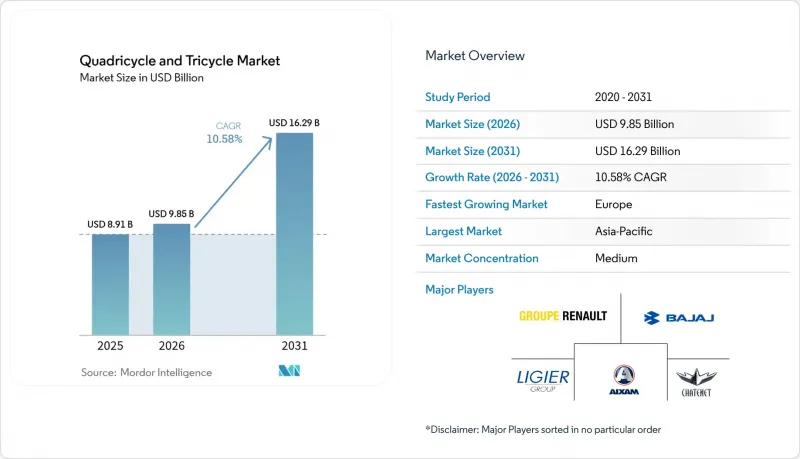
Mordor Intelligence에 의하면, 사륜차 및 삼륜차 시장 규모는 2025년에 89억 1,000만 달러로 평가되었고 2026년 98억 5,000만 달러에서 2031년까지 162억 9,000만 달러에 이를 것으로 예측되며, 예측 기간(2026-2031년) CAGR은 10.58%를 나타낼 전망입니다.
본 보고서는 차량 유형(사륜차 및 삼륜차), 용도 유형(개인용 및 상업용), 파워트레인 유형(내연기관 및 전기), 설계·구성(승용 및 화물용), 그리고 지역별로 분류되어 있습니다. 시장 전망은 금액(달러) 및 수량(대수)으로 제시되어 있습니다.
전 세계 사륜차 및 삼륜차 시장 동향과 인사이트
E-3W/마이크로 EV에 대한 정부의 보조금 및 우대 조치
인센티브 정책으로 인해 전기차와 가솔린차의 가격 차이는 점점 더 좁혀지고 있습니다. 인도의 ‘생산 연계형 인센티브(PLI)’ 제도에서는 현지 부품 생산을 촉진하고 단위 비용을 절감하기 위해 막대한 자금이 배정되어 있습니다. 태국의 ‘EV 3.5’ 정책에 따라, 전기 삼륜차를 조립하는 기업은 상당한 법인세 감면 혜택을 받을 자격이 있습니다. 한편, 몰타에서는 사륜차 구매에 대해 주목할 만한 재정적 보조금을 통한 인센티브를 제공합니다. 중국은 이러한 노력을 강조하는 차원에서 소형 차량에 대한 구매세 면제 조치를 몇 년간 더 연장했습니다. 이러한 조치들은 배터리 비용의 하락과 맞물려 전기차 판매 확대를 목표로 하고 있습니다. 이러한 예측 가능한 인센티브를 배경으로, 각 제조업체는 설비 투자 위험을 줄이고 공장 가동률을 높이는 수단으로서 생산 능력 계획 확충을 추진하고 있습니다.
전자상거래 분야의 라스트 마일 배송 수요 증가
도시 지역의 배송 비용은 운송비의 5분의 3에 가까운 비중을 차지하기 때문에 차량 관리자들은 주차 시간이나 정체 요금을 절감할 수 있는 차량을 찾고 있습니다. 아마존은 유럽의 몇몇 수도에서 전기 화물 삼륜차를 시범 운영하고 있으며, 플립카트는 인도 도시 거점에 배터리 교환 기능이 탑재된 삼륜차를 도입하고 있습니다. Gogoro와 Sun Mobility가 제공하는 'Battery-as-a-Service(BaaS)' 모델은 자산의 가동률을 높게 유지하여, 사업자가 주행 거리 걱정을 하지 않고 더 긴 근무 시간을 운영할 수 있도록 합니다. 저배출 구역 규제가 강화되는 것과 더불어 이러한 경제적 요인들로 인해 노선 계획은 소형 전기차 쪽으로 기울고 있습니다. 따라서 소포 운송량 증가는 섀시 수주로 직접 이어지며, 부품 제조업체에게는 선순환이 지속될 것입니다.
급속 충전/배터리 교환 인프라 부족
대부분의 신흥 시장에서 충전소 밀도는 국제에너지기구(IEA)가 제시한 ‘차량 10대당 충전기 1대’라는 지침을 여전히 밑돌고 있습니다. 민간 투자자들은 이용률이 불투명할 경우 투자를 주저하고 있으며, 공공 부문 계획 담당자들은 특히 지방에서 예산 제약에 직면해 있습니다. 전력망의 안정성이 확보되지 않은 지역에서는 사업자들이 상용 차량의 가동 시간을 보장하는 데 어려움을 겪고 있습니다. 일부 정부는 충전기에 대한 보조금을 지급하고 있지만, 도입 속도는 여전히 수요를 따라가지 못하고 있어 전기차 판매를 둔화시키고 있습니다. 안정적인 에너지 공급을 기대하기 어려운 상황에서는 차량 관리자들이 계속해서 내연기관 차량을 구매하게 될 것이며, 그 결과 완전 전기화로의 전환 시점이 미뤄질 가능성이 있습니다.
부문 분석
2025년, 삼륜차는 사륜차 및 삼륜차 시장 점유율의 87.05%라는 압도적인 비중을 차지했으며, 인도, 태국, 인도네시아에 뿌리내린 제조 클러스터에 힘입었습니다. 삼륜차 시장 규모는 꾸준히 확대될 것으로 예상되지만, 그 속도는 사륜차보다 완만할 전망입니다. 사륜차는 절대 수량 면에서는 삼륜차보다 적지만, 유럽이나 북아프리카에서는 안전성 및 기상 조건으로부터의 보호를 이유로 밀폐형 캐빈이 정책적으로 우대받고 있어, 2031년까지 연평균 성장률(CAGR) 10.62%를 나타낼 것으로 예측됩니다. 바자지 오토는 이집트의 차량 교체 프로그램을 위해 ‘Qute’의 생산을 확대하고 있으며, 피아지오는 유럽의 밀집된 도심 지역을 위해 ‘Porter’를 기반으로 한 마이크로 EV 플랫폼의 개량을 진행하고 있습니다. 따라서 지역별 보급 양상은 비용 우선순위, 기후 조건, 그리고 차량 등급을 서로 다른 기준으로 분류하는 규제의 복잡한 조합을 반영하고 있습니다.
삼륜차 플랫폼은 그 존재 가치를 유지하기 위해 배터리 교체 기능과 텔레매틱스를 통합하며 진화를 거듭하고 있습니다. 사륜차 설계에서는 배터리의 무게를 상쇄하기 위해 지붕에 장착된 태양광 발전 시스템과 경량 복합 소재가 채택되고 있습니다. 이에 따라 각 OEM 업체들은 단일 플랫폼을 지역에 관계없이 일률적으로 적용하는 대신, 개별 사용자의 요구 사항에 맞추어 연구개발 파이프라인을 조정하고 있습니다. 경쟁 우위는 부품을 공유하면서도 지역별 규제 요건에 따른 변경을 가능하게 하는 모듈식 아키텍처에 의존하고 있으며, 이를 통해 유연성과 적응성이 확보되고 있습니다. 첨단 운전자 경고 기능 및 기본적인 커넥티비티 기능의 통합 또한, ‘사고 제로’라는 안전 목표를 내세우는 도시에서 사륜 모델이 규제 당국의 승인을 얻는 데 기여하고 있습니다. 자금원이 제로 배출 목표에 맞추어 정비됨에 따라 사륜차 및 삼륜차 시장은 다양화되고 있으며, 두 형태는 완전히 통합되기보다는 공존하는 형태를 띠고 있습니다.
2025년에는 사륜차 및 삼륜차 시장 규모의 73.10%를 상업용 운영이 차지하며, 소포 배송 네트워크의 커버리지 확대에 따라 이 비중은 더욱 증가할 것으로 예측됩니다. 상업적 이용은 예측 가능한 운행 경로의 밀도와 저배출 구역에서의 요금 면제에 힘입어 2031년까지 연평균 성장률(CAGR) 10.7%를 나타낼 것으로 전망됩니다. 남아시아 전역에서는 카셰어링 및 비공식 택시 서비스에서 여전히 승용형 차량이 주류를 이루고 있지만, 새로운 지하철 노선과 버스 고속 수송 시스템(BRT) 회랑의 도입으로 그 성장 속도는 둔화되고 있습니다. 주요 전자상거래 플랫폼은 전용 조립 라인을 뒷받침할 판매 물량 보장을 제공함으로써, 공급업체가 다년간의 계약을 확보할 수 있도록 하고 있습니다.
차량 소유주들은 밀폐형 운전실과 공조 시스템을 도입하여 운전자의 이직률을 낮추고 있으며, 이를 통해 쾌적성을 높이는 동시에 킬로미터당 비용을 낮게 유지하고 있습니다. 도시 계획 담당자들은 주거지 근처에 마이크로 물류 허브를 지정하고 있으며, 이로 인해 이동 거리가 단축되어 소형 적재 공간이 적합하다는 점이 강조되고 있습니다. 소프트웨어 제공업체는 현재 삼륜차 전용 경로 계획 기능을 통합하고 있으며, 이를 통해 교통 정체 피크 시간대의 연료 및 배터리 소비를 줄이고 있습니다. 승용차는 규제가 허용하는 한도 내에서 관광 셔틀이나 캠퍼스 내 운송 수단으로 전환되고 있습니다. 따라서 예측 기간 동안 사륜 및 삼륜차 시장은 일반 인적 이동에서 수익성이 높고 자산 회전율을 높일 수 있는 전문 화물 운송 생태계로 전환될 것입니다.
지역별 분석
2025년, 아시아태평양은 사륜차 및 삼륜차 시장의 41.05%를 차지했습니다. 이는 인도의 방대한 삼륜차 제조 거점과 리튬 철 인산염 배터리 분야에서 중국의 규모의 경제가 뒷받침하고 있습니다. 인도의 대규모 PLI(생산 연계형 인센티브) 이니셔티브는 공급망을 재구축하고, 배터리 셀 제조업체와 부품 공급업체 모두를 유치하고 있습니다. 한편, 중국은 저출력 차량에 대한 구매세 면제 조치를 확대하여 마이크로 EV의 비용 경쟁력을 확보하고 있습니다. 태국의 전기차 프로그램은 태국을 지역 수출 허브로 자리매김하고, 인도네시아 및 필리핀공급 거점과 원활하게 연계하고 있습니다. 이러한 전략적 연계는 국경을 초월한 경제 활동을 통해 리드 타임이 단축되고 재고 주기가 효율화되므로, 사륜 및 삼륜차 시장에 유익합니다.
유럽은 현재 출하 대수 기준으로는 규모가 작지만, 지자체가 정체 요금 도입 및 주차 공간 축소를 법제화하고 있어 2031년까지 연평균 성장률(CAGR) 10.65%를 나타낼 것으로 예측됩니다. 이러한 성장은 지자체가 정체 요금 도입 및 주차 공간 축소를 시행하고 있기 때문입니다. 런던의 ‘초저배출구역(ULEZ)’에서는 기준을 충족하는 사륜차에 대해 면제 조치가 마련되어 있으며, 파리에서는 노상 주차 공간을 축소하여 주민들이 소형 차량을 선택하도록 장려하고 있습니다. 몰타의 승용차 우대 조치는 규정 168/2013의 표준화된 규정과 맞물려 형식 인증 절차를 효율화하고 있습니다. 이러한 명확성을 바탕으로 각 제조업체는 EU 전역에서의 출시를 계획하고, 연구개발(R&D) 비용을 여러 시장에 분산시켜 승용차 및 삼륜차 시장에서 해당 지역의 점유율을 확대되고 있습니다.
북미에서는 캘리포니아주의 ‘첨단 청정 차량 규정(Advanced Clean Fleets Rule)’과 같은 주 차원의 규제를 활용하면서, 신중하면서도 속도를 높이고 있습니다. 중동 및 아프리카에서는 이집트의 사륜 택시에 대한 공식 인증이 성장의 원동력이 되고 있으며, 이를 통해 인도 공급업체들에게 수출 경로가 열리고 있습니다. 남미에서는 거시경제 문제나 인프라 미비 등의 과제에 직면해 있습니다. 그러나 브라질 상파울루주가 제로 배출 구역을 도입하고, 아르헨티나가 마이크로 EV 시범 운행을 진행하고 있는 만큼, 신용 상황이 안정되면 성장 가능성이 있습니다. 지역별로 규제 도입 시기가 다르기 때문에 향후 10년 동안 주도적인 역할이 역동적으로 변화하고, 유연한 공급망이 확보될 것으로 예측됩니다.
기타 혜택:
- 엑셀 형식 시장 예측(ME) 시트
- 3개월간의 애널리스트 지원
자주 묻는 질문
목차
제1장 서론
제2장 조사 방법
제3장 주요 요약
제4장 시장 구도
제5장 시장 규모와 성장 예측
제6장 경쟁 구도
제7장 시장 기회와 향후 전망
JHS 26.08.11According to Mordor Intelligence, the quadricycles and Tricycles Market size was valued at USD 8.91 billion in 2025 and estimated to grow from USD 9.85 billion in 2026 to reach USD 16.29 billion by 2031, at a CAGR of 10.58% during the forecast period (2026-2031).
This report is Segmented by Vehicle Type (Quadricycle and Tricycle), Application Type (Personal and Commercial), Powertrain Type (Internal Combustion Engine and Electric), Design & Configuration (Passenger and Cargo), and Geography. The Market Forecasts are Provided in Terms of Value (USD) and Volume (Units).
Global Quadricycles and Tricycles Market Trends and Insights
Government Subsidies & Incentives For E-3W / Micro-EVs
Incentive packages are increasingly bridging the price gap between electric and gasoline vehicles. India's Production Linked Incentive scheme is allocating significant funding to boost local component production and reduce unit costs. Under Thailand's EV 3.5 policy, firms assembling electric tricycles are eligible for substantial corporate tax relief. Meanwhile, Malta is incentivizing quadricycle purchases with notable financial grants. In a move underscoring its commitment, China has extended purchase-tax exemptions for smaller vehicles for several more years. These initiatives, coinciding with falling battery costs, aim to boost electric car sales. With these predictable incentives, manufacturers are ramping up capacity planning, seeing it as a way to mitigate risks in capital spending and enhance plant utilization.
Rising E-Commerce Last-Mile Delivery Demand
Urban fulfillment costs account for almost three-fifths of shipping expenses, so fleet managers seek vehicles that reduce parking time and congestion fees. Amazon pilots electric cargo tricycles in several European capitals, while Flipkart equips Indian city hubs with swap-enabled three-wheelers. Battery-as-a-service models from Gogoro and Sun Mobility maintain high asset uptime, enabling operators to run longer shifts without range anxiety. Combined with stricter low-emission zones, these economics tilt route planning toward compact, electric vehicles. Volume growth in parcel shipments, therefore, transmits directly to chassis orders, sustaining a virtuous cycle for component makers.
Sparse Fast-Charging / Swap Infrastructure
Station density remains below the International Energy Agency guideline of one charger per ten vehicles across most emerging markets. Private investors hesitate where utilization rates are uncertain, and public planners face budget constraints, especially in rural areas. In regions with unreliable electricity grids, operators struggle to guarantee uptime for commercial fleets. Some governments subsidize chargers, but the rollout speed still lags behind demand, slowing electric vehicle sales. Without predictable access to energy, fleet managers may continue to purchase internal-combustion models, thereby delaying the tipping point for full electrification.
Other drivers and restraints analyzed in the detailed report include:
- Emission Regulations Accelerating ICE-To-EV Shift
- Urban Congestion & Parking Limits Favouring Quadricycles
- High Li-Ion Battery Upfront Cost
For complete list of drivers and restraints, kindly check the Table Of Contents.
Segment Analysis
Tricycles accounted for a commanding 87.05% of the Quadricycles and Tricycles Market share in 2025, sustained by entrenched manufacturing clusters in India, Thailand, and Indonesia. The Quadricycles and Tricycles Market size for tricycles is projected to expand steadily, yet at a slower pace than four-wheel formats. Quadricycles, though smaller in absolute volume, are projected to register a 10.62% CAGR through 2031 as European and North African policies reward enclosed cabins for safety and weather protection. Bajaj Auto scales Qute production for Egypt's replacement program, while Piaggio refines its Porter-based micro-EV platform for dense European cores. Regional adoption patterns, therefore, reflect a complex mix of cost priorities, climate conditions, and rulebooks that classify vehicle classes differently.
Tricycle platforms continue to evolve, integrating battery-swap compatibility and telematics to maintain their relevance. Quadricycle engineering now incorporates roof-mounted solar assistance and lightweight composites to offset the mass of the battery. OEMs thus tailor R&D pipelines to distinct user requirements rather than forcing a single platform across geographies. Competitive positioning relies on modular architectures that share components while allowing for local variations in compliance, thereby enabling flexibility and adaptability. The integration of advanced driver alerts and basic connectivity features also helps four-wheel models gain regulatory approval in cities targeting Zero-Accident safety outcomes. As funding pools align with zero-emission targets, the quadricycle and tricycle markets diversify, with both formats coexisting rather than fully converging.
Commercial operations controlled 73.10% of the Quadricycles and Tricycles Market size in 2025, a share expected to increase as parcel networks expand their coverage. Commercial operations are forecast to post a 10.7% CAGR through 2031, driven by predictable route density and fee exemptions in low-emission zones. Passenger formats still dominate ride-hailing and informal taxi services across South Asia; however, the introduction of new metro lines and bus rapid transit corridors is tempering incremental growth. Large e-commerce platforms offer volume guarantees that support dedicated assembly lines, allowing suppliers to secure multi-year contracts.
Fleet owners address driver retention by installing enclosed cabins and climate control systems, which enhance comfort while keeping the cost per kilometer low. Urban planners designate micro-logistics hubs near residential areas, shortening trip lengths and underscoring the suitability of compact cargo beds. Software providers are now integrating route planning specifically for three-wheel vehicles, which reduces fuel or battery consumption during peak congestion. Passenger units pivot toward tourism shuttles and campus transport where regulation permits. Over the forecast window, the Quadricycles and Tricycles Market therefore shifts from general people movement toward specialized freight ecosystems whose earnings justify faster asset turnover.
Complete Report Scope:
- By Vehicle Type
- Quadricycle
- Tricycle (Three-Wheeler)
- By Application Type
- Personal
- Commercial
- By Powertrain Type
- Internal Combustion Engine
- Electric
- By Design & Configuration
- Passenger
- Cargo
- Geography
- North America
- United States
- Canada
- Rest of North America
- South America
- Brazil
- Argentina
- Rest of South America
- Europe
- Germany
- United Kingdom
- France
- Italy
- Spain
- Rest of Europe
- Asia Pacific
- China
- India
- Japan
- South Korea
- Rest of Asia Pacific
- Middle East and Africa
- United Arab Emirates
- Saudi Arabia
- South Africa
- Turkey
- Rest of Middle East and Africa
- North America
Geography Analysis
Asia-Pacific commanded 41.05% of the Quadricycles and Tricycles Market share in 2025, anchored by India's expansive three-wheeler manufacturing base and China's scale advantages in lithium-iron-phosphate chemistry. India's significant PLI initiative is reshaping supply chains, attracting both cell manufacturers and component vendors. Meanwhile, China has extended purchase-tax waivers for vehicles with lower power output, ensuring cost parity for micro-EVs. Thailand's EV program is positioning the nation as a regional export hub, seamlessly connecting its supply bases with those of Indonesia and the Philippines. This strategic alignment benefits the Quadricycles and Tricycles Market, as cross-border economies reduce lead times and streamline inventory cycles.
Europe, while smaller in current shipments, is projected to log a 10.65% CAGR through 2031 as city halls codify congestion fees and parking reductions. This growth is driven by city halls implementing congestion fees and parking reductions. London's Ultra Low Emission Zone offers exemptions for compliant quadricycles, while Paris is reducing curbside stalls, encouraging residents to opt for compact vehicles. Malta's incentive for quadricycles, combined with the standardized rules of Regulation 168/2013, streamlines the homologation process. Capitalizing on this clarity, manufacturers are orchestrating pan-EU launches, distributing R&D costs across multiple markets, and bolstering the region's stake in the Quadricycles and Tricycles Market.
North America is treading cautiously yet picking up pace, harnessing state-level mandates, such as California's Advanced Clean Fleets Rule. In the Middle East and Africa, growth is driven by Egypt's official recognition of quadricycle taxis, which paves the way for export routes for Indian suppliers. South America faces challenges from macroeconomic issues and inconsistent infrastructure. Yet, with Brazil's Sao Paulo introducing a zero-emission zone and Argentina piloting micro-EVs, there's potential for growth once credit conditions stabilize. The varying regulatory timelines across regions suggest a dynamic shift in leadership roles over the decade, ensuring nimble supply chains.
- Bajaj Auto Ltd.
- Piaggio & C. SpA
- Mahindra & Mahindra Ltd. (Last Mile Mobility)
- YC Electric Vehicle Private Limited
- Groupe Renault
- TVS Motor Company Ltd.
- Atul Auto Ltd.
- Kinetic Green Energy & Power Solutions Ltd.
- Terra Motors Corp.
- Ligier Group
- AIXAM MEGA SAS
- Speego Vehicles Co. Pvt. Ltd.
- Saera Electric Auto Pvt. Ltd.
- E-Tuk Factory BV
- Polaris Inc. (Ranger LSV)
- Toyota Motor Corp. (C+Pod)
- BYD Co. Ltd. (mini-EV platforms)
Additional Benefits:
- The market estimate (ME) sheet in Excel format
- 3 months of analyst support
TABLE OF CONTENTS
1 Introduction
- 1.1 Study Assumptions & Market Definition
- 1.2 Scope of the Study
2 Research Methodology
3 Executive Summary
4 Market Landscape
- 4.1 Market Overview
- 4.2 Market Drivers
- 4.2.1 Government Subsidies & Incentives For E-3W / Micro-Evs
- 4.2.2 Rising E-Commerce Last-Mile Delivery Demand
- 4.2.3 Emission Regulations Accelerating ICE-To-EV Shift
- 4.2.4 Urban Congestion & Parking Limits Favouring Quadricycles
- 4.2.5 Battery-Swap Business Models For Commercial Tricycles
- 4.2.6 Egypt Tuk-Tuk-To-Quadricycle Replacement Programme
- 4.3 Market Restraints
- 4.3.1 Sparse Fast-Charging / Swap Infrastructure
- 4.3.2 High Li-Ion Battery Upfront Cost
- 4.3.3 Consumer Shift To Improved Electric Two-Wheelers
- 4.3.4 Pending EU Crash-Safety Rules For L6E/L7E
- 4.4 Value / Supply-Chain Analysis
- 4.5 Regulatory Landscape
- 4.6 Technological Outlook
- 4.7 Porter's Five Forces
- 4.7.1 Threat of New Entrants
- 4.7.2 Bargaining Power of Suppliers
- 4.7.3 Bargaining Power of Buyers
- 4.7.4 Threat of Substitutes
- 4.7.5 Industry Rivalry
5 Market Size & Growth Forecasts (Value (USD) and Volume (Units))
- 5.1 By Vehicle Type
- 5.1.1 Quadricycle
- 5.1.2 Tricycle (Three-Wheeler)
- 5.2 By Application Type
- 5.2.1 Personal
- 5.2.2 Commercial
- 5.3 By Powertrain Type
- 5.3.1 Internal Combustion Engine
- 5.3.2 Electric
- 5.4 By Design & Configuration
- 5.4.1 Passenger
- 5.4.2 Cargo
- 5.5 Geography
- 5.5.1 North America
- 5.5.1.1 United States
- 5.5.1.2 Canada
- 5.5.1.3 Rest of North America
- 5.5.2 South America
- 5.5.2.1 Brazil
- 5.5.2.2 Argentina
- 5.5.2.3 Rest of South America
- 5.5.3 Europe
- 5.5.3.1 Germany
- 5.5.3.2 United Kingdom
- 5.5.3.3 France
- 5.5.3.4 Italy
- 5.5.3.5 Spain
- 5.5.3.6 Rest of Europe
- 5.5.4 Asia Pacific
- 5.5.4.1 China
- 5.5.4.2 India
- 5.5.4.3 Japan
- 5.5.4.4 South Korea
- 5.5.4.5 Rest of Asia Pacific
- 5.5.5 Middle East and Africa
- 5.5.5.1 United Arab Emirates
- 5.5.5.2 Saudi Arabia
- 5.5.5.3 South Africa
- 5.5.5.4 Turkey
- 5.5.5.5 Rest of Middle East and Africa
- 5.5.1 North America
6 Competitive Landscape
- 6.1 Market Concentration
- 6.2 Strategic Moves
- 6.3 Market Share Analysis
- 6.4 Company Profiles (Includes Global Level Overview, Market Level Overview, Core Segments, Financials as Available, Strategic Information, Market Rank/Share for Key Companies, Products and Services, SWOT Analysis, and Recent Developments)
- 6.4.1 Bajaj Auto Ltd.
- 6.4.2 Piaggio & C. SpA
- 6.4.3 Mahindra & Mahindra Ltd. (Last Mile Mobility)
- 6.4.4 YC Electric Vehicle Private Limited
- 6.4.5 Groupe Renault
- 6.4.6 TVS Motor Company Ltd.
- 6.4.7 Atul Auto Ltd.
- 6.4.8 Kinetic Green Energy & Power Solutions Ltd.
- 6.4.9 Terra Motors Corp.
- 6.4.10 Ligier Group
- 6.4.11 AIXAM MEGA SAS
- 6.4.12 Speego Vehicles Co. Pvt. Ltd.
- 6.4.13 Saera Electric Auto Pvt. Ltd.
- 6.4.14 E-Tuk Factory BV
- 6.4.15 Polaris Inc. (Ranger LSV)
- 6.4.16 Toyota Motor Corp. (C+Pod)
- 6.4.17 BYD Co. Ltd. (mini-EV platforms)
7 Market Opportunities & Future Outlook
- 7.1 White-space & Unmet-Need Assessment


