|
시장보고서
상품코드
2100702
베트남의 시설 관리 시장 : 점유율 분석, 업계 동향 및 통계, 성장 예측(2026-2031년)Vietnam Facility Management - Market Share Analysis, Industry Trends & Statistics, Growth Forecasts (2026 - 2031) |
||||||
 Mordor Intelligence
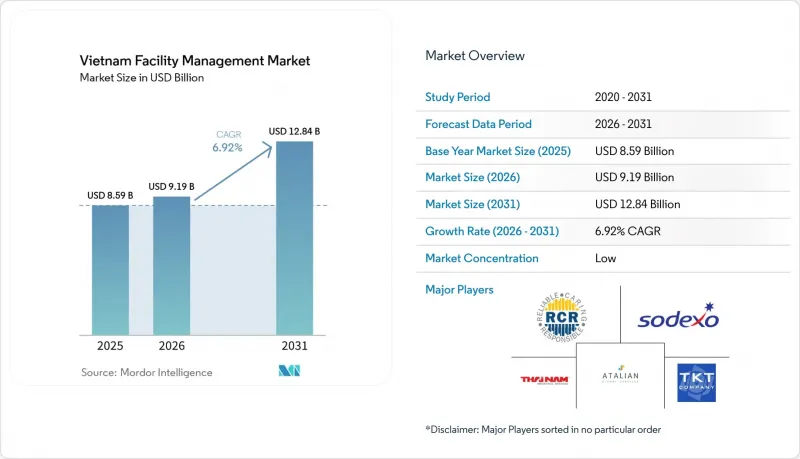
Mordor Intelligence에 의하면, 베트남 시설 관리 시장 규모는 2025년에 85억 9,000만 달러로 평가되었고 2026년 91억 9,000만 달러에서 2031년까지 128억 4,000만 달러에 이를 것으로 예측되며, 예측 기간(2026-2031년) CAGR은 6.92%를 나타낼 전망입니다.
본 보고서는 서비스 유형별(하드 서비스(자산 관리 등), 소프트 서비스(사무 지원·보안 등)), 제공 형태(사내 대응, 외부 위탁(단일 시설 관리, 포괄형 시설 관리 등)), 최종 사용자 산업(상업, 호스피탈리티, 제도적·공공 인프라, 산업·공정 등)별로 분류되어 있습니다. 시장 전망은 금액(달러) 기준으로 제시되어 있습니다.
베트남 시설 관리(FM) 시장 동향과 인사이트
A급 오피스 및 복합 용도 부동산 재고 확대
호치민시 및 하노이의 A급 부동산 재고는 2024년부터 2025년까지 18% 증가할 것으로 예상되며, 고도의 기계·전기·배관 유지 관리, 임차인 경험 향상을 위한 서비스, 그리고 엄격한 생명 안전 기준 준수를 필요로 하는 120만 제곱미터 이상의 프리미엄 공간이 추가되었습니다. 개발사들은 현재 5년에서 10년에 걸친 포괄 계약을 사전에 협상하고 있으며, 많은 경우 지급을 LEED나 LOTUS 인증 달성 마일스톤에 연동시켜, 이를 통해 10%-15%의 임대료 프리미엄을 실현하고 있습니다. Vinhomes Golden River와 같은 복합 용도 프로젝트에서는 주거용 컨시어지 서비스, 소매 구역 유지 관리, 사무실 하드 서비스가 단일 계약 범위로 통합되어 있어, 다각적인 자산을 관리할 수 있는 제공업체에게 유리한 상황이 조성되고 있습니다. 다낭에서 새로 준공되는 부동산은 지역 본사 이전을 목표로 하고 있어, 베트남의 시설 관리 시장을 하노이·호치민 시 회랑의 범위를 넘어 확장시키고 있습니다. 부동산의 노후화에 따라 예측 유지보수, 외관 보수, 엘리베이터 현대화에 대한 수요는 더욱 높아질 것입니다.
‘China + 1’ 전략과 FTA에 따른 제조 및 물류 성장
2025년에는 제조업에 228억 달러의 외국인 자본이 유입되어 빈즈엉, 박닌, 하이퐁 전역에서 1,500만 제곱미터 규모의 공장 및 물류 허브 건설이 촉진되었습니다. 반도체 조립, 배터리 생산, 섬유 마감 라인은 모두 ISO 규격의 클린룸, 유해 폐기물 처리, 연중무휴 24시간 공조 감시가 필요하며, 이로 인해 베트남 시설 관리 시장의 하드 서비스 수요가 확대되고 있습니다. 산업단지 운영 사업자는 경비, 조경, 배수 처리를 임대 계약에 포함시켜 개업 첫날부터 운영을 효과적으로 외주화하고 있습니다. RCEP 및 EU-베트남 자유무역협정(FTA)에 따른 관세 인하는 장기적인 수출 경쟁력을 공고히 하며, 가동률 98% 이상 보장 및 환경 규정 준수 감사를 필요로 하는 시설의 안정적인 공급을 보장하고 있습니다.
FM 인력 분야의 숙련된 근로자 부족과 높은 이직률
BMS 운영자, HVAC 기술자, 화재 안전 전문가의 연간 이직률은 30%를 초과하여 채용 비용을 상승시키고, 계약 시작까지의 준비 기간을 최대 3개월까지 연장시키고 있습니다. 공인된 FM 자격을 보유한 근로자는 고작 12%에 불과하여, 서비스 제공업체는 사내 교육 기관을 운영할 수밖에 없으며, 이로 인해 인건비가 8%-12% 증가하고 있습니다. 영어 능력의 격차는 다국적 기업 고객으로부터의 지식 이전을 방해하고, 세계적 모범 사례의 도입을 지연시키고 있습니다. 직업 훈련 커리큘럼에 FM 모듈이 포함되고, 세제 혜택에 의해 기술 향상이 촉진되지 않는 한, 인력 부족이 베트남 시설 관리 시장의 첨단 기술 흡수 능력을 제한하게 될 것입니다.
부문 분석
2025년, 베트남 시설 관리 시장에서 하드 서비스가 58.34%를 차지했습니다. 이 점유율은 기계 설비가 많은 건물과 분기별 점검 및 연간 시스템 재인증을 의무화하는 엄격한 안전 규제에 힘입은 것입니다. 베트남의 열대 기후로 인해 사무실, 쇼핑몰, 하이퍼스케일 데이터센터에서는 지속적인 냉방이 필요하기 때문에 난방·환기·공조(HVAC)가 지출의 대부분을 차지하고 있습니다. 2010년부터 2015년 사이에 건설된 1세대 A급 타워가 현재 수명 주기 전반에 걸친 전면 개보수가 필요함에 따라, 소방 시스템 업그레이드, 엘리베이터 개보수 및 외관 유지보수 수요가 확대되고 있습니다. 수익률을 유지하기 위해 데이터 기반의 자본 계획이 필요한 REIT 및 기관 투자자 소유의 부동산 소유주들 사이에서 자산 관리 자문 서비스가 지지를 얻고 있으며, 이로 인해 베트남 시설 관리 시장 전체에서 하드 서비스 전문 업체의 수익 기반이 더욱 견고해지고 있습니다.
소프트 서비스는 시장 규모 면에서는 작지만, 기업의 위생 기준 의무화 및 청소·경비 업무의 공식적인 위상 제고를 배경으로 연평균 성장률(CAGR) 7.32%로 확대되고 있습니다. 국제적인 호텔 체인이나 JCI 인증 병원은 서비스 제공업체에 대해 문서화된 감사 기록, 화학 물질 취급 기준, 감염 관리 체크리스트 준수를 의무화하고 있으며, 이로 인해 비정규 인력이 대체되고 있습니다. 사무실 케이터링 사업은 사무실 재입주에 따라 회복세를 보이고 있으며, 산업단지에서는 직원 정착률 향상을 위해 식사 프로그램의 외부 위탁이 진행되고 있습니다. 조경 및 폐기물 관리 계약은 LOTUS 그린 빌딩 인증 점수와 연계되는 사례가 증가하고 있으며, 이에 따라 기존에는 이익률이 낮았던 업무가 베트남 소프트 서비스 분야의 시설 관리 시장에서 부가가치가 높은 성과물로 변모하고 있습니다.
기타 혜택:
- 엑셀 형식 시장 예측(ME) 시트
- 3개월간의 애널리스트 지원
자주 묻는 질문
목차
제1장 서론
제2장 조사 방법
제3장 주요 요약
제4장 시장 구도
제5장 시장 규모와 성장 예측
제6장 경쟁 구도
제7장 시장 기회와 향후 전망
JHS 26.08.11According to Mordor Intelligence, the Vietnam facility management market size was valued at USD 8.59 billion in 2025 and estimated to grow from USD 9.19 billion in 2026 to reach USD 12.84 billion by 2031, at a CAGR of 6.92% during the forecast period (2026-2031).
This report is Segmented by Service Type (Hard Services [Asset Management, and More], and Soft Services [Office Support and Security, and More]), Offering Type (In-House, and Outsourced [Single FM, Bundled FM, and More]), and End-User Industry (Commercial. Hospitality, Institutional and Public Infrastructure, Industrial and Process, and More). The Market Forecasts are Provided in Terms of Value (USD).
Vietnam Facility Management Market Trends and Insights
Expansion of Grade-A Office and Mixed-Use Real Estate Stock
Grade-A inventory in Ho Chi Minh City and Hanoi climbed 18% between 2024 and 2025, adding more than 1.2 million m2 of premium space that requires sophisticated mechanical, electrical, and plumbing upkeep, tenant-experience services, and stringent life-safety compliance. Developers now pre-negotiate five-to-ten-year integrated contracts, often linking payment to LEED or LOTUS certification milestones that deliver 10%-15% rental premiums. Mixed-use schemes such as Vinhomes Golden River bundle residential concierge, retail area maintenance, and office hard services in a single scope, which favors providers able to manage multifaceted assets. New completions in Da Nang are targeting regional headquarters relocations, stretching the Vietnam facility management market beyond the Hanoi-Ho Chi Minh City corridor. As stock ages, demand will intensify for predictive maintenance, facade refurbishment, and elevator modernization.
Manufacturing and Logistics Growth via China + 1 and FTAs
Foreign capital of USD 22.8 billion flowed into manufacturing in 2025, stimulating the build-out of 15 million m2 of factories and logistics hubs across Binh Duong, Bac Ninh, and Hai Phong. Semiconductor assembly, battery production, and textile finishing lines all mandate ISO-class cleanrooms, hazardous-waste handling, and 24/7 HVAC monitoring, expanding the hard-services wallet within the Vietnam facility management market. Industrial-park operators bundle security, landscaping, and wastewater treatment into leases, effectively outsourcing operations from day one. Reduced tariffs under RCEP and the EU-Vietnam Free Trade Agreement lock in long-run export competitiveness, ensuring a steady stream of facilities that will require uptime guarantees above 98% and environmental compliance audits.
Skilled-Labour Shortage and High Turnover in FM Workforce
Annual turnover tops 30% for BMS operators, HVAC technicians, and fire-safety specialists, inflating recruitment costs and lengthening contract mobilization by up to three months. Only 12% of workers hold recognized FM certifications, forcing service providers to run in-house academies that add 8%-12% to labor expense. English-language gaps hinder knowledge transfer from multinational clients, slowing adoption of global best practices. Unless vocational curricula incorporate FM modules and tax incentives encourage upskilling, constrained talent will limit the Vietnam facility management market's ability to absorb sophisticated technologies.
Other drivers and restraints analyzed in the detailed report include:
- Hyperscale Data-Center Build-Out Driving Critical-Environment FM
- Government Smart-City and Infrastructure PPP Initiatives
- Price-Focused Procurement Undercutting Service Quality
For complete list of drivers and restraints, kindly check the Table Of Contents.
Segment Analysis
Hard Services accounted for 58.34% of the Vietnam facility management market in 2025, a share underpinned by mechanically intensive buildings and stringent safety regulations that require quarterly inspections and annual system recertification. Heating, ventilation, and air-conditioning dominates spend because Vietnam's tropical climate forces continuous cooling in offices, malls, and hyperscale data centers. Fire-system upgrades, elevator refurbishment, and facade maintenance are rising as first-generation Grade-A towers built between 2010 and 2015 now require lifecycle overhauls. Asset-management advisory is gaining favor among REITs and institutional landlords that need data-driven capital planning to defend yields, further cementing the revenue base for hard-service specialists across the Vietnam facility management market.
Soft Services represent a smaller dollar pool but expand at a 7.32% CAGR, driven by corporate hygiene mandates and the formalization of cleaning and security roles. International hospitality chains and JCI-accredited hospitals compel providers to meet documented audit trails, chemical-handling standards, and infection-control checklists, displacing informal labor pools. Office catering rebounds in tandem with workplace re-occupancy, and industrial campuses are outsourcing meal programs to manage worker retention. Landscaping and waste-management contracts are increasingly tied to LOTUS green-building points, transforming previously low-margin tasks into value-added deliverables within the Vietnam facility management market size for soft services.
Complete Report Scope:
- By Service Type
- Hard Services
- Asset Management
- MEP and HVAC Services
- Fire Systems and Safety
- Other Hard Facility Management Services
- Soft Services
- Office Support and Security
- Cleaning Services
- Catering Services
- Other Soft Facility Management Services
- Hard Services
- By Offering Type
- In-house
- Outsourced
- Single Facility Management
- Bundled Facility Management
- Integrated Facility Management
- By End-User Industry
- Commercial
- Hospitality
- Institutional and Public Infrastructure
- Healthcare
- Industrial and Process
- Other End-User Industries
List of Companies Covered in this Report:
- RCR Vietnam
- Sodexo Vietnam
- ADEN Vietnam
- Thainam Facility Services
- TKT Cleaning
- ATALIAN Global Services Vietnam
- Savills Vietnam
- AEON Delight Vietnam
- PMC Building Services and Engineering
- P. Dussmann Co. Ltd Vietnam
- Vintek Facility Management
- S4S Facility Services
- VSIP Facility Management
- CBRE Vietnam
- JLL Vietnam
- G4S Secure Solutions Vietnam
- Compass Group Vietnam
- Cleanhouse Vietnam
- Visaho Joint Stock Company
- Knight Frank Vietnam
Additional Benefits:
- The market estimate (ME) sheet in Excel format
- 3 months of analyst support
TABLE OF CONTENTS
1 INTRODUCTION
- 1.1 Study Assumptions and Market Definition
- 1.2 Scope of the Study
2 RESEARCH METHODOLOGY
3 EXECUTIVE SUMMARY
4 MARKET LANDSCAPE
- 4.1 Market Overview
- 4.1.1 Current Occupancy Rates
- 4.1.2 Profitability Rates of Major FM Players
- 4.1.3 Workforce Indicators - Labor Participation
- 4.1.4 Facility Management Market Share (%) by Service Type
- 4.1.5 Facility Management Market Share (%) by Hard Services
- 4.1.6 Facility Management Market Share (%) by Soft Services
- 4.1.7 Urbanization and Population Growth in Major Metros
- 4.1.8 Sector Investment Priorities in Vietnam's Infrastructure Pipeline
- 4.1.9 Regulatory Drivers Specific to Labor and Safety Standards
- 4.2 Market Drivers
- 4.2.1 Expansion of Grade-A Office and Mixed-Use Real Estate Stock
- 4.2.2 Manufacturing and Logistics Growth via China+1 and FTAs
- 4.2.3 Government Smart-City and Infrastructure PPP Initiatives
- 4.2.4 Cost-Optimization Outsourcing Trend in State and Private Enterprises
- 4.2.5 Hyperscale Data-Center Build-Out Driving Critical-Environment FM
- 4.2.6 Green-Building, Energy-Efficiency Certification Demand - LOTUS, EDGE
- 4.3 Market Restraints
- 4.3.1 Skilled-Labor Shortage and High Turnover in FM Workforce
- 4.3.2 Price-Focused Procurement Undercutting Service Quality
- 4.3.3 Absence of Unified FM Licensing and Standards Causing Fragmentation
- 4.3.4 Cyber-Physical Security Concerns Slowing IoT, BMS Adoption
- 4.4 Industry Value Chain Analysis
- 4.5 PESTEL Analysis
- 4.6 Regulatory and Legislative Framework for Market Entrants
- 4.7 Impact of Macroeconomic Indicators on FM Demand
- 4.8 Porter's Five Forces Analysis
- 4.8.1 Bargaining Power of Suppliers
- 4.8.2 Bargaining Power of Buyers
- 4.8.3 Threat of New Entrants
- 4.8.4 Threat of Substitute Services
- 4.8.5 Intensity of Competitive Rivalry
- 4.9 Investment and Funding Analysis
5 MARKET SIZE AND GROWTH FORECASTS (VALUE)
- 5.1 By Service Type
- 5.1.1 Hard Services
- 5.1.1.1 Asset Management
- 5.1.1.2 MEP and HVAC Services
- 5.1.1.3 Fire Systems and Safety
- 5.1.1.4 Other Hard Facility Management Services
- 5.1.2 Soft Services
- 5.1.2.1 Office Support and Security
- 5.1.2.2 Cleaning Services
- 5.1.2.3 Catering Services
- 5.1.2.4 Other Soft Facility Management Services
- 5.1.1 Hard Services
- 5.2 By Offering Type
- 5.2.1 In-house
- 5.2.2 Outsourced
- 5.2.2.1 Single Facility Management
- 5.2.2.2 Bundled Facility Management
- 5.2.2.3 Integrated Facility Management
- 5.3 By End-User Industry
- 5.3.1 Commercial
- 5.3.2 Hospitality
- 5.3.3 Institutional and Public Infrastructure
- 5.3.4 Healthcare
- 5.3.5 Industrial and Process
- 5.3.6 Other End-User Industries
6 COMPETITIVE LANDSCAPE
- 6.1 Market Concentration
- 6.2 Strategic Moves and Partnerships
- 6.3 Market Share Analysis
- 6.4 Company Profiles (includes Global Level Overview, Market Level Overview, Core Segments, Financials as available, Strategic Information, Market Rank/Share, Products and Services, Recent Developments)
- 6.4.1 RCR Vietnam
- 6.4.2 Sodexo Vietnam
- 6.4.3 ADEN Vietnam
- 6.4.4 Thainam Facility Services
- 6.4.5 TKT Cleaning
- 6.4.6 ATALIAN Global Services Vietnam
- 6.4.7 Savills Vietnam
- 6.4.8 AEON Delight Vietnam
- 6.4.9 PMC Building Services and Engineering
- 6.4.10 P. Dussmann Co. Ltd Vietnam
- 6.4.11 Vintek Facility Management
- 6.4.12 S4S Facility Services
- 6.4.13 VSIP Facility Management
- 6.4.14 CBRE Vietnam
- 6.4.15 JLL Vietnam
- 6.4.16 G4S Secure Solutions Vietnam
- 6.4.17 Compass Group Vietnam
- 6.4.18 Cleanhouse Vietnam
- 6.4.19 Visaho Joint Stock Company
- 6.4.20 Knight Frank Vietnam
7 MARKET OPPORTUNITIES AND FUTURE OUTLOOK
- 7.1 White-space and Unmet-Need Assessment
- 7.2 Technology-led Integrated FM (IoT, BMS, AI-Based Predictive Maintenance)
- 7.3 ESG-Compliant FM Solutions Demand
- 7.4 Future Service-Model Shifts (Outcome-Based Contracts)