

|
시장보고서
상품코드
2100709
현무암 섬유 시장 : 점유율 분석, 업계 동향 및 통계, 성장 예측(2026-2031년)Basalt Fiber - Market Share Analysis, Industry Trends & Statistics, Growth Forecasts (2026 - 2031) |
||||||
 Mordor Intelligence
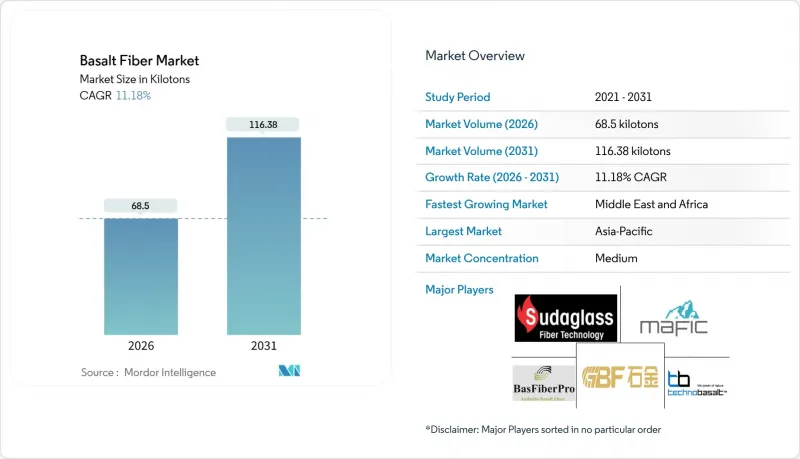
Mordor Intelligence에 의하면, 현무암 섬유 시장 규모는 2026년에 68.5 킬로톤으로 추정되고 있어 예측 기간(2026-2031년)에서 CAGR 11.18%로 성장을 지속하여, 2031년에는 116.38 킬로톤에 이른다고 전망되고 있습니다.
본 보고서는 형태(연속 섬유, 단섬유), 용도(복합재료, 비복합재료), 최종 이용 산업(건축 및 건설, 자동차, 산업, 선박, 에너지 산업, 기타(스포츠, 화학 산업, 석유 산업)), 지역(아시아태평양, 북미, 유럽, 남미, 중동 및 아프리카)별로 분류되어 있습니다. 시장 전망은 수량 기준으로 제시되어 있습니다.
전 세계 현무암 섬유 시장 동향 및 인사이트
EU의 넷제로 규제가 철근의 보급을 가속화
개정된 EU의 넷제로 산업법은 프로젝트 소유주에게 지구온난화계수(GWP)가 낮은 보강재의 채택을 의무화하고 있으며, 이에 따라 교량 데크판 및 방파제의 사양 목록에 현무암 섬유 철근이 포함되고 있습니다. 800-1,200 MPa의 인장 강도와 강철의 3배에 달하는 내식성 덕분에 염화물 농도가 높은 환경에서도 내구 연한을 100년까지 연장할 수 있습니다. EN 13706 규격에서는 현재 현무암이 참조 대상으로 지정되어, 기존 규제의 공백이 해소되었습니다. 프랑스와 독일에서는 교량 상판의 오버레이 및 연안 인프라 분야에서 현무암 섬유 철근의 시범 도입이 진행되고 있습니다. 이러한 장소에서는 염화물의 침투로 인해 기존에는 25년마다 강재를 교체해야 했습니다. 이러한 규제상의 뒷받침으로 인해, 노출도가 높은 용도에서의 현무암 섬유 철근 투자 회수 기간은 15년 미만으로 단축되었으며, 넷 제로 달성을 위한 비용 제약이 있는 공공 인프라 예산에서도 경제적으로 실현 가능한 선택지가 되고 있습니다.
해상 풍력 발전용 블레이드 건설 확대에는 내열성 섬유가 필수적입니다.
차세대 15 MW 터빈에는 콘크리트 경화에 따른 발열이나 낙뢰를 견딜 수 있는 스퍼 캡이 필요합니다. 현무암은 650°C까지 강도를 유지하며, 460°C에서 성능이 한계에 달하는 E-유리섬유를 능가합니다. 약 400 MPa의 굽힘 강도는 120미터 길이의 블레이드 스팬을 지탱하기에 충분합니다. 미국 선급협회(ABS)의 부유식 해상 풍력 터빈 관련 지침에서는 계류 및 동적 케이블 보호 시스템을 위한 적합 보강재로 현무암 섬유가 언급되어 있으며, 이는 규제 당국의 승인을 시사합니다. 이에 따라 2030년까지 북해 및 동중국해에서 계획된 80기가와트 규모의 해상 풍력 발전 프로젝트에서 이 소재의 채택이 가속화될 것입니다.
대체재의 용이한 입수 가능성
범용 복합재료나 단열재 등 성능이 엄격하게 요구되지 않는 용도에서는 유리 섬유가 현무암 섬유에 비해 10대 1의 비용 우위를 유지하고 있으며, 이로 인해 연간 700만 톤 규모의 세계 유리 섬유 시장으로의 현무암 섬유 침투가 제한되고 있습니다. E-유리섬유의 가격이 1Kg당 약 2-3달러인 반면, 현무암 섬유는 1Kg당 20-30달러로 비싸지만, 이러한 가격 차이는 열 안정성, 내식성 또는 극저온 성능이 요구되는 경우에만 정당화됩니다. 현무암과 비슷한 가격대의 탄소섬유는 항공우주 분야에서 30% 더 높은 비강도를 제공합니다. 콘크리트 보강재 시장에서는 확립된 규격과 시공업체들이 익숙한 소재라는 이유로 철근이 여전히 95%의 점유율을 차지하고 있어, 가격에 민감한 지역에서 현무암의 보급을 저해하고 있습니다.
부문 분석
2025년에는 터빈 블레이드나 자동차 차체 패널에 4,800 MPa를 초과하는 단방향 강도가 요구됨에 따라, 연속 로빙이 수량 기준으로 68.18%를 차지했습니다. 한편, 단섬유 제품 시장 규모는 2031년까지 연평균 성장률(CAGR) 13.28%로 성장할 전망입니다. 현장에서의 노동력을 절감해 주는 레디믹스트 콘크리트 수요에 힘입어, 단섬유 현무암 섬유 시장 규모는 2031년까지 30킬로톤을 넘어설 것으로 예측됩니다. 시험 결과에 따르면, 1%의 단섬유를 첨가하면 굽힘 강도가 25% 향상되고, 지진 하중 하에서 균열 폭이 40% 축소되는 것으로 나타났습니다. 연속 섬유 제조업체들은 시장 점유율을 유지하기 위해 터널 내벽용 파이버 그리드로의 다각화를 추진하고 있습니다.
아시아태평양 및 중동의 프로젝트 소유주들은 타설이 신속하고 더 엄격한 내구성 기준을 충족한다는 이유로 단섬유 혼합물을 선호하여 채택하고 있습니다. 미국 콘크리트 협회(ACI)는 현재 연속형 및 단섬유 양쪽의 현무암 보강재에 관한 설계 지침을 제공함으로써 기술적 격차를 해소하고 있습니다. 연속 섬유 공급업체들은 규모의 경제를 활용하여, 하이엔드 항공우주 분야 및 고급 자동차 부품에 적합한 6-13µm 길이의 필라멘트를 생산하고 있습니다. 건축 기준이 발전함에 따라, 연속 섬유의 확고한 기반이 있음에도 불구하고 단섬유 현무암 섬유 시장 점유율은 계속 상승할 것입니다.
지역별 분석
2025년 기준, 아시아태평양은 총 생산량의 48.75%를 차지했습니다. 중국은 Hengdian사의 연간 2만 톤 생산 공장과 2019년 이후 추가된 탱크 킬른 라인을 통해 시장을 주도하고 있습니다. 일본과 한국에서는 연안 지역 개보수 공사에 현무암이 채택되고 있으며, 인도에서는 1조 4,000억 달러 규모의 인프라 정비 계획이 철근 수요를 뒷받침하고 있습니다. 광석과의 근접성과 낮은 인건비 덕분에 이 지역의 가격 경쟁력은 유지되고 있습니다.
중동 및 아프리카는 2031년까지 연평균 성장률(CAGR) 15.52%로 확대될 전망이며, 해수 담수화 및 LNG 투자로 인한 혜택을 받을 것으로 예측됩니다. 사우디 아람코(Saudi Aramco)는 부식 환경에서의 사용 지침에 현무암 FRP를 명시하고 있습니다. 남아프리카의 광산 설비 현대화 및 GCC(걸프협력회의) 국가들의 메가 프로젝트로 인해 수주 잔고가 확대되면서, 이 지역은 현무암 섬유 시장에서 가장 빠르게 성장하는 클러스터로서의 입지를 공고히 하고 있습니다.
북미에서는 1조 2,000억 달러 규모의 인프라 법안을 활용하고 있으며, 메인 대학교(University of Maine)의 ARPA-I를 통한 노력이 AASHTO 규격 개정을 목표로 하고 있습니다. 캐나다에서는 북극권 건설에 현무암이 채택되었고, 멕시코에서는 전기차(EV)용 배터리 케이스에 적용되고 있습니다. 유럽에서는 EN 13706 규격 및 넷제로 의무화로 인해 연안 지역 및 내진 보강 공사가 추진되고 있습니다. 남미에서는 브라질의 수력 발전 댐 보수 및 아르헨티나의 곡물 사일로 건설로 인해 성장세가 가속화되고 있으나, 수입 비용이 보급을 저해하고 있습니다.
기타 혜택:
- 엑셀 형식 시장 예측(ME) 시트
- 3개월간의 애널리스트 지원
자주 묻는 질문
목차
제1장 서론
제2장 조사 방법
제3장 주요 요약
제4장 시장 구도
제5장 시장 규모와 성장 예측
제6장 경쟁 구도
제7장 시장 기회와 향후 전망
JHS 26.08.11According to Mordor Intelligence, the basalt fiber market size is estimated at 68.5 kilotons in 2026, and is expected to reach 116.38 kilotons by 2031, at a CAGR of 11.18% during the forecast period (2026-2031).
This report is Segmented by Form (Continuous and Discrete), Usage (Composites and Non-Composites), End-Use Industry (Building and Construction, Automotive, Industrial, Marine, Energy Industry, and Other (Sports, Chemical Industry, Petroleum Industry)), and Geography (Asia-Pacific, North America, Europe, South America, and Middle East and Africa). The Market Forecasts are Provided in Terms of Volume (tons).
Global Basalt Fiber Market Trends and Insights
EU Net-Zero Mandates Accelerating Basalt Rebar
The revised EU Net-Zero Industry Act compels project owners to adopt low-GWP reinforcements, placing basalt rebar on specification lists for bridge decks and seawalls. Tensile strengths of 800-1,200 MPa and triple the corrosion resistance of steel lengthen service life to 100 years in chloride-rich environments. EN 13706 now references basalt, removing earlier regulatory gaps. France and Germany are piloting basalt rebar in bridge deck overlays and coastal infrastructure, where chloride ingress has historically required steel replacement every 25 years. This regulatory push is compressing payback periods for basalt rebar to under 15 years in high-exposure applications, making it economically viable for public infrastructure budgets constrained by net-zero compliance costs.
Offshore Wind-Blade Build-Out Needs Heat-Resistant Fabrics
Next-generation 15 MW turbines require spar caps that withstand curing exotherms and lightning strikes. Basalt retains strength up to 650°C, outperforming E-glass at 460°C. Flexural strengths of roughly 400 MPa support 120-meter blade spans. The American Bureau of Shipping's guide for floating offshore wind turbines references basalt fiber as a compliant reinforcement for mooring and dynamic cable protection systems, signaling regulatory acceptance that will accelerate adoption in the 80-gigawatt offshore wind pipeline planned for the North Sea and East China Sea through 2030.
Easy Availability of Substitutes
Glass fiber maintains a 10-to-1 cost advantage over basalt fiber in non-performance-critical applications such as general-purpose composites and insulation, limiting basalt's penetration into the 7-million-tonne-per-year global glass fiber market. E-glass fiber costs approximately USD 2-3 per kilogram, whereas basalt fiber ranges from USD 20-30 per kilogram, a premium justified only when thermal stability, corrosion resistance, or cryogenic performance is required. Carbon fiber, priced similarly to basalt, offers 30% higher specific strength for aerospace. Steel rebar still holds a 95% share in concrete reinforcement, thanks to entrenched codes and installer familiarity, stalling basalt uptake in price-sensitive regions.
Other drivers and restraints analyzed in the detailed report include:
- Vehicle Lightweighting Roadmap Favoring Basalt Fiber Usage
- GCC Desalination Expansion Driving Basalt FRP Pipelines
- Basalt-Ore Freight-Rate Volatility
For complete list of drivers and restraints, kindly check the Table Of Contents.
Segment Analysis
Continuous rovings controlled 68.18% volume in 2025 as turbine blades and auto body panels require unidirectional strength exceeding 4,800 MPa. Discrete fiber volume will expand at a 13.28% CAGR to 2031. The basalt fiber market size for discrete formats is on track to surpass 30 kilotons by 2031, driven by ready-mix concrete mixes that cut on-site labor. Tests show 1% discrete addition lifts flexural strength 25% and shrinks crack width 40% under seismic load. Continuous makers are diversifying into fiber grids for tunnel linings to defend their share.
Project owners in Asia-Pacific and the Middle East favor discrete mixes because they pour faster and meet stricter durability codes. The American Concrete Institute now offers design guidance for both continuous and discrete basalt reinforcement, closing technical gaps. Continuous suppliers leverage economies of scale, producing 6-13 µm filaments suited to high-end aerospace and premium auto parts. As building codes evolve, the basalt fiber market share of discrete formats will keep rising despite the continuous fiber's entrenched base.
Complete Report Scope:
- By Form
- Continuous
- Discrete
- By Usage
- Composites
- Non-Composites
- By End-Use Industry
- Building & Construction
- Automotive
- Industrial
- Marine
- Energy Industry
- Other (Sports, Chemical Industry, Petroleum Industry)
- By Geography
- Asia-Pacific
- China
- Japan
- India
- South Korea
- Rest of Asia
- North America
- United States
- Canada
- Mexico
- Europe
- Germany
- United Kingdom
- Italy
- France
- Rest of Europe
- South America
- Brazil
- Argentina
- Rest of South America
- Middle East and Africa
- Saudi Arabia
- South Africa
- Rest of Middle East and Africa
- Asia-Pacific
Geography Analysis
Asia-Pacific held 48.75% volume in 2025. China leads through Hengdian's 20,000 tpa plant and additional tank-kiln lines since 2019. Japan and South Korea apply basalt in coastal retrofits, and India's USD 1.4 trillion infrastructure push fuels rebar demand. Proximity to ore and lower labor costs keep regional pricing competitive.
The Middle East and Africa, advancing at a 15.52% CAGR to 2031, will benefit from desalination and LNG investments. Saudi Aramco lists basalt FRP in corrosive service guidelines. South African mining upgrades and GCC megaprojects extend the order book, solidifying the region as the basalt fiber market's fastest-growing cluster.
North America leverages the USD 1.2 trillion Infrastructure Act, with the University of Maine's ARPA-I work aiming to update AASHTO codes. Canada deploys basalt in Arctic builds, and Mexico integrates it in EV battery enclosures. Europe's EN 13706 standards and net-zero mandates drive coastal and seismic retrofits. South America gains momentum in Brazil's hydro dam repairs and Argentina's grain silos, though import costs temper uptake.
- Albarrie Canada Limited
- Arab Basalt Fiber
- ARMBAS
- Basalt Engineering LLC
- Basaltex
- Basanite Industries LLC
- BASTECH
- Deutsche Basalt Faser GmbH
- EcoBasalt Solutions
- Fiberbas construction and building technologies
- Final Advanced Materials
- Galen Ltd
- Hengdian Group Holdings Limited
- INCOTELOGY GmbH
- Isomatex SA
- JiLin Tongxin Basalt Technology Co.,Ltd
- Kamenny Vek
- MAFIC SA
- Rockwool A/S
- Sudaglass Fiber Technology
- Technobasalt Invest
- Zhejiang Shijin Basalt Fiber Co., Ltd.
Additional Benefits:
- The market estimate (ME) sheet in Excel format
- 3 months of analyst support
TABLE OF CONTENTS
1 Introduction
- 1.1 Study Assumptions & Market Definition
- 1.2 Scope of the Study
2 Research Methodology
3 Executive Summary
4 Market Landscape
- 4.1 Market Overview
- 4.2 Market Drivers
- 4.2.1 EU Net-Zero Mandates accelerating basalt rebar
- 4.2.2 Offshore wind-blade build-out needs heat-resistant fabrics
- 4.2.3 Vehicle-lightweighting roadmap in several countries favoring basalt fiber usage
- 4.2.4 GCC desalination expansion driving basalt FRP pipelines
- 4.2.5 LNG platforms requiring cryogenic-tolerant reinforcements
- 4.3 Market Restraints
- 4.3.1 Easy availability of substitutes
- 4.3.2 Basalt-ore freight-rate volatility
- 4.3.3 Abrasive wear on processing equipment raising OPEX
- 4.4 Value Chain Analysis
- 4.5 Porter's Five Forces
- 4.5.1 Bargaining Power of Suppliers
- 4.5.2 Bargaining Power of Buyers
- 4.5.3 Threat of New Entrants
- 4.5.4 Threat of Substitutes
- 4.5.5 Degree of Competition
5 Market Size & Growth Forecasts (Volume)
- 5.1 By Form
- 5.1.1 Continuous
- 5.1.2 Discrete
- 5.2 By Usage
- 5.2.1 Composites
- 5.2.2 Non-Composites
- 5.3 By End-Use Industry
- 5.3.1 Building & Construction
- 5.3.2 Automotive
- 5.3.3 Industrial
- 5.3.4 Marine
- 5.3.5 Energy Industry
- 5.3.6 Other (Sports, Chemical Industry, Petroleum Industry)
- 5.4 By Geography
- 5.4.1 Asia-Pacific
- 5.4.1.1 China
- 5.4.1.2 Japan
- 5.4.1.3 India
- 5.4.1.4 South Korea
- 5.4.1.5 Rest of Asia
- 5.4.2 North America
- 5.4.2.1 United States
- 5.4.2.2 Canada
- 5.4.2.3 Mexico
- 5.4.3 Europe
- 5.4.3.1 Germany
- 5.4.3.2 United Kingdom
- 5.4.3.3 Italy
- 5.4.3.4 France
- 5.4.3.5 Rest of Europe
- 5.4.4 South America
- 5.4.4.1 Brazil
- 5.4.4.2 Argentina
- 5.4.4.3 Rest of South America
- 5.4.5 Middle East and Africa
- 5.4.5.1 Saudi Arabia
- 5.4.5.2 South Africa
- 5.4.5.3 Rest of Middle East and Africa
- 5.4.1 Asia-Pacific
6 Competitive Landscape
- 6.1 Market Concentration
- 6.2 Strategic Moves
- 6.3 Market Share(%)/Ranking Analysis
- 6.4 Company Profiles {(includes Global level Overview, Market level overview, Core Segments, Financials as available, Strategic Information, Market Rank/Share for key companies, Products & Services, and Recent Developments)}
- 6.4.1 Albarrie Canada Limited
- 6.4.2 Arab Basalt Fiber
- 6.4.3 ARMBAS
- 6.4.4 Basalt Engineering LLC
- 6.4.5 Basaltex
- 6.4.6 Basanite Industries LLC
- 6.4.7 BASTECH
- 6.4.8 Deutsche Basalt Faser GmbH
- 6.4.9 EcoBasalt Solutions
- 6.4.10 Fiberbas construction and building technologies
- 6.4.11 Final Advanced Materials
- 6.4.12 Galen Ltd
- 6.4.13 Hengdian Group Holdings Limited
- 6.4.14 INCOTELOGY GmbH
- 6.4.15 Isomatex SA
- 6.4.16 JiLin Tongxin Basalt Technology Co.,Ltd
- 6.4.17 Kamenny Vek
- 6.4.18 MAFIC SA
- 6.4.19 Rockwool A/S
- 6.4.20 Sudaglass Fiber Technology
- 6.4.21 Technobasalt Invest
- 6.4.22 Zhejiang Shijin Basalt Fiber Co., Ltd.
7 Market Opportunities & Future Outlook
- 7.1 White-space & Unmet-Need Assessment
- 7.2 Increasing Adoption of Environmentally Friendly Materials


