

|
시장보고서
상품코드
2100744
자동차용 반도체 메모리 시장 : 점유율 분석, 업계 동향 및 통계, 성장 예측(2026-2031년)Semiconductor Memory for Automotive - Market Share Analysis, Industry Trends & Statistics, Growth Forecasts (2026 - 2031) |
||||||
 Mordor Intelligence
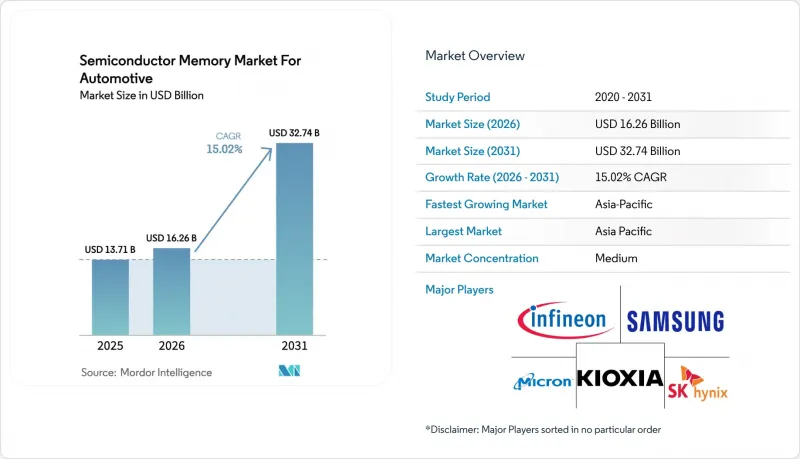
Mordor Intelligence에 의하면, 자동차용 반도체 메모리 시장 규모는 2025년에 137억 1,000만 달러로 평가되었고 2026년 162억 6,000만 달러에서 2031년까지 327억 4,000만 달러에 이를 것으로 예측되며, 예측 기간(2026-2031년) CAGR은 15.02%를 나타낼 전망입니다.
본 보고서는 기술적 역할(코드 스토리지, 워킹 메모리 등), 메모리 유형(DRAM, NAND 플래시 등), 용도(ADAS 및 자율주행, 디지털 콕핏 등), 차종(승용차, 소형 상용차 등), 메모리 밀도(128 Mb 미만 등), 지역별로 분류되어 있습니다. 시장 전망은 금액(달러) 기준으로 제시되어 있습니다.
세계 자동차용 반도체 메모리 시장 동향 및 인사이트
소프트웨어 정의 차량(SDV)의 보급이 메모리 용량 요구 사항을 가속화
각 자동차 제조업체는 최대 100개에 달하는 전자제어장치을 10개 미만의 도메인 컨트롤러로 통합하고 있으며, 각 컨트롤러에는 컨테이너화된 소프트웨어 스택을 호스팅하기 위해 최대 32 GB의 DRAM과 512 GB의 NAND가 탑재되어 있습니다. 테슬라의 'Hardware 4' 플랫폼에는 이미 64GB의 LPDDR5 DRAM과 256GB의 UFS 3.1 스토리지가 탑재되어 있어, 실시간 센서 퓨전 및 완전 자율 주행을 위한 추론 처리에 충분한 여유를 확보하고 있습니다. 제너럴 모터스(GM)의 ‘Ultifi’ 아키텍처는 48GB의 작업 메모리를 최소 기준으로 표준화하여, 하드웨어를 변경하지 않고도 새로운 기능을 다운로드할 수 있도록 했습니다. 메모리는 설계 단계에서 고정되므로 차량 생산 대수가 감소하더라도 수요는 지속되어 구조적인 성장의 기반을 뒷받침합니다. 이러한 동향은 소프트웨어의 증분적 제공을 통해 수익을 창출하는 구독형 기능에 특히 중요하며, 메모리를 단순한 비용 항목이 아닌 수익 창출을 가능하게 하는 자산으로 변화시키고 있습니다.
집중형 및 존형 E-E 아키텍처를 통한 차량용 메모리 풀 확대
존형 게이트웨이는 물리적 영역별로 센서 데이터를 집계함으로써 배선량을 줄이면서 연산 능력과 스토리지를 집중시킵니다. 폭스바겐의 E3 2.0 플랫폼은 8GB LPDDR5 게이트웨이 4개와 중앙의 64GB 연산 노드 1개를 탑재하고 있으며, 고밀도 디바이스로의 구매 전환이 진행되고 있습니다. 보쉬(Bosch)사의 추산에 따르면, 존형 설계에서는 차량 1대당 메모리 탑재량이 120-180달러 증가하며, 그 내역은 DRAM과 NAND가 약 60대 40의 비율을 이룹니다. 중국 브랜드들은 소프트웨어의 비대화에 대비해 미래를 내다보는 한편, 데이터 현지화 규제를 준수하기 위해 용량을 20-30% 과잉으로 설정하고 있으며, 이로 인해 국내 DRAM 및 NAND 공급업체에 대해 매우 큰 수요를 창출하고 있습니다.
자동차용 반도체 공급망의 변동
2025년 12월, 전 세계 자동차용 NAND의 15%를 공급하는 웨스턴디지털의 요카이치 공장에서 화재가 발생하여 리드타임이 12주에서 26주로 늘어났고, 고급차 제조업체들은 항공 운송비로 30%의 할증료를 지불할 수밖에 없었습니다. 시장 집중은 구조적인 문제입니다. 삼성, SK하이닉스, 마이크론이 자동차용 DRAM의 90% 이상을 공급하고 있으며, 이들 제조 거점의 상당수는 지진 활동이 활발한 동아시아에 위치해 있습니다. 첨단 제조 장비에 대한 수출 규제로 인해 중국 경쟁사들의 사업 확장이 제한되고 있어 대체 공급원이 제한적인 반면, 완충 재고 전략에 따른 비용 부담은 계속되고 있습니다.
부문 분석
자동차용 반도체 메모리 시장에서 DRAM 시장 규모는 2025년 매출의 47.91%를 차지하며, 실시간 연산의 주력으로서의 입지를 공고히 하고 있습니다. 카메라 수 증가와 고해상도 디스플레이의 보급에 힘입어 DRAM의 밀도 향상은 순조롭게 진행되고 있으며, LPDDR5T는 9.6Gb/s의 처리량을 실현하여 멀티 카메라를 통한 서라운드 뷰의 지연 시간 요건을 충족하고 있습니다. NAND 플래시 반도체 메모리 시장 규모는 비트당 비용을 대폭 절감하고, 중형 차량에서도 512 GB UFS가 보편화될 128층 디바이스에 힘입어 급속히 확대되고 있습니다.
NAND 플래시는 2025년 시장 점유율은 작지만, 무선 업데이트(OTA) 스테이징, 이벤트 데이터 기록, 고해상도 지도 캐시가 보급됨에 따라 15.08%라는 가장 높은 연평균 성장률(CAGR)을 기록하고 있습니다. 키오크시아와 웨스턴디지털이 제공하는 UFS 4.0 샘플은 4GB/s의 순차 읽기 속도를 실현하여, 10 GB 업데이트 설치 시간을 45분에서 12분으로 단축합니다. 한편, DRAM은 쿼드 채널 LPDDR4X에서 듀얼 채널 LPDDR5 구성으로 전환되어 기판 면적과 전력 소비를 줄이고 있습니다. MRAM은 매출의 3%에 불과하지만, 전기차 배터리 관리 시스템 등 무제한 수명과 즉각적인 부팅이 가격 프리미엄을 정당화할 수 있는 분야에서 수요가 확대되고 있습니다.
디지털 콕핏 시스템은 2025년 지출의 38.48%를 차지하고 있으며, 이는 프리미엄 사양에서 24GB의 DRAM과 256GB의 NAND가 필요한 다중 디스플레이, 음성 어시스턴트, 앱 스토어 생태계를 반영한 것입니다. 증강현실(AR) 오버레이와 8K 그래픽이 중급 모델에도 보급됨에 따라 좌석당 메모리 밀도가 지속적으로 상승하고 있으며, 대역폭을 대량으로 소비하는 렌더링 파이프라인에서 DRAM의 우위가 더욱 강화되고 있습니다.
연평균 성장률(CAGR) 15.17%로 확대되고 있는 ADAS(첨단 운전자 보조 시스템) 및 자율주행은 자동차용 반도체 메모리 시장에서 가장 빠르게 성장하는 분야입니다. 레벨 3 파일럿 프로그램에서는 4-8 GB/s의 속도로 LiDAR 포인트 클라우드가 기록되므로, 방대한 DRAM 버퍼와 지도 데이터를 저장하기 위한 512 GB급 NVMe SSD가 필요합니다. 이 부문은 모델 가중치만 10 GB를 초과하는 트랜스포머 기반 지각 스택의 혜택을 받고 있어, 작업 메모리 수요의 지속적인 증가가 확실시되고 있습니다. 규제 당국이 충돌 전 30초간의 데이터 수집을 의무화하고 있어, 영구 저장 장치의 점유 용량이 확대되고 있으며, 이는 NAND 출하량을 더욱 끌어올리고 있습니다.
지역별 분석
아시아태평양은 2025년 매출의 49.94%를 차지하며, 연평균 성장률(CAGR) 15.34%를 기록할 전망입니다. 이는 중국의 전기차 생산 대수 920만 대와, 차량 1대당 16-32GB의 추가 NAND가 필요한 데이터 현지화 규제에 힘입은 결과입니다. 국내 공급업체인 YMTC와 CXMT는 정책 지원을 활용해 수입품을 대체하고 있지만, 수출 규제로 인해 세계 시장 진출에는 한계가 있습니다. 일본과 한국은 수직 통합형 대기업인 삼성, SK하이닉스, 키오크시아를 통해 성장세를 보이고 있는 반면, 인도는 소규모 기반에서 성장하며 비용 제약과 ADAS 보급률 상승 사이의 균형을 맞추고 있습니다.
북미는 2025년에 전 세계 매출의 28%를 차지할 전망이며, 390억 달러 규모의 ‘CHIPS’ 인센티브를 바탕으로 연평균 성장률(CAGR) 15.1%로 성장하고 있습니다. 이 인센티브에 힘입어 마이크론은 뉴욕에 200억 달러 규모의 팹 건설을 약속했습니다. NHTSA(미국 도로교통안전국)가 제안한 규정에 따르면, 레벨 3 차량에 대해 30초 분량의 센서 기록을 저장할 의무가 부과되며, 이로 인해 차량당 8-16GB의 일회성 기록 메모리가 추가됩니다. 멕시코는 킹스턴(Kingston)과 트랜센드(Transcend)가 새로운 생산 라인을 가동 중인 과달라하라에서 모듈 조립을 진행함으로써, 해당 지역공급 탄력성을 강화하고 있습니다.
유럽은 2025년에 18%의 점유율을 확보하며 연평균 성장률(CAGR) 14.6%로 확대되고 있으나, 공급의 집중과 중국에 비해 전기화 속도가 느린 점이 제약 요인으로 작용하고 있습니다. 유럽 칩 법에 따라 반도체 프로젝트에 430억 유로(485억 9,000만 달러)가 배정되었으며, 여기에는 2027년부터 임베디드형 MRAM을 공급할 인피니온의 드레스덴 공장 확장 계획(50억 유로/56억 5,000만 달러)도 포함되어 있습니다. 독일은 고급차 브랜드의 집중형 아키텍처 분야에서 주도적인 입지를 차지하고 있는 반면, 동유럽은 보쉬와 콘티넨탈이 현지에서 제조된 존 게이트웨이에 메모리를 통합하고 있어 하위 지역 중 가장 빠른 성장을 보이고 있습니다.
기타 혜택:
- 엑셀 형식 시장 예측(ME) 시트
- 3개월간의 애널리스트 지원
자주 묻는 질문
목차
제1장 서론
제2장 조사 방법
제3장 주요 요약
제4장 시장 구도
제5장 시장 규모와 성장 예측
제6장 경쟁 구도
제7장 시장 기회와 향후 전망
JHS 26.08.07According to Mordor Intelligence, the semiconductor memory market size for automotive market size was valued at USD 13.71 billion in 2025 and estimated to grow from USD 16.26 billion in 2026 to reach USD 32.74 billion by 2031, at a CAGR of 15.02% during the forecast period (2026-2031).
This report is Segmented by Technology Role (Code Storage, Working Memory, and More), Memory Type (DRAM, NAND Flash, and More), Application (ADAS and Automated Driving, Digital Cockpit, and More), Vehicle Type (Passenger Cars, Light Commercial Vehicles, and More), Memory Density (Below 128 Mb and More) and Geography. The Market Forecasts are Provided in Terms of Value (USD).
Global Semiconductor Memory for Automotive Market Trends and Insights
Software-Defined Vehicle Adoption Accelerating Memory Capacity Requirements
Automakers are collapsing as many as 100 electronic control units into fewer than ten domain controllers, each with up to 32 GB of DRAM and 512 GB of NAND to host containerized software stacks. Tesla's Hardware 4 platform already ships with 64 GB of LPDDR5 DRAM and 256 GB of UFS 3.1 storage, giving it headroom for real-time sensor fusion and full-self-driving inference. General Motors' Ultifi architecture standardizes on a 48 GB working-memory floor so that new features can be downloaded without hardware changes. Because memory is locked at design-in, demand persists even when vehicle output softens, anchoring a structural growth baseline. This dynamic is especially relevant for subscription-based functions that monetize incremental software, turning memory into a revenue-enabling asset rather than a pure cost item.
Centralized and Zonal E-E Architectures Expanding In-Vehicle Memory Pools
Zonal gateways aggregate sensor data by physical region, shedding wiring mass while concentrating compute and storage. Volkswagen's E3 2.0 platform installs four 8 GB LPDDR5 gateways plus a central 64 GB compute node, shifting purchasing toward high-density devices. Bosch calculates that memory content rises by USD 120-180 per vehicle under zonal designs, split roughly 60-40 between DRAM and NAND. Chinese brands over-specify capacity by 20-30% to future-proof against software bloat and comply with data-localization rules, creating an outsized pull for domestic DRAM and NAND suppliers.
Volatility in Automotive Silicon Supply Chain
A December 2025 fire at Western Digital's Yokkaichi facility, which supplies 15% of global automotive-grade NAND, stretched lead times from 12 to 26 weeks and forced luxury OEMs to pay 30% air-freight premiums. Concentration is structural: Samsung, SK hynix, and Micron deliver more than 90% of automotive DRAM, with most fabs located in seismically active East Asia. Export controls on advanced tooling restrict expansion by Chinese contenders, capping alternate sources and keeping buffer-stock strategies expensive.
Other drivers and restraints analyzed in the detailed report include:
- Emergence of On-Package High-Bandwidth Memory for AI Domain Controllers
- Rapid Decline in Automotive-Qualified 3D NAND Cost per GB
- High ASP Premium vs Consumer-Grade Memory
For complete list of drivers and restraints, kindly check the Table Of Contents.
Segment Analysis
The Semiconductor Memory for Automotive Market market size for DRAM equated to 47.91% of 2025 revenue, cementing its place as the workhorse for real-time compute. Advancing camera counts and higher-resolution displays keep DRAM density growth on track, while LPDDR5T delivers 9.6 Gb s-1 throughput to meet multi-camera surround-view latency budgets. The semiconductor memory market size for NAND flash is accelerating, helped by 128-layer devices that slash cost-per-bit and make 512 GB UFS common even in mid-segment vehicles.
NAND flash, although smaller in 2025 share, posts the highest 15.08% CAGR as over-the-air update staging, event-data recording, and high-definition map caching proliferate. UFS 4.0 samples from Kioxia and Western Digital deliver 4 GB s-1 sequential reads, cutting 10 GB update installs from 45 minutes to 12 minutes. DRAM meanwhile migrates from quad-channel LPDDR4X toward dual-channel LPDDR5 configurations, saving board real estate and power. MRAM, though only 3% of revenue, finds traction where unlimited endurance and instant-on boot justify price premiums, such as battery-management systems in electric vehicles.
Digital-cockpit systems consumed 38.48% of 2025 spending, reflecting multiple displays, voice assistants, and app-store ecosystems that require 24 GB of DRAM and 256 GB of NAND in premium trims. Memory density per seat continues to climb as augmented-reality overlays and 8K graphics permeate mid-range models, reinforcing DRAM's hold on bandwidth-hungry rendering pipelines.
ADAS and automated driving, expanding at a 15.17% CAGR, is the fastest-growing slice of the Semiconductor Memory for Automotive Market . Level 3 pilots log lidar point clouds at 4-8 GB s-1, demanding vast DRAM buffers and 512 GB-class NVMe SSDs for map storage. The segment benefits from transformer-based perception stacks whose model weights alone exceed 10 GB, ensuring a durable lift in working-memory demand. As regulatory bodies mandate 30 seconds of pre-crash data capture, persistent storage footprints widen, further buoying NAND shipments.
Complete Report Scope:
- By Memory Type
- DRAM
- NAND Flash
- NOR Flash
- MRAM and Emerging NVM
- By Application
- ADAS and Automated Driving
- Digital Cockpit
- Powertrain
- Chassis and Safety
- Body and Comfort
- Vehicle Networking
- Battery Management System
- By Vehicle Type
- Passenger Cars
- Light Commercial Vehicles
- Heavy Commercial Vehicles
- Buses and Coaches
- Off-Highway Vehicles
- By Technology Role
- Code Storage
- Working Memory
- Data Storage
- Other Roles (Boot, Logs)
- By Memory Density
- Below 128 Mb
- 128 - 512 Mb
- 512 Mb - 1 Gb
- Above 1 Gb
- By Geography
- North America
- United States
- Canada
- Mexico
- South America
- Brazil
- Argentina
- Rest of South America
- Europe
- Germany
- United Kingdom
- France
- Italy
- Spain
- Rest of Europe
- Asia-Pacific
- China
- Japan
- India
- South Korea
- South-East Asia
- Rest of Asia-Pacific
- Middle East
- Saudi Arabia
- United Arab Emirates
- Rest of Middle East
- Africa
- South Africa
- Egypt
- Rest of Africa
- North America
Geography Analysis
Asia-Pacific commanded 49.94% of 2025 sales and is on course for a 15.34% CAGR, fueled by China's 9.2 million electric-vehicle output and data-localization mandates that require 16-32 GB of additional NAND per car. Domestic suppliers YMTC and CXMT leverage policy support to displace imports, although export controls cap their global reach. Japan and South Korea add momentum through vertically integrated champions Samsung, SK hynix, and Kioxia, while India grows from a smaller base, balancing cost constraints against rising ADAS penetration.
North America held 28% of global revenue in 2025 and grows at 15.1% CAGR on the back of USD 39 billion CHIPS incentives that drew Micron's USD 20 billion New York fab commitment. Proposed NHTSA rules oblige Level 3 vehicles to store 30 seconds of sensor history, adding 8-16 GB of write-once memory per unit. Mexico strengthens regional supply resilience by assembling modules in Guadalajara, where Kingston and Transcend run new lines.
Europe captured an 18% stake in 2025 and expands at 14.6% CAGR, limited by supply concentration and slower electrification than China. The European Chips Act earmarks EUR 43 billion (USD 48.59 billion) for semiconductor projects, including Infineon's EUR 5 billion (USD 5.65 billion) Dresden expansion that will supply embedded MRAM from 2027. Germany leads with centralized architectures in premium marques, while Eastern Europe posts the fastest sub-regional growth as Bosch and Continental integrate memory into zonal gateways built locally.
- Samsung Electronics Co., Ltd.
- Micron Technology, Inc.
- SK hynix Inc.
- Kioxia Holdings Corporation
- Infineon Technologies AG
- Renesas Electronics Corporation
- NXP Semiconductors N.V.
- Winbond Electronics Corporation
- Macronix International Co., Ltd.
- GigaDevice Semiconductor Inc.
- Integrated Silicon Solution, Inc. (ISSI)
- Everspin Technologies, Inc.
- Powerchip Technology Corporation
- Transcend Information, Inc.
- Kingston Technology Corporation
- Swissbit AG
- Virtium LLC
- Alliance Memory, Inc.
- AP Memory Technology Corp.
- Yangtze Memory Technologies Co. (YMTC)
- Western Digital Corporation
- Nanya Technology Corporation
- ChangXin Memory Technologies Inc. (CXMT)
Additional Benefits:
- The market estimate (ME) sheet in Excel format
- 3 months of analyst support
TABLE OF CONTENTS
1 INTRODUCTION
- 1.1 Study Assumptions and Market Definition
- 1.2 Scope of the Study
2 RESEARCH METHODOLOGY
3 EXECUTIVE SUMMARY
4 MARKET LANDSCAPE
- 4.1 Market Overview
- 4.2 Market Drivers
- 4.2.1 Software-Defined Vehicle (SDV) Adoption Accelerating Memory Capacity Requirements
- 4.2.2 Centralized and Zonal E-E Architectures Expanding In-Vehicle Memory Pools
- 4.2.3 Rapid Decline in Automotive-Qualified 3D NAND Cost per GB
- 4.2.4 High-Frequency OTA Update Cycles Requiring Larger Persistent Storage
- 4.2.5 Emergence of On-Package High-Bandwidth Memory (HBM) for AI Domain Controllers
- 4.2.6 Regulatory Push for In-Vehicle ML-Model Data Retention
- 4.3 Market Restraints
- 4.3.1 Volatility in Automotive Silicon Supply Chain
- 4.3.2 High ASP Premium vs Consumer-Grade Memory
- 4.3.3 Functional-Safety Certification Lead-Times
- 4.3.4 Thermal-Management Barriers in High-Density Modules
- 4.4 Industry Value Chain Analysis
- 4.5 Regulatory Landscape
- 4.6 Impact of Macroeconomic Factors on the Market
- 4.7 Porter's Five Forces Analysis
- 4.7.1 Threat of New Entrants
- 4.7.2 Bargaining Power of Buyers
- 4.7.3 Bargaining Power of Suppliers
- 4.7.4 Threat of Substitute Products
- 4.7.5 Intensity of Competitive Rivalry
5 MARKET SIZE AND GROWTH FORECASTS (VALUE)
- 5.1 By Memory Type
- 5.1.1 DRAM
- 5.1.2 NAND Flash
- 5.1.3 NOR Flash
- 5.1.4 MRAM and Emerging NVM
- 5.2 By Application
- 5.2.1 ADAS and Automated Driving
- 5.2.2 Digital Cockpit
- 5.2.3 Powertrain
- 5.2.4 Chassis and Safety
- 5.2.5 Body and Comfort
- 5.2.6 Vehicle Networking
- 5.2.7 Battery Management System
- 5.3 By Vehicle Type
- 5.3.1 Passenger Cars
- 5.3.2 Light Commercial Vehicles
- 5.3.3 Heavy Commercial Vehicles
- 5.3.4 Buses and Coaches
- 5.3.5 Off-Highway Vehicles
- 5.4 By Technology Role
- 5.4.1 Code Storage
- 5.4.2 Working Memory
- 5.4.3 Data Storage
- 5.4.4 Other Roles (Boot, Logs)
- 5.5 By Memory Density
- 5.5.1 Below 128 Mb
- 5.5.2 128 - 512 Mb
- 5.5.3 512 Mb - 1 Gb
- 5.5.4 Above 1 Gb
- 5.6 By Geography
- 5.6.1 North America
- 5.6.1.1 United States
- 5.6.1.2 Canada
- 5.6.1.3 Mexico
- 5.6.2 South America
- 5.6.2.1 Brazil
- 5.6.2.2 Argentina
- 5.6.2.3 Rest of South America
- 5.6.3 Europe
- 5.6.3.1 Germany
- 5.6.3.2 United Kingdom
- 5.6.3.3 France
- 5.6.3.4 Italy
- 5.6.3.5 Spain
- 5.6.3.6 Rest of Europe
- 5.6.4 Asia-Pacific
- 5.6.4.1 China
- 5.6.4.2 Japan
- 5.6.4.3 India
- 5.6.4.4 South Korea
- 5.6.4.5 South-East Asia
- 5.6.4.6 Rest of Asia-Pacific
- 5.6.5 Middle East
- 5.6.5.1 Saudi Arabia
- 5.6.5.2 United Arab Emirates
- 5.6.5.3 Rest of Middle East
- 5.6.6 Africa
- 5.6.6.1 South Africa
- 5.6.6.2 Egypt
- 5.6.6.3 Rest of Africa
- 5.6.1 North America
6 COMPETITIVE LANDSCAPE
- 6.1 Market Concentration
- 6.2 Strategic Moves
- 6.3 Market Share Analysis
- 6.4 Company Profiles (includes Global Level Overview, Market Level Overview, Core Segments, Financials as available, Strategic Information, Market Rank/Share, Products and Services, Recent Developments)
- 6.4.1 Samsung Electronics Co., Ltd.
- 6.4.2 Micron Technology, Inc.
- 6.4.3 SK hynix Inc.
- 6.4.4 Kioxia Holdings Corporation
- 6.4.5 Infineon Technologies AG
- 6.4.6 Renesas Electronics Corporation
- 6.4.7 NXP Semiconductors N.V.
- 6.4.8 Winbond Electronics Corporation
- 6.4.9 Macronix International Co., Ltd.
- 6.4.10 GigaDevice Semiconductor Inc.
- 6.4.11 Integrated Silicon Solution, Inc. (ISSI)
- 6.4.12 Everspin Technologies, Inc.
- 6.4.13 Powerchip Technology Corporation
- 6.4.14 Transcend Information, Inc.
- 6.4.15 Kingston Technology Corporation
- 6.4.16 Swissbit AG
- 6.4.17 Virtium LLC
- 6.4.18 Alliance Memory, Inc.
- 6.4.19 AP Memory Technology Corp.
- 6.4.20 Yangtze Memory Technologies Co. (YMTC)
- 6.4.21 Western Digital Corporation
- 6.4.22 Nanya Technology Corporation
- 6.4.23 ChangXin Memory Technologies Inc. (CXMT)
7 MARKET OPPORTUNITIES AND FUTURE OUTLOOK
- 7.1 White-Space and Unmet-Need Assessment


