|
시장보고서
상품코드
2100745
아시아태평양의 불소수지 시장 : 점유율 분석, 업계 동향 및 통계, 성장 예측(2026-2031년)Asia-Pacific Fluoropolymer - Market Share Analysis, Industry Trends & Statistics, Growth Forecasts (2026 - 2031) |
||||||
 Mordor Intelligence
Mordor Intelligence에 의하면, 아시아태평양 불소수지 시장 규모는 2025년에 256.25 킬로톤으로 평가되어 2026년 277.65 킬로톤에서 2031년까지 414.37 킬로톤에 이를 것으로 예측되며, 예측 기간 CAGR은 8.35%(2026-2031년)로 추정됩니다.
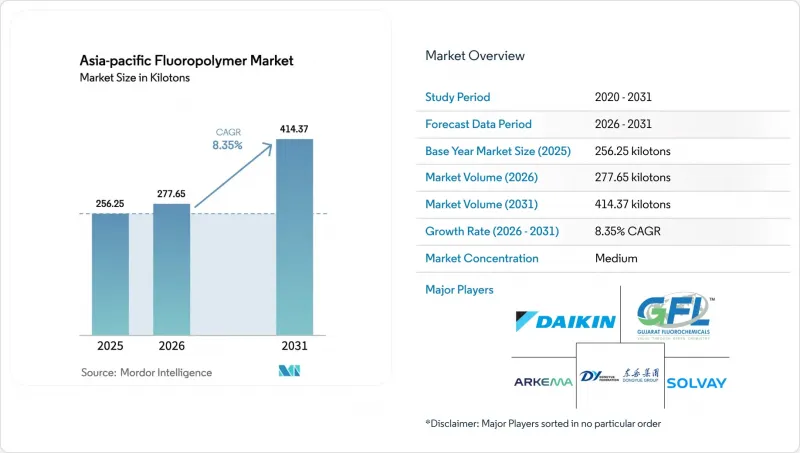
본 보고서는 수지 유형별(ETFE, FEP, PTFE, PVF, PVDF, 기타 수지), 최종 사용자 산업별(항공우주, 자동차, 건축 및 건설, 산업·기계, 기타), 지역별(중국, 인도, 일본, 한국, 호주, 말레이시아, 기타 아시아태평양)으로 분류되어 있습니다. 시장 전망은 수량(톤)과 금액(달러)으로 제시되어 있습니다.
아시아태평양 불소수지 시장 동향과 인사이트
아시아 배터리 공급망에서 전기차용 PVDF 수요 급증
2024년, 아시아태평양의 리튬 이온 배터리 생산 능력은 1,200 GWh에 달했으며, 그중 중국이 850 GWh를 차지했습니다. 이러한 규모에 대응하기 위해서는 금속 함량이 500 ppm 이하인 순도 기준을 충족하는 분리막 및 바인더용 배터리 등급 PVDF가 필요하며, 이는 산업용 등급에 비해 30% 이상의 가격 프리미엄이 발생하고 있습니다. CATL이 2027년까지 500 GWh의 증산을 계획하고 있다는 점은 공급 격차의 확대를 시사하며, 이에 따라 솔베이(Solvay)는 창수(常熟)에서 아르케마(Arkema)는 아시아태평양 전역에서 생산 능력 확충을 추진하고 있습니다. 동월 그룹(Dongyue Group) 등 중국 제조업체들은 국내 수요를 확보하고 궁극적으로는 수입품을 대체하기 위해 고순도 PVDF 전용 생산 라인을 확보하고 있습니다. 전기차용 원료의 현지화를 둘러싼 경쟁이 지속되면서 아시아태평양의 불소수지 시장이 장기적인 구조적 수요 증가로 이어지고 있습니다.
전자기기의 소형화가 고순도 PTFE 및 FEP 수요를 견인
3nm 로직 반도체, 첨단 패키징, 고주파 5G 모듈로의 전환에 따라 소모품 및 필름에 대한 10ppb 이하의 순도 요건 필요성이 더욱 높아지고 있습니다. 대만과 한국의 주요 파운드리 기업들은 극히 일부 불소수지 등급만이 충족할 수 있는 엄격한 기준을 설정하고 있습니다. 높은 가격 책정과 오염에 대한 낮은 허용도로 인해 케모어스(Chemours)와 다이킨(Daikin)은 반도체 등급 전용 생산 라인을 분리하여, 이러한 생산 라인을 일반 산업용 생산 라인에서 실질적으로 격리하게 되었습니다. 말레이시아와 태국의 수탁 제조업체들도 이에 발맞추어, 스마트폰 및 자동차용 LiDAR에 사용되는 연질 인쇄 회로 기판에 FEP 필름을 채택하고 있습니다. 따라서 아시아태평양의 불소수지 시장은 하이엔드 사양에 대한 수요와 가전 부문에서의 생산량 확대라는 두 가지 혜택을 모두 누리고 있습니다.
R-142b 및 R-22 원료 공급 상황의 변동
몬트리올 의정서 시행에 따라 2023년 이후 중국의 R-142b 생산량은 60% 감축되었고, 가격은 40% 급등하여 중소규모 불소수지 공장에 혼란이 발생하고 있습니다. 수입에 대한 의존도로 인해 생산자들은 물류 충격에 노출되어 있으며, 비-ODS(오존층 파괴 물질) 생산 라인으로의 공장 개조에는 18-24개월이 소요됩니다. 켐어즈(Chemours)나 다이킨(Daikin) 등 자체적으로 불화수소(HF) 제조 설비를 보유한 통합형 대기업은 후방 통합을 활용하여 이익률을 유지하고 있으며, 이는 시장 재편을 가속화하고 있습니다. 단기적인 가격 변동은 수주 예측의 확실성을 저해하며, 아시아태평양 불소수지 시장에서 특히 적시(JIT) 재고 관리가 필요한 전자기기 수탁 제조업체를 중심으로 하류 프로젝트의 지연을 초래할 가능성이 있습니다.
부문 분석
폴리테트라플루오로에틸렌(PTFE)은 고온 씰, 자동차용 개스킷, 화학 처리용 라이닝 용도에 힘입어 2025년 아시아태평양 불소수지 시장 점유율의 46.98%를 차지했습니다. 성숙한 최종 용도로 인해 중국, 인도, 동남아시아의 산업 생산량에 상응하는 기초적인 성장이 확보되고 있습니다. 한편, 폴리비닐리덴플루오라이드(PVDF)는 해당 지역 내 전 세계 셀 생산 능력의 70%를 차지하는 리튬 이온 배터리용 분리막 및 바인더 수요에 힘입어, 2031년까지 연평균 성장률(CAGR) 19.34%로 가장 빠른 성장을 기록할 것으로 예측됩니다. 아시아태평양의 PVDF 불소수지 시장 규모는 전기차 보급 확대와 고정형 에너지 저장 설비의 증설에 따라 확대될 것으로 예측됩니다. 불소화 에틸렌-프로파일렌(FEP)은 하이퍼스케일 데이터센터용 전선 및 케이블 절연재 분야에서 완만한 성장세를 보이고 있는 반면, ETFE의 성장은 높은 내화학성이 요구되는 건축용 필름 및 화학 탱크 라이닝에 힘입고 있습니다.
과거 비교 데이터는 이러한 변화를 여실히 보여주고 있습니다. PVDF의 연평균 성장률(CAGR)은 2019-2024년의 12.8%에서 2031년까지 19.34%로 급상승했습니다. 폴리플루오로비닐은 태양전지의 백시트나 파사드 필름을 통해 수요가 확대되고 있는 반면, 퍼플루오로알콕시나 ECTFE와 같은 틈새 소재는 반도체 웨트 벤치나 부식에 취약한 파이프라인 분야에서 입지를 다지고 있습니다. PFAS의 잔류성에 대한 규제 압력으로 인해, 분해 속도를 향상시키면서 전기화학적 안정성을 유지하는 개량형 PVDF 구조의 연구 개발이 촉진되고 있습니다. 이에 따라 각 공급업체들은 미량 금속 함유량이 100 ppb 이하인 특수 등급 개발에 자본을 투자하고 있으며, 이를 통해 아시아태평양의 불소수지 시장은 1kg당 부가가치 향상을 목표로 하고 있습니다.
기타 혜택
- 엑셀 형식 시장 예측(ME) 시트
- 3개월간의 애널리스트 지원
자주 묻는 질문
목차
제1장 서론
제2장 조사 방법
제3장 주요 요약
제4장 시장 구도
제5장 시장 규모와 성장 예측
제6장 경쟁 구도
제7장 시장 기회와 향후 전망
제8장 CEO가 직면하는 중요 전략적 과제
JHS 26.08.11According to Mordor Intelligence, the Asia-Pacific fluoropolymer market size was valued at 256.25 kilotons in 2025 and estimated to grow from 277.65 kilotons in 2026 to reach 414.37 kilotons by 2031, at a CAGR of 8.35% during the forecast period (2026-2031).
This report is Segmented by Sub-Resin Type (ETFE, FEP, PTFE, PVF, PVDF, and Other Sub-Resin Types), End-User Industry (Aerospace, Automotive, Building and Construction, Industrial and Machinery, and More), and Geography (China, India, Japan, South Korea, Australia, Malaysia, and Rest of Asia-Pacific). The Market Forecasts are Provided in Terms of Volume (Tons) and Value (USD).
Asia-Pacific Fluoropolymer Market Trends and Insights
EV-Grade PVDF Demand Surge from Asia's Battery Supply-Chain
Asia-Pacific's lithium-ion battery capacity reached 1,200 GWh in 2024, and China alone accounted for 850 GWh. This scale requires battery-grade PVDF for separators and binders that meet purity levels of under 500 ppm of metals, driving premiums of over 30% compared to industrial grades. CATL's plan to add 500 GWh by 2027 signals a widening supply gap that spurs capacity additions by Solvay in Changshu and Arkema across the region. Chinese producers such as Dongyue Group have earmarked dedicated high-purity PVDF lines to secure domestic demand and eventually displace imports. The ongoing race to localize raw materials for electric vehicles anchors the Asia-Pacific Fluoropolymer Market to long-term structural volume growth.
Electronics Miniaturization Driving High-Purity PTFE & FEP
The shift to 3-nanometer logic, advanced packaging, and high-frequency 5G modules intensifies the need for purity requirements below 10 ppb for consumables and films. Foundry giants in Taiwan and South Korea set stringent benchmarks that only a handful of fluoropolymer grades can satisfy. Premium pricing and low tolerance for contamination have encouraged Chemours and Daikin to ring-fence dedicated semiconductor-grade output, essentially quarantining these lines from bulk industrial streams. Malaysia and Thailand's contract manufacturers follow suit, adopting FEP films for flexible printed boards used in smartphones and automotive LiDAR. The Asia-Pacific Fluoropolymer Market, therefore, benefits from both top-end specification pull and volume ramp-up in the consumer electronics sector.
Volatile R-142b & R-22 Feedstock Availability
Montreal Protocol enforcement cut Chinese R-142b output by 60% since 2023, spiking prices 40% and disrupting small- and mid-tier fluoropolymer plants. Import dependence exposes producers to logistics shocks, while plant retrofits to non-ODS routes need 18-24 months. Integrated giants with captive HF units, including Chemours and Daikin, leverage backward integration to preserve margins, precipitating market consolidation. Short-term volatility affects order predictability and can delay downstream projects in the Asia-Pacific Fluoropolymer Market, particularly among electronics subcontractors that require just-in-time inventory management.
Other drivers and restraints analyzed in the detailed report include:
- Rapid Build-Out of Semiconductor Fabs in China & South Korea
- Construction Shift to ETFE/PVF Architectural Membranes
- Escalating PFAS Compliance Costs in Japan & Australia
For complete list of drivers and restraints, kindly check the Table Of Contents.
Segment Analysis
Polytetrafluoroethylene (PTFE) claimed 46.98% of the Asia-Pacific Fluoropolymer Market share in 2025, driven by its applications in high-temperature seals, automotive gaskets, and chemical-processing linings. Mature end-uses ensure baseline growth aligned with industrial output across China, India, and Southeast Asia. Meanwhile, polyvinylidene fluoride is expected to register the fastest growth, with a 19.34% CAGR to 2031, driven by the demand for lithium-ion battery separators and binders, which account for 70% of the global cell capacity in the region. The Asia-Pacific Fluoropolymer Market size for PVDF is projected to increase alongside the growth of electric vehicle penetration and the expansion of stationary storage installations. Fluorinated ethylene-propylene (FEP) gains moderate momentum in wire-and-cable insulation for hyperscale data centers, whereas ETFE growth is tied to architectural membranes and chemical-tank linings, which require elevated chemical resistance.
Historical comparisons underline the shift: PVDF's CAGR leapt from 12.8% during 2019-2024 to 19.34% through 2031. Polyvinyl fluoride strengthens via solar backsheets and facade films, while niche materials like perfluoroalkoxy and ECTFE carve a foothold in semiconductor wet benches and corrosion-prone pipelines. Regulatory pressure around PFAS persistence spurs R&D into modified PVDF architectures that degrade faster yet maintain electrochemical stability. Suppliers therefore allocate capital toward specialized grades with trace-metal thresholds under 100 ppb, positioning the Asia-Pacific Fluoropolymer Market for higher value capture per kilogram.
Complete Report Scope:
- By Sub-Resin Type
- Ethylenetetrafluoroethylene (ETFE)
- Fluorinated Ethylene-propylene (FEP)
- Polytetrafluoroethylene (PTFE)
- Polyvinyl Fluoride (PVF)
- Polyvinylidene Fluoride (PVDF)
- Other Sub-Resin Types
- By End-User Industry
- Aerospace
- Automotive
- Building and Construction
- Electrical and Electronics
- Industrial and Machinery
- Packaging
- Other End-user Industries
- By Geography
- China
- India
- Japan
- South Korea
- Australia
- Malaysia
- Rest of Asia-Pacific
List of Companies Covered in this Report:
- AGC Inc.
- Arkema
- Daikin Industries Ltd.
- Dongyue Group
- Gujarat Fluorochemicals Limited
- Halopolymer
- Kureha Corporation
- Shanghai Huayi 3F New Materials Co., Ltd.
- Sinochem Holdings
- Solvay
- Syensqo
- The Chemours Company
- Wuhan Everflon Fluoropolymers Co.,Ltd
Additional Benefits:
- The market estimate (ME) sheet in Excel format
- 3 months of analyst support
TABLE OF CONTENTS
1 Introduction
- 1.1 Study Assumptions & Market Definition
- 1.2 Scope of the Study
2 Research Methodology
3 Executive Summary
4 Market Landscape
- 4.1 Market Overview
- 4.2 Market Drivers
- 4.2.1 EV-grade PVDF demand surge from Asia's battery supply-chain
- 4.2.2 Electronics miniaturisation driving high-purity PTFE & FEP
- 4.2.3 Rapid build-out of semiconductor fabs in China & South Korea
- 4.2.4 Construction shift to ETFE/PVF architectural membranes
- 4.2.5 Sodium-ion battery separator pilots using modified PVDF
- 4.3 Market Restraints
- 4.3.1 Volatile R-142b & R-22 feedstock availability
- 4.3.2 Escalating PFAS compliance costs in Japan & Australia
- 4.3.3 Unplanned outages at key HF plants in Shandong
- 4.4 Value Chain Analysis
- 4.5 Porter's Five Forces
- 4.5.1 Threat of New Entrants
- 4.5.2 Bargaining Power of Suppliers
- 4.5.3 Bargaining Power of Buyers
- 4.5.4 Threat of Substitutes
- 4.5.5 Competitive Rivalry
- 4.6 End-use Sector Trends
- 4.6.1 Aerospace (Aerospace Component Production Revenue)
- 4.6.2 Automotive (Automobile Production)
- 4.6.3 Building and Construction (New Construction Floor Area)
- 4.6.4 Electrical and Electronics (Electrical and Electronics Production Revenue)
- 4.6.5 Packaging(Plastic Packaging Volume)
- 4.7 Import and Export Trends
- 4.8 Regulatory Framework
- 4.8.1 Australia
- 4.8.2 China
- 4.8.3 India
- 4.8.4 Japan
- 4.8.5 Malaysia
- 4.8.6 South Korea
5 Market Size & Growth Forecasts (Value and Volume)
- 5.1 By Sub-Resin Type
- 5.1.1 Ethylenetetrafluoroethylene (ETFE)
- 5.1.2 Fluorinated Ethylene-propylene (FEP)
- 5.1.3 Polytetrafluoroethylene (PTFE)
- 5.1.4 Polyvinyl Fluoride (PVF)
- 5.1.5 Polyvinylidene Fluoride (PVDF)
- 5.1.6 Other Sub-Resin Types
- 5.2 By End-User Industry
- 5.2.1 Aerospace
- 5.2.2 Automotive
- 5.2.3 Building and Construction
- 5.2.4 Electrical and Electronics
- 5.2.5 Industrial and Machinery
- 5.2.6 Packaging
- 5.2.7 Other End-user Industries
- 5.3 By Geography
- 5.3.1 China
- 5.3.2 India
- 5.3.3 Japan
- 5.3.4 South Korea
- 5.3.5 Australia
- 5.3.6 Malaysia
- 5.3.7 Rest of Asia-Pacific
6 Competitive Landscape
- 6.1 Market Concentration
- 6.2 Strategic Moves
- 6.3 Market Share (%)**/Ranking Analysis
- 6.4 Company Profiles (includes Global level Overview, Market level overview, Core Segments, Financials as available, Strategic Information, Market Rank/Share for key companies, Products & Services, and Recent Developments)
- 6.4.1 AGC Inc.
- 6.4.2 Arkema
- 6.4.3 Daikin Industries Ltd.
- 6.4.4 Dongyue Group
- 6.4.5 Gujarat Fluorochemicals Limited
- 6.4.6 Halopolymer
- 6.4.7 Kureha Corporation
- 6.4.8 Shanghai Huayi 3F New Materials Co., Ltd.
- 6.4.9 Sinochem Holdings
- 6.4.10 Solvay
- 6.4.11 Syensqo
- 6.4.12 The Chemours Company
- 6.4.13 Wuhan Everflon Fluoropolymers Co.,Ltd
7 Market Opportunities & Future Outlook
- 7.1 White-space & Unmet-Need Assessment