|
시장보고서
상품코드
2100751
LPG 탱커 시장 : 점유율 분석, 업계 동향 및 통계, 성장 예측(2026-2031년)LPG Tanker - Market Share Analysis, Industry Trends & Statistics, Growth Forecasts (2026 - 2031) |
||||||
 Mordor Intelligence
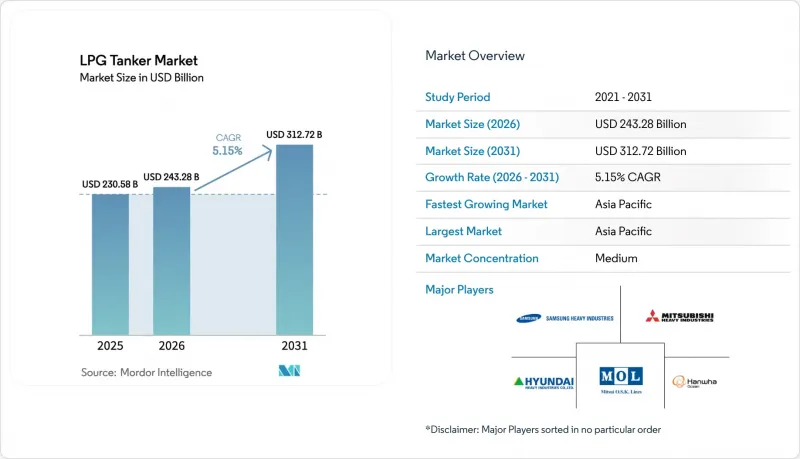
Mordor Intelligence에 의하면, LPG 탱커 시장 규모는 2025년 2,305억 8,000만 달러, 2026년 2,432억 8,000만 달러에서 2031년까지 3,127억 2,000만 달러로 확대되어 2026년부터 2031년까지 CAGR 5.15%를 나타낼 것으로 예측됩니다.
본 보고서는 선박 규모(초대형 가스 운반선, 대형 가스 운반선, 중형 가스 운반선, 소형 및 가압형), 화물 저장 시스템(완전 냉동식, 반가압/반냉동식, 완전 가압식, 에틸렌 수송 대응형), 지역(북미, 유럽, 아시아태평양, 남미, 중동 및 아프리카)별로 분류되어 있습니다. 시장 규모 및 전망은 금액(달러) 기준으로 제시되어 있습니다.
세계 LPG 탱커 시장 동향 및 인사이트
미국산 셰일가스 수출량 증가
미국의 셰일가스 생산량 급증으로 인해, 미국은 LPG 탱커 시장의 스윙 공급자로서의 입지를 확고히 하며, 태평양 항로에서 중동산 화물의 점유율을 빼앗고 있습니다. 엔터프라이즈 프로덕츠 파트너스(Enterprise Products Partners)는 2024년에 몬트 벨뷰 터미널의 처리 능력을 하루 30만 배럴 확대하고, 중국 및 인도의 구매자들과 장기 공급 계약을 체결했습니다. 멕시코만에서 출발하는 추가 화물 1건당, 북동아시아까지의 항로는 약 13,000해리에 달하는데, 이는 아라비아만에서 출발하는 6,500해리에 비해 장거리이며, 왕복 항해당 40일 동안 VLGC(초대형 LPG 탱커)공급 여력을 실질적으로 압박하게 됩니다. 미국 에너지정보청(EIA)은 헨리 허브의 가스 가격이 1MMBtu당 3달러 미만을 유지하는 한, 수출용 LPG는 계속 증가할 것이며 건전한 차익거래 기회가 유지될 것으로 전망하고 있습니다. 연방 정부의 허가 절차 지연으로 인해 멕시코만 연안의 신규 터미널 건설이 연기될 가능성은 있으나, 현행 양자 간 인수 계약에 따라 기준 운송량은 확보되어 있습니다. 그 결과, 톤마일 수요는 견조한 추세를 보이고 있으며, 선주들은 유리한 조건의 정기 용선 계약을 체결할 수 있게 되어 LPG 탱커 시장의 중기 전망에 대한 신뢰가 높아지고 있습니다.
신흥 아시아 국가들의 가정용 난방 및 조리용 LPG 수요 증가
도시화가 진행됨에 따라 중국, 인도, 아세안(ASEAN) 국가들의 수백만 가구가 바이오매스나 석탄에서 LPG 가스레인지로 전환하고 있습니다. 이러한 전환은 LPG 탱커 시장에 유리하게 작용하는 보조금 프로그램과 대기질 규제에 힘입어 가속화되고 있습니다. 이러한 가정용 수요 전환은 가격 탄력성이 비교적 낮기 때문에 원유 지표 가격이 변동하더라도 수송량 증가세는 유지될 것입니다. 중국은 2024년에 1,500만 톤 규모의 PDH 및 스팀 크래커 설비를 가동함에 따라 수입 수요를 확대하고, 연간 LPG 해상 수요 전망치를 3,600만 톤으로 상향 조정했습니다. 대륙간 운송에 따른 수요 증가는 VLGC(초대형 LPG 탱커)를 흡수하는 한편, 이후 연안 지역으로의 재분배에는 중형 가스 운반선이 활용되므로 각 선종에 이용률 향상이라는 혜택이 미치고 있습니다. 또한, 신흥 아시아 수요 기반은 미국 멕시코만 연안 및 캐나다산으로공급원 다각화를 통해 공급 선택지가 확대됨에 따라, 중동의 지정학적 혼란으로 인한 영향 위험을 경감시킵니다. 이러한 수요 측면의 펀더멘털이 종합적으로 작용하여, 향후 LPG 탱커 시장 성장의 상당 부분을 지탱하는 기반이 되고 있습니다.
변동이 심한 벙커유 및 원유 가격
2024년, VLSFO가 톤당 500-700달러 범위에서 등락했을 때, 벙커비는 항해 경비의 30-40%를 차지했으며, LPG 탱커 시장에 진출한 기업들의 수익은 원유 가격 변동에 좌우되었습니다. 비듀얼 연료 선박은 가격 급등 시 저렴한 화물 보일오프 가스로 전환할 수 없기 때문에 여전히 위험에 노출되어 있습니다. 브렌트 원유 가격은 2025년 내내 배럴당 70-90달러 사이에서 변동하며, 운임의 손익분기점 변동 폭을 확대시켰습니다. 선주들은 연료비 조정 조항을 포함하거나 다년간의 용선 계약을 체결함으로써 수익을 보호하고 있지만, 이러한 헤지 전략은 현물 시장의 유동성을 저하시키고 시장 가격 형성을 제한하고 있습니다. 연료비 급등은 PDH 크래커의 마진을 압박하며, 때로는 프로판 수입량이나 화물 운송량을 감소시키기도 합니다. 그럼에도 불구하고, 가정용 LPG 수요의 견조함이 기초적인 운송량을 뒷받침하고 있어, LPG 탱커 시장에 미치는 전반적인 부정적 영향을 완화하고 있습니다.
부문 분석
80,000 m³를 초과하는 VLGC는 2025년에 LPG 탱커 시장 점유율의 35.5%를 차지할 것으로 예상되며, 2031년까지 연평균 5.7%의 성장률을 보일 전망입니다. 이는 대륙 간 항로에서 타의 추종을 불허하는 톤당 운송 경제성을 반영한 것입니다. 최신 VLGC 설계는 네오파나막스 폭 제한 내에서 91,000-93,000 m³을 적재할 수 있도록 되어 있으며, 파나마 운하를 통과함으로써 미국에서 아시아까지의 항해 일수를 12-15일 단축하고, 연료 소비량을 15-20% 절감할 수 있습니다. BW LPG와 같은 컨소리데이터는 아반스 가스(Avance Gas)사의 VLGC 12척을 10억 5,000만 달러에 인수한 것을 계기로, 선단 규모를 활용해 조선소의 건조 할당량 및 연료 가격 인하 협상을 진행하며 지배력을 강화하고 있습니다. 대조적으로, 60,000-80,000 m³ 규모의 대형 가스 운반선(LGC)은 선저 깊이 제한으로 인해 VLGC의 운항이 불가능한 지중해나 동남아시아의 항만을 담당하고 있으며, 반면, 20,000-60,000 m³ 규모의 중형 가스 운반선(MGC)은 지역 내 무역 및 연안 지역의 재분배 역할을 담당하고 있습니다. 20,000 m³ 미만의 틈새 시장인 소형·가압 탱커는 도서 지역으로의 운송에 있어 구조적인 범용성이 높지만, 승무원 비용 상승과 운임 프리미엄을 잠식하는 IMO의 더욱 엄격해진 효율 곡선에 직면해 있습니다. 전반적으로 규모의 경제, 부두 접근성, 그리고 연료 절감을 위한 개조가 VLGC를 LPG 탱커 시장의 중심에 자리매김하게 하고 있습니다.
2세대 VLGC에서는 듀얼 연료 주기관이나 화물의 보일오프를 추진 연료로 재활용하는 샤프트 발전기를 탑재하는 사례가 늘고 있습니다. 이 기술을 통해 휴스턴-닝보 간 왕복 항해 시 하루 약 15메트르톤의 VLSFO를 절약할 수 있습니다. 구형 VLGC를 개조하는 데는 선박당 700만-900만 달러의 비용이 소요되지만, 이를 통해 CII(선박 배출 지수) 준수 기간이 연장되고, 정기 용선료 프리미엄이 하루당 4,000-5,000달러 상승합니다. 초대형 에탄/에틸렌 운반선(VLEC)에 대한 병행된 관심은 선체의 공통점을 부각시키고 있습니다. 강한국소가 ADNOC L&S 및 완화화학(Wanhua Chemical)으로부터 수주한 VLEC 9척 및 초대형 암모니아 운반선 4척에 대한 총액 19억 달러 규모의 계약은 듀얼 서비스 설계에 대한 수요 증가를 반영하고 있습니다. 적재 기술의 상호 활용을 통해 차익 거래 동향에 따라 프로판, 부탄, 에탄, 에틸렌의 적재물을 전환할 수 있게 되어 선박의 재판매 가치가 높아집니다. 그 결과, 선주들은 VLGC와 VLEC를 서로 보완하는 선단으로 인식하고 있으며, 이러한 요인들이 맞물려 LPG 탱커 시장의 중기적인 성장세를 뒷받침하고 있습니다.
지역별 분석
2025년에는 아시아태평양이 LPG 탱커 시장 규모의 38.1%를 차지하며 수익의 대부분을 차지했습니다. PDH(프로판 탈수소화) 플랜트의 가동 개시 및 가정 내 보급 확대로 수입 수요가 확대되어 연평균 성장률(CAGR)은 6.0%로 성장을 지속하고, 있습니다. 중국에서는 2024년부터 2025년까지 중류 부문의 인프라 구축이 진행되어 전용 LPG 터미널이 6곳 증설되었으며, VLGC 및 VLEC를 통한 운송에 적합한 대규모 화물 수송이 가능해졌습니다. 인도에서는 2025년까지 저소득 가구 9,000만 가구를 대상으로 실린더에 대한 보조금 지급 범위를 확대하여, 도시 지역의 조리용 연료로서 LPG의 입지를 공고히 했습니다. 아세안(ASEAN) 국가들, 특히 인도네시아와 베트남에서는 소형 실린더의 유통이 확대되고 있어, MGC 및 얕은 수심 항구에 대응하는 가압식 운반선에 대한 수요를 뒷받침하고 있습니다. 일본과 한국은 성숙한 수요 기반을 유지하고 있지만, 양국의 재수출 허브를 통해 화물의 일부가 태평양 제도 지역으로 재분배되고 있어, 이로 인해 단거리 운송 수요가 유지되고 있습니다.
북미는 LPG 탱커 시장 공급 거점 역할을 하고 있으며, 2025년에는 장거리 순수출의 50% 이상을 차지할 전망입니다. 엔터프라이즈 프로덕츠(Enterprise Products)의 몬트 벨뷰(Mont Bellevue) 확장 계획과 타가 리소시스(Targa Resources)의 생산 능력 증강은 모두 2024년에 완료될 예정이며, 주로 아시아로 수출될 프로판 플러스 제품의 일일 생산량을 40만 배럴 증가시킬 것으로 전망됩니다. 캐나다 리들리 섬 프로판 수출 터미널은 태평양 항로의 짧은 거리를 활용하여 일본으로 향하는 연안 탱커의 정기 운항을 유지하고 있습니다. 멕시코는 계속해서 순수입국이며, 미국 멕시코만 연안에서 선적되는 가압식 연안 탱커를 통해 공급받고 있습니다.
유럽 수요는 제재로 인해 러시아의 발트해 및 흑해에서공급이 위축됨에 따라, 미국 멕시코만 및 알제리에서의 수입으로 전환되고 있습니다. 독일, 프랑스, 영국은 분기당 총 170만 톤을 넘는 계절적 피크 수요를 흡수하고 있으며, 핸디사이즈 가압 탱커에 대한 주변 수요를 견인하고 있습니다. 남미에서는 공급 상황에 편차가 나타나고 있습니다. 브라질의 건기 동안 실린더 판매는 중형 탱커의 용선을 촉진하는 한편, 칠레는 벙커링 및 재분배의 거점 역할을 하고 있습니다.
중동 및 아프리카에서는 양극화된 경향이 나타납니다. 사우디아라비아와 아랍에미리트는 아시아로 프로판을 수송하고 있으며, 이들의 장기 용선 계약이 해당 지역의 톤마일 수를 뒷받침하고 있습니다. 대조적으로, 남아프리카, 케냐 및 서아프리카 국가들은 라고스와 몸바사의 항만 시설 확충을 배경으로, 가압식 탱커를 통해 실린더를 수입하고 있습니다. 나이지리아의 NLNG 보니 확장 계획에 따라 2026년에는 LPG 수출량이 증가할 전망이지만, 내전 위험으로 인해 선적이 간헐적으로 중단될 가능성이 있습니다. 전반적으로, 지리적 분산 덕분에 LPG 탱커 시장은 국지적인 충격으로부터 보호받고 있으며, 전 세계 선박 운항 상황의 균형이 유지되고 있습니다.
기타 혜택:
- 엑셀 형식 시장 예측(ME) 시트
- 3개월간의 애널리스트 지원
목차
제1장 서론
제2장 조사 방법
제3장 주요 요약
제4장 시장 구도
제5장 시장 규모와 성장 예측
제6장 경쟁 구도
제7장 시장 기회와 향후 전망
JHSAccording to Mordor Intelligence, the LPG tanker market size is projected to expand from USD 230.58 billion in 2025 and USD 243.28 billion in 2026 to USD 312.72 billion by 2031, registering a CAGR of 5.15% between 2026 to 2031.
This report is Segmented by Vessel Size (Very Large Gas Carrier, Large Gas Carrier, Medium Gas Carrier, and Small and Pressurized), Cargo Containment System (Fully Refrigerated, Semi-pressurized/Semi-refrigerated, Fully Pressurized, and Ethylene-Capable), and Geography (North America, Europe, Asia-Pacific, South America, and Middle East and Africa). The Market Size and Forecasts are Provided in Terms of Value (USD)
Global LPG Tanker Market Trends and Insights
Growing Shale-Gas Export Volumes from the United States
Surging U.S. shale output has positioned the country as the swing supplier for the LPG tanker market, displacing Middle Eastern cargoes on Pacific trades. Enterprise Products Partners expanded Mont Belvieu terminal capacity by 300,000 barrels per day in 2024, binding long-term volumes to Chinese and Indian buyers. Each additional Gulf cargo travels roughly 13,000 nautical miles to Northeast Asia, versus 6,500 nautical miles from the Arabian Gulf, effectively tightening the VLGC pool for 40 days per round voyage. The U.S. Energy Information Administration projects outbound LPG to keep climbing while Henry Hub gas prices stay under USD 3 per MMBtu, sustaining healthy arbitrage windows. Although federal permitting delays could defer Gulf Coast greenfield terminals, prevailing bilateral offtake agreements protect baseline flows. As a result, tonne-mile demand stays buoyant, enabling shipowners to lock in premium period charters and reinforcing confidence in the LPG tanker market's mid-term trajectory.
Rising LPG Demand for Domestic Heating & Cooking in Emerging Asia
Urbanization drives millions of households in China, India, and ASEAN states to swap biomass and coal for LPG stoves, a transition championed by subsidy programs and air-quality mandates that favor the LPG tanker market. This household shift is relatively price inelastic, protecting volume growth even when crude benchmarks swing. China augmented import requirements after commissioning 15 million tonnes of PDH and steam-cracker capacity in 2024, lifting its annual LPG seaborne demand forecast to 36 million tonnes. Intercontinental lifts absorb VLGCs, whereas subsequent coastal redistribution relies on medium gas carriers, spreading utilization benefits across fleet classes. The emerging Asia demand pool also dampens exposure to Middle East geopolitical interruptions because diversification toward U.S. Gulf and Canadian cargos broadens supply options. Collectively, these consumer-side fundamentals anchor a sizeable portion of future LPG tanker market growth.
Volatile Bunker-Fuel & Crude-Oil Prices
Bunker expenses absorbed 30-40% of voyage outlays in 2024 when VLSFO ranged USD 500-700 per tonne, yoking earnings for LPG tanker market participants to crude price swings. Non-dual-fuel vessels remain exposed because they cannot pivot to cheaper cargo boil-off gas during spikes. Brent oscillated between USD 70 and 90 per barrel through 2025, widening volatility bands for freight breakevens. Owners shelter earnings by inserting bunker-adjustment clauses and locking multiyear charters, but such hedges thin spot liquidity, limiting market discovery. Higher fuel costs also compress PDH cracker margins, occasionally trimming propane imports and cargo movements. Even so, resilience in household LPG demand shelters baseline flows, tempering the overall drag on the LPG tanker market.
Other drivers and restraints analyzed in the detailed report include:
- Expansion of Downstream PDH & Petrochemical Capacity
- IMO CII Rules Accelerating Replacement with Fuel-Efficient VLGCs
- Geopolitical Chokepoint Disruptions (Hormuz, Red Sea)
For complete list of drivers and restraints, kindly check the Table Of Contents.
Segment Analysis
VLGCs larger than 80,000 m3 captured 35.5% of the LPG tanker market share in 2025 and will grow 5.7% annually through 2031, reflecting unrivaled per-ton transport economics on intercontinental routes. Modern VLGC designs now load 91,000-93,000 m3 within Neopanamax beam limits, enabling Panama Canal transits that shave 12-15 days off US-to-Asia voyages and lower fuel burn 15-20%. Consolidators such as BW LPG, following its USD 1.05 billion purchase of 12 Avance Gas VLGCs, leverage fleet scale to bargain down dockyard slots and bunker prices, reinforcing dominance. In contrast, Large Gas Carriers (LGCs) of 60,000-80,000 m3 serve Mediterranean and Southeast Asian ports where draft constraints rule out VLGCs, while Medium Gas Carriers (MGCs) between 20,000-60,000 m3 handle intra-regional trades and coastal redistribution. Niche Small & Pressurized tankers below 20,000 m3, although structurally versatile for island chains, contend with rising crew costs and stricter IMO efficiency curves that erode rate premiums. Altogether, scale efficiencies, slot access, and fuel-saving retrofits anchor VLGCs at the heart of the LPG tanker market.
Second-generation VLGCs increasingly feature dual-fuel main engines and shaft generators that repurpose cargo boil-off as propulsion fuel, a technology that saves roughly 15 metric tonnes of VLSFO per day on a Houston-Ningbo round trip. Retrofitting older VLGCs costs USD 7-9 million per hull but extends CII compliance windows and lifts time-charter premiums by USD 4,000-5,000 per day. Parallel interest in very large ethane/ethylene carriers (VLECs) underscores hull commonality; Jiangnan Shipyard's USD 1.9 billion contract for 9 VLECs and 4 very large ammonia carriers for ADNOC L&S and Wanhua Chemical reflects growing appetite for dual-service designs. The cross-pollination of containment technology boosts resale values because vessels can switch between propane, butane, ethane, or ethylene cargoes as arbitrages evolve. Consequently, owners view VLGCs and VLECs as complementary tonnage pools that collectively reinforce the medium-term momentum of the LPG tanker market.
Complete Report Scope:
- By Vessel Size
- Very Large Gas Carrier (Above 80k m3)
- Large Gas Carrier (60 to 80k m3)
- Medium Gas Carrier (20 to 60k m3)
- Small and Pressurized (Up to 20k m3)
- By Cargo Containment System
- Fully Refrigerated
- Semi-pressurized/Semi-refrigerated
- Fully Pressurized
- Ethylene-capable (Extra-Refrigerated)
- By Geography
- North America
- United States
- Canada
- Mexico
- Europe
- Germany
- United Kingdom
- France
- Italy
- NORDIC Countries
- Russia
- Rest of Europe
- Asia-Pacific
- China
- India
- Japan
- South Korea
- ASEAN Countries
- Australia and New Zealand
- Rest of Asia-Pacific
- South America
- Brazil
- Argentina
- Chile
- Rest of South America
- Middle East and Africa
- Saudi Arabia
- United Arab Emirates
- South Africa
- Nigeria
- Rest of Middle East and Africa
- North America
Geography Analysis
Asia-Pacific dominated revenue with 38.1% of the LPG tanker market size in 2025, growing at a 6.0% CAGR as PDH start-ups and household adoption broaden import appetite. China's midstream build-out added 6 dedicated LPG terminals over 2024-2025, supporting larger parcel sizes that prefer VLGC or VLEC lifts. India extended subsidized cylinder coverage to 90 million low-income households by 2025, cementing LPG as the preferred urban cooking fuel. ASEAN economies, notably Indonesia and Vietnam, expand small cylinder distribution, anchoring demand for MGCs and pressurized carriers serving shallow-draft ports. Japan and South Korea maintain mature baseline requirements, but their re-export hubs redistribute partial cargoes to Pacific islands, sustaining short-haul fixtures.
North America sits at the supply center of the LPG tanker market, accounting for more than 50% of net long-haul exports in 2025. Enterprise Products' Mont Belvieu expansion and Targa Resources' capacity lift, both completed in 2024, promise an additional 400,000 bpd of propane-plus output, mainly destined for Asia. Canada's Ridley Island Propane Export Terminal logs steady coastal tanker rotations to Japan, leveraging shorter Pacific routes. Mexico remains a net importer served by pressurized coastal tankers operating from U.S. Gulf loadings.
Europe's demand has tilted toward imports from the U.S. Gulf and Algeria after sanctions squeezed Russian Baltic and Black Sea flows. Germany, France, and the United Kingdom absorb combined seasonal peaks exceeding 1.7 million tonnes per quarter, driving fringe demand for handy-sized pressurized carriers. South America displays patchy flows; Brazil's dry-season cylinder sales spur medium carrier charters, while Chile functions as a bunkering and redistribution node.
Middle East and Africa present a dualistic pattern. Saudi Arabia and the United Arab Emirates ship propane to Asia, exercising term charters that anchor regional tonne-miles. In contrast, South Africa, Kenya, and West African nations import cylinders via pressurized carriers, supported by port upgrades in Lagos and Mombasa. Nigeria's NLNG Bonny expansion promises incremental LPG export barrels in 2026, yet civil unrest risks could intermittently disrupt loadings. Overall, geographic diversification cushions the LPG tanker market against localized shocks, sustaining a balanced global employment landscape.
- Samsung Heavy Industries Co. Ltd
- HD Hyundai Heavy Industries Co. Ltd
- Hanwha Ocean Co. Ltd
- Mitsubishi Heavy Industries Ltd
- Kawasaki Heavy Industries Ltd
- Jiangnan Shipyard (Group) Co. Ltd
- K Shipbuilding Co. Ltd
- Japan Marine United Corp.
- BW LPG Ltd
- Dorian LPG Ltd
- Avance Gas Holding Ltd
- Petredec Holdings (Eastern) Pte Ltd
- Exmar NV
- Seapeak LLC
- Epic Gas Ltd
- Eastern Pacific Shipping Pte Ltd
- NYK Line
- K Line (Kawasaki Kisen Kaisha)
- China Merchants Energy Shipping Co. Ltd
- Tianjin Southwest Maritime Co. Ltd
Additional Benefits:
- The market estimate (ME) sheet in Excel format
- 3 months of analyst support
TABLE OF CONTENTS
1 Introduction
- 1.1 Study Assumptions & Market Definition
- 1.2 Scope of the Study
2 Research Methodology
3 Executive Summary
4 Market Landscape
- 4.1 Market Overview
- 4.2 Market Drivers
- 4.2.1 Growing shale-gas export volumes from the United States
- 4.2.2 Rising LPG demand for domestic heating & cooking in emerging Asia
- 4.2.3 Expansion of downstream propane-dehydrogenation & petrochemical capacity
- 4.2.4 IMO CII rules accelerating replacement with fuel-efficient VLGCs
- 4.2.5 Adoption of LPG as a low-carbon marine bunker fuel
- 4.2.6 Larger Neopanamax transit slots on the Panama Canal lowering tonne-mile costs
- 4.3 Market Restraints
- 4.3.1 Volatile bunker-fuel & crude-oil prices
- 4.3.2 Geopolitical chokepoint disruptions (Hormuz, Red Sea, etc.)
- 4.3.3 Competition from carbon-neutral gases (ammonia, methanol) in future fuel mix
- 4.3.4 Environmental-permitting delays for new US Gulf export terminals
- 4.4 Supply-Chain Analysis
- 4.5 Regulatory Landscape
- 4.6 Technological Outlook
- 4.7 Porter's Five Forces
- 4.7.1 Bargaining Power of Suppliers
- 4.7.2 Bargaining Power of Buyers
- 4.7.3 Threat of New Entrants
- 4.7.4 Threat of Substitutes
- 4.7.5 Intensity of Rivalry
5 Market Size & Growth Forecasts
- 5.1 By Vessel Size
- 5.1.1 Very Large Gas Carrier (Above 80k m3)
- 5.1.2 Large Gas Carrier (60 to 80k m3)
- 5.1.3 Medium Gas Carrier (20 to 60k m3)
- 5.1.4 Small and Pressurized (Up to 20k m3)
- 5.2 By Cargo Containment System
- 5.2.1 Fully Refrigerated
- 5.2.2 Semi-pressurized/Semi-refrigerated
- 5.2.3 Fully Pressurized
- 5.2.4 Ethylene-capable (Extra-Refrigerated)
- 5.3 By Geography
- 5.3.1 North America
- 5.3.1.1 United States
- 5.3.1.2 Canada
- 5.3.1.3 Mexico
- 5.3.2 Europe
- 5.3.2.1 Germany
- 5.3.2.2 United Kingdom
- 5.3.2.3 France
- 5.3.2.4 Italy
- 5.3.2.5 NORDIC Countries
- 5.3.2.6 Russia
- 5.3.2.7 Rest of Europe
- 5.3.3 Asia-Pacific
- 5.3.3.1 China
- 5.3.3.2 India
- 5.3.3.3 Japan
- 5.3.3.4 South Korea
- 5.3.3.5 ASEAN Countries
- 5.3.3.6 Australia and New Zealand
- 5.3.3.7 Rest of Asia-Pacific
- 5.3.4 South America
- 5.3.4.1 Brazil
- 5.3.4.2 Argentina
- 5.3.4.3 Chile
- 5.3.4.4 Rest of South America
- 5.3.5 Middle East and Africa
- 5.3.5.1 Saudi Arabia
- 5.3.5.2 United Arab Emirates
- 5.3.5.3 South Africa
- 5.3.5.4 Nigeria
- 5.3.5.5 Rest of Middle East and Africa
- 5.3.1 North America
6 Competitive Landscape
- 6.1 Market Concentration
- 6.2 Strategic Moves (M&A, Partnerships, PPAs)
- 6.3 Market Share Analysis (Market Rank/Share for key companies)
- 6.4 Company Profiles (includes Global level Overview, Market level overview, Core Segments, Financials as available, Strategic Information, Products & Services, and Recent Developments)
- 6.4.1 Samsung Heavy Industries Co. Ltd
- 6.4.2 HD Hyundai Heavy Industries Co. Ltd
- 6.4.3 Hanwha Ocean Co. Ltd
- 6.4.4 Mitsubishi Heavy Industries Ltd
- 6.4.5 Kawasaki Heavy Industries Ltd
- 6.4.6 Jiangnan Shipyard (Group) Co. Ltd
- 6.4.7 K Shipbuilding Co. Ltd
- 6.4.8 Japan Marine United Corp.
- 6.4.9 BW LPG Ltd
- 6.4.10 Dorian LPG Ltd
- 6.4.11 Avance Gas Holding Ltd
- 6.4.12 Petredec Holdings (Eastern) Pte Ltd
- 6.4.13 Exmar NV
- 6.4.14 Seapeak LLC
- 6.4.15 Epic Gas Ltd
- 6.4.16 Eastern Pacific Shipping Pte Ltd
- 6.4.17 NYK Line
- 6.4.18 K Line (Kawasaki Kisen Kaisha)
- 6.4.19 China Merchants Energy Shipping Co. Ltd
- 6.4.20 Tianjin Southwest Maritime Co. Ltd
7 Market Opportunities & Future Outlook
- 7.1 White-space & Unmet-Need Assessment