|
시장보고서
상품코드
2113194
환자 레지스트리 소프트웨어 : 시장 점유율 분석, 업계 동향과 통계, 성장 예측(2026-2031년)Patient Registry Software - Market Share Analysis, Industry Trends & Statistics, Growth Forecasts (2026 - 2031) |
||||||
 Mordor Intelligence
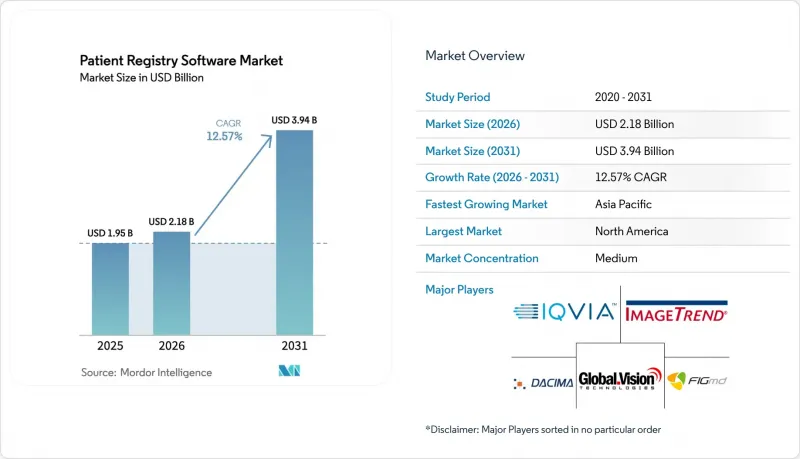
Mordor Intelligence에 따르면 환자 레지스트리 소프트웨어 시장 규모는 2025년 19억 5,000만 달러, 2026년 21억 8,000만 달러에서 2031년까지 39억 4,000만 달러로 확대할 것으로 예측되고 있으며, 2026-2031년에 CAGR은 12.57%에 달할 전망입니다.
이 보고서는 레지스트리 유형(질환 레지스트리 등), 소프트웨어 솔루션(독립형, 통합형 EHR 등), 최종사용자(병원·의료 시스템 등) 및 지역(북미, 유럽, 아시아태평양, 중동 및 아프리카, 남미)별로 분류되어 있습니다. 시장 예측은 금액(달러) 기준으로 제시되어 있습니다.
글로벌 환자 레지스트리 소프트웨어 시장의 동향 및 인사이트
정부 주도의 구상 시행 및 대규모 환자 레지스트리에 대한 자금 지원
공적 자금을 통해 레지스트리는 선택적 툴에서 규정 준수를 위한 필수 요건으로 변모하고 있습니다. 2025년 12월에 시작된 FDA의 TEMPO 파일럿 프로그램을 통해 의료기기 제조업체는 구조화된 레지스트리 제출을 통해 모니터링 의무를 이동할 수 있게 되었으며, 이는 후원사에게 약 30%의 비용 절감으로 이어지고 있습니다. 호주의 National Cancer Data Framework는 2025년에 보조금을 배정하여 공유형 종양 레지스트리 플랫폼의 시범 운영과 방사선 진단 보고서에서 진단시 병기 정보를 자동으로 추출하는 작업을 추진하고 있습니다. 유럽의약품청(EMA)의 DARWIN EU 네트워크 내에서는 1억 6,000만 명의 환자를 포괄하는 30개의 데이터 파트너가 다국적 연구를 위해 OMOP 형식의 데이터세트를 내보낼 수 있는 레지스트리를 현재 찾고 있습니다. 인도의 Ayushman Bharat Digital Mission에서는 65억 건 이상의 의료 기록을 고유 식별자와 연계하고, 레지스트리 활용을 공공 부문 계약의 필수 요건으로 규정하고 있습니다. 이러한 프로그램들은 전반적으로 조달 주기를 가속화하고, 즉시 사용 가능한 FHIR 및 OMOP 커넥터를 제공하는 공급업체를 우대하고 있습니다.
전자건강기록(EHR)의 보급 확대 및 상호운용성 의무화
2025년 8월에 발효되는 ONC HTI-4 최종 규정은 USCDI를 버전 4로 확장하고, 조회 및 동의 API에 관한 정보 차단 금지 조항을 통해 레지스트리 벤더에게 표준화된 데이터에 대한 실시간 접근 권한을 제공했습니다. 2024년 12월부터 운영 중인 TEFCA는 전국 규모의 쿼리 기반 데이터 교환 플랫폼을 제공하여, 레지스트리가 개별 데이터 이용 계약을 체결하지 않고도 경과 시간별 기록을 확보할 수 있도록 하고 있습니다. 미시간주의 CHRONICLE 시범 사업에서는 HL7 ADT 피드를 통해 만성질환 레지스트리에 대규모로 데이터를 수집할 수 있음이 입증되었으나, ICD-10 코딩의 비일관성이 여전히 분석의 걸림돌이 되고 있습니다. 이러한 추세를 반영하여 Oracle Health 등 기존 EHR 벤더들은 기존 고객 기반을 유지하고 증가하는 데이터 흐름에서 수익을 창출하기 위해 레지스트리 모듈을 통합했습니다. 그 결과, FHIR과의 호환성은 입찰의 핵심 요건이 되었습니다.
데이터 공유 생태계의 확대에 따른 개인정보 보호 및 데이터 보안에 대한 우려
2024년 2월에 발생한 Change Healthcare의 랜섬웨어 공격(1억 건의 기록이 영향을 받음)으로 인해 HIPAA 및 GDPR에 따른 제3자 처리 업체에 대한 감시가 강화되었습니다. Ascension Health가 2024년에 겪은 사이버 공격은 상호 연결된 시스템의 운영상 취약성을 드러냈습니다. 2025년 아일랜드 레지스트리 태스크포스가 지적했듯이, EU와 미국의 규제가 분열되어 있으며, 다국적 레지스트리의 가동 시작까지 3-6개월의 지연이 발생하고 있습니다. TEFCA의 환자 접근 기능은 신원 확인에 관한 법적 책임을 수반하지만, 소규모 공급업체의 경우 이를 감당하기 어렵습니다. 그 결과, 많은 후원자들이 데이터를 병원 서버에 보관하는 분리형 아키텍처를 요구하고 있으며, 이로 인해 총 소유 비용이 15-20% 증가하여 예산이 제한된 지역 사회에서의 도입이 더뎌지고 있습니다.
부문 분석
TEMPO 시범 사업을 통해 산부인과 의료기기 스폰서가 시판 후 안전성 평가에 레지스트리 데이터를 활용할 수 있게 되어 규정 준수 기간이 단축됨에 따라 임신 및 모자 레지스트리는 2031년까지 14.65%라는 가장 높은 연평균 성장률(CAGR)을 기록했습니다. Coordinated Registry Network의 FHIR 가이드라인에 따라 레지스트리별 구축 비용이 25% 추가로 절감되어, 여러 후원사 간의 협력이 가능해졌습니다. 질환 레지스트리는 성숙한 종양학 및 순환기 시스템에 기반하여 2025년 환자 레지스트리 소프트웨어 시장 점유율의 42.45%를 계속 차지하고 있습니다. 그러나 희귀 질환에 대한 규제적 중점화로 인해 임신 레지스트리는 지속적인 우위를 유지할 것으로 예상됩니다.
종양학 레지스트리는 여전히 가장 큰 질환 하위 부문이지만, 구조적 심장 중재술 데이터세트가 성숙해짐에 따라 심혈관 코호트는 빠르게 확대되고 있습니다. 당뇨병 레지스트리는 의료기기 데이터와의 통합을 추진하고 있으며, 희귀질환 그룹은 ERDRI를 통해 유럽 24개국에서 협력하고 있습니다. 임플란트 제품 레지스트리는 EU의 조건부 승인과 함께 탄력을 받고 있으며, 품질 개선 프로그램은 실시간 의사결정 지원 엔진으로 진화하고 있습니다.
지역별 분석
북미는 여전히 가장 큰 지역이며, CMS의 품질 프로그램과 ACC의 다기관 심혈관 네트워크에 힘입어 2025년 매출의 44.32%를 차지하고 있습니다. HTI-4 및 TEFCA를 통해 데이터 교환의 마찰이 크게 완화된 반면, 캐나다 각 주에서는 앨버타주의 Netcare 플랫폼과 같은 통합 기록 시스템으로의 통합이 진행되고 있습니다. 그러나 미국의 의료 시스템은 예산 압박 속에서 새로운 레지스트리 도입보다 EHR 최적화를 우선시하고 있으며, 성장이 둔화되고 있습니다.
아시아태평양은 성장세가 가장 두드러지는 지역으로, 2031년까지 연평균 성장률(CAGR) 13.54%로 확대되고 있습니다. 인도의 ABDM은 65억 건의 의료 기록을 연계하여 FHIR 호환 레지스트리를 위한 방대한 대상 코호트를 창출하고 있습니다. 호주의 National Cancer Data Framework는 공유 플랫폼에 자금을 지원하고 있으며, 중국에서는 지방 레지스트리 도입이 의무화됨에 따라 현지화 제약이 있음에도 불구하고 수요가 확대되고 있습니다. 일본에서는 마이넘버 건강 카드의 보급이 진행되고 있으며, 한자나 히라가나 데이터를 지원할 수 있는 레지스트리 구축 기반이 마련되어 있습니다.
유럽은 환자 레지스트리 소프트웨어 시장의 약 25%를 차지하고 있습니다. EHDS 규정에 따르면 2029년까지 2차 조사용 OMOP 데이터세트를 레지스트리에서 내보내는 것이 의무화되어 있으며, 이로 인해 개방적이고 클라우드 네이티브 아키텍처로의 업그레이드가 촉진되고 있습니다. 아일랜드의 2025년 로드맵에서는 비용을 분담하기 위해 5개 질환 영역에 걸친 클라우드 허브 구축이 제안되어, 지역적 통합이 더욱 진전될 것임을 시사하고 있습니다. GDPR로 인해 규정 준수 비용은 증가하고 있지만, 의사 익명화 및 연합 쿼리에 관한 명확한 지침이 제시됨에 따라 도입이 가속화되고 있습니다. 중동 및 아프리카, 남미의 신흥 시장은 여전히 발전 단계에 있지만, 클라우드 인프라를 기반으로 한 실증 실험이 진행되고 있습니다.
기타 혜택:
- 엑셀 형식의 시장 예측(ME) 시트
- 3개월간의 애널리스트 지원
자주 묻는 질문
목차
제1장 서론
제2장 조사 방법
제3장 개요
제4장 시장 구도
제5장 시장 규모와 성장 예측
제6장 경쟁 구도
제7장 시장 기회와 향후 전망
KSA 26.08.25According to Mordor Intelligence, the patient registry software market size is projected to expand from USD 1.95 billion in 2025 and USD 2.18 billion in 2026 to USD 3.94 billion by 2031, registering a CAGR of 12.57% between 2026 to 2031.
This report is Segmented by Type of Registry (Disease, and More), Software Solution (Stand-Alone, Integrated EHR-Embedded, and More), End User (Hospitals & Health Systems, and More), and Geography (North America, Europe, Asia-Pacific, Middle East and Africa, and South America). The Market Forecasts are Provided in Terms of Value (USD).
Global Patient Registry Software Market Trends and Insights
Implementation of Government Initiatives and Funding for Large-Scale Patient Registries
Public funding is transforming registries from discretionary tools into compliance requisites. The FDA's TEMPO pilot, launched in December 2025, enables device makers to fulfill surveillance duties through structured registry submissions, resulting in approximately 30% cost savings for sponsors. Australia's National Cancer Data Framework earmarked grants in 2025 to test a shared oncology-registry platform and automate stage-at-diagnosis capture from radiology reports. Within the European Medicines Agency's DARWIN EU network, 30 data partners covering 160 million lives now require registries that export OMOP-formatted datasets for multinational studies. India's Ayushman Bharat Digital Mission has linked over 6.5 billion health records to unique identifiers, making registry enablement a prerequisite for public-sector contracts. Collectively, these programs accelerate procurement cycles and favor vendors that ship out-of-the-box FHIR and OMOP connectors.
Rising Adoption of Electronic Health Records and Interoperability Mandates
The ONC HTI-4 Final Rule, effective August 2025, expanded the USCDI to version 4 and prohibited information blocking for matching and consent APIs, providing registry vendors with real-time access to standardized data . TEFCA, operational since December 2024, provides a nationwide query-based exchange, enabling registries to pull longitudinal records without one-off data-use agreements. Michigan's CHRONICLE pilot proved that HL7 ADT feeds can populate chronic-disease registries at scale, although inconsistent ICD-10 coding still hampers analytics. Faced with this momentum, EHR incumbents, such as Oracle Health, embedded registry modules to defend their installed bases and monetize incremental data flows. FHIR compatibility has therefore become a core requirement for tenders.
Privacy and Data-Security Concerns Amid Expanding Data-Sharing Ecosystems
Change Healthcare's February 2024 ransomware breach, affecting 100 million records, heightened scrutiny of third-party processors under HIPAA and GDPR. Ascension Health's 2024 cyberattack exposed the operational fragility of interconnected systems. Fragmented EU and U.S. rules add 3-6 months to the activation of multinational registries, as Ireland's registry task force observed in 2025. TEFCA's patient-access features introduce identity-proofing liabilities that smaller vendors struggle to absorb. Consequently, many sponsors demand federated architectures that keep data on hospital servers, adding 15-20% to the total cost of ownership and slowing uptake among budget-constrained societies.
Other drivers and restraints analyzed in the detailed report include:
- Increasing Utilization of Registry Data for Post-Marketing Surveillance and Real-World Evidence
- Growth of Chronic-Disease Burden Requiring Longitudinal Outcomes Tracking
- Shortage of Trained Clinical Abstractors and Informatics Personnel
For complete list of drivers and restraints, kindly check the Table Of Contents.
Segment Analysis
Pregnancy and maternal-child registries experienced the fastest 14.65% CAGR to 2031, following the TEMPO pilot, which enabled obstetric-device sponsors to rely on registry data for post-market safety, thereby reducing compliance timelines. The Coordinated Registry Network's FHIR guide further cut per-registry setup costs by 25% and enabled multi-sponsor collaboration. Disease registries retained 42.45% of the 2025 patient registry software market share, anchored by mature oncology and cardiovascular systems. Yet the regulatory tilt toward rare exposures favors pregnancy registries for sustained outperformance.
Oncology registries remain the largest disease sub-segment, while cardiovascular cohorts rapidly expand as structural-heart intervention data sets mature . Diabetes registries address device-data integration, and rare-disease groups collaborate across 24 European nations through ERDRI. Product registries for implants gain traction with EU conditional approvals, and quality-improvement programs evolve into real-time decision-support engines.
Complete Report Scope:
- By Type Of Registry
- Disease Registries
- Health Service Registries
- Product Registries
- Quality Improvement Registries
- Pregnancy & Maternal-Child Registries
- By Software Solution
- Stand-Alone Registry Software
- Integrated EHR-Embedded Software
- Cloud-Deployed SaaS Platforms
- On-Premise Installed Systems
- By End User
- Hospitals & Health Systems
- Government Agencies & Third-Party Administrators
- Pharmaceutical, Biotechnology & Medical-Device Firms
- Research Institutes & Academic Medical Centers
- Other End Users
- Geography
- North America
- United States
- Canada
- Mexico
- Europe
- Germany
- United Kingdom
- France
- Italy
- Spain
- Rest Of Europe
- Asia-Pacific
- China
- Japan
- India
- Australia
- South Korea
- Rest Of Asia-Pacific
- Middle East And Africa
- GCC
- South Africa
- Rest Of Middle East And Africa
- South America
- Brazil
- Argentina
- Rest Of South America
- North America
Geography Analysis
North America remained the largest region, accounting for 44.32% of the 2025 revenue, supported by CMS quality programs and the ACC's multi-hospital cardiovascular network. HTI-4 and TEFCA sharply reduce data-exchange friction, while Canadian provinces consolidate on integrated records such as Alberta's Netcare platform. Growth slows, however, as U.S. health systems prioritize EHR optimization over new registry rollouts amid budget pressure.
Asia-Pacific is the fastest-growing geography, advancing at a 13.54% CAGR through 2031. India's ABDM has linked 6.5 billion health records, creating vast addressable cohorts for FHIR-enabled registries. Australia's National Cancer Data Framework funds shared platforms, and China's provincial-registry mandates expand demand despite localization constraints. Japan's expansion of My Number health cards underpins registry readiness that accommodates kanji and hiragana data.
Europe accounts for approximately 25% of the patient registry software market. EHDS rules require registries to export OMOP datasets for secondary research by 2029, driving upgrades to open, cloud-native architectures. Ireland's 2025 roadmap proposes a cloud hub across five disease areas to share costs, signaling broader regional consolidation. GDPR raises compliance expenses, yet clarity on pseudonymisation and federated queries speeds adoption. Emerging markets in the Middle East, Africa, and South America remain nascent but show proof-of-concept pilots supported by cloud infrastructure.
- ArborMetrix
- Armus Corporation
- Axis Clinical Software Inc.
- BayaTree LLC
- CardioPulse (Intelligent Business Solutions)
- Carta Healthcare
- Cerner
- Dacima Software
- Epic Systems
- FIGmd
- Global Vision Technologies
- IBM
- ImageTrend Inc.
- Intelerad (LUMEDX) Corporation
- IQVIA
- Mckesson
- PatientIQ
- Q-Centrix LLC
- Syneos Health
- Velos
Additional Benefits:
- The market estimate (ME) sheet in Excel format
- 3 months of analyst support
TABLE OF CONTENTS
1 Introduction
- 1.1 Study Assumptions & Market Definition
- 1.2 Scope of the Study
2 Research Methodology
3 Executive Summary
4 Market Landscape
- 4.1 Market Overview
- 4.2 Market Drivers
- 4.2.1 Implementation of Government Initiatives and Funding for Large-Scale Patient Registries
- 4.2.2 Rising Adoption of Electronic Health Records and Interoperability Mandates
- 4.2.3 Increasing Utilization of Registry Data for Post-Marketing Surveillance and Real-World Evidence
- 4.2.4 Growth of Chronic Disease Burden Requiring Longitudinal Outcomes Tracking
- 4.2.5 Emergence of AI-Powered Automated Abstraction Reducing Registry Costs
- 4.2.6 Transition Toward Patient-Generated Health Data Integration from Wearables and Mobile Apps
- 4.3 Market Restraints
- 4.3.1 Privacy and Data Security Concerns Amid Expanding Data Sharing Ecosystems
- 4.3.2 Shortage of Trained Clinical Abstractors and Informatics Personnel
- 4.3.3 Vendor Lock-In and Interoperability Gaps Between Specialty Registries
- 4.3.4 Variable Registry Data Quality Undermining Reimbursement Tied to Outcomes
- 4.4 Value / Supply-Chain Analysis
- 4.5 Regulatory Landscape
- 4.6 Technological Outlook
- 4.7 Porter's Five Forces Analysis
- 4.7.1 Threat Of New Entrants
- 4.7.2 Bargaining Power Of Buyers/Consumers
- 4.7.3 Bargaining Power Of Suppliers
- 4.7.4 Threat Of Substitute Products
- 4.7.5 Intensity Of Competitive Rivalry
5 Market Size & Growth Forecasts (Value, USD)
- 5.1 By Type Of Registry
- 5.1.1 Disease Registries
- 5.1.2 Health Service Registries
- 5.1.3 Product Registries
- 5.1.4 Quality Improvement Registries
- 5.1.5 Pregnancy & Maternal-Child Registries
- 5.2 By Software Solution
- 5.2.1 Stand-Alone Registry Software
- 5.2.2 Integrated EHR-Embedded Software
- 5.2.3 Cloud-Deployed SaaS Platforms
- 5.2.4 On-Premise Installed Systems
- 5.3 By End User
- 5.3.1 Hospitals & Health Systems
- 5.3.2 Government Agencies & Third-Party Administrators
- 5.3.3 Pharmaceutical, Biotechnology & Medical-Device Firms
- 5.3.4 Research Institutes & Academic Medical Centers
- 5.3.5 Other End Users
- 5.4 Geography
- 5.4.1 North America
- 5.4.1.1 United States
- 5.4.1.2 Canada
- 5.4.1.3 Mexico
- 5.4.2 Europe
- 5.4.2.1 Germany
- 5.4.2.2 United Kingdom
- 5.4.2.3 France
- 5.4.2.4 Italy
- 5.4.2.5 Spain
- 5.4.2.6 Rest Of Europe
- 5.4.3 Asia-Pacific
- 5.4.3.1 China
- 5.4.3.2 Japan
- 5.4.3.3 India
- 5.4.3.4 Australia
- 5.4.3.5 South Korea
- 5.4.3.6 Rest Of Asia-Pacific
- 5.4.4 Middle East And Africa
- 5.4.4.1 GCC
- 5.4.4.2 South Africa
- 5.4.4.3 Rest Of Middle East And Africa
- 5.4.5 South America
- 5.4.5.1 Brazil
- 5.4.5.2 Argentina
- 5.4.5.3 Rest Of South America
- 5.4.1 North America
6 Competitive Landscape
- 6.1 Market Concentration
- 6.2 Market Share Analysis
- 6.3 Company Profiles {(Includes Global Level Overview, Market Level Overview, Core Segments, Financials as Available, Strategic Information, Market Rank/Share for Key Companies, Products & Services, and Recent Developments)}
- 6.3.1 ArborMetrix
- 6.3.2 Armus Corporation
- 6.3.3 Axis Clinical Software Inc.
- 6.3.4 BayaTree LLC
- 6.3.5 CardioPulse (Intelligent Business Solutions)
- 6.3.6 Carta Healthcare
- 6.3.7 Cerner Corporation
- 6.3.8 Dacima Software Inc.
- 6.3.9 Epic Systems Corporation
- 6.3.10 FIGmd Inc.
- 6.3.11 Global Vision Technologies Inc.
- 6.3.12 IBM Corporation
- 6.3.13 ImageTrend Inc.
- 6.3.14 Intelerad (LUMEDX) Corporation
- 6.3.15 IQVIA
- 6.3.16 McKesson Corporation
- 6.3.17 PatientIQ
- 6.3.18 Q-Centrix LLC
- 6.3.19 Syneos Health
- 6.3.20 Velos Inc.
7 Market Opportunities & Future Outlook
- 7.1 White-Space & Unmet-Need Assessment