

|
시장보고서
상품코드
2113203
급성 골수성 백혈병 치료 : 시장 점유율 분석, 업계 동향과 통계, 성장 예측(2026-2031년)Acute Myeloid Leukemia Therapeutics - Market Share Analysis, Industry Trends & Statistics, Growth Forecasts (2026 - 2031) |
||||||
 Mordor Intelligence
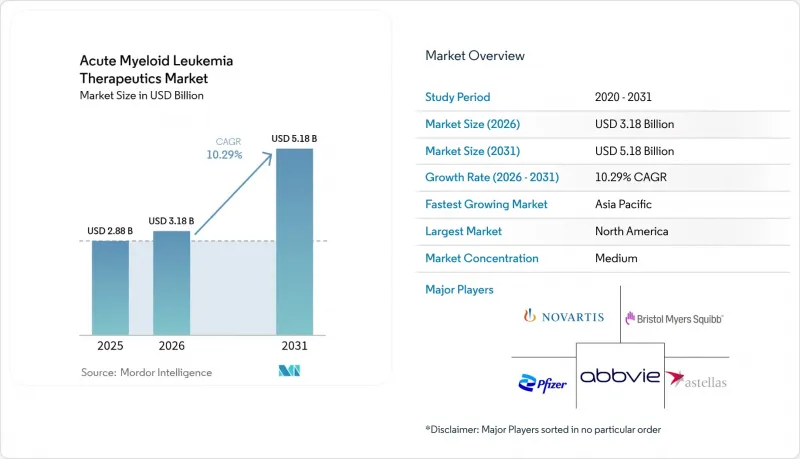
Mordor Intelligence에 따르면 급성 골수성 백혈병 치료 시장 규모는 2025년에 28억 8,000만 달러로 평가되며, 2026년 31억 8,000만 달러에서 2031년까지 51억 8,000만 달러에 달할 것으로 예측되고 있으며, 예측 기간(2026-2031년)에 CAGR은 10.29%에 달할 전망입니다.
이 보고서는 치료법별(화학요법, 표적요법 등), 작용 기전/분자 표적별(FLT3 억제제, IDH1/2 억제제 등), 환자 연령대별(소아, 성인 등),치료 단계별(1차 치료, 2차 치료 등), 최종사용자별(병원, 전문 종양 센터 등) 및 지역별로 분류되어 있습니다. 시장 예측은 금액(달러) 기준으로 제시되어 있습니다.
전 세계 급성 골수성 백혈병(AML) 치료 시장의 동향 및 인사이트
고령화에 따른 AML 발병률 상승
전 세계 평균 수명의 연장에 따라 AML 발병 위험이 가장 높은 65세 이상 환자층이 확대되고 있습니다. 이 환자층의 발병률 증가는 부작용이 적으면서도 강력한 치료 요법에 대한 수요를 가속화하고 있으며, 이 틈새 시장은 현재 베네토클락스를 기반으로 한 경구 병용 요법으로 충족되고 있습니다. 실제 임상에서 허약한 환자 집단에서 이 요법은 73%의 전체 반응률을 보고하고 있습니다. 외래에서 투여가 가능하므로 병원의 부담이 경감되고 지역적 접근 범위도 넓어짐에 따라 고령 환자층에서 연평균 성장률(CAGR) 12.42%를 견인하고 있습니다. 고령자에 대한 기준선 혈액 검사를 권장하는 국가의 선별 검사 정책으로 인해 진단되는 환자 수는 더욱 증가하고 있습니다.
FLT3/IDH/BCL-2 억제제에 대한 정밀 의료 승인
변이 특이적 약물은 1차 치료의 기준을 새롭게 바꾸고 있습니다. 레브메닙은 KMT2A 재조합 백혈병에 대해 승인된 최초의 메닌 억제제가 되었으며, 한편 키자르티닙은 1차 화학요법과 병용 투여했을 때 FLT3-ITD 양성 질환에서 전체 생존 기간의 중앙값을 거의 2배로 연장했습니다. 이러한 데이터에 대한 규제 당국의 신뢰를 바탕으로 각 기업은 적응증 확대 및 동반 진단제 도입을 추진하고 있으며, 그 결과 치료제 및 검사 분야의 수익에 시너지 효과가 발생하고 있습니다.
엄격한 다단계 임상시험에서의 중도 탈락률
AML의 생물학적 다양성으로 인해 대규모의 계층화된 임상시험이 요구되지만, 여기에는 피험자 모집의 병목 현상과 비용 급증이라는 과제가 수반됩니다. Moleculin사의 MIRACLE 임상시험은 여러 대륙에 걸쳐 유전자 변이가 일치하는 피험자를 모집하는 데 따르는 어려움을 여실히 보여주며, 이러한 장벽이 개발 기간을 연장시키고 비용을 증가시키고 있습니다. 투자자들은 이러한 위험을 자금 조달 조건에 반영하고 있으며, 파이프라인 확대를 지연시킬 가능성이 있습니다.
부문별 분석
2025년 기준, 급성 골수성 백혈병 치료 시장의 44.78%를 화학요법이 차지했으나, 면역요법의 연평균 성장률(CAGR) 12.14%가 향후 매출 성장률을 좌우할 것입니다. CD371을 표적으로 하는 CAR-T 세포 및 CD33-GSPT1 항체-약물 접합체에 대한 초기 임상 데이터는 세포독성 요법이 효과가 없는 재발 환자군에서 지속적인 관해가 관찰된다는 것을 보여줍니다. 또한 줄기세포 이식 전처치에서도 트레오설판과 플루다라빈의 병용 요법이 FDA 승인을 받음으로써 정밀 의학의 시대로 접어들었습니다. 이 요법은 기존의 부설판 프로토콜에 비해 우수한 장기 생존율을 보여줍니다.
투자 자금의 유입이 이러한 추세를 지원하고 있습니다. 브리스톨 마이어스 스큅(Bristol Myers Squibb)사는 여러 면역 경로를 포착하기 위해 세포 치료 사업과 항체-약물 접합체를 통합하고 있으며, 학술 컨소시엄에서는 항원 상실로 인한 재발을 방지하기 위한 이중 항원 CAR의 설계가 연구되고 있습니다. 현재 지지요법의 혁신은 사이토카인 방출 억제에 초점을 맞추고 있으며, 이를 통해 외래 치료의 적용 범위가 확대되고 있습니다. 따라서 치료제의 구성 비율은 표적 지향성 저분자 약물과 원활하게 통합되는 면역 조절제로 꾸준히 전환되어 급성 골수성 백혈병 치료 시장을 확대해 나갈 것입니다.
2025년에는 FLT3 억제제가 작용 기전별 점유율의 23.21%를 차지한 반면, BCL-2 하위 분류는 저메틸화제와의 병용으로 인한 베네토클락스의 견고한 완전 관해 깊이에 힘입어 13.22%라는 가장 높은 연평균 성장률(CAGR)을 기록했습니다. 레브메닙의 승인으로 메닌 억제가 새로운 작용 기전의 시대를 열었으며, 치료의 틀을 키나아제나 후성유전학적 표적의 범위를 넘어 확장시키고 있습니다.
각 개발사가 클론 탈출을 방지하기 위해 BCL-2 억제와 FLT3 또는 IDH 억제를 병용함으로써 파이프라인의 시너지 효과가 배가되고 있습니다. 헤지호그 및 CD33 경로는 미세잔류병변(MRD)을 표적으로 하는 병용 요법에서 전략적 중요성을 유지하고 있습니다. 그 결과, 단일 자산에 전적으로 의존하기보다는 다양한 표적 포트폴리오를 보유한 개발 기업이 해당 기간 중 급성 골수성 백혈병 치료 시장의 규모 확대로 인한 혜택을 최대한 활용할 수 있는 입장에 있습니다.
지역별 분석
2025년, 북미는 급성 골수성 백혈병 치료 시장의 43.12%를 차지했습니다. 미국은 견실한 민간 및 공적 보험 환급, 광범위한 의무 검사, 그리고 신청부터 임상 현장 도입까지의 기간을 단축하는 FDA의 신속 승인 절차를 통해 이러한 우위를 주도하고 있습니다. ‘임상시험 연합(Alliance for Clinical Trials)’과 같은 학술 네트워크는 소규모 병원을 전국적인 연구로 연결하여 임상시험 피험자 모집을 가속화하고 조기 접근 기회를 확대하고 있습니다. 세포 치료 우수 센터는 활기찬 연계 생태계의 기반이 되어, 고부가가치 치료법이 지속적으로 채택되도록 보장하고 있습니다. 캐나다도 유사한 진료 양상을 보이고 있지만, 때때로 보험 적용 리스트 등재가 지연되는 문제에 직면하고 있습니다. 한편, 멕시코는 국경을 초월한 임상시험 참여를 통해 접근성을 개선하고 있습니다. 전반적으로 이 지역은 2030년까지 이러한 성장세를 유지할 것으로 예상됩니다. 이는 지불 기관의 정책이 탁월한 가치를 입증하는 정밀 의료 접근법을 점점 더 지지하고 있기 때문입니다.
유럽은 매출 기준 2위를 차지하고 있으며, EMA(유럽의약품청)의 통합 승인 제도를 활용하여 의약품의 접근성을 통일하고 있습니다. 독일이나 영국 등의 시장에서는 엄격한 의료기술 평가를 통해 비용 대비 효과가 입증된 후, 새로 승인된 치료법이 신속하게 도입되고 있습니다. EMA가 최근 Rytelo와 CRISPR 기반 치료제인 Casgevy를 승인한 것은 혁신적인 치료법을 지원하겠다는 의지를 보여주는 사례입니다. 각국의 유전체 전략을 통해 NGS 패널에 대한 자금이 확보됨에 따라 변이 유형에 맞는 치료법이 적격 환자에게 확실하게 제공되고 있습니다. 남유럽 국가들은 예산 제약으로 인해 도입 속도가 완만하지만, 수량에 따른 할인을 협상하는 EU의 공동 조달 구상의 혜택을 받고 있습니다. 전반적으로 유럽의 증거 중심 환경은 안정적인 성장을 지원하며, 메커니즘 검증에 필수적인 임상시험의 다양성을 촉진하고 있습니다.
아시아태평양에서는 의료 인프라의 현대화와 진단 능력 확대에 힘입어 11.95%라는 가장 높은 연평균 성장률(CAGR)을 기록하고 있습니다. 일본의 국민건강보험 제도에서는 승인된 의약품이 신속하게 보험 적용되지만, 현지 연구에서는 전 세계의 치료법을 아시아인의 대사 프로파일에 맞춰 적용하고 있습니다. 중국의 국내 혁신 기업은 정부 자금을 활용하여 국제적인 3상 임상시험에 참여하고 있으며, 생존율 측면에서 서구의 벤치마크에 필적하거나 이를 능가하는 것을 목표로 하고 있습니다. 인도에서는 외래 환자 대상 베네토클락스 치료 프로토콜의 비용 대비 효과가 입증되어, 자원이 제한된 환경에서도 정밀 의료의 실현이 가능해졌습니다. 호주와 한국은 해당 지역내 승인을 목표로 하는 다국적 기업에게 임상 시험의 관문 역할을 하고 있습니다. 중동 및 아프리카는 여전히 발전 단계에 있지만, 진단 실험실 건설 및 단계적 가격 책정 협상을 진행하는 민관 파트너십을 통해 꾸준한 진전을 보이고 있습니다. 이러한 동향들이 맞물려 급성 골수성 백혈병 치료 시장을 새로운 고성장 분야로 끌어올리고 있습니다.
기타 혜택:
- 엑셀 형식의 시장 예측(ME) 시트
- 3개월간의 애널리스트 지원
자주 묻는 질문
목차
제1장 서론
제2장 조사 방법
제3장 개요
제4장 시장 구도
제5장 시장 규모와 성장 예측
제6장 경쟁 구도
제7장 시장 기회와 향후 전망
KSA 26.08.25According to Mordor Intelligence, the acute myeloid leukemia therapeutics market size was valued at USD 2.88 billion in 2025 and estimated to grow from USD 3.18 billion in 2026 to reach USD 5.18 billion by 2031, at a CAGR of 10.29% during the forecast period (2026-2031).
This report is Segmented by Therapy Class (Chemotherapy, Targeted Therapy, and More), Mechanism / Molecular Target (FLT3 Inhibitors, IDH1/2 Inhibitors and More), Patient Age Group (Paediatric, Adults and More), Tretament Line(First-Line, Second-Line and More), End User (Hospitals, Specialty Oncology Centres and More) and Geography. The Market Forecasts are Provided in Terms of Value (USD).
Global Acute Myeloid Leukemia Therapeutics Market Trends and Insights
Rising Incidence Of AML Among Ageing Populations
Global life expectancy gains widen the pool of patients over 65 years who are most susceptible to AML. The incidence in this cohort accelerates demand for gentler yet potent regimens, a niche currently filled by venetoclax-based oral combinations that report an overall response rate of 73% in real-world frail cohorts. Outpatient-enabled dosing reduces hospital burden and widens geographic reach, driving a 12.42% CAGR among geriatric patients. National screening policies that encourage baseline bloodwork in seniors further enlarge the diagnosed population.
Precision-Medicine Approvals For FLT3/IDH/BCL-2 Inhibitors
Mutation-specific drugs are rewriting first-line standards. Revumenib became the first menin inhibitor approved for KMT2A-rearranged leukemia, while quizartinib nearly doubled median overall survival in FLT3-ITD-positive disease when paired with backbone chemotherapy. Regulatory confidence in these data spurs companies to broaden label indications and bundle companion diagnostics, resulting in a multiplier effect across therapeutic and testing revenues.
Stringent Multi-Phase Clinical-Trial Attrition
AML's biological diversity demands large, stratified trials that encounter enrollment bottlenecks and soaring costs. Moleculin's MIRACLE study highlights the challenge of recruiting mutation-matched subjects across multiple continents, a hurdle that prolongs timelines and increases costs. Investors price this risk into financing terms, potentially slowing pipeline expansion.
Other drivers and restraints analyzed in the detailed report include:
- Escalating Global R&D Investments & Venture Financing
- Expedited FDA/EMA Pathways & Orphan-Drug Incentives
- Severe Chemo-Toxicity & Treatment-Related Mortality
For complete list of drivers and restraints, kindly check the Table Of Contents.
Segment Analysis
Chemotherapy controlled 44.78% of the acute myeloid leukemia therapeutics market in 2025, yet immunotherapy's 12.14% CAGR defines the future revenue slope. Early clinical data on CD371-directed CAR-T cells and CD33-GSPT1 antibody-drug conjugates demonstrate durable remissions in relapsed populations where cytotoxic therapies fail. Stem-cell transplant conditioning also entered the precision era with FDA approval of treosulfan plus fludarabine, a regimen that produces superior long-term survival compared with older busulfan protocols.
Investment inflows sustain this momentum. Bristol Myers Squibb aligns its cell-therapy franchise with antibody conjugates to capture multiple immune pathways, and academic consortia explore dual-antigen CAR designs to bypass antigen-loss relapse. Supportive-care innovations now focus on mitigating cytokine release, thereby broadening eligibility for outpatient administration. The therapy-class mix will therefore shift steadily toward immune-modulating agents that integrate seamlessly with targeted small molecules, expanding the acute myeloid leukemia therapeutics market.
FLT3 inhibitors held 23.21% mechanism-level share in 2025, yet the BCL-2 subclass posts the sharpest 13.22% CAGR, propelled by venetoclax's robust complete-remission depth when combined with hypomethylating agents. Menin inhibition inaugurates a new mechanistic era after revumenib's approval, broadening therapeutic geometry beyond kinase or epigenetic targets.
Pipeline synergies multiply as developers pair BCL-2 blockade with FLT3 or IDH inhibition to forestall clonal escape. Hedgehog and CD33 pathways retain strategic relevance in combination cocktails aimed at minimal residual disease. Consequently, sponsors with diversified target portfolios, rather than single-asset bets, are positioned to capitalize on the projected gains in the acute myeloid leukemia therapeutics market size for the period.
Complete Report Scope:
- By Therapy Class
- Chemotherapy
- Targeted Therapy
- Immunotherapy (incl. CAR-T, bispecifics)
- Stem-cell Transplant
- Supportive / Others
- By Mechanism / Molecular Target
- FLT3 Inhibitors
- IDH1/2 Inhibitors
- BCL-2 Inhibitors
- Hedgehog Pathway Inhibitors
- CD33-Directed Antibody-Drug Conjugates
- By Patient Age Group
- Paediatric (<18 yrs)
- Adults (18-64 yrs)
- Geriatric (>=65 yrs)
- By Treatment Line
- First-line
- Second-line/Relapsed
- Maintenance
- By End User
- Hospitals
- Specialty Oncology Centres
- Academic & Research Institutes
- Home/Out-patient Settings
- By Geography
- North America
- United States
- Canada
- Mexico
- Europe
- Germany
- United Kingdom
- France
- Italy
- Spain
- Rest of Europe
- Asia-Pacific
- China
- Japan
- India
- Australia
- South Korea
- Rest of Asia-Pacific
- Middle East and Africa
- GCC
- South Africa
- Rest of Middle East and Africa
- South America
- Brazil
- Argentina
- Rest of South America
- North America
Geography Analysis
North America captured 43.12% of the acute myeloid leukemia therapeutics market in 2025. The United States drives this dominance through robust private and public reimbursement, widespread mandatory testing, and rapid FDA pathways that reduce the time from submission to bedside. Academic networks such as the Alliance for Clinical Trials link smaller hospitals into nationwide studies, accelerating trial recruitment and broadening early access. Cellular-therapy centers of excellence anchor a thriving referral ecosystem, ensuring continued uptake of high-value interventions. Canada mirrors practice patterns but faces occasional formulary lags. At the same time, Mexico improves access through participation in cross-border clinical trials. Collectively, the region is expected to maintain momentum through 2030, as payer policies increasingly endorse precision approaches that demonstrate superior value.
Europe ranks second by revenue, leveraging centralized EMA approvals to harmonize drug availability. Markets such as Germany and the United Kingdom rapidly integrate newly authorized therapies after rigorous health technology appraisals validate their cost-effectiveness. Recent EMA endorsements of Rytelo and the CRISPR-derived Casgevy illustrate a willingness to back transformative modalities. National genomic strategies fund NGS panels, ensuring that mutation-matched therapies reach eligible patients. Southern European countries adopt at a measured pace due to budget constraints, yet benefit from EU joint procurement initiatives that negotiate volume-based discounts. Overall, Europe's evidence-driven environment sustains stable growth and drives clinical trial diversity, which is essential for mechanistic validation.
Asia-Pacific logs the highest 11.95% CAGR as healthcare infrastructure modernizes and diagnostic capacity expands. Japan's universal coverage rapidly reimburses approved agents, while local studies adapt global regimens to Asian metabolic profiles. China's domestic innovators are leveraging government funding to enter Phase 3 international trials, aiming to match or exceed Western benchmarks in survival rates. India proves the cost-effectiveness of outpatient venetoclax protocols, making precision care viable even in lower-resource settings. Australia and South Korea serve as gateways for clinical trials for multinationals targeting regional approval. The Middle East and Africa remain nascent but show incremental progress through public-private partnerships that build diagnostic labs and negotiate tiered pricing. Together, these trends propel theacute myeloid leukemia therapeutics market into new high-growth territories.
- Abbvie
- Amgen
- Astellas Pharma
- AstraZeneca
- Bristol Myers Squibb / Celgene
- Daiichi Sankyo
- Roche
- Genmab
- Gilead
- Jazz Pharmaceuticals
- Johnson & Johnson
- Novartis
- Otsuka
- Pfizer
- Sanofi
- Sunesis Pharmaceuticals
- Syndax Pharmaceuticals
- Takeda Pharmaceuticals
- Teva Pharmaceutical Industries
- Oncolyze
Additional Benefits:
- The market estimate (ME) sheet in Excel format
- 3 months of analyst support
TABLE OF CONTENTS
1 Introduction
- 1.1 Study Assumptions and Market Definition
- 1.2 Scope of the Study
2 Research Methodology
3 Executive Summary
4 Market Landscape
- 4.1 Market Overview
- 4.2 Market Drivers
- 4.2.1 Rising Incidence Of AML Among Ageing Populations
- 4.2.2 Precision-Medicine Approvals For FLT3/IDH/BCL-2 Inhibitors
- 4.2.3 Escalating Global R&D Investments & Venture Financing
- 4.2.4 Expedited FDA/EMA Pathways & Orphan-Drug Incentives
- 4.2.5 Outpatient Venetoclax-Based Regimens Expanding Treatable Pool
- 4.2.6 Wider Adoption Of NGS Companion Diagnostics In Emerging Markets
- 4.3 Market Restraints
- 4.3.1 Stringent Multi-Phase Clinical-Trial Attrition
- 4.3.2 Severe Chemo-Toxicity & Treatment-Related Mortality
- 4.3.3 Cold-Chain/IP Barriers Limiting Novel-Drug Access In Lmics
- 4.3.4 Rising Cost Burden Of Genomics-Driven Care
- 4.4 Value / Supply-Chain Analysis
- 4.5 Regulatory Landscape
- 4.6 Technology Outlook
- 4.7 Porter's Five Forces Analysis
- 4.7.1 Bargaining Power of Suppliers
- 4.7.2 Bargaining Power of Buyers
- 4.7.3 Threat of New Entrants
- 4.7.4 Threat of Substitutes
- 4.7.5 Intensity of Competitive Rivalry
5 Market Size and Growth Forecasts (Value-USD)
- 5.1 By Therapy Class
- 5.1.1 Chemotherapy
- 5.1.2 Targeted Therapy
- 5.1.3 Immunotherapy (incl. CAR-T, bispecifics)
- 5.1.4 Stem-cell Transplant
- 5.1.5 Supportive / Others
- 5.2 By Mechanism / Molecular Target
- 5.2.1 FLT3 Inhibitors
- 5.2.2 IDH1/2 Inhibitors
- 5.2.3 BCL-2 Inhibitors
- 5.2.4 Hedgehog Pathway Inhibitors
- 5.2.5 CD33-Directed Antibody-Drug Conjugates
- 5.3 By Patient Age Group
- 5.3.1 Paediatric (<18 yrs)
- 5.3.2 Adults (18-64 yrs)
- 5.3.3 Geriatric (>=65 yrs)
- 5.4 By Treatment Line
- 5.4.1 First-line
- 5.4.2 Second-line/Relapsed
- 5.4.3 Maintenance
- 5.5 By End User
- 5.5.1 Hospitals
- 5.5.2 Specialty Oncology Centres
- 5.5.3 Academic & Research Institutes
- 5.5.4 Home/Out-patient Settings
- 5.6 By Geography
- 5.6.1 North America
- 5.6.1.1 United States
- 5.6.1.2 Canada
- 5.6.1.3 Mexico
- 5.6.2 Europe
- 5.6.2.1 Germany
- 5.6.2.2 United Kingdom
- 5.6.2.3 France
- 5.6.2.4 Italy
- 5.6.2.5 Spain
- 5.6.2.6 Rest of Europe
- 5.6.3 Asia-Pacific
- 5.6.3.1 China
- 5.6.3.2 Japan
- 5.6.3.3 India
- 5.6.3.4 Australia
- 5.6.3.5 South Korea
- 5.6.3.6 Rest of Asia-Pacific
- 5.6.4 Middle East and Africa
- 5.6.4.1 GCC
- 5.6.4.2 South Africa
- 5.6.4.3 Rest of Middle East and Africa
- 5.6.5 South America
- 5.6.5.1 Brazil
- 5.6.5.2 Argentina
- 5.6.5.3 Rest of South America
- 5.6.1 North America
6 Competitive Landscape
- 6.1 Market Concentration
- 6.2 Market Share Analysis
- 6.3 Company profiles (includes Global level Overview, Market level overview, Core Segments, Financials as available, Strategic Information, Market Rank/Share for key companies, Products and Services, and Recent Developments)
- 6.3.1 AbbVie
- 6.3.2 Amgen
- 6.3.3 Astellas Pharma
- 6.3.4 AstraZeneca
- 6.3.5 Bristol Myers Squibb / Celgene
- 6.3.6 Daiichi Sankyo
- 6.3.7 F. Hoffmann-La Roche
- 6.3.8 Genmab
- 6.3.9 Gilead
- 6.3.10 Jazz Pharmaceuticals
- 6.3.11 Johnson & Johnson (Janssen)
- 6.3.12 Novartis
- 6.3.13 Otsuka Holdings
- 6.3.14 Pfizer
- 6.3.15 Sanofi
- 6.3.16 Sunesis Pharmaceuticals
- 6.3.17 Syndax Pharmaceuticals
- 6.3.18 Takeda
- 6.3.19 Teva Pharmaceutical
- 6.3.20 Oncolyze
7 Market Opportunities and Future Outlook
- 7.1 White-Space and Unmet-Need Assessment


