

|
시장보고서
상품코드
2113221
자동차용 에어 서스펜션 : 시장 점유율 분석, 업계 동향과 통계, 성장 예측(2026-2031년)Automotive Air Suspension - Market Share Analysis, Industry Trends & Statistics, Growth Forecasts (2026 - 2031) |
||||||
 Mordor Intelligence
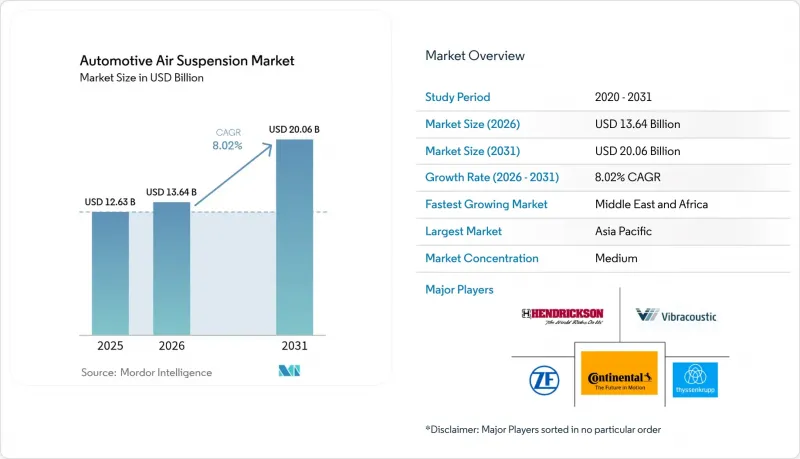
Mordor Intelligence에 의하면, 2026년 자동차용 에어 서스펜션 시스템 시장 규모는 136억 4,000만 달러로 추정되며, 2025년 126억 3,000만 달러에서 확대되어 2031년에는 200억 6,000만 달러에 달할 것으로 예측됩니다.
2026년부터 2031년까지 연평균 성장률(CAGR) 8.02%로 성장할 것으로 전망됩니다.
본 보고서는 제어 방식(ECAS 및 NECAS), 차종(승용차 등), 최종 사용자(OEM 및 애프터마켓),구성 부품(에어 스프링 등), 구동 방식(ICE 및 BEV), 서스펜션 구조(패시브 에어 서스펜션 등), 판매 채널(OEM에 대한 직접 판매 등), 지역별로 분류되어 있습니다. 시장 예측은 금액(미 달러) 및 수량(대)으로 제시되어 있습니다.
세계 자동차용 에어 서스펜션 시장 동향 및 인사이트
승차감 및 실내 쾌적성에 대한 수요 증가
소비자 인식의 제고와 브랜드 차별화 전략을 배경으로, 현재는 메인스트림 부문에서도 프리미엄급 쾌적성에 대한 기대가 두드러지고 있습니다. 인피니티의 2025년형 QX80은 승하차 편의성, 오프로드 주행 시 기동성, 견인 시 안정성을 확보하기 위해 차고를 동적으로 조절하는 전자식 에어 서스펜션을 탑재하고 있어 이러한 변화를 여실히 보여주고 있습니다. 가처분 소득 증가에 힘입은 아시아 소비자들은 편의성과 지위감을 겸비한 기능에 특히 민감합니다. 배터리식 전기 SUV의 경우, XPeng의 G9에 채택된 Vibracoustic사의 시스템과 같은 2챔버식 에어 스프링을 통합함으로써 승차감의 유연성과 배터리의 열 관리를 동시에 실현하고 있습니다. 노면 데이터를 활용한 예측 알고리즘을 통해 쾌적성과 핸들링이 한층 더 향상되었습니다. 랜드로버의 최신 모델 ‘레인지로버’에서는 내비게이션에서 얻은 eHorizon 정보를 활용해 댐퍼 설정을 사전에 조정하고 있습니다. 이러한 발전이 더해지면서 에어 서스펜션은 세계 시장에서 명확한 차별화 요소로서의 입지를 공고히 하고 있습니다.
아시아태평양 및 유럽에서의 고급차·프리미엄차 판매 확대
중국은 여전히 프리미엄 수요의 중심지이며, 국내 브랜드 및 수입 브랜드는 차량을 동경하는 구매자를 확보하기 위해 전자식 에어 서스펜션의 탑재를 확대되고 있습니다. BMW는 2024년 세계 판매 대수에서 전기차(EV) 비율 17.4%를 달성했으며, 이는 전동화가 차량 내 정숙성 및 공기역학적 성능에 최적화된 차고 제어를 실현하는 옵션인 에어 서스펜션 패키지와 밀접하게 관련되어 있음을 보여줍니다. 메르세데스-벤츠는 상하이의 연구개발 거점을 확대하고, 현지 도로 상황에 맞추어 설계된 에어 서스펜션 모듈을 포함한 섀시 기술의 현지화를 가속화하고 있습니다. 유럽과 미국의 경쟁사들보다 가격 경쟁력을 높이려는 중국의 고급 전기차 스타트업들은 비용을 절감한 에어 서스펜션 시스템을 중가대 차종에 도입하며, 해당 지역에서의 보급을 가속화하고 있습니다.
중형 부문 차량에서의 시스템 및 통합 비용 부담
전자식 에어 서스펜션의 부품 원가는 기존의 스틸 스프링에 비해 수백 달러 더 비쌀 수 있어, 비용 효율을 중시하는 C부문 차량에의 채택을 저해하고 있습니다. 복잡한 캘리브레이션 작업으로 인해 ECU 로직이 추가되고 섀시 마운트 보강도 필요해지면서 엔지니어링 비용이 더욱 증가하고 있습니다. 신흥 시장의 OEM 각사는 첨단 섀시의 승차감보다는 판매 가격의 저렴함을 우선시하고 있어 대중차 부문으로의 보급이 늦어지고 있습니다. 하지만 중국 내 현지 조달과 더욱 간소화된 부품 설계를 통해 그 격차는 점차 좁혀지고 있습니다. XPeng이 G9의 가격 경쟁력을 유지하면서도 Vibracoustic사의 2챔버 스프링을 채택한 결정은 비용 절감을 위한 혁신의 좋은 사례라고 할 수 있습니다.
부문 분석
2025년, NECAS 솔루션은 에어 서스펜션 시스템 시장에서 54.90%의 점유율을 유지했습니다. 이는 주로 플릿 구매자들이 검증된 단순성과 낮은 도입 비용을 중시하기 때문입니다. 이 부문은 정적 하중 레벨링만으로도 충분한 버스, 트레일러 및 기본형 픽업 모델에서 여전히 주류를 이루고 있습니다. 대조적으로, 각 OEM 업체들이 소프트웨어 중심 아키텍처로 전환함에 따라 ECAS는 연평균 성장률(CAGR) 9.03%라는 높은 속도로 급속히 확대되고 있습니다. ECAS 유닛은 가속도계, 카메라, 지도 서비스에서 데이터를 수집하여 서스펜션 설정을 예측하고, 주행 중 승차감과 핸들링을 모두 향상시킵니다. 또한 ECAS는 전기차(EV)의 공기역학적 최적화를 위한 가변 차고 기능도 지원하며, 향후 출시될 프리미엄 크로스오버 차량에 필수적인 요소가 되고 있습니다.
소프트웨어 정의 차량에서는 ECAS 고유의 기능인 무선(OTA)을 통한 보정 및 기능 잠금 해제가 중요시되고 있습니다. ZF의 ‘sMOTION’이나 콘티넨탈의 ‘E-Level’ 시리즈에서는 판매 후 업데이트를 통해 스프링 커브를 미세 조정하거나 오프로드 모드를 추가하는 것이 가능합니다. NECAS는 애프터마켓이나 비용 효율을 중시하는 지역에서 여전히 중요한 위치를 차지하고 있습니다. 그러나 중형 고급 세단, 고성능 SUV, 전기 배송 밴에 ECAS가 기본 사양으로 탑재됨에 따라 NECAS 시장 점유율은 하락할 것으로 예측됩니다. 밸브와 압력 센서의 가격 하락이 지속되고 있어, 가성비 부문 전반에서 ECAS로의 전환이 가속화될 것입니다.
2025년에는 승용차가 에어 서스펜션 시스템 시장 점유율의 65.10%를 차지했는데, 이는 승차감 향상이 주요 판매 포인트인 고급 세단과 SUV 덕분입니다. 한편, 중형·대형 트럭은 모든 차량 카테고리 중 가장 높은 연평균 성장률(CAGR) 7.94%를 기록할 전망입니다. 전동화된 드라이브트레인은 자동 하중 균형 조정 및 차고 제어를 가능하게 하고, 주행 거리를 연장함과 동시에 배터리 팩을 보호함으로써 에어 서스펜션의 가치를 높입니다. 소형 상용차와 장거리 버스도 각각 도시 지역 내 배송 효율화 및 승객의 편의성 향상을 위해 이 기술을 채택하고 있지만, 그 성장률은 중형·대형 트럭에 미치지 못할 전망입니다.
클래스 8 전기 트랙터의 에어 서스펜션 기술은 법정 중량 제한을 준수하면서 차축 하중을 분산시켜, 배터리 중량 증가로 인한 단점을 완화합니다. 판매 대수 면에서는 승용차가 계속해서 1위를 유지하고 있지만, 상용차 부문이 혁신 주기를 주도하고 있으며, 이는 부품의 내구성과 예측 유지보수 기능에 영향을 미치며, 이러한 기술은 나중에 일반용 모델로도 확산될 것입니다.
2025년 매출액 기준, 에어 서스펜션 시스템 시장 점유율의 73.60%를 OEM 순정 장비가 차지했습니다. 이는 통합의 복잡성에 더해, 서스펜션 튜닝을 충돌 안전성 및 ADAS 보정과 조화시켜야 할 필요성 때문입니다. 애프터마켓은 차량의 노후화가 진행되고 애호가들이 승차감이나 차고 높이를 업그레이드하기를 원함에 따라 연평균 성장률(CAGR) 7.38%로 확대되고 있습니다. 현재 MidOcean Partners 산하에 있는 Arnott Industries는 유럽산 SUV 및 미국산 머슬카용 멀티 브랜드 교체용 키트를 적극적으로 전개하고 있으며, 이는 애프터마켓 분야에서의 업계 재편 의도를 시사합니다.
소비자들은 순정 에어 스프링의 수명이 다하면(대개 8년 후) 애프터마켓 키트로 눈을 돌립니다. 플러그 앤 플레이 방식의 ECAS 교체 모듈을 쉽게 구할 수 있게 되면서 설치 시간이 단축되어 그 매력이 더욱 커지고 있습니다. 보증 범위, 형식 인증 및 통합 진단이 최우선으로 고려되는 최초 장착 단계에서는 OEM 채널이 여전히 필수적입니다. 애프터마켓은 노후화된 차량, 성능 애호가, 그리고 조절 가능한 최저 지상고를 원하는 틈새 오프로드 커뮤니티로부터 추가 매출을 확보하게 될 것입니다.
지역별 분석
2025년, 아시아태평양은 38.90%의 점유율로 에어 서스펜션 시스템 시장을 주도했습니다. 판매량의 대부분은 중국의 고급차 및 전기차 수요가 견인하고 있는 반면, 일본 브랜드는 승차감 기술의 정교화를 계속하고 있습니다. 메르세데스-벤츠의 현지화된 연구개발 및 세계 1차 공급업체의 생산 거점 덕분에 공급망이 단축되었으며, 지역의 승차감 선호도에 맞춘 사양 적용이 가능해졌습니다. 신에너지차에 대한 정부의 지원 또한 첨단 섀시 통합의 가능성을 더욱 넓히고 있습니다.
인프라 프로젝트와 부유층 소비자 기반이 맞물려, 중동 및 아프리카은 2031년까지 연평균 성장률(CAGR) 6.94%로 가장 높은 성장률을 기록할 전망입니다. 프리미엄 SUV와 픽업 트럭이 시장 구성의 대부분을 차지하고 있으며, 구매자들은 사막 지대에서의 다목적성을 높이기 위해 차고 조절이 가능한 서스펜션을 중요시하고 있습니다. 유럽에서는 차량의 CO₂ 배출량에 대한 엄격한 규제로 인해 경량 에어 스프링 및 차고를 기반으로 한 공기역학적 효율 향상 전략이 촉진되고 있어 높은 보급률을 유지하고 있습니다. 북미의 동향은 픽업 트럭 및 대형 트럭의 도입 상황에 달려 있습니다. 스텔란티스를 비롯한 디트로이트 3대 제조업체는 견인 시의 안정성과 BEV의 공기역학적 성능을 충족시키기 위해 에어 서스펜션 모듈을 중심으로 바디 온 프레임 플랫폼의 재구성을 추진하고 있습니다. 남미는 여전히 신흥 시장이지만, 연비 향상에 기여하는 부품에 대한 수입 관세 인하의 지원에 힘입어 브라질 내 프리미엄 SUV 생산 대수가 증가하는 추세입니다.
기타 혜택:
- 엑셀 형식 시장 예측(ME) 시트
- 3개월간의 애널리스트 지원
자주 묻는 질문
목차
제1장 서론
제2장 조사 방법
제3장 주요 요약
제4장 시장 구도
제5장 시장 규모와 성장 예측
제6장 경쟁 구도
제7장 시장 기회와 향후 전망
LSH 26.08.24According to Mordor Intelligence, automotive air suspension systems market size in 2026 is estimated at USD 13.64 billion, growing from 2025 value of USD 12.63 billion with 2031 projections showing USD 20.06 billion, growing at 8.02% CAGR over 2026-2031.
This report is Segmented by Control Type (ECAS and NECAS), Vehicle Type (Passenger Cars and More), End User (OEM and Aftermarket), Component (Air Springs and More), Propulsion (ICE and BEV), Suspension Architecture (Passive Air Suspension and More), Sales Channel (Direct To OEM and More) and Geography. The Market Forecasts are Provided in Terms of Value (USD) and Volume (Units).
Global Automotive Air Suspension Market Trends and Insights
Rising Demand for Ride Quality and Cabin Comfort
Premium comfort expectations are now evident even in mainstream segments, driven by consumer awareness and brand differentiation strategies. INFINITI's 2025 QX80 illustrates this shift with an Electronic Air Suspension that adjusts dynamic height for easy ingress, off-road articulation, and towing stability. Asian buyers, supported by rising disposable incomes, are particularly responsive to features that marry convenience with perceived status. In battery-electric SUVs, integrating two-chamber air springs, such as Vibracoustic's system for XPeng's G9, allows simultaneous ride compliance and battery thermal management. Predictive algorithms using road-surface data further enhance comfort and handling; Land Rover's latest Range Rover employs navigation-fed eHorizon information to pre-condition damper settings. Collectively, these advances reinforce air suspension as a tangible differentiator across global markets.
Growing Luxury and Premium Vehicle Sales in Asia-Pacific and Europe
China remains the epicenter of premium demand, with domestic and imported marques expanding electronic air suspension fitment to secure aspirational buyers. BMW achieved a 17.4% EV mix in 2024 global deliveries, underscoring how electrification often coincides with optional air suspension packages for cabin tranquility and aero-optimized stance control. Mercedes-Benz's enlarged R&D footprint in Shanghai accelerates the localization of chassis technologies, including air suspension modules designed for local road conditions. Chinese premium EV startups, keen to undercut Western rivals, are bringing cost-controlled air systems to mid-tier price points, quickening regional adoption.
High System and Integration Cost for Mid-Segment Vehicles
The electronic air suspension bill of material can exceed conventional steel springs by several hundred USD, discouraging inclusion in cost-sensitive C-segment cars. Complex calibration work added ECU logic and reinforced chassis mounts, further inflating engineering spending. Emerging-market OEMs prioritize lower transaction prices over advanced chassis comfort, delaying penetration in mass segments. Nonetheless, localized sourcing in China and leaner component designs are narrowing the gap; XPeng's decision to deploy Vibracoustic's two-chamber springs while keeping the G9's price competitive exemplifies cost-down innovation.
Other drivers and restraints analyzed in the detailed report include:
- Integration of ECAS with ADAS and Chassis Domain Controllers
- Fleet Fuel-Saving Benefits for Electric Heavy-Duty Trucks
- Reliability & Maintenance Complexity Concerns
For complete list of drivers and restraints, kindly check the Table Of Contents.
Segment Analysis
NECAS Solutions retained a 54.90% share of the air suspension systems market in 2025, mainly because fleet buyers value proven simplicity and lower acquisition costs. The segment remains prevalent in buses, trailers, and basic pickup models where static load leveling suffices. In contrast, ECAS is scaling fast at a 9.03% CAGR as OEMs migrate toward software-centric architectures. ECAS units harvest data from accelerometers, cameras, and map services to predict suspension settings, improving both comfort and handling on the fly. ECAS also supports variable ride height for EV aero optimization, making it indispensable for forthcoming premium crossovers.
Software-defined vehicles emphasize over-the-air calibration and feature unlocks, capabilities inherent to ECAS. ZF's sMOTION and Continental's E-Level families allow post-sale updates that fine-tune spring curves or add off-road modes. NECAS remains relevant in retrofit and cost-driven regions. Yet, its share is projected to decline as ECAS becomes standard on mid-size luxury sedans, performance SUVs, and electric delivery vans. The ongoing price erosion of valves and pressure sensors will accelerate the pivot toward ECAS across value segments.
Passenger cars captured 65.10% of the air suspension systems market share in 2025 through luxury sedans and SUVs, where heightened comfort is a selling point. Medium and Heavy trucks, however, are on track for an 7.94% CAGR, the highest among all vehicle categories. Electrified drivelines amplify the value of air suspension by enabling automated load balancing and ride-height control that extend the range and protect battery packs. Light commercial vans and coaches adopt the technology for urban delivery efficiency and passenger comfort, respectively, although their growth profile lags medium and heavy trucks.
Air suspension technology in Class 8 electric tractors mitigates battery mass penalties by distributing axle loads while preserving legal weight limits. Passenger cars will keep leading in volume terms, yet commercial segments drive innovation cycles, influencing component durability and predictive maintenance capabilities that later cascade into retail models
OEM fitment accounted for 73.60% of the air suspension systems market share in 2025 revenue because of integration complexity and the need to align suspension tuning with crash safety and ADAS calibration. The aftermarket expands at 7.38% CAGR as vehicle parc ages and enthusiasts seek comfort or stance upgrades. Arnott Industries, now under MidOcean Partners, is aggressively expanding multi-brand replacement kits for European SUVs and American muscle cars, signaling consolidation intent within the retrofit domain.
Consumers turn to aftermarket kits when factory air springs reach end-of-life, often after eight years. Increased availability of plug-and-play ECAS replacement modules reduces installation time, broadening appeal. OEM channels remain indispensable for first-fitment, where warranty coverage, homologation, and integrated diagnostics are paramount. The aftermarket will capture incremental revenue from aging fleets, performance enthusiasts, and niche off-road communities seeking adjustable ground clearance.
Complete Report Scope:
- By Control Type
- Electronically Controlled Air Suspension (ECAS)
- Non-Electronically Controlled Air Suspension (NECAS)
- By Vehicle Type
- Passenger Cars
- Light Commercial Vehicles
- Medium and Heavy Trucks
- Buses & Coaches
- By End User
- OEM
- Aftermarket
- By Component
- Air Springs
- Compressors and Reservoirs
- Electronic Control Units
- Height & Pressure Sensors
- Shock Dampers
- By Propulsion
- ICE Vehicles
- Battery-Electric Vehicles
- By Suspension Architecture
- Passive Air Suspension
- Semi-Active / Adaptive Air Suspension
- Fully Active Air Suspension
- By Sales Channel
- Direct to OEM
- Tier-1 / Module Supplier
- By Geography
- North America
- United States
- Canada
- Rest of North America
- South America
- Brazil
- Argentina
- Rest of South America
- Europe
- Germany
- United Kingdom
- France
- Italy
- Spain
- Rest of Europe
- Asia-Pacific
- China
- Japan
- India
- South Korea
- Rest of Asia-Pacific
- Middle East and Africa
- Saudi Arabia
- United Arab Emirates
- South Africa
- Nigeria
- Rest of Middle East and Africa
- North America
Geography Analysis
Asia-Pacific led the air suspension systems market with a 38.90% share in 2025. Chinese luxury and electric vehicle demand fuels most of the volume, while Japanese brands continue to refine comfort technologies. Mercedes-Benz's localized R&D and manufacturing footprints by global tier-1 suppliers shorten supply chains and adapt specifications for regional ride-comfort preferences. Government support for new energy vehicles also raises the ceiling for advanced chassis integration.
As infrastructure projects and affluent consumer bases converge, the Middle East and Africa will deliver the fastest CAGR at 6.94% through 2031. Premium SUVs and pickups dominate the mix, and buyers value height-adjustable suspensions for desert terrain versatility. Europe retains high penetration because stringent fleet CO2 limits encourage lightweight air springs and height-based aero efficiency strategies. North America's dynamics hinge on pickup and heavy-truck adoption. Stellantis and other Detroit-Three manufacturers are reorganizing body-on-frame platforms around air suspension modules to satisfy towing stability and BEV aerodynamics. South America remains emergent but shows rising uptake in Brazilian premium SUV assembly, aided by import-duty reductions on components that enhance fuel economy.
- Continental AG
- ZF Friedrichshafen AG
- Hendrickson International
- Thyssenkrupp Bilstein
- Vibracoustic SE
- Firestone Industrial Products
- Hitachi Astemo
- Mando Corporation
- SAF-Holland SE
- Meritor (Cummins)
- AccuAir Suspension
- Air Lift Company
- Arnott Industries
- BWI Group
- KYB Corporation
- Komman Air Suspension
- Guangzhou Guomat Air Spring
- Dunlop Systems & Components
- Tenneco Inc.
Additional Benefits:
- The market estimate (ME) sheet in Excel format
- 3 months of analyst support
TABLE OF CONTENTS
1 Introduction
- 1.1 Study Assumptions & Market Definition
- 1.2 Scope of the Study
2 Research Methodology
3 Executive Summary
4 Market Landscape
- 4.1 Market Overview
- 4.2 Market Drivers
- 4.2.1 Rising demand for ride quality & cabin comfort
- 4.2.2 Growing luxury & premium vehicle sales in Asia-Pacific & Europe
- 4.2.3 Integration of ECAS with ADAS & chassis domain controllers
- 4.2.4 Fleet fuel-saving benefits for electric heavy-duty trucks (under-reported)
- 4.2.5 Predictive-maintenance digital twins lowering TCO for logistics fleets (under-reported)
- 4.2.6 Vibration-sensitive cargo regulations tightening (under-reported)
- 4.3 Market Restraints
- 4.3.1 High system & integration cost for mid-segment vehicles
- 4.3.2 Reliability & maintenance complexity concerns
- 4.3.3 Cyber-security risks in ECU-connected ECAS (under-reported)
- 4.3.4 Elastomer & composite price volatility (under-reported)
- 4.4 Value / Supply-Chain Analysis
- 4.5 Regulatory Landscape
- 4.6 Technological Outlook
- 4.6.1 Transition to 48-V & software-defined chassis
- 4.6.2 Lightweight composite air-spring bellows
- 4.7 Porter's Five Forces Analysis
- 4.7.1 Threat of New Entrants
- 4.7.2 Bargaining Power of Buyers
- 4.7.3 Bargaining Power of Suppliers
- 4.7.4 Threat of Substitute Products
- 4.7.5 Intensity of Competitive Rivalry
5 Market Size & Growth Forecasts
- 5.1 By Control Type
- 5.1.1 Electronically Controlled Air Suspension (ECAS)
- 5.1.2 Non-Electronically Controlled Air Suspension (NECAS)
- 5.2 By Vehicle Type
- 5.2.1 Passenger Cars
- 5.2.2 Light Commercial Vehicles
- 5.2.3 Medium and Heavy Trucks
- 5.2.4 Buses & Coaches
- 5.3 By End User
- 5.3.1 OEM
- 5.3.2 Aftermarket
- 5.4 By Component
- 5.4.1 Air Springs
- 5.4.2 Compressors and Reservoirs
- 5.4.3 Electronic Control Units
- 5.4.4 Height & Pressure Sensors
- 5.4.5 Shock Dampers
- 5.5 By Propulsion
- 5.5.1 ICE Vehicles
- 5.5.2 Battery-Electric Vehicles
- 5.6 By Suspension Architecture
- 5.6.1 Passive Air Suspension
- 5.6.2 Semi-Active / Adaptive Air Suspension
- 5.6.3 Fully Active Air Suspension
- 5.7 By Sales Channel
- 5.7.1 Direct to OEM
- 5.7.2 Tier-1 / Module Supplier
- 5.8 By Geography
- 5.8.1 North America
- 5.8.1.1 United States
- 5.8.1.2 Canada
- 5.8.1.3 Rest of North America
- 5.8.2 South America
- 5.8.2.1 Brazil
- 5.8.2.2 Argentina
- 5.8.2.3 Rest of South America
- 5.8.3 Europe
- 5.8.3.1 Germany
- 5.8.3.2 United Kingdom
- 5.8.3.3 France
- 5.8.3.4 Italy
- 5.8.3.5 Spain
- 5.8.3.6 Rest of Europe
- 5.8.4 Asia-Pacific
- 5.8.4.1 China
- 5.8.4.2 Japan
- 5.8.4.3 India
- 5.8.4.4 South Korea
- 5.8.4.5 Rest of Asia-Pacific
- 5.8.5 Middle East and Africa
- 5.8.5.1 Saudi Arabia
- 5.8.5.2 United Arab Emirates
- 5.8.5.3 South Africa
- 5.8.5.4 Nigeria
- 5.8.5.5 Rest of Middle East and Africa
- 5.8.1 North America
6 Competitive Landscape
- 6.1 Market Concentration
- 6.2 Strategic Moves
- 6.3 Market Share Analysis
- 6.4 Company Profiles (includes Global level Overview, Market level overview, Core Segments, Financials as available, Strategic Information, Market Rank/Share for key companies, Products & Services, and Recent Developments)
- 6.4.1 Continental AG
- 6.4.2 ZF Friedrichshafen AG
- 6.4.3 Hendrickson International
- 6.4.4 Thyssenkrupp Bilstein
- 6.4.5 Vibracoustic SE
- 6.4.6 Firestone Industrial Products
- 6.4.7 Hitachi Astemo
- 6.4.8 Mando Corporation
- 6.4.9 SAF-Holland SE
- 6.4.10 Meritor (Cummins)
- 6.4.11 AccuAir Suspension
- 6.4.12 Air Lift Company
- 6.4.13 Arnott Industries
- 6.4.14 BWI Group
- 6.4.15 KYB Corporation
- 6.4.16 Komman Air Suspension
- 6.4.17 Guangzhou Guomat Air Spring
- 6.4.18 Dunlop Systems & Components
- 6.4.19 Tenneco Inc.
7 Market Opportunities & Future Outlook
- 7.1 White-space & Unmet-Need Assessment


