|
시장보고서
상품코드
2113250
단일 광자 방사 단층촬영(SPECT) : 시장 점유율 분석, 업계 동향과 통계, 성장 예측(2026-2031년)Single Photon Emission Computed Tomography (SPECT) - Market Share Analysis, Industry Trends & Statistics, Growth Forecasts (2026 - 2031) |
||||||
 Mordor Intelligence
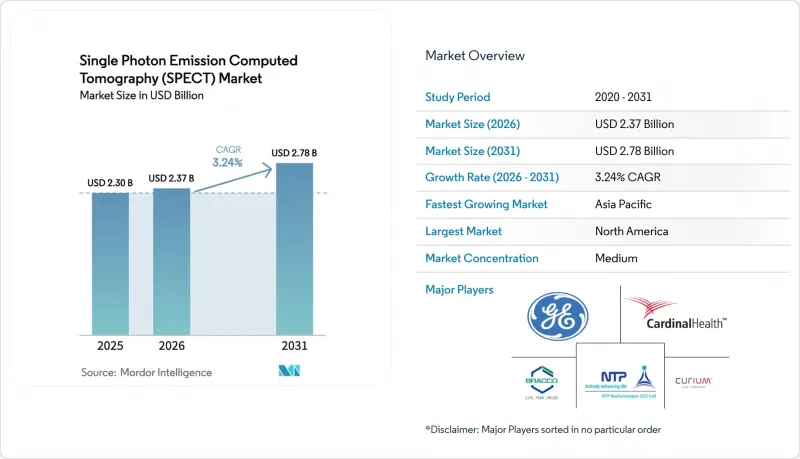
Mordor Intelligence에 따르면 단일 광자 방사 단층촬영(SPECT) 시장 규모는 2025년에 23억 달러로 평가되며, 2026년 23억 7,000만 달러에서 2031년까지 27억 8,000만 달러에 달할 것으로 예측되고 있으며, 예측 기간(2026-2031년)에 CAGR은 3.24%에 달할 전망입니다.
이 보고서는 시스템 유형(독립형 SPECT 및 하이브리드형 SPECT/CT), 검출기 기술(NaI(Tl) 앙거 카메라 및 고체 디지털 CZT SPECT),용도(순환기학 등), 최종사용자(병원·의료 시스템 등), 방사성동위원소(Tc-99m 등) 및 지역(북미, 유럽 등)별로 분류되어 있습니다. 시장 예측은 금액(달러) 기준으로 제시되어 있습니다.
전 세계 단일광자방출단층촬영(SPECT) 시장의 동향 및 인사이트
암 및 심혈관 질환 부담의 증가
2022년 전 세계 신규 암 발병 건수는 2,000만 건에 달했으며, 인구 고령화에 따라 2050년까지 77% 급증할 것으로 예측됩니다. 이러한 추세와 더불어, 2023년에는 심혈관 질환으로 인한 사망자 수가 1,920만 명에 달했으며, 핵의학 심장 진단에 대한 수요는 계속해서 높은 수준을 유지하고 있습니다. SPECT는 여전히 일선 ‘게이트키퍼’로서의 역할을 수행하고 있습니다. 골 스캔은 전이성 질환의 병기 분류에, 심근 관류 영상은 혈관 재건술의 적응증 환자 선별에 사용됩니다. 미국심장협회(AHA)의 2024년 지침에서는 심근 생존력 평가에 있으며, SPECT의 유용성이 재확인되면서 검사 건수의 증가가 확고해졌습니다. 병원에서는 한 번의 내원만으로 종양의 감쇠 보정과 관상동맥 칼슘 점수 측정을 동시에 수행할 수 있도록 하이브리드형 SPECT/CT 장비 도입이 확대되고 있으며, 시스템 교체 수요를 더욱 부추기고 있습니다.
하이브리드 SPECT/CT 시스템 도입 가속화
2025년에는 하이브리드 구성이 매출의 62.46%를 차지할 것으로 예상되며, 2031년까지 연평균 성장률(CAGR) 5.45%를 기록하며 단독형 감마 카메라를 추월할 전망입니다. 2025년 1월 SNMMI, ASNC, SCCT가 공동으로 발표한 지침에서는 하이브리드 SPECT/CT가 심장 진단의 표준 기법으로 정의되었으며, 위양성을 억제하기 위한 감쇠 보정이 의무화되었습니다. 2025년 5월 FDA 승인을 획득한 GE 헬스케어의 ‘Aurora’는 75cm 보어와 40mm 결정체를 채택하여 스캔 시간을 30% 단축했습니다. 한편, 지멘스의 ‘Symbia Pro.specta’ ROI 계산 툴에 따르면 검사 건수가 많은 의료기관에서는 3년 이내에 투자 회수가 가능함이 밝혀졌습니다. 병원 측에서는 하이브리드 시스템 도입을 미래를 내다본 투자로 간주하고 있으며, 단일 카메라로는 대응할 수 없는 세라노스틱스용 선량 측정 및 정량적 SPECT 영상 진단이 가능해집니다. 도입 비용은 높지만, 자본 예산은 그에 맞춰 배분되고 있습니다.
Mo-99/Tc-99m의 글로벌 공급망 취약성
전 세계 Mo-99의 95%는 6기의 원자로에서 생산되고 있으며, 가동 중단은 심각한 혼란을 초래합니다. 2024년 10월 퀴리움(Curium)사의 유럽 원자로가 가동을 중단했을 때, 영국의 진료소에서는 투여량을 제한할 수밖에 없었고, 심장 질환 검사 대기 리스트이 몇 주 동안 늘어났습니다. 병원들은 고선량의 탈륨-201 프로토콜로 되돌아갈 수밖에 없었고, 안전성과 효율성 측면에서 심각한 후퇴가 드러났습니다. 또한 원자로 운영자들은 고농축 우라늄 타겟에서 저농축 연료로 전환할 수밖에 없게 되었으며, 이로 인해 일시적으로 생산량이 약 20% 감소하여 공급 부족을 더욱 가중시키고 있습니다. 노스스타(Northstar)사의 ‘RadioGenix’는 사이클로트론 기반의 대안을 제공하고 있지만, 현재 생산량은 수요의 극히 일부만을 충족시키고 있습니다. 공급의 여유가 확보될 때까지 단일광자방출단층촬영(SPECT) 시장은 동위원소 공급 차질에 계속 노출될 것입니다.
부문 분석
하이브리드 SPECT/CT 플랫폼은 2025년 매출의 62.46%를 차지하며, 2031년까지 연평균 성장률(CAGR) 5.45%로 성장할 것으로 예측됩니다. 이러한 우위는 통합된 감쇠 보정, 해부학적 정렬 및 세라노스틱스 기능에 기인하며, 이를 통해 단일 기기에 비해 40%의 가격 프리미엄이 정당화됩니다. 2025년 5월 FDA 승인을 획득한 GE 헬스케어의 ‘Aurora’는 촬영 시간을 30% 단축하고, 하루당 심근 관류 검사 처리 능력을 20명의 환자로 늘렸습니다. 지멘스의 ‘Symbia Pro.specta’는 최대 588 keV의 동위원소를 지원하여 Lu-177을 이용한 치료 후 스캔을 가능하게 합니다. 독립형 감마 카메라는 CT 도입으로 인한 이점이 제한적인 이동 진료차나 지방 의료 현장에서 여전히 활용되고 있습니다. Digirad사의 가격이 25만 달러 미만인 휴대용 장치 ‘Ergo’는 이 틈새 시장을 채우고 있지만, ACR 종양학 인증에 필수적인 하이브리드 기능을 갖추고 있지 않습니다.
병원들은 하이브리드 시스템을 핵의학 부서의 미래 경쟁력을 확보하기 위한 전략적 자산으로 간주하고 있습니다. 투자 수익률(ROI) 산출에 따르면 재검사가 18% 감소하고 당일 보고를 통해 청구 주기가 단축될 경우, 3년 이내에 투자 회수가 가능합니다. 하이브리드 플랫폼용 단일 광자 방출 단층촬영(SPECT) 시장 규모는 2031년까지 19억 달러에 달할 것으로 예상되며, 이는 전체 장비 매출의 70% 가까이를 차지하게 될 것입니다. 인증 기관의 기준이 엄격해짐에 따라 하이브리드형과 독립형 장비의 시장 점유율 격차는 확대될 것이며, SPECT 시장에서 하이브리드형의 주도적 입지는 더욱 공고해질 것입니다.
2025년 매출에서 요오드화 나트륨(NaI) 카메라는 63.56%를 차지했으나, CZT 시스템이 가장 빠른 속도로 성장하고 있습니다. 풀 링형 CZT 스캐너는 4-10배의 감도와 5%의 에너지 분해능을 제공하여, PET의 피폭 선량 수준에 필적하는 1 mSv의 심장 검사를 가능하게 합니다. 스펙트럼 다이내믹스(Spectrum Dynamics)의 ‘Veriton-CT’(360° CZT 링)는 장기 특이적 기하학적 구조를 통해 스캔 시간을 절반으로 줄여주지만, 정가는 100만 달러 이상입니다. 카이저 퍼머넌트는 2025년 4월, CZT 기반의 심장 아밀로이드증 선별 검사를 도입하여 대규모 통합 네트워크에서 임상적 감별 진단의 유효성을 입증했습니다.
비용 및 공급 측면에서의 우위 덕분에 NaI는 특히 신흥 시장에서 여전히 중요한 위치를 차지하고 있습니다. 하지만 단일 광자 방출 단층촬영(SPECT) 시장의 점유율은 CZT로 이동하고 있으며, 2031년까지 45%를 넘어설 것으로 예측됩니다. AI 기반 노이즈 제거 워크플로가 성능 향상을 더욱 촉진함에 따라 생산성을 추구하는 외래 진료 센터에 있으며, CZT는 최적의 검출기로 자리매김하고 있습니다. 각 공급업체는 듀얼 검출기 포트폴리오를 통해 위험을 분산하고 있지만, 향후 연구개발 자원은 반도체 기반 설계로 점차 이동하고 있습니다.
지역별 분석
북미는 연간 1,500만-2,000만 건의 심근 관류 검사와 국내 Mo-99 공급을 지원하는 정책 인센티브에 힘입어 2025년 매출의 42.23%를 차지했습니다. 미국 에너지부(DOE)가 SHINE Technologies에 3,200만 달러를 지원한 것과 CMS가 제안한 1,000만 달러 규모의 Mo-99 추가 공급은 동위원소 공급망의 위험을 완화하고 검사 건수를 안정화시키고 있습니다. 설치 대수가 많아 성장세가 둔화되고 있으며, 병원들이 업그레이드 주기를 10년으로 연장함에 따라 해당 지역은 2031년까지 연평균 성장률(CAGR) 3.5%라는 완만한 속도로 추이할 전망입니다. 그러나 하이브리드 SPECT/CT 도입은 GE의 ‘Aurora’와 같이 비만 환자 및 세라노스틱스(theranostics)에 대응하는 플랫폼에 집중되고 있습니다.
아시아태평양은 중국내 1,200대 이상의 PET/CT 도입이 2급 도시의 저비용 SPECT에 대한 하류 수요를 견인하고, 인도의 검출기 선형성 업그레이드 의무화가 지원됨에 따라 4.54%라는 가장 높은 연평균 성장률(CAGR)을 기록할 전망입니다. 유나이티드 이미징(United Imaging)의 가격 경쟁력이 뛰어난 하이브리드 시스템이 지방 자치 단체의 입찰에서 수주하고 있는 반면, 일본의 의료 기관에서는 1인당 이용률이 미국 수준의 수치를 유지하고 있습니다. 규제의 불균형으로 인해 국경을 넘는 장비 유통은 주춤하고 있지만, 동남아시아에서 국제원자력기구(IAEA)의 기술 협력 프로젝트가 핵의학에 대한 접근성을 확대하며 장기적인 성장의 기반을 다지고 있습니다.
유럽은 연평균 성장률(CAGR) 3.18%로 성장하고 있습니다. 독일과 프랑스에서는 7년 주기로 장비 교체가 이루어지고 있지만, 벨기에 대한 BR2와 네덜란드 파라스(Pallas) 원자로의 유지보수로 인해 동위원소 공급이 주기적으로 제한되어 가동률이 하락하는 요인이 되고 있습니다. 중동 및 아프리카 및 남미는 합쳐서 한 자릿수 중반대의 성장률을 보이고 있으며, 걸프협력회의(GCC) 회원국의 병원 확장 및 브라질의 공공 조달 주기에 따라 도입 대수가 증가하고 있습니다. 걸프 국가에서는 서비스 제공 장소의 전환과 민간 영상 진단 센터가 세를 넓혀가고 있으며, 심장 검진 패키지 상품이 제공되고 있습니다.
기타 혜택:
- 엑셀 형식의 시장 예측(ME) 시트
- 3개월간의 애널리스트 지원
자주 묻는 질문
목차
제1장 서론
제2장 조사 방법
제3장 개요
제4장 시장 구도
제5장 시장 규모와 성장 예측
제6장 경쟁 구도
제7장 시장 기회와 향후 전망
KSA 26.08.25According to Mordor Intelligence, the single photon emission computed tomography market size was valued at USD 2.30 billion in 2025 and is estimated to grow from USD 2.37 billion in 2026 to reach USD 2.78 billion by 2031, at a CAGR of 3.24% during the forecast period (2026-2031).
This report is Segmented by System Type (Standalone SPECT and Hybrid SPECT/CT), Detector Technology (NaI(Tl) Anger Cameras and Solid-State Digital CZT SPECT), Application (Cardiology, and More), End-User (Hospitals & Health Systems, and More), Radioisotope (Tc-99m, and More), and Geography (North America, Europe, and More). The Market Forecasts are Provided in Terms of Value (USD).
Global Single Photon Emission Computed Tomography (SPECT) Market Trends and Insights
Growing Burden of Oncology and Cardiovascular Diseases
Global cancer incidence hit 20 million new cases in 2022 and is projected to surge 77% by 2050 as populations age. Parallel to this trend, cardiovascular disease caused 19.2 million deaths in 2023, keeping nuclear cardiology in high demand. SPECT remains the first-line gatekeeper: bone scans stage metastatic disease and myocardial-perfusion imaging triages revascularization candidates. The American Heart Association's 2024 guideline reaffirmed SPECT for assessing myocardial viability, solidifying procedure volumes. Hospitals increasingly install hybrid SPECT/CT units to capture oncologic attenuation correction and coronary calcium scoring in a single visit, reinforcing system-replacement momentum.
Accelerating Adoption of Hybrid SPECT/CT Systems
Hybrid configurations accounted for 62.46% revenue in 2025 and will outpace standalone gamma cameras with a 5.45% CAGR to 2031. January 2025 joint guidelines from SNMMI, ASNC, and SCCT defined hybrid SPECT/CT as standard cardiac practice, mandating attenuation correction to curb false positives. GE HealthCare's Aurora, cleared by the FDA in May 2025, uses a 75 cm bore and 40 mm crystal to trim scan time 30%, while Siemens' Symbia Pro.specta ROI calculator shows payback in under three years for high-volume sites. Hospitals view hybrid adoption as future-proof, enabling theranostics dosimetry and quantitative SPECT imaging that standalone cameras cannot handle. Capital budgets pivot accordingly despite higher acquisition costs.
Vulnerability of Mo-99/Tc-99m Global Supply Chain
Six reactors generate 95% of the world's Mo-99, making outages disruptive. When Curium's European reactors paused in October 2024, United Kingdom clinics rationed doses, extending cardiac waitlists by weeks. Hospitals reverted to higher-dose thallium-201 protocols, highlighting a critical safety and efficiency setback. Reactor operators must also transition from highly enriched uranium targets to low-enriched fuel, temporarily lowering yields by about 20%, compounding supply tension. NorthStar's RadioGenix provides a cyclotron-based alternative, yet current output covers only a fraction of demand. Until redundancy improves, the Single-Photon Emission Computed Tomography market remains exposed to isotope shocks.
Other drivers and restraints analyzed in the detailed report include:
- Advancements in Digital CZT and AI-Enabled Reconstruction
- Strengthening Tc-99m Generator and Radiopharmacy Networks
- Capital Intensity and Budget Constraints for SPECT/CT Upgrades
For complete list of drivers and restraints, kindly check the Table Of Contents.
Segment Analysis
Hybrid SPECT/CT platforms captured 62.46% of 2025 revenue and are predicted to grow at a 5.45% CAGR through 2031. This dominance stems from integrated attenuation correction, anatomical registration, and theranostics capabilities that justify a 40% premium over standalone units. GE HealthCare's Aurora, FDA-cleared in May 2025, trims acquisition time 30%, lifting daily myocardial-perfusion throughput to 20 patients. Siemens' Symbia Pro.specta supports isotopes up to 588 keV, enabling Lu-177 post-therapy scans. Standalone gamma cameras survive in mobile fleets and rural settings where CT adds limited benefit. Digirad's portable Ergo unit, priced under USD 250,000, fills this niche but lacks hybrid features essential for ACR oncology accreditation.
Hospitals view hybrid systems as strategic assets that future-proof nuclear-medicine departments. ROI calculators demonstrate breakeven in under three years when repeat studies drop 18% and same-day reporting accelerates billing cycles. Single-Photon Emission Computed Tomography market size for hybrid platforms is forecast to reach USD 1.9 billion by 2031, accounting for nearly 70% of total equipment revenue. As accreditation bodies tighten standards, the share gap between hybrid and standalone units will widen, reinforcing the former's leadership within the Single-Photon Emission Computed Tomography market.
Sodium-iodide (NaI) cameras held 63.56% of 2025 revenue, yet CZT systems are advancing at the fastest clip. Full-ring CZT scanners provide 4-to-10-fold sensitivity and 5% energy resolution, enabling 1 mSv cardiac studies that rival PET dose levels. Spectrum Dynamics' Veriton-CT, a 360° CZT ring, halves scan times with organ-specific geometries but carries a USD 1 million-plus list price. Kaiser Permanente adopted CZT-based cardiac amyloidosis screening in April 2025, validating clinical differentiation in a large integrated network.
Cost and supply advantages keep NaI relevant, particularly in emerging markets. Still, Single-Photon Emission Computed Tomography market share migration favors CZT, projected to rise above 45% by 2031. AI denoising workflows amplify performance gains, making CZT the detector of choice for outpatient centers chasing productivity. Vendors hedge by dual-detector portfolios, but future R&D resources tilt toward semiconductor-based designs.
Complete Report Scope:
- By System Type
- Standalone SPECT Systems
- Hybrid SPECT/CT Systems
- By Detector Technology
- NaI(Tl) Anger Cameras
- Solid-state Digital CZT SPECT
- By Application
- Cardiology
- Oncology
- Neurology
- Endocrine/Thyroid
- Other Applications
- By End-user
- Hospitals & Health Systems
- Diagnostic Imaging Centers
- Specialty & Academic Centers
- By Radioisotope
- Tc-99m
- Ra-223
- Ga-67
- I-123
- Other Radioisotopes
- By Geography
- North America
- United States
- Canada
- Mexico
- Europe
- Germany
- United Kingdom
- France
- Italy
- Spain
- Rest of Europe
- Asia-Pacific
- China
- Japan
- India
- Australia
- South Korea
- Rest of Asia-Pacific
- Middle East & Africa
- GCC
- South Africa
- Rest of Middle East & Africa
- South America
- Brazil
- Argentina
- Rest of South America
- North America
Geography Analysis
North America generated 42.23% of 2025 revenue, buoyed by 15-20 million annual myocardial-perfusion studies and policy incentives supporting domestic Mo-99 supply. DOE's USD 32 million grant to SHINE Technologies and CMS's proposed USD 10 Mo-99 add-on de-risk isotope logistics, stabilizing procedure volumes. High installed bases temper growth, so the region advances at a moderate 3.5% CAGR through 2031 as hospitals stretch upgrade cycles to ten years. Nonetheless, hybrid SPECT/CT installations concentrate in bariatric-capable and theranostics-ready platforms such as GE's Aurora.
Asia-Pacific will post the fastest 4.54% CAGR, propelled by China's 1,200-plus PET/CT fleet that spurs downstream demand for lower-cost SPECT in tier-two cities and India's mandated detector-linearity upgrades. United Imaging's aggressively priced hybrid systems win provincial tenders, while Japanese centers maintain per-capita utilization near U.S. levels. Regulatory fragmentation slows cross-border equipment flows, yet International Atomic Energy Agency technical-cooperation projects in Southeast Asia expand nuclear-medicine access, seeding long-term growth.
Europe advances at 3.18% CAGR. Germany and France refresh fleets on seven-year cycles, but reactor maintenance at Belgium's BR2 and the Netherlands' Pallas periodically restricts isotope supply, causing utilization dips. Middle East-Africa and South America together deliver mid-single-digit growth as Gulf Cooperation Council hospital expansions and Brazil's public procurement cycles lift installed bases. Site-of-service migration and private imaging centers gain traction in Gulf states offering bundled cardiac check-up packages.
- Bracco
- Canon
- Cardinal Health (Radiopharmacies)
- Curium Pharma (Generators & Kits)
- Digirad
- GE Healthcare
- Jubilant Radiopharma
- Kromek (CZT supply)
- Lantheus SPECT (Generators & Agents)
- Mediso Medical Imaging Systems
- Neusoft Medical Systems
- NorthStar Medical Radioisotopes
- NTP Radioisotopes
- Koninklijke Philips
- Redlen Technologies (CZT supply)
- Siemens Healthineers
- Spectrum Dynamics Medical
- United Imaging Healthcare
Additional Benefits:
- The market estimate (ME) sheet in Excel format
- 3 months of analyst support
TABLE OF CONTENTS
1 Introduction
- 1.1 Study Assumptions & Market Definition
- 1.2 Scope of the Study
2 Research Methodology
3 Executive Summary
4 Market Landscape
- 4.1 Market Overview
- 4.2 Market Drivers
- 4.2.1 Growing Burden of Oncology and Cardiovascular Diseases
- 4.2.2 Accelerating Adoption of Hybrid SPECT/CT Systems
- 4.2.3 Advancements in Digital CZT and AI-Enabled Reconstruction
- 4.2.4 Strengthening Tc-99m Generator and Radiopharmacy Networks
- 4.2.5 Replacement and Upgrade Cycles of Legacy Gamma Cameras
- 4.2.6 Expansion of Theranostics and Quantitative SPECT Workflows
- 4.3 Market Restraints
- 4.3.1 Vulnerability of Mo-99/Tc-99m Global Supply Chain
- 4.3.2 Capital Intensity and Budget Constraints for SPECT/CT Upgrades
- 4.3.3 Competitive Substitution from PET/CT in Oncology
- 4.3.4 Limited Availability and Cost of Detector-Grade CZT
- 4.4 Value / Supply-Chain Analysis
- 4.5 Regulatory Landscape
- 4.6 Technological Outlook
- 4.7 Porter's Five Forces
- 4.7.1 Threat of New Entrants
- 4.7.2 Bargaining Power of Buyers
- 4.7.3 Bargaining Power of Suppliers
- 4.7.4 Threat of Substitutes
- 4.7.5 Competitive Rivalry
5 Market Size & Growth Forecasts (Value, USD)
- 5.1 By System Type
- 5.1.1 Standalone SPECT Systems
- 5.1.2 Hybrid SPECT/CT Systems
- 5.2 By Detector Technology
- 5.2.1 NaI(Tl) Anger Cameras
- 5.2.2 Solid-state Digital CZT SPECT
- 5.3 By Application
- 5.3.1 Cardiology
- 5.3.2 Oncology
- 5.3.3 Neurology
- 5.3.4 Endocrine/Thyroid
- 5.3.5 Other Applications
- 5.4 By End-user
- 5.4.1 Hospitals & Health Systems
- 5.4.2 Diagnostic Imaging Centers
- 5.4.3 Specialty & Academic Centers
- 5.5 By Radioisotope
- 5.5.1 Tc-99m
- 5.5.2 Ra-223
- 5.5.3 Ga-67
- 5.5.4 I-123
- 5.5.5 Other Radioisotopes
- 5.6 By Geography
- 5.6.1 North America
- 5.6.1.1 United States
- 5.6.1.2 Canada
- 5.6.1.3 Mexico
- 5.6.2 Europe
- 5.6.2.1 Germany
- 5.6.2.2 United Kingdom
- 5.6.2.3 France
- 5.6.2.4 Italy
- 5.6.2.5 Spain
- 5.6.2.6 Rest of Europe
- 5.6.3 Asia-Pacific
- 5.6.3.1 China
- 5.6.3.2 Japan
- 5.6.3.3 India
- 5.6.3.4 Australia
- 5.6.3.5 South Korea
- 5.6.3.6 Rest of Asia-Pacific
- 5.6.4 Middle East & Africa
- 5.6.4.1 GCC
- 5.6.4.2 South Africa
- 5.6.4.3 Rest of Middle East & Africa
- 5.6.5 South America
- 5.6.5.1 Brazil
- 5.6.5.2 Argentina
- 5.6.5.3 Rest of South America
- 5.6.1 North America
6 Competitive Landscape
- 6.1 Market Concentration
- 6.2 Market Share Analysis
- 6.3 Company Profiles {(includes Global level Overview, Market level overview, Core Segments, Financials as available, Strategic Information, Market Rank/Share for key companies, Products & Services, and Recent Developments)}
- 6.3.1 Bracco Imaging
- 6.3.2 Canon Medical Systems
- 6.3.3 Cardinal Health (Radiopharmacies)
- 6.3.4 Curium Pharma (Generators & Kits)
- 6.3.5 Digirad Corporation
- 6.3.6 GE HealthCare
- 6.3.7 Jubilant Radiopharma
- 6.3.8 Kromek (CZT supply)
- 6.3.9 Lantheus SPECT (Generators & Agents)
- 6.3.10 Mediso Medical Imaging Systems
- 6.3.11 Neusoft Medical Systems
- 6.3.12 NorthStar Medical Radioisotopes
- 6.3.13 NTP Radioisotopes SOC Ltd
- 6.3.14 Koninklijke Philips NV
- 6.3.15 Redlen Technologies (CZT supply)
- 6.3.16 Siemens Healthineers
- 6.3.17 Spectrum Dynamics Medical
- 6.3.18 United Imaging Healthcare
7 Market Opportunities & Future Outlook
- 7.1 White-space & Unmet-need Assessment