|
시장보고서
상품코드
2113272
프래킹용 화학제품 : 시장 점유율 분석, 업계 동향과 통계, 성장 예측(2026-2031년)Fracking Chemicals - Market Share Analysis, Industry Trends & Statistics, Growth Forecasts (2026 - 2031) |
||||||
 Mordor Intelligence
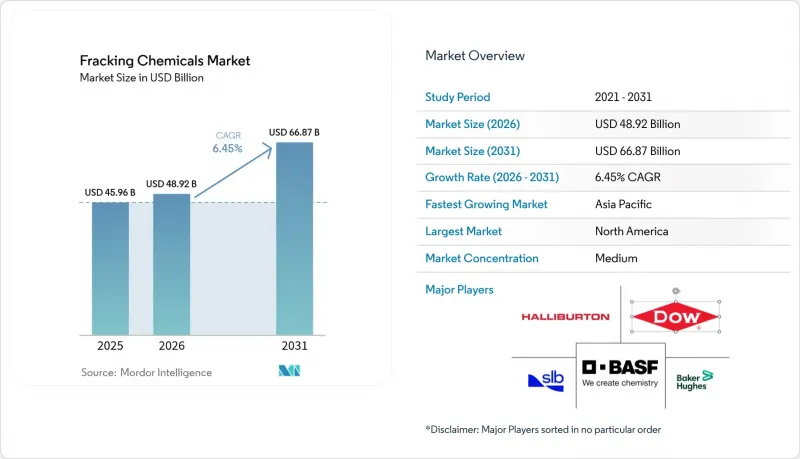
Mordor Intelligence에 따르면 2026년 프래킹용 화학제품 시장 규모는 489억 2,000만 달러로 추정되고 있으며, 2025년 459억 6,000만 달러에서 확대하며, 2031년에는 668억 7,000만 달러에 달할 것으로 예측됩니다.
2026-2031년까지 연평균 성장률(CAGR) 6.45%로 성장할 것으로 전망됩니다.
이 보고서는 유체 유형(수성, 유성, 발포성, 젤형, 산성), 첨가제의 기능(겔화제, 마찰 저감제, 계면활성제, 살균제, 부식·스케일 방지제, 가교제, 파쇄제),시추공 유형(수평 시추공 및 수직 시추공), 그리고 지역(북미, 유럽, 아시아태평양, 남미, 중동 및 아프리카)별로 분류되어 있습니다.
전 세계 프래킹용 화학물질 시장의 동향 및 인사이트
수평 시추 활동의 급증
시추 효율의 급속한 향상으로 인해 패드 수가 증가하고, 수평 시추공의 길이가 늘어나며, 프랙처링 단계 수가 증가하고 있으며, 이 모든 요인이 종합적으로 화학약품 소비량을 증가시키고 있습니다. 셰브론(Chevron)사의 ‘트리플 플랙(Triple Flack)’ 기술은 2025년 퍼미안 분지 유정의 약 절반에 적용되어, 완공까지 소요되는 시간을 25% 단축하고 유정당 비용을 12% 절감했습니다. 여러 유정을 동시에 프랙킹함에 따라 일일 물과 모래 수요가 약 60% 증가했으며, 10,000psi를 초과하는 펌프 압력 하에서도 성능을 유지할 수 있는 마찰 저감제, 살균제, 스케일 억제제에 대한 수요도 이에 따라 증가하고 있습니다. 2025년에 시추 유정 수가 6,604개에 달할 것으로 예상되는 캐나다의 운영사들도 기존 유정의 생산량 감소를 보충하기 위해 유사한 기법을 채택하고 있습니다. 시추 도급업체에 따르면 수평 터널의 연장이 증가함에 따라 유체 마찰이 커져 펌프 토출량을 유지하기 위해 슬릭 워터용 첨가제의 투여량을 늘려야 할 필요가 생겼다고 합니다. 덴버-줄스버그 분지에 첨단 시추 설계가 보급되고 있는 것은 이러한 성장세가 더 이상 기존의 주요 셰일 산지에만 국한되지 않음을 보여줍니다.
슬릭워터용 마찰 저감제에 대한 수요 증가
폴리아크릴아미드계 마찰 저감제는 총 용해 고형분(TDS)이 100,000 ppm을 초과하는 생산수의 염분 농도에서도 65%-70%의 마찰 저감 효과를 유지할 수 있으므로 현재 첨가제 지출의 대부분을 차지하고 있습니다. 내염성 화학 성분 덕분에 사업자는 현장에서 물을 재활용할 수 있게 되어, 펌프 출력을 일정하게 유지하면서 담수 취수량과 트럭 운송 비용을 절감할 수 있습니다. 저투수성 저류층에서의 현장 시험에서는 지층에 잔류 손상을 유발하지 않으면서 70% 이상의 마찰 감소 효과가 입증되어, 투수성 저하에 대한 우려가 완화되었습니다. 점도 증강형 마찰 저감제의 등장으로 슬릭 워터와 젤의 장점이 융합되어, 운영자는 더 높은 펌프 토출률로 고비중 프로판트를 이송할 수 있게 되었습니다. 또한 엄격한 배출 목표도 수요를 지원하고 있습니다. 슬릭워터 시스템은 고점도 겔에 비해 필요한 프로판트 농도가 낮기 때문에 현장 작업 시간이 단축되고 디젤 연료 소비량도 절감됩니다.
원유 가격 변동
가격 변동은 시추의 수익성을 거의 즉각적으로 변화시키며, 이로 인해 완공 공정의 일정이 조정되고, 결과적으로 화학 약품의 실시간 수요에 영향을 미칩니다. 댈러스 연방준비은행의 보고서에 따르면 2025년 상반기에는 에탄이 1파운드당 0.09달러,에틸렌은 1파운드당 0.21달러 등 원료 투입량이 감소했습니다. 2025년 초에 발생한 미국산 에탄의 중국 수출 중단은 마찰 저감제에 필수적인 아크릴아미드 및 구아 유도체의 공급 불안을 더욱 심화시켰습니다. 예산 제약을 받는 사업자들은 공정 단계를 단축하거나 프로판트 투입량을 줄이는 방식에 대응하고 있으며, 그 결과 유정당 사용되는 폴리머와 계면활성제의 양이 감소하고 있습니다. 화학약품 공급업체들은 재고 리스크를 안고 있으며, 가격 동향이 안정될 때까지 장기 계약 재협상을 강요받거나 가동률이 낮은 블렌딩 시설을 가동 중단할 수밖에 없는 상황에 처해 있습니다. 헤지 전략을 통해 위험의 일부는 완화되지만, 가격이 침체된 기간 중의 현금 흐름 부족으로 인해 보다 친환경적인 화학 기술 및 디지털 플랫폼에 대한 혁신 투자가 지연될 가능성이 있습니다.
부문별 분석
2025년, 각 운영사가 비용 효율성과 규제 준수를 우선시한 결과, 수성 시스템은 프래킹용 화학물질 시장 규모의 72.05%를 차지했습니다. 물류 부담 경감과 뛰어난 프로판트 수송 성능이라는 장점을 가진 발포계 유체는 연평균 성장률(CAGR) 14.85%로 성장할 것으로 예측되며, 시장 전체의 성장률을 상회할 것으로 전망됩니다. 내염성 마찰 저감제 및 생분해성 계면활성제의 등장으로, 양수율을 저하시키지 않으면서 생산수를 40%-60% 재이용할 수 있게 되어 수계 유체의 우위가 더욱 공고해졌습니다. 예를 들어 아르헨티나의 사업자는 95% 이상의 단계에서 수계 유체를 채택하고 있으며, 이는 물을 주성분으로 하는 화학 약품의 세계적 표준화를 여실히 보여주고 있습니다. 한편, 사우디아라비아에서 개발된 해수 기반 혼합물은 특수한 스케일 억제제를 사용하여 고농도의 황산염 부하에 효과적으로 대처하고 있으며, 이를 통해 건조 지역에서의 적용 범위를 확대하고 있습니다.
유성 및 겔화 유성 제제는 중동 전역의 초고온 탄산염암 저류층에서 틈새 시장 역할을 유지하고 있습니다. 이러한 지역에서는 150°C를 초과하는 온도에서 안정성을 확보하기 위해 방향족 용매와 고농도의 계면활성제가 필요합니다. 겔계 시스템은 북미의 워크오버 작업에서 계속해서 사용되고 있으며, 그 높은 점도가 저압 구역에서 프로판트의 현탁을 돕고 있습니다. 산계 유체는 탄산염암의 증산 처리에서 여전히 필수적이지만, 사업자들이 부식 위험을 최소화하는 하이브리드형(산·슬릭 워터 병용) 처리로 전환함에 따라 그 사용량은 감소 추세를 보이고 있습니다. 폐기 규제의 강화가 예상되는 가운데, 수계 시스템 공급업체들은 규제 준수와 비용 경쟁력을 유지하기 위해 현장에서의 재활용 장치 및 인라인 첨가제 주입 시스템 확충을 추진하고 있습니다.
지역별 분석
북미는 풍부한 셰일 자원, 견고한 미드스트림 인프라, 그리고 오랜 기간 사업을 운영해 온 서비스 기업의 존재에 힘입어 2025년 프래킹용 화학물질 시장에서 57.12%의 점유율을 차지하며, 여전히 프래킹 활동의 중심지로 자리 잡고 있습니다. 미국은 여전히 전 세계 수압 파쇄 용량의 대부분을 차지하고 있으며, 캐나다에서는 2025년에 6,604개 유정의 시추가 재개될 것으로 예상되어, 이는 폴리머 및 살균제에 대한 지역적 수요를 지원하고 있습니다. 생산수의 재사용에 관한 규제가 명확해진 데 더해, 바켄 및 퍼미안 분지에서 전기 구동 차량이 확대됨에 따라 이 지역이 저탄소 화학 솔루션을 통합할 준비가 되어 있음을 보여줍니다.
아시아태평양은 2031년까지 연평균 성장률(CAGR) 8.05%로 가장 높은 성장세를 보일 것으로 예측되며, 북미와의 격차를 점차 좁혀갈 전망입니다. 중국 칭주시(Qiongzhusi) 해양 셰일 시범 유정은 버넷 셰일의 초기 생산성을 반영하고 있으며, 기술 이전 노력이 결실을 맺고 있음을 입증함과 동시에, 중국석유화공(Sinopec) 및 중국석유(CNPC) 계열사의 국내 화학 제품 생산 능력 확대를 지원하고 있습니다. 인도 및 인도네시아에서는 심부 셰일층 탐사가 진행 중이며, 이것이 상용화될 경우 고염분 내성을 지닌 마찰 저감제 및 스케일 억제제에 대한 지역 수요가 수 배 증가할 가능성이 있습니다. 중국과 호주 일부 지역의 물 부족 현상은 발포계 및 해수계 유체의 도입을 가속화하고 있으며, 첨가제 포트폴리오는 수화 시간이 짧은 폴리머와 고발포성 계면활성제로 재편되고 있습니다.
남미에서는 아르헨티나의 바카 무에르타가 핵심을 이루고 있으며, 이 지역에서는 2023년 프랙처링 스테이지 수가 전년 대비 17.6% 증가하여 2024년에는 18,000스테이지에 달할 전망입니다. 구아검 및 모래 물류에 대한 국지적인 공급 제약을 배경으로, 혁신적인 마찰 저감제 배합 및 모듈식 모래 광산 전략 개발이 진행되고 있습니다. 브라질에서 막 시작된 육상 셰일 개발 프로젝트와 콜롬비아의 탐사 작업은 이 지역의 화학 약품 공급업체들에게 추가적인 성장 기회를 제공하고 있습니다.
유럽에서는 성숙한 대륙 산지의 재파쇄 및 북해의 타이트 가스 재개발 프로젝트를 원동력으로 수요가 꾸준히 증가하고 있습니다. 환경 측면의 규제는 여전히 엄격하지만, REACH 규정을 준수하는 EU산 친환경 첨가제가 점차 보급되고 있습니다. 폴란드와 우크라이나의 시범 프로젝트는 지질학적 복잡성을 여실히 드러내며, 더 높은 이산화탄소 분압을 견딜 수 있는 첨단 겔화제 및 부식 방지제의 필요성을 강조하고 있습니다.
중동 및 아프리카에서는 신흥 비전통적 목표지와 탄산염암 자극 프로그램이 결합되고 있습니다. 사우디아라비아의 해수를 이용한 프랙처링 성공 사례와 오만의 타이트 가스 개발 사업은 고온 환경에 특화된 스케일 방지 첨가제에 대한 미래 수요를 시사하고 있습니다. 사하라 이남 아프리카에서는 나미비아의 육상 셰일 평가가 새로운 시장을 개발할 가능성이 있지만, 인프라 및 수자원 확보는 여전히 큰 장벽으로 남아 있으며, 발포제 기반 시스템에 대한 의존도가 높아질 것으로 예상됩니다.
기타 혜택:
- 엑셀 형식의 시장 예측(ME) 시트
- 3개월간의 애널리스트 지원
자주 묻는 질문
목차
제1장 서론
제2장 조사 방법
제3장 개요
제4장 시장 구도
제5장 시장 규모와 성장 예측
제6장 경쟁 구도
제7장 시장 기회와 향후 전망
KSA 26.08.25According to Mordor Intelligence, fracking chemicals market size in 2026 is estimated at USD 48.92 billion, growing from 2025 value of USD 45.96 billion with 2031 projections showing USD 66.87 billion, growing at 6.45% CAGR over 2026-2031.
This report is Segmented by Fluid Type (Water-Based, Oil-Based, Foam-Based, Gel-Based, and Acid-Based), Additive Function (Gelling Agents, Friction Reducers, Surfactants, Biocides, Corrosion and Scale Inhibitors, Cross-Linkers, and Breakers), Well Type (Horizontal and Vertical), and Geography (North America, Europe, Asia-Pacific, South America, and Middle East and Africa).
Global Fracking Chemicals Market Trends and Insights
Surge in Horizontal Drilling Activity
Rapid gains in drilling efficiency are translating into larger pad counts, longer laterals, and higher stage counts, collectively intensifying chemical consumption. Chevron's triple-frac technology, applied to roughly half of its 2025 Permian wells, cut completion time by 25% and reduced per-well costs by 12%. Multi-well simultaneous fracturing increases daily water and sand demand by approximately 60%, necessitating a corresponding rise in friction reducers, biocides, and scale inhibitors that can maintain performance under pumping pressures exceeding 10,000 psi. Operators in Canada, where wells drilled are forecast to reach 6,604 in 2025, are adopting similar practices to compensate for declines in legacy wells. Drilling contractors report that longer laterals elevate fluid friction, prompting higher dosages of slick-water additives to preserve pump rates. The spread of advanced completion designs into the Denver-Julesberg basin indicates that the growth dynamic is no longer confined to traditional shale heartlands.
Growing Demand for Slick-Water Friction Reducers
Polyacrylamide-based friction reducers now dominate additive spend because they maintain 65%-70% friction reduction even in produced-water salinities above 100,000 ppm total dissolved solids. Salt-tolerant chemistries enable operators to recycle on-site water, reducing freshwater withdrawals and trucking costs while maintaining constant pump horsepower. Field trials in low-permeability reservoirs demonstrate over 70% friction reduction without residual formation damage, thereby mitigating concerns about permeability impairment. The arrival of viscosity-building friction reducers blends slick-water and gel benefits, helping operators carry heavier proppant at elevated pumping rates. Demand is also buoyed by strict emission targets: slick-water systems require lower proppant concentrations than high-viscosity gels, which translates into shorter on-site times and lower diesel consumption.
Crude-Oil Price Volatility
Price swings alter drilling economics almost immediately, thereby throttling completion schedules, which in turn affect real-time chemical demand. The Dallas Federal Reserve reported feedstock input declines in the first half of 2025, including ethane at $0.09 per pound and ethylene at $0.21 per pound. Export interruptions of U.S. ethane to China earlier in 2025 exacerbated supply uncertainty for acrylamide and guar derivatives, which are crucial to friction reducers. Budget-constrained operators respond by shortening stage lengths or reducing proppant loading, translating into lower polymer and surfactant volumes per well. Chemical suppliers bear inventory risk and are compelled to renegotiate long-term contracts or idle under-utilized blending facilities until price signals stabilize. While hedging strategies mitigate some exposure, cash-flow strain during low-price windows may delay innovation spending on greener chemistries and digital platforms.
Other drivers and restraints analyzed in the detailed report include:
- Expansion of Shale Development Outside North America
- Re-Fracturing of Mature Wells
- Stringent Wastewater-Disposal Regulations
For complete list of drivers and restraints, kindly check the Table Of Contents.
Segment Analysis
Water-based systems accounted for 72.05% of the fracking chemicals market size in 2025, as operators prioritized cost efficiency and regulatory alignment. Foam-based fluids, benefitting from reduced water logistics and superior proppant transport, are forecast at a 14.85% CAGR, outpacing overall market growth. The emergence of salt-tolerant friction reducers and biodegradable surfactants has further solidified water-based dominance by enabling 40%-60% reuse of produced water without penalties to pump rates. Operators in Argentina, for instance, employ aqueous fluids in over 95% of stages, illustrating the global standardization of water-centric chemistries. Meanwhile, seawater-based blends developed in Saudi Arabia effectively cope with high sulfate loads through the use of specialized scale inhibitors, thereby expanding their applicability in arid regions.
Oil-based and gelled-oil formulations retain niche roles in ultra-high-temperature carbonate reservoirs across the Middle East, where stability above 150 °C demands aromatic solvents and heavy loadings of surfactants. Gel-based systems continue to be used in North American workovers, where higher viscosity aids proppant suspension in low-pressure zones. Acid-based fluids remain indispensable for carbonate stimulation, though volumes represent a declining share as operators pivot toward hybrid acid-slick-water treatments that minimize corrosion risk. Given projected stricter disposal rules, water-based system suppliers are scaling on-site recycling units and inline additive dosing to maintain compliance and cost leadership.
Complete Report Scope:
- By Fluid Type
- Water-based
- Oil-based
- Foam-based
- Gel-based
- Acid-based
- By Additive Function
- Gelling Agents
- Friction Reducers
- Surfactants
- Biocides
- Corrosion and Scale Inhibitors
- Cross-linkers
- Breakers
- By Well Type
- Horizontal
- Vertical
- By Geography
- North America
- United States
- Canada
- Mexico
- Europe
- Germnay
- United Kingdom
- France
- Italy
- Spain
- Russia
- Rest of Europe
- Asia Pacific
- China
- India
- Japan
- South Korea
- Australia
- ASEAN Countries
- Rest of Asia Pacific
- South America
- Argentina
- Brazil
- Rest of South America
- Middle East and Africa
- Saudi Arabia
- United Arab Emirates
- South Africa
- Nigeria
- Rest of Middle East and Africa
- North America
Geography Analysis
North America remained the epicenter of fracking activity, with a 57.12% market share of fracking chemicals in 2025, supported by abundant shale resources, robust midstream infrastructure, and long-tenured service companies. The United States still fields the majority of global hydraulic-fracturing horsepower, and Canada's drilling rebound-forecast at 6,604 wells in 2025-bolsters regional demand for polymers and biocides. Regulatory clarity on produced-water reuse, coupled with the expansion of electric fleets in the Bakken and Permian, underscores the region's readiness to integrate low-carbon chemical solutions.
Asia-Pacific is projected to post the fastest 8.05% CAGR through 2031, narrowing the gap with North America. China's Qiongzhusi marine shale pilot wells mirror early Barnett Shale productivity, validating technology transfer efforts and spurring domestic chemical capacity expansions among Sinopec and CNPC affiliates. India and Indonesia are evaluating deep shale prospects that, if commercialized, could multiply regional demand for high-salinity-tolerant friction reducers and scale inhibitors. Water scarcity in parts of China and Australia is accelerating the adoption of foam-based and seawater-based fluids, reshaping additive portfolios toward lower-hydration-time polymers and high-foaming surfactants.
South America is anchored by Argentina's Vaca Muerta, where fracture stages rose 17.6% year on year in 2023 and are on track for 18,000 stages in 2024. Localized supply constraints of guar and sand logistics have driven the development of innovative friction-reducer blends and modular sand-mine strategies. Brazil's nascent onshore shale programs and Colombia's exploratory work offer incremental upside for regional chemical suppliers.
Europe shows steady demand growth driven by refracturing in mature continental plays and the North Sea's tight-gas redevelopment projects. While environmental scrutiny remains high, EU-sourced green additives that comply with REACH regulation are gaining ground. Pilot projects in Poland and Ukraine highlight the geological complexity, underscoring the need for advanced gelling agents and corrosion inhibitors that can withstand higher carbon dioxide partial pressures.
The Middle East and Africa combine emerging unconventional targets and carbonate stimulation programs. Saudi Arabia's successful seawater-based fracturing and Oman's tight-gas campaigns illustrate future demand for scale-resistant additives tailored to high-temperature settings. In Sub-Saharan Africa, Namibia's onshore shale evaluations could open a frontier market, though infrastructure and water sourcing remain significant hurdles that will lean heavily on foam-based systems.
- Halliburton Company
- Schlumberger Ltd (SLB)
- Baker Hughes Co.
- BASF SE
- Dow Inc.
- DuPont de Nemours Inc.
- Solvay SA
- Clariant AG
- Albemarle Corp.
- SNF Group
- Kemira Oyj
- Chevron Phillips Chemical Co.
- Nouryon (Nyxas Holding)
- Innospec Inc.
- Flotek Industries Inc.
- CES Energy Solutions Corp.
- Ashland Global Holdings Inc.
- Arkema SA
- Stepan Company
- Lamberti SpA
Additional Benefits:
- The market estimate (ME) sheet in Excel format
- 3 months of analyst support
TABLE OF CONTENTS
1 Introduction
- 1.1 Study Assumptions & Market Definition
- 1.2 Scope of the Study
2 Research Methodology
3 Executive Summary
4 Market Landscape
- 4.1 Market Overview
- 4.2 Market Drivers
- 4.2.1 Surge in horizontal drilling activity
- 4.2.2 Growing demand for slick-water friction-reducers
- 4.2.3 Expansion of shale development outside North America
- 4.2.4 Re-fracturing of mature wells
- 4.2.5 Lithium-recovery from produced-water initiatives
- 4.2.6 AI-driven digital fluid-optimisation platforms
- 4.3 Market Restraints
- 4.3.1 Crude-oil price volatility
- 4.3.2 Stringent wastewater-disposal regulations
- 4.3.3 Consumer backlash after chemical-disclosure mandates
- 4.3.4 Acrylamide monomer supply-chain disruptions
- 4.4 Supply-Chain Analysis
- 4.5 Regulatory Landscape
- 4.6 Technological Outlook
- 4.7 Porter's Five Forces
- 4.7.1 Bargaining Power of Suppliers
- 4.7.2 Bargaining Power of Customers
- 4.7.3 Threat of New Entrants
- 4.7.4 Threat of Substitutes
- 4.7.5 Intensity of Competitive Rivalry
5 Market Size & Growth Forecasts
- 5.1 By Fluid Type
- 5.1.1 Water-based
- 5.1.2 Oil-based
- 5.1.3 Foam-based
- 5.1.4 Gel-based
- 5.1.5 Acid-based
- 5.2 By Additive Function
- 5.2.1 Gelling Agents
- 5.2.2 Friction Reducers
- 5.2.3 Surfactants
- 5.2.4 Biocides
- 5.2.5 Corrosion and Scale Inhibitors
- 5.2.6 Cross-linkers
- 5.2.7 Breakers
- 5.3 By Well Type
- 5.3.1 Horizontal
- 5.3.2 Vertical
- 5.4 By Geography
- 5.4.1 North America
- 5.4.1.1 United States
- 5.4.1.2 Canada
- 5.4.1.3 Mexico
- 5.4.2 Europe
- 5.4.2.1 Germnay
- 5.4.2.2 United Kingdom
- 5.4.2.3 France
- 5.4.2.4 Italy
- 5.4.2.5 Spain
- 5.4.2.6 Russia
- 5.4.2.7 Rest of Europe
- 5.4.3 Asia Pacific
- 5.4.3.1 China
- 5.4.3.2 India
- 5.4.3.3 Japan
- 5.4.3.4 South Korea
- 5.4.3.5 Australia
- 5.4.3.6 ASEAN Countries
- 5.4.3.7 Rest of Asia Pacific
- 5.4.4 South America
- 5.4.4.1 Argentina
- 5.4.4.2 Brazil
- 5.4.4.3 Rest of South America
- 5.4.5 Middle East and Africa
- 5.4.5.1 Saudi Arabia
- 5.4.5.2 United Arab Emirates
- 5.4.5.3 South Africa
- 5.4.5.4 Nigeria
- 5.4.5.5 Rest of Middle East and Africa
- 5.4.1 North America
6 Competitive Landscape
- 6.1 Market Concentration
- 6.2 Strategic Moves (M&A, Partnerships, PPAs)
- 6.3 Market Share Analysis (Market Rank/Share for key companies)
- 6.4 Company Profiles (includes Global level Overview, Market level overview, Core Segments, Financials as available, Strategic Information, Products & Services, and Recent Developments)
- 6.4.1 Halliburton Company
- 6.4.2 Schlumberger Ltd (SLB)
- 6.4.3 Baker Hughes Co.
- 6.4.4 BASF SE
- 6.4.5 Dow Inc.
- 6.4.6 DuPont de Nemours Inc.
- 6.4.7 Solvay SA
- 6.4.8 Clariant AG
- 6.4.9 Albemarle Corp.
- 6.4.10 SNF Group
- 6.4.11 Kemira Oyj
- 6.4.12 Chevron Phillips Chemical Co.
- 6.4.13 Nouryon (Nyxas Holding)
- 6.4.14 Innospec Inc.
- 6.4.15 Flotek Industries Inc.
- 6.4.16 CES Energy Solutions Corp.
- 6.4.17 Ashland Global Holdings Inc.
- 6.4.18 Arkema SA
- 6.4.19 Stepan Company
- 6.4.20 Lamberti SpA
7 Market Opportunities & Future Outlook
- 7.1 White-space & Unmet-Need Assessment