

|
시장보고서
상품코드
2113287
가스 터빈 MRO : 시장 점유율 분석, 업계 동향과 통계, 성장 예측(2026-2031년)Gas Turbine MRO - Market Share Analysis, Industry Trends & Statistics, Growth Forecasts (2026 - 2031) |
||||||
 Mordor Intelligence
Mordor Intelligence에 따르면 가스 터빈 MRO 시장 규모는 2025년 167억 1,000만 달러에서 2026년에는 175억 3,000만 달러로 확대하며, 2026-2031년에 CAGR 4.88%로 추이하며, 2031년에는 222억 4,000만 달러에 달할 것으로 예측됩니다.
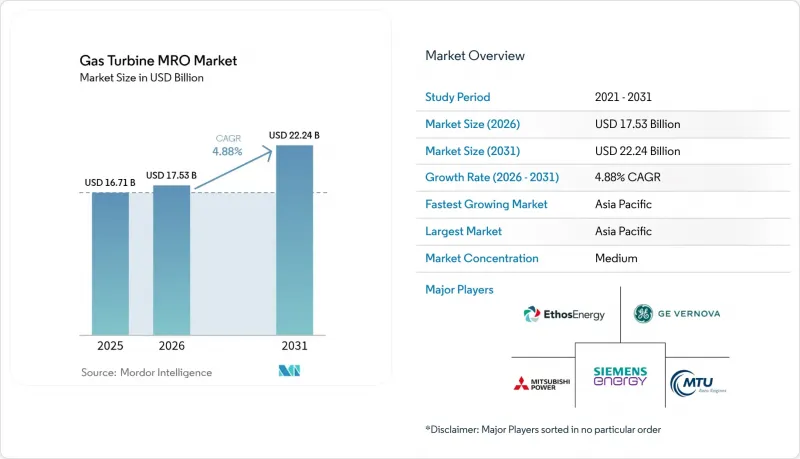
이 보고서는 용량(30MW 이하, 31-120MW, 120MW 이상), 터빈 사이클(복합 사이클, 오픈/심플 사이클), 서비스 유형(유지보수, 수리, 오버홀), 최종사용자 산업(발전, 석유 및 가스,산업 및 기타), 지역(북미, 유럽, 아시아태평양, 남미, 중동 및 아프리카)별로 분류되어 있습니다.
전 세계 가스 터빈 MRO 시장의 동향 및 인사이트
노후화되는 전 세계 터빈 군이 정기적인 대규모 오버홀을 촉진
전 세계에서 약 7,000기의 GE Vernova제 터빈이 로터 수명 연장 시기를 맞이하고 있으며, 이에 따라 가동 수명을 10-15년 연장할 수 있는 고온 가스 경로 부품 교체, 제어 시스템 업그레이드, 금속 조직 정밀 점검이 급증하고 있습니다. 1990년대 북미와 유럽의 붐기에 설치된 F급 유닛은 재생 가능 에너지의 변동성을 보완하기 위해 현재보다 높은 설비 가동률로 운영되고 있으며, 이로 인해 마모가 더욱 가속화되고 있습니다. EthosEnergy와 같은 서비스 전문 기업은 GE의 B/E/F형 및 구 웨스팅하우스제 프레임용으로 맞춤형 로터 재구축 프로그램을 전개하고 있으며, 여기에는 첨단 틈새 전문 지식이 필수적이라는 점이 부각되고 있습니다. 소유주들은 오버홀을 단순한 일상적인 경비가 아닌, 출력 향상으로 이어지는 자본 투자로 인식하는 경향이 강해지고 있습니다. 이는 점진적인 효율 향상이 남은 수명 주기 동안의 연료 소비량과 배출량을 줄여주기 때문입니다.
애프터마켓 수익을 확보하는 OEM의 장기 서비스 계약
LTSA(장기 서비스 계약)는 부품 공급, 인건비, 디지털 모니터링, 성능 보증을 포괄하는 15년 25년에 걸친 성과 기반 계약으로 성숙해졌으며, GE Vernova의 가스 발전 수익의 약 70%를 차지하고 있습니다. EthosEnergy가 EDF와 체결한, 프랑스와 그 영토내 20기의 대형 터빈을 대상으로 하는 다년 계약은, 전력 회사가 비용 변동 위험을 헤지하는 동시에 OEM이 예측 가능한 현금 흐름을 확보할 수 있는 구조를 여실히 보여주고 있습니다. 현지 인플레이션율에 연동된 에스컬레이터 조항이 이익률을 보호하며, 클라우드 기반 분석 기능을 통한 조기 고장 감지로 가동 중단 시간을 20-30% 단축할 수 있게 되었습니다.
가스 가격 변동에 따라 유지보수 주기가 단축됩니다.
2024년, 유럽의 주요 거래소에서 TTF 가스 가격이 100유로/MWh를 넘어서는 급등세를 보이자, 이에 따라 사업자들은 가스 화력 발전 출력을 감축하고 유지보수 주기를 연장했습니다. 그 결과, 당분간 부품 수요가 감소함과 동시에 서비스 기업의 수익도 뒤로 미루게 되었습니다. 현재 MRO 공급업체들은 가동률 변동을 완화하기 위해 계약에 유연한 수량 조항을 포함시키고 있습니다.
부문 분석
120MW를 초과하는 대형 설비는 2025년 가스 터빈 MRO 시장 매출의 57.60%를 차지했습니다. 이는 복잡한 고온 가스 경로의 작업 범위와 50일을 초과하기도 하는 장기 가동 중단 기간에 기인한 것입니다. 이러한 유닛은 복합 사이클 발전 블록의 핵심을 이루며, 효율이 1% 포인트 향상될 때마다 상당한 연료 절감으로 이어지기 때문에 소유주들은 오버홀시 최첨단 코팅 및 팁 클리어런스 업그레이드를 채택하고 있습니다. 한편, 31-120MW 구간은 데이터센터용 피크 대응 발전 설비의 증설과 항공기 파생형 엔진의 기동성을 중시하는 산업용 열병합 발전 프로젝트에 힘입어 연평균 성장률(CAGR) 6.45%로 가장 빠르게 성장하는 부문입니다. 이 부문에서는 모듈식 교체 전략을 통해 가동 중단 시간을 10일 이하로 단축할 수 있지만, 가동 횟수가 증가함에 따라 점검 빈도도 높아집니다.
30MW 이하의 소형 터빈은 오프그리드 광업, 외딴 지역의 석유 및 가스 시설, 병원 및 공항의 백업 용도를 지원하고 있습니다. 개별 오버홀 가치는 낮지만, 기체 수가 많기 때문에 전체적으로 의미 있는 작업량을 창출하고 있습니다. MRO 제공업체는 고비용의 크레인을 이용한 물류를 피하고, 현장에서 핫 섹션 교체를 수행할 수 있는 컨테이너형 이동 작업장을 통해 차별화를 꾀하고 있습니다.
복합 사이클 설비는 2025년 가스 터빈 MRO 시장 점유율의 85.20%를 차지하고 있으며, 이는 광범위한 설비 대수와 1개 플랜트당 정비 가능한 자산 수를 증가시키는 멀티 모듈 구조 모두를 반영한 것입니다. HRSG 튜브 점검, 증기 터빈 밸브 개조, 응축기 세척과 같은 복합적인 정지 작업의 범위는 가스 터빈의 핵심 부분을 넘어, 일정 지연을 피하기 위해 대부분의 경우 동기화된 프로젝트 관리가 필요합니다. 따라서 서비스 제공업체는 종단간(end-to-end) 솔루션을 패키지화하고, 전기, 기계, 플랜트 부대 설비(BOP) 작업에 대해 단일 책임 주체 아래 하청업체를 조정하고 있습니다.
연평균 성장률(CAGR) 5.65%로 확대되고 있는 오픈 사이클/심플 사이클 발전 설비는 효율보다 신속한 가동 능력이 중시되는 경우, 계통 조정용 피크 전력이나 산업용 백업 전원을 제공합니다. 단순한 구조 덕분에 정지 기간은 단축되지만, 고부하 상태에서의 가동은 열 응력을 악화시킵니다. 따라서 MRO 계약에서는 시동 횟수에 따른 수명 관리와 빈번한 보어스코프 검사가 중시되고 있습니다.
지역별 분석
아시아태평양이 압도적인 점유율을 차지하는 배경에는 복합 사이클 발전소의 지속적인 도입, 산업의 전기화, 석탄을 대체할 저탄소 기저 부하 전원을 지향하는 정부의 규제가 있습니다. 담맘, 쿠알라룸푸르, 상하이에 위치한 지역 OEM 창고에서는 중요한 고온 가스 경로용 부품을 재고로 보유하고 있으며, 통관 지연을 대폭 줄이고 평균 가동 중단 기간을 10% 단축하고 있습니다. 또한 서비스 제공업체는 국영 전력 회사와 협력하여 수소 대응 시범 프로젝트를 공동 개발하고 있으며, 탈탄소화 자금을 활용할 수 있게 되었을 때 선구자로서의 우위를 확보하고 있습니다.
북미에서는 풍부한 셰일 가스에 힘입어 연료 비용이 충분히 낮게 유지되고 있으므로 구형 터빈 유닛을 폐기하는 대신 개조하는 것이 타당화되고 있습니다. 미국에서는 항공기 정비와 동등한 서비스 수준을 채택한 데이터센터용 피크 대응 프로젝트가 상황을 더욱 복잡하게 만들고 있으며, 여기에는 예정에 없던 정지 발생시 최대 4시간 이내에 대응을 보장하는 것이 포함됩니다. 캐나다의 LNG 수출 터미널에서는 해수 염분을 포함한 공기에 노출되는 압축기 구동용 터빈이 사용되고 있으며, 흡기 필터의 교체 주기를 자주 수행해야 합니다.
유럽에서는 가스 가격 변동과 엄격한 ESG 규제에 직면해 있습니다. 사업자들은 탄소세 부담을 상쇄하기 위해 고효율화로의 업그레이드에 주력하고 있으며, 이로 인해 수명 연장 작업은 경제적으로 필수적인 요소가 되었습니다. 이에 따라 각 OEM 업체들은 자금 조달을 가능하게 하는 EU의 택소노미 기준을 준수하여, 최대 50%의 수소 사용이 인증된 연소기 키트를 번들로 제공하고 있습니다. 현장 서비스 인력 부족은 여전히 심각한 문제이며, 서비스 제공업체들은 이동식 컨테이너 작업장과 원격 전문가 지원을 활용하여 인력을 보강하고, 엄격한 계통 조정 시간 내에 가동 중단 일정을 유지하고 있습니다.
중동에서는 정유소 확장과 통합된 장기 열병합 발전 단지가 중심을 이루고 있습니다. 이러한 플랜트는 높은 부하율로 가동되고 있으므로 3년마다 치밀하게 계획된 대규모 가동 중단이 필수적입니다. OEM 각사는 현지화 할당량을 충족하기 위해 수리가 가능한 고온부 정비 공장을 현지에 개설하고 있습니다. 급성장하고 있지만 분산된 아프리카 시장에서는 단순 사이클 피크 대응 발전기 및 비상 발전기에 초점이 맞춰져 있으며, 모듈식 교체 전략을 통해 예비 부품 재고를 최소화하고 있습니다.
남미에서는 신규 CCGT에 공급되는 천연가스 매장량의 발견을 활용하고 있지만, 소규모 산업용 터빈의 방대한 기존 설비가 여전히 남아 있습니다. 각 OEM 업체들은 리드 타임을 단축하고 통관 병목 현상을 피하기 위해 콜롬비아와 칠레에 지역 부품 허브를 설립하여, Tier-1 품목의 24시간 이내 출고를 목표로 하고 있습니다.
기타 혜택
- 엑셀 형식의 시장 예측(ME) 시트
- 3개월간의 애널리스트 지원
자주 묻는 질문
목차
제1장 서론
제2장 조사 방법
제3장 개요
제4장 시장 구도
제5장 시장 규모와 성장 예측
제6장 경쟁 구도
제7장 시장 기회와 향후 전망
KSA 26.08.25According to Mordor Intelligence, the gas turbine MRO market size is expected to grow from USD 16.71 billion in 2025 to USD 17.53 billion in 2026 and is forecast to reach USD 22.24 billion by 2031 at 4.88% CAGR over 2026-2031.
This report is Segmented by Capacity (Below 30 MW, 31 To 120 MW, and Above 120 MW), Turbine Cycle (Combined Cycle and Open/Simple Cycle), Service Type (Maintenance, Repair, and Overhaul), End-User Industry (Power Generation, Oil and Gas, and Industrial and Other), and Geography (North America, Europe, Asia-Pacific, South America, and Middle East and Africa).
Global Gas Turbine MRO Market Trends and Insights
Aging Global Fleet Driving Scheduled Major Overhauls
Roughly 7,000 GE Vernova turbines worldwide are entering rotor-life extension windows, triggering an upsurge in hot-gas-path component swaps, control upgrades, and metallurgy overhauls that can add 10-15 years of service life. F-class units installed during the 1990s boom in North America and Europe now operate at higher capacity factors to support renewable variability, further accelerating wear. Service specialists such as EthosEnergy deploy bespoke rotor rebuild programs for GE B/E/F and legacy Westinghouse frames, underscoring the depth of niche expertise required. Owners are increasingly treating overhauls as capital investments tied to performance uprates, rather than routine expenses, because incremental efficiency gains reduce fuel burn and emissions over the remaining life cycle.
OEM Long-Term Service Agreements Ensuring Aftermarket Revenues
LTSAs have matured into 15 to 25-year, outcome-based pacts that bundle parts supply, labor, digital monitoring, and performance guarantees-representing about 70% of GE Vernova's gas-power revenue stream. EthosEnergy's multi-year master agreement with EDF, covering 20 heavy-duty turbines across France and its territories, illustrates how utilities hedge against cost volatility while OEMs lock in predictable cash flow. Escalator clauses keyed to local inflation protect margins, and cloud-based analytics enable early-fault detection, which trims outage duration by 20-30%.
Gas-Price Volatility Lowering Run-Hours Between Services
European hubs saw TTF gas spike above EUR 100/MWh in 2024, prompting operators to curtail gas-fired output and stretch maintenance intervals, which reduced immediate parts demand and deferred revenue for service firms. MRO providers now include flexible volume clauses in contracts to mitigate utilization fluctuations.
Other drivers and restraints analyzed in the detailed report include:
- Expansion of Combined-Cycle Plants in Emerging Economies
- Data-Center Peaker Demand for Aeroderivative Turbines
- Renewable-Energy Displacement of Baseload Gas Generation
For complete list of drivers and restraints, kindly check the Table Of Contents.
Segment Analysis
Large-frame machines, those above 120 MW, generated 57.60% of the 2025 gas turbine MRO market revenue, buoyed by complex hot-gas-path work scopes and extensive outage durations that can exceed 50 days. These units anchor combined-cycle blocks where every percentage-point efficiency gain drives significant fuel savings, encouraging owners to adopt cutting-edge coatings and tip-clearance upgrades during overhauls. The 31-120 MW bracket, however, is the fastest-growing segment at a 6.45% CAGR, driven by data-center peaker additions and industrial cogeneration projects that favor aeroderivative agility. Here, modular swap strategies trim downtime to under 10 days, but higher start counts inflate inspection frequency.
Smaller turbines, those below 30 MW, support off-grid mining, remote oil and gas facilities, and backup duties for hospitals and airports. Although the individual overhaul value is lower, fleet numbers generate meaningful aggregate work. MRO providers differentiate via containerized mobile workshops that execute hot-section exchanges on-site, sidestepping costly crane logistics.
Combined-cycle equipment captured 85.20% of the 2025 gas turbine MRO market share, reflecting both its extensive fleet footprint and the multi-module architecture that increases the number of serviceable assets per plant. HRSG tube inspection, steam-turbine valve refurbishment, and condenser cleaning compound outage scope extend beyond the gas-turbine core, often requiring synchronized project management to avoid schedule slips. Service providers thus package end-to-end solutions, coordinating subcontractors for electrical, mechanical, and balance-of-plant tasks under single-point accountability.
Open/simple-cycle sets, expanding at a 5.65% CAGR, provide grid-balancing peaking power and industrial back-up where quick-start capability outweighs efficiency. Their straightforward architecture lowers outage duration, but high-impact starts worsen thermal stress. MRO contracts, therefore, emphasize start-based life management and frequent borescopic inspections.
Complete Report Scope:
- By Capacity
- Below 30 MW
- 31 to 120 MW
- Above 120 MW
- By Turbine Cycle
- Combined Cycle
- Open/Simple Cycle
- By Service Type
- Maintenance
- Repair
- Overhaul
- By End-user Industry
- Power Generation
- Oil and Gas (Up-/Mid-/Down-stream)
- Industrial and Other
- By Geography
- North America
- United States
- Canada
- Mexico
- Europe
- Germany
- United Kingdom
- France
- Italy
- NORDIC Countries
- Russia
- Rest of Europe
- Asia-Pacific
- China
- India
- Japan
- South Korea
- ASEAN Countries
- Rest of Asia-Pacific
- South America
- Brazil
- Argentina
- Rest of South America
- Middle East and Africa
- Saudi Arabia
- United Arab Emirates
- South Africa
- Egypt
- Rest of Middle East and Africa
- North America
Geography Analysis
The Asia-Pacific's dominant share stems from the sustained rollout of combined-cycle power plants, industrial electrification, and government mandates that aim for lower-carbon baseload alternatives to coal. Regional OEM depots in Dammam, Kuala Lumpur, and Shanghai stock critical hot-gas-path parts, slashing customs delays and cutting average outage length by 10%. Service providers also align with state utilities to co-develop hydrogen-ready pilot projects, ensuring an early-mover advantage as decarbonization funds become available.
North America benefits from abundant shale gas, which keeps fuel costs low enough to justify refurbishing legacy frames rather than retiring them. The United States adds complexity through data-center peaker projects that adopt service levels akin to those in aviation maintenance, including a guaranteed four-hour maximum unscheduled-outage response. Canada's LNG export terminals rely on compressor-drive turbines that face marine-salt-laden air, necessitating aggressive inlet-filter replacement cycles.
Europe confronts volatile gas pricing and stringent ESG rules. Operators pivot toward high-efficiency upgrades to offset carbon tax exposure, making life extension work an economic imperative. OEMs thus bundle combustor kits certified for up to 50% hydrogen, aligning with EU taxonomy thresholds that unlock financing. Field-service staffing shortages remain acute; providers augment their crews with mobile container workshops and remote expert support to maintain outage schedules within tight grid-balancing windows.
The Middle East leans on long-term cogeneration complexes integrated with refinery expansions. These plants run at high load factors, dictating well-planned major outages every three years. OEMs open repair-capable hot-section workshops in-country to satisfy localization quotas. Africa's fast-growing but fragmented market focuses on simple-cycle peakers and emergency units where modular swap-out strategies minimize spares inventory.
South America capitalizes on natural-gas discoveries that feed new CCGTs yet retains a large legacy of smaller industrial turbines. OEMs establish regional parts hubs in Colombia and Chile to reduce lead times and circumvent customs bottlenecks, aiming for 24-hour shipping for Tier-1 items.
- General Electric (GE Vernova)
- Siemens Energy
- Mitsubishi Power
- MTU Aero Engines
- EthosEnergy
- Kawasaki Heavy Industries
- Ansaldo Energia
- Solar Turbines
- Baker Hughes
- Sulzer
- Rolls-Royce
- RWG (Rolls-Wood Group)
- Patria
- Harbin Electric International
- Bharat Heavy Electricals
- MAN Energy Solutions
- Pratt & Whitney
- Vericor Power Systems
- Wood Group
- Taqa Arabia Services
Additional Benefits:
- The market estimate (ME) sheet in Excel format
- 3 months of analyst support
TABLE OF CONTENTS
1 Introduction
- 1.1 Study Assumptions & Market Definition
- 1.2 Scope of the Study
2 Research Methodology
3 Executive Summary
4 Market Landscape
- 4.1 Market Overview
- 4.2 Market Drivers
- 4.2.1 Aging global fleet driving scheduled major overhauls
- 4.2.2 OEM long-term service agreements ensuring aftermarket revenues
- 4.2.3 Expansion of combined-cycle plants in emerging economies
- 4.2.4 Data-center peaker demand for aero-derivative turbines
- 4.2.5 Hydrogen-ready retrofit programs prompting part upgrades
- 4.2.6 AI-enabled predictive maintenance boosting service uptake
- 4.3 Market Restraints
- 4.3.1 Gas-price volatility lowering run-hours between services
- 4.3.2 Renewable-energy displacement of baseload gas generation
- 4.3.3 Global shortage of certified GT maintenance technicians
- 4.3.4 Regulatory ambiguity on H2 blends delaying overhaul plans
- 4.4 Supply-Chain Analysis
- 4.5 Regulatory Landscape
- 4.6 Technological Outlook
- 4.7 Porter's Five Forces
- 4.7.1 Bargaining Power of Suppliers
- 4.7.2 Bargaining Power of Consumers
- 4.7.3 Threat of New Entrants
- 4.7.4 Threat of Substitutes
- 4.7.5 Intensity of Competitive Rivalry
5 Market Size & Growth Forecasts
- 5.1 By Capacity
- 5.1.1 Below 30 MW
- 5.1.2 31 to 120 MW
- 5.1.3 Above 120 MW
- 5.2 By Turbine Cycle
- 5.2.1 Combined Cycle
- 5.2.2 Open/Simple Cycle
- 5.3 By Service Type
- 5.3.1 Maintenance
- 5.3.2 Repair
- 5.3.3 Overhaul
- 5.4 By End-user Industry
- 5.4.1 Power Generation
- 5.4.2 Oil and Gas (Up-/Mid-/Down-stream)
- 5.4.3 Industrial and Other
- 5.5 By Geography
- 5.5.1 North America
- 5.5.1.1 United States
- 5.5.1.2 Canada
- 5.5.1.3 Mexico
- 5.5.2 Europe
- 5.5.2.1 Germany
- 5.5.2.2 United Kingdom
- 5.5.2.3 France
- 5.5.2.4 Italy
- 5.5.2.5 NORDIC Countries
- 5.5.2.6 Russia
- 5.5.2.7 Rest of Europe
- 5.5.3 Asia-Pacific
- 5.5.3.1 China
- 5.5.3.2 India
- 5.5.3.3 Japan
- 5.5.3.4 South Korea
- 5.5.3.5 ASEAN Countries
- 5.5.3.6 Rest of Asia-Pacific
- 5.5.4 South America
- 5.5.4.1 Brazil
- 5.5.4.2 Argentina
- 5.5.4.3 Rest of South America
- 5.5.5 Middle East and Africa
- 5.5.5.1 Saudi Arabia
- 5.5.5.2 United Arab Emirates
- 5.5.5.3 South Africa
- 5.5.5.4 Egypt
- 5.5.5.5 Rest of Middle East and Africa
- 5.5.1 North America
6 Competitive Landscape
- 6.1 Market Concentration
- 6.2 Strategic Moves (M&A, Partnerships, PPAs)
- 6.3 Market Share Analysis (Market Rank/Share for key companies)
- 6.4 Company Profiles (includes Global level Overview, Market level overview, Core Segments, Financials as available, Strategic Information, Products & Services, and Recent Developments)
- 6.4.1 General Electric (GE Vernova)
- 6.4.2 Siemens Energy
- 6.4.3 Mitsubishi Power
- 6.4.4 MTU Aero Engines
- 6.4.5 EthosEnergy
- 6.4.6 Kawasaki Heavy Industries
- 6.4.7 Ansaldo Energia
- 6.4.8 Solar Turbines
- 6.4.9 Baker Hughes
- 6.4.10 Sulzer
- 6.4.11 Rolls-Royce
- 6.4.12 RWG (Rolls-Wood Group)
- 6.4.13 Patria
- 6.4.14 Harbin Electric International
- 6.4.15 Bharat Heavy Electricals
- 6.4.16 MAN Energy Solutions
- 6.4.17 Pratt & Whitney
- 6.4.18 Vericor Power Systems
- 6.4.19 Wood Group
- 6.4.20 Taqa Arabia Services
7 Market Opportunities & Future Outlook
- 7.1 White-space & Unmet-Need Assessment


