

|
시장보고서
상품코드
2113292
혈행동태 모니터링 : 시장 점유율 분석, 업계 동향과 통계, 성장 예측(2026-2031년)Hemodynamic Monitoring - Market Share Analysis, Industry Trends & Statistics, Growth Forecasts (2026 - 2031) |
||||||
 Mordor Intelligence
Mordor Intelligence에 따르면 혈행동태 모니터링 시장 규모는 2025년 11억 9,000만 달러에서 2026년에는 12억 4,000만 달러로 확대하며, 2026-2031년에 CAGR 4.02%로 추이하며, 2031년에는 15억 1,000만 달러에 달할 것으로 예측됩니다.
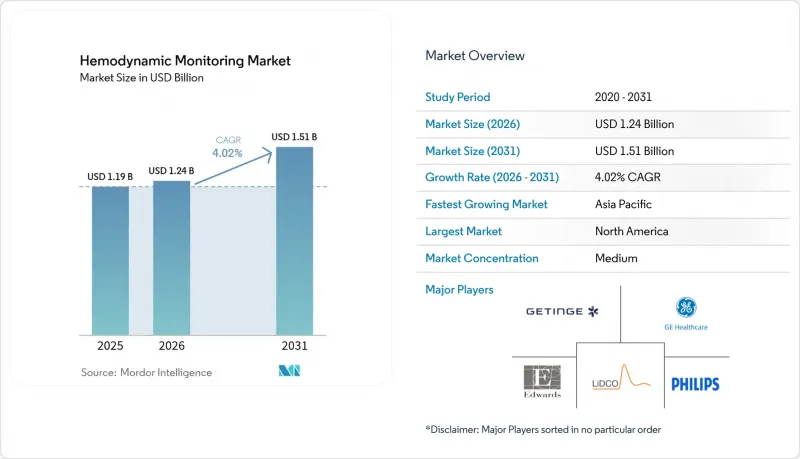
이 보고서에서는 업계를 시스템 유형(저침습 모니터링 시스템 등), 기기(폐동맥 카테터, 맥파 곡선 분석기 등), 최종사용자(병원·진료소 등) 및 지역(북미, 유럽, 아시아태평양, 중동 및 아프리카, 남미)별로 분류하고 있습니다. 시장 예측은 금액(달러) 기준으로 제시되어 있습니다.
글로벌 혈행동태 모니터링 시장의 동향 및 인사이트
중증 고령 인구 증가
65세 이상의 고령자는 병원내 환자층 중에서 가장 빠르게 증가하고 있으며, 지속적인 혈행동태 모니터링에 대한 꾸준한 수요를 주도하고 있습니다. 고령의 외과 환자는 상태 불안정화 비율이 높고, 목표 지향적 치료를 통해 합병증을 58%까지 줄일 수 있으므로 자원 계획에 있으며, 예측형 모니터가 필수적입니다. 병원 측은 감염 위험을 줄이고 쾌적성을 향상시키는 비침습적 기술을 선호하며, 보험사는 재입원을 억제하기 위해 더 긴 관찰 기간에 대한 보상을 제공하고 있습니다. 그 결과, 각 벤더들은 동맥 파형 분석과 프레이일 점수를 통합하여 수액 요법을 실시간으로 안내하는 플랫폼을 판매하고 있습니다.
심혈관 질환 및 당뇨병 유병률의 증가
당뇨병은 수술 전후 기간의 심혈관 사건 발생 위험을 3배로 높이며, 중환자실(ICU)에서는 혈당 수치와 혈압을 함께 모니터링하는 시스템 도입이 진행되고 있습니다. 진단 정확도 85%를 자랑하는 AI 툴 ‘Sepsis ImmunoScore’가 FDA 승인을 받은 것은 다양한 위험 요인이 공존하는 환자에 대한 알고리즘 기반 분류의 가치를 여실히 보여줍니다. 패혈증성 쇼크 발생을 1건 예방할 때마다 집중 치료 비용이 5만 달러 절감되며, 병원에서는 이러한 경제적 효과를 근거로 통합형 혈행동태 대시보드를 병원 전체 규모로 도입하고 있습니다.
침습적 모니터링 시스템에 수반되는 합병증
카테터 삽입의 2-15%에서 감염, 출혈, 혈관 손상이 발생하므로 임상의들은 침습적 라인의 사용을 가장 중증인 증례로 제한하고 있습니다. 연구에 따르면 비침습적 임피던스 심전도법은 치료 성과를 저해하지 않으면서도 많은 중등도 위험 수술에서 동맥 라인을 대체할 수 있는 것으로 확인되었습니다. 소송 위험이 높아짐에 따라 병원 관리자들은 프로토콜을 개정하여 초음파 유도 하 캐뉼라 삽입이나 카테터를 일절 사용하지 않는 기법을 우선적으로 채택하고 있습니다.
부문 분석
2025년에는 저침습 플랫폼이 혈행동태 모니터링 시장의 42.45% 점유율을 차지했습니다. 이는 수십년에 걸친 임상의들의 익숙한 사용 실적과 상세한 파형 분석 기능 덕분입니다. 그러나 카테터와 동등한 정확도를 지닌 소형 센서의 보급과, 감염과 관련된 입원 기간 연장을 억제하라는 보험사의 요구에 힘입어 비침습형 시스템은 연평균 성장률(CAGR) 4.95%로 가장 높은 성장률을 기록하고 있습니다. 중환자실(ICU) 및 스텝다운 병동에서는 현재 의료진이 통합된 워크스테이션 내에서 안정적인 환자에게는 커프 없는 혈압계를, 급성 보상 부전 환자에게는 동맥 파형 모듈을 번갈아 사용하고 있습니다. 병원 측은 라인 관리 비용 절감과 환자의 조기 이동을 이유로 설비 투자의 정당성을 내세우고 있습니다.
이러한 수요의 기세는 구조적인 전환을 시사하고 있습니다. 각 벤더사는 임피던스 심전도, 도플러 초음파, PPG(photoplethysmography) 채널을 하나의 도킹 가능한 섀시에 통합하여, 단일 기기군으로 여러 중증도 수준에 대응하고 있습니다. 소프트웨어 업그레이드를 통해 딥러닝을 활용한 박출량 변동(SVV) 계산 기능이 도입되어, 저혈압이 나타나기 훨씬 전에 의료진에게 경고를 보내며, 병상에서의 임상 의사결정 지원 기능이 통합되었습니다. 그 결과, 비침습적 모달리티를 이용한 혈행동태 모니터링 시장 규모는 2026-2031년 사이에 1억 5,800만 달러의 신규 매출이 증가할 것으로 예측되며, 기존의 침습적 시스템과의 격차가 좁혀질 것으로 전망됩니다.
지역별 분석
2025년에는 북미가 매출 점유율 39.85%로 1위를 차지했습니다. 이 시장의 우위는 견고한 중환자실(ICU) 인프라, 유리한 민간 보험사와의 계약, 그리고 수술 전후 워크플로우에 AI 모듈을 조기에 도입한 데 기인합니다. 이 지역에서는 합병증 감소에 대해 보상이 지급되는 포괄적 지불 모델이 채택되어 있으며, 경제적 인센티브가 알고리즘 기반의 조기 경보 시스템과 잘 부합하고 있습니다. 필립스와 매사추세츠 제너럴 브리검 병원의 실시간 데이터 연계와 같은 제휴는 기업급 분석 플랫폼에 대한 수요를 여실히 보여주고 있습니다.
아시아태평양은 2031년까지 연평균 성장률(CAGR)이 6.04%로 가장 빠르게 성장하는 지역입니다. 중국은 ‘건강 중국 2030’ 정책에 따라 2급 도시 병원의 첨단 모니터에 대한 보조금을 지원함으로써 이 지역 성장의 절반을 주도하고 있습니다. 일본에서는 조건부 승인 제도를 통해 획기적인 의료기기의 시장 출시 기간이 단축되고 있는 반면, 인도에서는 확대되는 중산층을 배경으로 민간 병원 체인이 비침습적 심박출량 측정 모듈의 도입을 추진하고 있습니다. 아시아 원격의료 포트폴리오로의 사모펀드 유입은 원격 환자 모니터링 확장에 자금을 지원함으로써 혈행동태 모니터링 시장을 더욱 가속화하고 있습니다.
유럽에서는 진료 지침의 표준화와 수술 전후 관리의 최적화를 기반으로 꾸준한 확장이 이어지고 있습니다. ERAS Society의 권고에 따라 외과 병동 전반에 걸쳐 일회 박출량 변동(SVV) 모니터 도입이 진행되고 있습니다. 브렉시트로 인해 두 가지 규제 경로가 도입되었으나, 상호 승인 협정 덕분에 공급망은 안정성을 유지하고 있습니다. 입찰 위원회는 성능뿐만 아니라 비용 효율성에 대한 증거를 점점 더 요구하고 있으며, 동료 심사를 거친 결과 데이터를 보유한 플랫폼이 우선시되고 있습니다.
기타 혜택:
- 엑셀 형식의 시장 예측(ME) 시트
- 3개월간의 애널리스트 지원
자주 묻는 질문
목차
제1장 서론
제2장 조사 방법
제3장 개요
제4장 시장 구도
제5장 시장 규모와 성장 예측
제6장 경쟁 구도
제7장 시장 기회와 향후 전망
KSA 26.08.25According to Mordor Intelligence, the hemodynamic monitoring market size is expected to grow from USD 1.19 billion in 2025 to USD 1.24 billion in 2026 and is forecast to reach USD 1.51 billion by 2031 at 4.02% CAGR over 2026-2031.
This report Segments the Industry Into System Type (Minimally Invasive Monitoring Systems, and More), Device (Pulmonary Artery Catheters, Pulse Contour Analysis Devices, and More), End User (Hospitals and Clinics, and More), and Geography (North America, Europe, Asia-Pacific, Middle East and Africa, and South America). The Market Forecasts are Provided in Terms of Value (USD).
Global Hemodynamic Monitoring Market Trends and Insights
Increasing Critically Ill Geriatric Population
People aged 65 and older are the fastest-growing hospital demographic, driving durable demand for continuous hemodynamic surveillance. Elderly surgical patients experience higher instability rates, and goal-directed therapy reduces complications by 58%, making predictive monitors essential to resource planning. Hospitals favor non-invasive technologies that cut infection risk and improve comfort, and payers reimburse longer observation windows to curb readmissions. Consequently, vendors market platforms that integrate arterial-waveform analytics with frailty scores to guide fluid resuscitation in real time.
Rising Prevalence of Cardiovascular Disorders & Diabetes
Diabetes triples the likelihood of perioperative cardiovascular events, pushing ICUs to adopt dual glucose-and-pressure monitoring suites. FDA clearance of the Sepsis ImmunoScore AI tool, which delivers 85% diagnostic accuracy, illustrates the value of algorithmic triage in mixed-risk patients. Each avoided septic-shock incident saves USD 50,000 in critical-care costs, and hospitals use such economics to justify enterprise-wide rollouts of integrated hemodynamic dashboards.
Complications Associated with Invasive Monitoring Systems
Infection, bleeding, and vascular injury occur in 2-15% of catheter insertions, prompting clinicians to reserve invasive lines for only the sickest cases. Studies confirm non-invasive impedance cardiography can replace arterial lines in many moderate-risk surgeries without compromising outcome quality. As litigation concerns mount, administrators update protocols to favor ultrasound-guided cannulation or entirely catheter-free modalities.
Other drivers and restraints analyzed in the detailed report include:
- Technological Advancements in Minimally & Non-Invasive Monitoring
- Growing Adoption of Hemodynamic Optimization During ERAS Protocols
- Stringent FDA / CE Approval Pathways
For complete list of drivers and restraints, kindly check the Table Of Contents.
Segment Analysis
Minimally invasive platforms captured 42.45% of the hemodynamic monitoring market share in 2025, reflecting decades of clinician familiarity and detailed waveform analytics. Yet non-invasive systems top the growth league at a 4.95% CAGR, propelled by miniaturized sensors that match catheter precision and by payer pressure to limit infection-related extensions of stay. Across ICUs and step-down units, staff now rotate between cuffless blood-pressure cuffs for stable cases and arterial-waveform modules for acute decompensation within unified workstations. Hospitals cite reduced line-care costs and faster mobilization to justify capital spending.
Demand momentum signals a structural pivot: vendors bundle impedance cardiography, Doppler ultrasound, and photoplethysmography channels into one dockable chassis, meeting multiple acuity tiers with a single fleet. Software upgrades introduce deep-learning stroke-volume variation calculations that alert staff long before hypotension manifests, embedding clinical decision support at the bedside. As a result, the hemodynamic monitoring market size for non-invasive modalities is projected to add USD 158 million new revenue between 2026 and 2031, narrowing the gap with legacy invasive systems.
Complete Report Scope:
- By System Type
- Minimally Invasive Monitoring Systems
- Invasive Monitoring Systems
- Non-invasive Monitoring Systems
- By Device
- Pulmonary Artery Catheters
- Pulse Contour Analysis Devices
- Esophageal Doppler Systems
- Electrical/Bio-impedance and Bio-reactance Monitors
- Volume Clamp / CNAP Devices
- Wearable Doppler Ultrasound Patches
- Other Devices
- By End User
- Hospitals and Clinics
- Ambulatory Surgical Centers
- Cath Labs and Diagnostic Centers
- Home-care and Remote Patient Monitoring
- By Geography
- North America
- United States
- Canada
- Mexico
- Europe
- Germany
- United Kingdom
- France
- Italy
- Spain
- Rest of Europe
- Asia-Pacific
- China
- Japan
- India
- Australia
- South Korea
- Rest of Asia-Pacific
- Middle East & Africa
- GCC
- South Africa
- Rest of Middle East & Africa
- South America
- Brazil
- Argentina
- Rest of South America
- North America
Geography Analysis
North America led with 39.85% revenue share in 2025. Market dominance stems from robust ICU infrastructure, favorable private-payer contracts, and early integration of AI modules into perioperative workflows. The region adopts bundled-payment models that reward fewer complications, aligning economic incentives with algorithmic early-warning systems. Partnerships such as Philips and Mass General Brigham's live-data collaboration illustrate demand for enterprise-scale analytics platforms.
Asia-Pacific is the fastest-growing region, with a 6.04% CAGR through 2031. China fuels half the regional gain under Healthy China 2030 policies that subsidize advanced monitors in Tier-2 city hospitals. Japan's conditional approval pathway shortens time-to-market for breakthrough devices, while India's expanding middle class spurs private-hospital chains to deploy non-invasive cardiac output modules. Private equity flows into Asian telehealth portfolios further accelerate the hemodynamic monitoring market by financing remote patient monitoring rollouts.
Europe sustains measured expansion anchored in guideline standardization and perioperative care optimization. ERAS Society endorsements drive procurement of stroke-volume variation monitors across surgical wards. Although Brexit injects dual regulatory pathways, mutual-recognition arrangements keep supply chains stable. Tender committees increasingly demand evidence of cost-utility alongside performance, favoring platforms with peer-reviewed outcome data.
- Edwards Lifesciences Corp.
- Koninklijke Philips
- Getinge
- Baxter
- GE HealthCare Technologies Inc.
- ICU Medical
- Dragerwerk
- Masimo Corp.
- LiDCO Group
- Deltex Medical Group PLC
- Tensys Medical
- CNSystems Medizintechnik GmbH
- Terumo Corp.
- Mindray Bio-Medical Electronics Co.
- Nihon Kohden Corp.
- Schwarzer Cardiotek
- Uscom Ltd.
- Flosonics Medical
- Smiths Group
- Change Healthcare
Additional Benefits:
- The market estimate (ME) sheet in Excel format
- 3 months of analyst support
TABLE OF CONTENTS
1 Introduction
- 1.1 Study Assumptions & Market Definition
- 1.2 Scope of the Study
2 Research Methodology
3 Executive Summary
4 Market Landscape
- 4.1 Market Overview
- 4.2 Market Drivers
- 4.2.1 Increasing Critically Ill Geriatric Population
- 4.2.2 Rising Prevalence of Cardiovascular Disorders and Diabetes
- 4.2.3 Technological Advancements in Minimally and Non-invasive Monitoring
- 4.2.4 Growing Adoption of Hemodynamic Optimization During ERAS Protocols
- 4.2.5 AI-driven Predictive Analytics for Early Sepsis and Shock Detection
- 4.2.6 Wearable Doppler Ultrasound Patches Enabling Remote Monitoring
- 4.3 Market Restraints
- 4.3.1 Complications Associated with Invasive Monitoring Systems
- 4.3.2 Stringent FDA / CE Approval Pathways
- 4.3.3 Alarm Fatigue & Data Overload Reducing Clinical Uptake
- 4.3.4 Reimbursement Gaps for Peri-operative Optimization Bundles
- 4.4 Technological Outlook
- 4.5 Porter's Five Forces Analysis
- 4.5.1 Threat of New Entrants
- 4.5.2 Bargaining Power of Buyers / Consumers
- 4.5.3 Bargaining Power of Suppliers
- 4.5.4 Threat of Substitute Products
- 4.5.5 Intensity of Competitive Rivalry
5 Market Size & Growth Forecasts (Value in USD)
- 5.1 By System Type
- 5.1.1 Minimally Invasive Monitoring Systems
- 5.1.2 Invasive Monitoring Systems
- 5.1.3 Non-invasive Monitoring Systems
- 5.2 By Device
- 5.2.1 Pulmonary Artery Catheters
- 5.2.2 Pulse Contour Analysis Devices
- 5.2.3 Esophageal Doppler Systems
- 5.2.4 Electrical/Bio-impedance and Bio-reactance Monitors
- 5.2.5 Volume Clamp / CNAP Devices
- 5.2.6 Wearable Doppler Ultrasound Patches
- 5.2.7 Other Devices
- 5.3 By End User
- 5.3.1 Hospitals and Clinics
- 5.3.2 Ambulatory Surgical Centers
- 5.3.3 Cath Labs and Diagnostic Centers
- 5.3.4 Home-care and Remote Patient Monitoring
- 5.4 By Geography
- 5.4.1 North America
- 5.4.1.1 United States
- 5.4.1.2 Canada
- 5.4.1.3 Mexico
- 5.4.2 Europe
- 5.4.2.1 Germany
- 5.4.2.2 United Kingdom
- 5.4.2.3 France
- 5.4.2.4 Italy
- 5.4.2.5 Spain
- 5.4.2.6 Rest of Europe
- 5.4.3 Asia-Pacific
- 5.4.3.1 China
- 5.4.3.2 Japan
- 5.4.3.3 India
- 5.4.3.4 Australia
- 5.4.3.5 South Korea
- 5.4.3.6 Rest of Asia-Pacific
- 5.4.4 Middle East & Africa
- 5.4.4.1 GCC
- 5.4.4.2 South Africa
- 5.4.4.3 Rest of Middle East & Africa
- 5.4.5 South America
- 5.4.5.1 Brazil
- 5.4.5.2 Argentina
- 5.4.5.3 Rest of South America
- 5.4.1 North America
6 Competitive Landscape
- 6.1 Market Concentration
- 6.2 Market Share Analysis
- 6.3 Company Profiles (includes Global level Overview, Market level overview, Core Segments, Financials as available, Strategic Information, Market Rank/Share for key companies, Products & Services, and Recent Developments)
- 6.3.1 Edwards Lifesciences Corp.
- 6.3.2 Koninklijke Philips N.V.
- 6.3.3 Getinge AB
- 6.3.4 Baxter International Inc.
- 6.3.5 GE HealthCare Technologies Inc.
- 6.3.6 ICU Medical Inc.
- 6.3.7 Draegerwerk AG & Co. KGaA
- 6.3.8 Masimo Corp.
- 6.3.9 LiDCO Group PLC
- 6.3.10 Deltex Medical Group PLC
- 6.3.11 Tensys Medical Inc.
- 6.3.12 CNSystems Medizintechnik GmbH
- 6.3.13 Terumo Corp.
- 6.3.14 Mindray Bio-Medical Electronics Co.
- 6.3.15 Nihon Kohden Corp.
- 6.3.16 Schwarzer Cardiotek GmbH
- 6.3.17 Uscom Ltd.
- 6.3.18 Flosonics Medical
- 6.3.19 Smiths Medical
- 6.3.20 Change Healthcare
7 Market Opportunities & Future Outlook
- 7.1 White-space & Unmet-need Assessment


