

|
시장보고서
상품코드
2113293
장루 배액주머니 : 시장 점유율 분석, 업계 동향과 통계, 성장 예측(2026-2031년)Ostomy Drainage Bags - Market Share Analysis, Industry Trends & Statistics, Growth Forecasts (2026 - 2031) |
||||||
 Mordor Intelligence
장루 배액주머니 시장 규모는 2025년 29억 4,000만 달러에서 2026년에는 30억 7,000만 달러로 확대하며, 2026-2031년에 CAGR 4.44%로 추이하며, 2031년에는 38억 2,000만 달러에 달할 것으로 예측됩니다.
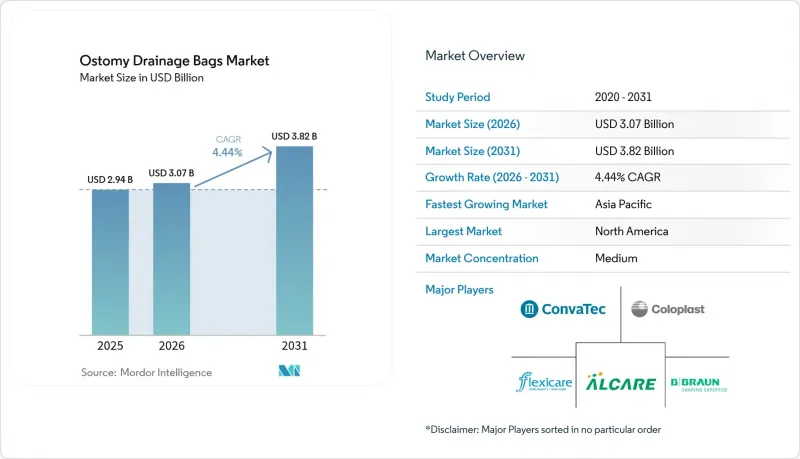
이 보고서는 유형별(인공 항문용 백, 인공 회장용 백, 인공 방광용 백 등), 시스템 유형별(원피스형 백 및 투피스형 백), 사용 편의성별(배수 가능형 및 밀폐형), 최종사용자별(병원, 재택 간호 시설, 기타),및 지역(북미, 유럽, 아시아태평양, 중동 및 아프리카, 남미)별로 분류되어 있습니다. 시장 예측은 금액() 기준으로 제시되어 있습니다.
전 세계 장루 용품 시장의 동향 및 인사이트
염증성 장 질환 유병률 증가
최신 역학 데이터에 따르면 궤양성 대장염 및 크론병은 성인 및 고령자의 더 광범위한 계층에 지속적으로 영향을 미치고 있으며, 이로 인해 더 조기에, 더 빈번한 장루 수술이 필요해지고 있습니다. 북미의 전문 의료 센터에서는 이미 250만 명을 훨씬 넘는 IBD 환자를 치료하고 있으며, 임상의들은 현재 환자 구성이 60세 이상 환자로 더욱 편중될 것으로 예상하고 있습니다. 보험사 데이터베이스에 따르면 미국의 IBD 직접 의료비는 현재 연간 270억 달러를 초과하고 있습니다. 그 대부분은 첨단 파우치 시스템의 도입이 필요한 외과적 우회 수술과 관련되어 있습니다. 인도나 중국 등 신흥 경제국에서는 IBD 신규 진단 건수가 전년 대비 급격히 증가하고 있는 반면, 장루 관리 인프라는 제한적이어서 장루 용품 시장에 있으며, 높은 성장이 기대되는 신흥 시장으로 부상하고 있습니다. 따라서 의료기기 개발 기업은 대량 판매가 예상되는 기본 부문과, 장루 주변 피부가 밀착되기 어려운 경우에 특화된 전문 제품 라인 모두를 아우르는 제품 라인업 확충에 주력하고 있습니다. 삶의 질(QOL) 지표에 대한 임상적 관심이 높아짐에 따라 확실한 접착력, 슬림한 디자인, 그리고 사용하기 편리한 고정 장치를 갖춘 제품에 대한 수요가 더욱 증가하고 있습니다.
급속히 증가하는 고령 인구
2024년 퇴원 기록에 따르면 수술 대상자의 고령화 및 비만화 경향이 두드러지며, 현재 선택적 대장 수술 5건 중 4건에서 BMI가 기준치를 초과하는 환자가 대상입니다. 고령화에 따라 피부 자극, 탈장, 누출에 대한 불안과 같은 장루 관련 합병증이 증가하고 있으며, 복부 윤곽 변화에 맞춰 유연하게 밀착되는 고품질 하이드로콜로이드 배리어에 대한 수요가 높아지고 있습니다. 수술 환자의 당뇨병 유병률이 15%를 넘어서는 추세이며, 상처 치유에 대한 과제가 커짐에 따라 임상의들은 항균층이 포함된 장기 착용형 파우치를 채택하고 있습니다. 재택 원격 모니터링은 고령 사용자들 사이에서 점차 수용되고 있으며, 최근 연구에 따르면 원격 평가와 병상에서의 장루 평가 간 일치율이 95%에 달하는 것으로 나타났습니다. 이러한 연구 결과는 커넥티드 기기의 보험 환급에 대한 논거를 강화합니다. 이러한 동향들이 결합되어 장루 용품 시장에 상당한 매출 증가를 초래하는 한편, 기술적으로 진보된 기능으로 인해 평균 판매 가격도 상승하고 있습니다.
불투명하거나 축소되는 추세인 보험 급여 범위
메디케어의 월별 파우치 수량 상한선 및 최근 HCPCS 코드 조정으로 인해 의료 제공자의 행정 부담이 증가하여, 수혜자가 개선된 장치를 이용할 수 있게 되는 데 지연이 발생할 가능성이 있습니다. 미국의 민간 보험사는 사전 승인 기준이나 공동 부담률에 편차가 있으며, 일부 환자는 피부 건강을 희생하더라도 착용 기간을 연장할 수밖에 없는 상황에 처해 있습니다. 유럽의 각 보험사 간 정책 차이가 격차를 확대시키고 있습니다. 예를 들어 미국 남부 지역의 메디케이드 프로그램에서는 배리어링 등의 부속품에 대해 명확한 의료적 필요성 증명이 의무화되어 있는 반면, 인접한 주에서는 본인 부담금을 부과하지 않거나 클로즈드 엔드형 파우치의 사용을 제한하고 있습니다. 일본에서는 엄격해진 비용 억제 규정에 따라 수입 의료기기의 환급 대상 리스트이 축소되어, 공급업체는 실제 임상 증거를 활용하여 성능상의 부가가치를 입증해야 합니다. 이러한 장벽으로 인해 장루 장구 시장에서 프리미엄 투피스 시스템의 단기적인 보급은 보험 적용 범위가 명확해질 때까지 억제될 것입니다.
부문 분석
2025년, 대장암 환자 수가 안정적으로 유지되고 게실증 유병률이 높은 점으로 인해 인공 항문 배액백 시장에서 대장 조루용 배액백은 매출의 45.32%를 차지하며 1위 자리를 유지했습니다. 이러한 압도적인 지위는 특히 영구 장루가 여전히 일반적인 북미 및 서유럽에서 인공 항문 배액백 시장에 있으며, 신뢰할 수 있는 기반이 되고 있습니다. 저위 전부 절제술에 따른 일시적인 배설 경로의 변화는 사회 활동 중 눈에 덜 띄게 하는 더 부드러운 플레이트나 얇은 플랜지와 같은 제품 개발 방향을 계속해서 결정짓고 있습니다. 한편, 회장 스토마 백은 50세 미만 성인의 염증성 장 질환 부담 증가에 힘입어 2031년까지 연평균 성장률(CAGR) 4.78%라는 가장 높은 성장률을 기록하고 있습니다. 외과 의사들은 문합부를 보호하기 위해 루프 회장 장루를 선호하고 있으며, 이러한 선택으로 인해 파우치 교체 빈도가 높아져 결과적으로 장루 용품 시장에서 환자 1인당 소비량이 증가하고 있습니다.
회장 장루에서 배출되는 액체량이 적기 때문에 잠금식 탭 밸브가 장착된 대용량 배액 가능 제품에 대한 수요가 증가하고 있습니다. 한편, 인공 항문(콜로스토미) 사용자들은 악취 차단 기능과 필터의 신뢰성을 중요하게 생각합니다. 현재 연구개발팀은 눈에 띄지 않는 특성을 해치지 않으면서 팽창을 억제하는 것을 목표로, 두 부문 모두에 가스 선택성 막을 통합하고 있습니다. 요로 분야에서는 허약한 환자를 대상으로 한 피하 요관루 수술이 보급되고 있으며, 이 시술로 인해 특수한 역류 방지용 요로루 파우치에 대한 수요가 증가하고 있습니다. K-파우치와 같은 배뇨 기능 유지형 조루술은 틈새 시장이지만 임상적으로 중요한 분야이며, 내부 저장탱크가 있더라도 야간에는 외부로 배액이 필요하므로 스토마 용품 시장의 혁신 기업에게는 새로운 마이크로 전문 분야가 열리고 있습니다.
2025년에는 일체형 제품이 매출의 59.46%를 차지했습니다. 이는 올인원 설계가 고령자나 손재주가 서툰 사용자에게 호응을 얻고 있기 때문입니다. 이러한 시스템은 사용 절차를 간소화하고, 배리어와 파우치 사이의 위치 어긋남 가능성을 최소화합니다. 한편, 투피스형 시스템은 연평균 성장률(CAGR) 5.02%로 성장을 이어가고 있습니다. 이는 모듈식 설계가 한 부품을 교체할 때 다른 부품에 영향을 주지 않는 자유도를 중시하는 활동적인 사용자들에게 지지를 받고 있기 때문입니다. 임상 조사에 따르면 성형 가능한 투피스 제품 사용자의 90% 이상이 체계적인 간호사 교육을 받은 후 착용이 쉬워졌다고 보고하고 있으며, 이는 장루 주변 피부 합병증의 감소와 착용 시간 연장으로 이어지고 있습니다. ‘락 앤 롤(Lock & Roll)’ 방식의 잠금 장치와 연결시 나는 ‘딸깍’ 소리 또한 장루 장구 시장 전체에서 사용자의 신뢰를 더욱 높이고 브랜드 충성도를 촉진하고 있습니다.
사출성형된 결합 링에 대한 제조 투자로 인해 비용 차이가 줄어들면서, 기존에 존재하던 형태 간 가격 격차가 좁혀지고 있습니다. 이러한 변화에 더해, 지불 주체가 단가가 아닌 총 치료 비용에 점점 더 중점을 두게된 점이 투피스 제품의 성장세를 지원하고 있습니다. 프리미엄 부문에서는 현재 연결형 센서 웨이퍼가 플랫 플레이트용으로만 출시되고 있지만, 로드맵에 따르면 곡면형 및 볼록형 버전도 향후 출시될 예정이며, 이를 통해 2피스 구성이 오스토미 배액백 시장의 스마트 디바이스 분야에서 조기에 시장 점유율을 확보할 수 있게 될 것입니다.
지역별 분석
북미는 첨단인 외과 의료 인프라, 광범위한 보험 적용 범위, 그리고 센서 탑재 기기의 조기 도입에 힘입어 2025년에는 전 세계 매출의 41.42%를 차지했습니다. 미국은 2025년에 200만 건 이상으로 예측되는 신규 암 환자 수와 프리미엄 성형 가능 웨이퍼에 대한 의사의 강력한 지지에 힘입어 계속해서 이 지역의 중심적인 역할을 수행하고 있습니다. 캐나다에서는 합병증 발생률을 낮게 억제하고 높은 평균 판매 가격을 정당화하는 전국적인 장루 간호사 네트워크를 통해 꾸준한 판매량 증가가 예상됩니다. 멕시코에서는 계속 확장되고 있는 민간 병원 체인이 현재 미국의 처방약 리스트을 반영하고 있으며, 잠금식 결합 시스템과 필터 기능이 개선된 2피스형 기기에 대한 새로운 수요를 촉진하고 있습니다.
유럽에서는 국민건강보험 제도가 비용 대비 효과를 중시하면서도 피부 건강에 구체적인 효과를 가져다주는 제품을 여전히 권장하고 있으며, 균형 잡힌 성장이 예상됩니다. 독일과 프랑스에서는 베스트 프랙티스 도입을 촉진하는 전문 스토마 클리닉이 활성화되고 있는 반면, 이탈리아와 스페인은 여전히 가격을 중시하는 경향이 있으나, 연결형 누출 경보 기능이 탑재된 부가 제품에 대한 수용도가 높아지고 있습니다. 환경 관련 법규는 중요한 의제로 떠오르고 있습니다. 곧 시행될 EU의 ‘포장 및 포장 폐기물 규정’에서는 2035년까지 의료용 파우치 포장의 완전한 재활용 가능성을 의무화하고 있으며, 공급업체들에게 더 얇은 다층 필름에 대한 연구를 가속화할 것을 요구하고 있습니다. 이러한 규제는 제품 설계 결정에 영향을 미치며, 조기에 규제 대응 제품군을 갖춘 기업의 장루 배액 주머니 시장 점유율을 확대할 가능성이 있습니다.
아시아태평양은 가장 활기찬 시장이며, 의료 인프라에 대한 투자가 가속화되는 가운데 2031년까지 연평균 성장률(CAGR) 5.65%를 기록할 것으로 전망됩니다. 중국에서는 병원 건설 붐이 지속되고 사회보험 적용 범위도 확대되고 있으며, 국제적인 브랜드들은 주요 도시 이외의 지역에서도 프리미엄 투피스형이나 스마트 센서가 탑재된 모델을 유통할 수 있게 되었습니다. 콤바텍(Combatec)은 2024년 중국에서 오스토미 제품 매출이 두 자릿수 성장을 기록했다고 보고했으며, 이는 고성능 솔루션에 대한 현지 시장의 높은 수요를 지원합니다. 인도에서는 염증성 장 질환(IBD)의 유병률이 급격히 상승하고 있으며, 장루 관리 자원이 부족하지만, 민간 병원 부문에서는 장루 주위 피부염을 억제하기 위해 대용량 배액 가능 파우치의 조달이 증가하고 있습니다. 일본에서는 보험 환급액 삭감으로 인해 단기적인 가격 상승은 억제되고 있지만, 현지 임상의들은 여전히 고품질 스킨 배리어를 선호하고 있으며, 단가가 안정적으로 유지되고 있습니다. 호주, 한국 및 일부 동남아시아 국가에서는 고령화의 진행과 대장암 검진 프로그램의 확대로 인해 지역적 성장세가 지속되고 있으며, 이러한 모든 요인이 결합되어 장루 배액백 시장은 향후 수년간 성장 궤도를 유지할 것으로 전망됩니다.
기타 혜택:
- 엑셀 형식의 시장 예측(ME) 시트
- 3개월간의 애널리스트 지원
자주 묻는 질문
목차
제1장 서론
제2장 조사 방법
제3장 개요
제4장 시장 구도
제5장 시장 규모와 성장 예측
제6장 경쟁 구도
제7장 시장 기회와 향후 전망
KSA 26.08.25According to Mordor Intelligence, the ostomy drainage bags market size is expected to grow from USD 2.94 billion in 2025 to USD 3.07 billion in 2026 and is forecast to reach USD 3.82 billion by 2031 at 4.44% CAGR over 2026-2031.
This report is Segmented by Type (Colostomy Bags, Ileostomy Bags, Urostomy Bags, and More), System Type (One-Piece Bags and Two-Piece Bags), Usability (Drainable and Closed-End), End User (Hospitals, Home Care Setups, Others), and Geography (North America, Europe, Asia-Pacific, Middle East and Africa, and South America). The Market Forecasts are Provided in Terms of Value (USD).
Global Ostomy Drainage Bags Market Trends and Insights
Increasing Incidence of Inflammatory Bowel Disease
New epidemiological updates confirm that ulcerative colitis and Crohn's disease continue to affect a wider segment of adults and seniors, prompting earlier and more frequent ostomy interventions. Specialist centers in North America already treat well over 2.5 million residents living with IBD, and clinicians expect the present caseload to tilt further toward patients aged over 60. Payer databases show that direct IBD care costs now exceed USD 27 billion annually in the United States, much of which relates to surgical diversion episodes that necessitate advanced pouching systems. Emerging economies such as India and China register rapid year-over-year jumps in newly diagnosed IBD yet have limited stoma-care infrastructure, creating a high-growth frontier for the Ostomy drainage bags market. Device developers therefore tailor portfolio extensions that address both the high-volume basic segment and specialist lines for hard-to-seal peristomal skin. Heightened clinical attention on quality-of-life metrics further elevates demand for products with secure adhesives, thin profiles and user-friendly closures.
Rapidly Growing Aging Population
Hospital discharge records for 2024 show a noticeable shift toward older and heavier surgical candidates, with four in every five elective colorectal operations now involving a patient who presents above normal BMI levels . Higher age correlates with greater ostomy-related complications such as skin irritation, herniation and leakage anxiety, expanding the requirement for premium hydrocolloid barriers that flex with abdominal contour changes. Diabetes prevalence among surgical patients is climbing past 15%, adding wound-healing challenges that push clinicians toward longer-wear pouches incorporating antibacterial layers. Home-based tele-monitoring garners acceptance among geriatric users, with recent studies showing 95% concordance between remote and bedside stoma assessments, a finding that strengthens reimbursement arguments for connected devices. Collectively, these dynamics add meaningful incremental volume to the Ostomy drainage bags market while also raising the average selling price through technology-rich features.
Unstructured or Shrinking Reimbursement Coverage
Medicare caps on monthly pouch quantities and recent HCPCS code adjustments increase provider paperwork and may delay beneficiary access to upgraded appliances. Private insurers in the United States impose variable prior-authorization thresholds or coinsurance levels, prompting some patients to stretch wear-time at the expense of skin health. Policy divergence across European payers magnifies disparity; for example, a regional Medicaid program in the southern United States now requires explicit medical-necessity proof for accessories such as barrier rings, whereas a neighboring state imposes no copayment but limits closed-end pouches. In Japan, toughened cost-containment rules cut reimbursement lists for imported devices, urging suppliers to justify incremental performance benefits with real-world evidence. Such hurdles temper short-term uptake of premium two-piece systems in the Ostomy drainage bags market until coverage clarity improves.
Other drivers and restraints analyzed in the detailed report include:
- Rising Colorectal and Bladder Cancer Cases
- Emergence of Smart-Sensor Ostomy Bags
- High Cost of Advanced Multi-Layer Barrier Materials
For complete list of drivers and restraints, kindly check the Table Of Contents.
Segment Analysis
Colostomy bags maintained 45.32% revenue leadership in 2025 due to steady colorectal cancer volumes and high prevalence of diverticular disease. This dominant position supplies a reliable baseline for the Ostomy drainage bags market, especially in North America and Western Europe where permanent stomas remain common. Temporary diversion patterns from low-anterior resection continue to shape product roadmaps toward softer plates and low-profile flanges that improve discretion during social activity. In parallel, ileostomy bags register the briskest 4.78% CAGR through 2031, supported by the climbing burden of inflammatory bowel disease among adults under 50. Surgeons favor loop ileostomy to protect anastomoses, a choice that drives higher pouch change frequency and thus raises per-patient consumption inside the Ostomy drainage bags market size.
The short fluidic output of ileostomies spurs demand for high-capacity drainable options with lockable tap valves, while colostomy users prioritize odor barriers and filter reliability. R&D teams now integrate gas-selective membranes into both segments, aiming to curb ballooning without compromising discretion. On the urinary side, cutaneous ureterostomy gains traction for frail patients, and this procedure raises the need for specialized anti-reflux urostomy pouches. Continent diversions such as K-pouch present a niche but clinically significant area where internal reservoirs still require external night drainage, opening another micro-specialty for innovators within the Ostomy drainage bags market.
One-piece appliances captured 59.46% revenue in 2025 as their all-in-one design appeals to elderly or dexterity-limited users. These systems reduce handling steps and minimize potential misalignment between barrier and pouch. Yet two-piece systems are advancing at a 5.02% CAGR because modularity resonates with active users who value the freedom to replace either component without disturbing the other. Clinical audits reveal that more than 90% of moldable two-piece users report easier application after structured nurse training, translating into lower peristomal skin complications and longer wear-time. Lock-and-roll closures as well as audible coupling clicks further elevate user confidence and fuel brand loyalty across the Ostomy drainage bags market.
Manufacturing investments in injection-molded coupling rings bring down cost differentials, narrowing the historic price gap between formats. This shift, combined with payers' growing focus on total-care cost rather than unit price, underpins the two-piece momentum. In the premium tier, connected sensor wafers currently launch only for flat plates, yet roadmaps indicate curved and convex versions will follow, allowing two-piece configurations to capture the earliest volumes in the smart-device niche of the Ostomy drainage bags market size.
Complete Report Scope:
- By Type
- Colostomy Bags
- Ileostomy Bags
- Urostomy Bags
- Continent Ileostomy & Urostomy Bags
- By System Type
- One-piece Bags
- Two-piece Bags
- By Usability
- Drainable
- Closed-end
- By End User
- Home-care Settings
- Hospitals
- Ambulatory Surgical Centers
- By Distribution Channel
- Direct Tender
- Retail & E-commerce
- By Geography
- North America
- United States
- Canada
- Mexico
- Europe
- Germany
- United Kingdom
- France
- Italy
- Spain
- Rest of Europe
- Asia-Pacific
- China
- Japan
- India
- Australia
- South Korea
- Rest of Asia-Pacific
- Middle East & Africa
- GCC
- South Africa
- Rest of Middle East & Africa
- South America
- Brazil
- Argentina
- Rest of South America
- North America
Geography Analysis
North America owned 41.42% of global revenue in 2025 because of its advanced surgical infrastructure, broad insurance coverage and early adoption of sensor-enabled devices. The United States remains the region's anchor, supported by more than 2 million projected new cancer cases during 2025 and strong physician loyalty to premium moldable wafers. Canada contributes steady volume growth through nationwide stoma-nurse networks that help keep complication rates low and justify higher average selling prices. In Mexico, expanding private hospital chains now mirror U.S. formularies, fostering fresh demand for two-piece appliances with lock-in coupling systems and filter upgrades.
Europe generates balanced growth as universal health schemes favor cost-effectiveness while still endorsing products that demonstrate tangible skin-health benefits. Germany and France promote specialist stoma clinics that encourage best-practice adoption, while Italy and Spain remain price-focused but increasingly receptive to connected leak-alert add-ons. Environmental legislation is a prominent agenda item; the upcoming EU Packaging and Packaging Waste Regulation requires full pouch packaging recyclability by 2035 for healthcare, urging suppliers to expedite thinner multilayer film research. Such regulation shapes product design decisions and could expand the Ostomy drainage bags market share of companies with early compliant portfolios.
Asia-Pacific is the most dynamic territory, clocking a 5.65% CAGR to 2031 as healthcare infrastructure investment accelerates. China's ongoing hospital construction boom and widening social-insurance coverage allow international brands to distribute premium two-piece and smart-sensor models beyond top-tier cities. ConvaTec reported double-digit ostomy sales growth in China during 2024, underscoring local appetite for higher-performance solutions. India shows fast-rising IBD incidence that stretches stoma nursing resources, but the private-hospital segment is increasingly sourcing high-capacity drainable pouches to limit peristomal dermatitis. Japan's reimbursement cuts temper near-term price escalation, yet local clinicians maintain a preference for high-quality skin barriers, sustaining stable unit value. Australia, South Korea and select Southeast Asian economies extend regional momentum through aging populations and rising colorectal screening programs, together ensuring that the Ostomy drainage bags market remains on a multi-year growth trajectory.
- Alcare
- B. Braun
- Coloplast
- Convatec
- Hollister
- Flexicare Medical
- Marlen Manufacturing
- Pelcin Healthcare
- Salts Healthcare
- Torbot Group
- Welland Medical
- Prowess Care
- Goodhealth
- Oakmed Healthcare
- 3M
- Genairex Inc.
- Cymed Ostomy Co.
- Nu-Hope Laboratories
- Jiangsu Steadlive Medical
Additional Benefits:
- The market estimate (ME) sheet in Excel format
- 3 months of analyst support
TABLE OF CONTENTS
1 Introduction
- 1.1 Study Assumptions & Market Definition
- 1.2 Scope of the Study
2 Research Methodology
3 Executive Summary
4 Market Landscape
- 4.1 Market Overview
- 4.2 Market Drivers
- 4.2.1 Increasing incidence of IBD & Crohn's disease
- 4.2.2 Rapidly growing aging population
- 4.2.3 Rising colorectal & bladder cancer cases
- 4.2.4 Emergence of smart-sensor ostomy bags
- 4.2.5 Rapid expansion of direct-to-patient home-delivery subscription
- 4.2.6 Expansion of home-delivery supply subscription models
- 4.3 Market Restraints
- 4.3.1 Unstructured or shrinking reimbursement coverage
- 4.3.2 High cost of advanced multi-layer barrier materials
- 4.3.3 Environmental disposal restrictions on single-use plastics
- 4.3.4 Supply-chain vulnerability for medical-grade resins
- 4.4 Value / Supply-Chain Analysis
- 4.5 Regulatory Landscape
- 4.6 Technological Outlook
- 4.7 Porter's Five Forces Analysis
- 4.7.1 Threat of New Entrants
- 4.7.2 Bargaining Power of Buyers/Consumers
- 4.7.3 Bargaining Power of Suppliers
- 4.7.4 Threat of Substitute Products
- 4.7.5 Intensity of Competitive Rivalry
5 Market Size & Growth Forecasts (Value, USD Million)
- 5.1 By Type
- 5.1.1 Colostomy Bags
- 5.1.2 Ileostomy Bags
- 5.1.3 Urostomy Bags
- 5.1.4 Continent Ileostomy & Urostomy Bags
- 5.2 By System Type
- 5.2.1 One-piece Bags
- 5.2.2 Two-piece Bags
- 5.3 By Usability
- 5.3.1 Drainable
- 5.3.2 Closed-end
- 5.4 By End User
- 5.4.1 Home-care Settings
- 5.4.2 Hospitals
- 5.4.3 Ambulatory Surgical Centers
- 5.5 By Distribution Channel
- 5.5.1 Direct Tender
- 5.5.2 Retail & E-commerce
- 5.6 By Geography
- 5.6.1 North America
- 5.6.1.1 United States
- 5.6.1.2 Canada
- 5.6.1.3 Mexico
- 5.6.2 Europe
- 5.6.2.1 Germany
- 5.6.2.2 United Kingdom
- 5.6.2.3 France
- 5.6.2.4 Italy
- 5.6.2.5 Spain
- 5.6.2.6 Rest of Europe
- 5.6.3 Asia-Pacific
- 5.6.3.1 China
- 5.6.3.2 Japan
- 5.6.3.3 India
- 5.6.3.4 Australia
- 5.6.3.5 South Korea
- 5.6.3.6 Rest of Asia-Pacific
- 5.6.4 Middle East & Africa
- 5.6.4.1 GCC
- 5.6.4.2 South Africa
- 5.6.4.3 Rest of Middle East & Africa
- 5.6.5 South America
- 5.6.5.1 Brazil
- 5.6.5.2 Argentina
- 5.6.5.3 Rest of South America
- 5.6.1 North America
6 Competitive Landscape
- 6.1 Market Concentration
- 6.2 Market Share Analysis
- 6.3 Company Profiles (includes Global level Overview, Market level overview, Core Segments, Financials as available, Strategic Information, Market Rank/Share for key companies, Products & Services, and Recent Developments)
- 6.3.1 Alcare Co. Ltd
- 6.3.2 B. Braun Melsungen AG
- 6.3.3 Coloplast A/S
- 6.3.4 ConvaTec Group Plc
- 6.3.5 Hollister Incorporated
- 6.3.6 Flexicare Medical Ltd
- 6.3.7 Marlen Manufacturing & Development
- 6.3.8 Pelcin Healthcare Ltd
- 6.3.9 Salts Healthcare Ltd
- 6.3.10 Torbot Group Inc.
- 6.3.11 Welland Medical Ltd
- 6.3.12 Prowess Care
- 6.3.13 Goodhealth Inc.
- 6.3.14 Oakmed Healthcare
- 6.3.15 3M Company
- 6.3.16 Genairex Inc.
- 6.3.17 Cymed Ostomy Co.
- 6.3.18 Nu-Hope Laboratories
- 6.3.19 Jiangsu Steadlive Medical
7 Market Opportunities & Future Outlook
- 7.1 White-space & Unmet-need Assessment


