
|
시장보고서
상품코드
2113298
항우울제 : 시장 점유율 분석, 업계 동향과 통계, 성장 예측(2026-2031년)Antidepressant - Market Share Analysis, Industry Trends & Statistics, Growth Forecasts (2026 - 2031) |
||||||
 Mordor Intelligence
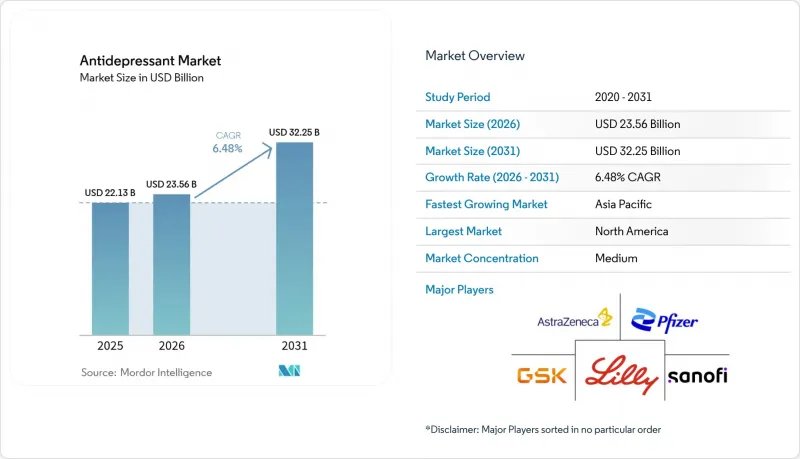
Mordor Intelligence에 따르면 항우울제 시장 규모는 2025년에 221억 3,000만 달러로 평가되며, 2026년 235억 6,000만 달러에서 2031년까지 322억 5,000만 달러에 달할 것으로 예측되고 있으며, 예측 기간(2026-2031년)에 CAGR은 6.48%에 달할 전망입니다.
이 보고서에서는 업계를 제품별(선택적 세로토닌 재흡수 억제제(SSRI) 등), 우울증 유형별(주요 우울 장애 등), 투여 경로별(경구, 비경구 등), 유통 채널별(병원 약국 등) 및 지역별(북미 등)로 분류하고 있습니다. 시장 전망은 금액(달러) 기준으로 제시되어 있습니다.
전 세계 항우울제 시장의 동향 및 인사이트
주요 우울 장애 유병률 증가
2024년까지 전 세계 우울증 환자 수는 3억 명에 육박할 것으로 예상되며, 그중 주요 우울 장애가 가장 큰 비중을 차지하고 있습니다. 팬데믹 이후의 스트레스, 경제적 불확실성, 사회적 고립으로 인해 특히 여성과 고령층에서 발병률이 지속적으로 증가하고 있습니다. 일차 진료에서의 선별 검사 프로토콜 확대와 행동 의학을 통합한 팀 체계 구축을 통해 더 많은 환자가 근거 기반 약물 치료로 유도되고 있습니다. 보험사의 장기 유지 요법에 대한 보험 적용이 확대됨에 따라 항우울제 시장은 판매량이 지속적으로 증가할 것으로 전망됩니다. 제약사들의 파이프라인에서는 변화하는 임상적 기대에 부응하기 위해, 작용 발현이 빠르고 내약성이 뛰어난 약물이 개발되고 있습니다.
우울증 위험이 높은 고령화 사회
노년기 우울증은 50세 이상 성인의 20% 이상에 영향을 미치고 있으며, 장기 요양 시설에서는 그 비율이 훨씬 더 높습니다. 만성적인 동반 질환은 항우울제 선택과 투여량을 복잡하게 만들고 있으며, 약물 상호작용 가능성이 최소화된 분자에 대한 연구개발을 촉진하고 있습니다. 고령자 전용 임상시험이나 제형 개선(예: 저용량 서방정 등)은 고령층을 향한 전략적 전환을 강조하고 있습니다. 또한 의료 시스템 예산도 치료받지 못한 고령자 우울증과 관련된 간접 비용의 증가에 직면해 있으며, 이로 인해 조기 약물 요법을 통한 개입이 촉진되고 있습니다.
부작용 프로필 및 블랙박스 경고
모든 항우울제에는 25세 미만 환자의 자살 경향에 관한 FDA의 블랙박스 경고가 첨부되어 있습니다. 성기능 장애나 체중 증가로 인한 높은 복용 중단률은 복약 순응도 저하를 초래하고 있습니다. Exxua와 같은 신약은 성기능 관련 부작용 위험이 낮다고 홍보하고 있지만, QT 간격 연장의 유무를 확인하기 위한 심전도 모니터링이 필요하여 치료의 복잡성을 가중시키고 있습니다. Spravato의 해리성 부작용 프로파일로 인해 REMS 인증 클리닉에서만 투여가 허용되고 있으며, 도시 지역 이외의 지역에서는 보급이 제한적입니다.
부문 분석
SSRI는 의사들의 수십년에 걸친 숙련도와 광범위한 처방약 리스트에 등재된 덕분에 2025년에도 항우울제 시장에서 43.12%의 점유율을 유지했습니다. 그러나 항우울제 시장은 현재 즉효성 글루타메이트 작용제로 중심을 옮기고 있으며, 2031년까지 연평균 성장률(CAGR) 6.78%를 기록하며 이 계열 시장 규모는 대폭 확대될 전망입니다. 에스케타민 단독 요법의 승인 및 3상 임상 시험 단계에 있는 경구용 R-케타민 정제는 이러한 급증을 상징적으로 보여줍니다. SNRI의 기존 약물은 신경병성 통증에 대한 이중 효능에 힘입어 여전히 상당한 판매량을 유지하고 있습니다. 부프로피온과 같은 비정형 항우울제는 체중에 미치는 영향이 적거나 금연 효과를 원하는 환자들을 끌어들이고 있으며, 기존의 삼환계 항우울제 부문에서 점유율 감소세를 완화하고 있습니다.
파이프라인 데이터는 작용 기전의 폭이 넓어지고 있음을 지원하고 있습니다. AMPA 수용체 증강제, 뉴로스테로이드 작용제, 5-HT2A 환각제 유사체는 모두 중기 임상 시험 단계에 있습니다. 대형 제약사의 신경과학 분야에 대한 지속적인 관심과 벤처 캐피털의 바이오기술 기업 발굴이 맞물리면서, 항우울제 시장은 잇따르는 혁신의 물결을 맞이할 준비가 되어 있습니다. SSRI를 중심으로 한 브랜드 수명 주기 연장 방안(중수소화 화합물 및 마이크로도징 요법 등)은 여전히 중요하지만, 미래를 내다보는 전략적 자본은 경쟁적 차별화가 기대되는 비모노아민계 경로로 집중되고 있습니다.
2025년, 주요 우울 장애는 항우울제 시장 규모의 36.74%를 차지하고 있으며, 이는 높은 유병률과 각종 건강보험 플랜의 강력한 보험 급여 지원을 반영한 것입니다. 2024년 ‘Zurzuvae’의 승인으로 산후 우울증에 특화된 하위 시장이 개발되었으며, 2031년까지 연평균 성장률(CAGR) 7.03%로 확대될 것으로 예측됩니다. 이 새로운 1일 1회 투여, 14일 과정의 신경활성 스테로이드 제제는 3일 이내에 증상 완화를 가져와, 신속한 기능 회복을 원하는 산후 산모들에게 지지를 받고 있습니다. 강박장애(OCD) 및 양극성 우울증의 틈새 시장에서는 SSRI와 병용 항정신병 약물의 활용이 계속되고 있지만, 루마테페론과 같은 표적화된 파이프라인 분자들은 혼합형 우울증 등의 증상군에서 효능 향상을 목표로 하고 있습니다.
환자 지원 캠페인과 고용주가 제공하는 산후 건강 복리후생 덕분에 산후 우울증 진단 및 전문의로의 치료 의뢰가 촉진되어, 장기적인 판매량 확대가 확고해지고 있습니다. 한편, 보험사는 질환별 임상 성과에 기반하여 약제 리스트 선정을 점점 더 세분화하고 있으며, 소정의 기간 내에 관해가 확인되는 약제를 우대하고 있습니다. 따라서 주요 우울 장애(MDD) 주력 제품군을 보유한 제약사들은 산후 우울증이나 고령자용과 같은 하위 카테고리로 사업을 다각화하고, 여러 우울증 스펙트럼에 걸쳐 높은 가격을 유지함으로써 항우울제 시장 전체에서의 입지를 강화하고 있습니다.
지역별 분석
북미는 높은 1인당 의료비, 광범위한 보험 적용 범위, 그리고 신속 승인 의약품의 급속한 보급에 힘입어 2025년에는 전 세계 매출의 36.21%를 차지했습니다. 신속 승인 절차와 엄격한 시판 후 감시의 균형을 중시하는 미국 FDA의 방침이 이 지역의 혁신적 위상을 공고히 하고 있습니다. 캐나다에서는 캐나다 보건부가 신약을 승인하면, 중앙 집중화된 처방약 리스트에 따라 전국적인 보급이 가속화됩니다. 멕시코에서는 ‘세구로 포풀라르(Seguro Popular)’의 확대로 더 많은 환자가 정식 의료 서비스를 받게 되면서 제네릭 SSRI의 판매량이 증가하고 있습니다.
아시아태평양은 도시화와 정신건강에 대한 의식의 향상에 힘입어 연평균 성장률(CAGR) 7.96%라는 가장 빠른 성장 궤도를 기록하고 있습니다. 중국에서는 2024년, 토르데스벤라팍신이 ‘국가 의약품 환급 리스트’에 추가되어 정신과 의료에 대한 정부의 자금 지원 노력이 지원되었습니다. 인도에서는 국내 생산 촉진으로 제네릭 의약품 비용이 낮아지면서 농촌 지역의 접근성이 확대되고 있습니다. 일본에서는 초고령화 사회와 국민건강보험제도로 인해 의료비 억제 노력에도 불구하고 환자 1인당 의약품 사용량이 높은 수준을 유지하고 있습니다. 한국에서는 첨단인 디지털 헬스 인프라를 활용하여 기분을 추적하는 웨어러블 기기와 처방 관리를 통합함으로써, 기술을 활용한 항우울제 치료의 미래상을 보여주고 있습니다.
유럽에서는 유럽의약품청(EMA)의 집중형 판매 승인 제도가 국경을 초월한 신약 출시를 효율화하고 있는 한편, 각국의 의료기술평가기관이 비용 대비 효과 기준을 엄격하게 적용하고 있으며, 시장이 안정적으로 확대되고 있습니다. 독일은 DiGA 프로그램 하에서 디지털 치료제의 보험 적용을 주도하고 있으며, 이는 의약품 사용에 대해 보완적이거나 대체적인 압력을 야기하고 있습니다. 의약품 폐수에 관한 EU의 엄격한 환경 기준은 규정 준수 비용의 증가를 초래하고 있으며, 제조사들이 폐쇄형 물 재활용 시설을 도입하도록 촉진하고 있습니다. 중동유럽에서는 소득 수준 상승에 따라 브랜드 제네릭 의약품의 보급이 확대되고 있으나, 외래 정신과 진료의 수용 능력 제약이 여전히 성장의 걸림돌로 작용하고 있습니다.
기타 혜택:
- 엑셀 형식의 시장 예측(ME) 시트
- 3개월간의 애널리스트 지원
자주 묻는 질문
목차
제1장 서론
제2장 조사 방법
제3장 개요
제4장 시장 구도
제5장 시장 규모와 성장 예측
제6장 경쟁 구도
제7장 시장 기회와 향후 전망
KSA 26.08.25According to Mordor Intelligence, the antidepressants market size was valued at USD 22.13 billion in 2025 and estimated to grow from USD 23.56 billion in 2026 to reach USD 32.25 billion by 2031, at a CAGR of 6.48% during the forecast period (2026-2031).
This report Segments the Industry Into Product (Selective Serotonin Reuptake Inhibitor (SSRI) and More), by Depressive Disorder (Major Depressive Disorder, and More), by Route of Administration (Oral, Parenteral and More), by Distribution Channel (Hospital Pharmacies, and More) and Geography (North America, and More). The Market Forecasts are Provided in Terms of Value (USD).
Global Antidepressant Market Trends and Insights
Rising Prevalence of Major Depressive Disorder
Global depression cases climbed to nearly 300 million by 2024, with major depressive disorder representing the largest share. Post-pandemic stress, economic uncertainty, and social isolation have sustained incidence rates, especially among women and older adults. Broader primary-care screening protocols and integrated behavioral-health teams now channel more patients toward evidence-based pharmacotherapy. Insurers increasingly reimburse long-term maintenance regimens, positioning the antidepressants market for continued volume growth. Pharmaceutical pipelines respond with agents promising faster onset and better tolerability, matching evolving clinical expectations.
Ageing Population with Higher Depression Risk
Late-life depression afflicts over 20% of adults older than 50 and far higher proportions in long-term-care settings. Chronic comorbidities complicate choice and dosing of antidepressants, driving R&D toward molecules with minimal drug-interaction potential. Dedicated geriatric trials and formulation tweaks (for example, lower-dose sustained-release tablets) underscore a strategic pivot toward older cohorts. Health-system budgets also face rising indirect costs linked to untreated geriatric depression, spurring earlier pharmacologic intervention.
Adverse-Event Profile & Black-Box Warnings
All antidepressants carry FDA black-box warnings about suicidality in patients under 25. High discontinuation rates linked to sexual dysfunction and weight gain spur non-adherence. Innovations like Exxua advertise reduced sexual-side-effect risk, but require electrocardiogram monitoring for QT prolongation, adding complexity. Spravato's dissociative profile mandates REMS-certified clinics, limiting uptake outside urban areas.
Other drivers and restraints analyzed in the detailed report include:
- Frequent Product Launches of Next-Gen SSRIs/SNRIs
- Expansion of Tele-psychiatry & E-Prescriptions
- Shift Toward Digital Therapeutics Curbing Drug Demand
For complete list of drivers and restraints, kindly check the Table Of Contents.
Segment Analysis
SSRIs retained a 43.12% antidepressants market share in 2025 owing to decades-long physician familiarity and broad formulary inclusion . Yet the antidepressants market now pivots toward rapid-acting glutamatergic drugs, whose 6.78% CAGR to 2031 will materially enlarge the class footprint. Esketamine's monotherapy sanction and oral R-ketamine tablets in Phase III exemplify this surge. SNRI incumbents still command meaningful volume, bolstered by dual efficacy in neuropathic pain. Atypicals such as bupropion attract patients seeking weight-neutral or smoking-cessation benefits, cushioning erosion in older tricyclic segments.
Pipeline data confirm a widening mechanistic palette: AMPA-receptor potentiators, neurosteroid agonists, and 5-HT2A psychedelic analogs are each in mid-stage trials. Sustained interest from large-pharma neuroscience franchises coincides with venture-backed biotech exploration, positioning the antidepressants market for successive innovation waves. Brand-lifecycle extensions around SSRIs-including deuterated chemistry and micro-dosing regimens-retain relevance, yet forward-looking strategic capital plows into non-monoaminergic paths promising competitive differentiation.
Major Depressive Disorder held 36.74% of the antidepressants market size in 2025, reflecting its prevalence and strong reimbursement support across health plans. Zurzuvae's 2024 approval opened a dedicated postpartum-depression submarket projected to climb 7.03% CAGR to 2031. The new once-daily, 14-day neuroactive-steroid course offers relief within 3 days, appealing to new mothers seeking rapid functional restoration. OCD and bipolar-depression niches continue to leverage SSRI and adjunctive antipsychotic use; yet targeted pipeline molecules such as lumateperone aim to sharpen efficacy in symptom clusters like mixed-features depression.
Patient-advocacy campaigns and employer-sponsored maternal-health benefits hasten postpartum-depression diagnosis and treatment specialist referral, cementing long-run volume contributions. Meanwhile, payers increasingly segment formularies by disorder-specific clinical performance, rewarding assets that demonstrate remission within defined timeframes. Hence, manufacturers defending MDD franchises diversify into postpartum or geriatric sub-labels to lock in premium pricing across multiple depressive spectrums, fortifying their stance in the wider antidepressants market.
Complete Report Scope:
- By Drug Class (Value)
- NMDA Receptor Antagonists
- Atypical Antipsychotic Augmentation
- Monoamine Modulators (SSRI/SNRI, MAOI, TCA)
- Psychedelics & Novel Compounds
- Others
- By End User (Value)
- Hospitals
- Specialty Clinics
- Homecare & Telepsychiatry
- Research & Academic Centers
- By Distribution Channel (Value)
- Retail Pharmacies
- Hospital Pharmacies
- Online Pharmacies
- By Geography (Value)
- North America
- United States
- Canada
- Mexico
- Europe
- Germany
- United Kingdom
- France
- Italy
- Spain
- Rest of Europe
- Asia-Pacific
- China
- India
- Japan
- South Korea
- Australia
- Rest of Asia-Pacific
- South America
- Brazil
- Argentina
- Rest of South America
- Middle East and Africa
- GCC
- South Africa
- Rest of Middle East and Africa
- North America
Geography Analysis
North America held 36.21% of global revenues in 2025 thanks to high per-capita spend, broad insurance coverage, and rapid adoption of accelerated-approval drugs. US FDA policy that balances expedited pathways with stringent post-marketing surveillance anchors the region's innovation status. Canada's centralized formularies speed nationwide uptake once Health Canada clears a new agent. Mexico's Seguro Popular expansion pulls more patients into formal care, lifting generic-SSRI volumes.
Asia-Pacific records the swiftest trajectory at an 7.96% CAGR as urbanization and mental-health literacy grow. China's 2024 inclusion of toludesvenlafaxine in the National Reimbursement Drug List validated government commitment to psychiatric care funding. India's domestic-manufacturing push lowers generic costs, widening rural access. Japan's super-aged demographics and universal health insurance sustain high per-patient drug utilization despite cost-containment efforts. South Korea leverages advanced digital-health infrastructure to integrate mood-tracking wearables with prescription management, illustrating the tech-enabled future of antidepressant care.
Europe shows stable expansion as the European Medicines Agency's centralized marketing authorization streamlines cross-border launches, while national health-technology-assessment bodies enforce cost-effectiveness hurdles. Germany leads digital-therapeutics reimbursement under its DiGA program, creating complementary or substitutive pressure on drug use. Stringent EU environmental standards on pharmaceutical effluent impose incremental compliance costs, nudging manufacturers toward closed-loop water-recycling plants. Central-Eastern Europe's rising income levels support branded-generic penetration, though capacity constraints in outpatient psychiatry remain a growth obstacle.
- Johnson & Johnson
- Alkermes plc
- H. Lundbeck
- Otsuka
- Axsome Therapeutics
- Relmada Therapeutics, Inc.
- Sage Therapeutics
- Seelos Therapeutics, Inc.
- COMPASS Pathways plc
- GH Research PLC
- Biohaven Ltd.
- Atai Life Sciences N.V.
- Revive Therapeutics Ltd.
- Teva Pharmaceutical Industries
- Dr. Reddy's Laboratories Ltd.
- Cipla
- Sun Pharmaceuticals Industries
- Viatris
- Pfizer
- GlaxoSmithKline
Additional Benefits:
- The market estimate (ME) sheet in Excel format
- 3 months of analyst support
TABLE OF CONTENTS
1 Introduction
- 1.1 Study Assumptions & Market Definition
- 1.2 Scope of the Study
2 Research Methodology
3 Executive Summary
4 Market Landscape
- 4.1 Market Overview
- 4.2 Market Drivers
- 4.2.1 Growing prevalence of partial/non-response to SSRI/SNRI therapy
- 4.2.2 Rapid commercial uptake of esketamine (Spravato) in key markets
- 4.2.3 Rising payer willingness to reimburse novel-mechanism add-ons
- 4.2.4 Psychedelic-assisted therapy clinics scaling in North America & Europe
- 4.2.5 FDA Breakthrough & Fast-Track designations accelerating pipelines
- 4.2.6 AI-enabled precision-psychiatry tools boosting treatment matching
- 4.3 Market Restraints
- 4.3.1 High cost & REMS burden for intranasal esketamine administration
- 4.3.2 Stringent insurance step-edit requirements delaying uptake
- 4.3.3 Social-stigma & regulatory uncertainty around psychedelic agents
- 4.3.4 Limited specialist capacity for intensive dosing & monitoring
- 4.4 Value / Supply-Chain Analysis
- 4.5 Regulatory Landscape
- 4.6 Technological Outlook
- 4.7 Porter's Five Forces
- 4.7.1 Threat of New Entrants
- 4.7.2 Bargaining Power of Buyers
- 4.7.3 Bargaining Power of Suppliers
- 4.7.4 Threat of Substitutes
- 4.7.5 Competitive Rivalry
5 Market Size & Growth Forecasts
- 5.1 By Drug Class (Value)
- 5.1.1 NMDA Receptor Antagonists
- 5.1.2 Atypical Antipsychotic Augmentation
- 5.1.3 Monoamine Modulators (SSRI/SNRI, MAOI, TCA)
- 5.1.4 Psychedelics & Novel Compounds
- 5.1.5 Others
- 5.2 By End User (Value)
- 5.2.1 Hospitals
- 5.2.2 Specialty Clinics
- 5.2.3 Homecare & Telepsychiatry
- 5.2.4 Research & Academic Centers
- 5.3 By Distribution Channel (Value)
- 5.3.1 Retail Pharmacies
- 5.3.2 Hospital Pharmacies
- 5.3.3 Online Pharmacies
- 5.4 By Geography (Value)
- 5.4.1 North America
- 5.4.1.1 United States
- 5.4.1.2 Canada
- 5.4.1.3 Mexico
- 5.4.2 Europe
- 5.4.2.1 Germany
- 5.4.2.2 United Kingdom
- 5.4.2.3 France
- 5.4.2.4 Italy
- 5.4.2.5 Spain
- 5.4.2.6 Rest of Europe
- 5.4.3 Asia-Pacific
- 5.4.3.1 China
- 5.4.3.2 India
- 5.4.3.3 Japan
- 5.4.3.4 South Korea
- 5.4.3.5 Australia
- 5.4.3.6 Rest of Asia-Pacific
- 5.4.4 South America
- 5.4.4.1 Brazil
- 5.4.4.2 Argentina
- 5.4.4.3 Rest of South America
- 5.4.5 Middle East and Africa
- 5.4.5.1 GCC
- 5.4.5.2 South Africa
- 5.4.5.3 Rest of Middle East and Africa
- 5.4.1 North America
6 Competitive Landscape
- 6.1 Market Concentration
- 6.2 Market Share Analysis
- 6.3 Company Profiles (includes Global level Overview, Market level overview, Core Segments, Financials as available, Strategic Information, Market Rank/Share for key companies, Products & Services, and Recent Developments)
- 6.3.1 Johnson & Johnson (Janssen)
- 6.3.2 Alkermes plc
- 6.3.3 H. Lundbeck A/S
- 6.3.4 Otsuka Pharmaceutical Co., Ltd.
- 6.3.5 Axsome Therapeutics, Inc.
- 6.3.6 Relmada Therapeutics, Inc.
- 6.3.7 Sage Therapeutics, Inc.
- 6.3.8 Seelos Therapeutics, Inc.
- 6.3.9 COMPASS Pathways plc
- 6.3.10 GH Research PLC
- 6.3.11 Biohaven Ltd.
- 6.3.12 Atai Life Sciences N.V.
- 6.3.13 Revive Therapeutics Ltd.
- 6.3.14 Teva Pharmaceutical Industries Ltd.
- 6.3.15 Dr. Reddy's Laboratories Ltd.
- 6.3.16 Cipla Ltd.
- 6.3.17 Sun Pharmaceutical Industries Ltd.
- 6.3.18 Viatris Inc. (Mylan)
- 6.3.19 Pfizer Inc.
- 6.3.20 GlaxoSmithKline plc
7 Market Opportunities & Future Outlook
- 7.1 White-space & Unmet-need Assessment