|
시장보고서
상품코드
2113318
터치스크린 컨트롤러 : 시장 점유율 분석, 업계 동향과 통계, 성장 예측(2026-2031년)Touch Screen Controllers - Market Share Analysis, Industry Trends & Statistics, Growth Forecasts (2026 - 2031) |
||||||
 Mordor Intelligence
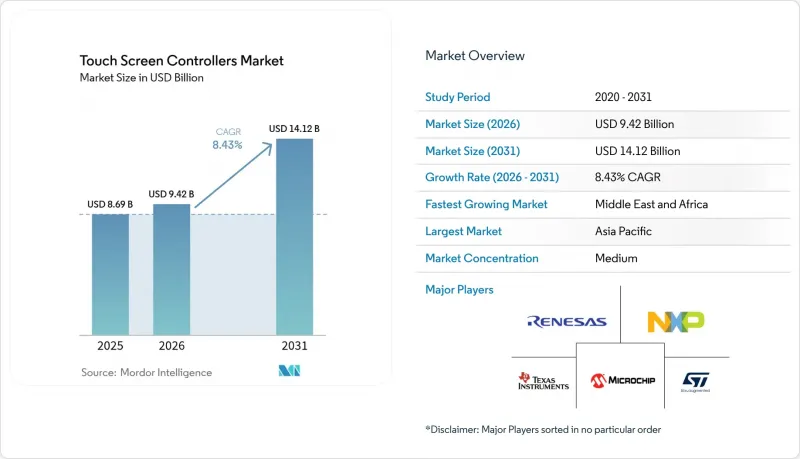
Mordor Intelligence에 따르면 터치스크린 컨트롤러 시장 규모는 2025년 86억 9,000만 달러에서 2026년에는 94억 2,000만 달러로 확대되고, 2026년부터 2031년까지 CAGR 8.43%를 기록하며 2031년에는 141억 2,000만 달러에 달할 것으로 예측됩니다.
본 보고서는 기술별(저항막 방식, 정전용량 방식 등), 인터페이스별(I2C, SPI, USB, UART), 터치 포인트별(싱글 터치, 멀티 터치), 디스플레이 크기별(5인치 미만, 5-10인치, 10인치 이상), 최종사용자 산업(소비자용 전자기기, 산업·제조, 소매·POS 단말기 등), 및 지역별로 분류되어 있습니다. 시장 예측은 금액(달러)으로 표시되어 있습니다.
세계 터치스크린 컨트롤러 시장의 동향 및 인사이트
플렉서블 OLED 스마트폰 디스플레이에 멀티터치 정전용량 방식 채택
스마트폰 제조사들은 디스플레이를 곡면 가장자리나 접이식 힌지로 확장함에 따라 터치 채널 배선 및 팜 리젝션 로직의 복잡성이 증가하고 있습니다. 컨트롤러는 불규칙한 표면에서의 가변적인 압력 입력을 처리하는 동시에 기생 정전용량을 최소화해야 합니다. 2025년에 공개된 산화물 기반 패널은 좁은 베젤에서 화면 대 본체 비율이 90%를 초과하는 조건에서도 신호 대 잡음비를 유지하는 통합형 터치 경로를 입증했습니다. 엣지 쉴드 및 국소 구동 파형에 관한 특허 포트폴리오는 터치스크린 컨트롤러 시장 내에서 프리미엄 계층을 형성하고 있으며, 공급업체들은 대량 생산되는 플래그십 단말기를 위해 전문적인 지적 재산(IP)을 활용하여 수익화를 도모하고 있습니다.
유럽 내 레벨 2 ADAS 탑재 차량용 인포테인먼트 업그레이드
현재 자동차 대시보드에는 계기판, 내비게이션, 미디어 조작 기능을 통합한 34인치 곡면 패널이 탑재되어 있습니다. 따라서 컨트롤러에는 넓은 작동 온도 범위, 엄격한 EMI 내성 및 내결함성 펌웨어가 요구됩니다. ATMXT3072M1과 같은 디바이스는 112개의 재구성 가능한 채널과 SNR을 15dB 향상시키는 독자적인 상호 용량 측정 방식을 채택하여, 파워트레인이나 ADAS 레이더로부터의 전자기 스트레스 하에서도 신뢰성 높은 감지를 보장합니다. 디스플레이 상단에 내장된 햅틱 노브는 촉각 피드백을 복원하여 운전자의 주의력 점수를 향상시키는 한편, 컨트롤러의 스캔 루프에 추가적인 지연 제약을 가합니다.
55nm 혼합 신호 웨이퍼 공급망의 부족
주요 55nm 노드의 파운드리 배정은 자동차용 MCU 및 산업용 IoT 수요가 소비자용 터치 칩과 경쟁하고 있기 때문에 여전히 어려운 상황에 처해 있습니다. 컨트롤러 제조사들은 생산능력을 확보하기 위해 수년에 걸친 테이크-오어-페이(take-or-pay) 계약을 체결하는 사례가 증가하고 있으며, 이로 인해 운전 자금이 압박받고 설계 주기가 장기화되고 있습니다. 일부 기업은 65nm 또는 40nm 벌크 CMOS용으로 제품을 재설계하고 있지만, 이러한 이식에는 재인증 비용이 발생하고 다이 크기가 커질 가능성이 있습니다. NXP가 할당량이 제한적임을 밝힌 것은 터치스크린 컨트롤러 시장 전체의 단기적인 공급 리스크를 여실히 드러내고 있습니다.
부문 분석
2025년, 정전용량식 솔루션은 터치스크린 컨트롤러 시장의 71.12%를 차지했으며, 이는 스마트폰, 태블릿, 차량용 콕핏에서의 채택이 확대되고 있음을 반영합니다. 커버 유리를 투과하여 감지할 수 있는 능력과 10개 이상의 터치 포인트를 지원할 수 있는 능력 덕분에, 내구성, 광학적 투명성, 풍부한 제스처가 중시되는 분야에서 설계 채택이 보장되고 있습니다. 이 부문은 베젤 수를 줄이고 모듈 두께를 얇게 만드는 통합형 TDDI 칩으로의 전환이 진행되고 있는 혜택을 받고 있습니다. 한편, 저항막 방식의 제품은 장갑을 착용하고 조작하는 공장용 콘솔이나 POS 단말기에서 계속해서 채택되고 있지만, PCAP의 가격 하락에 따라 그 증가분은 감소 추세를 보이고 있습니다.
적외선(IR) 컨트롤러는 2031년까지 10.45%라는 가장 높은 연평균 성장률(CAGR)을 기록할 전망입니다. 베젤에 장착된 이미터·리시버 어레이 덕분에 통합기는 적정한 비용으로 100인치를 넘는 규모로 확장할 수 있게 되었으며, 이는 교실, 디지털 사이니지 및 내구성이 뛰어난 키오스크에 중요한 이점이 되고 있습니다. IR LED 드라이버의 효율 향상과 정교한 시선 추적 알고리즘의 결합으로 지연이 감소하고 주변 빛에 대한 내성이 향상되고 있습니다. 이에 따라 교육 기관이나 기업의 회의실에서 인터랙티브월 도입이 검토되고 있습니다. 이러한 추세로 인해 터치스크린 컨트롤러 시장 내 기술 다양성이 유지되고 있으며, 각 벤더들은 PCAP, IR, 그리고 틈새 시장인 음향 및 광학 이미징 솔루션에 걸쳐 병행된 제품 라인을 유지하도록 촉진되고 있습니다.
I2C 프로토콜은 2선식의 간편함, 적은 핀 수 및 멀티 마스터 기능을 통해 시스템 온 칩(SoC) 환경을 지원하기 때문에 2025년에는 매출의 42.65%를 차지했습니다. 스마트폰, 웨어러블 기기 및 많은 자동차용 디스플레이에서는 컨트롤러와 호스트 프로세서 간의 저잡음·저전력 통신을 실현하기 위해 I2C가 채택되고 있습니다. SPI는 대역폭 요구 사항이 높아지는 패널 PC 및 고해상도 태블릿에서 안정적인 시장 점유율을 유지하고 있는 반면, UART는 펌웨어 업데이트를 최소화하고자 하는 기존 산업용 단말기에서 계속해서 채택되고 있습니다.
USB는 플러그 앤 플레이 특성과 스타일러스 데이터 및 호버 센싱을 지원하는 높은 처리량 덕분에 연평균 성장률(CAGR) 9.05%로 가장 빠르게 성장하는 시장으로 부상하고 있습니다. 키오스크, 의료용 카트, 탈부착식 모니터를 타겟으로 하는 ODM 업체들은 표준 커넥터와 호스트에 의존하지 않는 열거 프로세스를 높이 평가하고 있습니다. 화이트 박스 PC 제조업체들도 추가적인 브리지 IC가 필요 없기 때문에 USB 터치를 선호합니다. 이 인터페이스의 유연성으로 인해 애플리케이션의 적용 범위가 넓어지고 터치스크린 컨트롤러 시장의 규모가 확대됨에 따라, 벤더들에게는 현장에서 원활한 재구성이 가능한 멀티 인터페이스 펌웨어의 제공이 요구되고 있습니다.
지역별 분석
아시아태평양은 정교한 부품 공급망, 숙련된 인력, 그리고 반도체 자급자족을 촉진하는 정부의 인센티브에 힘입어 2025년에는 매출의 61.25%를 차지했습니다. 중국에는 주요 컨트롤러 IC 팹 외에도, 현지 스마트폰 및 가전 대기업에 제품을 공급하는 다운스트림 모듈 조립 제조업체들이 거점을 두고 있습니다. FocalTech와 같은 지역 공급업체들은 자동차 업계의 신뢰성 요건을 충족하는 디스플레이 및 터치 통합 솔루션을 통해 계속해서 혁신을 주도하고 있습니다. 한국과 일본은 OLED 및 산화물 TFT에 관한 최첨단 전문 지식을 제공하며, 플렉서블 디바이스 및 폴더블 디바이스에서 고부가가치 컨트롤러 소켓의 수요를 주도하고 있습니다.
북미는 자동차 전자기기, 의료용 영상 진단, 산업용 자동화 분야의 플랫폼 혁신에 힘입어 2위를 차지했습니다. 실리콘밸리의 설계 센터에서는 복잡한 노이즈 환경을 필터링하는 AI 강화형 신호 처리에 중점을 두고 있습니다. 소매 체인들은 셀프 체크아웃 단말기 도입을 가속화하고 있어, 컨트롤러 유닛에 대한 수요를 더욱 부추기고 있습니다. 이 지역의 엄격한 사이버 보안 요건으로 인해, 터치 컨트롤러에 내장된 하드웨어 가속을 통한 암호화에 대한 관심이 높아지고 있습니다.
유럽은 이에 이어 독일, 프랑스, 스웨덴의 자동차 생산 클러스터에 크게 의존하고 있습니다. 엄격한 기능 안전 및 전자기 호환성(EMC) 기준으로 인해 설계 기간은 길어지고 있지만, 인증 공급업체에게는 확고한 틈새 시장이 창출되고 있습니다. EU 전역에서 추진되고 있는 레벨 2 및 레벨 3 ADAS(첨단 운전자 지원 시스템)로의 전환에 따라, 다중 채널 컨트롤러를 활용하는 대형 콕핏 디스플레이가 보급되면서 터치스크린 컨트롤러 시장의 응용 분야가 더욱 다양해지고 있습니다.
중동 및 아프리카는 2031년까지 연평균 성장률(CAGR) 10.03%라는 가장 높은 성장률을 기록하고 있습니다. 걸프 국가들의 스마트 시티 계획에 따라 터치 지원 키오스크, 디지털 사이니지, 결제 단말기에 대한 수요가 증가하고 있습니다. 소매 및 호스피탈리티 분야에서는 서비스 대기 시간을 단축하는 인터랙티브 시스템이 도입되고 있습니다. 소규모 국내 시스템 통합업체들이 세계 유통업체를 통해 컨트롤러를 조달함에 따라 현지에서의 설계 활동이 활발해지고 있습니다.
남미에서는 완만한 성장이 나타나고 있으며, 브라질과 아르헨티나에서는 은행 ATM 및 교실 IT 설비의 업그레이드가 진행되고 있습니다. 환율 변동과 관세 구조가 조달 주기에 영향을 미치고 있지만, 스마트폰 보급률 증가로 인해 수리용 터치 모듈의 애프터마켓 수요가 뒷받침되고 있습니다. 지역 전반에 걸친 발전으로 터치스크린 컨트롤러 시장의 지리적 범위가 확대되어, 아시아에 편중된 공급에 대한 과도한 의존도가 완화되고 있습니다.
기타 혜택:
- 엑셀 형식의 시장 예측(ME) 시트
- 3개월간의 애널리스트 지원
자주 묻는 질문
목차
제1장 소개
제2장 조사 방법
제3장 주요 요약
제4장 시장 구도
제5장 시장 규모와 성장 예측
제6장 경쟁 구도
제7장 시장 기회와 향후 전망
KSM 26.08.25According to Mordor Intelligence, the touch screen controllers market size is expected to grow from USD 8.69 billion in 2025 to USD 9.42 billion in 2026 and is forecast to reach USD 14.12 billion by 2031 at 8.43% CAGR over 2026-2031.
This report is Segmented by Technology (Resistive, Capacitive, and More), Interface (I2C, SPI, USB, and UART), Touch Points (Single-Touch, and Multi-Touch), Display Size (Less Than 5 Inch, 5-10 Inch, and Above 10 Inch), End-User Industry (Consumer Electronics, Industrial and Manufacturing, Retail and POS Terminals, and More), and Geography. The Market Forecasts are Provided in Terms of Value (USD).
Global Touch Screen Controllers Market Trends and Insights
Multi-touch Capacitive Adoption in Flexible OLED Smartphone Displays
Smartphone makers are stretching displays over curved edges and foldable hinges, raising complexity for touch-channel routing and palm-rejection logic. Controllers must process variable pressure inputs over irregular surfaces while minimizing parasitic capacitance. Oxide-based panels showcased in 2025 demonstrated integrated touch paths that sustain signal-to-noise ratios at narrow bezels above 90% screen-to-body levels. Patent portfolios around edge shielding and localized drive waveforms create a premium tier inside the touch screen controllers market, where suppliers monetize specialized IP against high-volume flagship handsets.
In-Vehicle Infotainment Upgrades with Level-2 ADAS in Europe
Car dashboards now host curved 34-inch panels that merge cluster, navigation, and media controls. Controllers, therefore, need wide operating temperatures, stringent EMI resilience, and fault-tolerant firmware. Devices such as the ATMXT3072M1 adopt 112 reconfigurable channels and proprietary mutual-cap acquisition schemes that raise SNR by 15 dB, ensuring reliable detection under electromagnetic stress from powertrains and ADAS radars. Haptic knobs embedded atop displays restore tactile feedback, improving driver attention scores and placing additional latency constraints on the controller's scan loop.
55 nm Mixed-Signal Wafer Supply-Chain Tightness
Foundry allocations at key 55 nm nodes remain strained because automotive MCU and industrial IoT demand compete with consumer touch chips. Controller makers increasingly sign multi-year take-or-pay contracts to guarantee capacity, diverting working capital and elongating design cycles. Some firms are redesigning products for 65 nm or 40 nm bulk CMOS, though such porting introduces requalification costs and can raise die size. NXP's disclosure of limited allocation windows underscores near-term supply risk across the touch screen controllers market.
Other drivers and restraints analyzed in the detailed report include:
- Self-Checkout POS Proliferation amid North-American Labor Shortages
- Industry 4.0 Rugged PCAP Panels Replacing Membrane Keypads in China
- EMI/ESD Compliance Issues for >24" Capacitive Automotive Displays
For complete list of drivers and restraints, kindly check the Table Of Contents.
Segment Analysis
Capacitive solutions captured 71.12% of the touch screen controllers market share in 2025, reflecting strong adoption in phones, tablets, and vehicle cockpits. Their ability to sense through cover-glass and to support ten-plus touch points secures design wins where durability, optical clarity, and gesture richness matter. The segment benefits from ongoing migration to integrated TDDI chips that lower bezel count and shrink module thickness. Conversely, resistive products continue serving glove-based factory consoles and point-of-sale terminals, though incremental volumes decline as PCAP pricing falls.
Infrared controllers post the highest 10.45% CAGR to 2031. Bezel-mounted emitter-receiver arrays let integrators scale beyond 100 inches at moderate cost, a key advantage for classrooms, digital signage, and heavy-duty kiosks. Efficiency gains in IR LED drivers combined with refined line-of-sight algorithms are reducing latency and improving ambient light immunity, prompting education boards and corporate meeting rooms to consider interactive walls. This dynamic keeps technology diversity alive inside the touch screen controllers market, encouraging vendors to maintain parallel product lines across PCAP, IR, and niche acoustic or optical imaging solutions.
The I2C protocol delivered 42.65% revenue in 2025 thanks to its two-wire simplicity, low pin count, and multi-master capability, catering to system-on-chip environments. Smartphones, wearables, and many automotive displays rely on I2C for low-noise, low-power communication between the controller and host processor. SPI holds steady in panel PCs and higher-resolution tablets where bandwidth requirements rise, while UART persists in legacy industrial terminals seeking minimal firmware updates.
USB emerges as the fastest-growing at a 9.05% CAGR given its plug-and-play nature and high throughput that supports stylus data and hover sensing. ODMs targeting kiosks, medical carts, and detachable monitors appreciate the standard connector and host-agnostic enumeration process. White-box PC makers also favor USB touch due to the cost avoidance of additional bridge ICs. This interface flexibility widens application reach, adds volumes to the touch screen controllers market, and pressures vendors to supply multi-interface firmware capable of seamless field reconfiguration.
Complete Report Scope:
- By Technology
- Resistive
- capacitive (Projected and Surface)
- Surface Acoustic Wave
- Infrared
- Optical Imaging
- By Interface
- I2C
- SPI
- USB
- UART
- By Touch Points
- Single-Touch
- Multi-Touch
- By Display Size
- Less than 5 Inch
- 5 - 10 Inch
- Above 10 Inch
- By End-user Industry
- Consumer Electronics
- Industrial and Manufacturing
- Healthcare and Medical Devices
- Retail and POS Terminals
- Automotive
- Banking and Financial Kiosks
- Others (Aviation, Education)
- By Geography
- North America
- United States
- Canada
- Mexico
- Europe
- Germany
- United Kingdom
- France
- Italy
- Spain
- Nordics (Denmark, Sweden, Norway, Finland)
- Rest of Europe
- Asia-Pacific
- China
- Japan
- South Korea
- India
- Southeast Asia
- Australia
- Rest of Asia-Pacific
- South America
- Brazil
- Argentina
- Rest of South America
- Middle East
- Gulf Cooperation Council Countries
- Turkey
- Rest of Middle East
- Africa
- South Africa
- Nigeria
- Rest of Africa
- North America
Geography Analysis
Asia Pacific held 61.25% revenue in 2025, supported by dense component supply chains, skilled labor, and government incentives for semiconductor self-sufficiency. China hosts major controller IC fabs plus downstream module assemblers that feed local smartphone and appliance giants. Regional suppliers such as FocalTech continue to innovate with integrated display-and-touch solutions that meet automotive reliability goals. South Korea and Japan contribute leading OLED and oxide TFT expertise, fueling high-value controller sockets in flexible and foldable devices.
North America ranks second, driven by platform innovation in automotive electronics, medical imaging, and industrial automation. Silicon Valley design centers emphasize AI-enhanced signal processing that filters complex noise environments. Retail chains accelerate self-checkout installations, securing additional controller unit demand. Robust cybersecurity requirements in this region elevate interest in hardware-accelerated encryption embedded within touch controllers.
Europe follows closely and relies heavily on automotive production clusters in Germany, France, and Sweden. Stringent functional-safety and electromagnetic-compatibility norms lengthen design timelines yet create defendable niches for certified suppliers. EU-wide push toward Level-2 and Level-3 ADAS drives larger cockpit displays that utilize high-channel-count controllers, enriching application diversity in the touch screen controllers market.
The Middle East and Africa region posts the fastest 10.03% CAGR through 2031. Smart-city programs in Gulf economies order touch-enabled kiosks, digital signage, and payment terminals. Retail and hospitality segments adopt interactive systems that shorten service queues. Smaller domestic integrators procure controllers via global distributors, raising local design activity.
South America shows gradual expansion, with Brazil and Argentina upgrading banking ATMs and classroom technology. Currency volatility and tariff structures influence procurement cycles, yet growing smartphone penetration nourishes aftermarket demand for repair-grade touch modules. Collective regional progress broadens the geographic footprint of the touch screen controllers market, mitigating overreliance on Asia-based output.
- NXP Semiconductors
- Renesas Electronics Corporation
- Samsung Electronics Co. Ltd.
- Texas Instruments Incorporated
- Analog Devices Inc.
- STMicroelectronics
- Microchip Technology Inc.
- Cypress (Infineon Technologies AG)
- Synaptics Incorporated
- Goodix Technology Inc.
- FocalTech Systems Co. Ltd.
- MELFAS Co. Ltd.
- Elan Microelectronics Corp.
- Novatek Microelectronics Corp.
- Ilitek I-SFT Technology Inc.
- Silicon Labs
- Himax Technologies Inc.
- Semtech Corporation
- Broadcom Inc.
- PixArt Imaging Inc.
- ROHM Semiconductor
- AMS OSRAM AG
- Raydium Semiconductor Corp.
Additional Benefits:
- The market estimate (ME) sheet in Excel format
- 3 months of analyst support
TABLE OF CONTENTS
1 INTRODUCTION
- 1.1 Study Assumptions and Market Definition
- 1.2 Scope of the Study
2 RESEARCH METHODOLOGY
3 EXECUTIVE SUMMARY
4 MARKET LANDSCAPE
- 4.1 Market Overview
- 4.2 Market Drivers
- 4.2.1 Multi-Touch capacitive Adoption in Flexible OLED Smartphone Displays
- 4.2.2 In-Vehicle Infotainment Upgrades with Level-2 ADAS in Europe
- 4.2.3 Self-Checkout POS Proliferation amid North-American Labor Shortages
- 4.2.4 Hand-held Medical Imaging Devices Miniaturization
- 4.2.5 Industry 4.0 Rugged PCAP Panels Replacing Membrane Keypads in China
- 4.2.6 Touch-Enabled Smartwatch Shift Driving Low-Power 32-bit Controllers
- 4.3 Market Restraints
- 4.3.1 55 nm Mixed-Signal Wafer Supply-Chain Tightness
- 4.3.2 EMI/ESD Compliance Issues for Above 24-inch capacitive Automotive Displays
- 4.3.3 Controller-IP Litigation with Indian White-Box Tablet Makers
- 4.3.4 ASP Erosion from Panel-Maker Vertical Integration
- 4.4 Industry Ecosystem Analysis
- 4.5 Technological Outlook (Controller Architectures and Sensing Algorithms)
- 4.6 Regulatory Outlook (EMC and Automotive-Grade Standards)
- 4.7 Porter's Five Forces Analysis
- 4.7.1 Bargaining Power of Suppliers
- 4.7.2 Bargaining Power of Buyers
- 4.7.3 Threat of New Entrants
- 4.7.4 Threat of Substitute Products
- 4.7.5 Intensity of Competitive Rivalry
5 MARKET SIZE AND GROWTH FORECASTS (VALUE)
- 5.1 By Technology
- 5.1.1 Resistive
- 5.1.2 capacitive (Projected and Surface)
- 5.1.3 Surface Acoustic Wave
- 5.1.4 Infrared
- 5.1.5 Optical Imaging
- 5.2 By Interface
- 5.2.1 I2C
- 5.2.2 SPI
- 5.2.3 USB
- 5.2.4 UART
- 5.3 By Touch Points
- 5.3.1 Single-Touch
- 5.3.2 Multi-Touch
- 5.4 By Display Size
- 5.4.1 Less than 5 Inch
- 5.4.2 5 - 10 Inch
- 5.4.3 Above 10 Inch
- 5.5 By End-user Industry
- 5.5.1 Consumer Electronics
- 5.5.2 Industrial and Manufacturing
- 5.5.3 Healthcare and Medical Devices
- 5.5.4 Retail and POS Terminals
- 5.5.5 Automotive
- 5.5.6 Banking and Financial Kiosks
- 5.5.7 Others (Aviation, Education)
- 5.6 By Geography
- 5.6.1 North America
- 5.6.1.1 United States
- 5.6.1.2 Canada
- 5.6.1.3 Mexico
- 5.6.2 Europe
- 5.6.2.1 Germany
- 5.6.2.2 United Kingdom
- 5.6.2.3 France
- 5.6.2.4 Italy
- 5.6.2.5 Spain
- 5.6.2.6 Nordics (Denmark, Sweden, Norway, Finland)
- 5.6.2.7 Rest of Europe
- 5.6.3 Asia-Pacific
- 5.6.3.1 China
- 5.6.3.2 Japan
- 5.6.3.3 South Korea
- 5.6.3.4 India
- 5.6.3.5 Southeast Asia
- 5.6.3.6 Australia
- 5.6.3.7 Rest of Asia-Pacific
- 5.6.4 South America
- 5.6.4.1 Brazil
- 5.6.4.2 Argentina
- 5.6.4.3 Rest of South America
- 5.6.5 Middle East
- 5.6.5.1 Gulf Cooperation Council Countries
- 5.6.5.2 Turkey
- 5.6.5.3 Rest of Middle East
- 5.6.6 Africa
- 5.6.6.1 South Africa
- 5.6.6.2 Nigeria
- 5.6.6.3 Rest of Africa
- 5.6.1 North America
6 COMPETITIVE LANDSCAPE
- 6.1 Market Concentration
- 6.2 Strategic Moves
- 6.3 Market Share Analysis
- 6.4 Company Profiles (includes Global Overview, Market Overview, Core Segments, Financials, Strategic Information, Market Rank/Share, Products and Services, Recent Developments)
- 6.4.1 NXP Semiconductors
- 6.4.2 Renesas Electronics Corporation
- 6.4.3 Samsung Electronics Co. Ltd.
- 6.4.4 Texas Instruments Incorporated
- 6.4.5 Analog Devices Inc.
- 6.4.6 STMicroelectronics
- 6.4.7 Microchip Technology Inc.
- 6.4.8 Cypress (Infineon Technologies AG)
- 6.4.9 Synaptics Incorporated
- 6.4.10 Goodix Technology Inc.
- 6.4.11 FocalTech Systems Co. Ltd.
- 6.4.12 MELFAS Co. Ltd.
- 6.4.13 Elan Microelectronics Corp.
- 6.4.14 Novatek Microelectronics Corp.
- 6.4.15 Ilitek I-SFT Technology Inc.
- 6.4.16 Silicon Labs
- 6.4.17 Himax Technologies Inc.
- 6.4.18 Semtech Corporation
- 6.4.19 Broadcom Inc.
- 6.4.20 PixArt Imaging Inc.
- 6.4.21 ROHM Semiconductor
- 6.4.22 AMS OSRAM AG
- 6.4.23 Raydium Semiconductor Corp.
7 MARKET OPPORTUNITIES AND FUTURE OUTLOOK
- 7.1 White-Space and Unmet-Need Assessment