

|
시장보고서
상품코드
2113319
IC 소켓 : 시장 점유율 분석, 업계 동향과 통계, 성장 예측(2026-2031년)IC Socket - Market Share Analysis, Industry Trends & Statistics, Growth Forecasts (2026 - 2031) |
||||||
 Mordor Intelligence
Mordor Intelligence에 따르면 2026년 IC 소켓 시장 규모는 11억 9,000만 달러로 추정되며, 2025년 11억 4,000만 달러에서 확대되어 2031년에는 15억 1,000만 달러에 달할 것으로 예측됩니다.
2026년부터 2031년까지 연평균 성장률(CAGR) 4.8%로 성장할 것으로 전망됩니다.
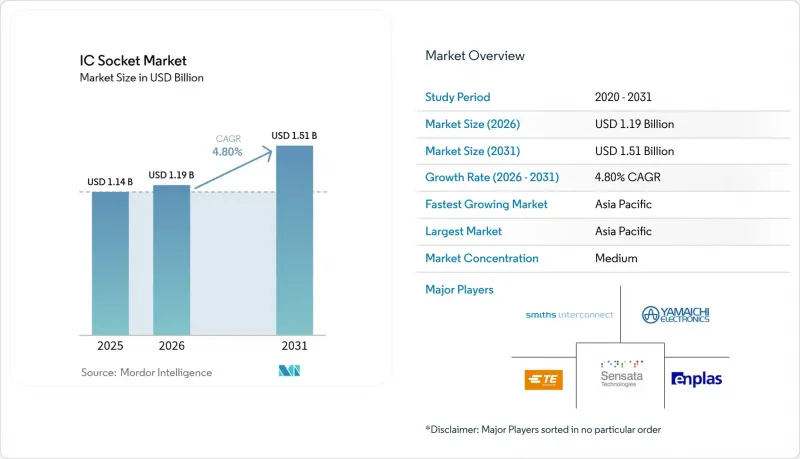
본 보고서는 소켓 유형(테스트 및 번인, 보드 간 연결/스루홀, 고밀도 PGA/LGA 등), IC 패키지 유형(DIP, QFP/SOP 등), 용도(CPU 및 프로세서, 메모리 모듈 등), 최종사용자 산업(소비자 가전, 자동차 등), 및 지역(아메리카, 아시아태평양 등)별로 분류되어 있습니다. 시장 전망은 금액(달러) 기준으로 제시되어 있습니다.
세계 IC 소켓 시장의 동향 및 인사이트
5G 네트워크 구축이 RF 디바이스 수요를 견인
세계 5G 인프라의 확대로 인해 RF 부품의 소켓 설계는 혁신을 겪고 있으며, 주파수는 현재 100 GHz에 달하여, 엄격한 임피던스 제어를 유지하면서 삽입 손실을 줄여주는 소재가 요구되고 있습니다. 4G에서 5G로의 전환에 따라 기지국당 RF 부품 수는 약 3배로 증가했으며, 최종 제품 인증 및 시스템 수준 검증 모두에서 소켓 사용량이 증가하고 있습니다. 밀리미터파 모듈에 시스템 인 패키지(SiP)가 채택됨에 따라, 특히 북미 및 유럽과 같은 조기 도입 지역에서 수요가 더욱 확대되고 있습니다.
자동차용 존 아키텍처 ECU의 보급
분산형 자동차용 ECU를 중앙 처리 허브로 통합함에 따라 핀 수와 열 부하가 증가하여, AEC-Q100을 준수하고 더 높은 전류 밀도를 지원할 수 있는 자동차용 등급 소켓에 대한 수요가 높아지고 있습니다. 독일, 일본, 미국에서 소프트웨어 정의 차량(SDV)을 뒷받침하는 규제 움직임이 이러한 전용 솔루션의 보급을 가속화하고 있습니다.
초기 금형 및 프로브 카드의 높은 비용
고급 프로브 카드는 구성당 50만 달러를 초과하며, 서브마이크론 수준의 접점 형상으로 인해 리드타임이 16-20주에 달합니다. CoWoS와 같은 새로운 패키지 형식에는 새로운 금형이 필요하며, 대량 생산을 통해 고정 비용을 상각할 수 없는 틈새 시장 소켓 공급업체에게는 진입 장벽이 높아지고 있습니다.
부문 분석
2025년에는 테스트 및 번인용 소켓이 IC 소켓 시장 점유율의 33.40%를 차지했으며, 이는 업계의 품질 보증에 대한 집중을 반영합니다. 연평균 성장률(CAGR) 7.1%로 예측되는 파인 피치 BGA/CSP/WLCSP 소켓은 디바이스의 소형화 및 첨단 패키징 수요에 부응하는 제품입니다. 모바일 기기 및 웨어러블 기기의 폼팩터가 소형화됨에 따라, 파인 피치 제품의 IC 소켓 시장 규모는 현저히 확대될 것으로 예측됩니다.
각 제조사는 0.35mm 미만의 피치 대응 능력과, 첨단 노드에서 허용되는 테스트 사이클 수가 감소하는 상황에서도 수명을 연장하는 내구성이 높은 접점에 대한 투자를 진행하고 있습니다. 예지보전 및 모듈식 인서트는 끊임없이 진화하는 테스트 핸들러 생태계와의 호환성을 유지하면서 총 소유 비용(TCO) 절감에 기여하고 있습니다.
BGA/μBGA 패키지는 높은 열 효율과 배선 밀도 덕분에 2025년 IC 소켓 시장 규모의 40.40%를 계속 차지했습니다. 한편, LGA/PGA/CGA 소켓은 서버 및 자동차 설계자들이 현장에서 교체 가능한 유닛을 선호하는 경향이 있어 연평균 성장률(CAGR) 6.6%로 시장 점유율을 확대하고 있습니다.
현재 소켓에는 프로그래밍 가능한 핀 매핑 및 적응형 접촉력이 탑재되어 있어, 단일 핸들러 내에서 서로 다른 패키지 유형을 지원할 수 있게 되었으며, 이는 가동 중단 시간과 금형 비용 절감으로 이어지고 있습니다. RoHS 및 REACH 규정을 준수함에 따라 공급업체들은 기존의 전기적 성능을 유지하기 위해 노력하고 있는 반면, 소재 선택은 베릴륨이 포함되지 않은 합금 쪽으로 이동하고 있습니다.
지역별 분석
아시아태평양은 2025년에 IC 소켓 시장의 44.40%를 차지했으며, 지역 파운드리 확장과 정부의 반도체 자급자족 지원에 힘입어 2031년까지 연평균 성장률(CAGR) 6.3%로 성장할 것으로 전망됩니다. 중국은 민생용 전자기기 조립 시장을 주도하고 있는 반면, 대만과 한국은 첨단 메모리 및 로직 노드 분야에서 우위를 점하고 있습니다. 인도는 인센티브 정책에 힘입어 비용 중심의 패키징 대체 거점으로 부상하고 있습니다.
북미는 자동차, 항공우주, 데이터센터의 수요에 힘입어 2위의 시장 점유율을 차지하고 있습니다. TSMC의 애리조나 공장이나 인텔의 오하이오주 확장 등 국내 제조 프로젝트로 인해 현지 소켓 조달이 확대될 전망입니다. 실리콘밸리에서의 AI 가속기 개발은 HBM을 다량으로 사용하는 패키지를 위해 가장 까다로운 소켓 사양 중 일부를 주도하고 있습니다.
유럽에서는 자동차 및 산업용 애플리케이션이 중시되고 있습니다. 독일의 1차 공급업체들은 견고한 열 사이클 성능을 갖춘 AEC-Q 인증 소켓을 요구하고 있습니다. 프랑스와 네덜란드는 고밀도 상호연결에 관한 연구 개발에 기여하고 있습니다. 한편, 환경 기준에 대한 규제적 압력으로 인해 유럽의 구매자들은 베릴륨이 포함되지 않은 접점 소재로의 전환을 요구받고 있습니다.
기타 혜택:
- 엑셀 형식의 시장 예측(ME) 시트
- 3개월간의 애널리스트 지원
자주 묻는 질문
목차
제1장 소개
제2장 조사 방법
제3장 주요 요약
제4장 시장 구도
제5장 시장 규모와 성장 예측
제6장 경쟁 구도
제7장 시장 기회와 향후 전망
KSM 26.08.25According to Mordor Intelligence, IC socket market size in 2026 is estimated at USD 1.19 billion, growing from 2025 value of USD 1.14 billion with 2031 projections showing USD 1.51 billion, growing at 4.8% CAGR over 2026-2031.
This report is Segmented by Socket Type (Test and Burn-In, Board-to-Board/Through-Hole, High-Density PGA/LGA, and More), IC Package Type (DIP, QFP/SOP, and More), Application (CPU and Processors, Memory Modules, and More), End-User Industry (Consumer Electronics, Automotive, and More), and Geography (North America, South America, Asia-Pacific, and More). The Market Forecasts are Provided in Terms of Value (USD).
Global IC Socket Market Trends and Insights
5G Network Roll-outs Boosting RF Device Demand
Global 5G infrastructure deployment is reshaping RF component socket design, with frequencies now reaching 100 GHz and requiring materials that reduce insertion loss while maintaining tight impedance control. The shift from 4G to 5G multiplies RF components per base station by roughly three, elevating socket use in both final product qualification and system-level validation. System-in-package adoption for millimeter-wave modules further magnifies demand, particularly across early-adopter regions in North America and Europe.
Automotive Zonal-Architecture ECU Proliferation
Consolidation of distributed automotive ECUs into centralized processing hubs raises pin counts and thermal loads, driving the need for automotive-grade sockets qualified under AEC-Q100 and capable of higher-current densities. Regulatory momentum behind software-defined vehicles in Germany, Japan, and the United States quickens the uptake of these specialized solutions.
High Initial Tooling and Probe-Card Costs
Advanced probe cards exceed USD 500,000 per configuration, with 16-20-week lead times due to sub-micron contact geometries. Emerging packaging formats such as CoWoS demand fresh tooling, raising entry barriers for niche socket providers unable to amortize fixed costs across large volumes.
Other drivers and restraints analyzed in the detailed report include:
- Higher Pin-Count ASICs in AI Accelerators
- Rapid Adoption of Chiplet-Based Packaging
- Supply-Chain Exposure to Ceramic Substrate Shortages
For complete list of drivers and restraints, kindly check the Table Of Contents.
Segment Analysis
Test and burn-in sockets controlled 33.40% of the IC socket market share in 2025, mirroring the industry's quality-assurance focus. Fine-pitch BGA/CSP/WLCSP sockets, projected at a 7.1% CAGR, cater to device miniaturization and advanced packaging demands. The IC socket market size for fine-pitch variants is forecast to widen notably as mobile and wearable devices shrink form factors.
Manufacturers invest in sub-0.35 mm pitch capabilities and durable contacts that extend useful life across fewer allowable test cycles at advanced nodes. Predictive maintenance and modular inserts help control the total cost of ownership while supporting compatibility with evolving test-handler ecosystems.
BGA/μBGA packages retained 40.40% of the IC socket market size in 2025, linked to their thermal efficiency and interconnect density. LGA/PGA/CGA sockets are gaining at a 6.6% CAGR as server and automotive designers prioritize field-replaceable units.
Sockets now feature programmable pin mapping and adaptive contact force to accommodate mixed package types within a single handler, reducing downtime and tooling spend. Compliance with RoHS and REACH is steering material choices toward beryllium-free alloys, even as suppliers strive to match legacy electrical performance.
Complete Report Scope:
- By Socket Type
- Test and Burn-in
- Board-to-Board / Through-Hole (DIP, SIP)
- High-Density (PGA/LGA)
- Fine-pitch BGA / CSP / WLCSP
- By IC Package Type
- DIP
- QFP / SOP
- BGA / μBGA
- LGA / PGA / CGA
- By Application
- CPU and Processors
- Memory Modules (DRAM, NAND)
- Sensor Devices
- RF and Analog Components
- Optoelectronic / Photonic ICs
- By End-User Industry
- Consumer Electronics
- Automotive
- Industrial and Automation
- Telecommunications and Datacom
- Aerospace and Defense
- Healthcare and Medical Devices
- Geography
- North America
- South America
- Europe
- Asia-Pacific
- Middle East
- Africa
Geography Analysis
Asia-Pacific captured 44.40% of the IC socket market in 2025 and is set to climb at a 6.3% CAGR through 2031 as regional foundries expand and governments subsidize semiconductor self-sufficiency. China dominates consumer electronics assembly, while Taiwan and South Korea excel in advanced memory and logic nodes. India is surfacing as a cost-sensitive packaging alternative, buoyed by incentive schemes.
North America ranks second, anchored by automotive, aerospace, and data-center demand. Domestic manufacturing projects such as TSMC's Arizona fab and Intel's Ohio build-out are poised to increase localized socket procurement. AI accelerator development in Silicon Valley drives some of the most challenging socket specifications for HBM-rich packages.
Europe emphasizes automotive and industrial applications. German tier-1 suppliers require AEC-Q qualified sockets with robust thermal cycling performance. France and the Netherlands contribute to research and development on high-density interconnects. Meanwhile, regulatory leadership in environmental standards pushes European buyers toward beryllium-free contact materials.
- TE Connectivity PLC
- Smiths Interconnect Inc.
- Yamaichi Electronics Co., Ltd.
- Enplas Corporation
- ISC Co., Ltd.
- Sensata Technologies Holding plc
- Ironwood Electronics, Inc.
- Plastronics Socket Company, Inc.
- INNO Global Inc.
- 3M Company
- Amphenol Corp.
- Molex LLC (Koch Industries)
- Foxconn Interconnect Technology Ltd.
- Samtec Inc.
- Loranger International Corp.
- Aries Electronics Inc.
- Mill-Max Manufacturing Corp.
- WinWay Technology Co., Ltd.
- Cohu, Inc.
Additional Benefits:
- The market estimate (ME) sheet in Excel format
- 3 months of analyst support
TABLE OF CONTENTS
1 Introduction
- 1.1 Study Assumptions and Market Definition
- 1.2 Scope of the Study
2 Research Methodology
3 Executive Summary
4 Market Landscape
- 4.1 Market Overview
- 4.2 Market Drivers
- 4.2.1 Surging smartphone and tablet production
- 4.2.2 5G network roll-outs boosting RF device demand
- 4.2.3 Automotive zonal-architecture ECU proliferation
- 4.2.4 Higher pin-count ASICs in AI accelerators
- 4.2.5 Rapid adoption of chiplet-based packaging
- 4.2.6 In-line test sockets for OSAT "known-good-die" services
- 4.3 Market Restraints
- 4.3.1 High initial tooling and probe-card costs
- 4.3.2 Socket life-cycle shortened by advanced nodes
- 4.3.3 Supply-chain exposure to ceramic substrate shortages
- 4.3.4 Environmental regulation on beryllium-copper alloys
- 4.4 Industry Value Chain Analysis
- 4.5 Regulatory Landscape
- 4.6 Technological Outlook
- 4.7 Porter's Five Forces Analysis
- 4.7.1 Threat of New Entrants
- 4.7.2 Bargaining Power of Buyers
- 4.7.3 Bargaining Power of Suppliers
- 4.7.4 Threat of Substitute Products
- 4.7.5 Intensity of Competitive Rivalry
- 4.8 Pricing Analysis
5 Market Size and Growth Forecasts (Value)
- 5.1 By Socket Type
- 5.1.1 Test and Burn-in
- 5.1.2 Board-to-Board / Through-Hole (DIP, SIP)
- 5.1.3 High-Density (PGA/LGA)
- 5.1.4 Fine-pitch BGA / CSP / WLCSP
- 5.2 By IC Package Type
- 5.2.1 DIP
- 5.2.2 QFP / SOP
- 5.2.3 BGA / μBGA
- 5.2.4 LGA / PGA / CGA
- 5.3 By Application
- 5.3.1 CPU and Processors
- 5.3.2 Memory Modules (DRAM, NAND)
- 5.3.3 Sensor Devices
- 5.3.4 RF and Analog Components
- 5.3.5 Optoelectronic / Photonic ICs
- 5.4 By End-User Industry
- 5.4.1 Consumer Electronics
- 5.4.2 Automotive
- 5.4.3 Industrial and Automation
- 5.4.4 Telecommunications and Datacom
- 5.4.5 Aerospace and Defense
- 5.4.6 Healthcare and Medical Devices
- 5.5 Geography
- 5.5.1 North America
- 5.5.2 South America
- 5.5.3 Europe
- 5.5.4 Asia-Pacific
- 5.5.5 Middle East
- 5.5.6 Africa
6 Competitive Landscape
- 6.1 Market Concentration
- 6.2 Strategic Moves
- 6.3 Market Share Analysis
- 6.4 Company Profiles (includes Global level Overview, Market level overview, Core Segments, Financials as available, Strategic Information, Market Rank/Share for key companies, Products and Services, and Recent Developments)
- 6.4.1 TE Connectivity PLC
- 6.4.2 Smiths Interconnect Inc.
- 6.4.3 Yamaichi Electronics Co., Ltd.
- 6.4.4 Enplas Corporation
- 6.4.5 ISC Co., Ltd.
- 6.4.6 Sensata Technologies Holding plc
- 6.4.7 Ironwood Electronics, Inc.
- 6.4.8 Plastronics Socket Company, Inc.
- 6.4.9 INNO Global Inc.
- 6.4.10 3M Company
- 6.4.11 Amphenol Corp.
- 6.4.12 Molex LLC (Koch Industries)
- 6.4.13 Foxconn Interconnect Technology Ltd.
- 6.4.14 Samtec Inc.
- 6.4.15 Loranger International Corp.
- 6.4.16 Aries Electronics Inc.
- 6.4.17 Mill-Max Manufacturing Corp.
- 6.4.18 WinWay Technology Co., Ltd.
- 6.4.19 Cohu, Inc.
7 Market Opportunities and Future Outlook
- 7.1 White-space and Unmet-Need Assessment


