

|
시장보고서
상품코드
2113331
파킨슨병 치료제 : 시장 점유율 분석, 업계 동향과 통계, 성장 예측(2026-2031년)Parkinson´s Disease Drugs - Market Share Analysis, Industry Trends & Statistics, Growth Forecasts (2026 - 2031) |
||||||
 Mordor Intelligence
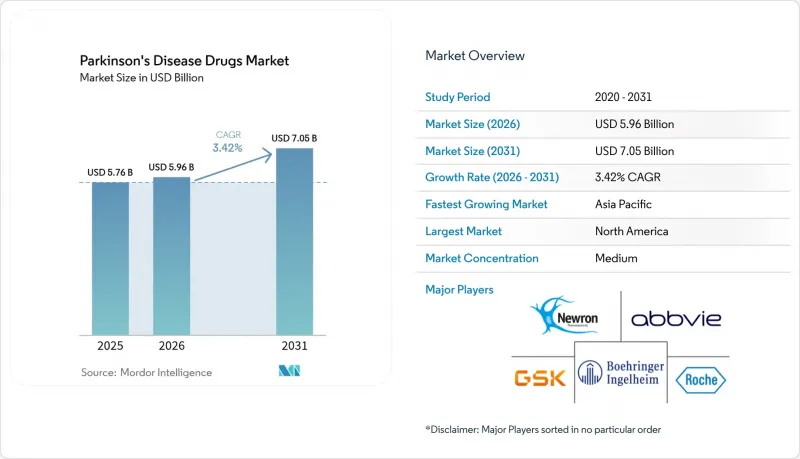
Mordor Intelligence에 따르면 파킨슨병 치료제 시장 규모는 2025년에 57억 6,000만 달러로 평가되며, 2026년 59억 6,000만 달러에서 2031년까지 70억 5,000만 달러에 달할 것으로 예측되며, 예측 기간(2026-2031년) 동안 CAGR은 3.42%가 될 전망입니다.
본 보고서는 약물의 작용 기전(도파민 작용제, 항콜린제, MAO-B 억제제, 카르비도파·레보도파 등), 투여 경로(경구, 점막 투과 등), 유통 채널(병원 약국, 온라인 약국 등), 및 지역별로 분류되어 있습니다. 본 보고서에서는 상기 각 부문별 시장 규모(단위 : 백만 달러)를 제시하고 있습니다.
세계 파킨슨병 치료제 시장의 동향 및 인사이트
고령 인구 증가와 질병 부담 확대
세계 평균 수명의 연장에 따라, 전 세계 파킨슨병 환자 수는 2050년까지 2,520만 명에 달할 것으로 예측되며, 이는 2021년 수준보다 2배 이상 증가한 수치입니다. 동아시아에서는 절대적인 환자 수의 증가가 가장 큰 반면, 사하라 이남 아프리카 서부에서는 비율의 증가가 가장 급격하여, 이로 인해 지역 맞춤형 치료 모델에 대한 투자가 촉진되고 있습니다. 미국의 연간 경제적 부담은 이미 520억 달러를 넘어섰으며, 장기적인 장애 비용을 억제하기 위해 지급 기관들은 조기 개입을 중시하고 있습니다.
인식 제고와 조기 진단 노력
AI를 활용한 혈액 검사를 통해 뚜렷한 증상이 나타나기 7년 전에 발병을 예측할 수 있으므로, 신경 보호 임상시험에 그 어느 때보다 조기에 참여할 수 있게 됩니다. 10만 명의 참가자를 대상으로 한 스마트워치를 활용한 보완적 분석을 통해, 전구 증상이 있는 사례를 식별하는 행동 패턴 바이오마커가 검증되었습니다. 태국에서 실시된 전국 규모의 디지털 선별 검사는 중소득 국가에서 저비용 도구가 어떻게 검출률을 향상시킬 수 있는지 보여주고 있습니다. 조기 진단을 통해 개발 중인 질환 수정 약물의 잠재적 대상 환자층이 확대됩니다.
기존 치료법에 수반되는 이상반응
레보도파의 장기 투여는 운동 합병증을 유발합니다. 벤세라지드를 포함한 투여법에서는 온-오프 현상의 오즈비가 170.74로 나타났으며, 이는 칼비도파의 67.5에 비해 현저히 높은 수치입니다. 도파민 작용제에는 충동 조절 장애의 위험이 있으며, 심부 뇌 자극 요법에는 수술에 따른 합병증의 위험이 있으므로, 자원이 풍부한 의료 센터 이외의 곳에서는 보급이 제한적입니다.
부문 분석
카르비도파·레보도파 부문은 수십 년에 걸친 임상적 정착도를 바탕으로 2025년에는 35.02%의 점유율로 파킨슨병 치료제 시장을 주도했습니다. 아데노신 A2A 길항제는 틈새 시장이지만, 연평균 성장률(CAGR) 4.10%로 가장 빠르게 성장하고 있는 약물군입니다. 선택적 D1/D5 부분 작용제인 타바파돈은 3상 임상시험에서 MDS-UPDRS 점수에서 유의미한 개선을 달성하여, 운동 이상증의 위험을 줄이면서 도파민 작용성 신호 전달을 유지하는 작용 기전에 대한 기대를 높이고 있습니다.
파이프라인의 다각화를 통해 도파민 조절에 대한 의존도가 완화되고 있습니다. AI를 활용하여 개발된 α-시누클레인 억제제 및 GDNF 유전자 치료 벡터는 질병 수정 치료로의 전환을 보여주고 있습니다. 이들이 상용화 단계에 도달함에 따라, 파킨슨병 시장에서 비도파민성 치료제 부문의 규모는 확대될 것으로 예상되며, 치료 선택지의 확충과 경쟁사와의 차별화가 촉진될 것입니다.
지역별 분석
북미는 2025년에 세계 시장의 44.02%를 차지했으며, 충분한 자금을 갖춘 의료 시스템, 종합적인 보험 제도, 그리고 운동 장애 전문의의 밀집된 네트워크를 활용하고 있습니다. '파킨슨병 퇴치를 위한 국가 계획법(National Plan to End Parkinson’s Act)'과 같은 연방 정부의 노력을 통해 추가 연구 자금이 확보되어 혁신의 모멘텀이 유지되고 있습니다. 그러나 지방 지역 사회에서는 신경과 전문의에 대한 접근성이 제한적이어서 여전히 진단까지의 지연이 길어지고 있습니다.
아시아태평양은 2031년까지 연평균 성장률(CAGR) 5.05%를 기록하며 가장 빠르게 성장하는 지역이 되고 있습니다. 중국에서는 1990년 이후 환자 수가 급증하고 있으며, 비운동 증상에 대한 임상의들의 인식도 향상되고 있지만, 지방 지역의 치료 격차는 여전히 남아 있습니다. 일본에서는 초고령화 사회가 진행됨에 따라 첨단 의료기기에 대한 수요가 증가하고 있으며, 인도에서는 확대되는 중산층이 시장 규모를 끌어올리고 있지만, 전문의의 분포가 불균형하여 그 성장에는 제약이 있습니다. 아세안(ASEAN) 회원국 간의 규제 조화로 인해 승인까지의 기간이 단축되어, 다국적 기업의 제품 출시가 촉진되고 있습니다.
유럽에서는 국민건강보험제도의 뒷받침을 받아 안정적인 시장 침투가 이루어지고 있으나, 국가별 환급 결정에 따라 편차가 발생하고 있습니다. 브렉시트로 인한 통관 절차 변경으로 영국에서는 레보도파 공급 부족이 때때로 발생하고 있어, 공급 안정성을 확보하기 위한 전략이 요구되고 있습니다. 독일에서는 2025년 진료 지침 개정에서 조기 다학제적 치료가 강조되고 있으며, 이에 따라 각 약물 분류별로 안정적인 수요가 뒷받침되고 있습니다. 라틴아메리카 및 중동 및 아프리카에서는 평균 수명의 연장 및 신경 질환 의료 인프라의 개선에 따라 새로운 비즈니스 기회가 생겨나고 있습니다.
기타 혜택:
- 엑셀 형식의 시장 예측(ME) 시트
- 3개월간 애널리스트 지원
자주 묻는 질문
목차
제1장 소개
제2장 조사 방법
제3장 주요 요약
제4장 시장 구도
제5장 시장 규모와 성장 예측
제6장 경쟁 구도
제7장 시장 기회와 향후 전망
KSM 26.08.25According to Mordor Intelligence, the parkinson's disease drugs market size was valued at USD 5.76 billion in 2025 and estimated to grow from USD 5.96 billion in 2026 to reach USD 7.05 billion by 2031, at a CAGR of 3.42% during the forecast period (2026-2031).
This report is Segmented by Drug's Mechanism of Action (Dopamine Agonists, Anticholinergic, MAO-B Inhibitors, Carbidopa-Levodopa, and More), Route of Administration (Oral, Transmucosal, and More), by Distribution Channel (Hospital Pharmacies, Online Pharmacies, and More), and Geography. The Market Provides the Value (in USD Million) for the Above Segments.
Global Parkinson's Disease Drugs Market Trends and Insights
Rising Geriatric Population & Rising Disease Burden
The global Parkinson patient base is projected to reach 25.2 million by 2050, more than doubling its 2021 level as longevity increases worldwide. East Asia shoulders the largest absolute case growth, while western Sub-Saharan Africa records the steepest percentage rise, steering investment toward region-tailored care models . Annual U.S. economic burden already tops USD 52 billion, prompting payer emphasis on early intervention to curb long-term disability costs.
Growing Awareness & Early Diagnosis Initiatives
AI-enabled blood assays can predict disease onset seven years before overt symptoms, allowing enrollment into neuroprotective trials earlier than ever. Complementary smartwatch analytics on 100,000 participants validated motion-pattern biomarkers that flag prodromal cases. Thailand's nationwide digital screening illustrates how low-cost tools enlarge detection in middle-income settings. Earlier diagnosis increases the addressable base for pipeline disease-modifying products.
Adverse Events Associated With Current Therapeutics
Chronic levodopa exposure produces motor complications; benserazide regimens show odds ratios of 170.74 for on-off phenomena, markedly higher than carbidopa's 67.5. Dopamine agonists carry impulse-control risks, and deep-brain stimulation involves surgical morbidity, limiting uptake outside high-resource centers.
Other drivers and restraints analyzed in the detailed report include:
- Expanding Reimbursement & Insurance Coverage
- Increasing R&D Investment & Continuous Drug Approvals
- Adoption of Long-Acting Continuous Infusion Formulations
- AI-Driven Drug-Repurposing Pipelines Targeting a-Synuclein
- High Treatment & R&D Costs
For complete list of drivers and restraints, kindly check the Table Of Contents.
Segment Analysis
The Carbidopa-levodopa segment led the Parkinson's disease drugs market with a 35.02% share in 2025, supported by decades of clinical familiarity. Adenosine A2A antagonists, though niche, are the quickest-growing class at 4.10% CAGR. Selective D1/D5 partial agonist tavapadon achieved significant MDS-UPDRS gains in Phase 3, reinforcing appetite for mechanisms that preserve dopaminergic signaling while reducing dyskinesia risk.
Pipeline diversification tempers reliance on dopamine modulation. AI-derived a-synuclein inhibitors and GDNF gene-therapy vectors illustrate a pivot toward disease modification. As these reach commercial stages, the Parkinson disease market size for non-dopaminergic categories is expected to widen, enhancing therapeutic choice and competitive differentiation.
Complete Report Scope:
- By Drug's Mechanism of Action
- Dopamine Agonists
- Anticholinergics
- MAO-B Inhibitors
- Amantadine
- Carbidopa-levodopa
- Adenosine A2A Antagonists
- Other Mechanisms of Action
- By Route of Administration
- Oral
- Transdermal
- Subcutaneous
- Infusion
- Intranasal
- By Distribution Channel
- Hospital Pharmacies
- Retail Pharmacies
- Online Pharmacies
- By Geography
- North America
- United States
- Canada
- Mexico
- Europe
- Germany
- United Kingdom
- France
- Italy
- Spain
- Rest of Europe
- Asia-Pacific
- China
- Japan
- India
- Australia
- South Korea
- Rest of Asia-Pacific
- Middle East & Africa
- GCC
- South Africa
- Rest of Middle East & Africa
- South America
- Brazil
- Argentina
- Rest of South America
- North America
Geography Analysis
North America contributed 44.02% of global value in 2025, leveraging well-funded health systems, comprehensive insurance, and dense movement-disorder specialist networks. Federal initiatives such as the National Plan to End Parkinson's Act earmark additional research financing, sustaining innovation momentum. Yet rural communities still face longer diagnostic delays due to limited neurologist access.
Asia Pacific ranks as the fastest-growing region at 5.05% CAGR to 2031. China's case load has soared since 1990, and clinician awareness of non-motor symptoms is improving, although rural treatment gaps persist. Japan's super-aged demographics spur demand for advanced devices, while India's expanding middle class boosts volume, albeit constrained by uneven specialist distribution. Regulatory harmonization across ASEAN members trims approval timelines, favoring multinational launches.
Europe enjoys consistent uptake backed by universal insurance, but individual-state reimbursement decisions create variability. Brexit-related customs changes caused occasional levodopa shortages in the United Kingdom, prompting calls for resilient supply strategies. Germany's 2025 guideline update emphasizes early interdisciplinary management, reinforcing stable demand across drug classes. Latin America and Middle East & Africa display emerging opportunities parallel to rising life expectancy and improving neurologic care infrastructure.
- Abbvie
- Amneal Pharmaceuticals
- Viatris
- Boehringer Ingelheim Intl. GmbH
- GlaxoSmithKline
- Teva Pharmaceutical Industries
- Pfizer
- Novartis
- Roche
- ABL bio
- KISSEI PHARMACEUTICAL
- AstraZeneca
- Prevail Therapeutics
- Newron Pharmaceuticals S.p.A.
- Kyowa Kirin
- ACADIA Pharmaceuticals Inc.
- UCB
- Sunovion Pharmaceuticals
- Neurocrine Biosciences
- Lundbeck A/S
- Voyager Therapeutics, Inc.
- Supernus Pharmaceuticals
Additional Benefits:
- The market estimate (ME) sheet in Excel format
- 3 months of analyst support
TABLE OF CONTENTS
1 Introduction
- 1.1 Study Assumptions & Market Definition
- 1.2 Scope of the Study
2 Research Methodology
3 Executive Summary
4 Market Landscape
- 4.1 Market Overview
- 4.2 Market Drivers
- 4.2.1 Rising Geriatric Population & Rising Disease Burden
- 4.2.2 Growing Awareness & Early Diagnosis Initiatives
- 4.2.3 Expanding Reimbursement & Insurance Coverage
- 4.2.4 Increasing R&D Investment & Continuous Drug Approvals
- 4.2.5 Adoption Of Long-Acting Continuous Infusion Formulations
- 4.2.6 Ai-Driven Drug-Repurposing Pipelines Targeting A-Synuclein
- 4.3 Market Restraints
- 4.3.1 Adverse Events Associated With Current Therapeutics
- 4.3.2 High Treatment & R&D Costs
- 4.3.3 Supply-Chain Constraints For Levodopa Apis
- 4.3.4 Regulatory Uncertainty Around Disease-Modifying Claims
- 4.4 Value / Supply-Chain Analysis
- 4.5 Regulatory Landscape
- 4.6 Technological Outlook
- 4.7 Porter's Five Forces Analysis
- 4.7.1 Threat of New Entrants
- 4.7.2 Bargaining Power of Buyers/Consumers
- 4.7.3 Bargaining Power of Suppliers
- 4.7.4 Threat of Substitute Products
- 4.7.5 Intensity of Competitive Rivalry
5 Market Size & Growth Forecasts (Value, USD million)
- 5.1 By Drug's Mechanism of Action
- 5.1.1 Dopamine Agonists
- 5.1.2 Anticholinergics
- 5.1.3 MAO-B Inhibitors
- 5.1.4 Amantadine
- 5.1.5 Carbidopa-levodopa
- 5.1.6 Adenosine A2A Antagonists
- 5.1.7 Other Mechanisms of Action
- 5.2 By Route of Administration
- 5.2.1 Oral
- 5.2.2 Transdermal
- 5.2.3 Subcutaneous
- 5.2.4 Infusion
- 5.2.5 Intranasal
- 5.3 By Distribution Channel
- 5.3.1 Hospital Pharmacies
- 5.3.2 Retail Pharmacies
- 5.3.3 Online Pharmacies
- 5.4 By Geography
- 5.4.1 North America
- 5.4.1.1 United States
- 5.4.1.2 Canada
- 5.4.1.3 Mexico
- 5.4.2 Europe
- 5.4.2.1 Germany
- 5.4.2.2 United Kingdom
- 5.4.2.3 France
- 5.4.2.4 Italy
- 5.4.2.5 Spain
- 5.4.2.6 Rest of Europe
- 5.4.3 Asia-Pacific
- 5.4.3.1 China
- 5.4.3.2 Japan
- 5.4.3.3 India
- 5.4.3.4 Australia
- 5.4.3.5 South Korea
- 5.4.3.6 Rest of Asia-Pacific
- 5.4.4 Middle East & Africa
- 5.4.4.1 GCC
- 5.4.4.2 South Africa
- 5.4.4.3 Rest of Middle East & Africa
- 5.4.5 South America
- 5.4.5.1 Brazil
- 5.4.5.2 Argentina
- 5.4.5.3 Rest of South America
- 5.4.1 North America
6 Competitive Landscape
- 6.1 Market Concentration
- 6.2 Market Share Analysis
- 6.3 Company Profiles (includes Global level Overview, Market level overview, Core Segments, Financials as available, Strategic Information, Market Rank/Share for key companies, Products & Services, and Recent Developments)
- 6.3.1 AbbVie Inc.
- 6.3.2 Amneal Pharmaceuticals LLC
- 6.3.3 Viatris
- 6.3.4 Boehringer Ingelheim Intl. GmbH
- 6.3.5 GSK plc
- 6.3.6 Teva Pharmaceutical Industries Ltd
- 6.3.7 Pfizer Inc.
- 6.3.8 Novartis AG
- 6.3.9 F. Hoffmann-La Roche Ltd
- 6.3.10 ABL bio
- 6.3.11 Kissei Pharmaceutical Co., Ltd.
- 6.3.12 AstraZeneca
- 6.3.13 Prevail Therapeutics
- 6.3.14 Newron Pharmaceuticals S.p.A.
- 6.3.15 Kyowa Kirin Co., Ltd.
- 6.3.16 ACADIA Pharmaceuticals Inc.
- 6.3.17 UCB S.A.
- 6.3.18 Sunovion Pharmaceuticals Inc.
- 6.3.19 Neurocrine Biosciences, Inc.
- 6.3.20 Lundbeck A/S
- 6.3.21 Voyager Therapeutics, Inc.
- 6.3.22 Supernus Pharmaceuticals, Inc.
7 Market Opportunities & Future Outlook
- 7.1 White-space & Unmet-need Assessment


