

|
시장보고서
상품코드
2113338
SDHI 살균제 : 시장 점유율 분석, 산업 동향·통계 데이터, 성장 예측(2026-2031년)SDHI Fungicide - Market Share Analysis, Industry Trends & Statistics, Growth Forecasts (2026 - 2031) |
||||||
 Mordor Intelligence
Mordor Intelligence에 따르면 SDHI 살균제 시장 규모는 2025년 39억 3,000만 달러에서 2026년에는 42억 3,000만 달러로 확대하며, 2026-2031년에 CAGR 7.72%로 추이하며, 2031년에는 61억 4,000만 달러에 달할 것으로 예측됩니다.
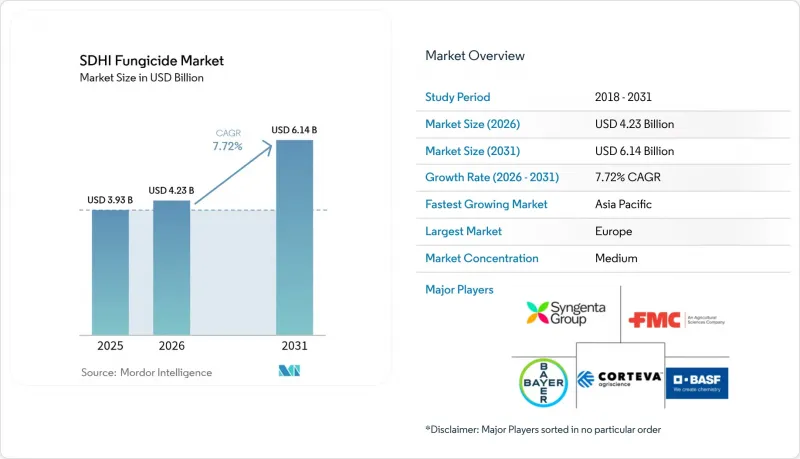
이 보고서는 용도별(곡물, 두류·지방종자 등), 적용 방법별(엽면 살포 등), 유효 성분별(보스카리드, 플루오피람 등), 제형별(액상 분무제, 과립 수화제 등),및 지역(북미, 유럽 등)별로 분류되어 있습니다. 시장 예측은 금액(달러) 기준으로 제시되어 있습니다.
세계 SDHI 살균제 시장의 동향 및 인사이트
기후 변화로 인한 병해 압력
병원체의 진화와 지역적 확산으로 인해 전 세계 농업에서 SDHI 살균제의 수요 패턴이 변화하고 있습니다. 밀 벼룩병(Magnaporthe oryzae)은 방글라데시와 브라질에서 상시 개체군을 형성하고 있으며, 생산자들은 SDHI(숙신산 탈수소효소 억제제) 순환 프로그램을 시행할 수밖에 없는 상황입니다. 기온 및 강우 패턴의 변화로 인해 푸사리움병, 셉토리아병 및 밀 벼룩병의 감염 기간이 길어지고 있습니다. 이러한 병해 주기의 장기화에 따라 살균제의 추가 살포가 필요해지면서 SDHI 사용량이 증가하고 있습니다. 기후 변화로 인한 병해 압력은 기존의 살균제 도입 패턴과는 달리 지속적인 수요 증가를 가져오고 있습니다. 이소플루시프람 및 벤조빈디플루필을 포함한 새로운 SDHI 계열 화합물은 기존의 트리아졸 계열이나 스트로빌린 계열 살균제와 비교하여 다양한 환경 조건에서 뛰어난 효능을 발휘합니다.
신흥 시장에서의 SDHI 등록 승인 급속한 확대
아시아태평양 및 남미 시장의 최근 규제 변경은 SDHI 살균제 제조업체에 성장 기회를 제공하고 있습니다. 중국에서는 2024년 ‘채용 및 의료 지원에 관한 주간 협정(ICAMA)’에 따라 보스카리드 및 플루오피람 제제에 대한 국내 생산 라이선스를 포함하여 여러 SDHI의 등록이 승인되었습니다. 브라질에서는 대두 및 옥수수에 대한 사용 관련 등록 절차가 간소화되어, 농가에게 내성 문제를 해결하기 위한 대안이 제공되었습니다. 2024년, 인도 식품안전표준청(FSSAI)은 허브 및 향신료에 포함된 농약의 최대 잔류 기준치(MRL)를 0.01 mg/kg에서 0.1 mg/kg으로 상향 조정하여, 인도 농업 부문 전반에 걸쳐 더 광범위한 채택을 가능하게 했습니다. 이러한 규제상의 진전은 등록 서류를 갖추고 현지 생산 거점을 보유한 기업에 유리하게 작용합니다. 승인 범위의 확대는 특히 SDHI 계열 화합물을 다른 작용 기전과 결합한 복합 제제를 지원하는 것이며, 포괄적인 내성 관리 전략을 추구하는 규제 당국의 의도에 부합하는 것입니다.
차세대 생물학적 살균제에 의한 파이프라인 경쟁
특정 작물 보호 시나리오에서 SDHI 계열 화합물의 대안으로 생물학적 살균제가 점차 수용되고 있으며, 이로 인해 프리미엄 부문의 시장 성장이 제한될 가능성이 있습니다. 주요 농약 기업은 합성 및 생물학적 제품을 결합한 제품을 개발하기 위해 생물학적 방제 역량을 확보하고 있습니다. 2024년 Certis Biologicals가 Howler와 Theia를 인수한 것은 특정 작물에서 동등한 효능이 입증되었음을 보여줍니다. BASF사의 생물학적 살균제 ‘Serifel’은 여러 작용 기전을 통해 광범위한 병해 방제를 실현하며, 종합 해충 방제 프로그램에서 SDHI 사용을 줄일 수 있게 해줍니다. 고급 과일·채소 시장에서는 구매자들이 화학 물질을 사용하지 않은 농산물을 선호하는 경향이 있으며, 생산자들은 생물학적 대체제로의 전환을 추진하고 있습니다.
부문 분석
2025년 시점에 곡물은 SDHI 살균제 시장 점유율의 44.22%를 차지하고 있습니다. 이 압도적인 점유율은 전 세계 밀, 옥수수, 보리 생산 시스템의 광대한 재배 면적과 철저한 병해 관리의 필요성에서 기인합니다. 밀 산지의 푸사리움 이삭마름병과 옥수수의 회색잎반점병 확산이 SDHI(특히 SDHI 계열 성분과 다른 작용 기전을 결합한 제품)에 대한 안정적인 수요를 견인하고 있습니다.
잔디·관상용 식물은 2031년까지 연평균 성장률(CAGR)이 9.55%로, 가장 빠르게 성장하고 있는 용도 부문입니다. 이러한 성장은 골프장, 스포츠 시설, 조경 용도에서의 높은 가격 수용성과 집중적인 유지 관리의 필요성에 의해 주도되고 있습니다. 과일·채소 분야는 특산 작물을 위한 새로운 SDHI 사용 승인으로 인해 확대되고 있습니다. 한편, 면화나 사탕수수 등의 상업 작물에서는 고부가가치 생산 시스템에 SDHI 프로그램이 도입되고 있습니다. 두류 및 지방종자 용도는 특히 병해 압력이 높아지고 있는 북미 지역에서 대두 및 카놀라 생산자들이 흰곰팡이병 및 스케로티니아병 관리를 위해 SDHI 기반 솔루션을 채택함에 따라 지속적으로 성장하고 있습니다. 이러한 용도의 다양성 덕분에 규제 요건을 충족하면서 특정 작물 병해를 대상으로 한 특수 제제의 개발이 가능해졌습니다.
엽면 살포 용도는 확립된 생산자 관행과 모든 작물 시스템에서 잎 부위 병원균에 대한 입증된 효능에 힘입어 2025년에는 SDHI 살균제 시장 규모의 66.35%를 차지할 것으로 예상됩니다. 종자 처리 용도는 새로운 SDHI 제제의 승인 및 생육 초기 병해 방제에 대한 수요 증가에 힘입어 2031년까지 연평균 성장률(CAGR) 9.78%로 성장하고 있습니다. 수확 후 처리는 곡물 저장 보호 및 과일 보존 등 특정 시장 부문을 차지하고 있으며, 특수 제제 개발 능력과 필요한 규제 당국의 승인을 보유한 기업에게 비즈니스 기회를 창출하고 있습니다.
종자 처리로의 전환에는 환경 영향 최소화, 병원체의 정밀한 방제, 살충제나 식물 성장 조절제 등 다른 종자 처리 제품과의 호환성 등 많은 이점이 있습니다. BASF사의 종자 처리제 ‘ILeVO’(플루오피람)는 SDHI 계열 화합물이 옥수수 및 대두 묘목을 토양 전염병으로부터 보호하는 데 효과적임을 보여주는 좋은 예입니다. 규제 당국은 드리프트 감소와 환경 위험이 낮다는 이유로 엽면 살포보다 종자 처리를 선호합니다. 이러한 추세는 종자 처리 제제에 대한 전문 지식을 보유하고, 종자 생산자 및 상업용 처리 시설과 견고한 관계를 유지하고 있는 기업에게 유리하게 작용합니다.
지역별 분석
2025년, 유럽은 SDHI 살균제 시장 점유율의 33.74%를 차지했습니다. 이 지역의 광범위한 곡물 생산, 충실한 농업 지도 서비스, 그리고 엄격한 적정 사용 요건으로 인해 SDHI 계열 약제는 내성 관리 전략에서 필수적인 요소로 자리 잡았습니다. 통합 해충 관리(IPM) 실천을 지원하는 해당 지역의 보조금 제도 덕분에 규제상 과제가 있음에도 불구하고 고품질 살균제에 대한 수요가 유지되고 있습니다. 독일, 프랑스, 영국은 곡물 생산이 활발하고 SDHI 사용이 정착되어 있으며, 주요 시장으로 자리 잡고 있습니다. 스페인과 이탈리아는 특히 과일 및 채소 등 특산 작물에 대한 사용에 중점을 두고 있습니다. 프랑스 식품·환경·노동위생안전청(ANSES) 및 유럽식품안전청(EFSA)의 지속적인 규제 재검토는 유럽의 특정 지역에서 향후 시장 성장에 영향을 미칠 가능성이 있습니다.
아시아태평양은 2031년까지 연평균 성장률(CAGR)이 9.52%로 가장 높은 성장률을 보이고 있습니다. 이러한 성장은 중국과 인도의 농업 현대화, 새로운 SDHI 제품의 승인, 그리고 다양한 작물 체계에서 병해 압력이 증가함에 기인합니다. 중국의 SDHI 국내 생산 능력과 주요 유효 성분에 대한 규제 체계가 이 지역의 성장을 지원하고 있습니다. 인도에서는 특산 작물의 확대와 최대 잔류 기준(MRL)의 개선이 시장 발전을 촉진하고 있습니다. 일본과 호주는 SDHI 사용이 정착되어 있으며, 프리미엄 가격도 수용되고 있는 성숙한 시장입니다.
북미에서는 특히 옥수수 및 대두 재배 분야에서 SDHI 계열 약제가 중요한 내성 관리 솔루션을 제공하고 있으며, 광범위한 곡물 생산과 포괄적인 병해 관리 프로그램을 통해 꾸준한 성장을 유지하고 있습니다. 남미, 중동 및 아프리카에서는 농업 생산의 확대와 살균제 채택 증가로 인해 성장 기회가 예상됩니다. 브라질의 농업 확대와 대두·옥수수에 대한 SDHI 계열 약제의 승인은 큰 시장 잠재력을 내포하고 있으며, 한편 아르헨티나를 비롯한 기타 지역 시장에서는 곡물 및 특산 작물을 위한 SDHI 프로그램이 전개되고 있습니다.
기타 혜택:
- Excel 형식의 시장 예측(ME) 시트
- 3개월간의 애널리스트 지원
자주 묻는 질문
목차
제1장 서론
제2장 분석 방법
제3장 개요
제4장 시장 구도
제5장 시장 규모·성장률 예측
제6장 경쟁 구도
제7장 비료 업계의 CEO가 직면하는 주요 전략적 과제
KSA 26.08.25According to Mordor Intelligence, the SDHI fungicide market size is expected to grow from USD 3.93 billion in 2025 to USD 4.23 billion in 2026 and is forecast to reach USD 6.14 billion by 2031 at 7.72% CAGR over 2026-2031.
This report is Segmented by Application (Grains and Cereals, Pulses and Oilseeds, and More), by Mode of Application (Foliar Spray, and More), by Active Ingredient (Boscalid, Fluopyram, and More), by Formulation Type (Liquid Suspension Concentrates, Water-Dispersible Granules, and More), and by Geography (North America, Europe, and More). The Market Forecasts are Provided in Terms of Value (USD).
Global SDHI Fungicide Market Trends and Insights
Climate-Change-Driven Disease Pressure
The evolution and geographic expansion of pathogens are altering the demand patterns for SDHI fungicides in global agriculture. Wheat blast (Magnaporthe oryzae) has established permanent populations in Bangladesh and Brazil, necessitating growers to implement SDHI rotation programs. Changes in temperature and rainfall patterns have extended infection periods for Fusarium, Septoria, and wheat blast diseases. These longer disease cycles necessitate additional fungicide applications, increasing SDHI usage. The climate-induced disease pressure generates sustained demand growth, unlike historical fungicide adoption patterns. New SDHI molecules, including isoflucypram and benzovindiflupyr, exhibit superior efficacy under varying environmental conditions compared to traditional triazole and strobilurin fungicides.
Rapid Expansion of SDHI Label Approvals in Emerging Markets
Recent regulatory changes in the Asia-Pacific and South American markets have created growth opportunities for SDHI fungicide manufacturers. In China, Interstate Compact on Adoption and Medical Assistance (ICAMA) approved several SDHI registrations in 2024, including domestic production licenses for boscalid and fluopyram formulations. Brazil streamlined registrations for soybean and corn applications, providing growers with alternatives to address resistance issues. In 2024, India's Food Safety Standards Authority (FSSAI) increased the Maximum Residue Limit (MRL) of pesticides in herbs and spices from 0.01 mg/kg to 0.1 mg/kg, enabling wider adoption across India's agricultural sector. These regulatory developments benefit companies with established registration documentation and local production facilities. The expanded approvals particularly support combination products that integrate SDHI chemistry with other modes of action, aligning with regulatory preferences for comprehensive resistance management strategies.
Pipeline Competition From Next-Gen Biologic Fungicides
Biological fungicides are gaining acceptance as alternatives to SDHI chemistry in specific crop protection scenarios, which may limit market growth in premium segments. Major agrochemical companies are acquiring biocontrol capabilities to develop synthetic-biological product combinations. Certis Biologicals' acquisition of Howler and Theia in 2024 demonstrates comparable efficacy in certain crops. BASF's Serifel biofungicide offers broad-spectrum disease control through multiple modes of action, enabling reduced SDHI usage in integrated pest management programs. In premium fruit and vegetable markets, growers are transitioning to biological alternatives where buyers prioritize chemical-free produce.
Other drivers and restraints analyzed in the detailed report include:
- Integration with Digital-Farming Decision Tools
- Rising Multi-Fungicide Resistance in Fungal Pathogens
- Growing Maximum-Residue-Limit (MRL) Scrutiny
For complete list of drivers and restraints, kindly check the Table Of Contents.
Segment Analysis
Grains and cereals account for 44.22% of the SDHI fungicide market share in 2025. This dominance stems from extensive acreage and intensive disease management needs across global wheat, corn, and barley production systems. The prevalence of Fusarium head blight in wheat regions and gray leaf spot in corn drives consistent SDHI demand, particularly for products combining SDHI chemistry with other modes of action.
Turf and ornamentals represent the fastest-growing application segment with a 9.55% CAGR through 2031. This growth is driven by high pricing tolerance and intensive maintenance needs in golf courses, sports facilities, and landscape applications. The fruits and vegetables segment expands through new SDHI label approvals for specialty crops, while commercial crops such as cotton and sugarcane implement SDHI programs in high-value production systems. Pulses and oilseeds applications continue to grow as soybean and canola producers adopt SDHI-based solutions for white mold and sclerotinia management, particularly in North American regions with increased disease pressure. This application diversity enables the development of specialized formulations targeting specific crop diseases while meeting regulatory requirements.
Foliar spray applications hold 66.35% of the SDHI fungicide market size in 2025, supported by established grower practices and demonstrated effectiveness against foliar pathogens across crop systems. Seed treatment applications are growing at a 9.78% CAGR through 2031, driven by new SDHI formulation approvals and increasing demand for early-season disease protection. Post-harvest treatments occupy specific market segments, including grain storage protection and fruit preservation, creating opportunities for companies with specialized formulation capabilities and required regulatory clearances.
The transition toward seed treatments offers multiple advantages, including minimized environmental impact, precise pathogen control, and compatibility with other seed-applied products like insecticides and plant growth regulators. BASF's ILeVO fluopyram seed treatment exemplifies SDHI chemistry's effectiveness in protecting corn and soybean seedlings from soilborne diseases. Regulatory bodies prefer seed treatments over foliar applications due to reduced drift and lower environmental risks. This trend benefits companies that possess seed treatment formulation expertise and maintain strong connections with seed producers and commercial treatment facilities.
Complete Report Scope:
- By Application
- Grains and Cereals
- Pulses and Oilseeds
- Commercial Crops
- Fruits and Vegetables
- Turf and Ornamentals
- Other Applications (Forage and Fodders, Flowers, etc.)
- By Mode of Application
- Foliar Spray
- Seed Treatment
- Post-Harvest Treatment
- By Active Ingredient
- Boscalid
- Fluopyram
- Fluxapyroxad
- Bixafen
- Benzovindiflupyr
- Isoflucypram
- Others (Penthiopyrad, Sedaxane, Isaflumet, etc.)
- By Formulation Type
- Liquid Suspension Concentrates
- Water-Dispersible Granules
- Emulsifiable Concentrates
- Wettable Powders
- Other Formulations (Dustable Powder, Soluble Powder, etc.)
- By Geography
- North America
- United States
- Canada
- Mexico
- Rest of North America
- Europe
- Spain
- United Kingdom
- France
- Germany
- Russia
- Italy
- Rest of Europe
- Asia-Pacific
- China
- Japan
- India
- Australia
- Rest of Asia-Pacific
- South America
- Brazil
- Argentina
- Rest of South America
- Middle East
- Saudi Arabia
- Turkey
- Rest of Middle East
- Africa
- South Africa
- Nigeria
- Rest of Africa
- North America
Geography Analysis
Europe held 33.74% of the SDHI fungicide market share in 2025. The region's extensive cereal production, robust agricultural advisory services, and strict stewardship requirements have established SDHIs as an essential component in resistance management strategies. The region's subsidy systems, which support integrated pest management practices, maintain the demand for premium fungicides despite regulatory challenges. Germany, France, and the United Kingdom serve as primary markets due to their intensive cereal production and established SDHI usage. Spain and Italy focus on specialty crop applications, particularly in fruits and vegetables. Ongoing regulatory reviews by the French Agency for Food, Environmental and Occupational Health & Safety (ANSES) and European Food Safety Authority (EFSA) may affect future market growth in specific European regions.
Asia-Pacific exhibits the highest growth rate at 9.52% CAGR through 2031. This growth stems from agricultural modernization in China and India, new SDHI product approvals, and increasing disease pressures across various crop systems. China's domestic SDHI manufacturing capabilities and regulatory framework for key active ingredients support regional growth. India's expansion in specialty crops and improved Maximum Residue Level (MRL) standards facilitate market development. Japan and Australia represent established markets with consistent SDHI usage and acceptance of premium pricing.
North America maintains consistent growth through extensive grain production and comprehensive disease management programs, particularly in corn and soybean cultivation, where SDHI chemistry provides key resistance management solutions. South America, the Middle East, and Africa present growth opportunities through expanding agricultural production and increasing fungicide adoption. Brazil's agricultural expansion and SDHI approvals for soybeans and corn applications offer significant market potential, while Argentina and other regional markets develop SDHI programs for cereals and specialty crops.
- Syngenta Group
- BASF SE
- Bayer AG
- Corteva Agriscience
- FMC Corporation
- UPL Limited
- Sumitomo Chemical Co., Ltd.
- Nufarm Limited
- PI Industries Limited
- Rallis India Limited (A Subsidiary of Tata Chemicals)
- Godrej Agrovet Limited
- Hebei Lansheng Biotech Co., Ltd..
- Natursim Science Co., Ltd.
- Indofil Industries Limited (KK Modi Group)
- Ishihara Sangyo Kaisha, Ltd.
Additional Benefits:
- The market estimate (ME) sheet in Excel format
- 3 months of analyst support
TABLE OF CONTENTS
1 Introduction
- 1.1 Study Assumptions and Market Definition
- 1.2 Scope of the Study
2 Research Methodology
3 Executive Summary
4 Market Landscape
- 4.1 Market Overview
- 4.2 Market Drivers
- 4.2.1 Climate-change-driven disease pressure
- 4.2.2 Rapid expansion of SDHI label approvals in emerging markets
- 4.2.3 Integration with digital-farming decision tools
- 4.2.4 Rising multi-fungicide resistance in fungal pathogens
- 4.2.5 Yield-boost imperatives for low-margin row crops
- 4.2.6 Investor focus on low-carbon crop-protection portfolios
- 4.3 Market Restraints
- 4.3.1 Pipeline competition from next-generation biologic fungicides
- 4.3.2 Growing maximum-residue-limit (MRL) scrutiny
- 4.3.3 High discovery and registration costs
- 4.3.4 Supply-chain volatility for key SDHI intermediates
- 4.4 Regulatory Landscape
- 4.5 Technological Outlook
- 4.6 Porter's Five Forces Analysis
- 4.6.1 Bargaining Power of Suppliers
- 4.6.2 Bargaining Power of Buyers
- 4.6.3 Threat of New Entrants
- 4.6.4 Threat of Substitutes
- 4.6.5 Intensity of Competitive Rivalry
5 Market Size and Growth Forecasts (Value)
- 5.1 By Application
- 5.1.1 Grains and Cereals
- 5.1.2 Pulses and Oilseeds
- 5.1.3 Commercial Crops
- 5.1.4 Fruits and Vegetables
- 5.1.5 Turf and Ornamentals
- 5.1.6 Other Applications (Forage and Fodders, Flowers, etc.)
- 5.2 By Mode of Application
- 5.2.1 Foliar Spray
- 5.2.2 Seed Treatment
- 5.2.3 Post-Harvest Treatment
- 5.3 By Active Ingredient
- 5.3.1 Boscalid
- 5.3.2 Fluopyram
- 5.3.3 Fluxapyroxad
- 5.3.4 Bixafen
- 5.3.5 Benzovindiflupyr
- 5.3.6 Isoflucypram
- 5.3.7 Others (Penthiopyrad, Sedaxane, Isaflumet, etc.)
- 5.4 By Formulation Type
- 5.4.1 Liquid Suspension Concentrates
- 5.4.2 Water-Dispersible Granules
- 5.4.3 Emulsifiable Concentrates
- 5.4.4 Wettable Powders
- 5.4.5 Other Formulations (Dustable Powder, Soluble Powder, etc.)
- 5.5 By Geography
- 5.5.1 North America
- 5.5.1.1 United States
- 5.5.1.2 Canada
- 5.5.1.3 Mexico
- 5.5.1.4 Rest of North America
- 5.5.2 Europe
- 5.5.2.1 Spain
- 5.5.2.2 United Kingdom
- 5.5.2.3 France
- 5.5.2.4 Germany
- 5.5.2.5 Russia
- 5.5.2.6 Italy
- 5.5.2.7 Rest of Europe
- 5.5.3 Asia-Pacific
- 5.5.3.1 China
- 5.5.3.2 Japan
- 5.5.3.3 India
- 5.5.3.4 Australia
- 5.5.3.5 Rest of Asia-Pacific
- 5.5.4 South America
- 5.5.4.1 Brazil
- 5.5.4.2 Argentina
- 5.5.4.3 Rest of South America
- 5.5.5 Middle East
- 5.5.5.1 Saudi Arabia
- 5.5.5.2 Turkey
- 5.5.5.3 Rest of Middle East
- 5.5.6 Africa
- 5.5.6.1 South Africa
- 5.5.6.2 Nigeria
- 5.5.6.3 Rest of Africa
- 5.5.1 North America
6 Competitive Landscape
- 6.1 Market Concentration
- 6.2 Strategic Moves
- 6.3 Market Share Analysis
- 6.4 Company Profiles (Includes Global level Overview, Market Level Overview, Core Segments, Financials as Available, Strategic Information, Market Rank/Share for Key Companies, Products and Services, and Recent Developments)
- 6.4.1 Syngenta Group
- 6.4.2 BASF SE
- 6.4.3 Bayer AG
- 6.4.4 Corteva Agriscience
- 6.4.5 FMC Corporation
- 6.4.6 UPL Limited
- 6.4.7 Sumitomo Chemical Co., Ltd.
- 6.4.8 Nufarm Limited
- 6.4.9 PI Industries Limited
- 6.4.10 Rallis India Limited (A Subsidiary of Tata Chemicals)
- 6.4.11 Godrej Agrovet Limited
- 6.4.12 Hebei Lansheng Biotech Co., Ltd..
- 6.4.13 Natursim Science Co., Ltd.
- 6.4.14 Indofil Industries Limited (KK Modi Group)
- 6.4.15 Ishihara Sangyo Kaisha, Ltd.


